

The shaky foundations of large language models and foundation models for electronic health records
Open accessThe DOI matches its Crossref record; 103 of the 103 references it cites were found in a registry or an index; 26 of the 36 sources its claims cite were checked for support.
Abstract
The success of foundation models such as ChatGPT and AlphaFold has spurred significant interest in building similar models for electronic medical records (EMRs) to improve patient care and hospital operations. However, recent hype has obscured critical gaps in our understanding of these models' capabilities. In this narrative review, we examine 84 foundation models trained on non-imaging EMR data (i.e., clinical text and/or structured data) and create a taxonomy delineating their architectures, training data, and potential use cases. We find that most models are trained on small, narrowly-scoped clinical datasets (e.g., MIMIC-III) or broad, public biomedical corpora (e.g., PubMed) and are evaluated on tasks that do not provide meaningful insights on their usefulness to health systems. Considering these findings, we propose an improved evaluation framework for measuring the benefits of clinical foundation models that is more closely grounded to metrics that matter in healthcare.
Overview
CoChat Summary
## TL;DR
This narrative review examines 84 clinical foundation models for non-imaging electronic health record data and argues that current evaluations mostly measure predictive accuracy rather than the healthcare value these models are claimed to provide. The authors propose that clinical FMs need new evaluation tasks, metrics, and datasets tied more directly to clinical utility.
## Key findings
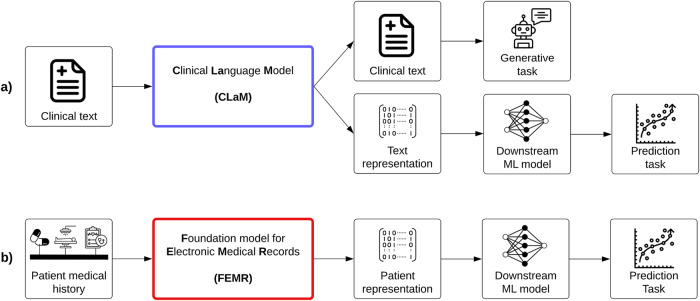
- The review identified 84 distinct clinical FMs published before March 1, 2023: 50 CLaMs and 34 FEMRs.
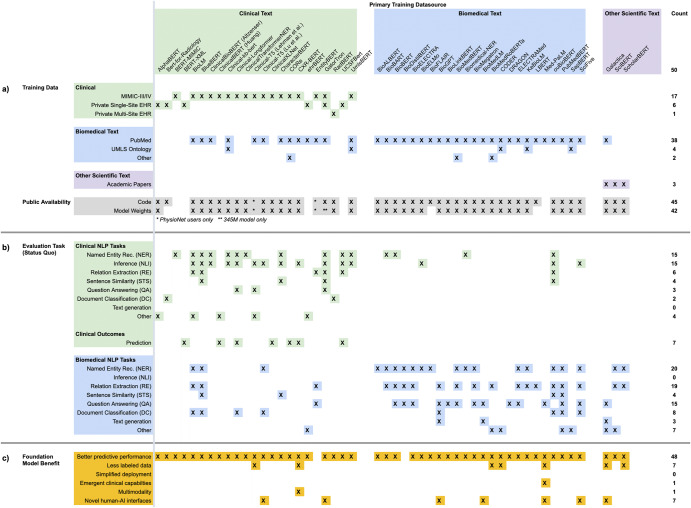
- Nearly all CLaMs were trained on just two data sources: MIMIC-III and PubMed; the paper states these two corpora contain about 18.5 billion words combined and that MIMIC-III includes about 2 million clinical notes.
- Most CLaMs are evaluated on standard NLP tasks such as named entity recognition, relation extraction, and document classification, and roughly half were not validated on clinical text.
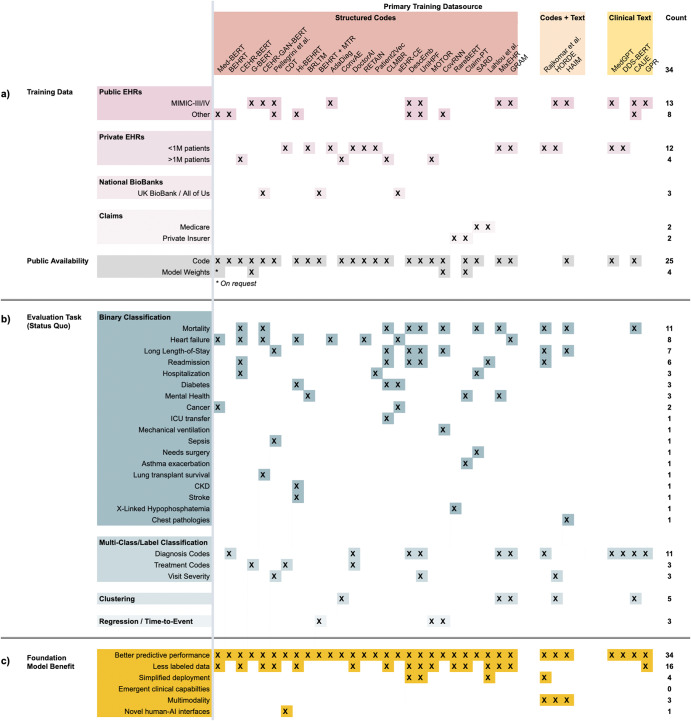
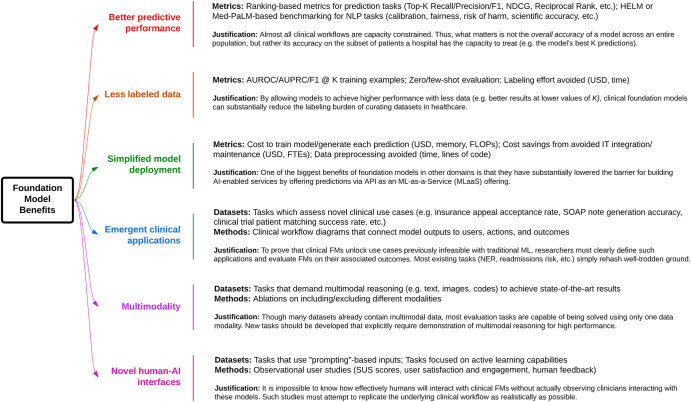
- For both CLaMs and FEMRs, the paper says evaluations mostly show better predictive accuracy, while other claimed FM benefits—such as simpler deployment, less labeled data, novel human-AI interfaces, and emergent clinical applications—are largely unstudied.
## Methods
- Design: Narrative review and taxonomy-building paper focused on clinical foundation models for EMR data, excluding images, genetics, and wearables.
- Data/sample: The authors curated 84 models published before March 1, 2023, including 50 clinical language models (CLaMs) and 34 foundation models for EMRs (FEMRs), identified through citations from representative samples and manual article curation.
- Main analysis: They summarized each model’s architecture, training data, accessibility, and evaluation tasks, then reorganized evaluations around six claimed FM benefits to assess whether current benchmarks support those claims.
## Limitations
- The authors explicitly state they do not claim to include every possible model or every recent advancement, and that their search was not systematic; this is a limitation stated in the paper.
- They also note the review excludes imaging data and therefore is scoped only to structured and unstructured EMR data; this is stated in the paper as a scope choice.
- Evident from the text: because the paper is a narrative review with curated examples, its conclusions depend on the selected models and evaluations rather than a systematic search or meta-analysis.
Model-written summary. Check it against the paper before relying on it.
Integrity signals
Registry
Cites
Statistics
Figures
Verification
Claims the paper makes
12 Valid · 8 Not valid · 7 Not checked · 27 Own results and interpretations
The cited sources support only part of this claim — read each source’s verdict below.
In the paper
“Clinical FMs lack the shared evaluation frameworks and datasets20 that have underpinned progress in other fields, such as natural language processing (NLP) and computer vision21.”
§ The shaky foundations of large language models and foundation models for electronic health records > Introduction
What the sources say
- Partly supportedcites [20] Blagec K Kraiger J Frühwirt W Samwald M Benchmark datasets driving artificial intelligence development fail to capture the needs of medical professionals J. Biomed. Inform. 2023 137 104274 10.1016/j.jbi.2022.104274 36539106 sourceExperimental — accuracy not yet measured
The Introduction describes public benchmarks as shared, standardized ways to compare AI models, and the Analysis of benchmark datasets finds that few benchmarks have direct clinical relevance. But the paper examines clinical and biomedical AI benchmarks, not clinical foundation models specifically; it also identifies some existing clinical benchmarks rather than a complete lack of them. Page numbers were not available in our copy. (LLM, conf=0.86)
- Supportedcites [21] Donoho D 50 years of data science J. Comput. Graph. Stat. 2017 26 745 766 10.1080/10618600.2017.1384734 source
Donoho's Section 6 develops exactly this point: the Common Task Framework combines a publicly available shared training dataset with a sequestered, automatic scoring referee (6.1), and 'those fields where machine learning has scored successes are essentially those fields where CTF has been applied systematically' (6.2). Our copy names NLP/speech progress explicitly (IBM speech and natural-language-processing team and the Canadian Hansards corpus, DARPA/NIST machine-translation evaluations, Google translate, smartphone voice recognition) and lists the visual-pattern-recognition domains where CTF variants succeeded (OCR, fingerprint recognition, speaker identification, automatic target recognition), so the attributed claim that shared datasets plus shared evaluation frameworks underpinned progress in fields such as NLP and computer vision is stated in the source, with equal or greater confidence; only the literal label 'computer vision' is not used, and the clinical-FM shortfall itself is the citing paper's own framing. (LLM, conf=0.82)
plain- Asserted: passes — The authors put it forward as true.
- Checkable: passes — It can be checked against evidence.
- Load-bearing: passes — The paper’s conclusions depend on it.
- Based: passes — The paper gives a reason why it holds.
- Partly supported
The cited sources support only part of this claim — read each source’s verdict below.
In the paper
“Almost all CLaMs trained on the clinical text used a single database: MIMIC-III, which contains approximately 2 million notes written between 2001–2012 in the ICU of the Beth Israel Deaconess Medical Center56.”
§ The shaky foundations of large language models and foundation models for electronic health records > State of published clinical FMs > CLaMs
What the sources say
- Partly supportedcites [56] Johnson AEW MIMIC-III, a freely accessible critical care database Sci. Data 2016 3 160035 10.1038/sdata.2016.35 27219127 PMC4878278 sourceExperimental — accuracy not yet measured
The Background & Summary identifies MIMIC-III as clinical data from Beth Israel Deaconess Medical Center, and the Data Records and Additional information sections describe its notes. Patient characteristics gives 2001–2012 for adult critical-care admissions, but the passages do not establish approximately 2 million notes or that all notes were written in the ICU during that period. The statement about how many CLaMs used MIMIC-III is the citing authors’ framing, not a finding attributed to this database description. (LLM, conf=0.85)
plain- Asserted: passes — The authors put it forward as true.
- Checkable: passes — It can be checked against evidence.
- Load-bearing: passes — The paper’s conclusions depend on it.
- Based: passes — The paper gives a reason why it holds.
- Partly supported
Every source the paper cites for this claim was checked and supports it.
In the paper
“Other public datasets vary greatly in size, from eICU’s 139,000 patients61 to the CPRD’s longitudinal records on 7% of all patients in the UK62.”
§ The shaky foundations of large language models and foundation models for electronic health records > State of published clinical FMs > FEMRs
What the sources say
- Supportedcites [61] Pollard TJ The eICU Collaborative Research Database, a freely available multi-center database for critical care research Sci. Data 2018 5 180178 10.1038/sdata.2018.178 30204154 PMC6132188 source
The Data Records section reports 139,367 unique patients in eICU, supporting the citing sentence’s rounded figure of 139,000. The CPRD figure is attributed to a different citation and is not assessed here; no page number is provided for the passage. (LLM, conf=0.95)
- Supportedcites [62] Li, Y. et al. Hi-BEHRT: hierarchical transformer-based model for accurate prediction of clinical events using multimodal longitudinal electronic health records. IEEE J. Biomed. Health Inform. 27 (2022). PMC7615082 36427286 source
The citation to this paper is attached to the CPRD portion of the sentence, not the eICU figure. In Methods, “Data Source and Cohort Selection,” the paper describes CPRD as a longitudinal EHR dataset containing data from approximately 7% of the U.K. population. (LLM, conf=0.94)
plainn = 139,000- Asserted: passes — The authors put it forward as true.
- Checkable: passes — It can be checked against evidence.
- Load-bearing: unclear — It is unclear whether the paper’s conclusions depend on it.
- Based: passes — The paper gives a reason why it holds.
- Supported
The sources with a verdict support this claim; the rest weren’t checked yet, have no full text we could read, or their verdicts aren’t rated yet.
In the paper
“In reality, clinical workflows are capacity constrained—a nursing team may only be able to act on a handful of model predictions per day79,80.”
§ The shaky foundations of large language models and foundation models for electronic health records > State of published clinical FMs > FEMRs
What the sources say
- Not checked — no full text of the sourcecites [79] Shah N Making machine learning models clinically useful JAMA 2019 322 1351 10.1001/jama.2019.10306 31393527 source
- Supportedcites [80] Wornow M Gyang Ross E Callahan A Shah NH APLUS: a Python library for usefulness simulations of machine learning models in healthcare J. Biomed. Inform. 2023 139 104319 10.1016/j.jbi.2023.104319 36791900 PMC10309067 source
The Introduction says that resource constraints affect clinical workflows. In Results (“Simulating unlimited downstream specialist capacity”), the paper describes low-capacity nursing settings where only the top few model predictions can be acted upon, including a simulated capacity of three patients per day. (LLM, conf=0.92)
hedged- Asserted: passes — The authors put it forward as true.
- Checkable: passes — It can be checked against evidence.
- Load-bearing: passes — The paper’s conclusions depend on it.
- Based: passes — The paper gives a reason why it holds.
The cited sources that could be checked couldn’t confirm or dispute this claim.
In the paper
“Currently, the majority of evaluation tasks span one data modality78”
§ The shaky foundations of large language models and foundation models for electronic health records > State of published clinical FMs > FEMRs
What the sources say
- Could not verifycites [78] McDermott, M. et al. A comprehensive EHR timeseries pre-training benchmark. In Proc. Conference on Health, Inference, and Learning 257–278 (Association for Computing Machinery, 2021). sourceExperimental — accuracy not yet measured
The High-Level Overview (Section 4; page unavailable) describes this paper’s ten downstream tasks using EHR time-series data. Neither it nor the task descriptions in Section 5.2 establish that the majority of evaluation tasks generally span one data modality; searches for single-modality and multimodal evaluation tasks found no such statement. (LLM, conf=0.73)
plain- Asserted: passes — The authors put it forward as true.
- Checkable: passes — It can be checked against evidence.
- Load-bearing: passes — The paper’s conclusions depend on it.
- Based: passes — The paper gives a reason why it holds.
- Could not verify
30 more claims · 4 with their cited sources checked
Create a free account to see all 54 claims and to verify the 2 references still open.
- It may state two separate claims as one. 16
- Probably not a substantial claim. 8
Claims other papers make about this one
Each is checked against this paper’s own text: does it say what the citing paper says it does?
The cited source says what the claim attributes to it.
In the citing paper
“Previous work has demonstrated potential across clinical NLP tasks22,23, adapting to the medical domain by training a new model24,25, fine-tuning an existing model26,27 or supplying task-specific examples in the model prompt27,28.”
From Adapted large language models can outperform medical experts in clinical text summarization (2024) · cites this paper as [22]
Experimental — accuracy not yet measuredThe cited source says what the claim attributes to it.
In the citing paper
“Third, many state-of-the-art models are inaccessible13, necessitating the development of effective open-source models for biomedicine.”
From A clinically accessible small multimodal radiology model and evaluation metric for chest X-ray findings (2025) · cites this paper as [13]
The check wasn’t confident either way, so it gives no verdict — never disputed.
In the citing paper
“Some LLMs have already been integrated into electronic medical record systems,174 such as the Nuance DAX Copilot, a generative AI-program embedded in an electronic health record software called Epic, which records patient interactions and automatically produces clinical documentation.175,176”
From Large Language Models for Chatbot Health Advice Studies: A Systematic Review (2025) · cites this paper as [174]
Experimental — accuracy not yet measuredThe check wasn’t confident either way, so it gives no verdict — never disputed.
In the citing paper
“Smaller models incur smaller carbon footprint12 and offer reduced serving costs and latency, which is of particular importance in resource-constrained settings outside of data centers13.”
From A clinically accessible small multimodal radiology model and evaluation metric for chest X-ray findings (2025) · cites this paper as [13]
Experimental — accuracy not yet measuredIn the citing paper
“Clinical notes summarization assists healthcare practitioners in identifying potential health risks within patients' electronic health records (Wornow et al. 2023), thereby reducing errors and facilitating informed decision-making.”
From Large language models in medical and healthcare fields: applications, advances, and challenges (2024) · cites this paper as Wornow et al. 2023
Citations
Cites
Highly accurate protein structure prediction with AlphaFold
Jumper, J., Evans, R., Pritzel, A., Green, T., Figurnov, M., Ronneberger, O., Tunyasuvunakool, K., Bates, R., Žídek, A., Potapenko, A., et al. (2021) · Nature · doi:10.1038/s41586-021-03819-2 · Cited by 43,764 · cited 2×
“FMs have received signi fi cant attention given their impressive range of capabilities across multiple domains, from text generation 2 and video editing 3 to protein folding 4 and robotics 5 .”
BackgroundLanguage Models are Few-Shot Learners
Brown, T. B., Mann, B., Ryder, N., Subbiah, M., Kaplan, J., Dhariwal, P., Neelakantan, A., Shyam, P., Sastry, G., Askell, A., et al. (2020) · arXiv · doi:10.48550/arxiv.2005.14165 · Cited by 23,372
Learning Transferable Visual Models From Natural Language Supervision
Radford, A., Kim, J. W., Hallacy, C., Ramesh, A., Goh, G., Agarwal, S., Sastry, G., Askell, A., Mishkin, P., Clark, J., et al. (2021) · arXiv · doi:10.48550/arxiv.2103.00020 · Cited by 15,293 · cited 1×
“Substantial prior work has shown that these models ’ large parameter counts and dataset sizes enable them to effectively model disparate modalities in the same shared latent space, thereby deriving richer representations for each modality than possible with unimodal models 48 – 51 .”
BackgroundTransformers: State-of-the-Art Natural Language Processing
Wolf, T., Debut, L., Sanh, V., Chaumond, J., Delangue, C., Moi, A., Cistac, P., Rault, T., Louf, R., Funtowicz, M., et al. (2020) · Proceedings of the 2020 Conference on Empirical Methods in Natural Language Processing: System Demonstrations · doi:10.18653/v1/2020.emnlp-demos.6 · Cited by 8,741
MIMIC-III, a freely accessible critical care database
Johnson, A. E. W., Pollard, T. J., Shen, L., Lehman, L.-W. H., Feng, M., Ghassemi, M., Moody, B., Szolovits, P., Anthony Celi, L., & Mark, R. G. (2016) · Scientific Data · doi:10.1038/sdata.2016.35 · Cited by 8,141 · cited 2×
“Again, the most popular public dataset is MIMIC-III, which contains less than 40,000 patients 56 .”
BackgroundMethodChain-Of-Thought Prompting Elicits Reasoning in Large Language Models
Wei, J., Wang, X., Schuurmans, D., Bosma, M., Ichter, B., Xia, F., Chi, E., Le, Q. V., & Zhou, D. (2022) · Advances in Neural Information Processing Systems 35 · doi:10.52202/068431-1800 · Cited by 4,505
Chain-of-Thought Prompting Elicits Reasoning in Large Language Models
Wei, J., Wang, X., Schuurmans, D., Bosma, M., Ichter, B., Xia, F., Chi, E., Le, Q., & Zhou, D. (2022) · arXiv · doi:10.48550/arxiv.2201.11903 · Cited by 4,263 · cited 1×
“This enables a two-way conversation between humans and machine, and allows for the decomposition of problems into smaller steps via techniques such as “ chain-of-thought ” prompting 54 .”
MethodKung, T. H., Cheatham, M., Medenilla, A., Sillos, C., De Leon, L., Elepaño, C., Madriaga, M., Aggabao, R., Diaz-Candido, G., Maningo, J., et al. (2023) · PLOS Digital Health · doi:10.1371/journal.pdig.0000198 · Cited by 4,115 · cited 1×
“Physicians were quick to apply the model to pass medical licensing exams 8 – 11 , simplify radiology reports 12 , and write research articles 13 .”
MethodKung, T. H., Cheatham, M., ChatGPT, Medenilla, A., Sillos, C., De Leon, L., Elepaño, C., Madriaga, M., Aggabao, R., Diaz-Candido, G., et al. (2022) · doi:10.1101/2022.12.19.22283643 · Cited by 4,115
Universal Language Model Fine-tuning for Text Classification
Howard, J., & Ruder, S. (2018) · Proceedings of the 56th Annual Meeting of the Association for Computational Linguistics (Volume 1: Long Papers) · doi:10.18653/v1/p18-1031 · Cited by 4,100
Research works printed but not linked: 12
- Lehman, E. et al. Do we still need clinical language models? Preprint at arXiv [cs.CL] (2023).
- Moradi, M., Blagec, K., Haberl, F. & Samwald, M. GPT-3 models are poor few-shot learners in the biomedical domain. Preprint at arXiv [cs.CL] (2021).
- Steinberg, E., Xu, Y., Fries, J. & Shah, N. Self-supervised time-to-event modeling with structured medical records. Preprint at arXiv [cs.LG] (2023).
- Lee, S., Da Young, L., Im, S., Kim, N. H. & Park, S.-M. Clinical decision transformer: intended treatment recommendation through goal prompting. Preprint at arXiv [cs.AI] (2023).
- Sushil, M., Ludwig, D., Butte, A. J. & Rudrapatna, V. A. Developing a general-purpose clinical language inference model from a large corpus of clinical notes. Preprint at arXiv [cs.CL] (2022).
- Dash, D. et al. Evaluation of GPT-3.5 and GPT-4 for supporting real-world information needs in healthcare delivery. Preprint at arXiv [cs.AI] (2023).
- Thomas, R. & Uminsky, D. The problem with metrics is a fundamental problem for AI. Preprint at arXiv [cs.CY] (2020).
- Lee, P., Goldberg, C. & Kohane, I. The AI Revolution in Medicine: GPT-4 and Beyond. (Pearson, 2023).
- Husmann, S., Yèche, H., Rätsch, G. & Kuznetsova, R. On the importance of clinical notes in multi-modal learning for EHR data. Preprint at arXiv [cs.LG] (2022).
- Peng, S., Kalliamvakou, E., Cihon, P. & Demirer, M. The impact of AI on developer productivity: evidence from GitHub copilot. Preprint at arXiv [cs.SE] (2023).
- Zhang, X., Zhou, Z., Chen, D. & Wang, Y. E. AutoDistill: an end-to-end framework to explore and distill hardware-efficient language models. Preprint at arXiv [cs.LG] (2022).
- El-Mhamdi, E.-M. et al. SoK: on the impossible security of very large foundation models. Preprint at arXiv [cs.LG] (2022).
Cited by
Items 201–300 of 326
PET und KI: Ein narrativer Überblick
Rogasch, J. M. M., Mikolajczak, J., Hellwig, D., Maus, J., Hofheinz, F., Braune, A., & Nikulin, P. (2025) · Angewandte Nuklearmedizin · doi:10.1055/a-2385-3773 · Cited by 1
Amirahmadi, A., Etminani, F., & Ohlsson, M. (2025) · Frontiers in Artificial Intelligence · doi:10.3389/frai.2025.1663484 · Cited by 3
“Wornow et al. (2023) injected Gaussian noise into the latent space of an encoder-decoder model for better image captioning, while Yuan et al. (2022) perturbed hidden representations during fine-tuning to marginally improve language model performance.”
Expanding the Reach of Generative AI to Industry: The Case of Domain Adaptation
Scepanski, E., Schnitzer, R., Jaremenko, C., & Zillner, S. (2025) · doi:10.1109/temsconglobal64363.2025.11238293 · Cited by 1
“That’s why researchers and companies are working on domain specific models such as healthcare models [13].”
Can, E., Uller, W., Kotter, E., Vogt, K., Doppler, M. C., Brönnimann, M. P., Alshinibr, R., Elkilany, A., Busch, F., Kader, A., et al. (2025) · CardioVascular and Interventional Radiology · doi:10.1007/s00270-025-04287-1 · Cited by 2
LLM-Assisted Keyword Curation for Early Disease Outbreak Detection Using Search Trends
Jerik Brahmos, A., & Princess, P. J. B. (2025) · International Conference on Applied Artificial Intelligence and Computing (ICAAIC) · doi:10.1109/icaaic64647.2025.11330303 · Cited by 1
“Wornow et al. [21] provide a comprehensive foundation by analyzing LLMs and foundation models for electronic health records, highlighting both capabilities and limitations in clinical data interpretation and healthcare system integration.”
Extending BEHRT to UK Biobank: assessing transformer model performance in clinical prediction
Yildiz, Y., Nenadić, G., Jani, M., & Jenkins, D. A. (2026) · Frontiers in Digital Health · doi:10.3389/fdgth.2026.1715506 · Cited by 3
Akbasli, I. T., Loomba, R. S., Kesici, S., Marino, B. S., Morca, A., & Baloğlu, O. (2026) · Current Treatment Options in Pediatrics · doi:10.1007/s40746-026-00374-8 · Cited by 2
Advances in generative biology and bio-inspired artificial intelligence
Wen-Ye, Z. E. N. G., ZHENG, S.-Y., Xiao-Qin, Z. H. A. O., Zhu, W. A. N. G., ZHANG, Y.-J., & Zheng-Yuan, M. A. (2026) · Shengming kexue · doi:10.3724/cbls.2026038 · Cited by 2
Amiri, M., & Shariatrad, P. (2026) · Biomedical Signal Processing and Control · doi:10.1016/j.bspc.2026.110605 · Cited by 2
Marini, N., Liang, Z., Rajaraman, S., Xue, Z., & Antani, S. (2026) · Journal of Biomedical Informatics · doi:10.1016/j.jbi.2026.105055 · Cited by 2
Wang, Y., Bowditch, L., Molloy, C. J., Ying-hua, Y., Hibbert, P., & Magrabi, F. (2026) · Journal of the American Medical Informatics Association · doi:10.1093/jamia/ocag068 · Cited by 1
“26 However, the sensitive nature of incident data and associated privacy constraints present significant challenges, as such data are typically stored within local reporting systems managed by individual patient safety units, limiting the creation and sharing of these essential resources.”
Mohammed, S. I., Abdulameer, K. A., salih, M., & Al-Hussaniy, H. A. (2026) · Journal of Umm Al-Qura University for Medical Sciences · doi:10.1007/s44361-026-00045-1 · Cited by 2
Wang, H., Liu, Y., Hu, L., & Wang, X. (2026) · Frontiers in Medicine · doi:10.3389/fmed.2026.1866874 · Cited by 1
Humphries, C., Anand, A., Casey, A., Chapman, W. W., Harrison, K., Hillis, J. M., James, E., MacIntyre, D. J., Nicholson, K., Schölin, L., et al. (2026) · Frontiers in Public Health · doi:10.3389/fpubh.2026.1901339 · Cited by 1
“For Layer 2, the choice of extraction approach should be determined by target and documentation style; large general-purpose models are not always necessary (27).”
Machine Learning on the Pediatric Intensive Care (PIC) Database: PIC-Powered Prediction
Ganatra, H. A., Shamim, D., Sood, S., & Ali, A. M. (2026) · Bioengineering · doi:10.3390/bioengineering13090978 · Cited by 1
“A comprehensive treatment of emerging architectures and their implications for pediatric critical care ML is available in the broader literature [10,43].”
Benchmarking biomedical foundation models
Sáez-Rodríguez, J., Schäfer, P. S. L., Kalavros, N., & Stolovitzky, G. A. (2026) · Nature Methods · doi:10.1038/s41592-026-03182-y · Cited by 7
“Even so, calibration is rarely a central focus of evaluation in EHR FMs, as most studies emphasize discrimination metrics (AUROC, AUPRC), leaving calibration largely underexplored 33,89 .”
AI in osteoarthritis: Illuminating the meandering path forward
Chaudhari, A. S. (2023) · Osteoarthritis and Cartilage · doi:10.1016/j.joca.2023.11.009 · Cited by 2
Sengupta, S., Rao, R., Kaufman, Z. A., Stuhlmiller, T. J., Wong, K. K., Kesari, S., Shapiro, M. A., & Kramer, G. A. (2024) · North Carolina Medical Journal · doi:10.18043/001c.120572 · Cited by 1
“To make AI/ML solutions useful in health care and fulfill their promise of improving patient care, easing clinician workloads, and accelerating clinical research, several challenges remain [8].”
Brown, E. D. L., Maity, A., Ward, M., Toscano, D. T., Baum, G. R., Mittler, M. A., Lo, S.-F. L., & D’Amico, R. S. (2024) · World Neurosurgery · doi:10.1016/j.wneu.2024.08.122 · Cited by 1
Opportunities in AI/ML to endotype asthma and other eosinophilic diseases
Ray, A., Das, J., & Khoury, P. (2025) · Journal of Allergy and Clinical Immunology · doi:10.1016/j.jaci.2025.01.044 · Cited by 1
Foundation Models for Generative AI in Time-Series Forecasting
Beltramin, D., & Cédric Bousquet, B. (2025) · Journal of Medical Internet Research · doi:10.2196/76964 · Cited by 2
“Additionally, the authors slightly modified Wornow et al’s [2] definition of FMs by adding the “generative” adjective to the word “tasks.””
Alkhalaf, M., Vithanage, D., Shen, J., Chang, H., Deng, C., & Yu, P. (2025) · Healthcare · doi:10.3390/healthcare13202614 · Cited by 6
“However, there remains a paucity of usable models for healthcare systems [24].”
Editorial: Human-centred computer audition: sound, music, and healthcare
Qian, K., Fazekas, G., Li, S., Li, Z., & Schuller, B. W. (2023) · Frontiers in Digital Health · doi:10.3389/fdgth.2023.1340517 · Cited by 1
Leveraging Foundation Models in Maternal and Child Health: A Systematic ReviewPreprint
Mai, X., Liu, Y., Chung, P., Reiss, J. D., Zhou, S., Wong, R. J., Lin, M., Marić, I., Sirota, M., Aghaeepour, N., et al. (2025) · medRxiv · doi:10.1101/2025.08.29.25333768 · Cited by 1
“116 Furthermore, FMs perform effectively with limited labeled data 117 , a notable advantage in MCH, where expert annotations are often challenging to obtain.”
Agweyu, A., Mwaniki, P., Musau, W., Korom, R., Isaaka, L., Wanyama, C. W., Kiptinness, S., Adan, N., Emmanuel-Fabula, M., & Mateen, B. A. (2025) · medRxiv · doi:10.1101/2025.09.05.25335163 · Cited by 1
“This has led to a proliferation of EMR-integrated solutions that leverage these purported clinical reasoning capabilities 24,25 ; however, no other studies appear to report a clinical evaluation of a real-world implementation of an EMR-embedded, CDSS-style copilot, regardless of context, making it…”
(How) Do Health Shocks Reallocate Research Direction?Preprint
Zhou, H., Garg, P., & Fetzer, T. (2025) · medRxiv · doi:10.1101/2025.09.29.25336909 · Cited by 1
Anand, A. S., Ganesan, D., & Karkar, R. (2026) · CHI Conference on Human Factors in Computing Systems · doi:10.1145/3772318.3791866 · Cited by 1
Waldock, W. J., Tekkis, N. P., Zhang, J., & Ashrafian, H. (2023) · doi:10.2196/preprints.55691
Implementing Generative AI in U.S. Hospital Systems
Armstrong, B., Kellogg, K. C., Levi, R., Shah, J., & Wiesenfeld, B. M. (2024) · doi:10.21428/e4baedd9.1729053f · Cited by 1
Artificial Intelligence: Revolutionizing the Medicolegal Field
Brigham, C. R., Buttar, W. A., Bucksbaum, M., & Talmage, J. B. (2023) · AMA guides newsletter · doi:10.1001/amaguidesnewsletters.2023.sepoct01 · Cited by 1
McInerney, D. J. (2024) · Digital Repository Service (Northeastern University) · doi:10.17760/d20653001
Wang, H., Li, J., Liu, B., Li, J., & Long, J. (2024) · IEEE Annual International Computer Software and Applications Conference (COMPSAC) · doi:10.1109/compsac61105.2024.00345
“These abundant data are precious resources to develop quantitative analysis model of patients and promise to advance clinical research[1-3], in which patient similarity has been identified as a key technology in medical reform.”
BackgroundA Safeguard and Safety in E-Health Records: A Committed Clinch
Al-Salim, K. A.-K., & Obaid, A. J. (2024) · Lecture notes in networks and systems · doi:10.1007/978-981-97-2671-4_59
A Quantum Leap in Dermatology & Cosmetology Through AI Powered Personalized Solutions
-, S. S. B. (2024) · International Journal For Multidisciplinary Research · doi:10.36948/ijfmr.2024.v06i06.32916
Concatenated Attention: A Novel Method for Regulating Information Structure Based on Sensors
Zhang, Z., Chen, T., & Todo, Y. (2025) · Applied Sciences · doi:10.3390/app15020523
Artificial intelligence for detecting anaphylaxis in electronic medical records
Ensina, L. F., Machado, M. M., Marques, J. B. M., Santos, M., Lario, F. C., de Araújo, C. A., Oliveira, F. A. N., & Moreira, D. D. A. (2025) · Asia Pacific Allergy · doi:10.5415/apallergy.0000000000000179 · Cited by 2
“We asked the model to link its recommendation reasons to text passages as a form to “ground” the model and avoid or reduce hallucinations [14].”
Sadiq, M., Tariq, R., Ullah, A., & Panezai, J. (2024) · International Conference on Foundation and Large Language Models (FLLM) · doi:10.1109/fllm63129.2024.10852445
What AIs are not learning (and why)
Stefik, M. (2025) · AI Magazine · doi:10.1002/aaai.12213 · Cited by 1
Jakobsen, T. S. T., Cristòbal-Cóppulo, E., Rasmussen, S., & Benros, M. E. (2025) · medRxiv · doi:10.1101/2025.03.07.25323558 · Cited by 3
Li, T., Still, J. M., Zuo, L., Liu, Y., Krishnan, A. R., Sandler, K. L., Maldonado, F., Lasko, T. A., & Landman, B. A. (2025) · medRxiv · doi:10.1101/2025.05.09.25327341 · Cited by 1
Pathological Analysis and Applied Sciences: Bridging Theory and Practice
Abbas, A. W. H., Ali, Y. A. T., Khadir, H. M. A., Yousif, Y. M., Abd, N. L., & Muscat, M. A. A. A. (2025) · Bright Sky Publications eBooks · doi:10.62906/bs.book.362 · Cited by 1
Verkijk, S., & Vossen, P. T. J. M. (2025) · Artificial Intelligence in Medicine · doi:10.1016/j.artmed.2025.103148 · Cited by 7
Waldock, W. J., Tekkis, N. P., Zhang, J., & Ashrafian, H. (2025) · Frontiers in Endocrinology · doi:10.3389/fendo.2025.1527092 · Cited by 1
Large Language Models Improve Cancer Survival Prediction Using Real-World Clinical NotesPreprint
Kiermeyer, N., Lenfers, T., Dada, A., Friedrich, J., Khattab, S., Knop, E. S., Egger, J., Pauly, M., Jung, A., Montavon, G., et al. (2025) · medRxiv · doi:10.1101/2025.08.17.25333835
“13,14 Here, we developed an explainable, end-to-end survival-prediction framework to integrate LLM-extracted features and specialized text embeddings on large, real-world cancer cohorts.”
Differential diagnosis making with large language models and probabilistic logic program
Galitsky, B. A. (2025) · Elsevier eBooks · doi:10.1016/b978-0-443-30046-2.00010-7
Yapay Zeka ve Derin Öğrenmenin Sağlık Bilişimi Üzerine Etkisi: Literatür Tabanlı Bir İnceleme
Çelik, Ö., & Tüfekçi, N. (2025) · Türkiye Sağlık Bilimleri ve Araştırmaları Dergisi · doi:10.51536/tusbad.1702172 · Cited by 4
Neves, B. D., Cerejo, J., Gonçalves, S., Mota, I., Moreira, J. M., Silva, N. A., Leite, F., Wornow, M., & Silva, M. J. (2025) · medRxiv · doi:10.1101/2025.09.08.25335368
Self-citationMasood, F., Ahmad, J. E., Alasbali, N. A., Nafea, I. T., Saeed, F., & Ullah, R. (2025) · Journal of Intelligent Systems · doi:10.1515/jisys-2024-0417 · Cited by 1
ClinMamba: Leveraging state–space modeling for medication prediction in Electronic Medical Records
Liu, Y., Wang, Y., Ji, S., & Jiang, Y. (2025) · Alexandria Engineering Journal · doi:10.1016/j.aej.2025.10.013 · Cited by 1
Multimorbidity measurement strategies for predicting hospital visits
Neves, B. D., Moreira, J. M., Gonçalves, S., Cerejo, J., Mota, I., Silva, N. A., Leite, F., & Silva, M. J. (2025) · BMC Health Services Research · doi:10.1186/s12913-025-13817-z
Foundational Models for Building Clinical Decision Support Systems: An Open-Source Models Comparison
D’Aniello, G., Fraenza, V., & Ritrovato, P. (2025) · IEEE International Conference on Consumer Electronics - Berlin (ICCE-Berlin) · doi:10.1109/icce-berlin67488.2025.11277904
“Recent reviews have classified over 80 foundational models into Clinical Language Models and Foundational Models for Electronic Medical Records (FEMRs) [1].”
InfluentialTowards a Library for the Analysis of Temporal Sequences
Guyet, T., & Duvermy, A. (2026) · Lecture notes in computer science · doi:10.1007/978-3-032-15535-1_11
Luo, J., Ma, J., Zhan, D., Zhou, Y., Li, J., Zhang, L., & Wang, W. (2026) · Journal of Medical Internet Research · doi:10.2196/86502 · Cited by 1
SleepSensei-AI: Revolutionizing Sleep Coaching
Nazareth, P., Kesti, S., Nayak, A., Madhusudhan, G., & Pavan Kumar, A. (2025) · International Conference on Intelligent Computing, Information and Control Systems (ICOIICS) · doi:10.1109/icoiics67115.2025.11390256
“In that regard, SleepSensei was created as a high-tech-based system that would help to revolutionize sleep tracking into an interactive, evidence-based sleep guidance [2].”
PET und KI: Ein narrativer Überblick
Rogasch, J. M. M., Mikolajczak, J., Hellwig, D., Maus, J., Hofheinz, F., Braune, A., & Nikulin, P. (2026) · TumorDiagnostik & Therapie · doi:10.1055/a-2765-4231 · Cited by 1
A detailed review of large language models in the healthcare sector
Ozsahin, D. U., Emegano, D. I., Uzun, B., & Özsahin, İ. (2026) · Journal of Electrical Systems and Information Technology · doi:10.1186/s43067-026-00327-z
“…[80], whereas during emergency scenarios, LLMs reliably direct diagnostic imaging referrals [38], which was in agreement with literary studies that LLMs facilitate clinical study design through aligning patients with trial result prediction, hence improving research efficiency Wornow et al., [81].”
Finding the most promising indications for novel treatments in oncology
Eckhoff, M., Klingelschmitt, S., Ruijssevelt, L. V., Großmann, S., Zichner, T., Stümpges, P., Roschewitz, D., Mlecnik, B., Merger, M., Graen, P., et al. (2026) · npj Precision Oncology · doi:10.1038/s41698-026-01352-x · Cited by 1
Sim, J.-A., Horan, M. R., Huang, X., Kim, M., Srivastava, D. K., Ness, K. K., Hudson, M. M., Baker, J. N., & Huang, I. (2026) · Communications Medicine · doi:10.1038/s43856-026-01499-5
“Embedding LLMs in this work fl ow could also generate targeted clari fi cation prompts (e.g., duration, severity, interference) when narratives are ambiguous, thereby enriching documentation, reducing clinician burden, and supporting earlier intervention and personalized survivorship care 45 .”
Luo, J., Ma, J., Qiu, Y., Wang, T., Yang, Y., Qiu, G., Chen, H., Pang, J., & Wang, W. (2026) · npj Digital Medicine · doi:10.1038/s41746-026-02591-9
The portability paradox of foundation models for clinical decision support
Rosen, K. L., Sui, M., Ong, A. Y., & Kvedar, J. C. (2026) · npj Digital Medicine · doi:10.1038/s41746-026-02615-4 · Cited by 2
Alzyood, M. A. (2026) · International Health · doi:10.1093/inthealth/ihag033 · Cited by 1
Farwa, U. E., Ali, S., & Kim, H. C. (2025) · International Conference on Electrical, Computer and Energy Technologies (ICECET) · doi:10.1109/icecet63943.2025.11472161
Xu, L., 李扬秋, Marczyk, M., & Łoś, M. (2026) · European Journal of Pharmacology · doi:10.1016/j.ejphar.2026.178884
Oyen, C. V., & Mirza-Haq, N. (2026) · medRxiv · doi:10.64898/2026.04.14.26350711 · Cited by 1
Carter, J., Anoruo, N., Rehman, N., Otaki, Y., Lydston, M., & BURKE, H. B. (2026) · Current Epidemiology Reports · doi:10.1007/s40471-026-00381-1
Babli, S. A., Gairola, P., Ogbu, C. E., Longa, F. A., Rautaray, A., Alamu, O. S., & Rizvi, S. F. H. (2026) · Cureus · doi:10.7759/cureus.108550
“Fifth, LLMs may introduce subtle, clinically plausible but incorrect data transformations in edge cases that are difficult to detect without comprehensive unit testing, a safety concern that warrants focused investigation before clinical deployment [19].”
Natural language processing for mental health assessment: a survey and comparative evaluation
Cao, Y., Xiao, G. G., Xi, P., Okuhara, S., Fan, Y., & Liu, Z. (2026) · International Journal of Data Science and Analytics · doi:10.1007/s41060-026-01146-1 · Cited by 2
“Critics argue that non-clinical data lack the diagnostic rigor and verification associated with clinician-annotated records [137].”
Patient-Centered Intelligent Healthcare
Ma, T., & Ye, C. (2026) · Springer eBooks · doi:10.1007/978-981-95-5585-7_23
Incorporating Graph-Constrained RAG Pipeline for Medicine data
Verma, S., & Sharma, R. (2026) · International World Wide Web Conference (WWW) · doi:10.1145/3774905.3794652
ABHA's Personalised Clinical Intelligence Assistant
Rajapandiyan, K., & Sridhar, L. (2026) · International Conference on Communications and Signal Processing (ICCSP) · doi:10.1109/iccsp68173.2026.11539113
“13][14].”
Chen, C., & Han, Z. (2026) · International Conference on Intelligent Computing and Signal Processing (ICSP) · doi:10.1109/icsp69961.2026.11540949
Pucher, G., Dada, A., Agbodoyetin, A., Nensa, F., Schuler, M., Reinhardt, H. C., Kleesiek, J., & Sauer, C. M. (2026) · Artificial Intelligence in Medicine · doi:10.1016/j.artmed.2026.103473 · Cited by 1
Reasoning or reciting? A temporal contamination audit of large language models in clinical medicine
Sheppert, A. P., Adams, B., Sheppert, A. D., & Riley, S. (2026) · Journal of the American Medical Informatics Association · doi:10.1093/jamia/ocag069 · Cited by 2
He, L., Do, D., Shet, V. G., Farghaly, O., Deshpande, P., Madiraju, P., Ye, J., & Beestrum, M. (2026) · Journal of the American Medical Informatics Association · doi:10.1093/jamia/ocag089
Wang, B., & Hua, X. (2026) · Cluster Computing · doi:10.1007/s10586-026-06141-6
“However, the current evalua - tion system is not yet perfect, which affects its clinical value [ 112 ].”
A multimodal generative model for structured and unstructured electronic health records
Sivarajkumar, S., Zhang, H., Ji, Y., Bilalpur, M., Wu, X., Li, C., Kwak, M. G., Visweswaran, S., & Wang, Y. (2026) · npj Health Systems · doi:10.1038/s44401-026-00095-y · Cited by 5
“…ClinicalLanguageModels,orCLaMs) 4,5 , and (2) Foundation models learn patient representations from structured EHR timelines and can be adapted (via fi ne-tuning or prompting) to perform speci fi c clinical tasks (e.g., Foundation models for Electronic Medical Records, or FEMRs) 6,7 .”
Automated Summarization of Military Medical Records Using AI: Evaluation Via the OPTICA Framework
Chechik, Y., Gutterman, Y. J., & Abuhasira, S. (2026) · Military Medicine · doi:10.1093/milmed/usag283
Zazueta, L., Covarrubias, B. L. L., Cota, C. X. N., Vázquez-Briseño, M., Hipólito, J. I. N., Romo-Cárdenas, G. S., & Avilés-Rodríguez, G. J. (2026) · Healthcare · doi:10.3390/healthcare14131865
“Performance can be unstable across distribution shifts, differences in institutional EHR systems, or variations in documentation styles, as demonstrated by Wornow et al. [47] and others.”
Yang, Y., Liu, J., & Liu, S. (2026) · Journal of Medical Internet Research · doi:10.2196/96152 · Cited by 3
“Foundation model–based and other complex clinical AI systems pose governance challenges that differ from those of more narrowly bounded tools because they often have broader capabilities, more variable downstream uses, and behaviors that are harder to characterize before deployment [34,35].”
Kiermeyer, N., Lenfers, T., Dada, A., Friedrich, J., Khattab, S., Knop, E., Egger, J., Pauly, M., Jung, A., Montavon, G., et al. (2026) · PLOS Digital Health · doi:10.1371/journal.pdig.0001546 · Cited by 2
“However, the clinical implementation of these existing approaches remains limited, and most approaches are applied on small, non-real-world datasets limiting their generalizability [13,14].”
Enhancing stratification for survival analyses across standardized data sources
Shubov, M., Beernink, M., Carus, J., Wiederhold, A. J., & Gundler, C. (2026) · BMC Medical Informatics and Decision Making · doi:10.1186/s12911-026-03666-z
“Despite these advancements, the outcomes of this research still lack generalizability and broader, more unified evaluation tasks and metrics [13].”
Xie, F., Rozema, E. J., Puttock, E. J., Zhou, B., Zeiger, R. S., Crawford, W., Schatz, M. X., Xu, S., & Chen, W. (2026) · doi:10.2196/preprints.106749
Risk-Aware Prioritization of Pharmacy Prescription Queues
Mohandas, P., Kumar, S. K. S., & Ramesh, S. K. (2026) · International Conference on Electronics, Computers and Artificial Intelligence (ECAI) · doi:10.1109/ecai69016.2026.11613686
“The data hygiene caveats applicable to retrospective EHR analyses generally [18], [19] apply here as well.”
Genetic decoding reveals druggable biology implicitly learned by a medical-history foundation modelPreprint
Zeng, W., Kohleick, L., Beuchel, C. F., Zoodsma, M., Koprulu, M., Carrasco-Zanini, J., Wild, B., Langenberg, C., & Pietzner, M. (2026) · medRxiv · doi:10.64898/2026.07.28.26359117
Dong, Y., Jiang, P., & Zhou, X. (2026) · Medical Review · doi:10.1515/mr-2026-0027
“They are often general-purpose systems that may be adapted through fi ne-tuning, prompting, retrieval augmentation, or integration into clinical software [111, 112].”
Alsakkaf, G. E. A. (2026) · medRxiv · doi:10.64898/2026.07.30.26359271
Sulaiman, M. A., Oyeyemi, B. F., & Sarafadeen, H. (2026) · medRxiv · doi:10.64898/2026.07.31.26359439
da Silva, R. P., & Pazin‐Filho, A. (2026) · Artificial Intelligence in Emergency Medicine · doi:10.1016/j.aiemed.2026.100030
A 7-criteria evaluation approach for the responsible use of synthetic medical data
Zamzmi, G., Subbaswamy, A., Deshpande, R., Sharma, D., Delfino, J. G., & Badano, A. G. (2026) · BJR|Artificial Intelligence · doi:10.1093/bjrai/ubag005
Fan, B., Fang, Y., Wang, Z., & Ma, F. (2026) · Frontiers in Pharmacology · doi:10.3389/fphar.2026.1884526 · Cited by 1
“However, their inherent reliance on static, pre-trained parameters inevitably leads to hallucinations, generating plausible but medically unverified outputs, which remains the most critical barrier to their deployment in safety-critical clinical environments (Wornow et al., 2023).”
Bleuze, C., Fort, K., Martin, V., & Névéol, A. (2026) · JMIR AI · doi:10.2196/88082
“…technical validity) and clinicians (regarding usage), would thus prevent misunder-standings between the two communities, thereby avoiding empty promises fueled by each community’s overclaims regarding the capabilities of the other—particularly regarding LLMs’ ability in clinical context [123].”
Wu, L., Xu, J., Dang, O., & Ball, R. (2026) · Frontiers in Drug Safety and Regulation · doi:10.3389/fdsfr.2026.1846339
Dlamini, N., Zulu, S., Nkosi, T., & Molefe, L. (2026) · International Journal Of Pharmaceutical Research And Allied Sciences · doi:10.51847/kowndomzzk
Tan, S., Zhang, H., Jin, H., Zhang, M., Liu, H., & Yang, X. (2026) · doi:10.2196/preprints.109308
Shayakhmetova, A., Sambetbayeva, M., Барахнин, В. Б., Sultangaziyeva, A., Мукажанов, Н., Batyrkhanov, A., Serikbayeva, S., & Begim, R. (2026) · Information · doi:10.3390/info17090825
“Natural language processing (NLP) has become one of the principal tools for the intelligent analysis of medical text in recent years, enabling automatic document classification, extraction of medical entities, and support for clinical decision-making [1–3].”
Metadata
- Authors
- Wornow, M., Xu, Y., Thapa, R., Patel, B., Steinberg, E., Fleming, S., Pfeffer, M. A., Fries, J., & Shah, N. H.
- Affiliations
- Stanford University (US)
- Stanford Medicine (US)
- Stanford Health Care (US)
- Corresponding author
- Wornow, Michael
- ORCID
- Venue
- npj Digital Medicine
- Published
- 2023-07-29
- Volume
- 6
- Issue
- 1
- Pages
- 135-135
- ISSN
- 2398-6352 (ISSN-L)
- PMC
- PMC10387101
- OpenAlex
- W4385381606
- Semantic Scholar
- 5e6566354b23f7e849b1b439a24ba9d4c5cb655f
- Cited by
- 324
- References
- 87
- Citations by year
- 2026: 97 · 2025: 110 · 2024: 103 · 2023: 14
- FWCI
- 6.77
- Type
- journal article
- Language
- en
- Open access
- gold
- doi.org
- Licence
- cc-by
- creativecommons.org/licenses/by/4.0 (tdm)
- creativecommons.org/licenses/by/4.0 (vor)
- Locations
- npj Digital Medicine (publishedVersion, cc-by)
- PubMed Central (publishedVersion, cc-by)
- PubMed (publishedVersion)
- DOAJ (DOAJ: Directory of Open Access Journals) (submittedVersion, cc-by-sa)
- Funders
- National Science Foundation
- Topics
- Physical Sciences › Computer Science › Artificial Intelligence › Machine Learning in Healthcare
- Health Sciences › Medicine › Health Informatics › Artificial Intelligence in Healthcare and Education
- Health Sciences › Health Professions › Health Information Management › Electronic Health Records Systems
- Keywords
- foundation models, large language models, electronic health records, model evaluation framework, clinical text, structured clinical data, MIMIC-III, PubMed, artificial intelligence in healthcare, model taxonomy
About these checks
Registry, retraction, Cites and statistics results are computed, not judged, with one exception: a printed reference that no index lists is read once by a model before it counts as a citation error. Claims are extracted by a model and kept only when their quote appears verbatim in the text; each cited source is then checked, with a model’s help, for whether it says what the claim relies on. Those verdicts can be wrong — read the claim’s quote and the cited source before relying on one.
The claim verdicts this report counts are experimental: their accuracy is not yet measured.
A language model drew the claims from the paper on 2026-10-10, under version 3 of the claim definition (model deepseek-v4.1-flash, prompt extract-v3).
A second model labelled each claim on 2026-10-10 (model jev-1.13-20260917, definition revision gold-guideline-v0.2).
Cited sources are checked with a language model’s help (gpt-6-sol and qwen3.8-omni-flash).
Statistics and arithmetic are recomputed, not judged.
Confidence bands are shown only for fields calibrated on our annotated test set. None is calibrated yet, so no band is shown.
What counts as a claim ›How we measure confidence ›How we check this ›
Are you an author, or do you see a problem with this page? Request a review
Data sources
Bibliographic data: Semantic Scholar, OpenAlex, Crossref.
Contains information from the Semantic Scholar Academic Graph Datasets, made available under the ODC Attribution License (ODC-BY 1.0).
Semantic Scholar’s data is described in: Kinney, R., et al. (2023). The Semantic Scholar Open Data Platform. arXiv:2301.10140.
