

The shaky foundations of large language models and foundation models for electronic health records
Open accessThe DOI matches its Crossref record; 103 of the 103 references it cites were found in a registry or an index; 26 of the 36 sources its claims cite were checked for support.
Abstract
The success of foundation models such as ChatGPT and AlphaFold has spurred significant interest in building similar models for electronic medical records (EMRs) to improve patient care and hospital operations. However, recent hype has obscured critical gaps in our understanding of these models' capabilities. In this narrative review, we examine 84 foundation models trained on non-imaging EMR data (i.e., clinical text and/or structured data) and create a taxonomy delineating their architectures, training data, and potential use cases. We find that most models are trained on small, narrowly-scoped clinical datasets (e.g., MIMIC-III) or broad, public biomedical corpora (e.g., PubMed) and are evaluated on tasks that do not provide meaningful insights on their usefulness to health systems. Considering these findings, we propose an improved evaluation framework for measuring the benefits of clinical foundation models that is more closely grounded to metrics that matter in healthcare.
Overview
CoChat Summary
## TL;DR
This narrative review examines 84 clinical foundation models for non-imaging electronic health record data and argues that current evaluations mostly measure predictive accuracy rather than the healthcare value these models are claimed to provide. The authors propose that clinical FMs need new evaluation tasks, metrics, and datasets tied more directly to clinical utility.
## Key findings
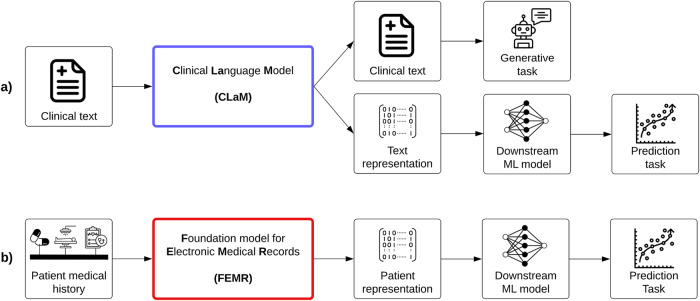
- The review identified 84 distinct clinical FMs published before March 1, 2023: 50 CLaMs and 34 FEMRs.
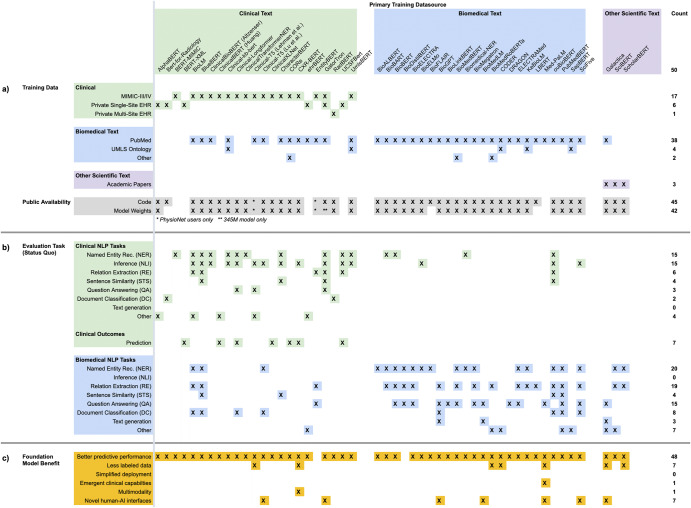
- Nearly all CLaMs were trained on just two data sources: MIMIC-III and PubMed; the paper states these two corpora contain about 18.5 billion words combined and that MIMIC-III includes about 2 million clinical notes.
- Most CLaMs are evaluated on standard NLP tasks such as named entity recognition, relation extraction, and document classification, and roughly half were not validated on clinical text.
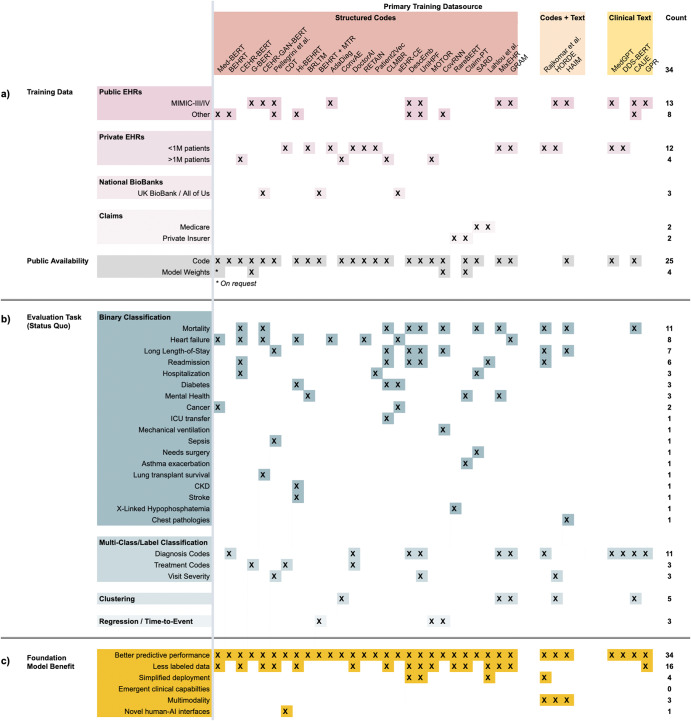
- For both CLaMs and FEMRs, the paper says evaluations mostly show better predictive accuracy, while other claimed FM benefits—such as simpler deployment, less labeled data, novel human-AI interfaces, and emergent clinical applications—are largely unstudied.
## Methods
- Design: Narrative review and taxonomy-building paper focused on clinical foundation models for EMR data, excluding images, genetics, and wearables.
- Data/sample: The authors curated 84 models published before March 1, 2023, including 50 clinical language models (CLaMs) and 34 foundation models for EMRs (FEMRs), identified through citations from representative samples and manual article curation.
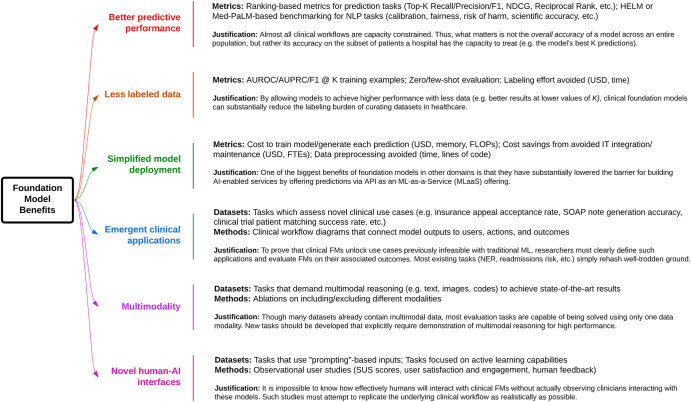
- Main analysis: They summarized each model’s architecture, training data, accessibility, and evaluation tasks, then reorganized evaluations around six claimed FM benefits to assess whether current benchmarks support those claims.
## Limitations
- The authors explicitly state they do not claim to include every possible model or every recent advancement, and that their search was not systematic; this is a limitation stated in the paper.
- They also note the review excludes imaging data and therefore is scoped only to structured and unstructured EMR data; this is stated in the paper as a scope choice.
- Evident from the text: because the paper is a narrative review with curated examples, its conclusions depend on the selected models and evaluations rather than a systematic search or meta-analysis.
Model-written summary. Check it against the paper before relying on it.
Integrity signals
Registry
Cites
Statistics
Figures
Verification
Claims the paper makes
12 Valid · 8 Not valid · 7 Not checked · 27 Own results and interpretations
The cited sources support only part of this claim — read each source’s verdict below.
In the paper
“Clinical FMs lack the shared evaluation frameworks and datasets20 that have underpinned progress in other fields, such as natural language processing (NLP) and computer vision21.”
§ The shaky foundations of large language models and foundation models for electronic health records > Introduction
What the sources say
- Partly supportedcites [20] Blagec K Kraiger J Frühwirt W Samwald M Benchmark datasets driving artificial intelligence development fail to capture the needs of medical professionals J. Biomed. Inform. 2023 137 104274 10.1016/j.jbi.2022.104274 36539106 sourceExperimental — accuracy not yet measured
The Introduction describes public benchmarks as shared, standardized ways to compare AI models, and the Analysis of benchmark datasets finds that few benchmarks have direct clinical relevance. But the paper examines clinical and biomedical AI benchmarks, not clinical foundation models specifically; it also identifies some existing clinical benchmarks rather than a complete lack of them. Page numbers were not available in our copy. (LLM, conf=0.86)
- Supportedcites [21] Donoho D 50 years of data science J. Comput. Graph. Stat. 2017 26 745 766 10.1080/10618600.2017.1384734 source
Donoho's Section 6 develops exactly this point: the Common Task Framework combines a publicly available shared training dataset with a sequestered, automatic scoring referee (6.1), and 'those fields where machine learning has scored successes are essentially those fields where CTF has been applied systematically' (6.2). Our copy names NLP/speech progress explicitly (IBM speech and natural-language-processing team and the Canadian Hansards corpus, DARPA/NIST machine-translation evaluations, Google translate, smartphone voice recognition) and lists the visual-pattern-recognition domains where CTF variants succeeded (OCR, fingerprint recognition, speaker identification, automatic target recognition), so the attributed claim that shared datasets plus shared evaluation frameworks underpinned progress in fields such as NLP and computer vision is stated in the source, with equal or greater confidence; only the literal label 'computer vision' is not used, and the clinical-FM shortfall itself is the citing paper's own framing. (LLM, conf=0.82)
plain- Asserted: passes — The authors put it forward as true.
- Checkable: passes — It can be checked against evidence.
- Load-bearing: passes — The paper’s conclusions depend on it.
- Based: passes — The paper gives a reason why it holds.
- Partly supported
The cited sources support only part of this claim — read each source’s verdict below.
In the paper
“Almost all CLaMs trained on the clinical text used a single database: MIMIC-III, which contains approximately 2 million notes written between 2001–2012 in the ICU of the Beth Israel Deaconess Medical Center56.”
§ The shaky foundations of large language models and foundation models for electronic health records > State of published clinical FMs > CLaMs
What the sources say
- Partly supportedcites [56] Johnson AEW MIMIC-III, a freely accessible critical care database Sci. Data 2016 3 160035 10.1038/sdata.2016.35 27219127 PMC4878278 sourceExperimental — accuracy not yet measured
The Background & Summary identifies MIMIC-III as clinical data from Beth Israel Deaconess Medical Center, and the Data Records and Additional information sections describe its notes. Patient characteristics gives 2001–2012 for adult critical-care admissions, but the passages do not establish approximately 2 million notes or that all notes were written in the ICU during that period. The statement about how many CLaMs used MIMIC-III is the citing authors’ framing, not a finding attributed to this database description. (LLM, conf=0.85)
plain- Asserted: passes — The authors put it forward as true.
- Checkable: passes — It can be checked against evidence.
- Load-bearing: passes — The paper’s conclusions depend on it.
- Based: passes — The paper gives a reason why it holds.
- Partly supported
Every source the paper cites for this claim was checked and supports it.
In the paper
“Other public datasets vary greatly in size, from eICU’s 139,000 patients61 to the CPRD’s longitudinal records on 7% of all patients in the UK62.”
§ The shaky foundations of large language models and foundation models for electronic health records > State of published clinical FMs > FEMRs
What the sources say
- Supportedcites [61] Pollard TJ The eICU Collaborative Research Database, a freely available multi-center database for critical care research Sci. Data 2018 5 180178 10.1038/sdata.2018.178 30204154 PMC6132188 source
The Data Records section reports 139,367 unique patients in eICU, supporting the citing sentence’s rounded figure of 139,000. The CPRD figure is attributed to a different citation and is not assessed here; no page number is provided for the passage. (LLM, conf=0.95)
- Supportedcites [62] Li, Y. et al. Hi-BEHRT: hierarchical transformer-based model for accurate prediction of clinical events using multimodal longitudinal electronic health records. IEEE J. Biomed. Health Inform. 27 (2022). PMC7615082 36427286 source
The citation to this paper is attached to the CPRD portion of the sentence, not the eICU figure. In Methods, “Data Source and Cohort Selection,” the paper describes CPRD as a longitudinal EHR dataset containing data from approximately 7% of the U.K. population. (LLM, conf=0.94)
plainn = 139,000- Asserted: passes — The authors put it forward as true.
- Checkable: passes — It can be checked against evidence.
- Load-bearing: unclear — It is unclear whether the paper’s conclusions depend on it.
- Based: passes — The paper gives a reason why it holds.
- Supported
The sources with a verdict support this claim; the rest weren’t checked yet, have no full text we could read, or their verdicts aren’t rated yet.
In the paper
“In reality, clinical workflows are capacity constrained—a nursing team may only be able to act on a handful of model predictions per day79,80.”
§ The shaky foundations of large language models and foundation models for electronic health records > State of published clinical FMs > FEMRs
What the sources say
- Not checked — no full text of the sourcecites [79] Shah N Making machine learning models clinically useful JAMA 2019 322 1351 10.1001/jama.2019.10306 31393527 source
- Supportedcites [80] Wornow M Gyang Ross E Callahan A Shah NH APLUS: a Python library for usefulness simulations of machine learning models in healthcare J. Biomed. Inform. 2023 139 104319 10.1016/j.jbi.2023.104319 36791900 PMC10309067 source
The Introduction says that resource constraints affect clinical workflows. In Results (“Simulating unlimited downstream specialist capacity”), the paper describes low-capacity nursing settings where only the top few model predictions can be acted upon, including a simulated capacity of three patients per day. (LLM, conf=0.92)
hedged- Asserted: passes — The authors put it forward as true.
- Checkable: passes — It can be checked against evidence.
- Load-bearing: passes — The paper’s conclusions depend on it.
- Based: passes — The paper gives a reason why it holds.
The cited sources that could be checked couldn’t confirm or dispute this claim.
In the paper
“Currently, the majority of evaluation tasks span one data modality78”
§ The shaky foundations of large language models and foundation models for electronic health records > State of published clinical FMs > FEMRs
What the sources say
- Could not verifycites [78] McDermott, M. et al. A comprehensive EHR timeseries pre-training benchmark. In Proc. Conference on Health, Inference, and Learning 257–278 (Association for Computing Machinery, 2021). sourceExperimental — accuracy not yet measured
The High-Level Overview (Section 4; page unavailable) describes this paper’s ten downstream tasks using EHR time-series data. Neither it nor the task descriptions in Section 5.2 establish that the majority of evaluation tasks generally span one data modality; searches for single-modality and multimodal evaluation tasks found no such statement. (LLM, conf=0.73)
plain- Asserted: passes — The authors put it forward as true.
- Checkable: passes — It can be checked against evidence.
- Load-bearing: passes — The paper’s conclusions depend on it.
- Based: passes — The paper gives a reason why it holds.
- Could not verify
30 more claims · 4 with their cited sources checked
Create a free account to see all 54 claims and every source verdict.
- It may state two separate claims as one. 16
- Probably not a substantial claim. 8
Claims other papers make about this one
Each is checked against this paper’s own text: does it say what the citing paper says it does?
The cited source says what the claim attributes to it.
In the citing paper
“Previous work has demonstrated potential across clinical NLP tasks22,23, adapting to the medical domain by training a new model24,25, fine-tuning an existing model26,27 or supplying task-specific examples in the model prompt27,28.”
From Adapted large language models can outperform medical experts in clinical text summarization (2024) · cites this paper as [22]
Experimental — accuracy not yet measuredThe cited source says what the claim attributes to it.
In the citing paper
“Third, many state-of-the-art models are inaccessible13, necessitating the development of effective open-source models for biomedicine.”
From A clinically accessible small multimodal radiology model and evaluation metric for chest X-ray findings (2025) · cites this paper as [13]
The check wasn’t confident either way, so it gives no verdict — never disputed.
In the citing paper
“Some LLMs have already been integrated into electronic medical record systems,174 such as the Nuance DAX Copilot, a generative AI-program embedded in an electronic health record software called Epic, which records patient interactions and automatically produces clinical documentation.175,176”
From Large Language Models for Chatbot Health Advice Studies: A Systematic Review (2025) · cites this paper as [174]
Experimental — accuracy not yet measuredThe check wasn’t confident either way, so it gives no verdict — never disputed.
In the citing paper
“Smaller models incur smaller carbon footprint12 and offer reduced serving costs and latency, which is of particular importance in resource-constrained settings outside of data centers13.”
From A clinically accessible small multimodal radiology model and evaluation metric for chest X-ray findings (2025) · cites this paper as [13]
Experimental — accuracy not yet measuredIn the citing paper
“Clinical notes summarization assists healthcare practitioners in identifying potential health risks within patients' electronic health records (Wornow et al. 2023), thereby reducing errors and facilitating informed decision-making.”
From Large language models in medical and healthcare fields: applications, advances, and challenges (2024) · cites this paper as Wornow et al. 2023
Citations
Cites
Highly accurate protein structure prediction with AlphaFold
Jumper, J., Evans, R., Pritzel, A., Green, T., Figurnov, M., Ronneberger, O., Tunyasuvunakool, K., Bates, R., Žídek, A., Potapenko, A., et al. (2021) · Nature · doi:10.1038/s41586-021-03819-2 · Cited by 43,764 · cited 2×
“FMs have received signi fi cant attention given their impressive range of capabilities across multiple domains, from text generation 2 and video editing 3 to protein folding 4 and robotics 5 .”
BackgroundLanguage Models are Few-Shot Learners
Brown, T. B., Mann, B., Ryder, N., Subbiah, M., Kaplan, J., Dhariwal, P., Neelakantan, A., Shyam, P., Sastry, G., Askell, A., et al. (2020) · arXiv · doi:10.48550/arxiv.2005.14165 · Cited by 23,372
Learning Transferable Visual Models From Natural Language Supervision
Radford, A., Kim, J. W., Hallacy, C., Ramesh, A., Goh, G., Agarwal, S., Sastry, G., Askell, A., Mishkin, P., Clark, J., et al. (2021) · arXiv · doi:10.48550/arxiv.2103.00020 · Cited by 15,293 · cited 1×
“Substantial prior work has shown that these models ’ large parameter counts and dataset sizes enable them to effectively model disparate modalities in the same shared latent space, thereby deriving richer representations for each modality than possible with unimodal models 48 – 51 .”
BackgroundTransformers: State-of-the-Art Natural Language Processing
Wolf, T., Debut, L., Sanh, V., Chaumond, J., Delangue, C., Moi, A., Cistac, P., Rault, T., Louf, R., Funtowicz, M., et al. (2020) · Proceedings of the 2020 Conference on Empirical Methods in Natural Language Processing: System Demonstrations · doi:10.18653/v1/2020.emnlp-demos.6 · Cited by 8,741
MIMIC-III, a freely accessible critical care database
Johnson, A. E. W., Pollard, T. J., Shen, L., Lehman, L.-W. H., Feng, M., Ghassemi, M., Moody, B., Szolovits, P., Anthony Celi, L., & Mark, R. G. (2016) · Scientific Data · doi:10.1038/sdata.2016.35 · Cited by 8,141 · cited 2×
“Again, the most popular public dataset is MIMIC-III, which contains less than 40,000 patients 56 .”
BackgroundMethodChain-Of-Thought Prompting Elicits Reasoning in Large Language Models
Wei, J., Wang, X., Schuurmans, D., Bosma, M., Ichter, B., Xia, F., Chi, E., Le, Q. V., & Zhou, D. (2022) · Advances in Neural Information Processing Systems 35 · doi:10.52202/068431-1800 · Cited by 4,505
Chain-of-Thought Prompting Elicits Reasoning in Large Language Models
Wei, J., Wang, X., Schuurmans, D., Bosma, M., Ichter, B., Xia, F., Chi, E., Le, Q., & Zhou, D. (2022) · arXiv · doi:10.48550/arxiv.2201.11903 · Cited by 4,263 · cited 1×
“This enables a two-way conversation between humans and machine, and allows for the decomposition of problems into smaller steps via techniques such as “ chain-of-thought ” prompting 54 .”
MethodKung, T. H., Cheatham, M., Medenilla, A., Sillos, C., De Leon, L., Elepaño, C., Madriaga, M., Aggabao, R., Diaz-Candido, G., Maningo, J., et al. (2023) · PLOS Digital Health · doi:10.1371/journal.pdig.0000198 · Cited by 4,115 · cited 1×
“Physicians were quick to apply the model to pass medical licensing exams 8 – 11 , simplify radiology reports 12 , and write research articles 13 .”
MethodKung, T. H., Cheatham, M., ChatGPT, Medenilla, A., Sillos, C., De Leon, L., Elepaño, C., Madriaga, M., Aggabao, R., Diaz-Candido, G., et al. (2022) · doi:10.1101/2022.12.19.22283643 · Cited by 4,115
Universal Language Model Fine-tuning for Text Classification
Howard, J., & Ruder, S. (2018) · Proceedings of the 56th Annual Meeting of the Association for Computational Linguistics (Volume 1: Long Papers) · doi:10.18653/v1/p18-1031 · Cited by 4,100
Large Language Models Encode Clinical Knowledge
Singhal, K., Azizi, S., Tu, T., Mahdavi, S. S., Wei, J., Chung, H. W., Scales, N., Tanwani, A., Cole-Lewis, H., Pfohl, S., et al. (2022) · arXiv · doi:10.48550/arxiv.2212.13138 · Cited by 4,083 · cited 3×
“CLaMs that might impact clinical decisions should be evaluated much more rigorously than automated metrics can provide, across axes such as agreement with scienti fi c consensus, minimization of the extent and risk of harm, possibility of bias, and the clinical utility of the advice 29,82 .”
BackgroundLarge language models encode clinical knowledge
Singhal, K., Azizi, S., Tu, T., Mahdavi, S. S., Wei, J., Chung, H. W., Scales, N., Tanwani, A., Cole-Lewis, H., Pfohl, S., et al. (2023) · Nature · doi:10.1038/s41586-023-06291-2 · Cited by 4,083 · cited 3×
“CLaMs that might impact clinical decisions should be evaluated much more rigorously than automated metrics can provide, across axes such as agreement with scienti fi c consensus, minimization of the extent and risk of harm, possibility of bias, and the clinical utility of the advice 29,82 .”
BackgroundThe potential for artificial intelligence in healthcare
Davenport, T., & Kalakota, R. (2019) · Future Healthcare Journal · doi:10.7861/futurehosp.6-2-94 · Cited by 3,800
HuggingFace's Transformers: State-of-the-art Natural Language Processing
Wolf, T., Debut, L., Sanh, V., Chaumond, J., Delangue, C., Moi, A., Cistac, P., Rault, T., Louf, R., Funtowicz, M., et al. (2019) · arXiv · doi:10.48550/arxiv.1910.03771 · Cited by 3,347
Rajpurkar, P., Chen, E., Banerjee, O., & Topol, E. J. (2022) · Nature Medicine · doi:10.1038/s41591-021-01614-0 · Cited by 3,212
On the Opportunities and Risks of Foundation Models
Bommasani, R., Hudson, D. A., Adeli, E., Altman, R., Arora, S., von Arx, S., Bernstein, M. S., Bohg, J., Bosselut, A., Brunskill, E., et al. (2021) · arXiv · doi:10.48550/arxiv.2108.07258 · Cited by 2,676 · cited 6×
“A foundation model (FM) is a type of machine learning model that has been pre-trained on large amounts of unlabeled data and can be adapted to a broad range of downstream tasks 1 .”
BackgroundInfluentialScalable and accurate deep learning with electronic health records
Rajkomar, A., Oren, E., Chen, K., Dai, A. M., Hajaj, N., Hardt, M., Liu, P. J., Liu, X., Marcus, J., Sun, M., et al. (2018) · npj Digital Medicine · doi:10.1038/s41746-018-0029-1 · Cited by 2,648
Self-citationScalable and accurate deep learning with electronic health records.
Rajkomar, A., Oren, E., Chen, K., Dai, A. M., Hajaj, N., Hardt, M., Liu, P. J., Liu, X., Marcus, J., Sun, M., et al. (2018) · eScholarship (California Digital Library) · Cited by 2,242
Self-citationExperimental Evidence on the Productivity Effects of Generative Artificial Intelligence
Noy, S., & Zhang, W. (2023) · doi:10.2139/ssrn.4375283 · Cited by 2,157
Experimental evidence on the productivity effects of generative artificial intelligence
Noy, S., & Zhang, W. (2023) · Science · doi:10.1126/science.adh2586 · Cited by 2,150
Gilson, A., Safranek, C. W., Huang, T., Socrates, V., Chi, L., Taylor, R. A., & Chartash, D. (2023) · JMIR Medical Education · doi:10.2196/45312 · Cited by 2,078
Pollard, T. J., Johnson, A. E. W., Raffa, J. D., Celi, L. A., Mark, R. G., & Badawi, O. (2018) · Scientific Data · doi:10.1038/sdata.2018.178 · Cited by 1,993 · cited 1×
“Other public datasets vary greatly in size, from eICU ’ s 139,000 patients 61 to the CPRD ’ s longitudinal records on 7% of all patients in the UK 62 .”
BackgroundThe rise of artificial intelligence in healthcare applications
Bohr, A., & Memarzadeh, K. (2020) · Artificial Intelligence in Healthcare · doi:10.1016/b978-0-12-818438-7.00002-2 · Cited by 1,636
Sparks of Artificial General Intelligence: Early experiments with GPT-4
Bubeck, S., Chandrasekaran, V., Eldan, R., Gehrke, J., Horvitz, E., Kamar, E., Lee, P., Lee, Y. T., Li, Y., Lundberg, S., et al. (2023) · arXiv · doi:10.48550/arxiv.2303.12712 · Cited by 1,526
Making Pre-trained Language Models Better Few-shot Learners
Gao, T., Fisch, A., & Chen, D. (2021) · Proceedings of the 59th Annual Meeting of the Association for Computational Linguistics and the 11th International Joint Conference on Natural Language Processing (Volume 1: Long Papers) · doi:10.18653/v1/2021.acl-long.295 · Cited by 1,380
Acosta, J. N., Falcone, G. J., Rajpurkar, P., & Topol, E. J. (2022) · Nature Medicine · doi:10.1038/s41591-022-01981-2 · Cited by 1,365
Emergent Abilities of Large Language Models
Wei, J., Tay, Y., Bommasani, R., Raffel, C., Zoph, B., Borgeaud, S., Yogatama, D., Bosma, M., Zhou, D., Metzler, D., et al. (2022) · arXiv · doi:10.48550/arxiv.2206.07682 · Cited by 1,264
Cascella, M., Montomoli, J., Bellini, V., & Bignami, E. (2023) · Journal of Medical Systems · doi:10.1007/s10916-023-01925-4 · Cited by 1,120
ChatGPT and other large language models are double-edged swords
Shen, Y., Heacock, L., Elias, J., Hentel, K. D., Reig, B., Shih, G., & Moy, L. (2023) · Radiology · doi:10.1148/radiol.230163 · Cited by 1,008
G-Eval: NLG Evaluation using Gpt-4 with Better Human Alignment
Liu, Y., Iter, D., Xu, Y., Wang, S., Xu, R., & Zhu, C. (2023) · Proceedings of the 2023 Conference on Empirical Methods in Natural Language Processing · doi:10.18653/v1/2023.emnlp-main.153 · Cited by 948
Self-citationG-Eval: NLG Evaluation using GPT-4 with Better Human Alignment
Liu, Y., Iter, D., Xu, Y., Wang, S., Xu, R., & Zhu, C. (2023) · arXiv · doi:10.48550/arxiv.2303.16634 · Cited by 948
Self-citationHuang, S.-C., Pareek, A., Seyyedi, S., Banerjee, I., & Lungren, M. P. (2020) · npj Digital Medicine · doi:10.1038/s41746-020-00341-z · Cited by 934
Rasmy, L., Xiang, Y., Xie, Z., Tao, C., & Zhi, D. (2021) · npj Digital Medicine · doi:10.1038/s41746-021-00455-y · Cited by 886
ImageBind One Embedding Space to Bind Them All
Girdhar, R., El-Nouby, A., Liu, Z., Singh, M., Alwala, K. V., Joulin, A., & Misra, I. (2023) · 2023 IEEE/CVF Conference on Computer Vision and Pattern Recognition (CVPR) · doi:10.1109/cvpr52729.2023.01457 · Cited by 863
Eysenbach, G. (2023) · JMIR Medical Education · doi:10.2196/46885 · Cited by 840
Xiao, C., Choi, E., & Sun, J. (2018) · Journal of the American Medical Informatics Association · doi:10.1093/jamia/ocy068 · Cited by 792
Donoho, D. (2017) · Journal of Computational and Graphical Statistics · doi:10.1080/10618600.2017.1384734 · Cited by 695
(2016) · PubMed · Cited by 576
ChatGPT makes medicine easy to swallow: an exploratory case study on simplified radiology reports
Jeblick, K., Schachtner, B., Dexl, J., Mittermeier, A., Stüber, A. T., Topalis, J., Weber, T., Wesp, P., Sabel, B. O., Ricke, J., et al. (2023) · European Radiology · doi:10.1007/s00330-023-10213-1 · Cited by 549
Multimodal machine learning in precision health: A scoping review
Kline, A., Wang, H., Li, Y., Dennis, S., Hutch, M., Xu, Z., Wang, F., Cheng, F., & Luo, Y. (2022) · npj Digital Medicine · doi:10.1038/s41746-022-00712-8 · Cited by 528 · cited 1×
“FMs can be designed to accept a wide range of data modalities (e.g., structured codes, lab values, clinical text, images, speech patterns, etc.) as inputs and incorporate them into a single uni fi ed representation 47 .”
BackgroundCapabilities of GPT-4 on Medical Challenge Problems
Nori, H., King, N., McKinney, S. M., Carignan, D., & Horvitz, E. (2023) · arXiv · doi:10.48550/arxiv.2303.13375 · Cited by 509 · cited 2×
“While we focused this review on FMs developed speci fi cally for clinical data, we recognize that there has been signi fi cant recent progress in adapting general-purpose LLMs to medical knowledge tasks 11 .”
MethodTraining a Helpful and Harmless Assistant with Reinforcement Learning from Human Feedback
Bai, Y., Jones, A., Ndousse, K., Askell, A., Chen, A., DasSarma, N., Drain, D., Fort, S., Ganguli, D., Henighan, T., et al. (2022) · arXiv · doi:10.48550/arxiv.2204.05862 · Cited by 442 · cited 2×
“…metrics for evaluating the more qualitative aspects of a model ’ s “ alignment ” with human values (e.g., helpfulness or harmlessness) 86 , even as the importance of human feedback during training has been repeatedly demonstrated via techniques like Reinforcement Learning from Human Feedback 87 .”
MethodStructure and Content-Guided Video Synthesis with Diffusion Models
Esser, P., Chiu, J., Atighehchian, P., Granskog, J., & Germanidis, A. (2023) · arXiv · doi:10.48550/arxiv.2302.03011 · Cited by 399
Structure and Content-Guided Video Synthesis with Diffusion Models
Esser, P., Chiu, J., Atighehchian, P., Granskog, J., & Germanidis, A. (2023) · 2023 IEEE/CVF International Conference on Computer Vision (ICCV) · doi:10.1109/iccv51070.2023.00675 · Cited by 391 · cited 1×
“2, 3 show that minimal work has been conducted to validate whether the other, potentially more valuable bene fi ts of FMs will be realized in healthcare.”
BackgroundA Structured Review of the Validity of BLEU
Reiter, E. (2018) · Computational Linguistics · doi:10.1162/coli_a_00322 · Cited by 386 · cited 1×
“Traditional NLP metrics such as ROUGE, METEOR, and BLEU — which simply count n-gram overlap between generated and reference text — are known to poorly correlate with human evaluations of natural language generations 83 – 85 .”
BackgroundIntegrated multimodal artificial intelligence framework for healthcare applications
Soenksen, L. R., Ma, Y., Zeng, C., Boussioux, L., Villalobos Carballo, K., Na, L., Wiberg, H. M., Li, M. L., Fuentes, I., & Bertsimas, D. (2022) · npj Digital Medicine · doi:10.1038/s41746-022-00689-4 · Cited by 380
Clinical text data in machine learning: systematic review
Spasic, I., & Nenadic, G. (2020) · JMIR Medical Informatics · doi:10.2196/17984 · Cited by 358 · cited 1×
“However, these NLP tasks are greatly limited by their overreliance on the same handful of data sources 74 , small dataset sizes (typically thousands of examples) 74,76 , highly repetitive content 77 , and low coverage of use cases 20 .”
BackgroundLarge language models are few-shot clinical information extractors
Agrawal, M., Hegselmann, S., Lang, H., Kim, Y., & Sontag, D. (2022) · Proceedings of the 2022 Conference on Empirical Methods in Natural Language Processing · doi:10.18653/v1/2022.emnlp-main.130 · Cited by 358 · cited 1×
“For example, a CLaM could extract drug names from a doctor ’ s note 28 , automatically reply to patient questions 29 , summarize medical dialogues 30 , or predict mechanical ventilation needs based on clinical notes 31 .”
BackgroundCan large language models reason about medical questions?
Liévin, V., Hother, C. E., Motzfeldt, A. G., & Winther, O. (2024) · Patterns · doi:10.1016/j.patter.2024.100943 · Cited by 343
Can large language models reason about medical questions?
Liévin, V., Hother, C. E., Motzfeldt, A. G., & Winther, O. (2022) · arXiv · doi:10.48550/arxiv.2207.08143 · Cited by 343
Making the Most of Text Semantics to Improve Biomedical Vision-Language Processing
Boecking, B., Usuyama, N., Bannur, S., Castro, D. C., Schwaighofer, A., Hyland, S., Wetscherek, M., Naumann, T., Nori, A., Alvarez-Valle, J., et al. (2022) · Lecture Notes in Computer Science · doi:10.1007/978-3-031-20059-5_1 · Cited by 317
Making Machine Learning Models Clinically Useful
Shah, N. H., Milstein, A., & Bagley, P. (2019) · JAMA · doi:10.1001/jama.2019.10306 · Cited by 294 · cited 2×
“Developing frameworks for determining a model ’ s overall worth remains indispensable 79 .”
BackgroundSelf-citationTowards artificial general intelligence via a multimodal foundation model
Fei, N., Lu, Z., Gao, Y., Yang, G., Huo, Y., Wen, J., Lu, H., Song, R., Gao, X., Xiang, T., et al. (2022) · Nature Communications · doi:10.1038/s41467-022-30761-2 · Cited by 280
Do Users Write More Insecure Code with AI Assistants?
Perry, N., Srivastava, M., Kumar, D., & Boneh, D. (2023) · Proceedings of the 2023 ACM SIGSAC Conference on Computer and Communications Security · doi:10.1145/3576915.3623157 · Cited by 259
Holistic Evaluation of Language Models
Liang, P., Bommasani, R., Lee, T., Tsipras, D., Soylu, D., Yasunaga, M., Zhang, Y., Narayanan, D., Wu, Y., Kumar, A., et al. (2022) · arXiv · doi:10.48550/arxiv.2211.09110 · Cited by 255
Artificial intelligence-based methods for fusion of electronic health records and imaging data
Mohsen, F., Ali, H., El Hajj, N., & Shah, Z. (2022) · Scientific Reports · doi:10.1038/s41598-022-22514-4 · Cited by 250
Doctor AI: Predicting Clinical Events via Recurrent Neural Networks
Choi, E., Bahadori, M. T., Schuetz, A., Stewart, W. F., & Sun, J. (2015) · arXiv (Cornell University) · doi:10.48550/arxiv.1511.05942 · Cited by 244
Can ChatGPT draft a research article? An example of population-level vaccine effectiveness analysis
Macdonald, C., Adeloye, D., Sheikh, A., & Rudan, I. (2023) · Journal of Global Health · doi:10.7189/jogh.13.01003 · Cited by 243 · cited 1×
“Physicians were quick to apply the model to pass medical licensing exams 8 – 11 , simplify radiology reports 12 , and write research articles 13 .”
MethodSi, Y., Du, J., Li, Z., Jiang, X., Miller, T., Wang, F., Jim Zheng, W., & Roberts, K. (2021) · Journal of Biomedical Informatics · doi:10.1016/j.jbi.2020.103671 · Cited by 235
data2vec: A General Framework for Self-supervised Learning in Speech, Vision and Language
Baevski, A., Hsu, W.-N., Xu, Q., Babu, A., Gu, J., & Auli, M. (2022) · arXiv (Cornell University) · doi:10.48550/arxiv.2202.03555 · Cited by 231
Wei, W.-Q., Teixeira, P. L., Mo, H., Cronin, R. M., Warner, J. L., & Denny, J. C. (2016) · Journal of the American Medical Informatics Association · doi:10.1093/jamia/ocv130 · Cited by 230 · cited 1×
“An additional limitation of relying on coded data is that it contains inconsistencies and errors 67 , and often provides an incomplete picture of patient state 68 .”
BackgroundQuantifying Memorization Across Neural Language Models
Carlini, N., Ippolito, D., Jagielski, M., Lee, K., Tramer, F., & Zhang, C. (2022) · arXiv · doi:10.48550/arxiv.2202.07646 · Cited by 204 · cited 1×
“Data privacy and security are signi fi cant concerns with FMs, as they may leak protected health information through model weights or prompt injection attacks 100,101 .”
BackgroundLatent bias and the implementation of artificial intelligence in medicine
DeCamp, M., & Lindvall, C. (2020) · Journal of the American Medical Informatics Association · doi:10.1093/jamia/ocaa094 · Cited by 198
Tang, P. C., Ralston, M., Arrigotti, M. F., Qureshi, L., & Graham, J. (2007) · Journal of the American Medical Informatics Association · doi:10.1197/jamia.m2198 · Cited by 193
Challenges in clinical natural language processing for automated disorder normalization
Leaman, R., Khare, R., & Lu, Z. (2015) · Journal of Biomedical Informatics · doi:10.1016/j.jbi.2015.07.010 · Cited by 187
Complacency and Automation Bias in the Use of Imperfect Automation
Wickens, C. D., Clegg, B. A., Vieane, A. Z., & Sebok, A. L. (2015) · Human Factors: The Journal of the Human Factors and Ergonomics Society · doi:10.1177/0018720815581940 · Cited by 176
Gilson, A., Safranek, C., Huang, T., Socrates, V., Chi, L., Taylor, R. A., & Chartash, D. (2022) · doi:10.1101/2022.12.23.22283901 · Cited by 172
Li, F., Jin, Y., Liu, W., Rawat, B. P. S., Cai, P., & Yu, H. (2019) · JMIR Medical Informatics · doi:10.2196/14830 · Cited by 161
Li, Y., Mamouei, M., Salimi-Khorshidi, G., Rao, S., Hassaine, A., Canoy, D., Lukasiewicz, T., & Rahimi, K. (2023) · IEEE Journal of Biomedical and Health Informatics · doi:10.1109/jbhi.2022.3224727 · Cited by 156 · cited 1×
“Other public datasets vary greatly in size, from eICU ’ s 139,000 patients 61 to the CPRD ’ s longitudinal records on 7% of all patients in the UK 62 .”
BackgroundLanguage models are an effective representation learning technique for electronic health record data
Steinberg, E., Jung, K., Fries, J. A., Corbin, C. K., Pfohl, S. R., & Shah, N. H. (2021) · Journal of Biomedical Informatics · doi:10.1016/j.jbi.2020.103637 · Cited by 132 · cited 2×
“This representation — also referred to as a “ patient embedding ”— is typically a fi xed-length, high-dimensional vector which condenses large amounts of patient information 34 .”
BackgroundMethodSelf-citationMaking Pre-trained Language Models Better Few-shot Learners
Gao, T., Fisch, A., & Chen, D. (2020) · arXiv · doi:10.48550/arxiv.2012.15723 · Cited by 124
Medically Aware GPT-3 as a Data Generator for Medical Dialogue Summarization
Chintagunta, B., Katariya, N., Amatriain, X., & Kannan, A. (2021) · Proceedings of the Second Workshop on Natural Language Processing for Medical Conversations · doi:10.18653/v1/2021.nlpmc-1.9 · Cited by 122 · cited 1×
“For example, a CLaM could extract drug names from a doctor ’ s note 28 , automatically reply to patient questions 29 , summarize medical dialogues 30 , or predict mechanical ventilation needs based on clinical notes 31 .”
BackgroundThe Cost of Training NLP Models: A Concise Overview
Sharir, O., Peleg, B., & Shoham, Y. (2020) · arXiv · doi:10.48550/arxiv.2004.08900 · Cited by 113
Quality Metrics in Recommender Systems: Do We Calculate Metrics Consistently?
Tamm, Y.-M., Damdinov, R., & Vasilev, A. (2021) · ACM Conference on Recommender Systems (RecSys) · doi:10.1145/3460231.3478848 · Cited by 111 · cited 1×
“We, therefore, recommend that researchers adopt ranking-based metrics (e.g., Top-K precision/recall/F1, reciprocal ranking, etc.), which are commonly used for recommendation systems 81 .”
MethodChatGPT Makes Medicine Easy to Swallow: An Exploratory Case Study on Simplified Radiology Reports
Jeblick, K., Schachtner, B., Dexl, J., Mittermeier, A., Stüber, A. T., Topalis, J., Weber, T., Wesp, P., Sabel, B., Ricke, J., et al. (2022) · arXiv · doi:10.48550/arxiv.2212.14882 · Cited by 97
VIMA: General Robot Manipulation with Multimodal Prompts
Jiang, Y., Gupta, A., Zhang, Z., Wang, G., Dou, Y., Chen, Y., Fei-Fei, L., Anandkumar, A., Zhu, Y., & Fan, L. (2022) · arXiv · doi:10.48550/arxiv.2210.03094 · Cited by 95
Yaeger, K., Martini, M. L., Yaniv, G., Oermann, E. K., & Costa, A. B. (2019) · Health Policy and Technology · doi:10.1016/j.hlpt.2019.05.006 · Cited by 58
Clinical XLNet: Modeling Sequential Clinical Notes and Predicting Prolonged Mechanical Ventilation
Huang, K., Singh, A., Chen, S., Moseley, E., Deng, C.-Y., George, N., & Lindvall, C. (2020) · Proceedings of the 3rd Clinical Natural Language Processing Workshop · doi:10.18653/v1/2020.clinicalnlp-1.11 · Cited by 54 · cited 1×
“For example, a CLaM could extract drug names from a doctor ’ s note 28 , automatically reply to patient questions 29 , summarize medical dialogues 30 , or predict mechanical ventilation needs based on clinical notes 31 .”
BackgroundEHR foundation models improve robustness in the presence of temporal distribution shift
Guo, L. L., Steinberg, E., Fleming, S. L., Posada, J., Lemmon, J., Pfohl, S. R., Shah, N., Fries, J., & Sung, L. (2023) · Scientific Reports · doi:10.1038/s41598-023-30820-8 · Cited by 54 · cited 1×
“These downstream models (built on the “ foundation ” of FEMR representations) tend to be more accurate and robust than traditional machine learning (ML) models on clinically relevant tasks, such as predicting 30-day readmission or long length-of-stay 35 .”
MethodSelf-citationPrakash, P. G., Chilukuri, S., Ranade, N., & Viswanathan, S. (2021) · Proceedings of the AAAI Conference on Artificial Intelligence · doi:10.1609/aaai.v35i1.16122 · Cited by 51
Memory-Based Model Editing at Scale
Mitchell, E., Lin, C., Bosselut, A., Manning, C. D., & Finn, C. (2022) · arXiv · doi:10.48550/arxiv.2206.06520 · Cited by 51
Blagec, K., Kraiger, J., Frühwirt, W., & Samwald, M. (2023) · Journal of Biomedical Informatics · doi:10.1016/j.jbi.2022.104274 · Cited by 47
Kashyap, S., Morse, K. E., Patel, B., & Shah, N. H. (2021) · Journal of the American Medical Informatics Association · doi:10.1093/jamia/ocab154 · Cited by 43 · cited 1×
“Health systems with dedicated Operations ( “ MLOps ” ) teams may be better positioned to realize these bene fi ts 90 .”
BackgroundSelf-citationPrediction Accuracy With Electronic Medical Records Versus Administrative Claims
Zeltzer, D., Balicer, R. D., Shir, T., Flaks-Manov, N., Einav, L., & Shadmi, E. (2019) · Medical Care · doi:10.1097/mlr.0000000000001135 · Cited by 34 · cited 1×
“Several FEMRs have been trained on insurance claims, which are typically larger in size and more diverse than EMR data but contain less granular information 63 .”
BackgroundHarmonized representation learning on dynamic EHR graphs
Lee, D., Jiang, X., & Yu, H. (2020) · Journal of Biomedical Informatics · doi:10.1016/j.jbi.2020.103426 · Cited by 34 · cited 1×
“Some FEMRs have tackled this problem by combining unstructured EHR data (i.e., text) with structured EMR data to boost performance on speci fi c phenotyping and prediction tasks 69,70 .”
MethodClinical Reading Comprehension: A Thorough Analysis of the emrQA Dataset
Yue, X., Jimenez Gutierrez, B., & Sun, H. (2020) · Proceedings of the 58th Annual Meeting of the Association for Computational Linguistics · doi:10.18653/v1/2020.acl-main.410 · Cited by 33
GatorTron: A Large Language Model for Clinical Natural Language Processing
Yang, X., PourNejatian, N., Shin, H. C., Smith, K. E., Parisien, C., Compas, C., Martin, C., Flores, M. G., Zhang, Y., Magoc, T., et al. (2022) · doi:10.1101/2022.02.27.22271257 · Cited by 33 · cited 1×
“Unfortunately, the exceptions are the very CLaMs that seem to have the best performance 58 — ehrBERT 59 , UCSF-Bert 58 , and GatorTron 60 — as they were trained on private EMR datasets.”
BackgroundCorrelating Automated and Human Evaluation of Code Documentation Generation Quality
Hu, X., Chen, Q., Wang, H., Xia, X., Lo, D., & Zimmermann, T. (2022) · ACM Transactions on Software Engineering and Methodology · doi:10.1145/3502853 · Cited by 33
CEHR-BERT: Incorporating temporal information from structured EHR data to improve prediction tasks
Pang, C., Jiang, X., Kalluri, K. S., Spotnitz, M., Chen, R., Perotte, A., & Natarajan, K. (2021) · arXiv (Cornell University) · doi:10.48550/arxiv.2111.08585 · Cited by 30
A scoping review of publicly available language tasks in clinical natural language processing
Gao, Y., Dligach, D., Christensen, L., Tesch, S., Laffin, R., Xu, D., Miller, T., Uzuner, O., Churpek, M. M., & Afshar, M. (2022) · Journal of the American Medical Informatics Association · doi:10.1093/jamia/ocac127 · Cited by 28 · cited 2×
“However, these NLP tasks are greatly limited by their overreliance on the same handful of data sources 74 , small dataset sizes (typically thousands of examples) 74,76 , highly repetitive content 77 , and low coverage of use cases 20 .”
BackgroundBedi, S., Fleming, S. L., Chiang, C.-C., Morse, K., Kumar, A., Patel, B., Jindal, J. A., Davenport, C., Yamaguchi, C., & Shah, N. H. (2024) · Biocomputing 2025 · doi:10.1142/9789819807024_0005 · Cited by 28
Self-citationFoundation Models in Healthcare: Opportunities, Biases and Regulatory Prospects in Europe
Wójcik, M. A. (2022) · Lecture notes in computer science · doi:10.1007/978-3-031-12673-4_3 · Cited by 26
APLUS: A Python library for usefulness simulations of machine learning models in healthcare
Wornow, M., Gyang Ross, E., Callahan, A., & Shah, N. H. (2023) · Journal of Biomedical Informatics · doi:10.1016/j.jbi.2023.104319 · Cited by 26
Self-citationA comprehensive EHR timeseries pre-training benchmark
McDermott, M., Nestor, B., Kim, E., Zhang, W., Goldenberg, A., Szolovits, P., & Ghassemi, M. (2021) · Proceedings of the Conference on Health, Inference, and Learning · doi:10.1145/3450439.3451877 · Cited by 24 · cited 2×
“Multimodality: Currently, the majority of evaluation tasks span one data modality 78 , even though models that simultaneously use multiple data modalities show substantial gains 94 .”
BackgroundBedi, S., Fleming, S. L., Chiang, C., et al. (2023) · medRxiv · doi:10.1101/2023.04.25.23288588 · Cited by 20 · cited 1×
“However, whether the use of these questions results in better-prepared medical students, or a lower burden for creating exam questions, remains to be quanti fi ed 93 .”
BackgroundSelf-citationBigBIO: A Framework for Data-Centric Biomedical Natural Language Processing
Fries, J. A., Weber, L., Seelam, N., Altay, G., Datta, D., Garda, S., Kang, M., Su, R., Kusa, W., Cahyawijaya, S., et al. (2022) · arXiv · doi:10.48550/arxiv.2206.15076 · Cited by 17 · cited 1×
“Most CLaMs are being evaluated on traditional NLP-style tasks such as named entity recognition, relation extraction, and document classi fi cation on either MIMIC-III (clinical text) or PubMed (biomedical text) 73,74 .”
BackgroundSelf-citationPretrained transformer framework on pediatric claims data for population specific tasks
Zeng, X., Linwood, S. L., & Liu, C. (2022) · Scientific Reports · doi:10.1038/s41598-022-07545-1 · Cited by 15
HAPI: A Large-scale Longitudinal Dataset of Commercial ML API PredictionsPreprint
Chen, L., Jin, Z., Eyuboglu, S., Ré, C., Zaharia, M., & Zou, J. Y. (2022) · Neural Information Processing Systems · doi:10.48550/arxiv.2209.08443 · Cited by 11
Hur, K., Lee, J., Oh, J., Price, W., Kim, Y., & Choi, E. (2021) · doi:10.2196/preprints.32523 · Cited by 8
BLOOM: A 176B-Parameter Open-Access Multilingual Language Model
Workshop, B., :, Scao, T. L., Fan, A., Akiki, C., Pavlick, E., Ilić, S., Hesslow, D., Castagné, R., Luccioni, A. S., et al. (2022) · arXiv · doi:10.48550/arxiv.2211.05100
Self-citationDo Users Write More Insecure Code with AI Assistants?
Perry, N., Srivastava, M., Kumar, D., & Boneh, D. (2022) · arXiv
HAPI: A Large-Scale Longitudinal Dataset of Commercial ML API Predictions
Chen, L., Jin, Z., Eyuboglu, E. S., Ré, C., Zaharia, M., & Zou, J. (2022) · Advances in Neural Information Processing Systems 35 · doi:10.52202/068431-1784
BigBio: A Framework for Data-Centric Biomedical Natural Language Processing
Fries, J., Weber, L., Seelam, N., Altay, G., Datta, D., Garda, S., Kang, S., Su, R., Kusa, W., Cahyawijaya, S., et al. (2022) · Advances in Neural Information Processing Systems 35 · doi:10.52202/068431-1870
Self-citation
Research works printed but not linked: 12
- Lehman, E. et al. Do we still need clinical language models? Preprint at arXiv [cs.CL] (2023).
- Moradi, M., Blagec, K., Haberl, F. & Samwald, M. GPT-3 models are poor few-shot learners in the biomedical domain. Preprint at arXiv [cs.CL] (2021).
- Steinberg, E., Xu, Y., Fries, J. & Shah, N. Self-supervised time-to-event modeling with structured medical records. Preprint at arXiv [cs.LG] (2023).
- Lee, S., Da Young, L., Im, S., Kim, N. H. & Park, S.-M. Clinical decision transformer: intended treatment recommendation through goal prompting. Preprint at arXiv [cs.AI] (2023).
- Sushil, M., Ludwig, D., Butte, A. J. & Rudrapatna, V. A. Developing a general-purpose clinical language inference model from a large corpus of clinical notes. Preprint at arXiv [cs.CL] (2022).
- Dash, D. et al. Evaluation of GPT-3.5 and GPT-4 for supporting real-world information needs in healthcare delivery. Preprint at arXiv [cs.AI] (2023).
- Thomas, R. & Uminsky, D. The problem with metrics is a fundamental problem for AI. Preprint at arXiv [cs.CY] (2020).
- Lee, P., Goldberg, C. & Kohane, I. The AI Revolution in Medicine: GPT-4 and Beyond. (Pearson, 2023).
- Husmann, S., Yèche, H., Rätsch, G. & Kuznetsova, R. On the importance of clinical notes in multi-modal learning for EHR data. Preprint at arXiv [cs.LG] (2022).
- Peng, S., Kalliamvakou, E., Cihon, P. & Demirer, M. The impact of AI on developer productivity: evidence from GitHub copilot. Preprint at arXiv [cs.SE] (2023).
- Zhang, X., Zhou, Z., Chen, D. & Wang, Y. E. AutoDistill: an end-to-end framework to explore and distill hardware-efficient language models. Preprint at arXiv [cs.LG] (2022).
- El-Mhamdi, E.-M. et al. SoK: on the impossible security of very large foundation models. Preprint at arXiv [cs.LG] (2022).
Cited by
Adapted large language models can outperform medical experts in clinical text summarization
Van Veen, D., Van Uden, C., Blankemeier, L., Delbrouck, J.-B., Aali, A., Bluethgen, C., Pareek, A., Polacin, M., Reis, E. P., Seehofnerová, A., et al. (2024) · Nature Medicine · doi:10.1038/s41591-024-02855-5 · Cited by 891
“Previous work has demonstrated potential across clinical NLP tasks 22,23 , adapting to the medical domain by training a new model 24,25 , fine-tuning an existing model 26,27 or supplying task-specific examples in the model prompt 27,28 .”
Bedi, S., Liu, Y., Orr-Ewing, L., Dash, D., Koyejo, S., Callahan, A., Fries, J. A., Wornow, M., Swaminathan, A., Lehmann, L. S., et al. (2024) · doi:10.1101/2024.04.15.24305869 · Cited by 738
Self-citationTesting and Evaluation of Health Care Applications of Large Language Models: A Systematic Review
Bedi, S., Liu, Y., Orr-Ewing, L., Dash, D., Koyejo, S., Callahan, A., Fries, J. A., Wornow, M., Swaminathan, A., Lehmann, L. S., et al. (2025) · JAMA · doi:10.1001/jama.2024.21700 · Cited by 662
Self-citationThe TRIPOD-LLM reporting guideline for studies using large language models
Gallifant, J., Afshar, M., Ameen, S., Aphinyanaphongs, Y., Chen, S., Cacciamani, G., Demner-Fushman, D., Dligach, D., Daneshjou, R., Fernandes, C., et al. (2025) · Nature Medicine · doi:10.1038/s41591-024-03425-5 · Cited by 615
Creation and Adoption of Large Language Models in Medicine
Shah, N. H., Entwistle, D., & Pfeffer, M. A. (2023) · JAMA · doi:10.1001/jama.2023.14217 · Cited by 435
Self-citation
Metadata
- Authors
- Wornow, M., Xu, Y., Thapa, R., Patel, B., Steinberg, E., Fleming, S., Pfeffer, M. A., Fries, J., & Shah, N. H.
- Affiliations
- Stanford University (US)
- Stanford Medicine (US)
- Stanford Health Care (US)
- Corresponding author
- Wornow, Michael
- ORCID
- Venue
- npj Digital Medicine
- Published
- 2023-07-29
- Volume
- 6
- Issue
- 1
- Pages
- 135-135
- ISSN
- 2398-6352 (ISSN-L)
- PMC
- PMC10387101
- OpenAlex
- W4385381606
- Cited by
- 324
- References
- 87
- Citations by year
- 2026: 97 · 2025: 110 · 2024: 103 · 2023: 14
- FWCI
- 6.77
- Type
- journal article
- Language
- en
- Open access
- gold
- doi.org
- Licence
- cc-by
- creativecommons.org/licenses/by/4.0 (tdm)
- creativecommons.org/licenses/by/4.0 (vor)
- Locations
- npj Digital Medicine (publishedVersion, cc-by)
- PubMed Central (publishedVersion, cc-by)
- PubMed (publishedVersion)
- DOAJ (DOAJ: Directory of Open Access Journals) (submittedVersion, cc-by-sa)
- Funders
- National Science Foundation
- Topics
- Physical Sciences › Computer Science › Artificial Intelligence › Machine Learning in Healthcare
- Health Sciences › Medicine › Health Informatics › Artificial Intelligence in Healthcare and Education
- Health Sciences › Health Professions › Health Information Management › Electronic Health Records Systems
- Keywords
- foundation models, large language models, electronic health records, model evaluation framework, clinical text, structured clinical data, MIMIC-III, PubMed, artificial intelligence in healthcare, model taxonomy
About these checks
Registry, retraction, Cites and statistics results are computed, not judged, with one exception: a printed reference that no index lists is read once by a model before it counts as a citation error. Claims are extracted by a model and kept only when their quote appears verbatim in the text; each cited source is then checked, with a model’s help, for whether it says what the claim relies on. Those verdicts can be wrong — read the claim’s quote and the cited source before relying on one.
The claim verdicts this report counts are experimental: their accuracy is not yet measured.
A language model drew the claims from the paper on 2026-10-10, under version 3 of the claim definition (model deepseek-v4.1-flash, prompt extract-v3).
A second model labelled each claim on 2026-10-10 (model jev-1.13-20260917, definition revision gold-guideline-v0.2).
Cited sources are checked with a language model’s help (gpt-6-sol and qwen3.8-omni-flash).
Statistics and arithmetic are recomputed, not judged.
Confidence bands are shown only for fields calibrated on our annotated test set. None is calibrated yet, so no band is shown.
What counts as a claim ›How we measure confidence ›How we check this ›
Are you an author, or do you see a problem with this page? Request a review
Data sources
Bibliographic data: Semantic Scholar, OpenAlex, Crossref.
Contains information from the Semantic Scholar Academic Graph Datasets, made available under the ODC Attribution License (ODC-BY 1.0).
Semantic Scholar’s data is described in: Kinney, R., et al. (2023). The Semantic Scholar Open Data Platform. arXiv:2301.10140.
