

The shaky foundations of large language models and foundation models for electronic health records
Open accessThe DOI matches its Crossref record; 103 of the 103 references it cites were found in a registry or an index; 26 of the 36 sources its claims cite were checked for support.
Abstract
The success of foundation models such as ChatGPT and AlphaFold has spurred significant interest in building similar models for electronic medical records (EMRs) to improve patient care and hospital operations. However, recent hype has obscured critical gaps in our understanding of these models' capabilities. In this narrative review, we examine 84 foundation models trained on non-imaging EMR data (i.e., clinical text and/or structured data) and create a taxonomy delineating their architectures, training data, and potential use cases. We find that most models are trained on small, narrowly-scoped clinical datasets (e.g., MIMIC-III) or broad, public biomedical corpora (e.g., PubMed) and are evaluated on tasks that do not provide meaningful insights on their usefulness to health systems. Considering these findings, we propose an improved evaluation framework for measuring the benefits of clinical foundation models that is more closely grounded to metrics that matter in healthcare.
Overview
CoChat Summary
## TL;DR
This narrative review examines 84 clinical foundation models for non-imaging electronic health record data and argues that current evaluations mostly measure predictive accuracy rather than the healthcare value these models are claimed to provide. The authors propose that clinical FMs need new evaluation tasks, metrics, and datasets tied more directly to clinical utility.
## Key findings
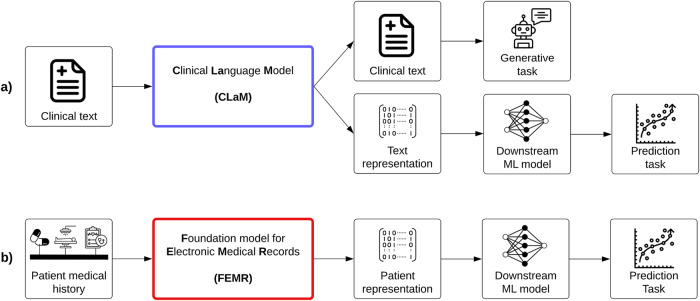
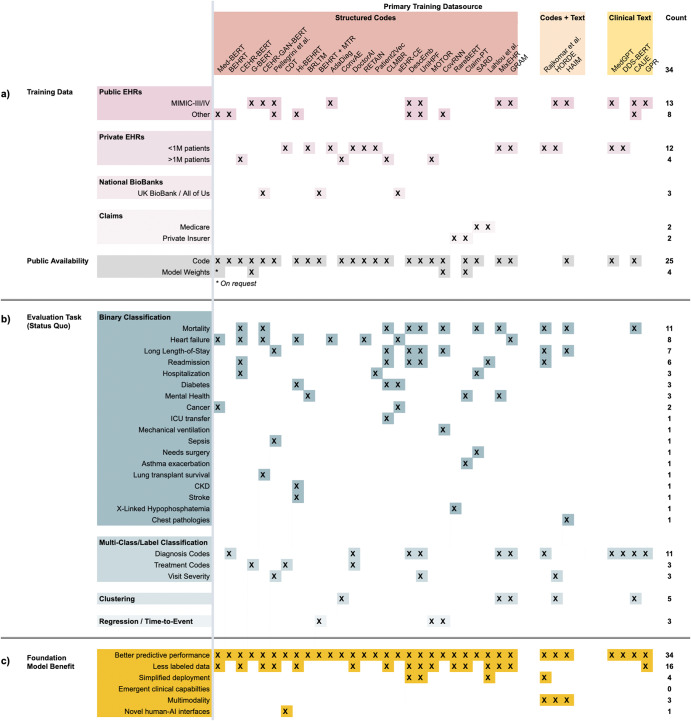
- The review identified 84 distinct clinical FMs published before March 1, 2023: 50 CLaMs and 34 FEMRs.
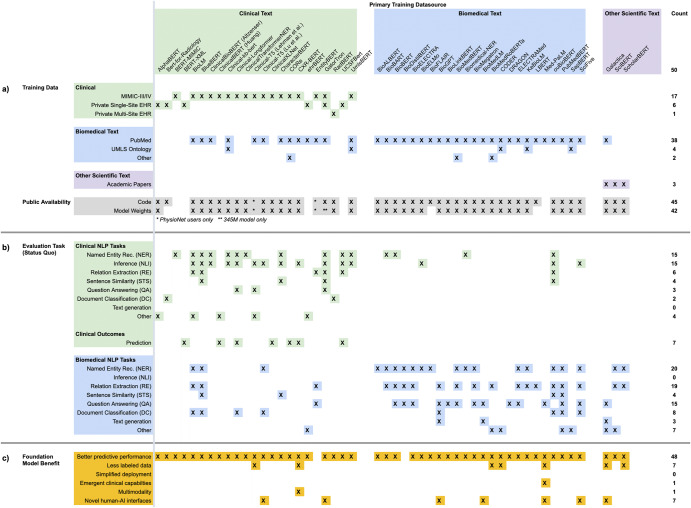
- Nearly all CLaMs were trained on just two data sources: MIMIC-III and PubMed; the paper states these two corpora contain about 18.5 billion words combined and that MIMIC-III includes about 2 million clinical notes.
- Most CLaMs are evaluated on standard NLP tasks such as named entity recognition, relation extraction, and document classification, and roughly half were not validated on clinical text.
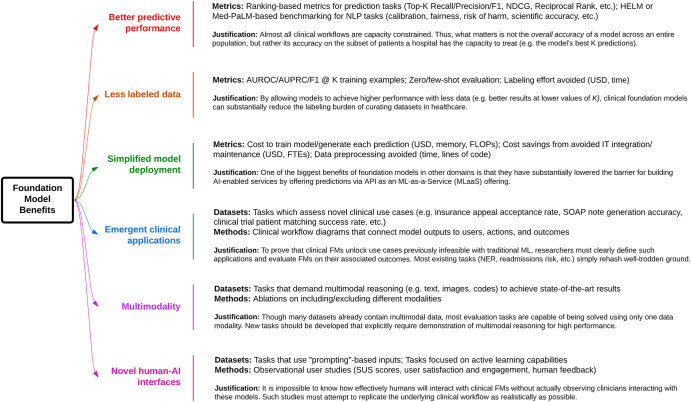
- For both CLaMs and FEMRs, the paper says evaluations mostly show better predictive accuracy, while other claimed FM benefits—such as simpler deployment, less labeled data, novel human-AI interfaces, and emergent clinical applications—are largely unstudied.
## Methods
- Design: Narrative review and taxonomy-building paper focused on clinical foundation models for EMR data, excluding images, genetics, and wearables.
- Data/sample: The authors curated 84 models published before March 1, 2023, including 50 clinical language models (CLaMs) and 34 foundation models for EMRs (FEMRs), identified through citations from representative samples and manual article curation.
- Main analysis: They summarized each model’s architecture, training data, accessibility, and evaluation tasks, then reorganized evaluations around six claimed FM benefits to assess whether current benchmarks support those claims.
## Limitations
- The authors explicitly state they do not claim to include every possible model or every recent advancement, and that their search was not systematic; this is a limitation stated in the paper.
- They also note the review excludes imaging data and therefore is scoped only to structured and unstructured EMR data; this is stated in the paper as a scope choice.
- Evident from the text: because the paper is a narrative review with curated examples, its conclusions depend on the selected models and evaluations rather than a systematic search or meta-analysis.
Model-written summary. Check it against the paper before relying on it.
Integrity signals
Registry
Cites
Statistics
Figures
Verification
Claims the paper makes
12 Valid · 8 Not valid · 7 Not checked · 27 Own results and interpretations
The cited sources support only part of this claim — read each source’s verdict below.
In the paper
“Clinical FMs lack the shared evaluation frameworks and datasets20 that have underpinned progress in other fields, such as natural language processing (NLP) and computer vision21.”
§ The shaky foundations of large language models and foundation models for electronic health records > Introduction
What the sources say
- Partly supportedcites [20] Blagec K Kraiger J Frühwirt W Samwald M Benchmark datasets driving artificial intelligence development fail to capture the needs of medical professionals J. Biomed. Inform. 2023 137 104274 10.1016/j.jbi.2022.104274 36539106 sourceExperimental — accuracy not yet measured
The Introduction describes public benchmarks as shared, standardized ways to compare AI models, and the Analysis of benchmark datasets finds that few benchmarks have direct clinical relevance. But the paper examines clinical and biomedical AI benchmarks, not clinical foundation models specifically; it also identifies some existing clinical benchmarks rather than a complete lack of them. Page numbers were not available in our copy. (LLM, conf=0.86)
- Supportedcites [21] Donoho D 50 years of data science J. Comput. Graph. Stat. 2017 26 745 766 10.1080/10618600.2017.1384734 source
Donoho's Section 6 develops exactly this point: the Common Task Framework combines a publicly available shared training dataset with a sequestered, automatic scoring referee (6.1), and 'those fields where machine learning has scored successes are essentially those fields where CTF has been applied systematically' (6.2). Our copy names NLP/speech progress explicitly (IBM speech and natural-language-processing team and the Canadian Hansards corpus, DARPA/NIST machine-translation evaluations, Google translate, smartphone voice recognition) and lists the visual-pattern-recognition domains where CTF variants succeeded (OCR, fingerprint recognition, speaker identification, automatic target recognition), so the attributed claim that shared datasets plus shared evaluation frameworks underpinned progress in fields such as NLP and computer vision is stated in the source, with equal or greater confidence; only the literal label 'computer vision' is not used, and the clinical-FM shortfall itself is the citing paper's own framing. (LLM, conf=0.82)
plain- Asserted: passes — The authors put it forward as true.
- Checkable: passes — It can be checked against evidence.
- Load-bearing: passes — The paper’s conclusions depend on it.
- Based: passes — The paper gives a reason why it holds.
- Partly supported
The cited sources support only part of this claim — read each source’s verdict below.
In the paper
“Almost all CLaMs trained on the clinical text used a single database: MIMIC-III, which contains approximately 2 million notes written between 2001–2012 in the ICU of the Beth Israel Deaconess Medical Center56.”
§ The shaky foundations of large language models and foundation models for electronic health records > State of published clinical FMs > CLaMs
What the sources say
- Partly supportedcites [56] Johnson AEW MIMIC-III, a freely accessible critical care database Sci. Data 2016 3 160035 10.1038/sdata.2016.35 27219127 PMC4878278 sourceExperimental — accuracy not yet measured
The Background & Summary identifies MIMIC-III as clinical data from Beth Israel Deaconess Medical Center, and the Data Records and Additional information sections describe its notes. Patient characteristics gives 2001–2012 for adult critical-care admissions, but the passages do not establish approximately 2 million notes or that all notes were written in the ICU during that period. The statement about how many CLaMs used MIMIC-III is the citing authors’ framing, not a finding attributed to this database description. (LLM, conf=0.85)
plain- Asserted: passes — The authors put it forward as true.
- Checkable: passes — It can be checked against evidence.
- Load-bearing: passes — The paper’s conclusions depend on it.
- Based: passes — The paper gives a reason why it holds.
- Partly supported
Every source the paper cites for this claim was checked and supports it.
In the paper
“Other public datasets vary greatly in size, from eICU’s 139,000 patients61 to the CPRD’s longitudinal records on 7% of all patients in the UK62.”
§ The shaky foundations of large language models and foundation models for electronic health records > State of published clinical FMs > FEMRs
What the sources say
- Supportedcites [61] Pollard TJ The eICU Collaborative Research Database, a freely available multi-center database for critical care research Sci. Data 2018 5 180178 10.1038/sdata.2018.178 30204154 PMC6132188 source
The Data Records section reports 139,367 unique patients in eICU, supporting the citing sentence’s rounded figure of 139,000. The CPRD figure is attributed to a different citation and is not assessed here; no page number is provided for the passage. (LLM, conf=0.95)
- Supportedcites [62] Li, Y. et al. Hi-BEHRT: hierarchical transformer-based model for accurate prediction of clinical events using multimodal longitudinal electronic health records. IEEE J. Biomed. Health Inform. 27 (2022). PMC7615082 36427286 source
The citation to this paper is attached to the CPRD portion of the sentence, not the eICU figure. In Methods, “Data Source and Cohort Selection,” the paper describes CPRD as a longitudinal EHR dataset containing data from approximately 7% of the U.K. population. (LLM, conf=0.94)
plainn = 139,000- Asserted: passes — The authors put it forward as true.
- Checkable: passes — It can be checked against evidence.
- Load-bearing: unclear — It is unclear whether the paper’s conclusions depend on it.
- Based: passes — The paper gives a reason why it holds.
- Supported
The sources with a verdict support this claim; the rest weren’t checked yet, have no full text we could read, or their verdicts aren’t rated yet.
In the paper
“In reality, clinical workflows are capacity constrained—a nursing team may only be able to act on a handful of model predictions per day79,80.”
§ The shaky foundations of large language models and foundation models for electronic health records > State of published clinical FMs > FEMRs
What the sources say
- Not checked — no full text of the sourcecites [79] Shah N Making machine learning models clinically useful JAMA 2019 322 1351 10.1001/jama.2019.10306 31393527 source
- Supportedcites [80] Wornow M Gyang Ross E Callahan A Shah NH APLUS: a Python library for usefulness simulations of machine learning models in healthcare J. Biomed. Inform. 2023 139 104319 10.1016/j.jbi.2023.104319 36791900 PMC10309067 source
The Introduction says that resource constraints affect clinical workflows. In Results (“Simulating unlimited downstream specialist capacity”), the paper describes low-capacity nursing settings where only the top few model predictions can be acted upon, including a simulated capacity of three patients per day. (LLM, conf=0.92)
hedged- Asserted: passes — The authors put it forward as true.
- Checkable: passes — It can be checked against evidence.
- Load-bearing: passes — The paper’s conclusions depend on it.
- Based: passes — The paper gives a reason why it holds.
The cited sources that could be checked couldn’t confirm or dispute this claim.
In the paper
“Currently, the majority of evaluation tasks span one data modality78”
§ The shaky foundations of large language models and foundation models for electronic health records > State of published clinical FMs > FEMRs
What the sources say
- Could not verifycites [78] McDermott, M. et al. A comprehensive EHR timeseries pre-training benchmark. In Proc. Conference on Health, Inference, and Learning 257–278 (Association for Computing Machinery, 2021). sourceExperimental — accuracy not yet measured
The High-Level Overview (Section 4; page unavailable) describes this paper’s ten downstream tasks using EHR time-series data. Neither it nor the task descriptions in Section 5.2 establish that the majority of evaluation tasks generally span one data modality; searches for single-modality and multimodal evaluation tasks found no such statement. (LLM, conf=0.73)
plain- Asserted: passes — The authors put it forward as true.
- Checkable: passes — It can be checked against evidence.
- Load-bearing: passes — The paper’s conclusions depend on it.
- Based: passes — The paper gives a reason why it holds.
- Could not verify
30 more claims · 4 with their cited sources checked
Create a free account to see all 54 claims and every source verdict.
- It may state two separate claims as one. 16
- Probably not a substantial claim. 8
Claims other papers make about this one
Each is checked against this paper’s own text: does it say what the citing paper says it does?
The cited source says what the claim attributes to it.
In the citing paper
“Previous work has demonstrated potential across clinical NLP tasks22,23, adapting to the medical domain by training a new model24,25, fine-tuning an existing model26,27 or supplying task-specific examples in the model prompt27,28.”
From Adapted large language models can outperform medical experts in clinical text summarization (2024) · cites this paper as [22]
Experimental — accuracy not yet measuredThe cited source says what the claim attributes to it.
In the citing paper
“Third, many state-of-the-art models are inaccessible13, necessitating the development of effective open-source models for biomedicine.”
From A clinically accessible small multimodal radiology model and evaluation metric for chest X-ray findings (2025) · cites this paper as [13]
The check wasn’t confident either way, so it gives no verdict — never disputed.
In the citing paper
“Some LLMs have already been integrated into electronic medical record systems,174 such as the Nuance DAX Copilot, a generative AI-program embedded in an electronic health record software called Epic, which records patient interactions and automatically produces clinical documentation.175,176”
From Large Language Models for Chatbot Health Advice Studies: A Systematic Review (2025) · cites this paper as [174]
Experimental — accuracy not yet measuredThe check wasn’t confident either way, so it gives no verdict — never disputed.
In the citing paper
“Smaller models incur smaller carbon footprint12 and offer reduced serving costs and latency, which is of particular importance in resource-constrained settings outside of data centers13.”
From A clinically accessible small multimodal radiology model and evaluation metric for chest X-ray findings (2025) · cites this paper as [13]
Experimental — accuracy not yet measuredIn the citing paper
“Clinical notes summarization assists healthcare practitioners in identifying potential health risks within patients' electronic health records (Wornow et al. 2023), thereby reducing errors and facilitating informed decision-making.”
From Large language models in medical and healthcare fields: applications, advances, and challenges (2024) · cites this paper as Wornow et al. 2023
Citations
Cites
Highly accurate protein structure prediction with AlphaFold
Jumper, J., Evans, R., Pritzel, A., Green, T., Figurnov, M., Ronneberger, O., Tunyasuvunakool, K., Bates, R., Žídek, A., Potapenko, A., et al. (2021) · Nature · doi:10.1038/s41586-021-03819-2 · Cited by 43,764 · cited 2×
“FMs have received signi fi cant attention given their impressive range of capabilities across multiple domains, from text generation 2 and video editing 3 to protein folding 4 and robotics 5 .”
BackgroundLanguage Models are Few-Shot Learners
Brown, T. B., Mann, B., Ryder, N., Subbiah, M., Kaplan, J., Dhariwal, P., Neelakantan, A., Shyam, P., Sastry, G., Askell, A., et al. (2020) · arXiv · doi:10.48550/arxiv.2005.14165 · Cited by 23,372
Learning Transferable Visual Models From Natural Language Supervision
Radford, A., Kim, J. W., Hallacy, C., Ramesh, A., Goh, G., Agarwal, S., Sastry, G., Askell, A., Mishkin, P., Clark, J., et al. (2021) · arXiv · doi:10.48550/arxiv.2103.00020 · Cited by 15,293 · cited 1×
“Substantial prior work has shown that these models ’ large parameter counts and dataset sizes enable them to effectively model disparate modalities in the same shared latent space, thereby deriving richer representations for each modality than possible with unimodal models 48 – 51 .”
BackgroundTransformers: State-of-the-Art Natural Language Processing
Wolf, T., Debut, L., Sanh, V., Chaumond, J., Delangue, C., Moi, A., Cistac, P., Rault, T., Louf, R., Funtowicz, M., et al. (2020) · Proceedings of the 2020 Conference on Empirical Methods in Natural Language Processing: System Demonstrations · doi:10.18653/v1/2020.emnlp-demos.6 · Cited by 8,741
MIMIC-III, a freely accessible critical care database
Johnson, A. E. W., Pollard, T. J., Shen, L., Lehman, L.-W. H., Feng, M., Ghassemi, M., Moody, B., Szolovits, P., Anthony Celi, L., & Mark, R. G. (2016) · Scientific Data · doi:10.1038/sdata.2016.35 · Cited by 8,141 · cited 2×
“Again, the most popular public dataset is MIMIC-III, which contains less than 40,000 patients 56 .”
BackgroundMethodChain-Of-Thought Prompting Elicits Reasoning in Large Language Models
Wei, J., Wang, X., Schuurmans, D., Bosma, M., Ichter, B., Xia, F., Chi, E., Le, Q. V., & Zhou, D. (2022) · Advances in Neural Information Processing Systems 35 · doi:10.52202/068431-1800 · Cited by 4,505
Chain-of-Thought Prompting Elicits Reasoning in Large Language Models
Wei, J., Wang, X., Schuurmans, D., Bosma, M., Ichter, B., Xia, F., Chi, E., Le, Q., & Zhou, D. (2022) · arXiv · doi:10.48550/arxiv.2201.11903 · Cited by 4,263 · cited 1×
“This enables a two-way conversation between humans and machine, and allows for the decomposition of problems into smaller steps via techniques such as “ chain-of-thought ” prompting 54 .”
MethodKung, T. H., Cheatham, M., Medenilla, A., Sillos, C., De Leon, L., Elepaño, C., Madriaga, M., Aggabao, R., Diaz-Candido, G., Maningo, J., et al. (2023) · PLOS Digital Health · doi:10.1371/journal.pdig.0000198 · Cited by 4,115 · cited 1×
“Physicians were quick to apply the model to pass medical licensing exams 8 – 11 , simplify radiology reports 12 , and write research articles 13 .”
MethodKung, T. H., Cheatham, M., ChatGPT, Medenilla, A., Sillos, C., De Leon, L., Elepaño, C., Madriaga, M., Aggabao, R., Diaz-Candido, G., et al. (2022) · doi:10.1101/2022.12.19.22283643 · Cited by 4,115
Universal Language Model Fine-tuning for Text Classification
Howard, J., & Ruder, S. (2018) · Proceedings of the 56th Annual Meeting of the Association for Computational Linguistics (Volume 1: Long Papers) · doi:10.18653/v1/p18-1031 · Cited by 4,100
Research works printed but not linked: 12
- Lehman, E. et al. Do we still need clinical language models? Preprint at arXiv [cs.CL] (2023).
- Moradi, M., Blagec, K., Haberl, F. & Samwald, M. GPT-3 models are poor few-shot learners in the biomedical domain. Preprint at arXiv [cs.CL] (2021).
- Steinberg, E., Xu, Y., Fries, J. & Shah, N. Self-supervised time-to-event modeling with structured medical records. Preprint at arXiv [cs.LG] (2023).
- Lee, S., Da Young, L., Im, S., Kim, N. H. & Park, S.-M. Clinical decision transformer: intended treatment recommendation through goal prompting. Preprint at arXiv [cs.AI] (2023).
- Sushil, M., Ludwig, D., Butte, A. J. & Rudrapatna, V. A. Developing a general-purpose clinical language inference model from a large corpus of clinical notes. Preprint at arXiv [cs.CL] (2022).
- Dash, D. et al. Evaluation of GPT-3.5 and GPT-4 for supporting real-world information needs in healthcare delivery. Preprint at arXiv [cs.AI] (2023).
- Thomas, R. & Uminsky, D. The problem with metrics is a fundamental problem for AI. Preprint at arXiv [cs.CY] (2020).
- Lee, P., Goldberg, C. & Kohane, I. The AI Revolution in Medicine: GPT-4 and Beyond. (Pearson, 2023).
- Husmann, S., Yèche, H., Rätsch, G. & Kuznetsova, R. On the importance of clinical notes in multi-modal learning for EHR data. Preprint at arXiv [cs.LG] (2022).
- Peng, S., Kalliamvakou, E., Cihon, P. & Demirer, M. The impact of AI on developer productivity: evidence from GitHub copilot. Preprint at arXiv [cs.SE] (2023).
- Zhang, X., Zhou, Z., Chen, D. & Wang, Y. E. AutoDistill: an end-to-end framework to explore and distill hardware-efficient language models. Preprint at arXiv [cs.LG] (2022).
- El-Mhamdi, E.-M. et al. SoK: on the impossible security of very large foundation models. Preprint at arXiv [cs.LG] (2022).
Cited by
Adapted large language models can outperform medical experts in clinical text summarization
Van Veen, D., Van Uden, C., Blankemeier, L., Delbrouck, J.-B., Aali, A., Bluethgen, C., Pareek, A., Polacin, M., Reis, E. P., Seehofnerová, A., et al. (2024) · Nature Medicine · doi:10.1038/s41591-024-02855-5 · Cited by 891
“Previous work has demonstrated potential across clinical NLP tasks 22,23 , adapting to the medical domain by training a new model 24,25 , fine-tuning an existing model 26,27 or supplying task-specific examples in the model prompt 27,28 .”
Bedi, S., Liu, Y., Orr-Ewing, L., Dash, D., Koyejo, S., Callahan, A., Fries, J. A., Wornow, M., Swaminathan, A., Lehmann, L. S., et al. (2024) · doi:10.1101/2024.04.15.24305869 · Cited by 738
Self-citationTesting and Evaluation of Health Care Applications of Large Language Models: A Systematic Review
Bedi, S., Liu, Y., Orr-Ewing, L., Dash, D., Koyejo, S., Callahan, A., Fries, J. A., Wornow, M., Swaminathan, A., Lehmann, L. S., et al. (2025) · JAMA · doi:10.1001/jama.2024.21700 · Cited by 662
Self-citationThe TRIPOD-LLM reporting guideline for studies using large language models
Gallifant, J., Afshar, M., Ameen, S., Aphinyanaphongs, Y., Chen, S., Cacciamani, G., Demner-Fushman, D., Dligach, D., Daneshjou, R., Fernandes, C., et al. (2025) · Nature Medicine · doi:10.1038/s41591-024-03425-5 · Cited by 615
Creation and Adoption of Large Language Models in Medicine
Shah, N. H., Entwistle, D., & Pfeffer, M. A. (2023) · JAMA · doi:10.1001/jama.2023.14217 · Cited by 435
Self-citationA study of generative large language model for medical research and healthcare
Peng, C., Yang, X., Chen, A., Smith, K. E., PourNejatian, N., Costa, A. B., Martin, C., Flores, M. G., Zhang, Y., Magoc, T., et al. (2023) · npj Digital Medicine · doi:10.1038/s41746-023-00958-w · Cited by 408
Large Language Models in Medicine: The Potentials and Pitfalls: A Narrative Review
Omiye, J. A., Gui, H., Rezaei, S. J., Zou, J., & Daneshjou, R. (2024) · Annals of Internal Medicine · doi:10.7326/m23-2772 · Cited by 361
“Use of this technology in health care should not be without careful oversight.”
BackgroundFDA Perspective on the Regulation of Artificial Intelligence in Health Care and Biomedicine
Warraich, H. J., Tazbaz, T., & Califf, R. M. (2025) · JAMA · doi:10.1001/jama.2024.21451 · Cited by 332
Large Language Models for Chatbot Health Advice Studies: A Systematic Review
Huo, B., Boyle, A., Marfo, N., Tangamornsuksan, W., Steen, J. P., McKechnie, T., Lee, Y., Mayol, J., Antoniou, S. A., Thirunavukarasu, A. J., et al. (2025) · JAMA Network Open · doi:10.1001/jamanetworkopen.2024.57879 · Cited by 283
Large language models in medical and healthcare fields: applications, advances, and challenges
Wang, D., & Zhang, S. (2024) · Artificial Intelligence Review · doi:10.1007/s10462-024-10921-0 · Cited by 246
“Clinical notes summarization assists healthcare practitioners in identifying potential health risks within patients’ electronic health records (Wornow et al. 2023), thereby reducing errors and facilitating informed decision-making.”
Younis, H. A., Eisa, T. A. E., Nasser, M., Sahib, T. M., Noor, A. A., Alyasiri, O. M., Salisu, S., Hayder, I. M., & Younis, H. A. (2024) · Diagnostics · doi:10.3390/diagnostics14010109 · Cited by 242
Chen, Q., Hu, Y., Peng, X., Xie, Q., Jin, Q., Gilson, A., Singer, M. B., Ai, X., Lai, P.-T., Wang, Z., et al. (2025) · Nature Communications · doi:10.1038/s41467-025-56989-2 · Cited by 219
“…instances withless than 50words forthe trainingandvalidationsets andkeptthetesting setuntouched. b The gold standardofthetesting setofMS^2 isnot publicly available;weused thevalidation setinstead. by the fi ne-tuning approaches to quantify the bene fi ts and challenges of LLMs in BioNLP applications.”
Ning, Y., Teixayavong, S., Shang, Y., Savulescu, J., Nagaraj, V., Miao, D., Mertens, M., Ting, D. S. W., Ong, J. C. L., Liu, M., et al. (2024) · The Lancet Digital Health · doi:10.1016/s2589-7500(24)00143-2 · Cited by 212
“…the increased complexity in the models and application settings will further complicate how model reliability is evaluated (which is already challenging for existing LLMs) 45–47 and the extended capability and wide adoption of such technology can amplify the impact of related ethical issues.”
BackgroundAn evaluation framework for clinical use of large language models in patient interaction tasks
Johri, S., Jeong, J., Tran, B. A., Schlessinger, D. I., Wongvibulsin, S., Barnes, L. A., Zhou, H.-Y., Cai, Z. R., Van Allen, E. M., Kim, D., et al. (2025) · Nature Medicine · doi:10.1038/s41591-024-03328-5 · Cited by 201
Transformers and large language models in healthcare: A review
Nerella, S., Bandyopadhyay, S., Zhang, J., Contreras, M., Siegel, S., Bumin, A., Silva, B., Sena, J., Shickel, B., Bihorac, A., et al. (2024) · Artificial Intelligence in Medicine · doi:10.1016/j.artmed.2024.102900 · Cited by 197
Alderman, J. E., Palmer, J., Laws, E., McCradden, M. D., Ordish, J., Ghassemi, M., Pfohl, S. R., Rostamzadeh, N., Cole-Lewis, H., Glocker, B., et al. (2025) · The Lancet Digital Health · doi:10.1016/s2589-7500(24)00224-3 · Cited by 170
Yang, Z., Mitra, A., Liu, W., Berlowitz, D., & Yu, H. (2023) · Nature Communications · doi:10.1038/s41467-023-43715-z · Cited by 158
“TransformEHR outperformed BERT for prediction of both single and multiple diseases/outcomes, as shown in Tables 2, 3, and 4.”
Evaluating large language models as agents in the clinic
Mehandru, N., Miao, B. Y., Almaraz, E. R., Sushil, M., Butte, A. J., & Alaa, A. (2024) · npj Digital Medicine · doi:10.1038/s41746-024-01083-y · Cited by 143
Black Box Warning: Large Language Models and the Future of Infectious Diseases Consultation
Schwartz, I. S., Link, K. E., Daneshjou, R., & Cortés-Penfield, N. (2024) · Clinical Infectious Diseases · doi:10.1093/cid/ciad633 · Cited by 131
“General-purpose LLMs like OpenAI’s GPT-3 and GPT-4, Google’s BERT, and Meta’s LLaMA—sometimes called foundation models—have been trained on massive quantities of text without specific domain (eg, biomedical) training [3].”
BackgroundPotential of large language models in health care: Delphi study
Denecke, K., May, R., LLMHealthGroup, & Rivera Romero, O. (2024) · Journal of Medical Internet Research · doi:10.2196/52399 · Cited by 111
“A large language model (LLM) is a machine learning model that encodes complex patterns of language use derived from vast quantities of input texts [1,2].”
BackgroundGenerative AI and large language models in health care: pathways to implementation
Raza, M. M., Venkatesh, K. P., & Kvedar, J. C. (2024) · npj Digital Medicine · doi:10.1038/s41746-023-00988-4 · Cited by 107
“Generative AI models trained on EMR data, such as notes, lab values, and billing codes, hold the promise of better predictive performance, simpler model development (with less labeled data required) and cheaper model deployment 7 .”
BackgroundMethodInfluentialRecent Advances in Large Language Models for Healthcare
Nassiri, K., & Akhloufi, M. (2024) · BioMedInformatics · doi:10.3390/biomedinformatics4020062 · Cited by 103
“Another important category of clinical FMs is EMR record integration models, called FMs for Electronic Medical Records (FEMRs) [284].”
BackgroundClinical Text Summarization: Adapting Large Language Models Can Outperform Human Experts
Veen, D. V., Uden, C. V., Blankemeier, L., Delbrouck, J.-B., Aali, A., Bluethgen, C., Pareek, A., Polacin, M., Reis, E. P., Seehofnerova, A., et al. (2023) · doi:10.21203/rs.3.rs-3483777/v1 · Cited by 892
“Recent work has adapted LLMs for various medical tasks, demonstrating great potential for medical language understanding and generation [42, 68, 71, 77].”
BackgroundBI-RADS Category Assignments by GPT-3.5, GPT-4, and Google Bard: A Multilanguage Study
Cozzi, A., Pinker, K., Hidber, A., Zhang, T., Bonomo, L., Gullo, R. L., Christianson, B., Curti, M., Rizzo, S., Grande, F. D., et al. (2024) · Radiology · doi:10.1148/radiol.232133 · Cited by 109
Derraz, B., Breda, G., Kaempf, C., Baenke, F., Cotte, F., Reiche, K., Köhl, U., Kather, J. N., Eskenazy, D., & Gilbert, S. (2024) · npj Precision Oncology · doi:10.1038/s41698-024-00517-w · Cited by 94
“…rather than the interactive complex system that is the hospital 100,112 . the AI-based design of proteins and receptors has only been from 2022 18,28,29,32,52,68,98 , it is not surprising that regulatory frameworks are not optimally designed for these concepts and that regulatory innovation,…”
BackgroundAntaki, F., Milad, D., Chia, M. A., Giguère, C.-É., Touma, S., El-Khoury, J., Keane, P. A., & Duval, R. (2024) · British Journal of Ophthalmology · doi:10.1136/bjo-2023-324438 · Cited by 83
“28 In ophthalmology, multimodality is crucial, as we frequently depend on imaging data for patient diagnosis and monitoring.”
A Comprehensive Survey of Foundation Models in Medicine
Khan, W., Leem, S., See, K. B., Wong, J. K., Zhang, S., & Fang, R. (2025) · IEEE Reviews in Biomedical Engineering · doi:10.1109/rbme.2025.3531360 · Cited by 218
“Multiple ML models have been used to extract useful patterns from the complex data structures associated with various omics domains, which include genomics, proteinomics, metabolomics, transcriptomics, Lipidomics, microbiomics, etc. [79], [80].”
Benefits and Harms of Large Language Models in Digital Mental Health
De Choudhury, M., Pendse, S. R., & Kumar, N. (2023) · doi:10.31234/osf.io/y8ax9 · Cited by 78
Benefits and Harms of Large Language Models in Digital Mental Health
De Choudhury, M., Pendse, S. R., & Kumar, N. (2023) · arXiv · doi:10.48550/arxiv.2311.14693 · Cited by 78
Augmented non-hallucinating large language models as medical information curators
Gilbert, S., Kather, J. N., & Hogan, A. (2024) · npj Digital Medicine · doi:10.1038/s41746-024-01081-0 · Cited by 111
“Some have challenged whether LLMs can ever have medical application due to theirweaknesses, whilstothershavedescribedtheverychallengingpathway to regulatory approval of existing LLM tools for use in diagnostic or therapeutic decision making 22,29 (Table 1, Fig.”
MethodPrinciples, applications, and future of artificial intelligence in dermatology
Omiye, J. A., Gui, H., Daneshjou, R., Cai, Z. R., & Muralidharan, V. (2023) · Frontiers in Medicine · doi:10.3389/fmed.2023.1278232 · Cited by 104
“As reported by Wornow et al., standard evaluations are lacking for evaluating emerging models (102).”
ResultJung, K.-H. (2025) · Healthcare Informatics Research · doi:10.4258/hir.2025.31.2.114 · Cited by 106
“Adapting these general-purpose models to specialized fields such as medicine requires a process known as fine-tuning [4].”
Empowering personalized pharmacogenomics with generative AI solutions
(2024) · doi:10.1093/jamia/ocae039 · Cited by 65
Zero shot health trajectory prediction using transformer
Renc, P., Jia, Y., Samir, A. E., Wąs, J., Li, Q., Bates, D. W., & Sitek, A. (2024) · npj Digital Medicine · doi:10.1038/s41746-024-01235-0 · Cited by 189
“CLaMsarepro fi cient in various clinical tasks such as extracting drug names, summarizing medical dialogues, predicting clinical outcomes, and responding to patient queries 9 – 13 .”
Progress and opportunities of foundation models in bioinformatics
Li, Q., Hu, Z., Wang, Y., Li, L., Fan, Y., King, I., Jia, G., Wang, S., Song, L., & Li, Y. (2024) · Briefings in Bioinformatics · doi:10.1093/bib/bbae548 · Cited by 91
“Additionally, in online healthcare, FMs serve as a central storage and backbone of healthcare systems, powering question-answering systems and healthcare-assistive robots to leverage medical data and resources effectively [136].”
BackgroundMedical Ethics of Large Language Models in Medicine
Ong, J. C. L., Chang, S. Y.-H., William, W., Butte, A. J., Shah, N. H., Chew, L. S. T., Liu, N., Doshi-Velez, F., Lu, W., Savulescu, J., et al. (2024) · NEJM AI · doi:10.1056/aira2400038 · Cited by 58
Self-citationA personal health large language model for sleep and fitness coaching
Khasentino, J., Belyaeva, A., Liu, X., Yang, Z., Furlotte, N. A., Lee, C., Schenck, E., Patel, Y., Cui, J., Schneider, L. D., et al. (2025) · Nature Medicine · doi:10.1038/s41591-025-03888-0 · Cited by 196
A multi-center study on the adaptability of a shared foundation model for electronic health records
Guo, L., Fries, J., Steinberg, E., Fleming, S. L., Morse, K., Aftandilian, C. C., Posada, J., Shah, N. H., & Sung, L. (2024) · npj Digital Medicine · doi:10.1038/s41746-024-01166-w · Cited by 120
“However, the absence of public structured EHR foundation models has hampered similar progress in EHR settings 17 .”
Self-citationMartindale, A. P. L., Llewellyn, C. D., de Visser, R. O., Ng, B., Ngai, V., Kale, A. U., di Ruffano, L. F., Golub, R. M., Collins, G. S., Moher, D., et al. (2024) · Nature Communications · doi:10.1038/s41467-024-45355-3 · Cited by 58
Large language models forecast patient health trajectories enabling digital twins
Makarov, N., Bordukova, M., Quengdaeng, P., Garger, D., Rodriguez‐Esteban, R., Schmich, F., & Menden, M. P. (2025) · npj Digital Medicine · doi:10.1038/s41746-025-02004-3 · Cited by 111
“DT-GPT addresses EHR challenges including noise, sparsity, and lack of data normalization 16 .”
InfluentialHolistic evaluation of large language models for medical tasks with MedHELM
Bedi, S., Cui, H., Fuentes, M., Unell, A., Wornow, M., Banda, J. M., Kotecha, N., Keyes, T., Mai, Y., Oez, M., et al. (2026) · Nature Medicine · doi:10.1038/s41591-025-04151-2 · Cited by 59
Self-citationZambrano Chaves, J. M., Huang, S.-C., Xu, Y., Xu, H., Usuyama, N., Zhang, S., Wang, F., Xie, Y., Khademi, M., Yang, Z., et al. (2025) · Nature Communications · doi:10.1038/s41467-025-58344-x · Cited by 45
“Third, many state-of-the-art models are inaccessible 13 , necessitating the development of effective open-source models for biomedicine.”
Self-citationNowak, S., Wulff, B., Layer, Y. C., Theis, M., Isaak, A., Salam, B., Block, W., Kuetting, D. L. R., Pieper, C. C., Luetkens, J. A., et al. (2025) · Radiology · doi:10.1148/radiol.240895 · Cited by 65
Large language models: a primer and gastroenterology applications
Shahab, O., Kurdi, B. E., Shaukat, A., Nadkarni, G. N., & Soroush, A. (2024) · Therapeutic Advances in Gastroenterology · doi:10.1177/17562848241227031 · Cited by 48
“11,15,49,50 LLMs can identify variations in care delivery across different providers or facilities and develop strategies to reduce these variations and improve the quality of care.”
Waldock, W. J., Zhang, J., Guni, A., Nabeel, A., Darzi, A. W., & Ashrafian, H. (2024) · Journal of Medical Internet Research · doi:10.2196/56532 · Cited by 65
Menezes, M. C. S., Hoffmann, A. F., Tan, A. L. M., Nalbandyan, M., Omenn, G. S., Mazzotti, D. R., Hernández-Arango, A., Visweswaran, S., Venkatesh, S., Mandl, K. D., et al. (2024) · The Lancet Digital Health · doi:10.1016/s2589-7500(24)00246-2 · Cited by 61
Wu, J., Liu, X., Li, M., Li, W., Su, Z., Lin, S., Garay, L., Zhang, Z., Zhang, Y., Zeng, Q., et al. (2024) · NEJM AI · doi:10.1056/aira2400012 · Cited by 41
Clay, B., Bergman, H. I., Salim, S., Pergola, G., Shalhoub, J., & Davies, A. H. (2025) · Computers in Biology and Medicine · doi:10.1016/j.compbiomed.2025.109808 · Cited by 41
Alba, C., Xue, B., Abraham, J., Kannampallil, T., & Lu, C. (2025) · npj Digital Medicine · doi:10.1038/s41746-025-01489-2 · Cited by 67
“This perspective highlights the potential limitations of relying purely entirely on pretrained models to capture precise context within diverse clinical texts and accentuates the necessity to refine these LLMs using more extensive clinical datasets [36, 42].”
InfluentialLi, H., Fu, J., & Python, A. (2025) · Journal of Medical Internet Research · doi:10.2196/71916 · Cited by 69
“…to be trained on clinical texts are usually trained on a few publicly available electronic medical record datasets (eg, Medical Information Mart for Intensive Care–Chest X-Ray, Medical Information Mart for Intensive Care–III, or PubMed) or on restricted datasets within medical institutions [79].”
Advancing Chinese biomedical text mining with community challenges
Zong, H., Wu, R., Cha, J., Feng, W., Wu, E., Li, J., Shao, A., Tao, L., Li, Z., Tang, B., et al. (2024) · Journal of Biomedical Informatics · doi:10.1016/j.jbi.2024.104716 · Cited by 44
Schouten, J., Kalden, M. A. C. M., van Twist, E., Reiss, I. K. M., Gommers, D. A. M. P. J., van Genderen, M. E., & Taal, H. R. (2024) · Intensive Care Medicine · doi:10.1007/s00134-024-07629-8 · Cited by 59
Bhattacharya, M., Pal, S., Chatterjee, S., Lee, S., & Chakraborty, C. (2024) · Molecular Therapy — Nucleic Acids · doi:10.1016/j.omtn.2024.102255 · Cited by 54
“91 Firstly, textual resources such as progress notes or PubMed abstracts train speci fi c models.”
BackgroundArtificial intelligence in hematology
Nazha, A., Elemento, O., Ahuja, S. P., Lam, B. D., Miles, M. E., Shouval, R., McWeeney, S. K., Sirhan, S., Srisuwananukorn, A., & Haferlach, T. (2025) · Blood · doi:10.1182/blood.2025029876 · Cited by 49
Risks of AI scientists: prioritizing safeguarding over autonomy
Tang, X., Jin, Q., Zhu, K., Yuan, T., Zhang, Y., Zhou, W., Qu, M., Zhao, Y., Tang, J., Zhang, Z., et al. (2025) · Nature Communications · doi:10.1038/s41467-025-63913-1 · Cited by 51
“This limitation becomes particularly evident when agents are required to navigate tasks that demand simultaneous attention to diverse objectives or the use of multiple tools in a cohesive manner.”
Parmanto, B., Aryoyudanta, B., Soekinto, T. W., Setiawan, I. M. A., Wang, Y., Hu, H., Saptono, A., & Choi, Y. K. (2024) · JMIR Formative Research · doi:10.2196/54633 · Cited by 45
“These data sets equip the FMs with the versatility to perform a wide range of tasks across different domains [17,19,23].”
BackgroundUnder the Influence: A Survey of Large Language Models in Fake News Detection
Kuntur, S., Wróblewska, A., Paprzycki, M., & Ganzha, M. (2024) · IEEE Transactions on Artificial Intelligence · doi:10.1109/tai.2024.3471735 · Cited by 74
“Nonetheless, post-training, LLMs can maximize, streamline and automate the fake news identification process, optimizing human resource utilization during real-time evaluations [159], [164].”
Mikhail, D., Farah, A., Milad, J., Nassrallah, W. B., Mihalache, A., Milad, D., Antaki, F., Balas, M., Popovic, M. M., Feo, A. D., et al. (2025) · British Journal of Ophthalmology · doi:10.1136/bjo-2025-327360 · Cited by 45
Machine learning predicts upper secondary education dropout as early as the end of primary school
Psyridou, M., Prezja, F., Torppa, M., Lerkkanen, M., Poikkeus, A., & Vasalampi, K. (2024) · Scientific Reports · doi:10.1038/s41598-024-63629-0 · Cited by 67
Large language models and synthetic health data: progress and prospects
Smolyak, D., Bjarnadóttir, M. V., Crowley, K., & Agarwal, R. (2024) · JAMIA Open · doi:10.1093/jamiaopen/ooae114 · Cited by 60
“64 Dimensions that are critical to measure include the aforementioned data realism, utility, and privacy, token usage, computational cost (including power consumption), and diversity.”
BackgroundHazard analysis in the era of AI: Assessing the usefulness of ChatGPT4 in STPA hazard analysis
Charalampidou, S., Zeleskidis, A., & Dokas, Ι. M. (2024) · Safety Science · doi:10.1016/j.ssci.2024.106608 · Cited by 44
Serapio, A., Chaudhari, G., Savage, C. H., Lee, Y. J., Vella, M., Sridhar, S., Schroeder, J., Liu, J., Yala, A., & Sohn, J. H. (2024) · BMC Medical Imaging · doi:10.1186/s12880-024-01435-w · Cited by 41
“This finding on the clinical risks of LLMs has also been explored in other investigations that examined the use of LLMs for biomedical applications [24–26].”
BackgroundScott, I. A., & Zuccon, G. (2024) · Internal Medicine Journal · doi:10.1111/imj.16393 · Cited by 39
Knowledge graph construction for heart failure using large language models with prompt engineering
Xu, T., Gu, Y., Xue, M., Gu, R., Li, B., & Gu, X. (2024) · Frontiers in Computational Neuroscience · doi:10.3389/fncom.2024.1389475 · Cited by 40
“…LaMDA (Thoppilan et al., 2022), PaLM (Chowdhery et al., 2022), and ChatGPT (Achiam et al., 2023) etc. are able to achieve more accurate answers through techniques such as continual pre-training (Singhal et al., 2023), fine tuning (Wornow et al., 2023), and prompt engineering (Wang et al., 2024).”
BackgroundEvaluation of AI Solutions in Health Care Organizations — The OPTICA Tool
Dagan, N., Devons-Sberro, S., Paz, Z., Zoller, L., Sommer, A., Shaham, G., Shahar, N., Ohana, R., Weinstein, O., Netzer, D., et al. (2024) · NEJM AI · doi:10.1056/aics2300269 · Cited by 27
Standardizing and Scaffolding Health Care AI-Chatbot Evaluation: Systematic Review
Hua, Y., Xia, W., Bates, D., Hartstein, G. L., Kim, H. T., Li, M., Nelson, B. W., Stromeyer IV, C., King, D., Suh, J., et al. (2025) · JMIR AI · doi:10.2196/69006 · Cited by 30
“However, despite their popularity and potential, evaluating health care chatbots poses many challenges [7-9].”
Is Generative AI Increasing the Risk for Technology‐Mediated Trauma Among Vulnerable Populations?
Abdulai, A. (2024) · Nursing Inquiry · doi:10.1111/nin.12686 · Cited by 41
Hein, D., Christie, A. L., Holcomb, M. J., Xie, B., Jain, A., Vento, J. A., Rakheja, N., Shakur, A. H., Christley, S., Cowell, L. G., et al. (2025) · npj Digital Medicine · doi:10.1038/s41746-025-01686-z · Cited by 56
Generative AI could revolutionize health care — but not if control is ceded to big tech
Toma, A., Senkaiahliyan, S., Lawler, P. R., Rubin, B., & Wang, B. (2023) · Nature · doi:10.1038/d41586-023-03803-y · Cited by 29
Du, X.-S., Zhou, Z., Wang, Y.-F., Chuang, Y.-W., Li, Y.-M., Yang, R., Zhang, W., Wang, X., Chen, X.-Y., Guan, H., et al. (2024) · medRxiv · doi:10.1101/2024.08.11.24311828 · Cited by 36
“62 ChatGPT has also been known to fabricate patient names when generating structured thyroid ultrasound reports from unstructured ultrasound reports.”
Advancing healthcare: the role and impact of AI and foundation models
Mahesh, N., Devishamani, C. S., Raghu, K., Mahalingam, M., Bysani, P., Chakravarthy, A. V., & Raman, R. (2024) · American Journal of Translational Research · doi:10.62347/wqwv9220 · Cited by 39
Aspects of 6th generation sensing technology: from sensing to sense
Mazumdar, H., Khondakar, K. R., Das, S., & Kaushik, A. K. (2024) · Frontiers in Nanotechnology · doi:10.3389/fnano.2024.1434014 · Cited by 29
Grout, R., Gupta, R. A., Bryant, R., Elmahgoub, M. A., Li, Y., Irfanullah, K., Patel, R. F., Fawkes, J., & Inness, C. (2024) · Frontiers in Artificial Intelligence · doi:10.3389/frai.2023.1287541 · Cited by 50
Generative AI Models in Time-Varying Biomedical Data: Scoping Review
He, R., Sarwal, V., Qiu, X., Zhuang, Y., Zhang, L., Liu, Y., & Chiang, J. N. (2025) · Journal of Medical Internet Research · doi:10.2196/59792 · Cited by 43
“While they achieve high predictive accuracy [115], these models are composed of millions to billions of parameters and have poor interpretability and high latency and runtime.”
The Promises and Perils of Foundation Models in Dermatology
Gui, H., Omiye, J. A., Chang, C. T., & Daneshjou, R. (2024) · Journal of Investigative Dermatology · doi:10.1016/j.jid.2023.12.019 · Cited by 30
van Genderen, M. E., Cecconi, M., & Jung, C. (2024) · Intensive Care Medicine · doi:10.1007/s00134-024-07408-5 · Cited by 33
“Currently, most ICU models are trained on small, nar-rowly scoped clinical datasets and are evaluated on tasks that do not provide meaningful insights on their usefulness to health systems [12].”
BackgroundArtificial Intelligence in Telemedicine: A Global Perspective Visualization Analysis
Zhang, X., Ma, L., Sun, D., Mo, Y., & Wang, Z. (2024) · Telemedicine Journal and e-Health · doi:10.1089/tmj.2023.0704 · Cited by 33
“53,54 Second, the foundation model may reinforce the phenomenon of bias in the health care field, which exacerbates discrimination and social inequality.”
Silbergleit, M., Tóth, A., Chamberlin, J., Hamouda, M., Baruah, D., Derrick, S., Schoepf, U. J., Burt, J. R., & Kabakus, I. M. (2024) · Journal of Imaging Informatics in Medicine · doi:10.1007/s10278-024-01328-y · Cited by 26
“Generic LLMs are publicly available and do not require additional cost or expertise to train and utilize, making them a more feasible option for most practices and healthcare systems presently [7].”
Large Language Models in Psychiatry: Current Applications, Limitations, and Future Scope
Liu, Z., Bao, Y., Zeng, S., Qian, R., Deng, M., Gu, A., Li, J., Wang, W., Cai, W., Li, W., et al. (2024) · Big Data Mining and Analytics · doi:10.26599/bdma.2024.9020046 · Cited by 32
Distilling the knowledge from large-language model for health event prediction
Ding, S., Ye, J., Hu, X., & Zou, N. (2024) · Scientific Reports · doi:10.1038/s41598-024-75331-2 · Cited by 44
Fox, B., Jiang, J. X., Wickramaratne, S., Kovatch, P., Suárez‐Fariñas, M., Shah, N. A., Parekh, A., & Nadkarni, G. N. (2025) · SLEEP · doi:10.1093/sleep/zsaf061 · Cited by 38
Self-citationJiao, C., Rosas, E., Asadigandomani, H., Delsoz, M., Madadi, Y., Raja, H., Munir, W. M., Tamm, B., Mehravaran, S., Djalilian, A. R., et al. (2025) · Diagnostics · doi:10.3390/diagnostics15101221 · Cited by 29
“These seven models were chosen primarily for their public accessibility, which eliminates the need for specialized training, expertise, or additional costs—making them more practical for most healthcare practices [27].”
Chiu, C., Wu, C.-M., Chien, T.-N., Kao, L., & Li, C. (2024) · Journal of Clinical Medicine · doi:10.3390/jcm13185503 · Cited by 33
Zheng, N. S., Keloth, V. K., You, K., Kats, D., Li, D. K., Deshpande, O., Sachar, H., Xu, H., Laine, L., & Shung, D. L. (2024) · Gastroenterology · doi:10.1053/j.gastro.2024.09.014 · Cited by 25
Leveraging foundation and large language models in medical artificial intelligence
Wong, I. N., Monteiro, O., Baptista‐Hon, D. T., Wang, K., Lu, W.-Y., Sun, Z., Nie, S., & Yin, Y. (2024) · Chinese Medical Journal · doi:10.1097/cm9.0000000000003302 · Cited by 31
Large Language Models to Identify Advance Care Planning in Patients With Advanced Cancer
Agaronnik, N. D., Davis, J., Manz, C. R., Tulsky, J. A., & Lindvall, C. J. (2024) · Journal of Pain and Symptom Management · doi:10.1016/j.jpainsymman.2024.11.016 · Cited by 34
The emerging role of generative artificial intelligence in transplant medicine
Deeb, M., Gangadhar, A., Rabindranath, M., Rao, K. R., Brudno, M., Sidhu, A., Wang, B., & Bhat, M. (2024) · American Journal of Transplantation · doi:10.1016/j.ajt.2024.06.009 · Cited by 30
Decoding pathology: the role of computational pathology in research and diagnostics
Hölscher, D. L., & Bülow, R. D. (2024) · Pflügers Archiv - European Journal of Physiology · doi:10.1007/s00424-024-03002-2 · Cited by 29
“…workflows, algorithms need to be continuously monitored and adapted to the collected real-world data which provides important long-term longitudinal information to further improve model performance primarily for non-imaging data [114], with a prominent example being the AlphaFold model [53].”
Klug, K., Beckh, K., Antweiler, D., Chakraborty, N., Baldini, G., Laue, K., Hosch, R., Nensa, F., Schüler, M., & Giesselbach, S. (2024) · BMC Medical Informatics and Decision Making · doi:10.1186/s12911-024-02641-w · Cited by 42
“We observe that most of the publications in the medical NLP literature use English datasets, see also [17].”
BackgroundInfluentialA Brief Review on Benchmarking for Large Language Models Evaluation in Healthcare
Cilar, L., Chen, H., Chen, A., Topaz, M., Tam, W., Bian, J., & Štiglic, G. (2025) · Wiley Interdisciplinary Reviews Data Mining and Knowledge Discovery · doi:10.1002/widm.70010 · Cited by 39
The TRIPOD-LLM Statement: A Targeted Guideline For Reporting Large Language Models UsePreprint
Gallifant, J., Afshar, M., Ameen, S., Aphinyanaphongs, Y., Chen, S., Cacciamani, G. E., Demner-Fushman, D., Dligach, D., Daneshjou, R., Fernandes, C., et al. (2024) · medRxiv · doi:10.1101/2024.07.24.24310930 · Cited by 14
Tan, R. E. S., Teo, W. Z. W., & Puhaindran, M. E. (2024) · The Journal of Hand Surgery (Asian-Pacific Volume) · doi:10.1142/s2424835524300019 · Cited by 22
Graph contrastive learning as a versatile foundation for advanced scRNA-seq data analysis
Zhang, Z., Liu, Y., Xiao, M., Wang, K., Huang, Y., Bian, J., Yang, R., & Li, F. (2024) · Briefings in Bioinformatics · doi:10.1093/bib/bbae558 · Cited by 27
“The foundation model has been instrumental in our understanding of the role of deep learning in the biological context.”
BackgroundZou, X., He, W., Huang, Y., Ouyang, Y., Zhang, Z., Wu, Y., Wu, Y., Feng, L., Wu, S., Yang, M., et al. (2024) · Journal of Medical Internet Research · doi:10.2196/54616 · Cited by 27
Deep Learning in Digital Breast Tomosynthesis: Current Status, Challenges, and Future Trends
Wang, R., Chen, F., Chen, H., Lin, C. X., Shuai, J., Wu, Y., Ma, L., Hu, X., Wu, M. H., Wang, J., et al. (2025) · MedComm · doi:10.1002/mco2.70247 · Cited by 23
Karnehed, S., Larsson, I., Petersson, L., Erlandsson, L., & Tyskbo, D. (2025) · BMC Nursing · doi:10.1186/s12912-025-03348-7 · Cited by 29
“However, AI can fuse data from imaging, laboratory tests, and patient histories to provide more comprehensive analysis and decision-making [81], but it still remains a problem that healthcare data are often incomplete and inconsistent [82].”
Large Language Models in Orthopaedics: Definitions, Uses, and Limitations
Yao, J. J., Aggarwal, M., Lopez, R. D., & Namdari, S. (2024) · Journal of Bone and Joint Surgery · doi:10.2106/jbjs.23.01417 · Cited by 22
Teles, A. S., de Moura, I. R., Silva, F., Roberts, A., & Stahl, D. R. (2025) · Information Fusion · doi:10.1016/j.inffus.2025.102981 · Cited by 27
Xu, T., Chen, L., Hu, Z., & Li, B. (2025) · Expert Systems with Applications · doi:10.1016/j.eswa.2025.127582 · Cited by 30
A systematic review of molecular representation learning foundation models
Song, B., Zhang, J., Liu, Y., Liu, Y., Jiang, J., Yuan, S., Zhen, X., & Li, J. (2026) · Briefings in Bioinformatics · doi:10.1093/bib/bbaf703 · Cited by 29
“Foundation models, defined as machine learning architectures characterized by massive parameter scales, enable adaptation to complex tasks [13–15].”
Metadata
- Authors
- Wornow, M., Xu, Y., Thapa, R., Patel, B., Steinberg, E., Fleming, S., Pfeffer, M. A., Fries, J., & Shah, N. H.
- Affiliations
- Stanford University (US)
- Stanford Medicine (US)
- Stanford Health Care (US)
- Corresponding author
- Wornow, Michael
- ORCID
- Venue
- npj Digital Medicine
- Published
- 2023-07-29
- Volume
- 6
- Issue
- 1
- Pages
- 135-135
- ISSN
- 2398-6352 (ISSN-L)
- PMC
- PMC10387101
- OpenAlex
- W4385381606
- Cited by
- 324
- References
- 87
- Citations by year
- 2026: 97 · 2025: 110 · 2024: 103 · 2023: 14
- FWCI
- 6.77
- Type
- journal article
- Language
- en
- Open access
- gold
- doi.org
- Licence
- cc-by
- creativecommons.org/licenses/by/4.0 (tdm)
- creativecommons.org/licenses/by/4.0 (vor)
- Locations
- npj Digital Medicine (publishedVersion, cc-by)
- PubMed Central (publishedVersion, cc-by)
- PubMed (publishedVersion)
- DOAJ (DOAJ: Directory of Open Access Journals) (submittedVersion, cc-by-sa)
- Funders
- National Science Foundation
- Topics
- Physical Sciences › Computer Science › Artificial Intelligence › Machine Learning in Healthcare
- Health Sciences › Medicine › Health Informatics › Artificial Intelligence in Healthcare and Education
- Health Sciences › Health Professions › Health Information Management › Electronic Health Records Systems
- Keywords
- foundation models, large language models, electronic health records, model evaluation framework, clinical text, structured clinical data, MIMIC-III, PubMed, artificial intelligence in healthcare, model taxonomy
About these checks
Registry, retraction, Cites and statistics results are computed, not judged, with one exception: a printed reference that no index lists is read once by a model before it counts as a citation error. Claims are extracted by a model and kept only when their quote appears verbatim in the text; each cited source is then checked, with a model’s help, for whether it says what the claim relies on. Those verdicts can be wrong — read the claim’s quote and the cited source before relying on one.
The claim verdicts this report counts are experimental: their accuracy is not yet measured.
A language model drew the claims from the paper on 2026-10-10, under version 3 of the claim definition (model deepseek-v4.1-flash, prompt extract-v3).
A second model labelled each claim on 2026-10-10 (model jev-1.13-20260917, definition revision gold-guideline-v0.2).
Cited sources are checked with a language model’s help (gpt-6-sol and qwen3.8-omni-flash).
Statistics and arithmetic are recomputed, not judged.
Confidence bands are shown only for fields calibrated on our annotated test set. None is calibrated yet, so no band is shown.
What counts as a claim ›How we measure confidence ›How we check this ›
Are you an author, or do you see a problem with this page? Request a review
Data sources
Bibliographic data: Semantic Scholar, OpenAlex, Crossref.
Contains information from the Semantic Scholar Academic Graph Datasets, made available under the ODC Attribution License (ODC-BY 1.0).
Semantic Scholar’s data is described in: Kinney, R., et al. (2023). The Semantic Scholar Open Data Platform. arXiv:2301.10140.
