

Considerations for addressing bias in artificial intelligence for health equity
Open accessThe DOI matches its Crossref record; 38 of the 41 references it cites were found in a registry or an index, and 2 are not checked yet; 19 of the 76 sources its claims cite were checked for support.
Abstract
Health equity is a primary goal of healthcare stakeholders: patients and their advocacy groups, clinicians, other providers and their professional societies, bioethicists, payors and value based care organizations, regulatory agencies, legislators, and creators of artificial intelligence/machine learning (AI/ML)-enabled medical devices. Lack of equitable access to diagnosis and treatment may be improved through new digital health technologies, especially AI/ML, but these may also exacerbate disparities, depending on how bias is addressed. We propose an expanded Total Product Lifecycle (TPLC) framework for healthcare AI/ML, describing the sources and impacts of undesirable bias in AI/ML systems in each phase, how these can be analyzed using appropriate metrics, and how they can be potentially mitigated. The goal of these “Considerations” is to educate stakeholders on how potential AI/ML bias may impact healthcare outcomes and how to identify and mitigate inequities; to initiate a discussion between stakeholders on these issues, in order to ensure health equity along the expanded AI/ML TPLC framework, and ultimately, better health outcomes for all.
Verified 2026-10-05 · 2 references not checked yet
Overview
CoChat Summary
TL;DR
The paper proposes expanding the Total Product Lifecycle (TPLC) framework to address bias and health equity across all phases of AI/ML-enabled medical devices. It argues that bias can arise or persist at every phase and should be quantified with equity metrics such as subgroup accuracy disaggregation and population-achieved sensitivity/specificity.
Key findings
- Bias in AI/ML healthcare can exacerbate existing inequities or create new disparities; the paper cites an example where an algorithm intended to identify patients needing extra help actually predicted healthcare costs, resulting in sicker Black patients receiving similar care to healthier White patients despite needing higher acuity care.
- Equity impact can occur at every TPLC phase and is independent across phases: even when bias is mitigated in earlier phases, a later phase can still introduce undesirable equity effects.
- Proposed equity metrics include sensitivity disaggregated by demographic subgroup, differential clinical outcome across subgroups, and population-achieved sensitivity/specificity to measure the impact of access and so-called “invisible populations.”
- Mitigation opportunities include diverse creator teams, racially invariant priors, representative training and validation datasets, diverse clinical sites, and monitoring real-world access, cost, and treatment follow-through.
Methods
- Conceptual/perspective paper with no empirical study, dataset, or statistical analysis; it synthesizes existing literature and regulatory frameworks, including Char et al., FDA’s TPLC approach, IMDRF, and Good Machine Learning Practice.
- The authors map TPLC phases—Conception, Design, Development, Validation, Access and marketing, and Monitoring—to sources of bias, equity metrics, and potential mitigation strategies.
- Analysis is narrative and illustrative, using Fig. 1 examples rather than original data collection or quantitative evaluation.
Limitations
- The paper states its framework is not intended to be comprehensive for all bias risks and mitigations and is meant to initiate discussion among stakeholders.
- The paper states it is beyond its scope to exhaustively list metrics for ethics and instead gives examples to illustrate the principle.
- Evident from the text: the proposed expanded TPLC framework is not empirically validated or quantitatively tested in this paper, and it relies on cited examples and conceptual reasoning.
Model-written summary. Check it against the paper before relying on it.
Integrity signals
Registry
Cites
Statistics
Figures
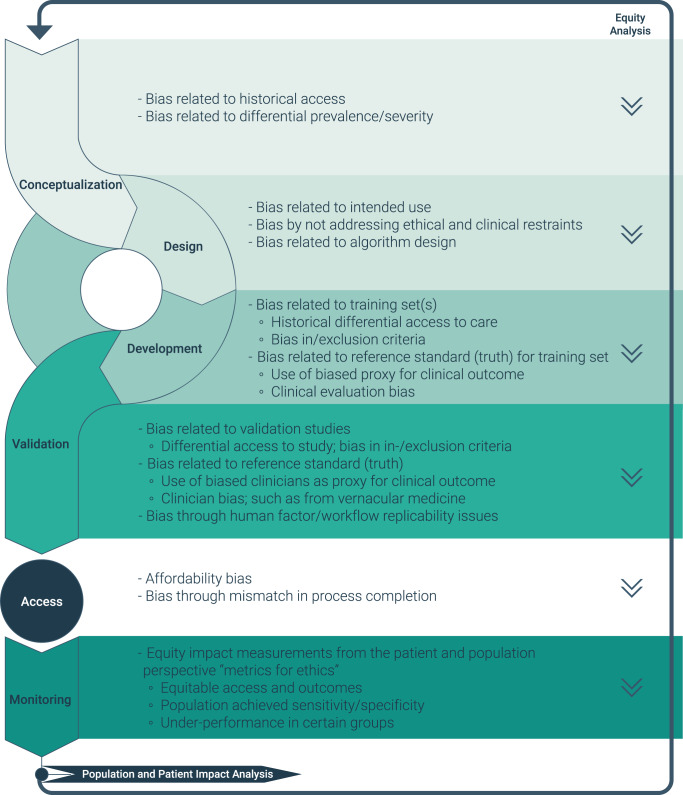
Verification
Claims the paper makes
11 Valid · 0 Not valid · 30 Not checked · 28 Own results and interpretations
The cited sources support only part of this claim — read each source’s verdict below.
In the paper
“Thus, the inherent bias in the algorithm appeared to contribute to worse outcomes for Black patients by influencing the likelihood they would receive the appropriate level of care25.”
§ Considerations for addressing bias in artificial intelligence for health equity > Introduction
What the sources say
- Partly supportedcites [25] Obermeyer Z Powers B Vogeli C Mullainathan S Dissecting racial bias in an algorithm used to manage the health of populations Science 2019 366 447 453 10.1126/science.aax2342 31649194 sourceExperimental — accuracy not yet measured
The paper’s opening summary (p. 2) reports that the algorithm’s racial bias affected which Black patients were identified to receive additional help; correcting it would increase the share of Black patients receiving that help from 17.7% to 46.5%. This supports the claim about likelihood of care, but the cited passages do not establish that the algorithm caused worse clinical outcomes for those patients. (LLM, conf=0.85)
hedgedstates a possible cause- Asserted: passes — The authors put it forward as true.
- Checkable: passes — It can be checked against evidence.
- Load-bearing: passes — The paper’s conclusions depend on it.
- Based: passes — The paper gives a reason why it holds.
- Partly supported
The cited sources support only part of this claim — read each source’s verdict below.
In the paper
“As an example, where there is concern about access to a diagnostic test, population-achieved sensitivity and specificity, which measures the impact of both access and sensitivity, has been proposed as a way to understand the impact of bias on population health, when including so-called invisible populations32.”
§ Considerations for addressing bias in artificial intelligence for health equity > Introduction > Measuring bias in AI systems
What the sources say
- Partly supportedcites [32] Abramoff MD Foundational considerations for artificial intelligence using ophthalmic images Ophthalmology 2022 129 e14 e32 10.1016/j.ophtha.2021.08.023 34478784 PMC9175066 sourceExperimental — accuracy not yet measured
The Equity section of our copy does state that "population-achieved sensitivity, or access-corrected sensitivity, is used to analyze such effects on equity," explicitly combining sensitivity (sc) with compliance/access (c) to give the effective sensitivity at the population level, and frames this around inappropriate bias and health disparities. However, two elements of the claim are absent: our copy only ever defines population-achieved SENSITIVITY (PAS) — there is no "population-achieved specificity" anywhere (searched: population-achieved specificity, access-corrected specificity) — and it never refers to "invisible populations"; the populations it corrects for are the "nonadherent"/differentially-served subgroups defined by race, ethnicity, age, sex and income. So the access-plus-sensitivity framing and the bias/equity-at-population-level purpose are supported, while the specificity extension and the 'invisible populations' qualifier are not. (LLM, conf=0.78)
plain- Asserted: passes — The authors put it forward as true.
- Checkable: passes — It can be checked against evidence.
- Load-bearing: unclear — It is unclear whether the paper’s conclusions depend on it.
- Based: passes — The paper gives a reason why it holds.
- Partly supported
Every source the paper cites for this claim was checked and supports it.
In the paper
“The impact of such differential access can be measured for example through population-achieved sensitivity32 compared to overall sensitivity, i.e., the fraction of correctly identified disease cases in a sample, without regard to representativeness of that sample (or lack thereof).”
§ Considerations for addressing bias in artificial intelligence for health equity > Introduction > Conception phase
What the sources say
- Supportedcites [32] Abramoff MD Foundational considerations for artificial intelligence using ophthalmic images Ophthalmology 2022 129 e14 e32 10.1016/j.ophtha.2021.08.023 34478784 PMC9175066 source
The Equity section (page not provided) says population-achieved sensitivity is used to analyze the effects of access on equity. It contrasts an AI system’s sensitivity among people who receive the examination with the lower effective sensitivity at the population level when access is limited. (LLM, conf=0.93)
plain- Asserted: passes — The authors put it forward as true.
- Checkable: passes — It can be checked against evidence.
- Load-bearing: unclear — It is unclear whether the paper’s conclusions depend on it.
- Based: passes — The paper gives a reason why it holds.
- Supported
The cited sources support only part of this claim — read each source’s verdict below.
In the paper
“As an example, if clinicians are used as the reference standard, their potential bias in their diagnosis may lead to bias in the training data, ultimately persisting as bias in the AI system37.”
§ Considerations for addressing bias in artificial intelligence for health equity > Introduction > Development phase
What the sources say
- Partly supportedcites [37] Sun M Oliwa T Peek ME Tung EL Negative patient descriptors: documenting racial bias in the electronic health record Health Aff. 2022 41 203 211 10.1377/hlthaff.2021.01423 PMC8973827 35044842 sourceExperimental — accuracy not yet measured
The Policy Implications section (page unavailable) says clinicians may introduce biased language into records, and the Limitations section says training-data trends may influence the machine-learning results. The paper does not address clinicians’ diagnoses being used as a reference standard or show diagnostic bias persisting in an AI system. (LLM, conf=0.76)
hedgedstates a possible cause- Asserted: passes — The authors put it forward as true.
- Checkable: passes — It can be checked against evidence.
- Load-bearing: passes — The paper’s conclusions depend on it.
- Based: passes — The paper gives a reason why it holds.
- Partly supported
The cited sources support only part of this claim — read each source’s verdict below.
In the paper
“Thus, such bias reduces the bioethical principle of “Justice,” as Char et al.28 and Abramoff et al.32 described.”
§ Considerations for addressing bias in artificial intelligence for health equity > Introduction > Measuring bias in AI systems
What the sources say
- Partly supportedcites [28] Char DS Abràmoff MD Feudtner C Identifying ethical considerations for machine learning healthcare applications Am. J. Bioeth. 2020 20 7 17 10.1080/15265161.2020.1819469 33103967 PMC7737650 sourceExperimental — accuracy not yet measured
Our copy of Char et al. (2020) extensively treats bias in ML-HCAs as an ethical problem — 'Development: Perpetuation of Bias within Training Data, Risk of Harm due to Group Membership' describes latent biases in training data being 'perpetuated or even amplified' with 'racially discriminatory outcomes' — and the 'Calibration' section names 'equity (that the advantages of the application are shared fairly by all)' as a cardinal design feature, so the substance of the claim (bias as an ethical harm falling along group/fairness lines) is present. However, no passage invokes the bioethical principle of 'Justice' (searched: justice, principlism, standard moral principles, fairness/equity), so the specific attribution that bias 'reduces' that named principle is not stated; indeed the 'Allure of Highly Restricted Focus' section criticises reducing ML-HCA ethics to the single consideration of fairness, and the paper hedges bias effects with 'may'/'possibility', which the citing sentence states as a settled reduction. (LLM, conf=0.70)
- Supportedcites [32] Abramoff MD Foundational considerations for artificial intelligence using ophthalmic images Ophthalmology 2022 129 e14 e32 10.1016/j.ophtha.2021.08.023 34478784 PMC9175066 source
The Equity section (Bioethical Foundation, same section) states that the authors use 'equity' rather than the traditional bioethical term 'justice' for the same concept, defined as freedom from bias or favoritism, so substituting 'Justice' is faithful to this source. The same section asserts that 'Inappropriate bias, increase in health disparities, and thus decreased equity can manifest across the entire AI pipeline,' which is exactly the paraphrased point attributed here (the pipeline-wide account is credited to Char et al, but the bias-to-decreased-equity link is stated by this paper itself). (LLM, conf=0.85)
plainstates a cause- Asserted: passes — The authors put it forward as true.
- Checkable: passes — It can be checked against evidence.
- Load-bearing: unclear — It is unclear whether the paper’s conclusions depend on it.
- Based: passes — The paper gives a reason why it holds.
- Partly supported
18 more claims
Create a free account to see all 69 claims and to verify the 57 references still open.
- It may state two separate claims as one. 20
- Probably not a substantial claim. 35
Claims other papers make about this one
Each is checked against this paper’s own text: does it say what the citing paper says it does?
The source backs part of the claim, not all of it — or backs it for a different population, condition or comparison.
In the citing paper
“While these reviews have made valuable contributions to our understanding of bias in medical AI, they differ in scope, depth, and focus, leaving a gap in understanding how bias permeates the development of AI for clinical decisions.”
From Bias in medical AI: Implications for clinical decision-making (2024) · cites this paper as [20]
Experimental — accuracy not yet measuredThe source backs part of the claim, not all of it — or backs it for a different population, condition or comparison.
In the citing paper
“However, the 100% care-gap closure rate by autonomous AI in this racially and ethnically diverse pediatric population could have the potential to reduce health disparities for vision loss from diabetes, furthering health equity, and deserves further study42,43.”
From Autonomous artificial intelligence increases screening and follow-up for diabetic retinopathy in youth: the ACCESS randomized control trial (2024) · cites this paper as [43]
Experimental — accuracy not yet measuredThe source backs part of the claim, not all of it — or backs it for a different population, condition or comparison.
In the citing paper
“However, the same technology can reproduce or worsen inequity if devices are unavailable, internet connectivity is weak, staff are inadequately trained, costs are shifted to patients, or algorithms perform differently across populations and camera systems (10,(31)(32)(33).”
From From validation to public health impact: implementing equitable AI-enabled diabetic retinopathy screening (2026) · cites this paper as [31]
Experimental — accuracy not yet measuredThe source backs part of the claim, not all of it — or backs it for a different population, condition or comparison.
In the citing paper
“As AI solutions have emerged, a wide variety of governance best practices in the form of frameworks, governance structures, checklists, and guidelines have been proposed7–23.”
From Advancing healthcare AI governance through a comprehensive maturity model based on systematic review (2026) · cites this paper as [7]
Experimental — accuracy not yet measuredThe source backs part of the claim, not all of it — or backs it for a different population, condition or comparison.
In the citing paper
“A recurring theme across multiple articles was the necessity for an overarching governance body7–10,17. This entity would not only assist in selecting AI tools and software for implementation but also guide the validation, implementation, and monitoring processes.”
From Advancing healthcare AI governance through a comprehensive maturity model based on systematic review (2026) · cites this paper as [7]
Experimental — accuracy not yet measured
8 more claims about this paper
Create a free account to see every claim other papers make about this one.
Self-check
Percentages, sums and reported differences re-computed from the paper’s own numbers.
Each contradiction between two passages listed here was confirmed by an independent check.
Rated minor: it would not touch a result — a value no result rests on, a p-value that stays on the same side of the significance level, or a conflict that is clerical, resolved elsewhere in the paper, or outside its own findings.
In the paper
§ Considerations for addressing bias in artificial intelligence for health equity > Introduction > The AI total product lifecycle
“the principles outlined in the International Medical Device Regulators Forum’s (IMDRF)47 Software as a Medical Device Clinical Evaluation”
§ Considerations for addressing bias in artificial intelligence for health equity > References
“47. International Medical Device Regulators Forum - Software as a Medical Device (SaMD) Working Group. “Software as a Medical Device”: Possible Framework for Risk Categorization and Corresponding Considerations.”
Rated minor: it would not touch a result — a value no result rests on, a p-value that stays on the same side of the significance level, or a conflict that is clerical, resolved elsewhere in the paper, or outside its own findings.
In the paper
§ Considerations for addressing bias in artificial intelligence for health equity > Introduction > Development phase
“For considerations around which reference standard to use, see Abramoff et al. 202132”
§ Considerations for addressing bias in artificial intelligence for health equity > References
“32. Abramoff MD Foundational considerations for artificial intelligence using ophthalmic images Ophthalmology 2022 129 e14 e32”
Citations
Cites
Dissecting racial bias in an algorithm used to manage the health of populations
Obermeyer, Z., Powers, B., Vogeli, C., & Mullainathan, S. (2019) · Science · doi:10.1126/science.aax2342 · Cited by 7,137 · cited 3×
“Multiple studies have shown examples of the use of AI in healthcare (not evaluated by regulatory agencies) exacerbating, rather than mitigating, health disparities 24,25 .”
BackgroundSelf-citationInternational Organization for Standardization (ISO)
Nahler, G. (2009) · Dictionary of Pharmaceutical Medicine · doi:10.1007/978-3-211-89836-9_723 · Cited by 3,677
Implementing Machine Learning in Health Care — Addressing Ethical Challenges
Char, D. S., Shah, N. H., & Magnus, D. (2018) · New England Journal of Medicine · doi:10.1056/nejmp1714229 · Cited by 1,857 · cited 1×
“These ethical and other concerns with AI in healthcare have been shown by a number of research studies 27 – 29 .”
BackgroundSelf-citationAbràmoff, M. D., Lavin, P. T., Birch, M., Shah, N., & Folk, J. C. (2018) · npj Digital Medicine · doi:10.1038/s41746-018-0040-6 · Cited by 1,638
Self-citationPotential Biases in Machine Learning Algorithms Using Electronic Health Record Data
Gianfrancesco, M. A., Tamang, S., Yazdany, J., & Schmajuk, G. (2018) · JAMA Internal Medicine · doi:10.1001/jamainternmed.2018.3763 · Cited by 1,395 · cited 1×
“Gianfrancesco et al. similarly limited their analysis to bias derived from characteristics of retrospective training sets derived from existing Electronic Health Record (EHR) data 44 .”
BackgroundEnsuring fairness in machine learning to advance health equity.
Rajkomar, A., Hardt, M., Howell, M. D., Corrado, G., & Chin, M. H. (2018) · Annals of Internal Medicine · doi:10.7326/m18-1990 · Cited by 1,341 · cited 1×
“Thus, AI systems are increasingly in a position to help improve patient and population health outcomes and drive down cost, increase physician job satisfaction, and address health disparities 20,21,3,22,23 .”
BackgroundWhat are Health Disparities and Health Equity? We Need to Be Clear
Braveman, P. (2014) · Public Health Reports® · doi:10.1177/00333549141291s203 · Cited by 860
Inequalities in health: definitions, concepts, and theories
Arcaya, M. C., Arcaya, A. L., & Subramanian, S. V. (2015) · Global Health Action · doi:10.3402/gha.v8.27106 · Cited by 696
Fairness in Machine Learning: A Survey
Caton, S., & Haas, C. (2020) · arXiv · doi:10.48550/arxiv.2010.04053 · Cited by 646 · cited 3×
“More recently, the Foundational Considerations on Algorithmic Interpretation (FPOAI) workgroup of the Collaborative Community on Ophthalmic Imaging published their “ Foundational Considerations ” 32 on AI as a start to developing metrics for ethics , including metrics for “ Equity ” 33 , in order to be able to evaluat…”
BackgroundFairness in machine learning: A survey
Caton, S., & Haas, C. (2024) · ACM Computing Surveys · doi:10.1145/3616865 · Cited by 646 · cited 3×
“More recently, the Foundational Considerations on Algorithmic Interpretation (FPOAI) workgroup of the Collaborative Community on Ophthalmic Imaging published their “ Foundational Considerations ” 32 on AI as a start to developing metrics for ethics , including metrics for “ Equity ” 33 , in order to be able to evaluat…”
Background
Research works printed but not linked: 2
- American Medical Association. Board of trustees policy summary. Augmented Intelligence In Healthcare. https://www.ama-assn.org/system/files/2019-08/ai-2018-board-policy-summary.pdf (2019).
- Chen I Johansson FD Sontag D Why is my classifier discriminatory? arXiv 2018 1805 12002
Cited by
Items 101–200 of 350
A Competency Framework for Medical AI Education: Mixed Methods Study
Cai, C., Zhu, G., Zhou, S., Ng, O., Duell, J., Ho, W. K., Chen, D. M., Lee, B. T. K., Li, F., Liu, S., et al. (2026) · JMIR Medical Education · doi:10.2196/91116 · Cited by 15
“Integrating UNESCO’s AI system design with a focus on health care equity [37,38], we introduced bias mitigation and health equity in AI design .”
Ethical debates amidst flawed healthcare artificial intelligence metrics
Gallifant, J., Bitterman, D. S., Celi, L. A., Gichoya, J. W., de Matos, J. C. R. G., McCoy, L. G., & Pierce, R. L. (2024) · npj Digital Medicine · doi:10.1038/s41746-024-01242-1 · Cited by 15
Nguyen, V., Iyengar, S., Rasheed, H., Apolo, G., Li, Z., Kumar, A., Nguyen, H., Bohner, A. D., Bolo, K. A., Dhodapkar, R. M., et al. (2025) · Ophthalmology Science · doi:10.1016/j.xops.2025.100751 · Cited by 11
Marshall, N. J., Loades, M. E., Jacobs, C., Biddle, L., & Lambert, J. D. (2025) · Current Treatment Options in Psychiatry · doi:10.1007/s40501-025-00348-x · Cited by 11
Bechný, M., Fiorillo, L., van der Meer, J., Schmidt, M. H., Bassetti, C. L., Tzovara, A., & Faraci, F. D. (2025) · Scientific Reports · doi:10.1038/s41598-025-06019-4 · Cited by 13
Kevat, A., Steinkey, R., Suresh, S., Ruehland, W. R., Chawla, J., Terrill, P. I., Collaro, A., & Iyer, K. K. (2024) · Journal of Clinical Sleep Medicine · doi:10.5664/jcsm.11362 · Cited by 12
Rough, K., Rashidi, E., Tai, C. G.-L., Lucia, R. M., Mack, C. D., & Largent, J. A. (2024) · Pharmacoepidemiology and Drug Safety · doi:10.1002/pds.70041 · Cited by 12
Implementing Artificial Intelligence in Family Medicine: Challenges and Limitations
Katsakiori, P. F., Kagadis, G. C., Mulita, F., & Marangos, M. N. (2024) · Cureus · doi:10.7759/cureus.75518 · Cited by 15
Sun, J.-R., Sun, X.-N., Lu, B.-J., & Deng, B. (2025) · World Journal of Gastroenterology · doi:10.3748/wjg.v31.i46.111176 · Cited by 14
Wong, C. Y. T., Liu, T., Wong, T. L., Tong, J. M.-K., Lau, H. H. W., & Keane, P. A. (2024) · JFO Open Ophthalmology · doi:10.1016/j.jfop.2024.100117 · Cited by 10
Fostering Trust in AI-Driven Healthcare: A Brief Review of Ethical and Practical Considerations
Sîrbu, C. L., & Mercioni, M. A. (2024) · International Symposium on Electronics and Telecommunications (ISETC) · doi:10.1109/isetc63109.2024.10797264 · Cited by 15
“Healthcare algorithms and AI bias can worsen the underlying health inequalities that exist within populations, including race, ethnicity, gender, age or other demographic characteristics [11], [12].”
Lederman, O., Llana, A., Murray, J., Stanton, R., Chugh, R., Haywood, D., Burdett, A., Warman, G., Walker, J., & Hart, N. H. (2025) · BMC Sports Science Medicine and Rehabilitation · doi:10.1186/s13102-025-01182-7 · Cited by 12
“This can significantly impact healthcare provision, raising broader ethical concerns, particularly around fairness and equity, as nuances in individual presentations are often overlooked, leading to misdiagnoses and inappropriate care plans for example [28].”
Chen, H., Alfred, M. C., & Cohen, E. (2025) · JMIR Medical Informatics · doi:10.2196/68955 · Cited by 19
Comprehensive Evaluation of AI-Driven Systems in Modern Hospital Environments
Ravikumar, R. N., Aarthi, S., Atamuratova, Z., Ashirova, A. I., Atamuratovich, J. K., & Hayitova, M. (2025) · Advances in computational intelligence and robotics book series · doi:10.4018/979-8-3373-2787-7.ch003 · Cited by 14
Chisompola, D., Luwaya, E. L., Nzobokela, J., Mwansa, P., & Chakulya, M. (2026) · Frontiers in Microbiology · doi:10.3389/fmicb.2025.1717859 · Cited by 16
Amaya-Santos, S., Jiménez-Pernett, J., & Bermúdez‐Tamayo, C. (2024) · Anales del Sistema Sanitario de Navarra · doi:10.23938/assn.1077 · Cited by 13
Advancing Healthcare AI Governance: A Comprehensive Maturity Model Based on Systematic ReviewPreprint
Hussein, R., Zink, A., Ramadan, B., Howard, F. M., Hightower, M., Shah, S. D., & Beaulieu‐Jones, B. K. (2024) · medRxiv · doi:10.1101/2024.12.30.24319785 · Cited by 8
“For example, detailed documentation of evaluation criteria, methodologies, and results, making this information accessible to potential users - and such information will be required by regulatory bodies 7 .”
Innovating global regulatory frameworks for generative AI in medical devices is an urgent priority
Ong, J. C. L., Ning, Y., Liu, M., Ma, Y., Zhao, L., Singh, K., Chang, R. T., Vogel, S., Lim, J. C. W., Tan, I. S. K., et al. (2026) · npj Digital Medicine · doi:10.1038/s41746-026-02552-2 · Cited by 7
“…are taking actionstopushhealthequitytotheforefrontinregulatorystrategies, e.g.the World Health Organisation's global Guidance for best practices for clinical trials to promote equitable clinical trials, and the FDA ’ s Health Care at Home Initiative to drive equity in digital medicine 75 .”
Kareemi, H., Li, H., Rajaram, A., Holodinsky, J. K., Hall, J. N., Grant, L., Goel, G., Hayward, J., Mehta, S., Ben‐Yakov, M., et al. (2025) · Canadian Journal of Emergency Medicine · doi:10.1007/s43678-024-00826-w · Cited by 8
“AI applications in healthcare can suffer from numerous forms of bias, many of which can exacerbate existing health inequities [12].”
Basem, J. I., Mani, R., Sun, S., Gilotra, K., Dianati‐Maleki, N., & Dashti, R. (2025) · Frontiers in Cardiovascular Medicine · doi:10.3389/fcvm.2025.1525966 · Cited by 9
Revisiting Technical Bias Mitigation Strategies
Mahamadou, A. J. D., & Trotsyuk, A. A. (2025) · Annual Review of Biomedical Data Science · doi:10.1146/annurev-biodatasci-103123-095737 · Cited by 14
Can we predict the future of respiratory failure prediction?
Pearce, A. K., Nemati, S., Goligher, E. C., Hough, C. L., Holder, A. L., Wardi, G., Yang, P., Boussina, A. E., Lyons, P. G., Sahetya, S. K., et al. (2025) · Critical Care · doi:10.1186/s13054-025-05484-7 · Cited by 11
Advancing AI Literacy in Medical Education: A Medical AI Competency Framework Development
Cai, C., Duell, J., Chen, D. M., Ho, W. K., Lee, B. T. K., Li, F., Liu, S., Ng, O., Sudarshan, V. K., Zhou, S., et al. (2025) · Lecture notes in computer science · doi:10.1007/978-3-031-98462-4_15 · Cited by 26
Artificial intelligence policy, the Trump Administration, and federalism
Mallinson, D. J., Azevedo, L., Best, E., & Robles, P. (2025) · Administrative Theory & Praxis · doi:10.1080/10841806.2025.2537601 · Cited by 9
“In health care, for instance, AI bias leads to differential impacts on underrepresented, underserved, and under-resourced groups (Abràmoff et al., 2023; Fletcher et al., 2020).”
Artificial Intelligence and the future of clinical trials
Sergi, C. M., & Sesso, H. D. (2025) · Contemporary Clinical Trials Communications · doi:10.1016/j.conctc.2025.101545 · Cited by 9
From matrix factorization to graph neural networks: Advances in computational drug repositioning
Wang, Y., Wang, J., Yang, Y., Ren, Y., Bai, H., & Li, H. (2025) · Drug Discovery Today · doi:10.1016/j.drudis.2025.104499 · Cited by 8
Hassoon, A., Lin, C. F., Woo, H., Irimia, R. M., Marsteller, J. A., Li, A., Banderia, A., Leo, H., Peng, X., Rastall, D. P. W., et al. (2025) · Annals of Epidemiology · doi:10.1016/j.annepidem.2025.11.004 · Cited by 12
Artificial intelligence in healthcare: A focus on the best practices
Haddiya, I., & Ramdani, S. (2024) · ITM Web of Conferences · doi:10.1051/itmconf/20246902010 · Cited by 8
Artificial Intelligence and Health Equity
Deo, R. C. (2024) · JACC Advances · doi:10.1016/j.jacadv.2024.101045 · Cited by 9
Predictive Analytics in Medical Diagnosis
Upadhyaya, V. (2024) · Wiley eBooks · doi:10.1002/9781394270910.ch2 · Cited by 8
Ibrahim, A. M., Okesanya, O. J., Ukoaka, B. M., Ahmed, M. M., Idris, N. B., Bamilosin, S., Ogaya, J. B., & Lucero‐Prisno, D. E. (2025) · Discover Water · doi:10.1007/s43832-025-00206-0 · Cited by 12
Alves, B., Alhussein, G., Riggare, S. S., Duncan, T. S., Saada, A., Lyreskog, D. M., Chatzichristos, C., Gerasimou, I., Hadjidimitriou, S., Hadjileontiadis, L. J., et al. (2025) · Journal of Medical Internet Research · doi:10.2196/73710 · Cited by 8
“From a policy perspective, the findings emphasize the need for comprehensive regulations, including bias mitigation, equitable access, and clinician involvement in AI decision-making [45,48].”
Khosravi, M., Herandi, Y., Far, S. S. T., Vasokolaei, G. R., Nejad, F. S. H., Bouzarjomehri, H., Izadi, R., Zare, Z., Abdollahzade, M., Rahmani, H., et al. (2025) · International Journal of Medical Informatics · doi:10.1016/j.ijmedinf.2025.106019 · Cited by 10
Barry, B. A., Sharp, R. R., & McGowan, M. L. (2025) · International Journal of Ethics Education · doi:10.1007/s40889-025-00218-3 · Cited by 11
“Additionally, the potential bias in AI system and end user bias can risk exacerbating health inequities, prompting ethical issues about fairness in care delivery and accountability (Abràmoff et al. 2023; Cross et al. 2024).”
Wislocki, K. E., Sami, S., Liberzon, G., & Zalta, A. K. (2025) · JMIR Mental Health · doi:10.2196/80801 · Cited by 9
“Moreover, bias reduction must be considered across the full lifecycle of model development and deployment, including continuous auditing and version monitoring [55].”
Improving Representation of Underserved Populations in Cardiovascular Research
Loh, I. K., Miller, T. E., Aggarwal, R., & Richmond, T. M. (2025) · Journal of the American Heart Association · doi:10.1161/jaha.124.038020 · Cited by 7
Xu, P., Liu, M., Liu, M., & Shen, A. (2025) · Intelligent Oncology · doi:10.1016/j.intonc.2025.09.001 · Cited by 15
Abortion AI: Toward an equity-centered research agenda for AI and abortion
Friend, J., Brindis, C. D., & Upadhyay, U. D. (2025) · Contraception · doi:10.1016/j.contraception.2025.111241 · Cited by 9
Tu, X., Shi, C. X., Qian, P., & Wang, L. (2026) · JMIR Medical Informatics · doi:10.2196/79922 · Cited by 7
“One of the main challenges in using RAG systems is that responsibility can become blurred when many parties—such as AI developers, health care providers, and institutions—take part in the same process [42].”
Jing, Z., Su, Z., Liu, Y., Wang, H., Zou, Z., & Zhang, H. F. (2026) · Communications Medicine · doi:10.1038/s43856-025-01269-9 · Cited by 7
“Data privacy concerns and unresolved issues regarding algorithmic transparency remained prevalent 41,42 .”
Potential of artificial intelligence in injury prevention research and practice
Quistberg, D. A. (2024) · Injury Prevention · doi:10.1136/ip-2023-045203 · Cited by 8
Artificial Intelligence in Health Sciences: opportunities, challenges, and future perspectives
Santos, H., & Lopes, A. A. (2024) · RevSALUS - Revista Científica da Rede Académica das Ciências da Saúde da Lusofonia · doi:10.51126/revsalus.v6i1.653 · Cited by 7
Generative AI Revolution: Shaping the Future of Healthcare Innovation
Arunachalam, M., Chiranjeev, C., Mondal, B., & Sanjay, T. (2024) · Advances in medical technologies and clinical practice book series · doi:10.4018/979-8-3693-3731-8.ch017 · Cited by 7
Artificial intelligence in obstetric anaesthesiology – the future of patient care?
Kong, A. Y. H., Liu, N., Tan, H. S., Sia, A. T. H., & Sng, B. L. (2024) · International Journal of Obstetric Anesthesia · doi:10.1016/j.ijoa.2024.104288 · Cited by 7
Chen, H., Alfred, M. C., Brown, A. D., Atinga, A., & Cohen, E. (2024) · JMIR Formative Research · doi:10.2196/59045 · Cited by 8
Saxena, A., Sharma, S., Johari, P. K., Pandey, A., & Kumar, S. (2025) · Discover Artificial Intelligence · doi:10.1007/s44163-025-00425-3 · Cited by 8
“Moreover, as methods for detecting and mitigating biases in AI systems become more mainstream, there lacks a common framework and tools to evaluate and implement fairness in different healthcare deployments [31].”
Mazzi, F. (2025) · Health Affairs Scholar · doi:10.1093/haschl/qxaf108 · Cited by 8
Evolving surgical teams in the age of artificial intelligence and robotics
Granados, A., Khanna, R., Fischer, N., Raison, N., Ciabattini, M., Robertshaw, H. H., Boels, M., Malik, M., Granados, V., Vercauteren, T. K., et al. (2026) · Frontiers in Science · doi:10.3389/fsci.2026.1783803 · Cited by 8
Geriatric End-of-Life Screening Tool Prediction of 6-Month Mortality in Older Patients
Haimovich, A. D., Burke, R. C., Nathanson, L. A., Rubins, D. M., Taylor, R. A., Kross, E. K., Ouchi, K., Shapiro, N. I., & Schonberg, M. A. (2024) · JAMA Network Open · doi:10.1001/jamanetworkopen.2024.14213 · Cited by 7
VASARI-auto: Equitable, efficient, and economical featurisation of glioma MRI
Ruffle, J. K., Mohinta, S., Baruteau, K. P., Rajiah, R., Lee, F., Brandner, S., Nachev, P., & Hyare, H. (2024) · NeuroImage Clinical · doi:10.1016/j.nicl.2024.103668 · Cited by 7
“Healthcare should be equitable, which extends to any such tool at our clinical disposal (Abramoff et al., 2023; Carruthers et al., 2022).”
Special Commentary: Balancing Benefits and Risks
(2024) · Ophthalmology · doi:10.1016/j.ophtha.2024.07.031 · Cited by 5
Amaya-Santos, S., Vargas, C., & Bermúdez-Tamayo, C. (2026) · Public Health in Practice · doi:10.1016/j.puhip.2025.100713 · Cited by 4
Jerjes, W., & Harding, D. (2025) · Frontiers in Medicine · doi:10.3389/fmed.2024.1438402 · Cited by 9
Distribution, Recognition, and Just Medical AI
Daus, Z. (2025) · Philosophy & Technology · doi:10.1007/s13347-025-00842-3 · Cited by 5
“…AI system may improve overall health outcomes, by improving healthcare access and making resources available for other urgent healthcare needs, it may do so in ways that are biased against certain groups (Abràmoff et al., 2023 ; Benjamin, 2019 ; Huang et al., 2022 ; Ober-meyer et al., 2019 ).”
Abejirinde, I. O., Itanyi, I. U., Kornas, K., Zaim, R., Guha, S., Chui, V., Lipscombe, L. L., Rosella, L. C., & Shaw, J. (2025) · Journal of Participatory Medicine · doi:10.2196/69497 · Cited by 7
“The AI life cycle has been described by different authors with varying degrees of detail and language, but with several points of overlap in the core ideas they capture [21,28,29].”
Bertrand, J. K., McNeely, M. L., Bates, J., Joy, J., Kanani, J., Ezeugwu, V. E., & Johnson, E. (2026) · PLOS Digital Health · doi:10.1371/journal.pdig.0001172 · Cited by 6
“Prior work has shown that computer vision systems may perform less accurately across different skin tones and body types [95,96], and broader digital health research warns that inadequate diversity in training and validation can perpetuate health inequities [97–99].”
Real concerns, artificial intelligence: Reality testing for psychiatrists
Dube, A. R., Ambrose, A. J. H., Velez, G. E., & Jadhav, M. (2024) · International Review of Psychiatry · doi:10.1080/09540261.2024.2363374 · Cited by 5
“However, as AI technologies become prevalent in mental health, health equity and ethics concerns relating to AI technological development and implementation will need to be addressed (Abràmoff et al., 2023).”
Preserving physician ethics in the era of autonomous AI
Feldman, E., & Cremer, D. D. (2024) · AI and Ethics · doi:10.1007/s43681-024-00602-7 · Cited by 8
“Until regulatory agencies monitor and correct racial and economic disparity, motivated ethical physicians are positioned to recognize and help remediate bias in AI systems [34, 35].”
Wu, B., & Zhu, Z. (2024) · Nursing Outlook · doi:10.1016/j.outlook.2024.102343 · Cited by 5
Isaza, K. A. C., Restrepo, J. C. G., & Uribe, J. C. G. (2025) · trilogía Ciencia Tecnología Sociedad · doi:10.22430/21457778.3272 · Cited by 13
A Narrative Review of Artificial Intelligence in Medical Diagnostics
Hirosawa, T., & Shimizu, T. (2025) · Computers, materials & continua/Computers, materials & continua (Print) · doi:10.32604/cmc.2025.063803 · Cited by 11
Abulibdeh, R., Tu, K., & Sejdić, E. (2025) · Expert Systems with Applications · doi:10.1016/j.eswa.2025.127928 · Cited by 7
Leveraging Synthetic Data as a Tool to Combat Bias in Artificial Intelligence (AI) Model Training
Fabuyi, J. A. (2024) · Journal of Engineering Research and Reports · doi:10.9734/jerr/2024/v26i121337 · Cited by 8
Raising awareness of potential biases in medical machine learning: Experience from a Datathon
Hochheiser, H., Klug, J., Mathie, T., Pollard, T., Raffa, J. D., Ballard, S. L., Conrad, E. A., Edakalavan, S., Joseph, A. M., Alnomasy, N., et al. (2025) · PLOS Digital Health · doi:10.1371/journal.pdig.0000932 · Cited by 4
Muralidharan, V., Adewale, B. A., Huang, C. J., Nta, M. T., Ademiju, P. O., Pathmarajah, P., Hang, M. K., Adesanya, O. A., Abdullateef, R. O., Babatunde, A. O., et al. (2024) · medRxiv · doi:10.1101/2024.05.20.24307582 · Cited by 4
“The ramifications of inadequate demographic, socioeconomic, and statistical information in the majority of 501(k) submissions to the FDA for AI/ML medical devices approved for clinical use are multifaceted and extend across societal, health, legal, and ethical dimensions (10,34,62).”
BackgroundWhat Do We Do with Physicians When Autonomous AI-Enabled Workflow is Better for Patient Outcomes?
Abràmoff, M. D., & Char, D. S. (2024) · The American Journal of Bioethics · doi:10.1080/15265161.2024.2377111 · Cited by 6
“Under the total product lifecycle concept we developed with US FDA (Abramoff et al. 2023), such an AI (Abràmoff et al. 2018) can be iteratively introduced in specific invisible populations, potential bias in the real world assessed through continuous monitoring, and where necessary, the AI improved to mitigate the new…”
InfluentialSelf-citationEthical Considerations and Bias in AI Applications in Healthcare
Ali, A. (2025) · Information systems engineering and management · doi:10.1007/978-3-031-84404-1_7 · Cited by 6
Wijesinghe, M. S. D., Pathirana, A., Weerasinghe, W. M. P. C., Gunawardana, B. M. I., Nissanka, N. A. K. A. I., Karawita, U. G., Batuwanthudawe, R., & Alagiyawanna, A. M. A. A. P. (2025) · Health Promotion Practice · doi:10.1177/15248399251341845 · Cited by 4
“Third, minimizing potential discrepancies in engagement and improving equity can be achieved by incorporating bias detection and mitigation techniques into the AI content development process (Abràmoff et al., 2023).”
Artificial Intelligence in Pediatric Anesthesia.
Madadi, F., Dabbagh, A., & Sabouri, A. (2025) · Anesthesiology Clinics · doi:10.1016/j.anclin.2025.06.003 · Cited by 4
Chen, K. Y., Ross, J. S., Cohen, A. B., Karlawish, J. H., Oh, E. S., & Gupta, R. (2025) · JAMA · doi:10.1001/jama.2025.12779 · Cited by 3
Akingbola, A., Adegbesan, A., Tundealao, S. T., Benson, A. E., Makinde, A. O., Shekoni, M., Animashaun, K., & Fakiyesi, T. T. (2025) · Frontiers in Public Health · doi:10.3389/fpubh.2025.1648970 · Cited by 8
Enhancing Patient Safety in Artificial Intelligence–Enabled Health Care: The Role of Human Factors
Hose, B., Handley, J. L., Biro, J., Krevat, S. A., & Ratwani, R. M. (2025) · Journal of Patient Safety · doi:10.1097/pts.0000000000001444 · Cited by 4
Assessing the safety of patient-centred discharge medication instructions generated by an AI model
Tang, M., Markova, K., Stanceski, K., Zhong, S., Tracy, M., Koria, L. G., Lo, S. Y., Zhang, X., Pan, A., Kim, J., et al. (2026) · International Journal of Medical Informatics · doi:10.1016/j.ijmedinf.2026.106272 · Cited by 5
Decoding complexity through machine learning is redefining scientific discovery
Vinuesa, R., Cinnella, P., Rabault, J., Azizpour, H., Bauer, S., Brunton, B. W., Elofsson, A., Jarlebring, E., Kjellström, H., Markidis, S., et al. (2026) · Communications Physics · doi:10.1038/s42005-026-02676-7 · Cited by 21
Artificial intelligence–based retinal imaging for brain health assessment: a scoping review
Ran, A. R., Zhu, Z., Cheng, K. H. L., Ng, C. F., Choi, O. Y. M., He, Q., Zheng, C., Hu, W., Hu, X., Chan, V. T. T., et al. (2026) · The Lancet Digital Health · doi:10.1016/j.landig.2026.101020 · Cited by 5
Self-citationMackenzie, A. C. L., Chung, S. R., Hoppes, E., Miller, N., Burke, A. E., Achilles, S. L., Allen, C. L., Bahamondes, L. G., Blithe, D., Brache, V., et al. (2025) · Contraception · doi:10.1016/j.contraception.2025.110829 · Cited by 7
“However, researchers should always prioritize protecting participant privacy and data security when considering the use of new methodology, especially when using Artificial Intelligence or Big Data approaches [50 – 54].”
Using machine learning to predict outcomes following transcarotid artery revascularization
Li, B., Eisenberg, N., Beaton, D., Lee, D. S., Al‐Omran, L., Wijeysundera, D. N., Hussain, M. A., Rotstein, O. D., de Mestral, C., Mamdani, M., et al. (2025) · Scientific Reports · doi:10.1038/s41598-024-81625-2 · Cited by 3
“Subgroup analysis of model performance has been reported to be an effective method to assess for bias against underrepresented populations 44,45 .”
Woite, N. L., Gameiro, R. R., Leite, M. G. H. S. J., Hammond, A., Cobanaj, M., & Celi, L. A. (2025) · Critical Care Science · doi:10.62675/2965-2774.20250380 · Cited by 7
“(56) Regular audits and quality assessments could enable timely interventions to correct biases and improve fairness.”
Teledentistry platforms and their application and integration into clinical orthodontic practice
Park, J. H., Kim, Y. H., Wolfe, B., & Zhang, X. (. (2025) · Seminars in Orthodontics · doi:10.1053/j.sodo.2025.08.009 · Cited by 3
Alhur, A., Alhur, A. A., Alghamdi, S. J. H., Asiri, Z. I., Alzamil, S. K. S., Alfateih, S., Fataih, S. S. M. A., Alfahad, A. H., Alzmanan, S. M. M., Alghamdi, M. M. F., et al. (2023) · Journal of Population Therapeutics and Clinical Pharmacology · doi:10.53555/jptcp.v30i19.4744 · Cited by 3
Role of Artificial Intelligence in Improving Syncope Management
Thiruganasambandamoorthy, V., Probst, M. A., Poterucha, T. J., Sandhu, R. K., Toarta, C., Raj, S. R., Sheldon, R. S., Rahgozar, A., & Grant, L. (2024) · Canadian Journal of Cardiology · doi:10.1016/j.cjca.2024.05.027 · Cited by 7
The Impact of Artificial Intelligence on Health Equity in Dermatology
Rinderknecht, F.-A. B., Nwandu, L., Daneshjou, R., & Lester, J. (2024) · Current Dermatology Reports · doi:10.1007/s13671-024-00436-w · Cited by 5
Sex-Based Bias in Artificial Intelligence-Based Segmentation Models in Clinical Oncology
Doo, F. X., Naranjo, W. G., Kapouranis, T., Thor, M., Chao, M., Yang, X., & Marshall, D. C. (2025) · Clinical Oncology · doi:10.1016/j.clon.2025.103758 · Cited by 7
Salwei, M. E., & Weinger, M. B. (2024) · Anesthesiology · doi:10.1097/aln.0000000000005046 · Cited by 3
Nguyễn, V. H., Iyengar, S., Rasheed, H., Apolo, G., Li, Z., Kumar, A., Nguyen, H., Bohner, A. D., Dhodapkar, R. M., Jiun, L., et al. (2024) · medRxiv · doi:10.1101/2024.08.25.24312563 · Cited by 3
A survey of Large Language Model use in a hospital, research, and teaching campusPreprint
Gasparini, L., Phillipson, N., Daniel Capurro, N., Rosenberg, R., Buttery, J. P., Howley, J., Ranganathan, S., Quinlan, C., Selvadurai, N., Wildenauer, M., et al. (2024) · medRxiv · doi:10.1101/2024.09.11.24313512 · Cited by 3
Puttanapura, J., Singh, T. M., Fatima, S., & Dadireddy, M. K. R. (2025) · IGI Global eBooks · doi:10.4018/979-8-3373-1022-0.ch009 · Cited by 3
Structural Barriers and the Future of AI in Global Health: Lessons From Eradicable Diseases
Hailu, K. T., & Haddad, R. R. (2025) · Cureus · doi:10.7759/cureus.92061 · Cited by 2
Onah, C. O., Chukwuemeka, O. A., Yusuff, T. A., Abraham, E. E., Mounange-Badimi, M. S., Oladosu, T. A., & Okpalanwaka, I. F. (2025) · Cureus · doi:10.7759/cureus.95928 · Cited by 3
Artificial Intelligence in Health Tourism: A Bibliometric Analysis
Tosun, N., Arık, Y., & Güner, A. (2026) · Turkish Research Journal of Academic Social Science · doi:10.59372/turajas.1825150 · Cited by 2
Jawarkar, R. D., Deshmukh, P. K., Mandwale, B., & Long Chaiu, M. I. N. G. (2026) · Artificial Intelligence Chemistry · doi:10.1016/j.aichem.2026.100108 · Cited by 5
How to bring generative AI to oncology practice
Truhn, D., & Kather, J. (2026) · ESMO Real World Data and Digital Oncology · doi:10.1016/j.esmorw.2025.100679 · Cited by 3
Brima, Y., & Atemkeng, M. (2026) · Scientific Reports · doi:10.1038/s41598-026-56413-9 · Cited by 5
Zhao, Q., Jiang, W., Zhang, C., Ouyang, M., Wu, N., & Guo, Y. (2026) · Frontiers in Public Health · doi:10.3389/fpubh.2026.1863050 · Cited by 3
Kakish, D. R. K., AlSamhori, J. F., Qaqish, L. N., Aburumman, L., Sarsur, R., Salkhadi, A. A., Nassif, Z. B., Akmal, M. A., & Nashwan, A. J. (2025) · Dermatological Reviews · doi:10.1002/der2.70022 · Cited by 5
“Incentivizing the development of diverse training data sets that reflect variations in skin tone, gender, and socioeconomic backgrounds will enhance the generalizability and fairness of AI models [112, 113].”
Kazi, J. U. (2025) · Elsevier eBooks · doi:10.1016/b978-0-443-27374-2.00002-9 · Cited by 3
The Impacts of Artificial Intelligence on Reducing Surgical Errors in Heart Surgeries
Bekele, Y. (2025) · International journal of high school research · doi:10.36838/v7i3.15 · Cited by 1
Navigating the Transformative Impact of Artificial Intelligence in Health Services Research
Wu, G., & Yang, F. (2025) · Health Science Reports · doi:10.1002/hsr2.70793 · Cited by 3
“Additionally, ongoing research is essential to identify and address biases in AI algorithms, ensuring equitable healthcare delivery [42].”
Role and Use of Race in Artificial Intelligence and Machine Learning Models Related to Health
Were, M. C., Li, A., Malin, B., Yin, Z., Coco, J., Collins, B. X., Clayton, E. W., Novak, L. L., Hendricks‐Sturrup, R., Oluyomi, A., et al. (2025) · Journal of Medical Internet Research · doi:10.2196/73996 · Cited by 5
“These approaches also aim to elucidate how historical and existing social structures and practices affect health outcomes [9,11] and advocate moving from race-based to race-conscious medicine [12].”
Editorial: Artificial intelligence and machine learning in pediatric surgery
Verhoeven, R., & Hulscher, J. B. F. (2024) · Frontiers in Pediatrics · doi:10.3389/fped.2024.1404600 · Cited by 3
“While doing so, factors like algorithm bias and transparency must be meticulously considered to prevent disproportionate impacts on the vulnerable pediatric populations (24 – 26).”
Metadata
- Authors
- Abràmoff, M. D., Tarver, M. E., Loyo-Berrios, N., Trujillo, S., Char, D., Obermeyer, Z., Eydelman, M. B., Foundational Principles of Ophthalmic Imaging and Algorithmic Interpretation Working Group of the Collaborative Community for Ophthalmic Imaging Foundation, W., & Maisel, W. H.
- Affiliations
- University of Iowa (US)
- United States Food and Drug Administration (US)
- Ochin (US)
- Stanford Medicine (US)
- University of California, Berkeley (US)
- Corresponding author
- Abràmoff, Michael D.
- Venue
- npj Digital Medicine
- Published
- 2023-09-12
- Volume
- 6
- Issue
- 1
- Pages
- 170-170
- ISSN
- 2398-6352 (ISSN-L)
- PMC
- PMC10497548
- OpenAlex
- W4386637335
- Cited by
- 349
- References
- 41
- Citations by year
- 2026: 106 · 2025: 141 · 2024: 98 · 2023: 4
- FWCI
- 13.47
- Type
- journal article
- Language
- en
- Open access
- gold
- doi.org
- Licence
- cc-by
- creativecommons.org/licenses/by/4.0 (tdm)
- creativecommons.org/licenses/by/4.0 (vor)
- Locations
- npj Digital Medicine (publishedVersion, cc-by)
- PubMed Central (publishedVersion, cc-by)
- PubMed (publishedVersion)
- eScholarship (California Digital Library) (submittedVersion, cc-by)
- DOAJ (DOAJ: Directory of Open Access Journals) (submittedVersion, cc-by-sa)
- Topics
- Physical Sciences › Computer Science › Artificial Intelligence › Ethics and Social Impacts of AI
- Health Sciences › Medicine › Health Informatics › Artificial Intelligence in Healthcare and Education
- Health Sciences › Health Professions › Health Information Management › Artificial Intelligence in Healthcare
- Keywords
- algorithmic bias, artificial intelligence in healthcare, health equity, bias mitigation, health disparities, machine learning, digital health technologies, bias metrics
About these checks
Registry, retraction, Cites and statistics results are computed, not judged, with one exception: a printed reference that no index lists is read once by a model before it counts as a citation error. Claims are extracted by a model and kept only when their quote appears verbatim in the text; each cited source is then checked, with a model’s help, for whether it says what the claim relies on. Those verdicts can be wrong — read the claim’s quote and the cited source before relying on one.
The claim verdicts this report counts are experimental: their accuracy is not yet measured.
A language model drew the claims from the paper on 2026-10-05, under version 3 of the claim definition (model deepseek-v4.1-flash, prompt extract-v3).
A second model labelled each claim on 2026-10-05 (model jev-1.13-20260917, definition revision gold-guideline-v0.2).
Cited sources are checked with a language model’s help (gpt-6-sol and qwen3.8-omni-flash).
Statistics and arithmetic are recomputed, not judged.
Confidence bands are shown only for fields calibrated on our annotated test set. None is calibrated yet, so no band is shown.
What counts as a claim ›How we measure confidence ›How we check this ›
Are you an author, or do you see a problem with this page? Request a review
Data sources
Bibliographic data: Semantic Scholar, OpenAlex, Crossref.
Contains information from the Semantic Scholar Academic Graph Datasets, made available under the ODC Attribution License (ODC-BY 1.0).
Semantic Scholar’s data is described in: Kinney, R., et al. (2023). The Semantic Scholar Open Data Platform. arXiv:2301.10140.
