

Considerations for addressing bias in artificial intelligence for health equity
Open accessThe DOI matches its Crossref record; 38 of the 41 references it cites were found in a registry or an index, and 2 are not checked yet; 19 of the 76 sources its claims cite were checked for support.
Abstract
Health equity is a primary goal of healthcare stakeholders: patients and their advocacy groups, clinicians, other providers and their professional societies, bioethicists, payors and value based care organizations, regulatory agencies, legislators, and creators of artificial intelligence/machine learning (AI/ML)-enabled medical devices. Lack of equitable access to diagnosis and treatment may be improved through new digital health technologies, especially AI/ML, but these may also exacerbate disparities, depending on how bias is addressed. We propose an expanded Total Product Lifecycle (TPLC) framework for healthcare AI/ML, describing the sources and impacts of undesirable bias in AI/ML systems in each phase, how these can be analyzed using appropriate metrics, and how they can be potentially mitigated. The goal of these “Considerations” is to educate stakeholders on how potential AI/ML bias may impact healthcare outcomes and how to identify and mitigate inequities; to initiate a discussion between stakeholders on these issues, in order to ensure health equity along the expanded AI/ML TPLC framework, and ultimately, better health outcomes for all.
Verified 2026-10-05 · 2 references not checked yet
Overview
CoChat Summary
TL;DR
The paper proposes expanding the Total Product Lifecycle (TPLC) framework to address bias and health equity across all phases of AI/ML-enabled medical devices. It argues that bias can arise or persist at every phase and should be quantified with equity metrics such as subgroup accuracy disaggregation and population-achieved sensitivity/specificity.
Key findings
- Bias in AI/ML healthcare can exacerbate existing inequities or create new disparities; the paper cites an example where an algorithm intended to identify patients needing extra help actually predicted healthcare costs, resulting in sicker Black patients receiving similar care to healthier White patients despite needing higher acuity care.
- Equity impact can occur at every TPLC phase and is independent across phases: even when bias is mitigated in earlier phases, a later phase can still introduce undesirable equity effects.
- Proposed equity metrics include sensitivity disaggregated by demographic subgroup, differential clinical outcome across subgroups, and population-achieved sensitivity/specificity to measure the impact of access and so-called “invisible populations.”
- Mitigation opportunities include diverse creator teams, racially invariant priors, representative training and validation datasets, diverse clinical sites, and monitoring real-world access, cost, and treatment follow-through.
Methods
- Conceptual/perspective paper with no empirical study, dataset, or statistical analysis; it synthesizes existing literature and regulatory frameworks, including Char et al., FDA’s TPLC approach, IMDRF, and Good Machine Learning Practice.
- The authors map TPLC phases—Conception, Design, Development, Validation, Access and marketing, and Monitoring—to sources of bias, equity metrics, and potential mitigation strategies.
- Analysis is narrative and illustrative, using Fig. 1 examples rather than original data collection or quantitative evaluation.
Limitations
- The paper states its framework is not intended to be comprehensive for all bias risks and mitigations and is meant to initiate discussion among stakeholders.
- The paper states it is beyond its scope to exhaustively list metrics for ethics and instead gives examples to illustrate the principle.
- Evident from the text: the proposed expanded TPLC framework is not empirically validated or quantitatively tested in this paper, and it relies on cited examples and conceptual reasoning.
Model-written summary. Check it against the paper before relying on it.
Integrity signals
Registry
Cites
Statistics
Figures
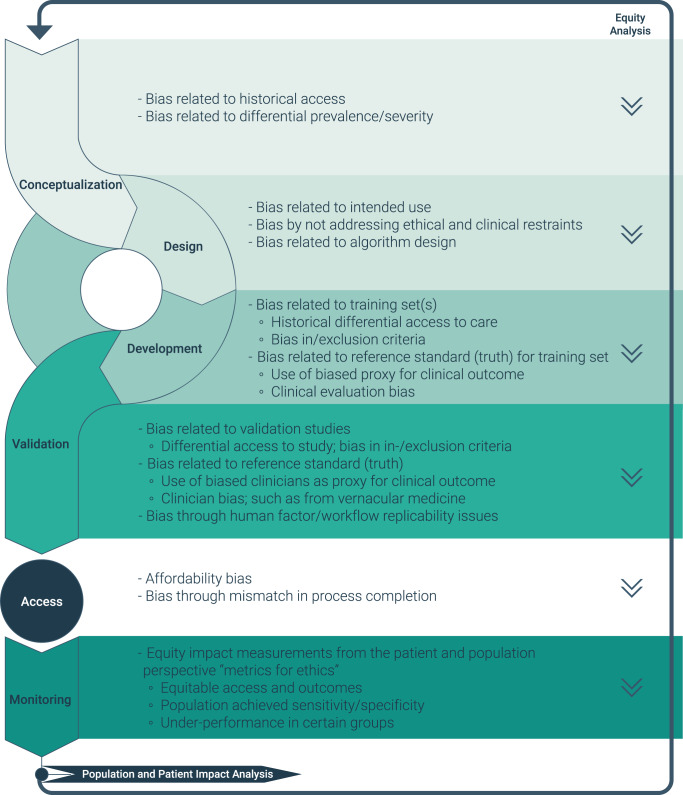
Verification
Claims the paper makes
11 Valid · 0 Not valid · 30 Not checked · 28 Own results and interpretations
The cited sources support only part of this claim — read each source’s verdict below.
In the paper
“Thus, the inherent bias in the algorithm appeared to contribute to worse outcomes for Black patients by influencing the likelihood they would receive the appropriate level of care25.”
§ Considerations for addressing bias in artificial intelligence for health equity > Introduction
What the sources say
- Partly supportedcites [25] Obermeyer Z Powers B Vogeli C Mullainathan S Dissecting racial bias in an algorithm used to manage the health of populations Science 2019 366 447 453 10.1126/science.aax2342 31649194 sourceExperimental — accuracy not yet measured
The paper’s opening summary (p. 2) reports that the algorithm’s racial bias affected which Black patients were identified to receive additional help; correcting it would increase the share of Black patients receiving that help from 17.7% to 46.5%. This supports the claim about likelihood of care, but the cited passages do not establish that the algorithm caused worse clinical outcomes for those patients. (LLM, conf=0.85)
hedgedstates a possible cause- Asserted: passes — The authors put it forward as true.
- Checkable: passes — It can be checked against evidence.
- Load-bearing: passes — The paper’s conclusions depend on it.
- Based: passes — The paper gives a reason why it holds.
- Partly supported
The cited sources support only part of this claim — read each source’s verdict below.
In the paper
“As an example, where there is concern about access to a diagnostic test, population-achieved sensitivity and specificity, which measures the impact of both access and sensitivity, has been proposed as a way to understand the impact of bias on population health, when including so-called invisible populations32.”
§ Considerations for addressing bias in artificial intelligence for health equity > Introduction > Measuring bias in AI systems
What the sources say
- Partly supportedcites [32] Abramoff MD Foundational considerations for artificial intelligence using ophthalmic images Ophthalmology 2022 129 e14 e32 10.1016/j.ophtha.2021.08.023 34478784 PMC9175066 sourceExperimental — accuracy not yet measured
The Equity section of our copy does state that "population-achieved sensitivity, or access-corrected sensitivity, is used to analyze such effects on equity," explicitly combining sensitivity (sc) with compliance/access (c) to give the effective sensitivity at the population level, and frames this around inappropriate bias and health disparities. However, two elements of the claim are absent: our copy only ever defines population-achieved SENSITIVITY (PAS) — there is no "population-achieved specificity" anywhere (searched: population-achieved specificity, access-corrected specificity) — and it never refers to "invisible populations"; the populations it corrects for are the "nonadherent"/differentially-served subgroups defined by race, ethnicity, age, sex and income. So the access-plus-sensitivity framing and the bias/equity-at-population-level purpose are supported, while the specificity extension and the 'invisible populations' qualifier are not. (LLM, conf=0.78)
plain- Asserted: passes — The authors put it forward as true.
- Checkable: passes — It can be checked against evidence.
- Load-bearing: unclear — It is unclear whether the paper’s conclusions depend on it.
- Based: passes — The paper gives a reason why it holds.
- Partly supported
Every source the paper cites for this claim was checked and supports it.
In the paper
“The impact of such differential access can be measured for example through population-achieved sensitivity32 compared to overall sensitivity, i.e., the fraction of correctly identified disease cases in a sample, without regard to representativeness of that sample (or lack thereof).”
§ Considerations for addressing bias in artificial intelligence for health equity > Introduction > Conception phase
What the sources say
- Supportedcites [32] Abramoff MD Foundational considerations for artificial intelligence using ophthalmic images Ophthalmology 2022 129 e14 e32 10.1016/j.ophtha.2021.08.023 34478784 PMC9175066 source
The Equity section (page not provided) says population-achieved sensitivity is used to analyze the effects of access on equity. It contrasts an AI system’s sensitivity among people who receive the examination with the lower effective sensitivity at the population level when access is limited. (LLM, conf=0.93)
plain- Asserted: passes — The authors put it forward as true.
- Checkable: passes — It can be checked against evidence.
- Load-bearing: unclear — It is unclear whether the paper’s conclusions depend on it.
- Based: passes — The paper gives a reason why it holds.
- Supported
The cited sources support only part of this claim — read each source’s verdict below.
In the paper
“As an example, if clinicians are used as the reference standard, their potential bias in their diagnosis may lead to bias in the training data, ultimately persisting as bias in the AI system37.”
§ Considerations for addressing bias in artificial intelligence for health equity > Introduction > Development phase
What the sources say
- Partly supportedcites [37] Sun M Oliwa T Peek ME Tung EL Negative patient descriptors: documenting racial bias in the electronic health record Health Aff. 2022 41 203 211 10.1377/hlthaff.2021.01423 PMC8973827 35044842 sourceExperimental — accuracy not yet measured
The Policy Implications section (page unavailable) says clinicians may introduce biased language into records, and the Limitations section says training-data trends may influence the machine-learning results. The paper does not address clinicians’ diagnoses being used as a reference standard or show diagnostic bias persisting in an AI system. (LLM, conf=0.76)
hedgedstates a possible cause- Asserted: passes — The authors put it forward as true.
- Checkable: passes — It can be checked against evidence.
- Load-bearing: passes — The paper’s conclusions depend on it.
- Based: passes — The paper gives a reason why it holds.
- Partly supported
The cited sources support only part of this claim — read each source’s verdict below.
In the paper
“Thus, such bias reduces the bioethical principle of “Justice,” as Char et al.28 and Abramoff et al.32 described.”
§ Considerations for addressing bias in artificial intelligence for health equity > Introduction > Measuring bias in AI systems
What the sources say
- Partly supportedcites [28] Char DS Abràmoff MD Feudtner C Identifying ethical considerations for machine learning healthcare applications Am. J. Bioeth. 2020 20 7 17 10.1080/15265161.2020.1819469 33103967 PMC7737650 sourceExperimental — accuracy not yet measured
Our copy of Char et al. (2020) extensively treats bias in ML-HCAs as an ethical problem — 'Development: Perpetuation of Bias within Training Data, Risk of Harm due to Group Membership' describes latent biases in training data being 'perpetuated or even amplified' with 'racially discriminatory outcomes' — and the 'Calibration' section names 'equity (that the advantages of the application are shared fairly by all)' as a cardinal design feature, so the substance of the claim (bias as an ethical harm falling along group/fairness lines) is present. However, no passage invokes the bioethical principle of 'Justice' (searched: justice, principlism, standard moral principles, fairness/equity), so the specific attribution that bias 'reduces' that named principle is not stated; indeed the 'Allure of Highly Restricted Focus' section criticises reducing ML-HCA ethics to the single consideration of fairness, and the paper hedges bias effects with 'may'/'possibility', which the citing sentence states as a settled reduction. (LLM, conf=0.70)
- Supportedcites [32] Abramoff MD Foundational considerations for artificial intelligence using ophthalmic images Ophthalmology 2022 129 e14 e32 10.1016/j.ophtha.2021.08.023 34478784 PMC9175066 source
The Equity section (Bioethical Foundation, same section) states that the authors use 'equity' rather than the traditional bioethical term 'justice' for the same concept, defined as freedom from bias or favoritism, so substituting 'Justice' is faithful to this source. The same section asserts that 'Inappropriate bias, increase in health disparities, and thus decreased equity can manifest across the entire AI pipeline,' which is exactly the paraphrased point attributed here (the pipeline-wide account is credited to Char et al, but the bias-to-decreased-equity link is stated by this paper itself). (LLM, conf=0.85)
plainstates a cause- Asserted: passes — The authors put it forward as true.
- Checkable: passes — It can be checked against evidence.
- Load-bearing: unclear — It is unclear whether the paper’s conclusions depend on it.
- Based: passes — The paper gives a reason why it holds.
- Partly supported
18 more claims
Create a free account to see all 69 claims and to verify the 57 references still open.
- It may state two separate claims as one. 20
- Probably not a substantial claim. 35
Claims other papers make about this one
Each is checked against this paper’s own text: does it say what the citing paper says it does?
The source backs part of the claim, not all of it — or backs it for a different population, condition or comparison.
In the citing paper
“While these reviews have made valuable contributions to our understanding of bias in medical AI, they differ in scope, depth, and focus, leaving a gap in understanding how bias permeates the development of AI for clinical decisions.”
From Bias in medical AI: Implications for clinical decision-making (2024) · cites this paper as [20]
Experimental — accuracy not yet measuredThe source backs part of the claim, not all of it — or backs it for a different population, condition or comparison.
In the citing paper
“However, the 100% care-gap closure rate by autonomous AI in this racially and ethnically diverse pediatric population could have the potential to reduce health disparities for vision loss from diabetes, furthering health equity, and deserves further study42,43.”
From Autonomous artificial intelligence increases screening and follow-up for diabetic retinopathy in youth: the ACCESS randomized control trial (2024) · cites this paper as [43]
Experimental — accuracy not yet measuredThe source backs part of the claim, not all of it — or backs it for a different population, condition or comparison.
In the citing paper
“However, the same technology can reproduce or worsen inequity if devices are unavailable, internet connectivity is weak, staff are inadequately trained, costs are shifted to patients, or algorithms perform differently across populations and camera systems (10,(31)(32)(33).”
From From validation to public health impact: implementing equitable AI-enabled diabetic retinopathy screening (2026) · cites this paper as [31]
Experimental — accuracy not yet measuredThe source backs part of the claim, not all of it — or backs it for a different population, condition or comparison.
In the citing paper
“As AI solutions have emerged, a wide variety of governance best practices in the form of frameworks, governance structures, checklists, and guidelines have been proposed7–23.”
From Advancing healthcare AI governance through a comprehensive maturity model based on systematic review (2026) · cites this paper as [7]
Experimental — accuracy not yet measuredThe source backs part of the claim, not all of it — or backs it for a different population, condition or comparison.
In the citing paper
“A recurring theme across multiple articles was the necessity for an overarching governance body7–10,17. This entity would not only assist in selecting AI tools and software for implementation but also guide the validation, implementation, and monitoring processes.”
From Advancing healthcare AI governance through a comprehensive maturity model based on systematic review (2026) · cites this paper as [7]
Experimental — accuracy not yet measured
8 more claims about this paper
Create a free account to see every claim other papers make about this one.
Self-check
Percentages, sums and reported differences re-computed from the paper’s own numbers.
Each contradiction between two passages listed here was confirmed by an independent check.
Rated minor: it would not touch a result — a value no result rests on, a p-value that stays on the same side of the significance level, or a conflict that is clerical, resolved elsewhere in the paper, or outside its own findings.
In the paper
§ Considerations for addressing bias in artificial intelligence for health equity > Introduction > The AI total product lifecycle
“the principles outlined in the International Medical Device Regulators Forum’s (IMDRF)47 Software as a Medical Device Clinical Evaluation”
§ Considerations for addressing bias in artificial intelligence for health equity > References
“47. International Medical Device Regulators Forum - Software as a Medical Device (SaMD) Working Group. “Software as a Medical Device”: Possible Framework for Risk Categorization and Corresponding Considerations.”
Rated minor: it would not touch a result — a value no result rests on, a p-value that stays on the same side of the significance level, or a conflict that is clerical, resolved elsewhere in the paper, or outside its own findings.
In the paper
§ Considerations for addressing bias in artificial intelligence for health equity > Introduction > Development phase
“For considerations around which reference standard to use, see Abramoff et al. 202132”
§ Considerations for addressing bias in artificial intelligence for health equity > References
“32. Abramoff MD Foundational considerations for artificial intelligence using ophthalmic images Ophthalmology 2022 129 e14 e32”
Citations
Cites
Dissecting racial bias in an algorithm used to manage the health of populations
Obermeyer, Z., Powers, B., Vogeli, C., & Mullainathan, S. (2019) · Science · doi:10.1126/science.aax2342 · Cited by 7,137 · cited 3×
“Multiple studies have shown examples of the use of AI in healthcare (not evaluated by regulatory agencies) exacerbating, rather than mitigating, health disparities 24,25 .”
BackgroundSelf-citationInternational Organization for Standardization (ISO)
Nahler, G. (2009) · Dictionary of Pharmaceutical Medicine · doi:10.1007/978-3-211-89836-9_723 · Cited by 3,677
Implementing Machine Learning in Health Care — Addressing Ethical Challenges
Char, D. S., Shah, N. H., & Magnus, D. (2018) · New England Journal of Medicine · doi:10.1056/nejmp1714229 · Cited by 1,857 · cited 1×
“These ethical and other concerns with AI in healthcare have been shown by a number of research studies 27 – 29 .”
BackgroundSelf-citationAbràmoff, M. D., Lavin, P. T., Birch, M., Shah, N., & Folk, J. C. (2018) · npj Digital Medicine · doi:10.1038/s41746-018-0040-6 · Cited by 1,638
Self-citationPotential Biases in Machine Learning Algorithms Using Electronic Health Record Data
Gianfrancesco, M. A., Tamang, S., Yazdany, J., & Schmajuk, G. (2018) · JAMA Internal Medicine · doi:10.1001/jamainternmed.2018.3763 · Cited by 1,395 · cited 1×
“Gianfrancesco et al. similarly limited their analysis to bias derived from characteristics of retrospective training sets derived from existing Electronic Health Record (EHR) data 44 .”
BackgroundEnsuring fairness in machine learning to advance health equity.
Rajkomar, A., Hardt, M., Howell, M. D., Corrado, G., & Chin, M. H. (2018) · Annals of Internal Medicine · doi:10.7326/m18-1990 · Cited by 1,341 · cited 1×
“Thus, AI systems are increasingly in a position to help improve patient and population health outcomes and drive down cost, increase physician job satisfaction, and address health disparities 20,21,3,22,23 .”
BackgroundWhat are Health Disparities and Health Equity? We Need to Be Clear
Braveman, P. (2014) · Public Health Reports® · doi:10.1177/00333549141291s203 · Cited by 860
Inequalities in health: definitions, concepts, and theories
Arcaya, M. C., Arcaya, A. L., & Subramanian, S. V. (2015) · Global Health Action · doi:10.3402/gha.v8.27106 · Cited by 696
Fairness in Machine Learning: A Survey
Caton, S., & Haas, C. (2020) · arXiv · doi:10.48550/arxiv.2010.04053 · Cited by 646 · cited 3×
“More recently, the Foundational Considerations on Algorithmic Interpretation (FPOAI) workgroup of the Collaborative Community on Ophthalmic Imaging published their “ Foundational Considerations ” 32 on AI as a start to developing metrics for ethics , including metrics for “ Equity ” 33 , in order to be able to evaluat…”
BackgroundFairness in machine learning: A survey
Caton, S., & Haas, C. (2024) · ACM Computing Surveys · doi:10.1145/3616865 · Cited by 646 · cited 3×
“More recently, the Foundational Considerations on Algorithmic Interpretation (FPOAI) workgroup of the Collaborative Community on Ophthalmic Imaging published their “ Foundational Considerations ” 32 on AI as a start to developing metrics for ethics , including metrics for “ Equity ” 33 , in order to be able to evaluat…”
Background
Research works printed but not linked: 2
- American Medical Association. Board of trustees policy summary. Augmented Intelligence In Healthcare. https://www.ama-assn.org/system/files/2019-08/ai-2018-board-policy-summary.pdf (2019).
- Chen I Johansson FD Sontag D Why is my classifier discriminatory? arXiv 2018 1805 12002
Cited by
Bias in medical AI: Implications for clinical decision-making
Cross, J. L., Choma, M. A., & Onofrey, J. A. (2024) · PLOS Digital Health · doi:10.1371/journal.pdig.0000651 · Cited by 607
Bias recognition and mitigation strategies in artificial intelligence healthcare applications
Hasanzadeh, F., Josephson, C. B., Waters, G., Adedinsewo, D., Azizi, Z., & White, J. A. (2025) · npj Digital Medicine · doi:10.1038/s41746-025-01503-7 · Cited by 320
“Mitigating Bias in Healthcare AI: A Model Life-cycle Approach Establishing standardized and repeatable approaches for mitigating bias is an expanding societal responsibility for AI-healthcare developers and providers 23 .”
InfluentialEthical and legal considerations in healthcare AI: innovation and policy for safe and fair use
Pham, T. (2025) · Royal Society Open Science · doi:10.1098/rsos.241873 · Cited by 261
A Scoping Review of Reporting Gaps in FDA-Approved AI Medical Devices
Muralidharan, V., Adewale, B. A., Huang, C. J., Nta, M. T., Ademiju, P. O., Pathmarajah, P., Hang, M. K., Adesanya, O., Abdullateef, R. O., Babatunde, A. O., et al. (2024) · npj Digital Medicine · doi:10.1038/s41746-024-01270-x · Cited by 201
Artificial intelligence for personalized nanomedicine; from material selection to patient outcomes
Mazumdar, H., Khondakar, K. R., Das, S., Halder, A., & Kaushik, A. (2025) · Expert Opinion on Drug Delivery · doi:10.1080/17425247.2024.2440618 · Cited by 159
“Furthermore, Abràmoff et al. [204] offered an extended Total Product Lifecycle (TPLC) paradigm for AI/ML in healthcare, outlining the causes and effects of undesired bias in AI/ML systems at each stage, how to assess them with suitable metrics, and how to possibly reduce them.”
Wolf, R. M., Channa, R., Liu, T. Y. A., Zehra, A., Bromberger, L., Patel, D., Ananthakrishnan, A., Brown, E. A., Prichett, L., Lehmann, H. P., et al. (2024) · Nature Communications · doi:10.1038/s41467-023-44676-z · Cited by 159
Self-citationA toolbox for surfacing health equity harms and biases in large language models
Pfohl, S. R., Cole-Lewis, H., Sayres, R., Neal, D., Asiedu, M., Dieng, A., Tomasev, N., Rashid, Q. M., Azizi, S., Rostamzadeh, N., et al. (2024) · Nature Medicine · doi:10.1038/s41591-024-03258-2 · Cited by 113
Ong, J. C. L., Seng, B. J. J., Law, J. Z. F., Low, L. L., Kwa, A. L. H., Giacomini, K. M., & Ting, D. S. W. (2024) · Cell Reports Medicine · doi:10.1016/j.xcrm.2023.101356 · Cited by 111
Generalizability of FDA-Approved AI-Enabled Medical Devices for Clinical Use
Windecker, D., Baj, G., Shiri, I., Kazaj, P. M., Kaesmacher, J., Gräni, C., & Siontis, G. C. M. (2025) · JAMA Network Open · doi:10.1001/jamanetworkopen.2025.8052 · Cited by 143
Ng, J. Y., Cramer, H., Lee, M. S., & Moher, D. (2024) · Integrative Medicine Research · doi:10.1016/j.imr.2024.101024 · Cited by 129
Nadarzynski, T., Knights, N., Husbands, D., Graham, C. A., Llewellyn, C. D., Buchanan, T., Montgomery, I., & Ridge, D. (2024) · PLOS Digital Health · doi:10.1371/journal.pdig.0000492 · Cited by 117
Exploring the potential and limitations of artificial intelligence in animal anatomy
Choudhary, O. P., Infant, S. S., As, V., Chopra, H., & Manuta, N. (2024) · Annals of Anatomy - Anatomischer Anzeiger · doi:10.1016/j.aanat.2024.152366 · Cited by 135
Abramoff, M. D., Whitestone, N., Patnaik, J. L., Rich, E., Ahmed, M., Husain, L., Hassan, M. Y., Tanjil, M. S. H., Weitzman, D., Dai, T., et al. (2023) · npj Digital Medicine · doi:10.1038/s41746-023-00931-7 · Cited by 81
“…ethical framework 23,24 , outperformed physician accuracy to the same prognostic standard in clinical trials 13 , shows no racial or ethnic bias 13,25 as also demonstrated in Hansen et al. 26 , is explainable 12 , is highly effective for outcomes 27 , is supported by all US healthcare…”
BackgroundThe Evolving Regulatory Paradigm of AI in MedTech: A Review of Perspectives and Where We Are Today
Zhou, K., & Gattinger, G. (2024) · Therapeutic Innovation & Regulatory Science · doi:10.1007/s43441-024-00628-3 · Cited by 89
“The pipeline model framework provides a systematic appraisal of the AI model from early development through deployment by working through the sources and impacts of bias on health equity, which will inform stakeholders, including regulators, health-care providers, as well as payors [47, 48].”
MethodEvaluation and mitigation of cognitive biases in medical language models
Schmidgall, S., Harris, C., Essien, I., Olshvang, D., Rahman, T., Kim, J. W., Ziaei, R., Eshraghian, J., Abadir, P., & Chellappa, R. (2024) · npj Digital Medicine · doi:10.1038/s41746-024-01283-6 · Cited by 68
“In clinical settings, the deployment of biased LLMs could lead to systematic errors in diagnosis and treatment recommendations, potentially increasing existing health disparities 23 .”
Artificial intelligence empowering public health education: prospects and challenges
Wang, J., & Li, J. (2024) · Frontiers in Public Health · doi:10.3389/fpubh.2024.1389026 · Cited by 103
“Such approaches not only promote the globalization and personalization of public health education but also ensure fairness and inclusivity in its application (74).”
BackgroundKim, J. Y., Hasan, A., Kellogg, K. C., Ratliff, W., Murray, S. G., Suresh, H., Valladares, A., Shaw, K., Tobey, D., Vidal, D. E., et al. (2024) · PLOS Digital Health · doi:10.1371/journal.pdig.0000390 · Cited by 61
A general framework for governing marketed AI/ML medical devices
Babic, B., Cohen, I. G., Stern, A. D., Li, Y., & Ouellet, M. (2025) · npj Digital Medicine · doi:10.1038/s41746-025-01717-9 · Cited by 78
“Finally,thedevicemayre fl ectbias for certainracial orother groups but perform well across thefull population (an instance of the well-known Simpson ’ s Paradox) 16 .”
Artificial Intelligence Applications in Smart Healthcare: A Survey
Gao, X., He, P., Zhou, Y. X., & Qin, X. (2024) · Future Internet · doi:10.3390/fi16090308 · Cited by 93
Matheny, M. E., Goldsack, J. C., Saria, S., Shah, N. H., Gerhart, J., Cohen, I. G., Price, W. N., Patel, B., Payne, P. R. O., Embí, P. J., et al. (2025) · Health Affairs · doi:10.1377/hlthaff.2024.01003 · Cited by 55
Wearable AI to enhance patient safety and clinical decision-making
Mahajan, A., Heydari, K., & Powell, D. (2025) · npj Digital Medicine · doi:10.1038/s41746-025-01554-w · Cited by 82
Artificial intelligence bias in the prediction and detection of cardiovascular disease
Mihan, A., Pandey, A., & Van Spall, H. G. C. (2024) · npj Cardiovascular Health · doi:10.1038/s44325-024-00031-9 · Cited by 51
“Algorithm access, use, and performance should be monitored after implementation, and the algorithm should be updated with new data if needed 14,31 .”
InfluentialArtificial Intelligence in Cardiovascular Clinical Trials
Cunningham, J. W., Abraham, W. T., Bhatt, A. S., Dunn, J., Felker, G. M., Jain, S. S., Lindsell, C. J., Mace, M., Martyn, T., Shah, R. U., et al. (2024) · Journal of the American College of Cardiology · doi:10.1016/j.jacc.2024.08.069 · Cited by 57
“100 Fourth, the confidentiality of participant medical data must be protected.”
The illusion of safety: A report to the FDA on AI healthcare product approvals
Abulibdeh, R., Celi, L. A., & Sejdić, E. (2025) · PLOS Digital Health · doi:10.1371/journal.pdig.0000866 · Cited by 58
“This can disproportionately harm vulnerable groups like racial minorities, women, or socioeconomically disadvantaged individuals [29–31].”
Generative artificial intelligence: synthetic datasets in dentistry
Umer, F., & Adnan, N. (2024) · BDJ Open · doi:10.1038/s41405-024-00198-4 · Cited by 56
Advancing healthcare AI governance through a comprehensive maturity model based on systematic review
Hussein, R., Zink, A., Ramadan, B., Howard, F. M., Hightower, M., Shah, S., & Beaulieu-Jones, B. K. (2026) · npj Digital Medicine · doi:10.1038/s41746-026-02418-7 · Cited by 96
Establishing organizational AI governance in healthcare: a case study in Canada
Kim, J. Y., Hasan, A., Kueper, J., Tang, T., Hayes, C., Fine, B., Balu, S., & Sendak, M. (2025) · npj Digital Medicine · doi:10.1038/s41746-025-01909-3 · Cited by 42
“However, these frameworks largely emphasize high-level ethical principles 30 – 32 or focus on technical considerations related to algorithm development, implementation, and maintenance 33,34 .”
Towards equitable AI in oncology
Viswanathan, V. S., Parmar, V. V., & Madabhushi, A. (2024) · Nature Reviews Clinical Oncology · doi:10.1038/s41571-024-00909-8 · Cited by 56
“These applications might encompass a wide range of functionalities, including AI-powered diagnostic tools 147 .”
Equity in Digital Mental Health Interventions in the United States: Where to Next?
Robinson, A. H., Flom, M., Forman‐Hoffman, V. L., Histon, T., Levy, M., Darcy, A. M., Ajayi, T., Mohr, D. C., Wicks, P. J., Greene, C. J., et al. (2024) · Journal of Medical Internet Research · doi:10.2196/59939 · Cited by 61
The AI revolution in glaucoma: Bridging challenges with opportunities
Li, F., Wang, D., Yang, Z., Zhang, Y., Jiang, J., Liu, X., Kong, K., Zhou, F., Tham, C. C. Y., Medeiros, F. A., et al. (2024) · Progress in Retinal and Eye Research · doi:10.1016/j.preteyeres.2024.101291 · Cited by 49
Cary, M. P., Gagne, J. C. D., Kauschinger, E. D., & Carter, B. M. (2024) · Creative Nursing · doi:10.1177/10784535241249193 · Cited by 49
“Given the growing presence of AI technologies in health-care settings, ranging from diagnostic tools to patient interaction systems, the risk of exacerbating existing disparities or introducing new biases is heightened (Abràmoff et al., 2023).”
BackgroundHuang, J. J., Channa, R., Wolf, R. M., Dong, Y., Liang, M., Wang, J., Abramoff, M. D., & Liu, T. Y. A. (2024) · npj Digital Medicine · doi:10.1038/s41746-024-01197-3 · Cited by 51
Self-citationAI-READI: rethinking AI data collection, preparation and sharing in diabetes research and beyond
Baxter, S. L., de Sa, V. R., Ferryman, K. S., Jain, P., Lee, C. S., Li‐Pook‐Than, J., Liu, T. Y. A., Owen, J. P., Patel, B. J., Yu, Q., et al. (2024) · Nature Metabolism · doi:10.1038/s42255-024-01165-x · Cited by 68
AI in Context: Harnessing Domain Knowledge for Smarter Machine Learning
Miller, T. I., Durlik, I., Łobodzińska, A., Dorobczyński, L., & Jasionowski, R. (2024) · Applied Sciences · doi:10.3390/app142411612 · Cited by 56
The Ethics of AI in Healthcare: An Updated Mapping Review
Morley, J., & Floridi, L. (2025) · The International Library of Bioethics · doi:10.1007/978-3-031-94690-5_2 · Cited by 45
Hou, Z., Wu, Z., Qu, Z., Gong, L., Peng, H., Jit, M., Larson, H. J., Wu, J. T. K., & Lin, L. K. (2025) · Nature Medicine · doi:10.1038/s41591-025-03618-6 · Cited by 52
“AI technologies could potentiate discriminatory bias and health disparities or instead, foster access to healthcare for underserved populations to mitigate health inequities 48–50 .”
Stroud, A. M., Minteer, S. A., Zhu, X., Ridgeway, J. L., Miller, J. E., & Barry, B. A. (2025) · PLOS Digital Health · doi:10.1371/journal.pdig.0000826 · Cited by 49
El-Sayed, A., Lovat, L. B., & Ahmad, O. F. (2025) · Gastroenterology · doi:10.1053/j.gastro.2025.01.254 · Cited by 47
Abramoff, M. D., Dai, T., & Zou, J. (2024) · NEJM AI · doi:10.1056/aipc2400083 · Cited by 32
Bozeman, J. F., Hollauer, C., Ramshankar, A. T., Nakkasunchi, S., Jambeck, J., Hicks, A., Bilec, M. M., McCauley, D., & Heidrich, O. (2024) · Journal of Industrial Ecology · doi:10.1111/jiec.13509 · Cited by 34
Bucher, A., Chaudhry, B. M., Davis, J. W., Lawrence, K. S., Panza, E. A., Baqer, M., Feinstein, R. T., Fields, S. A., Huberty, J., Kaplan, D. M., et al. (2024) · PLOS Digital Health · doi:10.1371/journal.pdig.0000591 · Cited by 42
Unlocking new frontiers in epilepsy through AI: From seizure prediction to personalized medicine
AbuAlrob, M. A., Itbaisha, A., & Mesraoua, B. (2025) · Epilepsy & Behavior · doi:10.1016/j.yebeh.2025.110327 · Cited by 48
“[57].”
Alhazmi, A. H. J., Islam, S. M. N., & Prokofieva, M. (2025) · International Journal of Financial Studies · doi:10.3390/ijfs13010021 · Cited by 78
Ku, W. L., & Min, H. (2024) · Healthcare · doi:10.3390/healthcare12060625 · Cited by 50
AI in Aesthetic/Cosmetic Dermatology: Current and Future
Thunga, S., Khan, M., Cho, S. I., Na, J., & Yoo, J. Y. (2024) · Journal of Cosmetic Dermatology · doi:10.1111/jocd.16640 · Cited by 32
Patel, J., Hung, C., & Katapally, T. R. (2024) · Psychiatry Research · doi:10.1016/j.psychres.2024.116277 · Cited by 35
“…for mental health symptom prediction because algorithms trained on biased datasets that are not inclusive of marginalized youth will further widen existing inequities in mental health (Timmons et al., 2023, Abr ` amoff et al., 2023), and can potentially cause harm (Favaretto et al., 2019).”
Application of artificial intelligence and digital tools in cancer pathology
Shaktah, L., Carrero, Z. I., Hewitt, K. J., Gustav, M., Cecchini, M. J., Foersch, S., Berezowska, S., & Kather, J. N. (2025) · The Lancet Digital Health · doi:10.1016/j.landig.2025.100933 · Cited by 52
Riley, B. K., & Dixon, A. L. (2024) · Current Opinion in Psychology · doi:10.1016/j.copsyc.2024.101833 · Cited by 44
The future of artificial intelligence: Insights from recent Delphi studies
Alón, I., Haidar, H., Haidar, A., & Guimón, J. (2024) · Futures · doi:10.1016/j.futures.2024.103514 · Cited by 48
Embracing Generative Artificial Intelligence in Clinical Research and Beyond
Foote, H. P., Hong, C., Anwar, M. M., Borentain, M., Bugin, K., Dreyer, N. A., Fessel, J. P., Goyal, N., Hanger, M., Hernandez, A. F., et al. (2025) · JACC Advances · doi:10.1016/j.jacadv.2025.101593 · Cited by 42
Belbase, P., Bhusal, R., Ghimire, S. S., Sharma, S., & Banskota, B. (2024) · Frontiers in Artificial Intelligence · doi:10.3389/frai.2024.1442254 · Cited by 40
Measuring fairness preferences is important for artificial intelligence in health care
Näher, A., Krumpal, I., Antão, E.-M., Ong, E. P., Rojo, M., Kaggwa, F., Balzer, F., Celi, L. A., Braune, K., Wieler, L. H., et al. (2024) · The Lancet Digital Health · doi:10.1016/s2589-7500(24)00059-1 · Cited by 27
Ritoré, Á., Jiménez, C. M., González-Caballero, J. L., Rejón-Parrilla, J. C., Hervás, P., Toro, E., Parra-Calderón, C. L., Celi, L. A., Túnez, I., & de la Hoz, M. Á. A. (2024) · PLOS Digital Health · doi:10.1371/journal.pdig.0000599 · Cited by 27
“Overall, a few approaches and frameworks have been considered to reduce AI bias in healthcare [11–13].”
BackgroundAI in the clinical management of GA: A novel therapeutic universe requires novel tools
Reiter, G. S., Mai, J., Riedl, S., Birner, K., Frank‐Publig, S., Bogunović, H., & Schmidt-Erfurth, U. M. (2024) · Progress in Retinal and Eye Research · doi:10.1016/j.preteyeres.2024.101305 · Cited by 24
Performance of Machine Learning Suicide Risk Models in an American Indian Population
Haroz, E. E., Rebman, P., Goklish, N. A., Garcia, M., Suttle, R., Maggio, D., Clattenburg, E. J., Mega, J., & Adams, R. (2024) · JAMA Network Open · doi:10.1001/jamanetworkopen.2024.39269 · Cited by 27
Reuben, J. S., Meiri, H., & Arien‐Zakay, H. (2024) · Frontiers in Digital Health · doi:10.3389/fdgth.2024.1458811 · Cited by 32
Liu, F., Zhou, H., Wang, K., Yu, Y., Gao, Y., Sun, Z., Liu, S., Sun, S., Zou, Z., Li, Z., et al. (2025) · Cell Reports Medicine · doi:10.1016/j.xcrm.2025.102056 · Cited by 22
AI-driven wearable sensors for postoperative monitoring in surgical patients: A systematic review
Khan, M. M., & Shah, N. (2025) · Computers in Biology and Medicine · doi:10.1016/j.compbiomed.2025.110783 · Cited by 33
Addressing ethical issues in healthcare artificial intelligence using a lifecycle-informed process
Collins, B. X., Bélisle-Pipon, J.-C., Evans, B. J., Ferryman, K., Jiang, X., Nebeker, C., Novak, L., Roberts, K., Were, M., Yin, Z., et al. (2024) · JAMIA Open · doi:10.1093/jamiaopen/ooae108 · Cited by 21
Artificial Intelligence in Communication Sciences and Disorders: Introduction to the Forum
Green, J. R. (2024) · Journal of Speech Language and Hearing Research · doi:10.1044/2024_jslhr-24-00594 · Cited by 25
Artificial intelligence and digital tools for design and execution of cardiovascular clinical trials
Hu, J., Power, J. R., Zannad, F. M., & Lam, C. S. P. (2024) · European Heart Journal · doi:10.1093/eurheartj/ehae794 · Cited by 32
Solaiman, B., Mekki, Y. M., Qadir, J., Ghaly, M. M., Abdelkareem, M. I., & Al-Ansari, A. A. (2025) · npj Digital Medicine · doi:10.1038/s41746-025-01614-1 · Cited by 23
“Other research has outlined similar structures to the Qatar guidelines to reduce biases in the conception, design, development, validation, and monitoring phasesof AI development 29 .”
Moodley, K. (2023) · South African Medical Journal · doi:10.7196/samj.2024.v114i1.1631 · Cited by 33
“[20] Given the historical bias inherent in medical data produced in the clinical environment and via medial research, AI has the potential to amplify such bias.”
Biases in Artificial Intelligence Application in Pain Medicine
Jumreornvong, O., Perez, A., Malave, B., Fatimah, M., Kia, A., & Nwaneshiudu, C. A. (2025) · Journal of Pain Research · doi:10.2147/jpr.s495934 · Cited by 25
Martinson, A. K., Chin, A. T., Butte, M. J., & Rider, N. L. (2024) · The Journal of Allergy and Clinical Immunology In Practice · doi:10.1016/j.jaip.2024.08.012 · Cited by 22
Hirosawa, T., Suzuki, T., Shiraishi, T., Hayashi, A., Fujii, Y., Harada, T., & Shimizu, T. (2024) · International Journal of General Medicine · doi:10.2147/ijgm.s497753 · Cited by 26
Uncovering ethical biases in publicly available fetal ultrasound datasets
Fiorentino, M. C., Moccia, S., Cosmo, M. D., Frontoni, E., Giovanola, B., & Tiribelli, S. (2025) · npj Digital Medicine · doi:10.1038/s41746-025-01739-3 · Cited by 28
Equity by design principles for digital health interventions
Bitomsky, L., Nißen, M., & Kowatsch, T. (2025) · International Journal for Equity in Health · doi:10.1186/s12939-025-02645-6 · Cited by 26
“• Finally, during the evaluation and dissemination , design principles center around following through on health equity promises with stringent monitoring and feedback loops (e.g., [79, 84, 91]) and transparent communication of best practices and learnings from unintended consequences [75, 76].”
Trust and AI in healthcare: a systematic review
Astobiza, A. M., Fernández, M. A., & Lozano, R. O. (2025) · Bioethics News · doi:10.1007/s40592-025-00272-z · Cited by 37
Madadi, Y., Delsoz, M., Khouri, A. S., Boland, M. V., Grzybowski, A. E., & Yousefi, S. (2024) · Current Opinion in Ophthalmology · doi:10.1097/icu.0000000000001035 · Cited by 25
“The ethical implications and the need for substantial investment in infrastructure, training, and maintenance are also major concerns [12].”
Potential application of artificial intelligence in cancer therapy
Riaz, I. B., Khan, M. A., & Haddad, T. C. (2024) · Current Opinion in Oncology · doi:10.1097/cco.0000000000001068 · Cited by 21
Dentistry in the Era of Artificial Intelligence: Medical Behavior and Clinical Responsibility
Sciarra, F. M., Caivano, G., Cacioppo, A., Messina, P., Cumbo, E. M. G., Vita, E. D., & Scardina, G. A. (2025) · Prosthesis · doi:10.3390/prosthesis7040095 · Cited by 21
Artificial intelligence in primary care: innovation at a crossroads
Laranjo, L., Car, L. T., Payne, R. E., Neves, A. L., Kidd, M. R., & Miranda, J. J. (2025) · The Lancet Primary Care · doi:10.1016/j.lanprc.2025.100078 · Cited by 36
Multimodal Wearable Biosensing Meets Multidomain AI: A Pathway to Decentralized Healthcare
Liu, C., Fan, H., Kim, M., Zhou, T., Yang, P., Zhao, L., Wang, Y., Che, Z., Liu, C., Li, B., et al. (2026) · Advanced Science · doi:10.1002/advs.202522900 · Cited by 32
Horsfall, L., Bondaronek, P., Ive, J., & Poduval, S. (2025) · Clinical Epidemiology · doi:10.2147/clep.s527000 · Cited by 18
Levkovich, I. (2025) · Medical Sciences · doi:10.3390/medsci13010008 · Cited by 24
Lammert, J. M., Roberts, A. C., McRae, K., Batterink, L. J., & Butler, B. E. (2025) · Journal of Speech, Language, and Hearing Research · doi:10.1044/2024_jslhr-24-00515 · Cited by 17
Multi-omic profiling in breast cancer: utility for advancing diagnostics and clinical care
Gazzah, E. E., Parker, S., & Pierobon, M. (2025) · Expert Review of Molecular Diagnostics · doi:10.1080/14737159.2025.2482639 · Cited by 14
“AI’s effectiveness depends on the quality and volume of data available, and there are concerns regarding data privacy, algorithm transparency, and potential biases in AI models [193].”
Applying Machine Learning Techniques to Predict Drug-Related Side Effect: A Policy Brief
Toni, E., & Ayatollahi, H. (2025) · INQUIRY The Journal of Health Care Organization Provision and Financing · doi:10.1177/00469580251335805 · Cited by 19
Application of GenAI in Synthetic Data Generation in the Healthcare System
Farhadi, A., & Taheri, A. (2025) · Springer eBooks · doi:10.1007/978-3-031-82963-5_3 · Cited by 20
Jin, K., & Grzybowski, A. E. (2025) · Current Opinion in Ophthalmology · doi:10.1097/icu.0000000000001150 · Cited by 18
“Ensuring that AI systems are transparent, explainable, and free from biases is essential to their acceptance in clinical practice [54].”
Equity360: Gender, Race, and Ethnicity—The Power of AI to Improve or Worsen Health Disparities
O’Connor, M. I. (2024) · Clinical Orthopaedics and Related Research · doi:10.1097/corr.0000000000002986 · Cited by 14
Enhancing neuro-oncology care through equity-driven applications of artificial intelligence
Mehari, M., Sibih, Y., Dada, A., Chang, S. M., Wen, P. Y., Molinaro, A. M., Chukwueke, U. N., Budhu, J. A., Jackson, S., McFaline-Figueroa, J. R., et al. (2024) · Neuro-Oncology · doi:10.1093/neuonc/noae127 · Cited by 15
Gramkow, M. H., Waldemar, G., & Frederiksen, K. S. (2024) · Nature Reviews Neurology · doi:10.1038/s41582-024-01033-y · Cited by 17
“Although a risk of bias exists in AI, digital solutions might also offset cultural bias if these aspects are taken into consideration at the earliest developmental stage 46,47 .”
Mitigation of AI adoption bias through an improved autonomous AI system for diabetic retinal disease
Abràmoff, M. D., Lavin, P. T., Jakubowski, J. R., Blodi, B. A., Keeys, M., Joyce, C., & Folk, J. C. (2024) · npj Digital Medicine · doi:10.1038/s41746-024-01389-x · Cited by 15
“Key in AI validation trials is that the sample and work fl ow are representative of the population the AI will be used in, after FDA clearance, as underlined by our work with US FDA on this subject 21,28 .”
InfluentialSelf-citationCromack, S. C., Lew, A. M., Bazzetta, S. E., Xu, S., & Walter, J. R. (2025) · Journal of Assisted Reproduction and Genetics · doi:10.1007/s10815-024-03382-5 · Cited by 16
“The objectivity of AI is not a foregone conclusion; just as AI is designed to mimic human behaviors, it may also perpetuate societal biases, compromising its ability to improve health outcomes safely and equitably [25, 26].”
Wyatt, K. D., Alexander, N., Hills, G. D., Liang, W. H., Kadauke, S., Volchenboum, S. L., Mian, A., & Phillips, C. (2024) · Pediatric Blood & Cancer · doi:10.1002/pbc.31143 · Cited by 16
Collective action for responsible AI in health
Anderson, B., & Sutherland, E. (2024) · OECD artificial intelligence papers · doi:10.1787/f2050177-en · Cited by 53
Strategies to improve the quality of nurse triage in emergency departments: A systematic review
Ouellet, S., Gallani, M. C. B. J., Fontaine, G., Mercier, É., Lapierre, A., Severino, F., Gélinas, C., & Berube, M. (2025) · International Emergency Nursing · doi:10.1016/j.ienj.2025.101639 · Cited by 26
The state of the art in artificial intelligence and digital pathology in prostate cancer
Ni, H. M., Kouzy, R., Sabbagh, A., Rooney, M. K., Feng, J., Castillo, S. P., Gadoue, S. M., Kouzi, Z. E., Hoffman, K. E., Yuan, Y., et al. (2025) · Nature Reviews Urology · doi:10.1038/s41585-025-01070-2 · Cited by 23
“This phenomenon has been observed in medical and non-medical applications 127–130 .”
Health disparities in neurology
Budhu, J. A., Mejia, N. I., & Saadi, A. (2025) · Nature Reviews Neurology · doi:10.1038/s41582-025-01134-2 · Cited by 13
“Many concerns have been raised about AI, with the general understanding that AI can perpetuate existing disparities and biases owing to flawed training, datasets and the lack of community and under-represented populations in development 226,227 .”
Alibudbud, R. C., Aruta, J. J. B. R., Sison, K. A., & Guinto, R. (2024) · International Review of Psychiatry · doi:10.1080/09540261.2024.2363373 · Cited by 13
“The bioethical principle of ‘Justice’ emphasizes that biases in AI can lead to differential impacts on health outcomes for underrepresented groups, necessitating the development of metrics to quantify and address these biases (Abràmoff et al., 2023).”
Ensign, D., Nisly, S. A., & Pardo, C. O. (2024) · Journal of CME · doi:10.1080/28338073.2024.2437288 · Cited by 16
Reshadi, M. S., & Chehragh, A. M. (2025) · AI & Society · doi:10.1007/s00146-024-02178-6 · Cited by 27
“AI systems may unintentionally contribute to healthcare inequities if they are trained on data that does not fairly reflect various populations (Celi et al. 2022; Abràmoff et al. 2023).”
Using large language models as decision support tools in emergency ophthalmology
Krešo, A., Boban, Z., Kabić, Š., Rada, F., Batistic, D., Barun, I., Znaor, L., Kumrić, M., Božić, J., & Vrdoljak, J. (2025) · International Journal of Medical Informatics · doi:10.1016/j.ijmedinf.2025.105886 · Cited by 16
AI Literacy: Foundations, Importance, and Broader Implications
Asrifan, A., Said, U. M. R., Jakob, J. C., & Wanci, R. (2024) · Advances in educational technologies and instructional design book series · doi:10.4018/979-8-3693-8252-3.ch002 · Cited by 15
Oberije, C., Currie, R., Leaver, A., Redman, A., Teh, W., Sharma, N., Fox, G., Glocker, B., Khara, G. S., Nash, J., et al. (2025) · BMJ Health & Care Informatics · doi:10.1136/bmjhci-2024-101318 · Cited by 17
Advanced AI Applications for Drug Discovery
Yingngam, B., & Sethabouppha, B. (2024) · Advances in medical technologies and clinical practice book series · doi:10.4018/979-8-3693-2333-5.ch003 · Cited by 15
Marshall, N. J., Loades, M. E., Jacobs, C., Biddle, L., & Lambert, J. D. (2025) · Current Treatment Options in Psychiatry · doi:10.1007/s40501-025-00348-x · Cited by 11
Artificial Intelligence Applications in Emergency Toxicology: Advancements and Challenges
Yong, L. P. X., Tung, J. Y. M., Cheung, N. M. T., Lee, Z. Y., Ng, E. Y., Ng, A. J. Y., Lim, C. K. W., Boon, Y., Lim, D. Y. Z., Sng, G. G. R., et al. (2025) · Journal of Medical Internet Research · doi:10.2196/73121 · Cited by 13
“For instance, a model trained predominantly on datasets from urban hospitals may underperform in rural or underserved settings where patterns of poisoning and health care infrastructure differ [35].”
Metadata
- Authors
- Abràmoff, M. D., Tarver, M. E., Loyo-Berrios, N., Trujillo, S., Char, D., Obermeyer, Z., Eydelman, M. B., Foundational Principles of Ophthalmic Imaging and Algorithmic Interpretation Working Group of the Collaborative Community for Ophthalmic Imaging Foundation, W., & Maisel, W. H.
- Affiliations
- University of Iowa (US)
- United States Food and Drug Administration (US)
- Ochin (US)
- Stanford Medicine (US)
- University of California, Berkeley (US)
- Corresponding author
- Abràmoff, Michael D.
- Venue
- npj Digital Medicine
- Published
- 2023-09-12
- Volume
- 6
- Issue
- 1
- Pages
- 170-170
- ISSN
- 2398-6352 (ISSN-L)
- PMC
- PMC10497548
- OpenAlex
- W4386637335
- Semantic Scholar
- 94f7c7f614e9ed688ec3f2d1d193b02c6f0b255a
- Cited by
- 349
- References
- 41
- Citations by year
- 2026: 106 · 2025: 141 · 2024: 98 · 2023: 4
- FWCI
- 13.47
- Type
- journal article
- Language
- en
- Open access
- gold
- doi.org
- Licence
- cc-by
- creativecommons.org/licenses/by/4.0 (tdm)
- creativecommons.org/licenses/by/4.0 (vor)
- Locations
- npj Digital Medicine (publishedVersion, cc-by)
- PubMed Central (publishedVersion, cc-by)
- PubMed (publishedVersion)
- eScholarship (California Digital Library) (submittedVersion, cc-by)
- DOAJ (DOAJ: Directory of Open Access Journals) (submittedVersion, cc-by-sa)
- Topics
- Physical Sciences › Computer Science › Artificial Intelligence › Ethics and Social Impacts of AI
- Health Sciences › Medicine › Health Informatics › Artificial Intelligence in Healthcare and Education
- Health Sciences › Health Professions › Health Information Management › Artificial Intelligence in Healthcare
- Keywords
- algorithmic bias, artificial intelligence in healthcare, health equity, bias mitigation, health disparities, machine learning, digital health technologies, bias metrics
About these checks
Registry, retraction, Cites and statistics results are computed, not judged, with one exception: a printed reference that no index lists is read once by a model before it counts as a citation error. Claims are extracted by a model and kept only when their quote appears verbatim in the text; each cited source is then checked, with a model’s help, for whether it says what the claim relies on. Those verdicts can be wrong — read the claim’s quote and the cited source before relying on one.
The claim verdicts this report counts are experimental: their accuracy is not yet measured.
A language model drew the claims from the paper on 2026-10-05, under version 3 of the claim definition (model deepseek-v4.1-flash, prompt extract-v3).
A second model labelled each claim on 2026-10-05 (model jev-1.13-20260917, definition revision gold-guideline-v0.2).
Cited sources are checked with a language model’s help (gpt-6-sol and qwen3.8-omni-flash).
Statistics and arithmetic are recomputed, not judged.
Confidence bands are shown only for fields calibrated on our annotated test set. None is calibrated yet, so no band is shown.
What counts as a claim ›How we measure confidence ›How we check this ›
Are you an author, or do you see a problem with this page? Request a review
Data sources
Bibliographic data: Semantic Scholar, OpenAlex, Crossref.
Contains information from the Semantic Scholar Academic Graph Datasets, made available under the ODC Attribution License (ODC-BY 1.0).
Semantic Scholar’s data is described in: Kinney, R., et al. (2023). The Semantic Scholar Open Data Platform. arXiv:2301.10140.
