

Considerations for addressing bias in artificial intelligence for health equity
Open accessThe DOI matches its Crossref record; 38 of the 41 references it cites were found in a registry or an index, and 2 are not checked yet; 19 of the 76 sources its claims cite were checked for support.
Abstract
Health equity is a primary goal of healthcare stakeholders: patients and their advocacy groups, clinicians, other providers and their professional societies, bioethicists, payors and value based care organizations, regulatory agencies, legislators, and creators of artificial intelligence/machine learning (AI/ML)-enabled medical devices. Lack of equitable access to diagnosis and treatment may be improved through new digital health technologies, especially AI/ML, but these may also exacerbate disparities, depending on how bias is addressed. We propose an expanded Total Product Lifecycle (TPLC) framework for healthcare AI/ML, describing the sources and impacts of undesirable bias in AI/ML systems in each phase, how these can be analyzed using appropriate metrics, and how they can be potentially mitigated. The goal of these “Considerations” is to educate stakeholders on how potential AI/ML bias may impact healthcare outcomes and how to identify and mitigate inequities; to initiate a discussion between stakeholders on these issues, in order to ensure health equity along the expanded AI/ML TPLC framework, and ultimately, better health outcomes for all.
Verified 2026-10-05 · 2 references not checked yet
Overview
CoChat Summary
TL;DR
The paper proposes expanding the Total Product Lifecycle (TPLC) framework to address bias and health equity across all phases of AI/ML-enabled medical devices. It argues that bias can arise or persist at every phase and should be quantified with equity metrics such as subgroup accuracy disaggregation and population-achieved sensitivity/specificity.
Key findings
- Bias in AI/ML healthcare can exacerbate existing inequities or create new disparities; the paper cites an example where an algorithm intended to identify patients needing extra help actually predicted healthcare costs, resulting in sicker Black patients receiving similar care to healthier White patients despite needing higher acuity care.
- Equity impact can occur at every TPLC phase and is independent across phases: even when bias is mitigated in earlier phases, a later phase can still introduce undesirable equity effects.
- Proposed equity metrics include sensitivity disaggregated by demographic subgroup, differential clinical outcome across subgroups, and population-achieved sensitivity/specificity to measure the impact of access and so-called “invisible populations.”
- Mitigation opportunities include diverse creator teams, racially invariant priors, representative training and validation datasets, diverse clinical sites, and monitoring real-world access, cost, and treatment follow-through.
Methods
- Conceptual/perspective paper with no empirical study, dataset, or statistical analysis; it synthesizes existing literature and regulatory frameworks, including Char et al., FDA’s TPLC approach, IMDRF, and Good Machine Learning Practice.
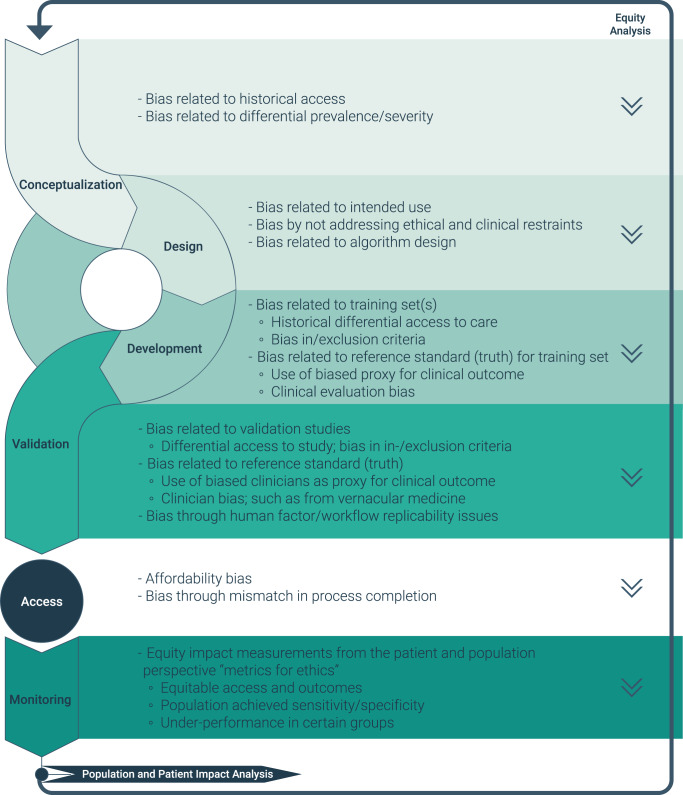
- The authors map TPLC phases—Conception, Design, Development, Validation, Access and marketing, and Monitoring—to sources of bias, equity metrics, and potential mitigation strategies.
- Analysis is narrative and illustrative, using Fig. 1 examples rather than original data collection or quantitative evaluation.
Limitations
- The paper states its framework is not intended to be comprehensive for all bias risks and mitigations and is meant to initiate discussion among stakeholders.
- The paper states it is beyond its scope to exhaustively list metrics for ethics and instead gives examples to illustrate the principle.
- Evident from the text: the proposed expanded TPLC framework is not empirically validated or quantitatively tested in this paper, and it relies on cited examples and conceptual reasoning.
Model-written summary. Check it against the paper before relying on it.
Integrity signals
Registry
Cites
Statistics
Figures
Verification
Claims the paper makes
11 Valid · 0 Not valid · 30 Not checked · 28 Own results and interpretations
The cited sources support only part of this claim — read each source’s verdict below.
In the paper
“Thus, the inherent bias in the algorithm appeared to contribute to worse outcomes for Black patients by influencing the likelihood they would receive the appropriate level of care25.”
§ Considerations for addressing bias in artificial intelligence for health equity > Introduction
What the sources say
- Partly supportedcites [25] Obermeyer Z Powers B Vogeli C Mullainathan S Dissecting racial bias in an algorithm used to manage the health of populations Science 2019 366 447 453 10.1126/science.aax2342 31649194 sourceExperimental — accuracy not yet measured
The paper’s opening summary (p. 2) reports that the algorithm’s racial bias affected which Black patients were identified to receive additional help; correcting it would increase the share of Black patients receiving that help from 17.7% to 46.5%. This supports the claim about likelihood of care, but the cited passages do not establish that the algorithm caused worse clinical outcomes for those patients. (LLM, conf=0.85)
hedgedstates a possible cause- Asserted: passes — The authors put it forward as true.
- Checkable: passes — It can be checked against evidence.
- Load-bearing: passes — The paper’s conclusions depend on it.
- Based: passes — The paper gives a reason why it holds.
- Partly supported
The cited sources support only part of this claim — read each source’s verdict below.
In the paper
“As an example, where there is concern about access to a diagnostic test, population-achieved sensitivity and specificity, which measures the impact of both access and sensitivity, has been proposed as a way to understand the impact of bias on population health, when including so-called invisible populations32.”
§ Considerations for addressing bias in artificial intelligence for health equity > Introduction > Measuring bias in AI systems
What the sources say
- Partly supportedcites [32] Abramoff MD Foundational considerations for artificial intelligence using ophthalmic images Ophthalmology 2022 129 e14 e32 10.1016/j.ophtha.2021.08.023 34478784 PMC9175066 sourceExperimental — accuracy not yet measured
The Equity section of our copy does state that "population-achieved sensitivity, or access-corrected sensitivity, is used to analyze such effects on equity," explicitly combining sensitivity (sc) with compliance/access (c) to give the effective sensitivity at the population level, and frames this around inappropriate bias and health disparities. However, two elements of the claim are absent: our copy only ever defines population-achieved SENSITIVITY (PAS) — there is no "population-achieved specificity" anywhere (searched: population-achieved specificity, access-corrected specificity) — and it never refers to "invisible populations"; the populations it corrects for are the "nonadherent"/differentially-served subgroups defined by race, ethnicity, age, sex and income. So the access-plus-sensitivity framing and the bias/equity-at-population-level purpose are supported, while the specificity extension and the 'invisible populations' qualifier are not. (LLM, conf=0.78)
plain- Asserted: passes — The authors put it forward as true.
- Checkable: passes — It can be checked against evidence.
- Load-bearing: unclear — It is unclear whether the paper’s conclusions depend on it.
- Based: passes — The paper gives a reason why it holds.
- Partly supported
Every source the paper cites for this claim was checked and supports it.
In the paper
“The impact of such differential access can be measured for example through population-achieved sensitivity32 compared to overall sensitivity, i.e., the fraction of correctly identified disease cases in a sample, without regard to representativeness of that sample (or lack thereof).”
§ Considerations for addressing bias in artificial intelligence for health equity > Introduction > Conception phase
What the sources say
- Supportedcites [32] Abramoff MD Foundational considerations for artificial intelligence using ophthalmic images Ophthalmology 2022 129 e14 e32 10.1016/j.ophtha.2021.08.023 34478784 PMC9175066 source
The Equity section (page not provided) says population-achieved sensitivity is used to analyze the effects of access on equity. It contrasts an AI system’s sensitivity among people who receive the examination with the lower effective sensitivity at the population level when access is limited. (LLM, conf=0.93)
plain- Asserted: passes — The authors put it forward as true.
- Checkable: passes — It can be checked against evidence.
- Load-bearing: unclear — It is unclear whether the paper’s conclusions depend on it.
- Based: passes — The paper gives a reason why it holds.
- Supported
The cited sources support only part of this claim — read each source’s verdict below.
In the paper
“As an example, if clinicians are used as the reference standard, their potential bias in their diagnosis may lead to bias in the training data, ultimately persisting as bias in the AI system37.”
§ Considerations for addressing bias in artificial intelligence for health equity > Introduction > Development phase
What the sources say
- Partly supportedcites [37] Sun M Oliwa T Peek ME Tung EL Negative patient descriptors: documenting racial bias in the electronic health record Health Aff. 2022 41 203 211 10.1377/hlthaff.2021.01423 PMC8973827 35044842 sourceExperimental — accuracy not yet measured
The Policy Implications section (page unavailable) says clinicians may introduce biased language into records, and the Limitations section says training-data trends may influence the machine-learning results. The paper does not address clinicians’ diagnoses being used as a reference standard or show diagnostic bias persisting in an AI system. (LLM, conf=0.76)
hedgedstates a possible cause- Asserted: passes — The authors put it forward as true.
- Checkable: passes — It can be checked against evidence.
- Load-bearing: passes — The paper’s conclusions depend on it.
- Based: passes — The paper gives a reason why it holds.
- Partly supported
The cited sources support only part of this claim — read each source’s verdict below.
In the paper
“Thus, such bias reduces the bioethical principle of “Justice,” as Char et al.28 and Abramoff et al.32 described.”
§ Considerations for addressing bias in artificial intelligence for health equity > Introduction > Measuring bias in AI systems
What the sources say
- Partly supportedcites [28] Char DS Abràmoff MD Feudtner C Identifying ethical considerations for machine learning healthcare applications Am. J. Bioeth. 2020 20 7 17 10.1080/15265161.2020.1819469 33103967 PMC7737650 sourceExperimental — accuracy not yet measured
Our copy of Char et al. (2020) extensively treats bias in ML-HCAs as an ethical problem — 'Development: Perpetuation of Bias within Training Data, Risk of Harm due to Group Membership' describes latent biases in training data being 'perpetuated or even amplified' with 'racially discriminatory outcomes' — and the 'Calibration' section names 'equity (that the advantages of the application are shared fairly by all)' as a cardinal design feature, so the substance of the claim (bias as an ethical harm falling along group/fairness lines) is present. However, no passage invokes the bioethical principle of 'Justice' (searched: justice, principlism, standard moral principles, fairness/equity), so the specific attribution that bias 'reduces' that named principle is not stated; indeed the 'Allure of Highly Restricted Focus' section criticises reducing ML-HCA ethics to the single consideration of fairness, and the paper hedges bias effects with 'may'/'possibility', which the citing sentence states as a settled reduction. (LLM, conf=0.70)
- Supportedcites [32] Abramoff MD Foundational considerations for artificial intelligence using ophthalmic images Ophthalmology 2022 129 e14 e32 10.1016/j.ophtha.2021.08.023 34478784 PMC9175066 source
The Equity section (Bioethical Foundation, same section) states that the authors use 'equity' rather than the traditional bioethical term 'justice' for the same concept, defined as freedom from bias or favoritism, so substituting 'Justice' is faithful to this source. The same section asserts that 'Inappropriate bias, increase in health disparities, and thus decreased equity can manifest across the entire AI pipeline,' which is exactly the paraphrased point attributed here (the pipeline-wide account is credited to Char et al, but the bias-to-decreased-equity link is stated by this paper itself). (LLM, conf=0.85)
plainstates a cause- Asserted: passes — The authors put it forward as true.
- Checkable: passes — It can be checked against evidence.
- Load-bearing: unclear — It is unclear whether the paper’s conclusions depend on it.
- Based: passes — The paper gives a reason why it holds.
- Partly supported
18 more claims
Create a free account to see all 69 claims and to verify the 57 references still open.
- It may state two separate claims as one. 20
- Probably not a substantial claim. 35
Claims other papers make about this one
Each is checked against this paper’s own text: does it say what the citing paper says it does?
The source backs part of the claim, not all of it — or backs it for a different population, condition or comparison.
In the citing paper
“While these reviews have made valuable contributions to our understanding of bias in medical AI, they differ in scope, depth, and focus, leaving a gap in understanding how bias permeates the development of AI for clinical decisions.”
From Bias in medical AI: Implications for clinical decision-making (2024) · cites this paper as [20]
Experimental — accuracy not yet measuredThe source backs part of the claim, not all of it — or backs it for a different population, condition or comparison.
In the citing paper
“However, the 100% care-gap closure rate by autonomous AI in this racially and ethnically diverse pediatric population could have the potential to reduce health disparities for vision loss from diabetes, furthering health equity, and deserves further study42,43.”
From Autonomous artificial intelligence increases screening and follow-up for diabetic retinopathy in youth: the ACCESS randomized control trial (2024) · cites this paper as [43]
Experimental — accuracy not yet measuredThe source backs part of the claim, not all of it — or backs it for a different population, condition or comparison.
In the citing paper
“However, the same technology can reproduce or worsen inequity if devices are unavailable, internet connectivity is weak, staff are inadequately trained, costs are shifted to patients, or algorithms perform differently across populations and camera systems (10,(31)(32)(33).”
From From validation to public health impact: implementing equitable AI-enabled diabetic retinopathy screening (2026) · cites this paper as [31]
Experimental — accuracy not yet measuredThe source backs part of the claim, not all of it — or backs it for a different population, condition or comparison.
In the citing paper
“As AI solutions have emerged, a wide variety of governance best practices in the form of frameworks, governance structures, checklists, and guidelines have been proposed7–23.”
From Advancing healthcare AI governance through a comprehensive maturity model based on systematic review (2026) · cites this paper as [7]
Experimental — accuracy not yet measuredThe source backs part of the claim, not all of it — or backs it for a different population, condition or comparison.
In the citing paper
“A recurring theme across multiple articles was the necessity for an overarching governance body7–10,17. This entity would not only assist in selecting AI tools and software for implementation but also guide the validation, implementation, and monitoring processes.”
From Advancing healthcare AI governance through a comprehensive maturity model based on systematic review (2026) · cites this paper as [7]
Experimental — accuracy not yet measured
8 more claims about this paper
Create a free account to see every claim other papers make about this one.
Self-check
Percentages, sums and reported differences re-computed from the paper’s own numbers.
Each contradiction between two passages listed here was confirmed by an independent check.
Rated minor: it would not touch a result — a value no result rests on, a p-value that stays on the same side of the significance level, or a conflict that is clerical, resolved elsewhere in the paper, or outside its own findings.
In the paper
§ Considerations for addressing bias in artificial intelligence for health equity > Introduction > The AI total product lifecycle
“the principles outlined in the International Medical Device Regulators Forum’s (IMDRF)47 Software as a Medical Device Clinical Evaluation”
§ Considerations for addressing bias in artificial intelligence for health equity > References
“47. International Medical Device Regulators Forum - Software as a Medical Device (SaMD) Working Group. “Software as a Medical Device”: Possible Framework for Risk Categorization and Corresponding Considerations.”
Rated minor: it would not touch a result — a value no result rests on, a p-value that stays on the same side of the significance level, or a conflict that is clerical, resolved elsewhere in the paper, or outside its own findings.
In the paper
§ Considerations for addressing bias in artificial intelligence for health equity > Introduction > Development phase
“For considerations around which reference standard to use, see Abramoff et al. 202132”
§ Considerations for addressing bias in artificial intelligence for health equity > References
“32. Abramoff MD Foundational considerations for artificial intelligence using ophthalmic images Ophthalmology 2022 129 e14 e32”
Citations
Cites
Dissecting racial bias in an algorithm used to manage the health of populations
Obermeyer, Z., Powers, B., Vogeli, C., & Mullainathan, S. (2019) · Science · doi:10.1126/science.aax2342 · Cited by 7,137 · cited 3×
“Multiple studies have shown examples of the use of AI in healthcare (not evaluated by regulatory agencies) exacerbating, rather than mitigating, health disparities 24,25 .”
BackgroundSelf-citationInternational Organization for Standardization (ISO)
Nahler, G. (2009) · Dictionary of Pharmaceutical Medicine · doi:10.1007/978-3-211-89836-9_723 · Cited by 3,677
Implementing Machine Learning in Health Care — Addressing Ethical Challenges
Char, D. S., Shah, N. H., & Magnus, D. (2018) · New England Journal of Medicine · doi:10.1056/nejmp1714229 · Cited by 1,857 · cited 1×
“These ethical and other concerns with AI in healthcare have been shown by a number of research studies 27 – 29 .”
BackgroundSelf-citationAbràmoff, M. D., Lavin, P. T., Birch, M., Shah, N., & Folk, J. C. (2018) · npj Digital Medicine · doi:10.1038/s41746-018-0040-6 · Cited by 1,638
Self-citationPotential Biases in Machine Learning Algorithms Using Electronic Health Record Data
Gianfrancesco, M. A., Tamang, S., Yazdany, J., & Schmajuk, G. (2018) · JAMA Internal Medicine · doi:10.1001/jamainternmed.2018.3763 · Cited by 1,395 · cited 1×
“Gianfrancesco et al. similarly limited their analysis to bias derived from characteristics of retrospective training sets derived from existing Electronic Health Record (EHR) data 44 .”
BackgroundEnsuring fairness in machine learning to advance health equity.
Rajkomar, A., Hardt, M., Howell, M. D., Corrado, G., & Chin, M. H. (2018) · Annals of Internal Medicine · doi:10.7326/m18-1990 · Cited by 1,341 · cited 1×
“Thus, AI systems are increasingly in a position to help improve patient and population health outcomes and drive down cost, increase physician job satisfaction, and address health disparities 20,21,3,22,23 .”
BackgroundWhat are Health Disparities and Health Equity? We Need to Be Clear
Braveman, P. (2014) · Public Health Reports® · doi:10.1177/00333549141291s203 · Cited by 860
Inequalities in health: definitions, concepts, and theories
Arcaya, M. C., Arcaya, A. L., & Subramanian, S. V. (2015) · Global Health Action · doi:10.3402/gha.v8.27106 · Cited by 696
Fairness in Machine Learning: A Survey
Caton, S., & Haas, C. (2020) · arXiv · doi:10.48550/arxiv.2010.04053 · Cited by 646 · cited 3×
“More recently, the Foundational Considerations on Algorithmic Interpretation (FPOAI) workgroup of the Collaborative Community on Ophthalmic Imaging published their “ Foundational Considerations ” 32 on AI as a start to developing metrics for ethics , including metrics for “ Equity ” 33 , in order to be able to evaluat…”
BackgroundFairness in machine learning: A survey
Caton, S., & Haas, C. (2024) · ACM Computing Surveys · doi:10.1145/3616865 · Cited by 646 · cited 3×
“More recently, the Foundational Considerations on Algorithmic Interpretation (FPOAI) workgroup of the Collaborative Community on Ophthalmic Imaging published their “ Foundational Considerations ” 32 on AI as a start to developing metrics for ethics , including metrics for “ Equity ” 33 , in order to be able to evaluat…”
Background
Research works printed but not linked: 2
- American Medical Association. Board of trustees policy summary. Augmented Intelligence In Healthcare. https://www.ama-assn.org/system/files/2019-08/ai-2018-board-policy-summary.pdf (2019).
- Chen I Johansson FD Sontag D Why is my classifier discriminatory? arXiv 2018 1805 12002
Cited by
Items 201–300 of 350
A quantitative analysis of global AI medical studies: gaps in randomized controlled trials
Wang, Q., Yang, Y., Qiu, L., Xu, Y., Sun, R., Xue, P., & Qiao, Y. (2026) · npj Digital Medicine · doi:10.1038/s41746-026-02698-z · Cited by 4
“Such regional bias could inadvertently exacerbate existing health disparities if models were not robustly validated in varied clinical contexts 36 – 38 .”
Inclusion of Sex and Gender to Improve the State of the Science in Women’s Health
Temkin, S. M., & Clayton, J. A. (2024) · Journal of Bone and Joint Surgery · doi:10.2106/jbjs.24.00172 · Cited by 2
Ethical aspects of using artificial intelligence in digital and computational pathology
Chauhan, C. (2024) · Elsevier eBooks · doi:10.1016/b978-0-443-13809-6.00016-6 · Cited by 1
Melo, Z. (2024) · Trayectorias Humanas Trascontinentales · doi:10.25965/trahs.6349 · Cited by 4
Preparedness of European pediatric oncologists to integrate AI in the clinical routine
Tozzi, A. E., Ferro, D., Croci, I., Fabozzi, F., & Mastronuzzi, A. (2025) · EJC Paediatric Oncology · doi:10.1016/j.ejcped.2024.100213 · Cited by 1
Shrotriya, S., Banu, N., Kulkarni, A., & Aiyangar, S. (2025) · Journal of the Society for Clinical Data Management · doi:10.47912/jscdm.412 · Cited by 4
Responsible Use of AI: Ethics, Biases, and Fairness
Blades, K. (2025) · Springer eBooks · doi:10.1007/978-3-031-83526-1_10 · Cited by 2
Structural inequalities and chronic disease health outcomes: Impact of AI on health equity
Linde, S., Walker, R. J., Campbell, J. A., & Egede, L. E. (2025) · Elsevier eBooks · doi:10.1016/b978-0-443-23750-8.00029-1 · Cited by 1
Layer by Layer: Assessing AI Diagnostic Accuracy With Incremental Case Information in Neuroradiology
Lotfian, G., Jhaveri, M. D., Dua, S. G., & Suthar, P. P. (2025) · Cureus · doi:10.7759/cureus.85874 · Cited by 2
Enriching patient populations in ICU trials: reducing heterogeneity through machine learning
Oh, W., Veshtaj, M., & Sakhuja, A. (2025) · Current Opinion in Critical Care · doi:10.1097/mcc.0000000000001280 · Cited by 4
Cultural Bias and Linguistic Representation in AI Curriculum Design: Implications for Society 5.0
Usman, N., Kusumanegara, A., Husnaini, H., Said, Y. R., & Ismayanti, D. (2025) · Advances in computational intelligence and robotics book series · doi:10.4018/979-8-3373-1062-6.ch008 · Cited by 3
Characterizing industry payments for FDA-approved AI medical devices
Bergman, A., Patel, T. A., & Shah, K. P. (2025) · Health Affairs Scholar · doi:10.1093/haschl/qxaf211 · Cited by 2
“16,17 Finally, as payment pathways for AIMDs are still being developed, payors could reimburse for devices that have been demonstrated to work effectively across multiple health settings with more diverse populations, creating financial incentives for adoption of high-quality AIMDs.”
O’Connor, S., Gagne, J. C. D., & Hui, V. C. C. (2025) · Nurse Education in Practice · doi:10.1016/j.nepr.2025.104646 · Cited by 2
Ethical considerations in artificial intelligence-powered patient counseling
Patne, A. Y., & Suryawanshic, M. (2025) · Elsevier eBooks · doi:10.1016/b978-0-443-43823-3.00011-x · Cited by 2
Ahmed, H., & Sadka, A. H. (2026) · IEEE Access · doi:10.1109/access.2026.3656396 · Cited by 3
“In healthcare, where existing inequities already affect vulnerable populations, algorithmic bias in AI systems poses serious and potentially life-threatening risks [30], [31].”
Terespolsky, S., Yassi, A., Ehrlich, R. I., Bruton, J., Lockhart, K., Wang, H., Klein, R., Sive, W., Statheros, J., & Spiegel, J. (2026) · Annals of Global Health · doi:10.5334/aogh.5064 · Cited by 2
Closing the AI benefits gap: Systems design for population health equity
Morley, J., & Floridi, L. (2026) · Public Health · doi:10.1016/j.puhe.2026.106205 · Cited by 3
Artificial intelligence in pediatric myopia - a narrative review
Pawar, N., Berendschot, T. T. J. M., Bauer, N. J. C., Ravindran, M., Maheshwari, D., Giap, B. D., & Nallasamy, N. (2026) · Graefe s Archive for Clinical and Experimental Ophthalmology · doi:10.1007/s00417-026-07193-5 · Cited by 2
Impact of Progress of AI on Circular Bioeconomy: Applications, Challenges, and Future Directions
Cao, C. Q., Zhuang, J., Wu, J. J., & Zhou, W. (2026) · Natural resource management and policy · doi:10.1007/978-3-032-07112-5_18 · Cited by 2
Ashrafzadeh, C. M., Bahi, M., Mostafa, A. M. S., Manhaly, M. E., Ghoneim, M., Al-Bayoumy, B., Khamis, E., Mostafa, M., Aziz, H. A., Khaled, N., et al. (2026) · Ophthalmology Science · doi:10.1016/j.xops.2026.101191 · Cited by 1
“11 13 Additionally, the adoption of commercially available AI can be costly and often inaccessible, representing another barrier to equitable AIaMD use.”
Omeljanciuk, A., Peičius, E., Urbonienė, A., & Urbonas, G. (2026) · Healthcare · doi:10.3390/healthcare14121638 · Cited by 2
“Some experts say we should keep checking the AI throughout its life cycle to fix this [68,69].”
Ramezani, A., Bagheri, M., Mahmoudian, F., Fattahi, F., ghahroodi, F. N., Nasirmoghadas, P., Pourzardosht, N., Khalesi, B., Hashemi, Z. S., & Khalili, S. (2026) · Expert Review of Molecular Diagnostics · doi:10.1080/14737159.2026.2706000 · Cited by 1
“Therefore, systematic bias assessment and mitigation are essential for developing trustworthy, equitable, and clinically robust AI systems based on EHR data [171,176].”
Changaris, M., & Niameh, F. V. (2026) · Frontiers in Digital Health · doi:10.3389/fdgth.2026.1761009 · Cited by 1
“AI systems may assist by synthesizing data from EHRs, wearables, patient-reported outcomes, and narrative notes, with NLP helping surface unmet SDOH needs that may not appear in structured fields (14, 80).”
Ethics of Autonomous AI Clinical Trials: Delphi Study
Nichol, A. A., Youssef, A., Larson, D. B., Abràmoff, M. D., Wolf, R. M., Char, D. S., & Martinez‐Martin, N. (2026) · Journal of Medical Internet Research · doi:10.2196/91472 · Cited by 1
Self-citationHopkins, H. S., Bianchi, J., Cevidanes, L., Puntillo, A. M., Tai, M., Goy, R., Hemm, F., Relic, Z., Alvetro, L., Brothers, M., et al. (2026) · American Journal of Orthodontics and Dentofacial Orthopedics · doi:10.1016/j.ajodo.2026.04.008 · Cited by 1
Ruffle, J. K., Mohinta, S., Pombo, G., Biswas, A., Campbell, A. D., Davagnanam, I., Doig, D., Hammam, A., Hyare, H., Jabeen, F., et al. (2026) · The Lancet Medical Imaging & Theranostics · doi:10.1016/j.lanmit.2026.100012 · Cited by 2
Cognitive Bias and Fairness Challenges in AI Consciousness
Ashwini, P., & Padhy, P. C. (2024) · Advances in computational intelligence and robotics book series · doi:10.4018/979-8-3693-2015-0.ch005 · Cited by 2
Next-Generation Medical Devices: Pioneering Healthcare Solutions
Talib, R. B., Abbas, A. K., Mishaal, D. A., Abbas, A. O. O., & Al-Bassam, A. M. S. (2025) · Bright Sky Publications eBooks · doi:10.62906/bs.book.327 · Cited by 1
Senel, B. (2025) · International Journal of Health Services Research and Policy · doi:10.33457/ijhsrp.1649066 · Cited by 1
Pathoor, N. N., Gopal, R. K., & Ganesh, P. S. (2024) · Oral Oncology Reports · doi:10.1016/j.oor.2024.100506 · Cited by 1
Pellegrino, A., & Stasi, A. (2024) · SSRN Electronic Journal · doi:10.2139/ssrn.4881173 · Cited by 1
Chen, J., & Chen, B. (2026) · Frontiers in Public Health · doi:10.3389/fpubh.2026.1976572
Why is Measuring Fairness Preferences Important for AI in Health?Preprint
Näher, A., Krumpal, I., Antão, E.-M., Ong, E. P., Rojo, M., Kaggwa, F., Balzer, F., Celi, L. A., Braune, K., Wieler, L. H., et al. (2023) · SSRN Electronic Journal · doi:10.2139/ssrn.4634163
Carrillo-Larco, R. M. (2024) · Pediatric Cardiology · doi:10.1007/s00246-024-03561-2
Automation of the Analysis of Medical Interviews to Improve Diagnoses Using NLP for Medicine
Probierz, B., & Straś, A. (2024) · Lecture notes in computer science · doi:10.1007/978-981-97-4982-9_10 · Cited by 1
Musunuri, R. L., & Bhatt, A. (2024) · Advances in healthcare information systems and administration book series · doi:10.4018/979-8-3693-8552-4.ch003
Padillah, R. (2024) · Journal of Public Health · doi:10.1093/pubmed/fdae164 · Cited by 2
Aplicação Ética da Inteligência Artificial na Atenção Primária à Saúde
Nascimento, D. C., Pereira, L. F. A., & Silva, D. (2024) · Conferência Latino-Americana de Ética em Inteligência Artificial (LAAI-Ethics) · doi:10.5753/laai-ethics.2024.32466 · Cited by 1
Cunningham, B., & Visaria, R. (2025) · Elsevier eBooks · doi:10.1016/b978-0-443-15728-8.00028-8
Zegers, F. D., Qin, L., Selani, D., Gomon, G., Maarseveen, T. D., Glas, H. K., van Tubergen, A. M., Goekoop-Ruiterman, Y. P. M., Reinders, M. J. T., van den Akker, E. B., et al. (2025) · doi:10.2196/preprints.73887
Balancing Innovation and Safety in Digital Healthcare
Sharma, S., Singh, M. P., & Pradhan, K. B. (2025) · Global Clinical Engineering Journal · doi:10.31354/globalce.v7i1.262
Ethical concerns in healthcare analytics: exploring the complexities of data-driven decision making
Rajak, M. K., & Dey, S. (2025) · Elsevier eBooks · doi:10.1016/b978-0-443-26480-1.00012-6
Boante, L. M., Driver, S., Morelli, D., Lang, T. A., & Segrt, A. (2025) · doi:10.2196/preprints.75436
Implementing Generative AI into Health Systems, Hospitals and Your Practice: Preparing for Change
Urban, H. (2025) · Springer eBooks · doi:10.1007/978-3-031-83526-1_15
The Challenges of Artificial Intelligence in the European Legal Space
Varjú, M., & Sandor, J. M. (2025) · Data science, machine intelligence, and law · doi:10.1007/978-3-031-86813-9_1 · Cited by 1
The Internet of Senses for Healthcare 5.0: Enabling Technologies, Opportunities, and Challenges
Falk, T. H. (2025) · Springer eBooks · doi:10.1007/978-981-96-1437-0_2
Ethical Implications of Predictive Rehabilitation Technologies
Premavathi, T., Kumar, A. Y., Sathvika, G., Palaniappan, D., Parmar, K. J., & Jain, R. (2025) · IGI Global eBooks · doi:10.4018/979-8-3373-0194-5.ch017
Tıp Alanında ChatGPT Kullanımının Etik Açıdan İncelenmesi
Birden, B. (2025) · Mersin Üniversitesi Tıp Fakültesi Lokman Hekim Tıp Tarihi ve Folklorik Tıp Dergisi · doi:10.31020/mutftd.1553518
AI-powered Glaucoma Management: Predicting the Optimal Surgical TreatmentPreprint
Mole, G., Qidwai, U. A., Qidwai, U., Kerr, N. M., Barton, K., & Ratnarajan, G. (2025) · Research Square · doi:10.21203/rs.3.rs-6244012/v1
Putta, M., & Sandbulte, J. (2025) · Lecture notes of the Institute for Computer Sciences, Social Informatics and Telecommunications Engineering · doi:10.1007/978-3-031-95571-6_5 · Cited by 1
Mandating Transparency: A Regulatory Framework for Algorithmic Bias and Opacity
Zhang, K. (2025) · Applied and Computational Engineering · doi:10.54254/2755-2721/2025.po25142
Title: Artificial Intelligence for Healthcare Revenue Cycle Management: The Art of the SciencePreprint
Iloanusi, N.-J. R., & Nweke, A. C. (2025) · doi:10.31124/advance.175393950.04849798/v1
Building trust in digital healthcare: Navigating disinformation, AI, ethics, and legal challenges
Kalina, J. (2025) · Elsevier eBooks · doi:10.1016/b978-0-443-27444-2.00003-4 · Cited by 1
Sisohor, J., Ambegaonkar, J. P., Lindsey, B., Shaul, Y., & Martin, J. R. (2025) · medRxiv · doi:10.1101/2025.08.01.25332763
“Health technology developers and regulators should thus require subgroup validation to ensure objectivity before wide deployment [33,34].”
Gu, W., Xu, H., Gu, T., Li, X., Zhang, P., Liu, B., Li, X., & Yu, Z. (2025) · doi:10.2196/preprints.81058
Gaur, L., & Abraham, A. (2025) · Elsevier eBooks · doi:10.1016/b978-0-443-33124-4.00011-4
Health equity and generative AI: Role, impact, and challenges
Gaur, L., & Abraham, A. (2025) · Elsevier eBooks · doi:10.1016/b978-0-443-33124-4.00006-0
Analysis of AI-Bias in Modern Healthcare Systems
Kumar, A., & Singh, D. (2025) · Transactions on computer systems and networks · doi:10.1007/978-981-96-6703-1_14 · Cited by 1
Making Better Medical Decisions Using Machine Learning: A Bayesian Model
Terán-Bustamante, A., & Martínez-Velasco, A. (2025) · Studies in computational intelligence · doi:10.1007/978-3-031-96328-5_13
Ragab, H., Aydemir, D. G., Cicek, H., Kahl, H., Möhring, L., Striegler, M., de Jong, L. T., Karaagac, H., Adam, G., & Avanesov, M. (2025) · RöFo - Fortschritte auf dem Gebiet der Röntgenstrahlen und der bildgebenden Verfahren · doi:10.1055/a-2704-7577 · Cited by 2
Zheng, Q., Li, M., Zhou, Y., Xu, J., Liu, M., Cui, Y., Wang, J., & Tian, J. H. (2025) · Pediatric Cardiology · doi:10.1007/s00246-025-04102-1
“The risk is that the AI-driven transformation in CHD could inadvertently per-petuate or even exacerbate existing global health disparities [ 27, 28].”
Introduction to Medical Diagnosis
Hirosawa, T. (2025) · Springer eBooks · doi:10.1007/978-981-95-4338-0_1
Novel artificial intelligence model predicts the need for reduction of distal radius fractures
Scioscia, J. P., Fiedler, B., Ghilzai, U. M., Birhiray, D. G., Hauck, J., Chilukuri, S. V., Vemu, R., Morrow, J., & Deveza, L. R. (2025) · European Journal of Orthopaedic Surgery & Traumatology · doi:10.1007/s00590-025-04592-y
Dwivedi, A., Yusufi, R., Derashri, A., Sharma, D., Vinchurkar, K., Patel, D., & Suryawanshi, M. V. (2025) · Elsevier eBooks · doi:10.1016/b978-0-443-43823-3.00012-1
Hosseiniravandi, M., Sheykhotayefeh, M., & Khodaveisi, T. (2025) · مجله دانشگاه علوم پزشکی تربت حیدریه · doi:10.61882/jmsthums.13.3.78
A survey of large language model use in a hospital, research, and teaching campus
Gasparini, L., Phillipson, N., Capurro, D., Rosenberg, R., Buttery, J., Howley, J., Ranganathan, S., Quinlan, C., Selvadurai, N., Wildenauer, M., et al. (2025) · Data & Policy · doi:10.1017/dap.2025.10044 · Cited by 6
“…in confidentiality and privacy, inaccuracies, ‘ hallucinations ’ (generation of content that is not real), medical liability, biases embedded within models and a lack of accountability or transparency in how LLMs make decisions (Abràmoff et al., 2023; Chin et al., 2023; Zaretsky et al., 2024).”
Wilkie, P. Y., Namdar, K., Samsel, K., Pasricha, S. V., Jaiswal, N., Salo, Z., So, M., Panchal, S., Malhotra, A. K., Nashnoush, E., et al. (2025) · FACETS · doi:10.1139/facets-2025-0117 · Cited by 1
Friend, J., Chow, C., Sideman, A. B., Pinheiro‐Chagas, P., Brooks-Smith-Lowe, S., Dulaney, S., Sawyer, R. J., Hess, M., Lum, H. D., Olney, N. T., et al. (2025) · doi:10.2196/preprints.88543
Ethical Considerations in AI-Enabled Healthcare
Aldemir, E., Bloom, C., Honeyman, S. I., & Vardanyan, R. (2026) · Biomedical visualization · doi:10.1007/978-3-032-06520-9_5 · Cited by 1
Ethics and regulation of generative AI in medical device development
Phillips, S., McColl, D., & Duncan, A. (2026) · AI and Ethics · doi:10.1007/s43681-025-00947-7
Cai, C., Zhu, G., Zhou, S., Ng, O., Duell, J., Ho, W. K., Chen, D. M., Lee, B. T. K., Li, F., Liu, S., et al. (2026) · doi:10.2196/preprints.91116
AI in Projectional Radiography
McNally, C. S., Rainey, C., & Szczepura, K. R. (2026) · Springer eBooks · doi:10.1007/978-3-032-05080-9_5
Boyarchuk, O. R. (2025) · Eastern Ukrainian Medical Journal · doi:10.21272/eumj.2025;13(4);993-1004
Harnessing the power of artificial intelligence in diagnostic systems
Dong, J., Woo, D., Wang, Y., & Matiru, R. (2026) · Machine Learning Health · doi:10.1088/3049-477x/ae3aa8
“Proactive bias mitigation strategies, such as adversarial debiasing and diverse dataset curation, are essential to ensure AI tools perform equitably across patient subgroups [8].”
Li, S., Salowe, R., Lee, R., Ying, G., Lee, I., O'Brien, J., & Bastani, O. (2026) · npj Digital Medicine · doi:10.1038/s41746-025-02318-2
“A lack of diversity in training datasets can result in worse performance of the AI model in other populations, limiting generalizability and exacerbating existing healthcare disparities 17 .”
Predictive Analytics in Personalized Medical Care: Early Risk Assessment and Management
Dehankar, P., & Das, S. (2026) · IGI Global eBooks · doi:10.4018/979-8-3373-3531-5.ch012
Tu, X., Shi, C., Qian, P., & Wang, L. (2025) · doi:10.2196/preprints.79922
Mahamadou, A. J. D., Trotsyuk, A. A., Downing, N. L., Char, D. S., & Mello, M. M. (2026) · The American Journal of Bioethics · doi:10.1080/15265161.2025.2608630
“These deployment-focused interventions complement technical debiasing efforts (Abràmoff et al. 2023) and situate algorithmic fairness within the operational workflows of clinical care, where bias emerges not only from algorithms but from the workflow choices that shape their use.”
Self-citationResponsible Use of AI: Ethical Considerations for Marginalized Groups
Scholz, S. (2026) · Springer eBooks · doi:10.1007/978-3-032-16837-5_13
de Laffolie, J., & Weber, A. (2026) · Die Gastroenterologie · doi:10.1007/s11377-026-00969-5
Upadhyaya, P., & Tomar, P. (2025) · International Conference on Artificial Intelligence and Speech Technology (AIST) · doi:10.1109/aist68591.2025.11441629
“…of female-specific clinical features (pregnancy history, menopausal status, autoimmune conditions), federated and multi-site external validation, fairness-aware training objectives, and prospective monitoring — to ensure AI systems help rather than harm women’s cardiovascular health [76] .”
Fast and Precise: AI Medical Devices at the Intersection of Speed and Accuracy
Seth, R., Nagpal, M., Swami, R., & Kaur, M. (2026) · Current Pharmacology Reports · doi:10.1007/s40495-026-00450-5
Deep learning methods for localization, segmentation and robustness in medical imaging
Laousy, O. (2024) · theses.fr (ABES) · doi:10.70675/4ffc4285z667dz430czb4d9za731fb5f4d27 · Cited by 2
Parker, A. G., Vardoulakis, L., & Harrington, C. (2026) · CHI Conference on Human Factors in Computing Systems · doi:10.1145/3772318.3791451 · Cited by 1
Barra, F. L., Jalilian, L., Costa, A., Leuci, L., Rodella, G., & Carenzo, L. (2026) · Simulation in Healthcare The Journal of the Society for Simulation in Healthcare · doi:10.1097/sih.0000000000000933
Calais‐Ferreira, L., Barreto, M. E., & Borschmann, R. (2026) · Journal of Health Equity · doi:10.1080/29944694.2026.2633158
Belmejdoub, N., Rektouti, M., Benkayba, W., Mouniane, Y., Belomaria, M., Ouardi, B. E., Ouaaziz, N. A., Elkhlifi, F., Njili, S., Hmouni, D., et al. (2026) · Advances in computational intelligence and robotics book series · doi:10.4018/979-8-2600-0939-0.ch008
Perspective Chapter: Emerging Technologies and Future Dilemmas
Sun, M. (2026) · Genetics. · doi:10.5772/intechopen.1015218
Clinical AI/ML Model Testing and Validation
Pandey, A., Gupta, P., & Sehgal, N. K. (2026) · Springer eBooks · doi:10.1007/978-3-032-10808-1_6
Zegers, F. D., Qin, L., Selani, D., Gomon, G., Maarseveen, T. D., Glas, H. K., van Tubergen, A. M., Goekoop-Ruiterman, Y. P. M., Reinders, M. J. T., van den Akker, E. B., et al. (2026) · Frontiers in Artificial Intelligence · doi:10.3389/frai.2026.1815241
Ferryman, K. S., & Kane, O. (2026) · Frontiers in Digital Health · doi:10.3389/fdgth.2026.1797705
Enzendorfer, M. L., Reiter, G. S., Bogunović, H., Riedl, S., Mai, J., Schrittwieser, J., Stapf, C., Mares, V., Mihelčič, M., Little, J., et al. (2026) · Eye · doi:10.1038/s41433-026-04487-0
Uca, E., & Sabuncular, G. (2026) · Food and Humanity · doi:10.1016/j.foohum.2026.101226
Esther., V., Aswathy Prakash, G., Thangamayan, S., Valli, A. V., N.UMAMAHESWARI, & Paldano, A. S. (2026) · International Conference on Computing for Sustainable Global Development · doi:10.23919/indiacom70271.2026.11526703
Paul, B. M., Kannan, G., & Thangaraj, P. (2026) · ACS Applied Engineering Materials · doi:10.1021/acsaenm.6c00314
Nayak, K. (2026) · Journal of Public and Clinical Health Research · doi:10.63486/jpchr.26060801
“[17-19] However, these frameworks primarily emphasize assessment, ethical appraisal, implementation guidance, or bias mitigation rather than explicitly theorizing structural inequity as a sequential compounding process across d ata, model, deployment, and governance levels.”
Zhang, E., Jin, Y., Lin, C.-C., Kuo, R. N.-C., & Liao, J. M. (2026) · JMIR Formative Research · doi:10.2196/92726
“Understanding facilitators and barriers is critical, as AI may exacerbate existing health disparities, particularly considering the longstanding inequities in access to imaging and emerging technologies among underserved populations [10,11].”
Guillen-Ramirez, H., Lucas, K. L., Wintsch, Y. M., Blatter, T. U., Triep, K., Endrich, O., & Beldi, G. (2026) · Journal of the American Medical Informatics Association · doi:10.64898/2026.06.15.26355656
Medical AI across Data Regimes to Promote Proactive Health
Li, P., Wu, J., Zuo, Q., Zhang, L., & Zhan, Q. (2026) · Health Data Science · doi:10.34133/hds.0495
From Asana to Algorithm: Reimagining Holistic Wellness Through Yoga-Informed AI
Saha, S., Singh, M. K., Khati, A., & Digra, K. (2026) · Advances in computational intelligence and robotics book series · doi:10.4018/979-8-3373-7625-7.ch006
Metadata
- Authors
- Abràmoff, M. D., Tarver, M. E., Loyo-Berrios, N., Trujillo, S., Char, D., Obermeyer, Z., Eydelman, M. B., Foundational Principles of Ophthalmic Imaging and Algorithmic Interpretation Working Group of the Collaborative Community for Ophthalmic Imaging Foundation, W., & Maisel, W. H.
- Affiliations
- University of Iowa (US)
- United States Food and Drug Administration (US)
- Ochin (US)
- Stanford Medicine (US)
- University of California, Berkeley (US)
- Corresponding author
- Abràmoff, Michael D.
- Venue
- npj Digital Medicine
- Published
- 2023-09-12
- Volume
- 6
- Issue
- 1
- Pages
- 170-170
- ISSN
- 2398-6352 (ISSN-L)
- PMC
- PMC10497548
- OpenAlex
- W4386637335
- Semantic Scholar
- 94f7c7f614e9ed688ec3f2d1d193b02c6f0b255a
- Cited by
- 349
- References
- 41
- Citations by year
- 2026: 106 · 2025: 141 · 2024: 98 · 2023: 4
- FWCI
- 13.47
- Type
- journal article
- Language
- en
- Open access
- gold
- doi.org
- Licence
- cc-by
- creativecommons.org/licenses/by/4.0 (tdm)
- creativecommons.org/licenses/by/4.0 (vor)
- Locations
- npj Digital Medicine (publishedVersion, cc-by)
- PubMed Central (publishedVersion, cc-by)
- PubMed (publishedVersion)
- eScholarship (California Digital Library) (submittedVersion, cc-by)
- DOAJ (DOAJ: Directory of Open Access Journals) (submittedVersion, cc-by-sa)
- Topics
- Physical Sciences › Computer Science › Artificial Intelligence › Ethics and Social Impacts of AI
- Health Sciences › Medicine › Health Informatics › Artificial Intelligence in Healthcare and Education
- Health Sciences › Health Professions › Health Information Management › Artificial Intelligence in Healthcare
- Keywords
- algorithmic bias, artificial intelligence in healthcare, health equity, bias mitigation, health disparities, machine learning, digital health technologies, bias metrics
About these checks
Registry, retraction, Cites and statistics results are computed, not judged, with one exception: a printed reference that no index lists is read once by a model before it counts as a citation error. Claims are extracted by a model and kept only when their quote appears verbatim in the text; each cited source is then checked, with a model’s help, for whether it says what the claim relies on. Those verdicts can be wrong — read the claim’s quote and the cited source before relying on one.
The claim verdicts this report counts are experimental: their accuracy is not yet measured.
A language model drew the claims from the paper on 2026-10-05, under version 3 of the claim definition (model deepseek-v4.1-flash, prompt extract-v3).
A second model labelled each claim on 2026-10-05 (model jev-1.13-20260917, definition revision gold-guideline-v0.2).
Cited sources are checked with a language model’s help (gpt-6-sol and qwen3.8-omni-flash).
Statistics and arithmetic are recomputed, not judged.
Confidence bands are shown only for fields calibrated on our annotated test set. None is calibrated yet, so no band is shown.
What counts as a claim ›How we measure confidence ›How we check this ›
Are you an author, or do you see a problem with this page? Request a review
Data sources
Bibliographic data: Semantic Scholar, OpenAlex, Crossref.
Contains information from the Semantic Scholar Academic Graph Datasets, made available under the ODC Attribution License (ODC-BY 1.0).
Semantic Scholar’s data is described in: Kinney, R., et al. (2023). The Semantic Scholar Open Data Platform. arXiv:2301.10140.
