

A study of generative large language model for medical research and healthcare
Open accessThe DOI matches its Crossref record; 52 of the 52 references it cites were found in a registry or an index.
Abstract
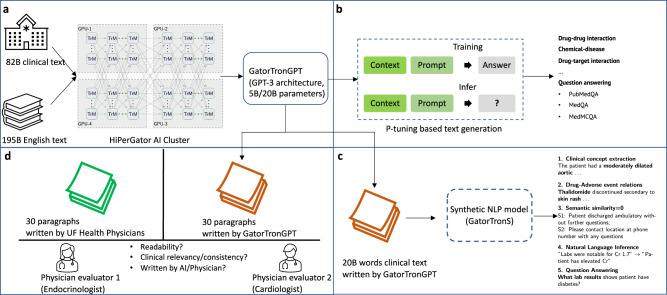
There are enormous enthusiasm and concerns in applying large language models (LLMs) to healthcare. Yet current assumptions are based on general-purpose LLMs such as ChatGPT, which are not developed for medical use. This study develops a generative clinical LLM, GatorTronGPT, using 277 billion words of text including (1) 82 billion words of clinical text from 126 clinical departments and approximately 2 million patients at the University of Florida Health and (2) 195 billion words of diverse general English text. We train GatorTronGPT using a GPT-3 architecture with up to 20 billion parameters and evaluate its utility for biomedical natural language processing (NLP) and healthcare text generation. GatorTronGPT improves biomedical natural language processing. We apply GatorTronGPT to generate 20 billion words of synthetic text. Synthetic NLP models trained using synthetic text generated by GatorTronGPT outperform models trained using real-world clinical text. Physicians’ Turing test using 1 (worst) to 9 (best) scale shows that there are no significant differences in linguistic readability (p = 0.22; 6.57 of GatorTronGPT compared with 6.93 of human) and clinical relevance (p = 0.91; 7.0 of GatorTronGPT compared with 6.97 of human) and that physicians cannot differentiate them (p < 0.001). This study provides insights into the opportunities and challenges of LLMs for medical research and healthcare.
Overview
The claims and statistics of this paper haven’t been checked yet.
Free: it reads the open-access text and checks the first 5 claims that cite a source we can check. Create a free account to check every claim.
Integrity signals
Registry
Cites
Statistics
Figures
Verification
Claims the paper makes
The claims and statistics of this paper haven’t been checked yet.
Free: it reads the open-access text and checks the first 5 claims that cite a source we can check. Create a free account to check every claim.
Claims other papers make about this one
Each is checked against this paper’s own text: does it say what the citing paper says it does?
The source backs part of the claim, not all of it — or backs it for a different population, condition or comparison.
In the citing paper
“As shown in Figure 2A, AI agents possess the capacity to process extensive patient data, including medical histories, diagnostic test results, and imaging, thereby aiding healthcare professionals in making more informed and precise diagnostic decisions.62,63,64,65,66,67,68,69”
From A foundational architecture for AI agents in healthcare (2025) · cites this paper as [62]
Experimental — accuracy not yet measuredThe source backs part of the claim, not all of it — or backs it for a different population, condition or comparison.
In the citing paper
“Large Language Models (LLMs) have attained human-level accuracy on medical question-answer (QA) benchmarks.”
From Limitations of large language models in clinical problem-solving arising from inflexible reasoning (2025) · cites this paper as [5]
Experimental — accuracy not yet measuredThe source backs part of the claim, not all of it — or backs it for a different population, condition or comparison.
In the citing paper
“GatorTronGPT is a domain-adapted clinical generative LLM built on a GPT-3 decoder-only architecture and pretrained on large-scale biomedical and de-identified clinical corpora, making it specifically optimized for healthcare language tasks and was accessed locally via institutional computing infrastructure.”
From A Curated Dataset for Question Answering on Laboratory Test Reference Ranges and Interpretation (2026) · cites this paper as [58]
Experimental — accuracy not yet measuredThe source backs part of the claim, not all of it — or backs it for a different population, condition or comparison.
In the citing paper
“Most LLM studies have depended on human lead semi-quantitative assessment of coherence, comprehensiveness, harmfulness and factual inconsistencies as well as comparing LLM with human based summaries [5, 13, 14].”
From A pilot feasibility study comparing large language models in extracting key information from ICU patient text records from an Irish population (2024) · cites this paper as [14]
Experimental — accuracy not yet measuredThe source backs part of the claim, not all of it — or backs it for a different population, condition or comparison.
In the citing paper
“Most studies applying LLM on clinical notes have been conducted in the US without individual consent, using de-identified data, with only one study from France utilising retrospective MRI reports without identifiable data [5, 6, 13, 14, 17–20].”
From A pilot feasibility study comparing large language models in extracting key information from ICU patient text records from an Irish population (2024) · cites this paper as [14]
Experimental — accuracy not yet measured
1 more claim about this paper
Create a free account to see every claim other papers make about this one.
Self-check
Percentages, sums and reported differences re-computed from the paper’s own numbers.
The self-check needs the paper’s full text.
Citations
Cites
BERT: Pre-training of Deep Bidirectional Transformers for Language Understanding
Devlin, J., Chang, M.-W., Lee, K., & Toutanova, K. (2019) · Proceedings of the 2019 Conference of the North American Chapter of the Association for Computational Linguistics: Human Language Technologies, Volume 1 (Long and Short Papers) · doi:10.18653/v1/n19-1423 · Cited by 54,325
MIMIC-III, a freely accessible critical care database
Johnson, A. E. W., Pollard, T. J., Shen, L., Lehman, L.-W. H., Feng, M., Ghassemi, M., Moody, B., Szolovits, P., Anthony Celi, L., & Mark, R. G. (2016) · Scientific Data · doi:10.1038/sdata.2016.35 · Cited by 8,141 · cited 1×
“We sampled the beginning 15 tokens from all sections of the de-identi fi ed notes from the MIMIC III database 22 and generated approximately 8 million prompts.”
Liu, P., Yuan, W., Fu, J., Jiang, Z., Hayashi, H., & Neubig, G. (2023) · ACM Computing Surveys · doi:10.1145/3560815 · Cited by 4,361 · cited 1×
“Speci fi cally, we adopted a fi xed-LLM prompt-tuning strategy 42 to attach a continuous embedding (i.e., virtue tokens) to the input sequence [ virtual tokens; x; y ] as a soft prompt to control the text generation; the LLM was not changed during training.”
Liu, P., Yuan, W., Fu, J., Jiang, Z., Hayashi, H., & Neubig, G. (2021) · arXiv · doi:10.48550/arxiv.2107.13586 · Cited by 4,352 · cited 1×
“Speci fi cally, we adopted a fi xed-LLM prompt-tuning strategy 42 to attach a continuous embedding (i.e., virtue tokens) to the input sequence [ virtual tokens; x; y ] as a soft prompt to control the text generation; the LLM was not changed during training.”
Training language models to follow instructions with human feedback
Ouyang, L., Wu, J., Jiang, X., Almeida, D., Wainwright, C. L., Mishkin, P., Zhang, C., Agarwal, S., Slama, K., Ray, A., et al. (2022) · arXiv · doi:10.48550/arxiv.2203.02155 · Cited by 4,208 · cited 2×
“Researchers are exploring solutions such as reinforcement learning from human feedback (RLHF) 34 to reduce hallucinations, but it is still a not yet solved limitation of current LLMs. Future studies should explore strategies to better control the hallucinations at a minimal level to ensure the safety of using LLMs in…”
Large language models encode clinical knowledge
Singhal, K., Azizi, S., Tu, T., Mahdavi, S. S., Wei, J., Chung, H. W., Scales, N., Tanwani, A., Cole-Lewis, H., Pfohl, S., et al. (2023) · Nature · doi:10.1038/s41586-023-06291-2 · Cited by 4,083 · cited 5×
“…47 — a biomedical question answering dataset collected from PubMed abstracts, which requires answering questions with ‘ yes/no/maybe ’ ; MedMCQA 48 — a large-scale multi-choice question answering dataset designed to address real world medical entrance exam questions covering 2400 healthcare…”
InfluentialSemantics derived automatically from language corpora contain human-like biases
Caliskan, A., Bryson, J. J., & Narayanan, A. (2017) · Science · doi:10.1126/science.aal4230 · Cited by 2,887 · cited 1×
“Bias inherited from the original training data may be imitated and sometimes even ampli fi ed by AI models, which may cause systematic bias to speci fi c patient groups 36 .”
On the Opportunities and Risks of Foundation Models
Bommasani, R., Hudson, D. A., Adeli, E., Altman, R., Arora, S., von Arx, S., Bernstein, M. S., Bohg, J., Bosselut, A., Brunskill, E., et al. (2021) · arXiv · doi:10.48550/arxiv.2108.07258 · Cited by 2,676 · cited 1×
“It might be still early to judge if LLMs will become the one and only foundation model 12 for NLP, but it looks like we are closer than ever.”
Self-citationGPT-3: Its Nature, Scope, Limits, and Consequences
Floridi, L., & Chiriatti, M. (2020) · Minds and Machines · doi:10.1007/s11023-020-09548-1 · Cited by 2,519 · cited 5×
“We inherited the GPT-3 architecture implemented in the MegaTron-LM 40 and trained GatorTronGPT models from scratch with the default GPT-3 loss function 13 .”
InfluentialPrefix-Tuning: Optimizing Continuous Prompts for Generation
Li, X. L., & Liang, P. (2021) · Proceedings of the 59th Annual Meeting of the Association for Computational Linguistics and the 11th International Joint Conference on Natural Language Processing (Volume 1: Long Papers) · doi:10.18653/v1/2021.acl-long.353 · Cited by 2,473 · cited 1×
“Following previous studies 18,41 , we approached the two tasks using a uni fi ed prompt-based text generation architecture.”
Large language models are zero-shot reasoners
Kojima, T., Gu, S. (., Reid, M., Matsuo, Y., & Iwasawa, Y. (2022) · Advances in Neural Information Processing Systems 35 · doi:10.52202/068431-1613 · Cited by 2,013 · cited 1×
“For example, LLMs can learn knowledge from one task and apply it to another task (i.e., transfer learning), learn from very few labeled samples (i.e., few-shot learning), and learn without human-labeled samples (i.e., zero-shot learning) 11 – 13 .”
Large Language Models are Zero-Shot Reasoners
Kojima, T., Gu, S. S., Reid, M., Matsuo, Y., & Iwasawa, Y. (2022) · arXiv · doi:10.48550/arxiv.2205.11916 · Cited by 2,013
Benefits, Limits, and Risks of GPT-4 as an AI Chatbot for Medicine
Lee, P., Bubeck, S., & Petro, J. (2023) · New England Journal of Medicine · doi:10.1056/nejmsr2214184 · Cited by 1,738 · cited 2×
“Generative large language models (LLMs) such as the ChatGPT 1 have surprised the world by answering questions conversationally and generating textual content such as emails, articles, and even computer codes, triggering enormous enthusiasm in applying LLMs to healthcare 2 – 4 .”
The Curious Case of Neural Text Degeneration
Holtzman, A., Buys, J., Du, L., Forbes, M., & Choi, Y. (2019) · arXiv · doi:10.48550/arxiv.1904.09751 · Cited by 1,304 · cited 1×
“Following previous studies 51 , we approached synthetic clinical text generation using an iterative sampling algorithm and applied top-p (i.e., nucleus sampling) sampling and temperature sampling to balance the diversity and quality of text generation 51 .”
BioGPT: generative pre-trained transformer for biomedical text generation and mining
Luo, R., Sun, L., Xia, Y., Qin, T., Zhang, S., Poon, H., & Liu, T.-Y. (2022) · Briefings in Bioinformatics · doi:10.1093/bib/bbac409 · Cited by 1,150 · cited 6×
“We compared the two GatorTronGPT models with four existing transformer models including GPT-2 43 , REBEL, REBEL-pt 25 , and BioGPT 18 on three biomedical tasks for end-to-end relation extraction using three benchmark datasets including drug-drug interaction 44 (DDI), BioCreative V chemical-disease…”
InfluentialCascella, M., Montomoli, J., Bellini, V., & Bignami, E. (2023) · Journal of Medical Systems · doi:10.1007/s10916-023-01925-4 · Cited by 1,120 · cited 1×
“…facilitate documentation of patient reports (e.g., a progress report) 3,4 , improving diagnostic accuracy 5 , and assisting in various clinical care 6,7 , while at the same time concerning the hallucinations and fabrications 7,8 , bias and stereotype 9 , and risks of patient privacy and ethics 10 .”
Wongpakaran, N., Wongpakaran, T., Wedding, D., & Gwet, K. L. (2013) · BMC Medical Research Methodology · doi:10.1186/1471-2288-13-61 · Cited by 1,041 · cited 1×
“Percent agreement and Gwet ’ s AC 1 were calculated to evaluate interrater reliability 56 .”
Liu, X., Zheng, Y., Du, Z., Ding, M., Qian, Y., Yang, Z., & Tang, J. (2021) · arXiv · doi:10.48550/arxiv.2103.10385 · Cited by 908
Megatron-LM: Training Multi-Billion Parameter Language Models Using Model Parallelism
Shoeybi, M., Patwary, M., Puri, R., LeGresley, P., Casper, J., & Catanzaro, B. (2019) · arXiv · doi:10.48550/arxiv.1909.08053 · Cited by 893
BioCreative V CDR task corpus: a resource for chemical disease relation extraction
Li, J., Sun, Y., Johnson, R. J., Sciaky, D., Wei, C.-H., Leaman, R., Davis, A. P., Mattingly, C. J., Wiegers, T. C., & Lu, Z. (2016) · Database · doi:10.1093/database/baw068 · Cited by 870 · cited 1×
“…models including GPT-2 43 , REBEL, REBEL-pt 25 , and BioGPT 18 on three biomedical tasks for end-to-end relation extraction using three benchmark datasets including drug-drug interaction 44 (DDI), BioCreative V chemical-disease relation 45 (BC5CDR), and drug-target interaction 46 (KD-DTI).”
A large language model for electronic health records
Yang, X., Chen, A., PourNejatian, N., Shin, H. C., Smith, K. E., Parisien, C., Compas, C., Martin, C., Costa, A. B., Flores, M. G., et al. (2022) · npj Digital Medicine · doi:10.1038/s41746-022-00742-2 · Cited by 847 · cited 9×
“Following our previous study 15 , we performed a minimal preprocessing procedure.”
InfluentialSelf-citationChatGPT: the future of discharge summaries?
Patel, S. B., & Lam, K. (2023) · The Lancet Digital Health · doi:10.1016/s2589-7500(23)00021-3 · Cited by 728 · cited 1×
“People are enthusiastic about LLMs in the potential to facilitate documentation of patient reports (e.g., a progress report) 3,4 , improving diagnostic accuracy 5 , and assisting in various clinical care 6,7 , while at the same time concerning the hallucinations and fabrications 7,8 , bias and…”
Jin, D., Pan, E., Oufattole, N., Weng, W.-H., Fang, H., & Szolovits, P. (2021) · Applied Sciences · doi:10.3390/app11146421 · Cited by 718
Jin, D., Pan, E., Oufattole, N., Weng, W.-H., Fang, H., & Szolovits, P. (2021) · doi:10.20944/preprints202105.0498.v1 · Cited by 718
PubMedQA: A Dataset for Biomedical Research Question Answering
Jin, Q., Dhingra, B., Liu, Z., Cohen, W., & Lu, X. (2019) · Proceedings of the 2019 Conference on Empirical Methods in Natural Language Processing and the 9th International Joint Conference on Natural Language Processing (EMNLP-IJCNLP) · doi:10.18653/v1/d19-1259 · Cited by 685 · cited 5×
“We compared GatorTronGPT with six existing transformer models using three widely used benchmark dataset including PubMedQA 47 — a biomedical question answering dataset collected from PubMed abstracts, which requires answering questions with ‘ yes/no/maybe ’ ; MedMCQA 48 — a large-scale multi-choice…”
InfluentialClinicalBERT: Modeling Clinical Notes and Predicting Hospital Readmission
Huang, K., Altosaar, J., & Ranganath, R. (2019) · arXiv · doi:10.48550/arxiv.1904.05342 · Cited by 618
The Pile: An 800GB Dataset of Diverse Text for Language Modeling
Gao, L., Biderman, S., Black, S., Golding, L., Hoppe, T., Foster, C., Phang, J., He, H., Thite, A., Nabeshima, N., et al. (2021) · arXiv · doi:10.48550/arxiv.2101.00027 · Cited by 492 · cited 5×
“We performed minimal preprocessing for the Pile dataset and applied a de-identi fi cation system to remove 18 PHI categories de fi ned in the Health Insurance Portability and Accountability Act (HIPAA) from the UF Health notes.”
InfluentialThe DDI corpus: An annotated corpus with pharmacological substances and drug–drug interactions
Herrero-Zazo, M., Segura-Bedmar, I., Martínez, P., & Declerck, T. (2013) · Journal of Biomedical Informatics · doi:10.1016/j.jbi.2013.07.011 · Cited by 478 · cited 1×
“…models including GPT-2 43 , REBEL, REBEL-pt 25 , and BioGPT 18 on three biomedical tasks for end-to-end relation extraction using three benchmark datasets including drug-drug interaction 44 (DDI), BioCreative V chemical-disease relation 45 (BC5CDR), and drug-target interaction 46 (KD-DTI).”
Evaluating temporal relations in clinical text: 2012 i2b2 Challenge
Sun, W., Rumshisky, A., & Uzuner, O. (2013) · Journal of the American Medical Informatics Association · doi:10.1136/amiajnl-2013-001628 · Cited by 473
Health system-scale language models are all-purpose prediction engines
Jiang, L. Y., Liu, X. C., Nejatian, N. P., Nasir-Moin, M., Wang, D., Abidin, A., Eaton, K., Riina, H. A., Laufer, I., Punjabi, P., et al. (2023) · Nature · doi:10.1038/s41586-023-06160-y · Cited by 460 · cited 2×
“A recent study 32 examined an LLM developed at New York University, i.e., NYUTron, and our previously developed Gator-Tron 15 for prediction of readmission, in-hospital mortality, comorbidity, length of stay, and insurance denial, demonstrating the potential utility of LLMs in healthcare.”
Self-citationPhysician Burnout in the Electronic Health Record Era: Are We Ignoring the Real Cause?
Downing, N. L., Bates, D. W., & Longhurst, C. A. (2018) · Annals of Internal Medicine · doi:10.7326/m18-0139 · Cited by 418
Mohammed, M., Khan, M. B., & Bashier, E. B. M. (2016) · doi:10.1201/9781315371658 · Cited by 389
Using ChatGPT to write patient clinic letters
Ali, S. R., Dobbs, T. D., Hutchings, H. A., & Whitaker, I. S. (2023) · The Lancet Digital Health · doi:10.1016/s2589-7500(23)00048-1 · Cited by 375 · cited 2×
“Generative large language models (LLMs) such as the ChatGPT 1 have surprised the world by answering questions conversationally and generating textual content such as emails, articles, and even computer codes, triggering enormous enthusiasm in applying LLMs to healthcare 2 – 4 .”
Hirosawa, T., Harada, Y., Yokose, M., Sakamoto, T., Kawamura, R., & Shimizu, T. (2023) · International Journal of Environmental Research and Public Health · doi:10.3390/ijerph20043378 · Cited by 343 · cited 1×
“…about LLMs in the potential to facilitate documentation of patient reports (e.g., a progress report) 3,4 , improving diagnostic accuracy 5 , and assisting in various clinical care 6,7 , while at the same time concerning the hallucinations and fabrications 7,8 , bias and stereotype 9 ,…”
Association of Electronic Health Record Design and Use Factors With Clinician Stress and Burnout
Kroth, P. J., Morioka-Douglas, N., Veres, S., Babbott, S., Poplau, S., Qeadan, F., Parshall, C., Corrigan, K., & Linzer, M. (2019) · JAMA Network Open · doi:10.1001/jamanetworkopen.2019.9609 · Cited by 333 · cited 1×
“The evaluation of GatorTronGPT shows that clinical LLMs can be used to generate clinical-relevant content with the potential to help document 3 and code patient information in EHR systems, thus reducing the extensively onerous documentation burden for clinicians 27 – 29 .”
The shaky foundations of large language models and foundation models for electronic health records
Wornow, M., Xu, Y., Thapa, R., Patel, B., Steinberg, E., Fleming, S., Pfeffer, M. A., Fries, J., & Shah, N. H. (2023) · npj Digital Medicine · doi:10.1038/s41746-023-00879-8 · Cited by 324
Large language models and the perils of their hallucinations
Azamfirei, R., Kudchadkar, S. R., & Fackler, J. (2023) · Critical Care · doi:10.1186/s13054-023-04393-x · Cited by 323 · cited 1×
“…facilitate documentation of patient reports (e.g., a progress report) 3,4 , improving diagnostic accuracy 5 , and assisting in various clinical care 6,7 , while at the same time concerning the hallucinations and fabrications 7,8 , bias and stereotype 9 , and risks of patient privacy and ethics 10 .”
Prefix-Tuning: Optimizing Continuous Prompts for Generation
Li, X. L., & Liang, P. (2021) · arXiv · doi:10.48550/arxiv.2101.00190 · Cited by 289
Ethics of large language models in medicine and medical research
Li, H., Moon, J. T., Purkayastha, S., Celi, L. A., Trivedi, H., & Gichoya, J. W. (2023) · The Lancet Digital Health · doi:10.1016/s2589-7500(23)00083-3 · Cited by 286 · cited 1×
“…facilitate documentation of patient reports (e.g., a progress report) 3,4 , improving diagnostic accuracy 5 , and assisting in various clinical care 6,7 , while at the same time concerning the hallucinations and fabrications 7,8 , bias and stereotype 9 , and risks of patient privacy and ethics 10 .”
REBEL: Relation Extraction By End-to-end Language generation
Huguet Cabot, P.-L., & Navigli, R. (2021) · Findings of the Association for Computational Linguistics: EMNLP 2021 · doi:10.18653/v1/2021.findings-emnlp.204 · Cited by 261 · cited 3×
“We compared the two GatorTronGPT models with four existing transformer models including GPT-2 43 , REBEL, REBEL-pt 25 , and BioGPT 18 on three biomedical tasks for end-to-end relation extraction using three benchmark datasets including drug-drug interaction 44 (DDI), BioCreative V chemical-disease relation 45 (BC5CDR)…”
The exciting potential for ChatGPT in obstetrics and gynecology
Grünebaum, A., Chervenak, J., Pollet, S. L., Katz, A., & Chervenak, F. A. (2023) · American Journal of Obstetrics and Gynecology · doi:10.1016/j.ajog.2023.03.009 · Cited by 234 · cited 2×
“We formulate biomedical relation extraction and question answering using a uni fi ed text generation architecture 18 to evaluate how GatorTronGPT could bene fi t medical research using 6 benchmark datasets.”
Evaluation of Text Generation: A Survey
Celikyilmaz, A., Clark, E., & Gao, J. (2020) · arXiv · doi:10.48550/arxiv.2006.14799 · Cited by 207
Artificial Intelligence in mental health and the biases of language based models
Straw, I., & Callison-Burch, C. (2020) · PLOS ONE · doi:10.1371/journal.pone.0240376 · Cited by 164 · cited 1×
“…facilitate documentation of patient reports (e.g., a progress report) 3,4 , improving diagnostic accuracy 5 , and assisting in various clinical care 6,7 , while at the same time concerning the hallucinations and fabrications 7,8 , bias and stereotype 9 , and risks of patient privacy and ethics 10 .”
Medical Documentation Burden Among US Office-Based Physicians in 2019: A National Study
Gaffney, A., Woolhandler, S., Cai, C., Bor, D., Himmelstein, J., McCormick, D., & Himmelstein, D. U. (2022) · JAMA Internal Medicine · doi:10.1001/jamainternmed.2022.0372 · Cited by 118 · cited 1×
“The evaluation of GatorTronGPT shows that clinical LLMs can be used to generate clinical-relevant content with the potential to help document 3 and code patient information in EHR systems, thus reducing the extensively onerous documentation burden for clinicians 27 – 29 .”
Neural Text Generation in Stories Using Entity Representations as Context
Clark, E., Ji, Y., & Smith, N. A. (2018) · Proceedings of the 2018 Conference of the North American Chapter of the Association for Computational Linguistics: Human Language Technologies, Volume 1 (Long Papers) · doi:10.18653/v1/n18-1204 · Cited by 115
A study of deep learning methods for de-identification of clinical notes in cross-institute settings
Yang, X., Lyu, T., Li, Q., Lee, C.-Y., Bian, J., Hogan, W. R., & Wu, Y. (2019) · BMC Medical Informatics and Decision Making · doi:10.1186/s12911-019-0935-4 · Cited by 73 · cited 1×
“Detailed information about the development of the de-identi fi cation system can be accessed from our previous paper 38 .”
Self-citationPRAG: Paninian Retrieval-Augmented Generation for Safety-Critical Medical Question Answering
Jin, D., Pan, E., Oufattole, N., Weng, W., Fang, H., & Peter Szolovits, B. (2020) · arXiv (Cornell University) · doi:10.48550/arxiv.2009.13081 · Cited by 63 · cited 5×
“These datasets have been widely used to evaluate LLMs 18,47 – 49 .”
InfluentialLi, J., Zhou, Y., Jiang, X., Natarajan, K., Pakhomov, S. V., Liu, H., & Xu, H. (2021) · Journal of the American Medical Informatics Association · doi:10.1093/jamia/ocab112 · Cited by 53
An Opinion on ChatGPT in Health Care—Written by Humans Only
Kleesiek, J., Wu, Y., Stiglic, G., Egger, J., & Bian, J. (2023) · Journal of Nuclear Medicine · doi:10.2967/jnumed.123.265687 · Cited by 52 · cited 1×
“Therefore, the current use of ChatGPT for healthcare is more like a typical case of intended use versus actual use as described in the medical device regulation 33 .”
Self-citationClinical concept and relation extraction using prompt-based machine reading comprehension
Cheng, P., Yang, X., Yu, Z., Bian, J., Hogan, W. R., & Wu, Y. (2023) · Journal of the American Medical Informatics Association · doi:10.1093/jamia/ocad107 · Cited by 43 · cited 1×
“…demonstrated in this study, generative LLMs provide a uni fi ed solution using prompt-based text generation 25 , which leads to a new paradigm of “ one model for all NLP tasks ” and has better few-shot learning and transfer learning ability to deliver portable clinical NLP systems 13,26 .”
Self-citationEstimating redundancy in clinical text
Searle, T., Ibrahim, Z. M., Teo, J., & Dobson, R. (2021) · Journal of Biomedical Informatics · doi:10.1016/j.jbi.2021.103938 · Cited by 32
Discovering drug–target interaction knowledge from biomedical literature
Hou, Y., Xia, Y., Wu, L., Xie, S., Fan, Y., Zhu, J., Qin, T., & Liu, T.-Y. (2022) · Bioinformatics · doi:10.1093/bioinformatics/btac648 · Cited by 17
Research works printed but not linked: 3
- Brown T Mann B Ryder N Language models are few-shot learners Adv. Neural Inf. Process. Syst. 2020 33 1877 1901
- Levine, Y., Wies, N., Sharir, O., Bata, H. & Shashua, A. The depth-to-width interplay in self-attention. arXiv [cs.LG] (2020).
- Holtzman, A., Buys, J., Du, L., Forbes, M. & Choi, Y. The curious case of neural text degeneration. arXiv preprintarXiv:1904.09751 (2019).
Cited by
The TRIPOD-LLM reporting guideline for studies using large language models
Gallifant, J., Afshar, M., Ameen, S., Aphinyanaphongs, Y., Chen, S., Cacciamani, G., Demner-Fushman, D., Dligach, D., Daneshjou, R., Fernandes, C., et al. (2025) · Nature Medicine · doi:10.1038/s41591-024-03425-5 · Cited by 615
The application of large language models in medicine: A scoping review
Meng, X., Yan, X., Zhang, K., Liu, D., Cui, X., Yang, Y., Zhang, M., Cao, C., Wang, J., Wang, X., et al. (2024) · iScience · doi:10.1016/j.isci.2024.109713 · Cited by 414
Medical Hallucination in Foundation Models and Their Impact on Healthcare
Kim, Y., Jeong, H., Chen, S., Li, S. S., Park, C., Lu, M., Alhamoud, K., Mun, J., Grau, C., Jung, M., et al. (2025) · medRxiv · doi:10.1101/2025.02.28.25323115 · Cited by 136
PMC-LLaMA: toward building open-source language models for medicine
Wu, C., Lin, W., Zhang, X., Zhang, Y., Xie, W., & Wang, Y. (2024) · Journal of the American Medical Informatics Association · doi:10.1093/jamia/ocae045 · Cited by 300
Self-citationAutonomous biomedical research with an artificial intelligence agent
Huang, K., Zhang, S., Wang, H., Qu, Y., Lu, Y., Li, R., Roohani, Y., Qiu, L., Cao, S., Li, G. L., et al. (2026) · Science · doi:10.1126/science.adz4351 · Cited by 364
Metadata
- Authors
- Peng, C., Yang, X., Chen, A., Smith, K. E., PourNejatian, N., Costa, A. B., Martin, C., Flores, M. G., Zhang, Y., Magoc, T., Lipori, G., Mitchell, D. A., Ospina, N. S., Ahmed, M. M., Hogan, W. R., Shenkman, E. A., Guo, Y., Bian, J., & Wu, Y.
- Affiliations
- University of Florida (US)
- Nvidia (United States) (US)
- University of Florida Health (US)
- Corresponding author
- Wu, Yonghui
- ORCID
- Venue
- npj Digital Medicine
- Published
- 2023-11-16
- Volume
- 6
- Issue
- 1
- Pages
- 210-210
- ISSN
- 2398-6352 (ISSN-L)
- PMC
- PMC10654385
- OpenAlex
- W4388725043
- Semantic Scholar
- e154dd91de91558f9d671370754eace62a54c911
- Cited by
- 408
- References
- 37
- Citations by year
- 2026: 95 · 2025: 182 · 2024: 124 · 2023: 7
- FWCI
- 16.25
- Type
- journal article
- Language
- en
- Open access
- gold
- doi.org
- Licence
- cc-by
- creativecommons.org/licenses/by/4.0 (tdm)
- creativecommons.org/licenses/by/4.0 (vor)
- Locations
- npj Digital Medicine (publishedVersion, cc-by)
- PubMed Central (publishedVersion, cc-by)
- PubMed (publishedVersion)
- arXiv (Cornell University) (submittedVersion)
- DOAJ (DOAJ: Directory of Open Access Journals) (submittedVersion, cc-by-sa)
- arXiv (Cornell University)
- Funders
- Patient-Centered Outcomes Research Institute (ME-2018C3-14754)
- U.S. Department of Health & Human Services | NIH | National Cancer Institute (R56AG069880, 1R01CA246418)
- Topics
- Health Sciences › Medicine › Health Informatics › Artificial Intelligence in Healthcare and Education
- Physical Sciences › Computer Science › Artificial Intelligence › Topic Modeling
- Physical Sciences › Computer Science › Artificial Intelligence › Machine Learning in Healthcare
- Keywords
- generative large language models, clinical language models, biomedical natural language processing, GPT-3, medical research applications
About these checks
Registry, retraction, Cites and statistics results are computed, not judged, with one exception: a printed reference that no index lists is read once by a model before it counts as a citation error. Claims are extracted by a model and kept only when their quote appears verbatim in the text; each cited source is then checked, with a model’s help, for whether it says what the claim relies on. Those verdicts can be wrong — read the claim’s quote and the cited source before relying on one.
Statistics and arithmetic are recomputed, not judged.
Confidence bands are shown only for fields calibrated on our annotated test set. None is calibrated yet, so no band is shown.
What counts as a claim ›How we measure confidence ›How we check this ›
Are you an author, or do you see a problem with this page? Request a review
Data sources
Bibliographic data: Semantic Scholar, OpenAlex, Crossref.
Contains information from the Semantic Scholar Academic Graph Datasets, made available under the ODC Attribution License (ODC-BY 1.0).
Semantic Scholar’s data is described in: Kinney, R., et al. (2023). The Semantic Scholar Open Data Platform. arXiv:2301.10140.
