

A study of generative large language model for medical research and healthcare
Open accessThe DOI matches its Crossref record; 52 of the 52 references it cites were found in a registry or an index.
Abstract
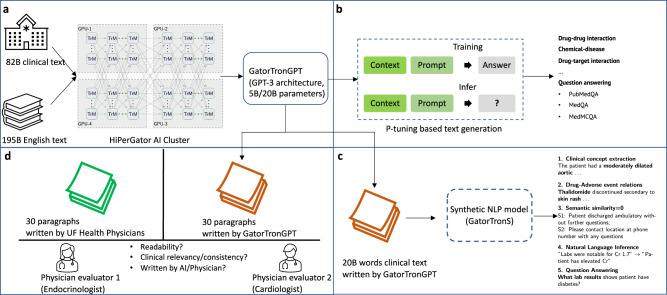
There are enormous enthusiasm and concerns in applying large language models (LLMs) to healthcare. Yet current assumptions are based on general-purpose LLMs such as ChatGPT, which are not developed for medical use. This study develops a generative clinical LLM, GatorTronGPT, using 277 billion words of text including (1) 82 billion words of clinical text from 126 clinical departments and approximately 2 million patients at the University of Florida Health and (2) 195 billion words of diverse general English text. We train GatorTronGPT using a GPT-3 architecture with up to 20 billion parameters and evaluate its utility for biomedical natural language processing (NLP) and healthcare text generation. GatorTronGPT improves biomedical natural language processing. We apply GatorTronGPT to generate 20 billion words of synthetic text. Synthetic NLP models trained using synthetic text generated by GatorTronGPT outperform models trained using real-world clinical text. Physicians’ Turing test using 1 (worst) to 9 (best) scale shows that there are no significant differences in linguistic readability (p = 0.22; 6.57 of GatorTronGPT compared with 6.93 of human) and clinical relevance (p = 0.91; 7.0 of GatorTronGPT compared with 6.97 of human) and that physicians cannot differentiate them (p < 0.001). This study provides insights into the opportunities and challenges of LLMs for medical research and healthcare.
Overview
The claims and statistics of this paper haven’t been checked yet.
Free: it reads the open-access text and checks the first 5 claims that cite a source we can check. Create a free account to check every claim.
Integrity signals
Registry
Cites
Statistics
Figures
Verification
Claims the paper makes
The claims and statistics of this paper haven’t been checked yet.
Free: it reads the open-access text and checks the first 5 claims that cite a source we can check. Create a free account to check every claim.
Claims other papers make about this one
Each is checked against this paper’s own text: does it say what the citing paper says it does?
The source backs part of the claim, not all of it — or backs it for a different population, condition or comparison.
In the citing paper
“As shown in Figure 2A, AI agents possess the capacity to process extensive patient data, including medical histories, diagnostic test results, and imaging, thereby aiding healthcare professionals in making more informed and precise diagnostic decisions.62,63,64,65,66,67,68,69”
From A foundational architecture for AI agents in healthcare (2025) · cites this paper as [62]
Experimental — accuracy not yet measuredThe source backs part of the claim, not all of it — or backs it for a different population, condition or comparison.
In the citing paper
“Large Language Models (LLMs) have attained human-level accuracy on medical question-answer (QA) benchmarks.”
From Limitations of large language models in clinical problem-solving arising from inflexible reasoning (2025) · cites this paper as [5]
Experimental — accuracy not yet measuredThe source backs part of the claim, not all of it — or backs it for a different population, condition or comparison.
In the citing paper
“GatorTronGPT is a domain-adapted clinical generative LLM built on a GPT-3 decoder-only architecture and pretrained on large-scale biomedical and de-identified clinical corpora, making it specifically optimized for healthcare language tasks and was accessed locally via institutional computing infrastructure.”
From A Curated Dataset for Question Answering on Laboratory Test Reference Ranges and Interpretation (2026) · cites this paper as [58]
Experimental — accuracy not yet measuredThe source backs part of the claim, not all of it — or backs it for a different population, condition or comparison.
In the citing paper
“Most LLM studies have depended on human lead semi-quantitative assessment of coherence, comprehensiveness, harmfulness and factual inconsistencies as well as comparing LLM with human based summaries [5, 13, 14].”
From A pilot feasibility study comparing large language models in extracting key information from ICU patient text records from an Irish population (2024) · cites this paper as [14]
Experimental — accuracy not yet measuredThe source backs part of the claim, not all of it — or backs it for a different population, condition or comparison.
In the citing paper
“Most studies applying LLM on clinical notes have been conducted in the US without individual consent, using de-identified data, with only one study from France utilising retrospective MRI reports without identifiable data [5, 6, 13, 14, 17–20].”
From A pilot feasibility study comparing large language models in extracting key information from ICU patient text records from an Irish population (2024) · cites this paper as [14]
Experimental — accuracy not yet measured
1 more claim about this paper
Create a free account to see every claim other papers make about this one.
Self-check
Percentages, sums and reported differences re-computed from the paper’s own numbers.
The self-check needs the paper’s full text.
Citations
Cites
BERT: Pre-training of Deep Bidirectional Transformers for Language Understanding
Devlin, J., Chang, M.-W., Lee, K., & Toutanova, K. (2019) · Proceedings of the 2019 Conference of the North American Chapter of the Association for Computational Linguistics: Human Language Technologies, Volume 1 (Long and Short Papers) · doi:10.18653/v1/n19-1423 · Cited by 54,325
MIMIC-III, a freely accessible critical care database
Johnson, A. E. W., Pollard, T. J., Shen, L., Lehman, L.-W. H., Feng, M., Ghassemi, M., Moody, B., Szolovits, P., Anthony Celi, L., & Mark, R. G. (2016) · Scientific Data · doi:10.1038/sdata.2016.35 · Cited by 8,141 · cited 1×
“We sampled the beginning 15 tokens from all sections of the de-identi fi ed notes from the MIMIC III database 22 and generated approximately 8 million prompts.”
Liu, P., Yuan, W., Fu, J., Jiang, Z., Hayashi, H., & Neubig, G. (2023) · ACM Computing Surveys · doi:10.1145/3560815 · Cited by 4,361 · cited 1×
“Speci fi cally, we adopted a fi xed-LLM prompt-tuning strategy 42 to attach a continuous embedding (i.e., virtue tokens) to the input sequence [ virtual tokens; x; y ] as a soft prompt to control the text generation; the LLM was not changed during training.”
Liu, P., Yuan, W., Fu, J., Jiang, Z., Hayashi, H., & Neubig, G. (2021) · arXiv · doi:10.48550/arxiv.2107.13586 · Cited by 4,352 · cited 1×
“Speci fi cally, we adopted a fi xed-LLM prompt-tuning strategy 42 to attach a continuous embedding (i.e., virtue tokens) to the input sequence [ virtual tokens; x; y ] as a soft prompt to control the text generation; the LLM was not changed during training.”
Training language models to follow instructions with human feedback
Ouyang, L., Wu, J., Jiang, X., Almeida, D., Wainwright, C. L., Mishkin, P., Zhang, C., Agarwal, S., Slama, K., Ray, A., et al. (2022) · arXiv · doi:10.48550/arxiv.2203.02155 · Cited by 4,208 · cited 2×
“Researchers are exploring solutions such as reinforcement learning from human feedback (RLHF) 34 to reduce hallucinations, but it is still a not yet solved limitation of current LLMs. Future studies should explore strategies to better control the hallucinations at a minimal level to ensure the safety of using LLMs in…”
Large language models encode clinical knowledge
Singhal, K., Azizi, S., Tu, T., Mahdavi, S. S., Wei, J., Chung, H. W., Scales, N., Tanwani, A., Cole-Lewis, H., Pfohl, S., et al. (2023) · Nature · doi:10.1038/s41586-023-06291-2 · Cited by 4,083 · cited 5×
“…47 — a biomedical question answering dataset collected from PubMed abstracts, which requires answering questions with ‘ yes/no/maybe ’ ; MedMCQA 48 — a large-scale multi-choice question answering dataset designed to address real world medical entrance exam questions covering 2400 healthcare…”
InfluentialSemantics derived automatically from language corpora contain human-like biases
Caliskan, A., Bryson, J. J., & Narayanan, A. (2017) · Science · doi:10.1126/science.aal4230 · Cited by 2,887 · cited 1×
“Bias inherited from the original training data may be imitated and sometimes even ampli fi ed by AI models, which may cause systematic bias to speci fi c patient groups 36 .”
On the Opportunities and Risks of Foundation Models
Bommasani, R., Hudson, D. A., Adeli, E., Altman, R., Arora, S., von Arx, S., Bernstein, M. S., Bohg, J., Bosselut, A., Brunskill, E., et al. (2021) · arXiv · doi:10.48550/arxiv.2108.07258 · Cited by 2,676 · cited 1×
“It might be still early to judge if LLMs will become the one and only foundation model 12 for NLP, but it looks like we are closer than ever.”
Self-citationGPT-3: Its Nature, Scope, Limits, and Consequences
Floridi, L., & Chiriatti, M. (2020) · Minds and Machines · doi:10.1007/s11023-020-09548-1 · Cited by 2,519 · cited 5×
“We inherited the GPT-3 architecture implemented in the MegaTron-LM 40 and trained GatorTronGPT models from scratch with the default GPT-3 loss function 13 .”
InfluentialPrefix-Tuning: Optimizing Continuous Prompts for Generation
Li, X. L., & Liang, P. (2021) · Proceedings of the 59th Annual Meeting of the Association for Computational Linguistics and the 11th International Joint Conference on Natural Language Processing (Volume 1: Long Papers) · doi:10.18653/v1/2021.acl-long.353 · Cited by 2,473 · cited 1×
“Following previous studies 18,41 , we approached the two tasks using a uni fi ed prompt-based text generation architecture.”
Research works printed but not linked: 3
- Brown T Mann B Ryder N Language models are few-shot learners Adv. Neural Inf. Process. Syst. 2020 33 1877 1901
- Levine, Y., Wies, N., Sharir, O., Bata, H. & Shashua, A. The depth-to-width interplay in self-attention. arXiv [cs.LG] (2020).
- Holtzman, A., Buys, J., Du, L., Forbes, M. & Choi, Y. The curious case of neural text degeneration. arXiv preprintarXiv:1904.09751 (2019).
Cited by
The TRIPOD-LLM reporting guideline for studies using large language models
Gallifant, J., Afshar, M., Ameen, S., Aphinyanaphongs, Y., Chen, S., Cacciamani, G., Demner-Fushman, D., Dligach, D., Daneshjou, R., Fernandes, C., et al. (2025) · Nature Medicine · doi:10.1038/s41591-024-03425-5 · Cited by 615
The application of large language models in medicine: A scoping review
Meng, X., Yan, X., Zhang, K., Liu, D., Cui, X., Yang, Y., Zhang, M., Cao, C., Wang, J., Wang, X., et al. (2024) · iScience · doi:10.1016/j.isci.2024.109713 · Cited by 414
Medical Hallucination in Foundation Models and Their Impact on Healthcare
Kim, Y., Jeong, H., Chen, S., Li, S. S., Park, C., Lu, M., Alhamoud, K., Mun, J., Grau, C., Jung, M., et al. (2025) · medRxiv · doi:10.1101/2025.02.28.25323115 · Cited by 136
PMC-LLaMA: toward building open-source language models for medicine
Wu, C., Lin, W., Zhang, X., Zhang, Y., Xie, W., & Wang, Y. (2024) · Journal of the American Medical Informatics Association · doi:10.1093/jamia/ocae045 · Cited by 300
Self-citationAutonomous biomedical research with an artificial intelligence agent
Huang, K., Zhang, S., Wang, H., Qu, Y., Lu, Y., Li, R., Roohani, Y., Qiu, L., Cao, S., Li, G. L., et al. (2026) · Science · doi:10.1126/science.adz4351 · Cited by 364
A Survey of Large Language Models in Medicine: Progress, Application, and Challenge
Zhou, H., Liu, F., Gu, B., Zou, X., Huang, J., Wu, J., Li, Y., Chen, S. S., Zhou, P., Liu, J., et al. (2023) · arXiv · doi:10.48550/arxiv.2311.05112 · Cited by 240
“The internal UF Health clinical corpus (EHRs) was further introduced in pre-training GatorTron [23] and GatorTronGPT [79].”
BackgroundMethodCascella, M., Semeraro, F., Montomoli, J., Bellini, V., Piazza, O., & Bignami, E. (2024) · Journal of Medical Systems · doi:10.1007/s10916-024-02045-3 · Cited by 219
“In November 2023, research - ers from the University of Florida and NVIDIA published a paper for explaining GatorTronGPT [ 36].”
BackgroundKresevic, S., Giuffrè, M., Ajcevic, M., Accardo, A., Crocè, L. S., & Shung, D. L. (2024) · npj Digital Medicine · doi:10.1038/s41746-024-01091-y · Cited by 207
Freyer, O., Wiest, I. C., Kather, J. N., & Gilbert, S. (2024) · The Lancet Digital Health · doi:10.1016/s2589-7500(24)00124-9 · Cited by 157
Foundation Model for Advancing Healthcare: Challenges, Opportunities and Future Directions
He, Y., Huang, F., Jiang, X., Nie, Y., Wang, M., Wang, J., & Chen, H. (2024) · IEEE Reviews in Biomedical Engineering · doi:10.1109/rbme.2024.3496744 · Cited by 248
“Representatively, GatorTronGPT [63] combined medical and general text to pre-train a GPT-like model via the NTP, achieving effectiveness on multiple medical NLP tasks.”
A comprehensive survey of large language models and multimodal large language models in medicine
Xiao, H., Zhou, F., Liu, X., Liu, T., Li, Z., Liu, X., & Huang, X. (2025) · Information Fusion · doi:10.1016/j.inffus.2024.102888 · Cited by 113
He, K., Mao, R., Lin, Q., Ruan, Y., Lan, X., Feng, M., & Cambria, E. (2025) · Information Fusion · doi:10.1016/j.inffus.2025.102963 · Cited by 147
Oniani, D., Hilsman, J., Peng, Y., Poropatich, R. K., Pamplin, J. C., Legault, G. L., & Wang, Y. (2023) · npj Digital Medicine · doi:10.1038/s41746-023-00965-x · Cited by 143
“…but more so in the healthcare domain, where algorithmic bias may result in the mistreatment of patients 48 , hallucination may carry misinformation 49 , poor commonsense reasoning can result in confusing interactions 50 , and lack of general and domain-speci fi c metrics can make it dif fi cult to…”
BackgroundJavaid, M., Haleem, A., & Singh, R. P. (2024) · Informatics and Health · doi:10.1016/j.infoh.2024.05.001 · Cited by 167
A Comprehensive Survey of Foundation Models in Medicine
Khan, W., Leem, S., See, K. B., Wong, J. K., Zhang, S., & Fang, R. (2025) · IEEE Reviews in Biomedical Engineering · doi:10.1109/rbme.2025.3531360 · Cited by 218
“Forinstance, the GatorTronGPT [27] model was built on the GPT-3 [28] architecture and includes 20 billion parameters.”
Biomni: A general-purpose biomedical ai agent
Huang, K., Zhang, S., Wang, H., Qu, Y., Lu, Y., Roohani, Y., Li, R., Qiu, L., Li, G., Zhang, J., et al. (2025) · doi:10.1101/2025.05.30.656746 · Cited by 125
Generative AI for Synthetic Data Generation: Methods, Challenges and the FuturePreprint
Guo, X., & Chen, Y. (2024) · arXiv (Cornell University) · doi:10.48550/arxiv.2403.04190 · Cited by 180
“Additionally, GatorTronGPT, as explored in Peng et al. (2023) [20], which involved training GPT-3 from scratch on a dataset amalgamating 277-billion words from English and clinical texts, exhibited remarkable proficiency in generating synthetic clinical text.”
DynamoLLM: Designing LLM Inference Clusters for Performance and Energy Efficiency
Stojkovic, J., Zhang, C., Goiri, Í., Torrellas, J., & Choukse, E. (2025) · 2025 IEEE International Symposium on High Performance Computer Architecture (HPCA) · doi:10.1109/hpca61900.2025.00102 · Cited by 112
“Today, we see use-cases of LLMs in various domains, such as healthcare [53], developer productivity [13], data analytics [70], education [5], and others.”
Artificial intelligence in neurology: opportunities, challenges, and policy implications
Voigtlaender, S., Pawelczyk, J., Geiger, M., Vaios, E., Karschnia, P., Cudkowicz, M., Dietrich, J., Haraldsen, I., Feigin, V. L., Owolabi, M. O., et al. (2024) · Journal of Neurology · doi:10.1007/s00415-024-12220-8 · Cited by 127
“Another FM trained on electronic health record data could generate artificial clinical text data indistinguishable from real clinical text [80].”
Ng, K. K. Y., Matsuba, I., & Zhang, P. C. (2025) · NEJM AI · doi:10.1056/aira2400380 · Cited by 107
Time Series Forecasting with LLMs: Understanding and Enhancing Model Capabilities
Tang, H., Zhang, C., Jin, M., Yu, Q., Wang, Z., Jin, X., Zhang, Y., & Du, M. (2025) · ACM SIGKDD Explorations Newsletter · doi:10.1145/3715073.3715083 · Cited by 145
“Recently, large language models (LLMs) have been widely used and have achieved promising performance across various domains, such as health management, customer analysis, and text feature mining [16, 15, 12].”
Self-citationEvaluating large language models and agents in healthcare: key challenges in clinical applications
Chen, X., Xiang, J., Lu, S., Liu, Y., He, M., & Shi, D. (2025) · Intelligent Medicine · doi:10.1016/j.imed.2025.03.002 · Cited by 68
Application of large language models in medicine
Liu, F., Zhou, H., Gu, B., Zou, X., Huang, J., Wu, J., Li, Y., Chen, S. S., Hua, Y., Zhou, P., et al. (2025) · Nature Reviews Bioengineering · doi:10.1038/s44222-025-00279-5 · Cited by 94
MoralBench: Moral Evaluation of LLMs
Ji, J., Chen, Y., Jin, M., Xu, W., Hua, W., & Zhang, Y. (2025) · ACM SIGKDD Explorations Newsletter · doi:10.1145/3748239.3748246 · Cited by 150
“The integration of LLMs into critical areas such as healthcare [23; 24], law [25; 26], and education [27] underscores the urgent need to ensure that these models can reflect moral standards that align with societal values.”
Self-citationLarge language models in biomedicine and health: current research landscape and future directions
Lu, Z., Peng, Y., Cohen, T., Ghassemi, M., Weng, C., & Tian, S. (2024) · Journal of the American Medical Informatics Association · doi:10.1093/jamia/ocae202 · Cited by 92
Yuan, M., Bao, P., Yuan, J., Shen, Y., Chen, Z., Xie, Y., Zhao, J., Li, Q., Chen, Y., Zhang, L., et al. (2024) · Medicine Plus · doi:10.1016/j.medp.2024.100030 · Cited by 70
Hua, R., Xin, D., Wei, Y., Shu, Z., Yang, P., Hu, Y., Zhou, S., Sun, H., Yan, K., Yan, X., et al. (2024) · Journal of the American Medical Informatics Association · doi:10.1093/jamia/ocae087 · Cited by 107
Glicksberg, B. S., Timsina, P., Patel, D., Sawant, A., Vaid, A., Raut, G., Charney, A. W., Apakama, D., Carr, B. G., Freeman, R., et al. (2024) · Journal of the American Medical Informatics Association · doi:10.1093/jamia/ocae103 · Cited by 82
Limitations of large language models in clinical problem-solving arising from inflexible reasoning
Kim, J., Podlasek, A., Shidara, K., Liu, F., Alaa, A., & Bernardo, D. (2025) · Scientific Reports · doi:10.1038/s41598-025-22940-0 · Cited by 78
“LLMs have demonstrated high accuracy on the United States Medical Licensing Exam (USMLE)[3], USMLE-styled question banks[4, 5, 6], subspecialty medical board examinations[7, 8], and clinical reasoning benchmarks validated for physicians[9].”
Medical foundation large language models for comprehensive text analysis and beyond
Xie, Q., Chen, Q., Chen, A., Peng, C., Hu, Y., Lin, F., Peng, X., Huang, J., Zhang, J., Keloth, V., et al. (2025) · npj Digital Medicine · doi:10.1038/s41746-025-01533-1 · Cited by 74
Self-citationHuang, Y., Wu, R., He, J., & Xiang, Y. (2024) · Journal of Global Health · doi:10.7189/jogh.14.04070 · Cited by 72
Large Language Models for Mobility Analysis in Transportation Systems: A Survey on Forecasting Tasks
Zhang, Z., Sun, Y., Wang, Z., Nie, Y., Ma, X., Li, R., Sun, P., & Ban, X. J. (2025) · Transportation Research Record Journal of the Transportation Research Board · doi:10.1177/03611981251367699 · Cited by 89
“Recently, the machine learning based models, especially deep learning methods, become more popular in the field of traffic forecasting due to their strong performance.”
He, K., Mao, R., Lin, Q., Ruan, Y., Lan, X., Feng, M., & Cambria, E. (2024) · doi:10.2139/ssrn.4809363 · Cited by 69
BiomedRAG: A retrieval augmented large language model for biomedicine
Li, M., Kilicoglu, H., Xu, H., & Zhang, R. (2025) · Journal of Biomedical Informatics · doi:10.1016/j.jbi.2024.104769 · Cited by 106
Me-LLaMA: Foundation Large Language Models for Medical Applications
Xie, Q., Chen, Q., Chen, A., Peng, C., Hu, Y., Lin, F., Peng, X., Huang, J., Zhang, J., Keloth, V., et al. (2024) · Research Square · doi:10.21203/rs.3.rs-4240043/v1 · Cited by 56
“Very few of them used clinical data and evaluated clinical tasks (GatorTronGPT 21 and Clinical-LLaMA 22 are notable exceptions).”
BackgroundMethodSelf-citationToward Clinical Generative AI: Conceptual Framework
Bragazzi, N. L., & Garbarino, S. (2024) · JMIR AI · doi:10.2196/55957 · Cited by 57
Healthcare agent: eliciting the power of large language models for medical consultation
Ren, Z., Zhan, Y., Yu, B., Ding, L., Xu, P., & Tao, D. (2025) · npj Artificial Intelligence · doi:10.1038/s44387-025-00021-x · Cited by 86
Large language models for biomedicine: foundations, opportunities, challenges, and best practices
Sahoo, S. S., Plasek, J. M., Xu, H., Uzuner, Ö., Cohen, T., Yetisgen, M., Liu, H., Meystre, S., & Wang, Y. (2024) · Journal of the American Medical Informatics Association · doi:10.1093/jamia/ocae074 · Cited by 57
A survey for large language models in biomedicine
Wang, C., Li, M., He, J., Wang, Z., Darzidehkalani, E., Chen, Z., Ye, J., Li, T., Su, Y., Ke, J., et al. (2025) · Artificial Intelligence in Medicine · doi:10.1016/j.artmed.2025.103268 · Cited by 77
Shao, Y., Tang, X., Sohn, J., Chen, J., Liao, Y., Zhang, J., Xiang, J., Wu, F., Zhao, Y., Wu, C., et al. (2026) · Patterns · doi:10.1016/j.patter.2026.101658 · Cited by 69
Medical Ethics of Large Language Models in Medicine
Ong, J. C. L., Chang, S. Y.-H., William, W., Butte, A. J., Shah, N. H., Chew, L. S. T., Liu, N., Doshi-Velez, F., Lu, W., Savulescu, J., et al. (2024) · NEJM AI · doi:10.1056/aira2400038 · Cited by 58
Jain, R. K., & Jain, A. (2024) · Lecture notes in networks and systems · doi:10.1007/978-3-031-66329-1_42 · Cited by 55
The Internet of Things in the Era of Generative AI: Vision and Challenges
Wang, X., Wan, Z., Hekmati, A., Zong, M., Alam, S., Zhang, M., & Krishnamachari, B. (2024) · IEEE Internet Computing · doi:10.1109/mic.2024.3443169 · Cited by 79
“8 For example, LLMs can be used to automatically process and understand medical literature as well as to draft patient reports and personalized treatment plans based on patient history.”
Ferrario, A., Sedlakova, J., & Trachsel, M. (2024) · JMIR Mental Health · doi:10.2196/56569 · Cited by 61
Data-Centric Foundation Models in Computational Healthcare: A Survey
Zhang, Y., Gao, J. G., Tan, Z., Zhou, L., Ding, K., Zhou, M., Zhang, S., & Wang, D. (2026) · ACM Computing Surveys · doi:10.1145/3800677 · Cited by 75
“Healthcare FM development also requires stronger multi-modal integration across imaging, text, and biological data to capture multi-scale disease patterns and improve patient-level decision support [67].”
Self-citationWang, J., Yang, Z., Yao, Z., & Yu, H. Z. (2024) · arXiv (Cornell University) · doi:10.48550/arxiv.2402.17887 · Cited by 81
“…solutions to democratize access to this essential aspect of medical knowledge (Achiam et al., 2023; Touvron et al., 2023; Singhal et al., 2022; Peng et al., 2023; Bommasani et al., 2021; Hoffmann et al., 2022; Raffel et al., 2020; Gao et al., 2020; Computer, 2023; Soldaini et al., 2023;…”
BackgroundMethodTsai, M., Chen, K., & Chen, P. (2025) · Journal of the American Heart Association · doi:10.1161/jaha.124.036946 · Cited by 88
“97,98 Clinical notes, often underused due to their unstructured format, contain rich, in-depth details about patient histories, symptoms, and treatment responses.”
Fleurence, R. L., Bian, J., Wang, X., Xu, H., Dawoud, D., Higashi, M., & Chhatwal, J. (2025) · Value in Health · doi:10.1016/j.jval.2024.10.3846 · Cited by 54
Self-citationApplications of Large Language Models in the Field of Suicide Prevention: Scoping Review
Holmes, G., Tang, B., Gupta, S., Venkatesh, S., Christensen, H. M., & Whitton, A. E. (2025) · Journal of Medical Internet Research · doi:10.2196/63126 · Cited by 80
“Nevertheless, LLMs hold promise for improving models of suicide risk (eg, via digital phenotyping) [17]; for creating synthetic data [19] to increase sample sizes and statistical power for research on low base-rate events such as suicide; for powering conversational agents that support early…”
Ong, C. S., Obey, N. T., Zheng, Y., Cohan, A., & Schneider, E. B. (2024) · npj Digital Medicine · doi:10.1038/s41746-024-01391-3 · Cited by 73
Liu, X., Wu, J., Shao, A., Shen, W., Ye, P., Wang, Y., Ye, J., Jin, K., & Yang, J. (2024) · Journal of Medical Internet Research · doi:10.2196/51926 · Cited by 52
“Also, it is imperative to incorporate more extensive and higher-quality clinical data sets and knowledge into ChatGPT [32-34].”
A review on generative AI models for synthetic medical text, time series, and longitudinal data
Loni, M., Poursalim, F., Asadi, M., & Gharehbaghi, A. (2025) · npj Digital Medicine · doi:10.1038/s41746-024-01409-w · Cited by 76
“• Large language models (LLMs) [88] can predict the probability of the next word in a text sequence based on preceding words, typically leveraging transformer architectures adept at capturing long-range dependencies.”
InfluentialEvans, W. R. H., Meslin, E. M., Kai, J., & Qureshi, N. (2024) · Journal of Personalized Medicine · doi:10.3390/jpm14040418 · Cited by 54
“The situation is changing with significant advances in NLP [68], although many of the information governance concerns remain.”
BackgroundChakraborty, C., Bhattacharya, M., Pal, S., Chatterjee, S., Das, A., & Lee, S. (2025) · Journal of Advanced Research · doi:10.1016/j.jare.2025.02.011 · Cited by 60
“The introduction of LLMs has uniquely transformed medical writing, particularly by incorporating models like ChatGPT [93].”
Chen, X., Wang, L., You, M., Liu, W., Fu, Y., Xu, J., Zhang, S., Chen, G., Li, K., & Li, J. (2024) · Journal of Medical Internet Research · doi:10.2196/58158 · Cited by 48
Human–large language model collaboration in clinical medicine: a systematic review and meta-analysis
Wang, G., Zhang, K., Jiang, J., Wang, C., Bi, H., Liang, H., Qi, Z., Huang, Y., Li, Y., & Yang, X. (2026) · npj Digital Medicine · doi:10.1038/s41746-026-02382-2 · Cited by 68
Self-citationLarge language models: a primer and gastroenterology applications
Shahab, O., Kurdi, B. E., Shaukat, A., Nadkarni, G. N., & Soroush, A. (2024) · Therapeutic Advances in Gastroenterology · doi:10.1177/17562848241227031 · Cited by 48
Omar, M., Nassar, S., Hijazi, K., Glicksberg, B. S., Nadkarni, G. N., & Klang, E. (2025) · Computers in Biology and Medicine · doi:10.1016/j.compbiomed.2024.109545 · Cited by 43
Enhancing Postmarketing Surveillance of Medical Products With Large Language Models
Matheny, M. E., Yang, J., Smith, J. C., Walsh, C. G., Al-Garadi, M. A., Davis, S. E., Marsolo, K. A., Fabbri, D., Reeves, R. R., Johnson, K. B., et al. (2024) · JAMA Network Open · doi:10.1001/jamanetworkopen.2024.28276 · Cited by 38
Wu, J., Wu, X., Qiu, Z., Li, M., Lin, S., Zhang, Y., Zheng, Y., Yuan, C., & Yang, J. (2024) · Journal of the American Medical Informatics Association · doi:10.1093/jamia/ocae079 · Cited by 41
“While existing studies tried to integrate clinical knowledge into LLMs during the training stage, as exemplified by Med-PaLM 22 and GatorTronGPT, 31 these primarily English-centric LLMs lack the generalizability needed for diverse linguistic contexts, thus limiting their global applicability in healthcare.”
MethodSelf-citationA foundational architecture for AI agents in healthcare
Liu, F., Niu, Y., Zhang, Q., Wang, K., Dong, Z., Wong, I. N., Cheng, L., Li, T., Duan, L., Li, K., et al. (2025) · Cell Reports Medicine · doi:10.1016/j.xcrm.2025.102374 · Cited by 41
MedSyn: LLM-Based Synthetic Medical Text Generation Framework
Kumichev, G., Blinov, P. D., Kuzkina, Y., Goncharov, V., Zubkova, G., Zenovkin, N., Goncharov, A., & Савченко, А. А. (2024) · Lecture notes in computer science · doi:10.1007/978-3-031-70381-2_14 · Cited by 90
“[26] trained the GPT-3 model from scratch using clinical and general English texts, then produced 20B of medical texts utilizing this model and introduced a smaller version of the model on synthetic data only.”
MethodGPT-4 in a Cancer Center — Institute-Wide Deployment Challenges and Lessons Learned
Umeton, R., Kwok, A., Maurya, R., Leco, D., Lenane, N., Willcox, J., Abel, G. A., Tolikas, M., & Johnson, J. M. (2024) · NEJM AI · doi:10.1056/aics2300191 · Cited by 36
Shahin, M. H., Goswami, S., Lobentanzer, S., & Corrigan, B. (2025) · Clinical and Translational Science · doi:10.1111/cts.70188 · Cited by 50
“5 [25], (i.e., ChatGPT) have demonstrated remarkable capabilities in understanding and generating human-like text, facilitating the analysis of medical records and scientific publications [26].”
Accuracy of Large Language Models for Literature Screening in Thoracic Surgery: Diagnostic Study
Dai, Z.-Y., Wang, F., Shen, C., Ji, Y.-L., Li, Z.-Y., Wang, Y., & Pu, Q. (2025) · Journal of Medical Internet Research · doi:10.2196/67488 · Cited by 45
Rebitschek, F. G., Carella, A., Kohlrausch-Pazin, S., Zitzmann, M., Steckelberg, A., & Wilhelm, C. (2025) · npj Digital Medicine · doi:10.1038/s41746-025-01752-6 · Cited by 46
Reyhan, A. H., Mutaf, Ç., Uzun, İ., & Yüksekyayla, F. (2024) · Journal of Clinical Medicine · doi:10.3390/jcm13216512 · Cited by 40
Bioinformatics and biomedical informatics with ChatGPT: Year one review
Wang, J., Cheng, Z., Yao, Q., Liu, L., Xu, D. H., & Hu, G. (2024) · Quantitative Biology · doi:10.1002/qub2.67 · Cited by 42
“These areas include the management of electronic health records [108,109], emotion analysis through social media [110], and medical consultation [111,112].”
Generative AI Models in Time-Varying Biomedical Data: Scoping Review
He, R., Sarwal, V., Qiu, X., Zhuang, Y., Zhang, L., Liu, Y., & Chiang, J. N. (2025) · Journal of Medical Internet Research · doi:10.2196/59792 · Cited by 43
Vizniuk, A., Diachenko, G., Laktionov, І., Siwocha, A., Xiao, M., & Smoląg, J. (2025) · Journal of Artificial Intelligence and Soft Computing Research · doi:10.2478/jaiscr-2025-0007 · Cited by 42
An Overview of Large Language Models for Statisticians
Ji, W., Yuan, W., Getzen, E. J., Cho, K., Jordan, M. I., Mei, S., Weston, J., Su, W., Xu, J., & Zhang, L. (2026) · The American Statistician · doi:10.1080/00031305.2026.2657480 · Cited by 51
Medical Hallucinations in Foundation Models and Their Impact on Healthcare
Kim, Y., Jeong, H., Chen, S., Li, S. S., Park, C., Lu, M., Alhamoud, K., Mun, J., Grau, C., Jung, M., et al. (2025) · arXiv · doi:10.48550/arxiv.2503.05777 · Cited by 33
Evaluation and Analysis of Large Language Models for Clinical Text Augmentation and Generation
Latif, A., & Kim, J. (2024) · IEEE Access · doi:10.1109/access.2024.3384496 · Cited by 51
“GatorTronGPT developed by [40] used GPT-3 architecture to generate 20 billion words of clinical synthetic text.”
MethodCheng, P., Yang, X., Chen, A., Yu, Z., Smith, K. E., Costa, A. B., Flores, M. G., Bian, J., & Wu, Y. (2024) · Journal of the American Medical Informatics Association · doi:10.1093/jamia/ocae078 · Cited by 39
Self-citationLiu, L., Yang, X., Lei, J., Shen, Y., Wang, J., Wei, P., Chu, Z., Qin, Z., & Ren, K. (2026) · IEEE Transactions on Knowledge and Data Engineering · doi:10.1109/tkde.2026.3709941 · Cited by 31
“A synchronized training mechanism is formulated to retrieve clinical guidelines and leverage medical knowledge, significantly improving the clinical reasoning capabilities of LLMs and decrease the requirements for computational resources.”
Self-citationLarge Language Models for Clinical Text Cleansing Enhance Medical Concept Normalization
Abdulnazar, A., Roller, R., Schulz, S., & Kreuzthaler, M. (2024) · IEEE Access · doi:10.1109/access.2024.3472500 · Cited by 35
“This suggests their potential and versatility for better few-shot and transfer learning abilities, indicating that they may ultimately serve as a comprehensive framework for various NLP tasks [7], [8], [9], [10], [11].”
BackgroundContreras, M., Kapoor, S., Zhang, J., Davidson, A., Ren, Y., Guan, Z., Ozrazgat‐Baslanti, T., Sena, J., Nerella, S., Bihorac, A., et al. (2025) · Scientific Reports · doi:10.1038/s41598-025-22634-7 · Cited by 39
“First, the short context length of GatorTronS (512 tokens) limits the amount of information that can be incorporated into the EHR text report.”
InfluentialTavakoli, N., Abad, Z. S. H., Gowda, V., Samsel, K., Bedayat, A., Ghasemiesfe, A., Bağcı, U., Hsiao, A., Leiner, T., Carr, J., et al. (2025) · Radiology · doi:10.1148/radiol.242961 · Cited by 38
Suitability of GPT-4o as an evaluator of cardiopulmonary resuscitation skills examinations
Wang, L., Mao, Y., Wang, L., Sun, Y., Song, J., & Zhang, Y. (2024) · Resuscitation · doi:10.1016/j.resuscitation.2024.110404 · Cited by 29
Self-citationTelecom Language Models: Must They Be Large?
Piovesan, N., Domenico, A. D., & Ayed, F. (2024) · IEEE International Symposium on Personal, Indoor and Mobile Radio Communications (PIMRC) · doi:10.1109/pimrc59610.2024.10817162 · Cited by 32
“In the healthcare sector, for instance, LLMs such as GatorTronGPT have established new benchmarks in biomedical natural language processing [1].”
Fleurence, R., Dawoud, D., Bian, J., Higashi, M. K., Wang, X., Xu, H., Chhatwal, J., & Ayer, T. (2025) · Value in Health · doi:10.1016/j.jval.2025.06.018 · Cited by 42
Self-citationLeveraging Biomolecule and Natural Language through Multi-Modal Learning: A Survey
Pei, Q., Zhou, Z., Gao, K., Jinhua, Z., Wang, Y., Wang, Z., Qin, T., Lijun, W., & Yan, R. (2026) · IEEE Transactions on Pattern Analysis and Machine Intelligence · doi:10.48550/arxiv.2403.01528 · Cited by 31
“2.”
He, K., Mao, R., Lin, Q., Ruan, Y., Lan, X., Feng, M., & Cambria, E. (2023) · arXiv · doi:10.48550/arxiv.2310.05694 · Cited by 27
“GatorTronGPT underwent evaluation on two Healthcare-related tasks: biomedical RE and QA.”
InfluentialEvaluating Human-AI Partnership for LLM-based Code Migration
Omidvar-Tehrani, B., Ishaani, M., & Anubhai, A. (2024) · CHI Conference Extended Abstracts on Human Factors in Computing Systems (CHI EA) · doi:10.1145/3613905.3650896 · Cited by 43
“However, LLMs are most effective when they are adapted for specific domain [19, 24] and thus the interactions need to adapt to those domains for an effective human-AI partnership.”
DALL-M: Context-aware clinical data augmentation with large language models
Hsieh, C., Moreira, C., Nobre, I. B., Sousa, S. C., Ouyang, C., Brereton, M. F., Jorge, J. A., & Nascimento, J. C. (2025) · Computers in Biology and Medicine · doi:10.1016/j.compbiomed.2025.110022 · Cited by 34
A Brief Review on Benchmarking for Large Language Models Evaluation in Healthcare
Cilar, L., Chen, H., Chen, A., Topaz, M., Tam, W., Bian, J., & Štiglic, G. (2025) · Wiley Interdisciplinary Reviews Data Mining and Knowledge Discovery · doi:10.1002/widm.70010 · Cited by 40
Self-citationChen, J., Duan, H., Zhang, X., Gao, B., Grau, V., & Han, J. (2025) · IEEE Transactions on Medical Imaging · doi:10.1109/tmi.2025.3616598 · Cited by 45
“By aligning image features with large-scale textual corpora, these models can generate captions or explanations that approximate expert reasoning—such as the expected morphology, size, or location of a lesion [19].”
Towards Artificial Intelligence Applications in Next Generation Cytopathology
Giarnieri, E., & Scardapane, S. (2023) · Biomedicines · doi:10.3390/biomedicines11082225 · Cited by 33
“The study used a GPT-3 architecture with 277 billion words of clinical text mixed with English text, demonstrating the utility of synthetic clinical text generation for clinical research with linguistic readability comparable to real world clinical notes [65].”
Mondillo, G., Frattolillo, V., Colosimo, S., Perrotta, A., Sessa, A. D., Guarino, S., del Giudice, E. M., & Marzuillo, P. (2024) · Pediatric Nephrology · doi:10.1007/s00467-024-06486-3 · Cited by 30
Cheligeer, K., Wu, G., Laws, A., Quan, M. L., Li, A., Brisson, A.-M., Xie, J., & Xu, Y. (2024) · BMC Medical Informatics and Decision Making · doi:10.1186/s12911-024-02677-y · Cited by 29
Rider, N. L., Li, Y., Chin, A. T., DiGiacomo, D. V., Dutmer, C. M., Farmer, J. R., Roberts, K. E., Savova, G., & Ong, M. (2025) · Journal of Allergy and Clinical Immunology · doi:10.1016/j.jaci.2025.02.004 · Cited by 34
Aspects of 6th generation sensing technology: from sensing to sense
Mazumdar, H., Khondakar, K. R., Das, S., & Kaushik, A. K. (2024) · Frontiers in Nanotechnology · doi:10.3389/fnano.2024.1434014 · Cited by 29
Coal Mine Accident Risk Analysis with Large Language Models and Bayesian Networks
Du, G., & Chen, A. (2025) · Sustainability · doi:10.3390/su17051896 · Cited by 26
Self-citationDecoding the mind: A RAG-LLM on ICD-11 for decision support in psychology
Cremaschi, M., Ditolve, D., Curcio, C., Panzeri, A., Spoto, A., & Maurino, A. (2025) · Expert Systems with Applications · doi:10.1016/j.eswa.2025.127191 · Cited by 32
Large Language Model and Text Generation
Wu, Y. (2024) · Cognitive informatics in biomedicine and healthcare · doi:10.1007/978-3-031-55865-8_10 · Cited by 34
Self-citationLarge Language Models in Psychiatry: Current Applications, Limitations, and Future Scope
Liu, Z., Bao, Y., Zeng, S., Qian, R., Deng, M., Gu, A., Li, J., Wang, W., Cai, W., Li, W., et al. (2024) · Big Data Mining and Analytics · doi:10.26599/bdma.2024.9020046 · Cited by 32
Liu, C., & Chou, J. (2024) · Automation in Construction · doi:10.1016/j.autcon.2024.105891 · Cited by 30
Huang, T.-Y., Hsieh, P. H., & Chang, Y. (2024) · JMIR Medical Education · doi:10.2196/59902 · Cited by 26
“These findings collectively underscore the potential of artificial intelligence (AI) tools such as ChatGPT in both medical education and clinical practice [11-13].”
Natural Language Processing for Digital Health in the Era of Large Language Models
Sarker, A., Zhang, R., Wang, Y., Xiao, Y., Das, S., Schutte, D., Oniani, D., Xie, Q., & Xu, H. (2024) · Yearbook of Medical Informatics · doi:10.1055/s-0044-1800750 · Cited by 39
“GatorTron [44] and GatorTronGPT [29] represent the few medical LLMs that have been trained from scratch.”
HUMANELY: HUMAN EVALUATION OF LLM YIELD, USING A NOVEL WEB BASED EVALUATION TOOLPreprint
Awasthi, R., Mishra, S., Mahapatra, D., Khanna, A., Maheshwari, K., Cywinski, J., Papay, F., & Mathur, P. (2023) · medRxiv · doi:10.1101/2023.12.22.23300458 · Cited by 32
“For evaluation of Gatotron, human evaluation performed by (Peng et al. [2023]), readability of the response which aligns with coherence metrics in HumanELY including fluency,grammar and comprehension was assessed.”
Method
Metadata
- Authors
- Peng, C., Yang, X., Chen, A., Smith, K. E., PourNejatian, N., Costa, A. B., Martin, C., Flores, M. G., Zhang, Y., Magoc, T., Lipori, G., Mitchell, D. A., Ospina, N. S., Ahmed, M. M., Hogan, W. R., Shenkman, E. A., Guo, Y., Bian, J., & Wu, Y.
- Affiliations
- University of Florida (US)
- Nvidia (United States) (US)
- University of Florida Health (US)
- Corresponding author
- Wu, Yonghui
- ORCID
- Venue
- npj Digital Medicine
- Published
- 2023-11-16
- Volume
- 6
- Issue
- 1
- Pages
- 210-210
- ISSN
- 2398-6352 (ISSN-L)
- PMC
- PMC10654385
- OpenAlex
- W4388725043
- Semantic Scholar
- e154dd91de91558f9d671370754eace62a54c911
- Cited by
- 408
- References
- 37
- Citations by year
- 2026: 95 · 2025: 182 · 2024: 124 · 2023: 7
- FWCI
- 16.25
- Type
- journal article
- Language
- en
- Open access
- gold
- doi.org
- Licence
- cc-by
- creativecommons.org/licenses/by/4.0 (tdm)
- creativecommons.org/licenses/by/4.0 (vor)
- Locations
- npj Digital Medicine (publishedVersion, cc-by)
- PubMed Central (publishedVersion, cc-by)
- PubMed (publishedVersion)
- arXiv (Cornell University) (submittedVersion)
- DOAJ (DOAJ: Directory of Open Access Journals) (submittedVersion, cc-by-sa)
- arXiv (Cornell University)
- Funders
- Patient-Centered Outcomes Research Institute (ME-2018C3-14754)
- U.S. Department of Health & Human Services | NIH | National Cancer Institute (R56AG069880, 1R01CA246418)
- Topics
- Health Sciences › Medicine › Health Informatics › Artificial Intelligence in Healthcare and Education
- Physical Sciences › Computer Science › Artificial Intelligence › Topic Modeling
- Physical Sciences › Computer Science › Artificial Intelligence › Machine Learning in Healthcare
- Keywords
- generative large language models, clinical language models, biomedical natural language processing, GPT-3, medical research applications
About these checks
Registry, retraction, Cites and statistics results are computed, not judged, with one exception: a printed reference that no index lists is read once by a model before it counts as a citation error. Claims are extracted by a model and kept only when their quote appears verbatim in the text; each cited source is then checked, with a model’s help, for whether it says what the claim relies on. Those verdicts can be wrong — read the claim’s quote and the cited source before relying on one.
Statistics and arithmetic are recomputed, not judged.
Confidence bands are shown only for fields calibrated on our annotated test set. None is calibrated yet, so no band is shown.
What counts as a claim ›How we measure confidence ›How we check this ›
Are you an author, or do you see a problem with this page? Request a review
Data sources
Bibliographic data: Semantic Scholar, OpenAlex, Crossref.
Contains information from the Semantic Scholar Academic Graph Datasets, made available under the ODC Attribution License (ODC-BY 1.0).
Semantic Scholar’s data is described in: Kinney, R., et al. (2023). The Semantic Scholar Open Data Platform. arXiv:2301.10140.
