

Economic evaluation for medical artificial intelligence: accuracy vs. cost-effectiveness in a diabetic retinopathy screening case
Open accessThe DOI matches its Crossref record; 56 of the 64 references it cites were found in a registry or an index; 30 of the 67 sources its claims cite were checked for support.
Abstract
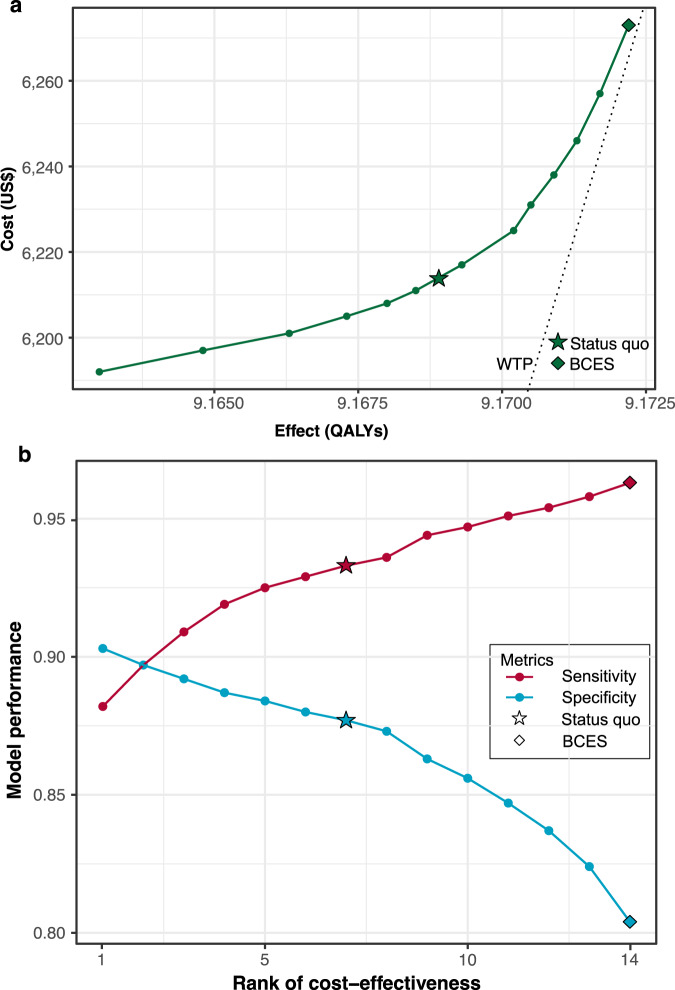
Artificial intelligence (AI) models have shown great accuracy in health screening. However, for real-world implementation, high accuracy may not guarantee cost-effectiveness. Improving AI’s sensitivity finds more high-risk patients but may raise medical costs while increasing specificity reduces unnecessary referrals but may weaken detection capability. To evaluate the trade-off between AI model performance and the long-running cost-effectiveness, we conducted a cost-effectiveness analysis in a nationwide diabetic retinopathy (DR) screening program in China, comprising 251,535 participants with diabetes over 30 years. We tested a validated AI model in 1100 different diagnostic performances (presented as sensitivity/specificity pairs) and modeled annual screening scenarios. The status quo was defined as the scenario with the most accurate AI performance. The incremental cost-effectiveness ratio (ICER) was calculated for other scenarios against the status quo as cost-effectiveness metrics. Compared to the status quo (sensitivity/specificity: 93.3%/87.7%), six scenarios were cost-saving and seven were cost-effective. To achieve cost-saving or cost-effective, the AI model should reach a minimum sensitivity of 88.2% and specificity of 80.4%. The most cost-effective AI model exhibited higher sensitivity (96.3%) and lower specificity (80.4%) than the status quo. In settings with higher DR prevalence and willingness-to-pay levels, the AI needed higher sensitivity for optimal cost-effectiveness. Urban regions and younger patient groups also required higher sensitivity in AI-based screening. In real-world DR screening, the most accurate AI model may not be the most cost-effective. Cost-effectiveness should be independently evaluated, which is most likely to be affected by the AI’s sensitivity.
Overview
CoChat Summary
TL;DR
In a modeled cost-effectiveness analysis of AI-based diabetic retinopathy screening using 251,535 Chinese participants over 30 years, the most accurate AI (sensitivity/specificity 93.3%/87.7%) was not the most cost-effective. Cost-saving or cost-effective screening required minimum sensitivity of 88.2% and specificity of 80.4%, and the best cost-effective scenario had higher sensitivity (96.3%) and lower specificity (80.4%) than the status quo.
Key findings
- Among 1100 AI performance scenarios, 6 were cost-saving and 7 were cost-effective compared with the status quo; the minimum thresholds were 88.2% sensitivity (paired specificity 90.3%) and 80.4% specificity (paired sensitivity 96.3%).
- The most cost-saving scenario (88.2%/90.3%) saved US$5.54 million but compromised 1,490 QALYs versus the status quo; the best cost-effective scenario (96.3%/80.4%) cost an additional US$14.8 million and gained 839 QALYs in the 251,535 population over 30 years.
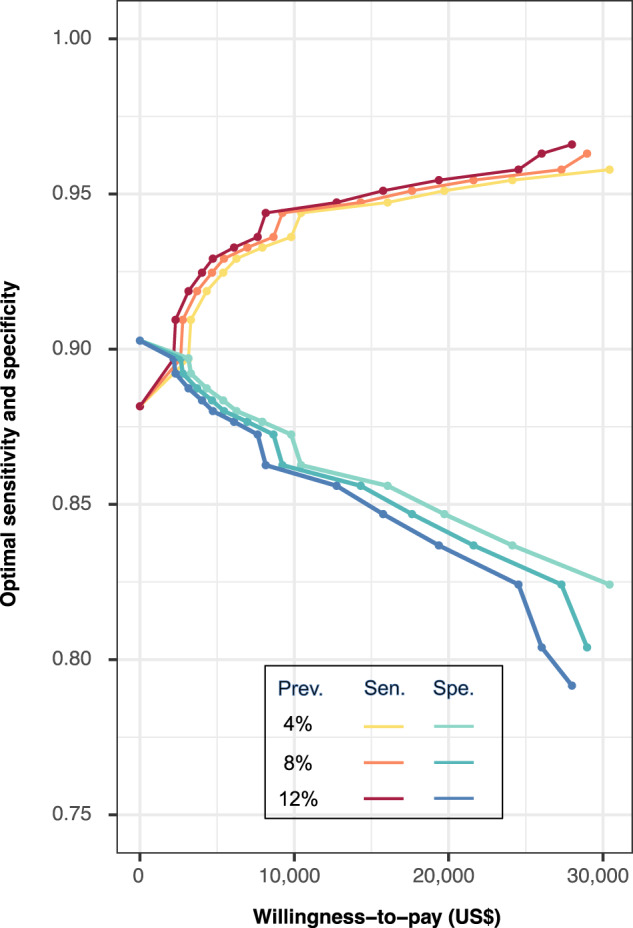
- Higher referable DR prevalence and higher willingness-to-pay required higher AI sensitivity. At 4%, 8%, and 12% prevalence, the best cost-effective scenario had sensitivity/specificity of 95.8%/82.4%, 96.3%/80.4%, and 96.6%/79.2%, with additional costs of 11–16 million and extra 662–974 QALYs.
- In subgroup analyses, urban settings required sensitivity 96.9% (specificity 77.5%) and rural settings required sensitivity 94.7% (specificity 85.6%); at the 3-time per-capita GDP WTP level (US$30,828), the best cost-effective AI had a 55.43% probability of being the dominant choice.
Methods
- Simulation using data from the Lifeline Express DR Screening Program, a nationwide program in China that enrolled 251,535 participants with diabetes from 2014 to 2019 and collected 865,152 color fundus images; referable DR was detected in 18,709 (7.44%) participants by human graders.
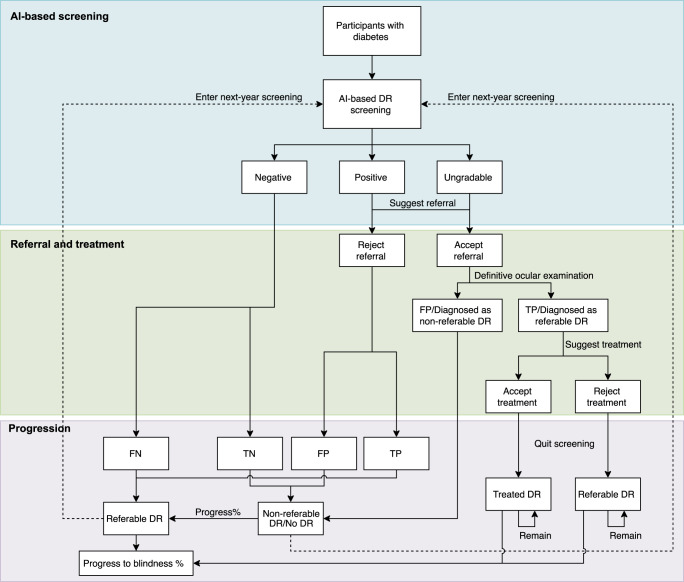
- A hybrid decision tree/Markov model from a societal perspective modeled annual AI-based DR screening over 30 1-year cycles in a population with mean age 60; 1100 sensitivity/specificity pairs were generated by threshold adjustment on a validated AI model, with the status quo defined as the maximum-AUC scenario.
- ICERs were calculated against the status quo and reference scenarios, with WTP set at three times per-capita GDP (US$30,828); analyses included net monetary benefit, univariate and probabilistic sensitivity analyses (10,000 Monte Carlo simulations), and subgroup analyses by rural/urban setting, age group, and referable DR prevalence (4%, 8%, 12%).
Limitations
- The paper states that only one AI model was used to classify referable DR, although 1100 sensitivity/specificity pairs were simulated; cost-effectiveness was based on China’s health economic characteristics and may not be directly generalizable; and the study did not consider diabetic macular edema or impaired visual acuity, modeling only a simple natural DR progression.
- Text-evident limitations include reliance on a cross-sectional screening program without follow-up, so transition probabilities were derived from prior studies and assumptions; referral and treatment compliance were assumed at 50% and 70%, respectively; and ungradable images were reclassified as positive, which lowered the AI’s specificity relative to prior validation.
Model-written summary. Check it against the paper before relying on it.
Integrity signals
Registry
Cites
Statistics
Figures
Verification
Claims the paper makes
15 Valid · 4 Not valid · 7 Not checked · 57 Own results and interpretations
At least one cited source doesn’t support this claim or points to a different paper, and none confirmed it — see the verdicts below.
In the paper
“However, these studies only focused on theoretical scenarios where sensitivity and specificity can change independently, overlooking that in practical screening tools, these two parameters have an inverse correlation.”
§ Economic evaluation for medical artificial intelligence: accuracy vs. cost-effectiveness in a diabetic retinopathy screening case > Introduction
What the sources say
- Not checked — no full text of the sourcecites [14] Liu H Economic evaluation of combined population-based screening for multiple blindness-causing eye diseases in China: a cost-effectiveness analysis Lancet Glob. Health 2023 11 e456 e465 10.1016/S2214-109X(22)00554-X 36702141 source
- Disputedcites [15] Lin S Artificial intelligence in community-based diabetic retinopathy telemedicine screening in urban china: cost-effectiveness and cost-utility analyses with real-world data JMIR Public Health Surveill. 2023 9 e41624 10.2196/41624 36821353 PMC9999255 sourceExperimental — accuracy not yet measured
The Discussion’s Principal Findings (page unavailable) says this study modeled practical screening approaches using real-world data from an ongoing program in urban China. That contradicts the characterization that it focused only on theoretical scenarios. The Methods’ Sensitivity Analysis describes varying sensitivity and specificity, but does not say they can change independently or discuss an inverse correlation between them. (LLM, conf=0.87)
Checked by a reasoning model — may be wrong.
- Not checked — no full text of the sourcecites [16] Nguyen HV Cost-effectiveness of a national telemedicine diabetic retinopathy screening program in Singapore Ophthalmology 2016 123 2571 2580 10.1016/j.ophtha.2016.08.021 27726962 source
plain- Asserted: passes — The authors put it forward as true.
- Checkable: passes — It can be checked against evidence.
- Load-bearing: passes — The paper’s conclusions depend on it.
- Based: passes — The paper gives a reason why it holds.
At least one cited source doesn’t support this claim or points to a different paper, and none confirmed it — see the verdicts below.
In the paper
“As recommended by the World Health Organization (WHO), we set the WTP level at three-time per-capita GDP in China (US$ 30,828, in 201954).”
§ Economic evaluation for medical artificial intelligence: accuracy vs. cost-effectiveness in a diabetic retinopathy screening case > Methods > Cost-effectiveness analysis
What the sources say
- Disputedcites [54] Bertram MY Lauer JA Stenberg K Edejer TTT Methods for the economic evaluation of health care interventions for priority setting in the health system: an update from WHO CHOICE Int. J. Health Policy Manag 2021 10 673 677 33619929 PMC9278384 sourceExperimental — accuracy not yet measured
The Thresholds section (page not provided) says earlier GDP-based thresholds were intended as broad categories for local consideration, not decision rules. It recommends against using a cost-effectiveness threshold as a decision rule and uses no threshold to classify interventions. It therefore does not recommend setting willingness to pay at three times China’s per-capita GDP. (LLM, conf=0.90)
Checked by a reasoning model — may be wrong.
plain- Asserted: passes — The authors put it forward as true.
- Checkable: passes — It can be checked against evidence.
- Load-bearing: passes — The paper’s conclusions depend on it.
- Based: passes — The paper gives a reason why it holds.
- Disputed
At least one cited source doesn’t support this claim or points to a different paper, and none confirmed it — see the verdicts below.
In the paper
“To capture the general progression rate of DR in China, we estimated the transition rates from non-referable DR to referable DR as 7%.”
§ Economic evaluation for medical artificial intelligence: accuracy vs. cost-effectiveness in a diabetic retinopathy screening case > Methods > Transition probabilities and mortalities
What the sources say
- Not checked — no full text of the sourcecites [14] Liu H Economic evaluation of combined population-based screening for multiple blindness-causing eye diseases in China: a cost-effectiveness analysis Lancet Glob. Health 2023 11 e456 e465 10.1016/S2214-109X(22)00554-X 36702141 source
- Could not verifycites [15] Lin S Artificial intelligence in community-based diabetic retinopathy telemedicine screening in urban china: cost-effectiveness and cost-utility analyses with real-world data JMIR Public Health Surveill. 2023 9 e41624 10.2196/41624 36821353 PMC9999255 sourceExperimental — accuracy not yet measured
The Methods sections “Model Overview” and “Prevalence and Transition Probabilities” describe annual progression between diabetic-retinopathy stages and the sources of transition probabilities, but give no 7% rate for progression from non-referable to referable DR. Searches for “7%,” “0.07,” and the named transition found no such estimate in our copy; the paper points to multimedia appendices for detailed parameters. (LLM, conf=0.72)
- Disputedcites [37] Huang XM Cost-effectiveness of artificial intelligence screening for diabetic retinopathy in rural China BMC Health Serv. Res. 2022 22 260 10.1186/s12913-022-07655-6 35216586 PMC8881835 sourceExperimental — accuracy not yet measured
Table 1 (Methods, Model inputs; page unavailable) assigns 7% to progression from no DR to mild DR, not from non-referable to referable DR. It lists 19% for mild-to-moderate DR and 17% for moderate-to-vision-threatening DR. (LLM, conf=0.88)
Checked by a reasoning model — may be wrong.
hedged- Asserted: passes — The authors put it forward as true.
- Checkable: passes — It can be checked against evidence.
- Load-bearing: passes — The paper’s conclusions depend on it.
- Based: passes — The paper gives a reason why it holds.
The sources with a verdict support this claim; the rest weren’t checked yet, have no full text we could read, or their verdicts aren’t rated yet.
In the paper
“To evaluate cost-effectiveness change, previous studies assigned different values to the sensitivity and specificity of AI models14–16.”
§ Economic evaluation for medical artificial intelligence: accuracy vs. cost-effectiveness in a diabetic retinopathy screening case > Introduction
What the sources say
- Not checked — no full text of the sourcecites [14] Liu H Economic evaluation of combined population-based screening for multiple blindness-causing eye diseases in China: a cost-effectiveness analysis Lancet Glob. Health 2023 11 e456 e465 10.1016/S2214-109X(22)00554-X 36702141 source
- Supportedcites [15] Lin S Artificial intelligence in community-based diabetic retinopathy telemedicine screening in urban china: cost-effectiveness and cost-utility analyses with real-world data JMIR Public Health Surveill. 2023 9 e41624 10.2196/41624 36821353 PMC9999255 source
The Methods sections on Sensitivity Analysis and Screening Accuracy state that the study evaluated the cost-effectiveness of an AI screening model and varied probability-related inputs, including sensitivity and specificity, by 10% in its sensitivity analyses. The indexed copy provides no page numbers for these sections. (LLM, conf=0.88)
- Not checked — no full text of the sourcecites [16] Nguyen HV Cost-effectiveness of a national telemedicine diabetic retinopathy screening program in Singapore Ophthalmology 2016 123 2571 2580 10.1016/j.ophtha.2016.08.021 27726962 source
plain- Asserted: passes — The authors put it forward as true.
- Checkable: passes — It can be checked against evidence.
- Load-bearing: passes — The paper’s conclusions depend on it.
- Based: passes — The paper gives a reason why it holds.
The cited sources support only part of this claim — read each source’s verdict below.
In the paper
“However, this aspect is commonly underestimated, and the trade-off between diagnostic performance and cost-effectiveness has not been adequately addressed10.”
§ Economic evaluation for medical artificial intelligence: accuracy vs. cost-effectiveness in a diabetic retinopathy screening case > Introduction
What the sources say
- Partly supportedcites [10] Xie Y Health economic and safety considerations for artificial intelligence applications in diabetic retinopathy screening Transl. Vis. Sci. Technol. 2020 9 22 10.1167/tvst.9.2.22 32818083 PMC7396187 sourceExperimental — accuracy not yet measured
The Methods of HEA section says few studies have assessed the health economics of AI-assisted diabetic retinopathy screening, while the section on false positives explains how screening performance can affect costs. The paper supports a gap in evaluating performance alongside costs for diabetic retinopathy screening, but does not establish the broader claim about AI in health screening generally. Page numbers are unavailable in our copy. (LLM, conf=0.82)
plain- Asserted: passes — The authors put it forward as true.
- Checkable: passes — It can be checked against evidence.
- Load-bearing: passes — The paper’s conclusions depend on it.
- Based: passes — The paper gives a reason why it holds.
- Partly supported
45 more claims · 5 with their cited sources checked
Create a free account to see all 83 claims and to verify the 2 references still open.
- It may state two separate claims as one. 22
- Probably not a substantial claim. 14
Claims other papers make about this one
Each is checked against this paper’s own text: does it say what the citing paper says it does?
The source backs part of the claim, not all of it — or backs it for a different population, condition or comparison.
In the citing paper
“Together with the improvements in reporting time and diagnostic accuracy, our proposed InterpreFFA model still offers high cost-effectiveness given the tremendous reporting volume and the shortage of ophthalmologists in real-world clinical settings27,28.”
From Generative artificial intelligence for fundus fluorescein angiography interpretation and human expert evaluation (2025) · cites this paper as [27]
Experimental — accuracy not yet measuredThe cited source says what the claim attributes to it.
In the citing paper
“Wang and colleagues showed that the most diagnostically accurate model is not necessarily the most cost-effective option; the preferred trade-off between sensitivity and specificity depends on prevalence, willingness-to-pay thresholds, costs of false positives, costs of missed disease, and downstream treatment capacity (25).”
From From validation to public health impact: implementing equitable AI-enabled diabetic retinopathy screening (2026) · cites this paper as [25]
Self-check
Percentages, sums and reported differences re-computed from the paper’s own numbers.
Each contradiction between two passages listed here was confirmed by an independent check.
Rated minor: it would not touch a result — a value no result rests on, a p-value that stays on the same side of the significance level, or a conflict that is clerical, resolved elsewhere in the paper, or outside its own findings.
In the paper
§ Economic evaluation for medical artificial intelligence: accuracy vs. cost-effectiveness in a diabetic retinopathy screening case > Results > Main analysis
“14 cost-saving or cost-effective scenarios remained, including the status quo and 13 intervention scenarios.”
§ Economic evaluation for medical artificial intelligence: accuracy vs. cost-effectiveness in a diabetic retinopathy screening case > Results > Main analysis
“These 14 cost-effective scenarios and the status quo are visualized in Fig. 1A based on costs and effects”
Citations
Cites
Gulshan, V., Peng, L., Coram, M., Stumpe, M. C., Wu, D., Narayanaswamy, A., Venugopalan, S., Widner, K., Madams, T., Cuadros, J., et al. (2016) · JAMA · doi:10.1001/jama.2016.17216 · Cited by 7,697
Global prevalence and major risk factors of diabetic retinopathy
Yau, J. W. Y., Rogers, S. L., Kawasaki, R., Lamoureux, E. L., Kowalski, J. W., Bek, T., Chen, S.-J., Dekker, J. M., Fletcher, A., Grauslund, J., et al. (2012) · Diabetes Care · doi:10.2337/dc11-1909 · Cited by 4,985 · cited 1×
“Globally, the overall prevalence of referable DR has been estimated to be around 10%, but this varies across geographic regions, ethnicities,andstudymethodologies 33 .”
The National Institute for Clinical Excellence
(2001) · Nursing Management · doi:10.7748/nm.8.2.39.s15 · Cited by 3,876
Ting, D. S. W., Cheung, C. Y.-L., Lim, G., Tan, G. S. W., Quang, N. D., Gan, A., Hamzah, H., Garcia-Franco, R., San Yeo, I. Y., Lee, S. Y., et al. (2017) · JAMA · doi:10.1001/jama.2017.18152 · Cited by 2,402 · cited 1×
“In the UK and Australia, previous recommendations suggestedaminimumsensitivityofeither80%or60%,andaspeci fi cityofat least 95% 25 – 30 .”
Self-citationAbràmoff, M. D., Lavin, P. T., Birch, M., Shah, N., & Folk, J. C. (2018) · npj Digital Medicine · doi:10.1038/s41746-018-0040-6 · Cited by 1,638
Attia, Z. I., Noseworthy, P. A., Lopez-Jimenez, F., Asirvatham, S. J., Deshmukh, A. J., Gersh, B. J., Carter, R. E., Yao, X., Rabinstein, A. A., Erickson, B. J., et al. (2019) · The Lancet · doi:10.1016/s0140-6736(19)31721-0 · Cited by 1,613
Ting, D. S. W., Cheung, G. C. M., & Wong, T. Y. (2016) · Clinical & Experimental Ophthalmology · doi:10.1111/ceo.12696 · Cited by 1,066
Diabetic Retinopathy Preferred Practice Pattern®
Flaxel, C. J., Adelman, R. A., Bailey, S. T., Fawzi, A., Lim, J. I., Vemulakonda, G. A., & Ying, G.-S. (2020) · Ophthalmology · doi:10.1016/j.ophtha.2019.09.025 · Cited by 717
Screening for diabetic retinopathy: new perspectives and challenges
Vujosevic, S., Aldington, S. J., Silva, P., Hernández, C., Scanlon, P., Peto, T., & Simó, R. (2020) · The Lancet Diabetes & Endocrinology · doi:10.1016/s2213-8587(19)30411-5 · Cited by 671 · cited 3×
“These criteria were mostly developed based on empirical considerations from different screening modalities (e.g., fundus cameras), and without explicit evidence, especiallyfromcost-effectiveperspectives 25 .”
The English National Screening Programme for diabetic retinopathy 2003–2016
Scanlon, P. H. (2017) · Acta Diabetologica · doi:10.1007/s00592-017-0974-1 · Cited by 440
Research works printed but not linked: 2
- Zhang L Qiu Z Current situation for patients with diabetic retinopathy of visiting hospital and analysis on influencing factors Chin. J. Prat. Ophthalmol. 2011 29 1170 1172
- Zhang W Wei M The evaluation of the mortality and life expectancy of Chinese population Popul. J. 2016 38 18 28
Cited by
Oculomics: Current concepts and evidence
Zhu, Z., Wang, Y., Qi, Z., Hu, W., Zhang, X., Wagner, S. K., Wang, Y., Ran, A. R., Ong, J., Waisberg, E., et al. (2025) · Progress in Retinal and Eye Research · doi:10.1016/j.preteyeres.2025.101350 · Cited by 120
Self-citationArtificial intelligence-based biomarkers for treatment decisions in oncology
Ligero, M., Nahhas, O. S. M. E., Aldea, M. D., & Kather, J. N. (2025) · Trends in cancer · doi:10.1016/j.trecan.2024.12.001 · Cited by 84
KHAN, Z., GAIDHANE, A. M., SINGH, M., GANESAN, S., KAUR, M., SHARMA, G. C., RANI, P., SHARMA, R., THAPLIYAL, S., KUSHWAHA, M., et al. (2025) · American Journal of Ophthalmology · doi:10.1016/j.ajo.2025.02.022 · Cited by 49
Enhancing Ophthalmic Diagnosis and Treatment with Artificial Intelligence
Olawade, D. B., Weerasinghe, K., Mathugamage, M. D. D. E., Odetayo, A., Aderinto, N., Teke, J., & Boussios, S. (2025) · Medicina · doi:10.3390/medicina61030433 · Cited by 76
Artificial intelligence for early detection of diabetes mellitus complications via retinal imaging
Sobhi, N., Sadeghi-Bazargani, Y., Mirzaei, M., Abdollahi, M., Jafarizadeh, A., Pedrammehr, S., Alizadehsani, R., Tan, R.-S., Islam, S. M. S., & Acharya, U. R. (2025) · Journal of Diabetes & Metabolic Disorders · doi:10.1007/s40200-025-01596-7 · Cited by 39
Lopes, M. B., Coletti, R., Duranton, F., Glorieux, G., Campos, M. A. J., Klein, J., Ley, M., Perco, P., Sampri, A., & Tur‐Sinai, A. (2025) · PROTEOMICS · doi:10.1002/pmic.202400108 · Cited by 44
Soe, N. N., Yu, Z. T., Latt, P. M., Lee, D. M., Ong, J. J., Ge, Z., Fairley, C. K., & Zhang, L. (2024) · BMC Medicine · doi:10.1186/s12916-024-03512-x · Cited by 36
Self-citationAI applications in HIV research: advances and future directions
Jin, R., & Zhang, L. (2025) · Frontiers in Microbiology · doi:10.3389/fmicb.2025.1541942 · Cited by 30
Self-citationFuture horizons in diabetes: integrating AI and personalized care
Zhang, K., Qi, Y. P., Wang, W., Tian, X., Wang, J., Xu, L., & Zhai, X. (2025) · Frontiers in Endocrinology · doi:10.3389/fendo.2025.1583227 · Cited by 36
AI framework for multidisease detection via retinal imaging
Zhang, X., Li, Q., Liang, Y., Lai, C., Cao, J., Feng, Y., Hu, W., Jiang, H., Liu, C., Zhang, F., et al. (2026) · Yearbook of pediatric endocrinology · doi:10.1038/s41591-026-04359-w · Cited by 32
Self-citationVujosevic, S., Limoli, C., & Nucci, P. (2024) · Current Opinion in Ophthalmology · doi:10.1097/icu.0000000000001084 · Cited by 20
Shao, A., Liu, X., Shen, W., Li, Y., Wu, H., Pan, X., Yang, Z., Xu, Y., Zhu, T., Wang, Y., et al. (2025) · npj Digital Medicine · doi:10.1038/s41746-025-01759-z · Cited by 16
“Together with the improvements in reporting time and diagnostic accuracy, our proposed InterpreFFA model still offers high cost-effectiveness given the tremendous reporting volume and the shortage of ophthalmologists in real-world clinical settings 27,28 .”
Self-citationCurrent perspectives and challenges of using artificial intelligence in immunodeficiencies
Riviere, J. G., Cantenys-Saba, R., Carot-Sans, G., Piera-Jiménez, J., Butte, M. J., Soler‐Palacín, P., & Peng, X. P. (2025) · Journal of Allergy and Clinical Immunology · doi:10.1016/j.jaci.2025.06.015 · Cited by 18
Campos, V. M. S., Prudente, T. P., Leão, L. L., Costa, M., Oliva, H. N. P., & Monteiro-Júnior, R. S. (2025) · Health Information Science and Systems · doi:10.1007/s13755-025-00368-0 · Cited by 14
Akune, Y., Kawasaki, R., Goto, R., Tamura, H., Hiratsuka, Y., & Yamada, M. (2025) · Diabetes Research and Clinical Practice · doi:10.1016/j.diabres.2025.112015 · Cited by 18
Mohamed, A., Abdelrehim, M., & Al-Barazie, R. (2025) · Scientific Reports · doi:10.1038/s41598-025-26855-8 · Cited by 19
Leigh, J., Drinkwater, J., Turner, A., & Schroeder, E. (2026) · Clinical & Experimental Ophthalmology · doi:10.1111/ceo.70016 · Cited by 8
“Most studies in our review modelled for equivalent adherence to follow-up [21–26, 29 ] , or”
InfluentialRan, A. R., Ding, J. L., Tang, Z., Lam, C., Nguyen, T. X., Zhou, J., Zhang, S., Fang, D., Yang, D., Ng, V., et al. (2026) · Diabetes Care · doi:10.2337/dc25-1493 · Cited by 7
Fahmy, A. M. (2025) · Premier journal of public health. · doi:10.70389/pjph.100021 · Cited by 9
Hatzikou, M., Latsou, D., Apostolidis, G. K., Billis, A. S., Charisis, V. S., Rigas, E. S., Bamidis, P. D., & Hadjileontiadis, L. J. (2025) · Healthcare · doi:10.3390/healthcare13141661 · Cited by 9
Artificial Intelligence in Drug-Coated Cardiovascular Devices: A Narrative Review
Dinç, R. (2025) · Reviews in Cardiovascular Medicine · doi:10.31083/rcm40892 · Cited by 6
Armadá-Maresca, F., Capote, M., Cidad-Betegón, M. D. P., Cordero-Ros, R. M., Martínez-Godoy, L., Colomo, P. V., Laín-Olia, B., Songel-Sanchis, B., Caminos-Melguizo, A., & Haddi, I. B. O. (2025) · Frontiers in Medicine · doi:10.3389/fmed.2025.1593556 · Cited by 7
Morytko, M. Z., Matusik, P. S., Wawrzyniak, R., & Popiela, T. J. (2025) · Rheumatology International · doi:10.1007/s00296-025-06051-7 · Cited by 8
DeLuca, N. J., Wertheimer, B., & Ansari, Z. (2025) · Current Ophthalmology Reports · doi:10.1007/s40135-025-00333-w · Cited by 7
Thomas, N. R., Anitha, J., Popîrlan, C., Popirlan, C.-I., & Hemanth, D. J. (2025) · Computers, materials & continua/Computers, materials & continua (Print) · doi:10.32604/cmc.2025.070689 · Cited by 5
Goh, S. S. N., Lim, Y. Z., Ong, C., Hartman, M., & Wang, Y. (2026) · Cancers · doi:10.3390/cancers18050836 · Cited by 5
Self-citationA systematic review of economic evidence of artificial intelligence in healthcare
Schmidt, J., Carter, A. W., McGuire, A. J., Mossialos, E. A., & van Kessel, R. (2026) · Health Policy · doi:10.1016/j.healthpol.2026.105715 · Cited by 5
Detection of diabetic retinopathy using artificial intelligence: an exploratory systematic review
Injante, R., & Julca, M. (2024) · LatIA · doi:10.62486/latia2024112 · Cited by 3
Artificial Intelligence for Early Detection and Prognosis Prediction of Diabetic RetinopathyPreprint
Susilo, Y. K. B., Yuliana, D., Mahadi, M., Rahman, S. A., & Ariffin, A. E. (2025) · medRxiv · doi:10.1101/2025.03.29.25324873 · Cited by 8
Lee, J. T., Shen, T. K.-B., Liu, V. T.-N., Chen, T. H.-H., Lee, C., Lu, C., Huang, C., & Atun, R. A. (2025) · medRxiv · doi:10.1101/2025.10.27.25338867 · Cited by 3
Ali, S. G., Yang, X., Masood, S., Ghazanfar, Z., Jung, Y., Chen, T., & Wang, X. (2025) · The Visual Computer · doi:10.1007/s00371-025-04024-2 · Cited by 6
Conceptual model for assessing the economic efficiency of AI solutions in healthcare
Tokareva, O. (2025) · Economics and Management · doi:10.35854/1998-1627-2025-6-804-815 · Cited by 3
Energy Considerations for Scaling Artificial Intelligence Adoption in Medicine: First Do No Harm
Malhotra, A. K., Verma, A. A., Smith, C. W., Shakil, H., Mamdani, M., Rosella, L. C., Witiw, C. D., & Wilson, J. R. (2025) · NEJM AI · doi:10.1056/aip2500154 · Cited by 4
Applications of AI in the management of elderly diabetes patients
Xie, T., Wang, Z., He, J., & Zhang, J. (2025) · Ageing Research Reviews · doi:10.1016/j.arr.2025.102960 · Cited by 4
Self-citationAI-Automated Risk Operative Stratification for Severe Aortic Stenosis: A Proof-of-Concept Study
Garín, D., Arroyo, D., Skalidis, I., di Cicco, P., Ferry, C., Bennar, W., Puricel, S., Meier, P., Togni, M., & Cook, S. (2025) · Journal of Clinical Medicine · doi:10.3390/jcm14238304 · Cited by 4
Suleman, M. U., Mursaleen, M., Khalil, U., Khan, S. A., Saboor, A., Hussnain, M. A., Zahir, M., Khan, U. A., Rehman, D. U., & Tabassum, S. N. (2025) · Annals of Medicine and Surgery · doi:10.1097/ms9.0000000000004505 · Cited by 2
Soe, M. W. Y., Ge, J., Aung, K. H., La, S. M., & Tan, A. C. (2025) · AJO International · doi:10.1016/j.ajoint.2025.100149 · Cited by 4
AI APPLICATIONS IN SCREENING AND DIAGNOSIS OF DIABETIC RETINOPATHY IN RURAL SETTINGS
Chidi, R., & Odimba, U. (2024) · International Medical Science Research Journal · doi:10.51594/imsrj.v4i3.918 · Cited by 4
Jaiteh, M., Phalane, E., Shiferaw, Y. A., & Phaswana-Mafuya, R. N. (2025) · Frontiers in Digital Health · doi:10.3389/fdgth.2025.1618781 · Cited by 1
Demystifying Explainable Artificial Intelligence (XAI) in Healthcare: The Role of XAI
Harshavardhan, K., Murugadoss, H., Priyankaa, V., & Rajanadh, M. G. (2026) · Advances in computational intelligence and robotics book series · doi:10.4018/979-8-3373-6400-1.ch001 · Cited by 1
Chen, Z., Li, W., & Lin, Z. (2026) · PLOS Digital Health · doi:10.1371/journal.pdig.0001283 · Cited by 7
Lin, T., Lau, R. Y. K., & Hu, S. (2026) · Artificial Intelligence Review · doi:10.1007/s10462-026-11565-y · Cited by 13
Diabetic Retinopathy Detection: AI Models and Approaches
Madi, M. M. M., Clarke-Farr, P. C., & Bester, D. J. (2026) · Journal of Ophthalmology · doi:10.1155/joph/8857887 · Cited by 2
Ahmed, M. M., Okesanya, O. J., Othman, Z. K., Adebayo, U. O., Oso, T. A., & Lucero‐Prisno, D. E. (2026) · Informatics and Health · doi:10.1016/j.infoh.2026.03.002 · Cited by 1
Cost-effectiveness analysis of human–AI collaboration in disease screening
Wang, Y., Han, X., Hu, W., Zhou, K., Liu, C., Zhang, J., Zhu, Z., Joseph, S., Yin, Q., Luo, L., et al. (2026) · Nature Health · doi:10.1038/s44360-026-00142-w · Cited by 2
Self-citationChen, J., & Chen, B. (2026) · Frontiers in Public Health · doi:10.3389/fpubh.2026.1976572
Di Matteo, L., Whitestone, N., & Bhambhwani, V. (2026) · BMJ Open Ophthalmology · doi:10.1136/bmjophth-2026-002904 · Cited by 1
Provenzano, D., Wang, J. Y., Goyal, S., & Rao, Y. J. (2025) · Tomography · doi:10.3390/tomography11030038
Artificial Intelligence in Diabetic Retinopathy
Grzybowski, A. E., & Brona, P. (2025) · Springer eBooks · doi:10.1007/978-3-031-83756-2_11 · Cited by 1
Fahrisky, A., Nurmandi, A., Younus, M., & Suardi, W. (2025) · Lecture notes in social networks · doi:10.1007/978-3-031-92681-5_5
Ke, G.-Q., Fu, Y., Huang, Z., Dai, S., Wen, Y.-H., & Lv, H.-X. (2025) · Frontiers in Medicine · doi:10.3389/fmed.2025.1644456 · Cited by 4
Alam, A. (2025) · Advances in computational intelligence and robotics book series · doi:10.4018/979-8-3373-5462-0.ch010 · Cited by 1
Keller, S. A., Schuessler, M., Naderalvojoud, B., Seto, T., Tian, L., Roy, M., & Hernandez‐Boussard, T. (2025) · JMIR Medical Informatics · doi:10.2196/77891
May AI be sustainable? An outlook on sustainability and technology
Kondratenko, A., Kondratenko, A. A., & Kamberov, K. H. (2025) · AI & Society · doi:10.1007/s00146-025-02804-x
Soe, N. N., Yu, Z., Latt, P. M., Lee, D., Ong, J. J., Ge, Z., Fairley, C. K., & Zhang, L. (2024) · Figshare · doi:10.6084/m9.figshare.26322665
Self-citationZheng, J., Li, X., Guo, Z., Wu, J., Yang, H., Ma, Q., & Fang, J. (2026) · Experimental Eye Research · doi:10.1016/j.exer.2026.110938
Acceptable accuracy for medical AI: a survey of physicians and the general population in Sweden
Arvidsson, R., Widén, J., Al-Naasan, L., Gunnarsson, R. K., Nymberg, P., Blease, C., Moberg, A. B., Sundvall, P., Wikberg, C., & Sundemo, D. S. (2026) · BMJ Health & Care Informatics · doi:10.1136/bmjhci-2025-101899
Potential of Data Science in the Analysis of Clinical and Scientific Issues in Medicine
Siennicka, A. E., Matera-Witkiewicz, A., Pondel, M., & Chomiak-Orsa, I. (2026) · IFIP advances in information and communication technology · doi:10.1007/978-3-032-18920-2_46
Donocik, W., Sałak, J., Tryczyński, P., Wrona, J., Helbin, P., Gralec, A., Ożga, S., & Spirkowicz, A. (2026) · International Journal of Innovative Technologies in Social Science · doi:10.31435/ijitss.1(49).2026.5728
Dzieran, R., Dağli, C. H., & Marley, R. J. (2026) · Current Transplantation Reports · doi:10.1007/s40472-026-00519-6 · Cited by 2
Χαλλουμής, C. C. Κ. (2026) · Advances in computational intelligence and robotics book series · doi:10.4018/979-8-3373-8944-8.ch002
Wei, C., Zhang, L., Chen, C., Le, Y., Feng, Q., Li, Z., & Leng, Z. (2026) · Value in Health · doi:10.1016/j.jval.2026.06.005 · Cited by 1
Self-citationLiu, C., Zhou, Y., Shen, S., Ge, Z., Jing, F., Zhang, S., Jiang, Y., Wang, A., Liu, W., Yang, F., et al. (2026) · Knowledge-Based Systems · doi:10.1016/j.knosys.2026.116585
Self-citationSingh, A. K., Pandey, G., Kolipaka, T., & Srivastava, S. (2026) · BioNanoScience · doi:10.1007/s12668-026-02733-z · Cited by 2
Ashraf, M., Mostafa, A. M. S., Al-Bayoumy, B., Khamis, E., Abdelaziz, H., Mostafa, M., Manhaly, M. E., Ghoneim, M., Khaled, N., Souka, A., et al. (2026) · Translational Vision Science & Technology · doi:10.1167/tvst.15.8.15
Cost-effectiveness of Artificial Intelligence applications in healthcare: A systematic review
Imani, A., & Monaghesh, E. (2026) · Health Informatics Journal · doi:10.1177/14604582261460314 · Cited by 1
Artificial intelligence in diabetic retinopathy: from automated screening to risk-stratified care
Zhang, F., Shao, P., Wei, D., & Wang, C. (2026) · Graefe s Archive for Clinical and Experimental Ophthalmology · doi:10.1007/s00417-026-07390-2
Grønlykke, L., Wiberg, S. C., Carter, A., Ratgen, P. H., Lowater, S. J., Andersen, J., Savarimuthu, T. R., & Grauslund, J. (2026) · Acta Ophthalmologica · doi:10.1111/aos.70225
Closing Editorial: Toward Safe, Equitable, and Intelligent Healthcare
Tang, D., & Lam, T. Y. T. (2026) · Healthcare · doi:10.3390/healthcare14172703
Avitabile, A., Toro, M. D., Amato, R., Rusciano, D., & Gagliano, C. (2026) · Diagnostics · doi:10.3390/diagnostics16172699
Liu, Y., & Liu, H. (2026) · Eye & ENT Research · doi:10.1002/eer3.70059
Sukhadeve, A., Nair, N., & Bhise, T. (2026) · Journal of Clinical Sciences · doi:10.4103/jcls.jcls_110_25
Alqahtani, E., Alrumaih, H. A., Alghamdi, H. H., Alkhalifah, M. K., Basudan, L. K., & Zoëga, B. (2026) · Journal of Patient Experience · doi:10.1177/23743735261493024
Wong, M. Y. Z., & Ang, M. (2026) · Current Opinion in Ophthalmology · doi:10.1097/icu.0000000000001246
Metadata
- Authors
- Wang, Y., Liu, C., Hu, W., Luo, L., Shi, D., Zhang, J., Yin, Q., Zhang, L., Han, X., & He, M.
- Affiliations
- Sun Yat-sen University (CN)
- City University of Macau (MO)
- The Royal Victorian Eye & Ear Hospital (AU)
- Hong Kong Polytechnic University (HK)
- The Alfred Hospital (AU)
- Corresponding author
- Zhang, Lei
- Han, Xiaotong
- He, Mingguang
- ORCID
- Venue
- npj Digital Medicine
- Published
- 2024-02-21
- Volume
- 7
- Issue
- 1
- Pages
- 43-43
- ISSN
- 2398-6352 (ISSN-L)
- PMC
- PMC10881978
- OpenAlex
- W4391991419
- Cited by
- 76
- References
- 64
- Citations by year
- 2026: 32 · 2025: 39 · 2024: 5
- FWCI
- 19.29
- Type
- journal article
- Language
- en
- Open access
- gold
- doi.org
- Licence
- cc-by
- creativecommons.org/licenses/by/4.0 (tdm)
- creativecommons.org/licenses/by/4.0 (vor)
- Locations
- npj Digital Medicine (publishedVersion, cc-by)
- PubMed Central (publishedVersion, cc-by)
- PubMed (publishedVersion)
- PolyU Institutional Research Archive (Hong Kong Polytechnic University) (submittedVersion, cc-by)
- DOAJ (DOAJ: Directory of Open Access Journals) (submittedVersion, cc-by-sa)
- Minerva Access (University of Melbourne) (submittedVersion, cc-by)
- Funders
- National Natural Science Foundation of China (82101171, 82000901, P0046113)
- State Key Laboratory of Ophthalmology (303060202400201209)
- Topics
- Health Sciences › Medicine › Radiology, Nuclear Medicine and Imaging › Retinal Imaging and Analysis
- Social Sciences › Economics, Econometrics and Finance › Economics and Econometrics › Health Systems, Economic Evaluations, Quality of Life
- Health Sciences › Medicine › Health Informatics › Artificial Intelligence in Healthcare and Education
- Keywords
- diabetic retinopathy screening, artificial intelligence, cost-effectiveness, sensitivity and specificity trade-off, incremental cost-effectiveness ratio, diabetes mellitus, screening programs, willingness to pay, prevalence
About these checks
Registry, retraction, Cites and statistics results are computed, not judged, with one exception: a printed reference that no index lists is read once by a model before it counts as a citation error. Claims are extracted by a model and kept only when their quote appears verbatim in the text; each cited source is then checked, with a model’s help, for whether it says what the claim relies on. Those verdicts can be wrong — read the claim’s quote and the cited source before relying on one.
The claim verdicts this report counts are experimental: their accuracy is not yet measured.
A language model drew the claims from the paper on 2026-10-13, under version 3 of the claim definition (model deepseek-v4.1-flash, prompt extract-v3).
A second model labelled each claim on 2026-10-13 (model jev-1.13-20260917, definition revision gold-guideline-v0.2).
Cited sources are checked with a language model’s help (gpt-6-sol).
Statistics and arithmetic are recomputed, not judged.
Confidence bands are shown only for fields calibrated on our annotated test set. None is calibrated yet, so no band is shown.
What counts as a claim ›How we measure confidence ›How we check this ›
Are you an author, or do you see a problem with this page? Request a review
Data sources
Bibliographic data: Semantic Scholar, OpenAlex, Crossref.
Contains information from the Semantic Scholar Academic Graph Datasets, made available under the ODC Attribution License (ODC-BY 1.0).
Semantic Scholar’s data is described in: Kinney, R., et al. (2023). The Semantic Scholar Open Data Platform. arXiv:2301.10140.
