

Self-supervised learning of accelerometer data provides new insights for sleep and its association with mortality
Open accessPublished version of a preprint
The DOI matches its Crossref record; 35 of the 37 references it cites were found in a registry or an index, and 1 are not checked yet; 4 of the 24 sources its claims cite were checked for support.
Abstract
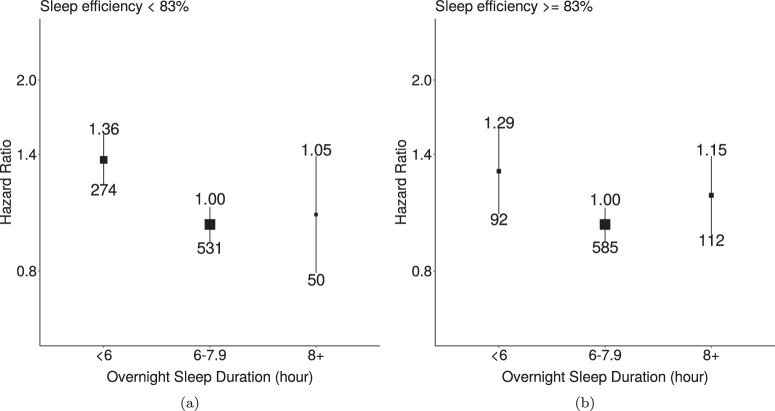
Sleep is essential to life. Accurate measurement and classification of sleep/wake and sleep stages is important in clinical studies for sleep disorder diagnoses and in the interpretation of data from consumer devices for monitoring physical and mental well-being. Existing non-polysomnography sleep classification techniques mainly rely on heuristic methods developed in relatively small cohorts. Thus, we aimed to establish the accuracy of wrist-worn accelerometers for sleep stage classification and subsequently describe the association between sleep duration and efficiency (proportion of total time asleep when in bed) with mortality outcomes. We developed a self-supervised deep neural network for sleep stage classification using concurrent laboratory-based polysomnography and accelerometry. After exclusion, 1113 participant nights of data were used for training. The difference between polysomnography and the model classifications on the external validation was 48.2 min (95% limits of agreement (LoA): −50.3 to 146.8 min) for total sleep duration, −17.1 min for REM duration (95% LoA: −56.7 to 91.0 min) and 31.1 min (95% LoA: −67.3 to 129.5 min) for NREM duration. The sleep classifier was deployed in the UK Biobank with ~100,000 participants to study the association of sleep duration and sleep efficiency with all-cause mortality. Among 66,262 UK Biobank participants, 1644 mortality events were observed. Short sleepers (<6 h) had a higher risk of mortality compared to participants with normal sleep duration 6–7.9 h, regardless of whether they had low sleep efficiency (Hazard ratios (HRs): 1.36; 95% confidence intervals (CIs): 1.18 to 1.58) or high sleep efficiency (HRs: 1.29; 95% CIs: 1.04–1.61). Deep-learning-based sleep classification using accelerometers has a fair to moderate agreement with polysomnography. Our findings suggest that having short overnight sleep confers mortality risk irrespective of sleep continuity.
Verified 2026-10-05 · 1 reference not checked yet
Overview
CoChat Summary
TL;DR
The authors developed SleepNet, a self-supervised deep recurrent neural network that classifies wrist accelerometer data into wake, REM, and NREM sleep and validated it against laboratory polysomnography. Deployed in 66,262 UK Biobank participants, short overnight sleep (<6 h) was associated with higher all-cause mortality regardless of sleep efficiency.
Key findings
- SleepNet achieved internal-validation F1 of 0.75 ± 0.1 for sleep/wake and 0.57 ± 0.11 for wake/REM/NREM; external-validation F1 was 0.66 ± 0.12 and 0.49 ± 0.10, respectively. Three-class epoch-level Kappa was 0.39 internally and 0.32 externally.
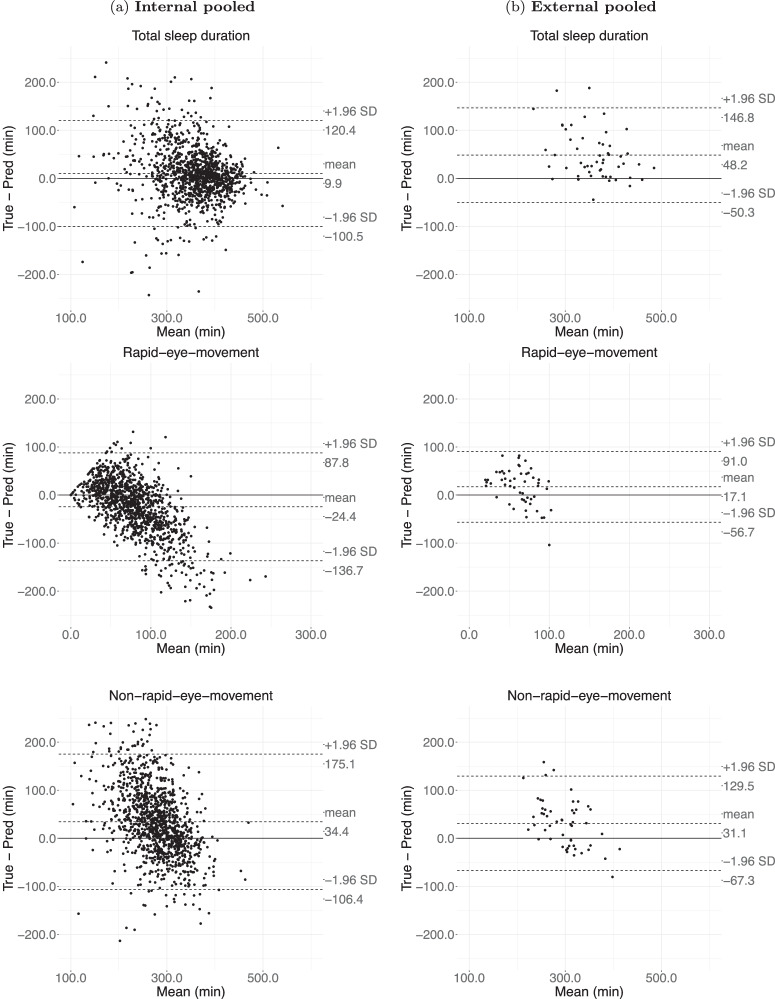
- Against polysomnography, external-validation mean bias was 48.2 min for total sleep duration (95% LoA: −50.3 to 146.8 min), −17.1 min for REM duration (95% LoA: −56.7 to 91.0 min), and 31.1 min for NREM duration (95% LoA: −67.3 to 129.5 min). Internal-validation biases were 9.9 min, −24.4 min, and 34.4 min, respectively.
- In 66,262 UK Biobank participants with 1,644 mortality events over 452,652 follow-up years, short sleepers (<6 h) had higher mortality risk than those sleeping 6–7.9 h, both with low sleep efficiency (HR 1.36; 95% CI 1.18–1.58) and high sleep efficiency (HR 1.29; 95% CI 1.04–1.61).
- Overall UK Biobank sleep parameters were overnight sleep 6.8 ± 0.9 h/day, NREM 5.3 ± 0.9 h/day, REM 1.5 ± 0.6 h/day, and sleep efficiency 81.5 ± 8.6%. Longer overnight sleep was not associated with higher mortality risk than the reference group.
Methods
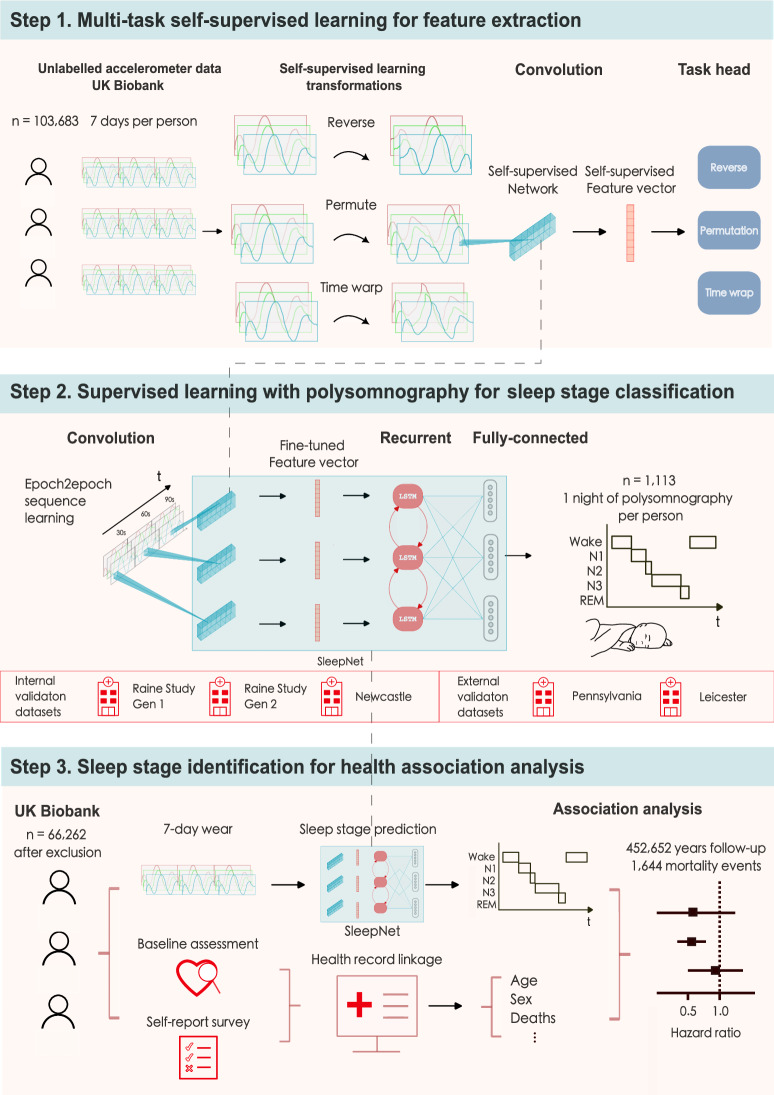
- SleepNet used a ResNet-17 V2 1D convolutional feature extractor, a bidirectional LSTM, and fully connected layers to classify each 30-s accelerometry window. It was pre-trained by multi-task self-supervision on 700,000 person-days of unlabelled UK Biobank accelerometry, then fine-tuned using concurrent laboratory polysomnography as ground truth; 1,157,913 (~10,000 h) sleep windows were used to train the network.
- Internal validation used subject-wise five-fold cross-validation in Raine Gen1, Raine Gen2, and Newcastle cohorts (1,113 participants/nights after preprocessing); external validation used Leicester and Pennsylvania cohorts (53 participants/nights). Performance was compared with a random forest model using hand-crafted spatiotemporal features.
- For health association analysis, SleepNet was deployed in the UK Biobank using sleep windows detected by a random forest model; after exclusions, 66,262 participants were analyzed. Cox proportional hazards regression used age as the timescale and adjusted for sex, ethnicity, Townsend Deprivation Index, educational qualifications, smoking status, alcohol consumption, and overall activity.
Limitations
- Stated: validation datasets mainly consisted of healthy populations from Caucasian ethnic backgrounds; validation in chronic disease and different ethnic populations is needed. Laboratory polysomnography may suffer from the first-night effect, and future validation could assess within-person variability using multi-night polysomnography. Sleep stage identification from actigraphy is highly challenging, especially for wake periods in bed without wrist movement.
- Stated: the analysis did not include daytime naps in the measurement of overnight sleep duration, which may explain why long overnight sleep was not associated with increased mortality risk.
- Evident from the text: external validation was much smaller than internal validation (53 vs. 1,113 participants/nights) and showed lower agreement, with the model tending to underestimate REM and short sleep and overestimate NREM and long sleep.
Model-written summary. Check it against the paper before relying on it.
Integrity signals
Registry
Cites
Statistics
Figures
Verification
Claims the paper makes
4 Valid · 0 Not valid · 12 Not checked · 62 Own results and interpretations
The cited sources support only part of this claim — read each source’s verdict below.
In the paper
“The inferred sleep architecture estimates had a fair agreement (κ = 0.37) with the polysomnography ground truth on the internal validation12.”
§ Self-supervised learning of accelerometer data provides new insights for sleep and its association with mortality > Discussion
What the sources say
- Partly supportedcites [12] McHugh ML Interrater reliability: the kappa statistic Biochem. Med. 2012 22 276 282 10.11613/BM.2012.031 PMC3900052 23092060 sourceExperimental — accuracy not yet measured
In “Theoretical issues in measurement of rater reliability,” the paper reports a convention classifying κ values of 0.21–0.40 as fair, which includes 0.37. It does not report sleep-architecture estimates, polysomnography comparisons, or an internal-validation result. The paper also cautions that κ values below 0.60 indicate inadequate agreement. (LLM, conf=0.88)
plainstates an association- Asserted: passes — The authors put it forward as true.
- Checkable: passes — It can be checked against evidence.
- Load-bearing: passes — The paper’s conclusions depend on it.
- Based: passes — The paper gives a reason why it holds.
- Rests on an assumption not shown here.
- Partly supported
Every source the paper cites for this claim was checked and supports it.
In the paper
“Even for sleep/wake classification, SleepNet achieved comparable results to a systematic evaluation of eight state-of-the-art sleep algorithms8 in the Newcastle dataset.”
§ Self-supervised learning of accelerometer data provides new insights for sleep and its association with mortality > Discussion
What the sources say
- Supportedcites [8] Patterson MR 40 years of actigraphy in sleep medicine and current state of the art algorithms NPJ Digit. Med. 2023 6 51 10.1038/s41746-023-00802-1 36964203 PMC10039037 source
The Abstract identifies this work as a systematic evaluation of eight state-of-the-art sleep algorithms. The Discussion identifies the dataset as the Newcastle PSG dataset. The citation is attached to that evaluation, not to the citing authors’ comparison with SleepNet. (LLM, conf=0.92)
plain- Asserted: passes — The authors put it forward as true.
- Checkable: passes — It can be checked against evidence.
- Load-bearing: unclear — It is unclear whether the paper’s conclusions depend on it.
- Based: passes — The paper gives a reason why it holds.
- Rests on an assumption not shown here.
- Supported
The cited sources support only part of this claim — read each source’s verdict below.
In the paper
“We did not find a U-shape association between device-measured sleep and mortality that has been suggested by other smaller studies15.”
§ Self-supervised learning of accelerometer data provides new insights for sleep and its association with mortality > Discussion
What the sources say
- Partly supportedcites [15] Yin J Relationship of sleep duration with all-cause mortality and cardiovascular events: a systematic review and dose-response meta-analysis of prospective cohort studies J. Am. Heart Assoc. 2017 6 e005947 10.1161/JAHA.117.005947 28889101 PMC5634263 sourceExperimental — accuracy not yet measured
The cited meta-analysis clearly supports the core point: the Discussion states 'Our study demonstrated U‐shaped associations between sleep duration and risk of all‐cause mortality, total CVD, CHD, and stroke, with the lowest risk observed with ≈7 hours of sleep duration,' echoed in the Results (restricted cubic splines, P<0.01 for nonlinearity) and the Abstract. However, the 'device-measured sleep' qualifier is not supported by this source: the Discussion limitations state that 'nearly all studies relied on sleep duration that was self‐reported by questionnaire or interview,' with only 1 included study (Zuurbier et al., ref 93) reporting RRs for both subjective and objective sleep duration and showing no substantial difference — no U-shape analysis of objectively/device-measured sleep. The framing as 'other smaller studies' also sits awkwardly with the source, which presents itself as 'the largest and most comprehensive study on the association of sleep duration with all‐cause mortality and cardiovascular events' and is a pooled analysis of prospective cohorts rather than a single smaller study. (LLM, conf=0.72)
plain- Asserted: passes — The authors put it forward as true.
- Checkable: passes — It can be checked against evidence.
- Load-bearing: passes — The paper’s conclusions depend on it.
- Based: passes — The paper gives a reason why it holds.
- Partly supported
Every source the paper cites for this claim was checked and supports it.
In the paper
“The devices used have been shown to have a high inter-instrument agreement (>80%) in derived sedentary and sleep-related time estimates in free-living environments28.”
§ Self-supervised learning of accelerometer data provides new insights for sleep and its association with mortality > Methods > Accelerometer devices and data preprocessing
What the sources say
- Supportedcites [28] Migueles JH Equivalency of four research-grade movement sensors to assess movement behaviors and its implications for population surveillance Sci. Rep. 2022 12 1 9 10.1038/s41598-022-09469-2 35365696 PMC8975935 source
The Conclusion (Discussion) states the four research-grade monitors (Movisens Move 4, ActiGraph GT3X+, GENEActiv, Axivity AX3) 'have a high agreement (> 80%) for estimations of the daily time spent in sleep, sedentary time, light, and MVPA', and the Abstract reports 'high inter-instrument reliability with respect to sedentary, PA and sleep-related estimates'. The Results (Table 2/Fig. 1 discussion) give 83–87% of daily time equally classified across all monitor pairs, and the Discussion confirms this was a seven-day free-living assessment in adults. The one qualifier the citing sentence drops is that this holds only when raw data are processed identically (here via GGIR), which the paper stresses repeatedly; the citing wording 'derived ... estimates' is broadly consistent with it. (LLM, conf=0.86)
plainstates an association- Asserted: passes — The authors put it forward as true.
- Checkable: passes — It can be checked against evidence.
- Load-bearing: passes — The paper’s conclusions depend on it.
- Based: passes — The paper gives a reason why it holds.
- Supported
A result the paper reports from its own data — it cites no other source for it, so there is none to check. The quote shows it is in the paper.
In the paper
“on the external validation, the mean bias was 48.2 min (95% LoA: −50.3–146.8 min) for total sleep duration”
§ Self-supervised learning of accelerometer data provides new insights for sleep and its association with mortality > Results > Comparison to polysomnography
plainn = 53- Asserted: passes — The authors put it forward as true.
- Checkable: passes — It can be checked against evidence.
- Load-bearing: unclear — It is unclear whether the paper’s conclusions depend on it.
- Based: passes — The paper gives a reason why it holds.
- Rests on an assumption not shown here.
41 more claims
Create a free account to see all 78 claims and to verify the 20 references still open.
- Probably not a substantial claim. 24
- It may state two separate claims as one. 14
Claims other papers make about this one
Each is checked against this paper’s own text: does it say what the citing paper says it does?
The cited source says what the claim attributes to it.
In the citing paper
“Indeed, the obtained pre-trained model has already been used with success in enhancing digital monitoring for a clinical population with motor impairment37 and epidemiological research38,39.”
From Self-supervised learning for human activity recognition using 700,000 person-days of wearable data (2024) · cites this paper as [39]
Self-check
Percentages, sums and reported differences re-computed from the paper’s own numbers.
Each contradiction between two passages listed here was confirmed by an independent check.
Rated major: it would touch a result — a value a result rests on, reported and recomputed p-values on opposite sides of the significance level, two passages that conflict with no sign which is right, or a cited work retracted before this paper was published.
In the paper
“−17.1 min (95% LoA: −56.7–91.0 min) for REM duration”
§ Self-supervised learning of accelerometer data provides new insights for sleep and its association with mortality > Results > Comparison to polysomnography
Reported -17.1 · recomputed 17.15
Rated minor: it would not touch a result — a value no result rests on, a p-value that stays on the same side of the significance level, or a conflict that is clerical, resolved elsewhere in the paper, or outside its own findings.
In the paper
§ Self-supervised learning of accelerometer data provides new insights for sleep and its association with mortality > Discussion
“in an epidemiological analysis of 66,214 participants”
§ Self-supervised learning of accelerometer data provides new insights for sleep and its association with mortality > Results > Association with all-cause mortality
“The model used 1644 events among 66,262 participants.”
Rated minor: it would not touch a result — a value no result rests on, a p-value that stays on the same side of the significance level, or a conflict that is clerical, resolved elsewhere in the paper, or outside its own findings.
In the paper
§ Self-supervised learning of accelerometer data provides new insights for sleep and its association with mortality > Discussion
“a fair agreement (κ = 0.37) with the polysomnography ground truth on the internal validation”
§ Self-supervised learning of accelerometer data provides new insights for sleep and its association with mortality > Results > Comparison to polysomnography
“the SleepNet achieved a Kappa score of 0.39 on the internal validation set and a Kappa score of 0.32 on the external validation set in the three-class setting”
Citations
Cites
Interrater reliability: The kappa statistic
McHugh, M. L. (2012) · Biochemia Medica · doi:10.11613/bm.2012.031 · Cited by 19,877
Identity mappings in deep residual networks
He, K., Zhang, X., Ren, S., & Sun, J. (2016) · Lecture Notes in Computer Science · doi:10.1007/978-3-319-46493-0_38 · Cited by 10,741
Berry, R. B., Budhiraja, R., Gottlieb, D. J., Gozal, D., Iber, C., Kapur, V. K., Marcus, C. L., Mehra, R., Parthasarathy, S., Quan, S. F., et al. (2012) · Journal of Clinical Sleep Medicine · doi:10.5664/jcsm.2172 · Cited by 5,302
Short sleep duration and health outcomes: a systematic review, meta-analysis, and meta-regression
Itani, O., Jike, M., Watanabe, N., & Kaneita, Y. (2017) · Sleep Medicine · doi:10.1016/j.sleep.2016.08.006 · Cited by 1,252
Doherty, A., Jackson, D., Hammerla, N., Plötz, T., Olivier, P., Granat, M. H., White, T., van Hees, V. T., Trenell, M. I., Owen, C. G., et al. (2017) · PLOS ONE · doi:10.1371/journal.pone.0169649 · Cited by 1,250 · cited 3×
“22).”
BackgroundMethodInfluentialSelf-citationTHE FIRST NIGHT EFFECT: AN EEG STUDYOF SLEEP
Agnew, H. W., Webb, W. B., & Williams, R. L. (1966) · Psychophysiology · doi:10.1111/j.1469-8986.1966.tb02650.x · Cited by 1,147 · cited 1×
“Detailed population characteristics and inclusion criteria are listed in Supplementary Section 1.1.”
BackgroundInfluentialYin, J., Jin, X., Shan, Z., Li, S., Huang, H., Li, P., Peng, X., Peng, Z., Yu, K., Bao, W., et al. (2017) · Journal of the American Heart Association · doi:10.1161/jaha.117.005947 · Cited by 721
Estimating sleep parameters using an accelerometer without sleep diary
van Hees, V. T., Sabia, S., Jones, S. E., Wood, A. R., Anderson, K. N., Kivimäki, M., Frayling, T. M., Pack, A. I., Bucan, M., Trenell, M. I., et al. (2018) · Scientific Reports · doi:10.1038/s41598-018-31266-z · Cited by 554
Self-citationGWAS identifies 14 loci for device-measured physical activity and sleep duration
Doherty, A., Smith-Byrne, K., Ferreira, T., Holmes, M. V., Holmes, C., Pulit, S. L., & Lindgren, C. M. (2018) · Nature Communications · doi:10.1038/s41467-018-07743-4 · Cited by 408 · cited 1×
“Furthermore,existingactigraphy-basedsleepstudiesonlarge health datasets have only focused on the differentiation between sleep and wakefulness 4,9 – 11 without evaluating variations in the stages of sleep.”
BackgroundSelf-citationWang, C., Bangdiwala, S. I., Rangarajan, S., Lear, S. A., AlHabib, K. F., Mohan, V., Teo, K., Poirier, P., TSE, L. A., Liu, Z., et al. (2019) · European Heart Journal · doi:10.1093/eurheartj/ehy695 · Cited by 385 · cited 2×
“25(SupplementaryFig.18).”
Background
Research works printed but not linked: 1
- Huang, Z., Xu, W. & Yu, K. Bidirectional lstm-crf models for sequence tagging. arXiv preprint arXiv:1508.01991 (2015). · arXiv
Cited by
Self-supervised learning for human activity recognition using 700,000 person-days of wearable data
Yuan, H., Chan, S., Creagh, A. P., Tong, C., Acquah, A., Clifton, D. A., & Doherty, A. (2024) · npj Digital Medicine · doi:10.1038/s41746-024-01062-3 · Cited by 166
Self-citationA foundation model for continuous glucose monitoring data
Lutsker, G., Sapir, G., Shilo, S., Merino, J., Godneva, A., Greenfield, J. R., Samocha‐Bonet, D., Dhir, R., Gude, F., Mannor, S., et al. (2026) · Nature · doi:10.1038/s41586-025-09925-9 · Cited by 82
Chan, S., Hang, Y., Tong, C., Acquah, A., Schonfeldt, A., Gershuny, J., & Doherty, A. (2024) · Scientific Data · doi:10.1038/s41597-024-03960-3 · Cited by 61
Self-citationA systematic review of the performance of actigraphy in measuring sleep stages
Yuan, H., Hill, E. A., Kyle, S. D., & Doherty, A. (2024) · Journal of Sleep Research · doi:10.1111/jsr.14143 · Cited by 56
Self-citationToward Foundation Model for Multivariate Wearable Sensing of Physiological Signals
Luo, Y., Chen, Y., Salekin, A., & Rahman, T. (2026) · ACM Transactions on Computing for Healthcare · doi:10.1145/3803808 · Cited by 52
Foundation models for cardiovascular disease detection via biosignals from digital stethoscopes
Mathew, G., Barbosa, D., Prince, J., & Venkatraman, S. (2024) · npj Cardiovascular Health · doi:10.1038/s44325-024-00027-5 · Cited by 45
Wang, Y., & Zhao, Y. (2025) · Proceedings of the AAAI Conference on Artificial Intelligence · doi:10.1609/aaai.v39i20.35435 · Cited by 34
Challenges and opportunities of deep learning for wearable-based objective sleep assessment
Zhai, B., Elder, G. J., & Godfrey, A. (2024) · npj Digital Medicine · doi:10.1038/s41746-024-01086-9 · Cited by 34
Hu, S., Liu, J., Wang, Y., Fu, C., Zhu, J., Yu, H. J., & Yang, C. (2025) · Nature Communications · doi:10.1038/s41467-025-62864-x · Cited by 30
Zou, M., Lu, D., Luo, Z., Huang, N., Wang, W., Zhuang, Z., Song, Z., Xiao, W., Huang, T., & Ding, R. (2025) · Critical Care · doi:10.1186/s13054-025-05287-w · Cited by 22
Zisou, C., Calvin, C. M., Taylor, H., Lacey, B., Hammami, I., Walmsley, R., Strain, T., Wijndaele, K., Wareham, N. J., Brage, S., et al. (2026) · International Journal of Epidemiology · doi:10.1093/ije/dyag014 · Cited by 20
Self-citationKobir, M. I., Machado, P., Lotfi, A., Haider, D., & Ihianle, I. K. (2025) · Sensors · doi:10.3390/s25133955 · Cited by 18
Logacjov, A., Skarpsno, E. S., Kongsvold, A., Bach, K., & Mork, P. J. (2024) · Nature and Science of Sleep · doi:10.2147/nss.s452799 · Cited by 17
Bloomberg, M., Brocklebank, L. A., Doherty, A., Hamer, M., & Steptoe, A. (2024) · International Journal of Behavioral Nutrition and Physical Activity · doi:10.1186/s12966-024-01683-7 · Cited by 17
Self-citationSakal, C., Chen, T., Xu, W., Zhang, W., Yu, Y., & Li, X. (2025) · SLEEP · doi:10.1093/sleep/zsaf113 · Cited by 11
Bertram, D., Ophey, A., Röttgen, S., Kufer, K., Merten, N., Fink, G. R., Kalbe, E., Hansen, C., Maetzler, W., Kapsecker, M., et al. (2026) · npj Digital Medicine · doi:10.1038/s41746-026-02738-8 · Cited by 9
Wang, L., Luo, Z., & Zhang, T. (2025) · BMC Biomedical Engineering · doi:10.1186/s42490-025-00088-2 · Cited by 8
Long-term self-supervised learning for accelerometer-based sleep–wake recognition
Logacjov, A., Bach, K., & Mork, P. J. (2024) · Engineering Applications of Artificial Intelligence · doi:10.1016/j.engappai.2024.109758 · Cited by 8
A digital, real-time, history-based sleep-management tool to enhance alertness
Song, Y. M., Choi, S. J., Lim, D., Wijaya, R. H., Jang, H. J., Park, H. R., Joo, E. Y., & Kim, J. K. (2025) · SLEEP · doi:10.1093/sleep/zsaf160 · Cited by 8
Jahangir, A. H., Haleem, A., Javaid, M., & Jami, A. R. (2025) · Intelligent Hospital · doi:10.1016/j.inhs.2025.100028 · Cited by 5
Buller‐Peralta, I., Gregory, S., Low, A., Dounavi, M., Bridgeman, K., Ntailianis, G., LAWLOR, B. A., Naçi, L., Koychev, I. G., Malhotra, P., et al. (2024) · Frontiers in Human Neuroscience · doi:10.3389/fnhum.2024.1509223 · Cited by 5
PixleepFlow: A Pixel-Based Lifelog Framework for Predicting Sleep Quality and Stress Level
Na, Y., Oh, S.-H., Ko, S., & Lee, H.-K. (2024) · International Conference on Information and Communication Technology Convergence (ICTC) · doi:10.1109/ictc62082.2024.10826866 · Cited by 5
Yun, J., Brocklebank, L. A., Harper, C., & Doherty, A. (2026) · EClinicalMedicine · doi:10.1016/j.eclinm.2026.103769 · Cited by 4
Self-citationSocial disadvantage, insufficient sleep, and cardiovascular disease
Kennedy, G. A. (2025) · Frontiers in Sleep · doi:10.3389/frsle.2025.1500218 · Cited by 4
Wang, L., & Yang, G. (2025) · Sensors · doi:10.3390/s25206459 · Cited by 3
Brocklebank, L. A., Steptoe, A., Zhao, Y., Bloomberg, M., Acquah, A., Yuan, H., Chan, S., Wang, Y., Maylor, B. D., Plekhanova, T., et al. (2025) · Journal for the Measurement of Physical Behaviour · doi:10.1123/jmpb.2025-0011 · Cited by 2
Self-citationCircadian and sleep medicine: challenges and future directions for metabolic and endocrine research
Marjot, T., Yang, N., & Ray, D. W. (2026) · The Lancet Diabetes & Endocrinology · doi:10.1016/s2213-8587(25)00391-2 · Cited by 2
Self-citationSleep and circadian health in the UK Biobank: report on the 2023 sleep questionnaire enhancement
Tse, K. Y. K., Yuan, H., Zisou, C., Holliday, J., Espie, C. A., Dijk, D., Burns, A. C., Doherty, A., Lane, J. M., Ollila, H. M., et al. (2026) · SLEEP · doi:10.1093/sleep/zsag068 · Cited by 2
Self-citationBrocklebank, L. A., Steptoe, A., Bloomberg, M., & Doherty, A. (2026) · The Journals of Gerontology Series A · doi:10.1093/gerona/glag197 · Cited by 2
Self-citationGenetic architecture of sleep in a genome wide association study of device measured sleep traits
Portas, L., Yuan, H., Cai, L., Smith-Byrne, K., van Duijvenboden, S., Kyle, S. D., Ray, D. W., Howson, J. M. M., & Doherty, A. (2026) · Nature Communications · doi:10.1038/s41467-026-71252-y · Cited by 2
Self-citationLee, J., Lee, S. A., Tanade, C., Nathan, V., Thukral, M., Zhou, H., Chun, K. S., & Desai, S. A. (2026) · IEEE International Conference on Acoustics Speech and Signal Processing · doi:10.1109/icassp55912.2026.11462724 · Cited by 2
KAN-GAN: Awaring Continuity and Frequency for Inertial Signal Super-Resolution
Wang, Y., Chen, R., & Zhao, Y. (2025) · IFAC-PapersOnLine · doi:10.1016/j.ifacol.2025.11.242 · Cited by 1
Tuo, W., Yan, P., Qin, W., Li, L. J., Zhou, Z., Zhang, T., Chen, L., Song, Y., & Wang, A. (2025) · BMC Public Health · doi:10.1186/s12889-025-25986-x · Cited by 1
Maylor, B. D., Small, S. R., Plekhanova, T., Brocklebank, L. A., van Duijvenboden, S., Sharman, R. L., Hill, E. A., Karpe, F., Kyle, S. D., & Doherty, A. (2025) · JMIR Research Protocols · doi:10.2196/78779 · Cited by 1
Self-citationMachine learning approaches in predicting circadian rhythm sleep-wake disorders: A review
Sengupta, T., Gaur, A., & Varatharajan, S. (2026) · Chronobiology International · doi:10.1080/07420528.2026.2667404 · Cited by 1
Xie, H., Xue, F., & Wang, X. (2026) · Lifetime Data Analysis · doi:10.1007/s10985-026-09721-1 · Cited by 1
Wong, A. T., Floud, S., REEVES, G. K., Holmes, M. V., Travis, R. C., van Duijn, C. M., Doherty, A., & Smith‐Byrne, K. (2026) · Frontiers in Dementia · doi:10.3389/frdem.2026.1843867
Self-citationBirmpili, P., Brocklebank, L. A., Portas, L., Littlejohns, T. J., & Doherty, A. (2026) · European Journal of Preventive Cardiology · doi:10.1093/eurjpc/zwag306
Self-citationSleep-Stage Efficient Classification Using a Lightweight Self-Supervised Model
Durães, E., & Florindo, J. (2025) · International Joint Conference on Computer Vision, Imaging and Computer Graphics Theory and Applications (VISIGRAPP) · doi:10.5220/0013367900003912
Yang, F., Zhang, T.-T., Mao, R., & Ma, Q. (2025) · Resuscitation · doi:10.1016/j.resuscitation.2025.110756
From stages to states: rethinking sleep from first principles
Lim, D. C., Chen, C., & Bartsch, R. P. (2025) · SLEEP · doi:10.1093/sleep/zsaf298
Using machine learning for wearables to understand the association of sleep with future morbidity
Yuan, H. (2024) · Oxford University Research Archive (ORA) (University of Oxford) · doi:10.5287/ora-e9m8dob29
Self-citationMura, M., Portugal, B., Mouton, C., Seil, R., & Malisoux, L. (2026) · BMJ Open Sport & Exercise Medicine · doi:10.1136/bmjsem-2025-003144
Seol, J., Ochiai, R., Suzuki, A., Hase, T., Tokuyama, K., Kokubo, T., Okura, T., & Yanagisawa, M. (2026) · Frontiers in Public Health · doi:10.3389/fpubh.2026.1863955
Fratta, I. L., Calisti, L., Bigelli, L., Chiacchiaretta, P., Mascitelli, A., D’Ardes, D., Carlo, P. D., Lucertini, F., Ferretti, A., Lattanzi, E., et al. (2026) · Data in Brief · doi:10.1016/j.dib.2026.113201
Brink-Kjær, A., Abildgaard, J. N., Lorenzen, N. R., Mejia, G. R., Ryu, K. H., Marwaha, S., Mignot, E. J.-M., Winer, J. R., Poston, K. L., Şenel, G. B., et al. (2026) · medRxiv · doi:10.64898/2026.08.03.26359506
Wrist Temperature-Based Sleep Detection for Maritime Environments
Longo, G., Ceccanti, S., Charrez, B., Quarck, G., Rubino, A., Faraguna, U., & Liguori, R. (2026) · IEEE Sensors Letters · doi:10.1109/lsens.2026.3721195
Liu, R., Luo, J., Zhang, Y., Wang, F., Xu, J., Cao, W., & Sun, S. (2026) · Aging Cell · doi:10.1111/acel.70685
Learning Human Health and Diseases from 24-hour Wrist MovementPreprint
Wang, Y., McGagh, D., Broomberg, K., Zhang, Z., Carter, J., Naushad, J., Brocklebank, L. A., Sun, Y., Nicholson, G., Sun, D., et al. (2026) · arXiv (Cornell University) · doi:10.48550/arxiv.2608.29494
Self-citationLuo, J., Liu, R., Yin, J., Cao, W., Sun, S., & Chen, R. (2026) · PLoS Medicine · doi:10.1371/journal.pmed.1005213
Variable Input Masked Autoencoders for Wrist-Worn AccelerometryPreprint
Haresamudram, H., Mao, W., Radhakrishnan, A., Xu, M. A., & Rehg, J. M. (2026) · arXiv (Cornell University) · doi:10.48550/arxiv.2610.17383
IoT-Enabled deep learning for monitoring physical responses in biological systems
Yashieva, F., Sarvinoz, A., Eshonqulov, D., Khudoyberdiyeva, N., & Narzullaev, F. (2026) · AIP conference proceedings · doi:10.1063/12.0047387
He, J. (2026) · Frontiers in Bioengineering and Biotechnology · doi:10.3389/fbioe.2026.1941539
Metadata
- Authors
- Yuan, H., Plekhanova, T., Walmsley, R., Reynolds, A. C., Maddison, K. J., Bucan, M., Gehrman, P., Rowlands, A., Ray, D. W., Bennett, D., McVeigh, J., Straker, L., Eastwood, P., Kyle, S. D., & Doherty, A.
- Affiliations
- University of Oxford (GB)
- University of Leicester (GB)
- Flinders University (AU)
- The University of Western Australia (AU)
- University of Pennsylvania (US)
- John Radcliffe Hospital (GB)
- Curtin University (AU)
- Murdoch University (AU)
- Corresponding author
- Doherty, Aiden
- ORCID
- Venue
- npj Digital Medicine
- Published
- 2024-06-30
- Volume
- 7
- Issue
- 1
- Pages
- 86-86
- ISSN
- 2398-6352 (ISSN-L)
- PMC
- PMC11106264
- OpenAlex
- W4398139961
- Cited by
- 40
- References
- 36
- Citations by year
- 2026: 17 · 2025: 15 · 2024: 8
- FWCI
- 16.68
- Type
- journal article
- Language
- en
- Update notices
- correction (2024-07-01)
- Open access
- gold
- doi.org
- Licence
- cc-by
- creativecommons.org/licenses/by/4.0 (tdm)
- creativecommons.org/licenses/by/4.0 (vor)
- Locations
- npj Digital Medicine (publishedVersion, cc-by)
- PubMed Central (publishedVersion, cc-by)
- PubMed (publishedVersion)
- Murdoch University Research Portal (submittedVersion, cc-by)
- UWA Profiles and Research Repository (UWA) (submittedVersion, cc-by)
- DOAJ (DOAJ: Directory of Open Access Journals) (submittedVersion)
- Funders
- Wellcome Trust (223100/Z/21/Z, 227093/Z/23/Z)
- Novo Nordisk
- British Heart Foundation (RE/18/3/34214)
- Swiss Re | Swiss Re Foundation
- DH | National Institute for Health Research (NIHR203316)
- U.S. Department of Health & Human Services | NIH | National Institute of Mental Health
- Topics
- Social Sciences › Psychology › Experimental and Cognitive Psychology › Sleep and related disorders
- Physical Sciences › Computer Science › Computer Vision and Pattern Recognition › Context-Aware Activity Recognition Systems
- Life Sciences › Neuroscience › Endocrine and Autonomic Systems › Circadian rhythm and melatonin
- Keywords
- sleep stage classification, wrist-worn accelerometers, self-supervised deep learning, polysomnography validation, sleep duration, sleep efficiency, all-cause mortality, short sleepers, REM sleep, NREM sleep, UK Biobank, wearable devices
About these checks
Registry, retraction, Cites and statistics results are computed, not judged, with one exception: a printed reference that no index lists is read once by a model before it counts as a citation error. Claims are extracted by a model and kept only when their quote appears verbatim in the text; each cited source is then checked, with a model’s help, for whether it says what the claim relies on. Those verdicts can be wrong — read the claim’s quote and the cited source before relying on one.
The claim verdicts this report counts are experimental: their accuracy is not yet measured.
A language model drew the claims from the paper on 2026-10-05, under version 3 of the claim definition (model deepseek-v4.1-flash, prompt extract-v3).
A second model labelled each claim on 2026-10-05 (model jev-1.13-20260917, definition revision gold-guideline-v0.2).
Cited sources are checked with a language model’s help (gpt-6-sol and qwen3.8-omni-flash).
Statistics and arithmetic are recomputed, not judged.
Confidence bands are shown only for fields calibrated on our annotated test set. None is calibrated yet, so no band is shown.
What counts as a claim ›How we measure confidence ›How we check this ›
Are you an author, or do you see a problem with this page? Request a review
Data sources
Bibliographic data: Semantic Scholar, OpenAlex, Crossref.
Contains information from the Semantic Scholar Academic Graph Datasets, made available under the ODC Attribution License (ODC-BY 1.0).
Semantic Scholar’s data is described in: Kinney, R., et al. (2023). The Semantic Scholar Open Data Platform. arXiv:2301.10140.
