

Use of automated conversational agents in improving young population mental health: a scoping review
Open accessThe DOI matches its Crossref record; 55 of the 56 references it cites were found in a registry or an index; 34 of the 43 sources its claims cite were checked for support.
Abstract
Automated conversational agents (CAs) emerged as a promising solution in mental health interventions among young people. Therefore, the objective of this scoping review is to examine the current state of research into fully automated CAs mediated interventions for the emotional component of mental health among young people. Selected databases were searched in March 2023. Included studies were primary research, reporting on development, feasibility/usability, or evaluation of fully automated CAs as a tool to improve the emotional component of mental health among young population. Twenty-five studies were included (N = 1707). Most automated CAs applications were standalone preventions targeting anxiety and depression. Automated CAs were predominantly AI-based chatbots, using text as the main communication channel. Overall, the results of the current scoping review showed that automated CAs mediated interventions for emotional problems are acceptable, engaging and with high usability. However, the results for clinical efficacy are far less conclusive, since almost half of evaluation studies reported no significant effect on emotional mental health outcomes. Based on these findings, it can be concluded that there is a pressing need to improve the existing automated CAs applications to increase their efficacy as well as conducting more rigorous methodological research in this area. © The Author(s) 2024.
Overview
CoChat Summary
TL;DR
This scoping review included 25 studies (N = 1707) on fully automated conversational agents for young people’s emotional mental health and found they are generally acceptable, feasible, engaging, and usable. However, clinical efficacy was mixed and “almost half” of evaluation studies reported no significant effect, so the authors conclude the field still needs stronger methods, safety work, and longer-term evidence.
Key findings
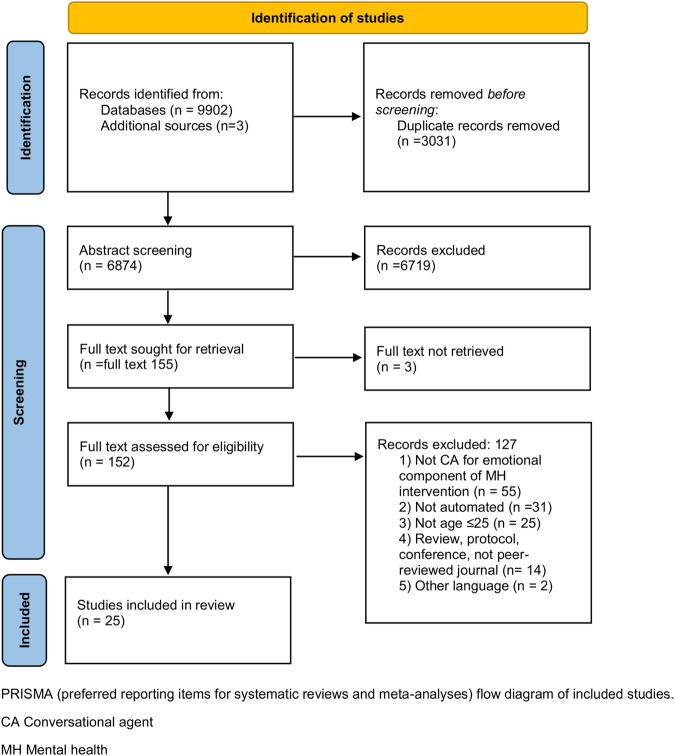
- The review screened 9905 records and included 25 studies; the included studies had N = 1707 participants, with most published between 2020 and 2023 and conducted mainly in the US (n = 12).
- Across the 25 studies, 21 different agents were identified; most were disembodied chatbots (n = 15), followed by robots (n = 7), and most used text as the communication channel (n = 13).
- The most common targets were anxiety (n = 12) and depression (n = 8); 20 studies tested standalone interventions and 5 used automated CAs as components embedded in other technologies or services.
- Feasibility/usability was generally positive, but safety concerns appeared in 2 studies; for example, one study reported 1 participant with suicidal tendency for the first time after the intervention, and another reported 4 (24%) participants with one alert for suicidal ideation, 4 with 3 alerts, and 2 with 6 alerts.
- Efficacy was mixed: for anxiety, 5 studies found a significant benefit versus control and 4 found no difference; for depression, 5 controlled studies found a significant benefit and 2 found no difference.
Methods
- Scoping review conducted according to PRISMA guidelines; protocol registered in OSF (ID 10.17605/OSF.IO/8KU6P).
- Searched in March 2023 across Web of Science, PubMed, Scopus, PsychInfo, ACM Digital Library, and IEEE Xplore, plus reference lists.
- Included English-language, peer-reviewed primary studies of fully autonomous CAs for young people with mean age ≤25 years; data were extracted by two reviewers and synthesized with descriptive statistics and narrative summary.
Limitations
- The paper states it included only peer-reviewed journal articles, so it may have missed relevant gray literature, conference proceedings, dissertations, and ongoing studies.
- The review was limited to the emotional component of mental health, not broader social, cognitive, or physical outcomes.
- The paper notes small sample sizes, mostly non-clinical populations, and substantial heterogeneity in how feasibility/usability and efficacy were measured, which limits generalizability and comparability.
- Evident from the text: the evidence base is mostly recent, predominantly from high-income countries, and has limited long-term follow-up, so conclusions about durability and applicability in low-income settings remain uncertain.
Model-written summary. Check it against the paper before relying on it.
Integrity signals
Registry
Cites
Statistics
Figures
Verification
Claims the paper makes
14 Valid · 9 Not valid · 15 Not checked · 77 Own results and interpretations
Some cited sources support this claim and some don’t — read each source’s verdict below.
In the paper
“Third, the previous reviews limited their focus to a subset of CAs based on the embodiment level, such as disembodied CAs13,20, CAs with virtual representation15, or with a physical representation23–25.”
§ Use of automated conversational agents in improving young population mental health: a scoping review > Introduction
What the sources say
- Not checked — no full text of the sourcecites [13] Lim SM Shiau CWC Cheng LJ Lau Y Chatbot-delivered psychotherapy for adults with depressive and anxiety symptoms: a systematic review and meta-regression Behav. Ther. 2022 53 334 347 10.1016/j.beth.2021.09.007 35227408 source
- Supportedcites [20] Car LT Conversational agents in health care: scoping review and conceptual analysis J. Med. Internet Res. 2020 22 e17158 10.2196/17158 32763886 PMC7442948 source
The Methods (Inclusion and Exclusion Criteria) explicitly exclude embodied, relational, animated, and other visually represented conversational agents. This supports citing the review as an example of a previous review focused on disembodied agents. (LLM, conf=0.92)
- Disputedcites [15] Provoost S Lau HM Ruwaard J Riper H Embodied conversational agents in clinical psychology: a scoping review J. Med. Internet Res. 2017 19 e151 10.2196/jmir.6553 28487267 PMC5442350 sourceExperimental — accuracy not yet measured
The Methods (Study Selection; page unavailable) explicitly include agents with either virtual or physical embodiment. The Introduction (Embodied Conversational Agents; page unavailable) likewise says embodiment ranges from on-screen characters to robots. This review was not limited to agents with virtual representation. (LLM, conf=0.90)
Checked by a reasoning model — may be wrong.
- Supportedcites [23] Bartl-Pokorny KD Robot-based intervention for children with autism spectrum disorder: a systematic literature review IEEE Access 2021 9 165433 165450 10.1109/ACCESS.2021.3132785 source
The Introduction describes the paper as a systematic review of social robots used in interventions for children with autism. The “Robots” section examines robots used in child–robot interactions and groups them by physical form, supporting its use as an example of a review focused on physically represented agents. The paper does not use the broader label “conversational agents,” but the citation identifies this embodiment-focused review rather than attributing a finding about all such agents to it. (LLM, conf=0.87)
- Supportedcites [24] Berrezueta-Guzman J Robles-Bykbaev VE Pau I Pesántez-Avilés F Martín-Ruiz M-L Robotic technologies in ADHD care: literature review IEEE Access 2022 10 608 625 10.1109/ACCESS.2021.3137082 source
The Introduction describes this as a review of robotic developments for ADHD treatment, and the Analysis of Results classifies studies by robot type. Its Humanoid Multipurpose Robots section discusses physical robots, so it fits the citing sentence’s example of a review focused on physically represented agents. (LLM, conf=0.90)
- Supportedcites [25] Kabacińska K Prescott TJ Robillard JM Socially assistive robots as mental health interventions for children: a scoping review Int. J. Soc. Robot. 2021 13 919 935 10.1007/s12369-020-00679-0 source
The Introduction describes this as a scoping review focused on social robots used to support children’s mental health. Section 3.1 identifies the robots reviewed, including physically embodied robots such as Nao and Paro, supporting its use as an example of a review focused on agents with a physical representation. (LLM, conf=0.88)
plain- Asserted: passes — The authors put it forward as true.
- Checkable: passes — It can be checked against evidence.
- Load-bearing: passes — The paper’s conclusions depend on it.
- Based: passes — The paper gives a reason why it holds.
At least one cited source doesn’t support this claim or points to a different paper, and none confirmed it — see the verdicts below.
In the paper
“Second, according to a meta-analysis, for self-guided digital interventions to be efficient for youths, at least minimal support from a human therapist is needed55.”
§ Use of automated conversational agents in improving young population mental health: a scoping review > Discussion
What the sources say
- Disputedcites [55] Bennett SD Practitioner review: unguided and guided self-help interventions for common mental health disorders in children and adolescents: a systematic review and meta-analysis J. Child Psychol. Psychiatry 2019 60 828 847 10.1111/jcpp.13010 30775782 sourceExperimental — accuracy not yet measured
The Meta-analysis section reports that all self-help subgroups, including unguided interventions, were more effective than controls; guidance was associated with larger effects, not shown to be necessary. The Discussion describes superiority of guided interventions as only potential, and the paper does not establish a minimum therapist-support requirement specifically for digital interventions. No page numbers are available in our copy. (LLM, conf=0.88)
Checked by a reasoning model — may be wrong.
plainstates a possible cause- Asserted: passes — The authors put it forward as true.
- Checkable: passes — It can be checked against evidence.
- Load-bearing: passes — The paper’s conclusions depend on it.
- Based: passes — The paper gives a reason why it holds.
- Disputed
At least one cited source doesn’t support this claim or points to a different paper, and none confirmed it — see the verdicts below.
In the paper
“the evidence supporting applicability of automated CAs in improving emotional health among youths is limited to non-clinical populations8”
§ Use of automated conversational agents in improving young population mental health: a scoping review > Discussion
What the sources say
- Disputedcites [8] Rossi S Using the Social Robot NAO for emotional support to children at a pediatric emergency department: randomized clinical trial J. Med. Internet Res. 2022 24 e29656 10.2196/29656 34854814 PMC8796042 sourceExperimental — accuracy not yet measured
The Introduction (page unavailable) says the study tested a social robot with children attending a pediatric emergency department, and the Results report a greater decrease in salivary cortisol after robot interaction than in the comparison groups. The paper therefore provides evidence from a clinical setting, contrary to the claim that evidence is limited to non-clinical populations. It measures stress through cortisol rather than directly assessing emotional health with a psychological test. (LLM, conf=0.88)
Checked by a reasoning model — may be wrong.
plain- Asserted: passes — The authors put it forward as true.
- Checkable: passes — It can be checked against evidence.
- Load-bearing: passes — The paper’s conclusions depend on it.
- Based: passes — The paper gives a reason why it holds.
- Disputed
Some cited sources support this claim and some don’t — read each source’s verdict below.
In the paper
“Second, engagement and adherence appear to decrease over time29,31.”
§ Use of automated conversational agents in improving young population mental health: a scoping review > Discussion
What the sources say
- Disputedcites [29] Gabrielli S Rizzi S Carbone S Donisi V A chatbot-based coaching intervention for adolescents to promote life skills: pilot study JMIR Hum. Factors 2020 7 e16762 10.2196/16762 32130128 PMC7055808 sourceExperimental — accuracy not yet measured
The Results (Phase 2; page unavailable) report that all 21 participants completed all eight coaching sessions over four weeks, contrary to declining adherence in this study. The paper does not report a longitudinal decline in engagement. (LLM, conf=0.76)
Checked by a reasoning model — may be wrong.
- Partly supportedcites [31] He Y Mental health chatbot for young adults with depressive symptoms during the COVID-19 pandemic: single-blind, three-arm randomized controlled trial J. Med. Internet Res. 2022 24 e40719 10.2196/40719 36355633 PMC9680932 sourceExperimental — accuracy not yet measured
The Results (Adherence and Attrition) report additional dropouts by the 1-month follow-up, supporting declining adherence. But Results (Use and Engagement) and Discussion (Principal Findings) describe fluctuating engagement that was high both early and near the end of the 1-week intervention, not a steady decrease. (LLM, conf=0.84)
hedgedstates an association- Asserted: passes — The authors put it forward as true.
- Checkable: passes — It can be checked against evidence.
- Load-bearing: passes — The paper’s conclusions depend on it.
- Based: passes — The paper gives a reason why it holds.
- Disputed
Every source the paper cites for this claim was checked and supports it.
In the paper
“there is evidence pointing to youth preference towards an interaction with CAs using speech and auditory channels beyond text48”
§ Use of automated conversational agents in improving young population mental health: a scoping review > Discussion
What the sources say
- Supportedcites [48] Nguyen, H. Examining teenagers’ perceptions of conversational agents in learning settings. In Interaction Design and Children 374–381 (ACM, Braga Portugal,). 10.1145/3501712.3529740 (2022). source
Section 4.2.4 (Multimodal Output; page not provided) reports that participants expected CAs to interact through auditory and visual channels beyond text, and describes their desired agent voices and sounds. This supports the cited statement about a youth preference for speech and auditory interaction beyond text. (LLM, conf=0.90)
hedged- Asserted: passes — The authors put it forward as true.
- Checkable: passes — It can be checked against evidence.
- Load-bearing: unclear — It is unclear whether the paper’s conclusions depend on it.
- Based: passes — The paper gives a reason why it holds.
- Supported
45 more claims · 8 with their cited sources checked
Create a free account to see all 115 claims and to verify the 2 references still open.
- It may state two separate claims as one. 42
- Probably not a substantial claim. 30
- The quote only partly states this claim. 4
Self-check
Percentages, sums and reported differences re-computed from the paper’s own numbers.
Self-check results appear here once an independent check has confirmed them.
Cited works that were retracted
Works this paper cites that were later retracted, from the retraction notices publishers deposit. Major when the notice came out before this paper was published.
A note, not an issue: for example, a cited work that was retracted only after this paper was published, which its authors could not have known.
In the paper
“Most of the interventions last between 2-and 4-weeks ( n = 8) 8,10,29,38 – 40,42 – 44 , followed by interventions with a duration of 1 day or less ( n = 5) 9,28,34,41,45 , and interventions of 2 up to 7 days ( n = 3) 26,31,33 .”
Cited work 10.1186/s13034-022-00519-1 · retracted 2024-10-14 · notice 10.1186/s13034-024-00830-z · this paper published 2024-03-19
Citations
Cites
1 retracted
Tanaka, K., Hayakawa, M., Noda, C., Nakamura, A., & Akiyama, C. (2022) · Child and Adolescent Psychiatry and Mental Health · doi:10.1186/s13034-022-00519-1 · Cited by 11 · cited 9×
“Most of the interventions last between 2-and 4-weeks ( n = 8) 8,10,29,38 – 40,42 – 44 , followed by interventions with a duration of 1 day or less ( n = 5) 9,28,34,41,45 , and interventions of 2 up to 7 days ( n = 3) 26,31,33 .”
InfluentialRetractedPRISMA Extension for Scoping Reviews (PRISMA-ScR): Checklist and Explanation
Tricco, A. C., Lillie, E., Zarin, W., O'Brien, K. K., Colquhoun, H., Levac, D., Moher, D., Peters, M. D. J., Horsley, T., Weeks, L., et al. (2018) · Annals of Internal Medicine · doi:10.7326/m18-0850 · Cited by 43,565 · cited 1×
“The scoping review was conducted in line with the PRISMA (Preferred Reporting Items for Systematic Reviews and Meta-Analyses) guidelines for conducting systematic scoping reviews 56 .”
Fitzpatrick, K. K., Darcy, A., & Vierhile, M. (2017) · JMIR Mental Health · doi:10.2196/mental.7785 · Cited by 2,730
Conversational agents in healthcare: a systematic review
Laranjo, L., Dunn, A. G., Tong, H. L., Kocaballi, A. B., Chen, J., Bashir, R., Surian, D., Gallego, B., Magrabi, F., Lau, A. Y. S., et al. (2018) · Journal of the American Medical Informatics Association · doi:10.1093/jamia/ocy072 · Cited by 1,388 · cited 1×
“One such cutting edge digital solution is conversational agents (CAs), de fi ned as systems simulating human interaction using text, speech, gestures, facial, or sensorial expressions as input and/or output 5 .”
Araujo, T. (2018) · Computers in Human Behavior · doi:10.1016/j.chb.2018.03.051 · Cited by 1,156 · cited 1×
“The category of CAs covers a broad spectrum of embodiment types, from dis-embodied agents with no dynamic physical representation (chatbots) to agents with virtual representation or robots with a physical representation 6 .”
Cochrane Rapid Reviews Methods Group offers evidence-informed guidance to conduct rapid reviews
Garritty, C., Gartlehner, G., Nussbaumer-Streit, B., King, V. J., Hamel, C., Kamel, C., Affengruber, L., & Stevens, A. (2021) · Journal of Clinical Epidemiology · doi:10.1016/j.jclinepi.2020.10.007 · Cited by 1,141
Werner-Seidler, A., Perry, Y., Calear, A. L., Newby, J. M., & Christensen, H. (2017) · Clinical Psychology Review · doi:10.1016/j.cpr.2016.10.005 · Cited by 773 · cited 1×
“First, most of the automated CAs interventions reviewed here were in fact universal prevention, directed at youths from the general population, with initial low levels of mental health problems and consequently with limited room for improvement 54 .”
Aguirre Velasco, A., Cruz, I. S. S., Billings, J., Jimenez, M., & Rowe, S. (2020) · BMC Psychiatry · doi:10.1186/s12888-020-02659-0 · Cited by 736 · cited 1×
“Despite high prevalence and long-term negative consequences of mental health problems, most children and youths do not participate in preventive or intervention actions because of attitudinal or logistic barriers 3 .”
Fulmer, R., Joerin, A., Gentile, B., Lakerink, L., & Rauws, M. (2018) · doi:10.2196/preprints.9782 · Cited by 715
Conversational Agents in Health Care: Scoping Review and Conceptual Analysis
Tudor Car, L., Dhinagaran, D. A., Kyaw, B. M., Kowatsch, T., Joty, S., Theng, Y.-L., & Atun, R. (2020) · Journal of Medical Internet Research · doi:10.2196/17158 · Cited by 553 · cited 4×
“This contrastswithresearchconductedonsubsetsofCAsorwithadults,that identi fi ed mainly pilot uncontrolled studies investigating their feasibility and usability 20 .”
Influential
Cited by
Lee, H. S., Wright, C., Ferranto, J., Buttimer, J., Palmer, C. E., Welchman, A., Mazor, K. M., Fisher, K. A., Smelson, D., O’Connor, L., et al. (2025) · Frontiers in Psychiatry · doi:10.3389/fpsyt.2024.1505024 · Cited by 55
Li, J., Li, Y., Hu, Y., Ma, C. F., Mei, X., Chan, E. A., & Yorke, J. (2025) · Worldviews on Evidence-Based Nursing · doi:10.1111/wvn.70059 · Cited by 87
Large Language Models in Biomedical and Health Informatics: A Review with Bibliometric Analysis
Yu, H., Fan, L., Li, L., Zhou, J., Ma, Z., Xian, L., Hua, W., He, S., Jin, M., Zhang, Y., et al. (2024) · Journal of Healthcare Informatics Research · doi:10.1007/s41666-024-00171-8 · Cited by 101
Risks from Language Models for Automated Mental Healthcare: Ethics and Structure for Implementation
Grabb, D., Lamparth, M., & Vasan, N. (2024) · doi:10.1101/2024.04.07.24305462 · Cited by 40
“…et al., 2023), deliver treatment in the form of increasingly automated psychotherapy or conversational agent (Thieme et al., 2023; Li et al., 2023; Balan et al., 2024), aid in psychiatric diagnosis (Kasula, 2023), and investigated the use of AI to analyze biometric data in the setting of stress…”
BackgroundRisks from Language Models for Automated Mental Healthcare: Ethics and Structure for Implementation
Grabb, D., Lamparth, M., & Vasan, N. (2024) · arXiv · doi:10.48550/arxiv.2406.11852 · Cited by 39
Conversational AI in Pediatric Mental Health: A Narrative Review
Mansoor, M. A., Hamide, A., & Tran, T. (2025) · Children · doi:10.3390/children12030359 · Cited by 59
“These special considerations must inform both research and practice to ensure that these technologies appropriately address the unique needs of children and adolescents.”
Park, J., Singh, V. K., & Wiśniewski, P. (2025) · JMIR Medical Informatics · doi:10.2196/62758 · Cited by 39
“Recently, Balan et al [16] conducted a scoping review of 25 studies on CAs designed to improve the emotional components of mental health (eg, depression and anxiety) of the young population and found that although usability outcomes are optimistic, the clinical effectiveness of CA-based mental…”
Artificial Intelligence in Social Work: An EPIC Model for Practice
Boetto, H. (2025) · Australian Social Work · doi:10.1080/0312407x.2025.2488345 · Cited by 43
“For example, a scoping review of AI-powered chatbots found limited evidence supporting the efficacy of chatbots for improving mental health in young people (Balan et al., 2024).”
Ohu, F. C., Burrell, D. N., & Jones, L. A. (2025) · Healthcare · doi:10.3390/healthcare13212721 · Cited by 32
“Reviews of youth-focused agents report mixed but promising effects with careful caveats for safety and reporting quality [14,18].”
Уэтова, Е., Hederman, L., Ross, R., & O’Sullivan, D. M. (2024) · Digital Health · doi:10.1177/20552076241277693 · Cited by 17
The problem of atypicality in LLM-powered psychiatry
Garcia, B., Chua, E. Y. S., & Brah, H. S. (2025) · Journal of Medical Ethics · doi:10.1136/jme-2025-110972 · Cited by 11
“2 3 These technologies, like chatbot-assisted psychotherapy, have shown some promise in helping patients with autism spectrum disorder, panic disorder and compulsive behaviours by offering convenient, stigma-free support, 4 5 promising 24 / 7 access to therapy on demand.”
InfluentialHealth Care Social Robots in the Age of Generative AI: Protocol for a Scoping Review
Lempe, P. N., Guinemer, C., Fürstenau, D., Dressler, C., Balzer, F., & Schaaf, T. (2025) · JMIR Research Protocols · doi:10.2196/63017 · Cited by 9
The Therapist in the Machine: Confronting AI’s Challenge to Clinical Social Work
Victor, B. G., & Goldkind, L. (2025) · Journal of Technology in Human Services · doi:10.1080/15228835.2025.2500827 · Cited by 10
“In studies involving Wysa, users engaged frequently and voluntarily, with sustained use over weeks and high ratings for ease of access and confidentiality (Balan et al., 2024; Esmaeilzadeh et al., 2025).”
Kutá, B., Novák, L., Žídková, R., Fürstová, J., Maliňáková, K., de Winter, A. F., & Hušek, V. (2025) · JMIR Mental Health · doi:10.2196/82642 · Cited by 15
“The therapeutic approach that is most commonly integrated into CAs, cognitive behavioral therapy [44], appears to be more effective in reducing negative affect than in enhancing positive affect [45].”
Leung, W. K. C., Lam, S. C., Chan, B. C. L., Chow, J. N. L., Wong, Y. Y. Y., Ng, F., Yip, C. C. K., & Chan, A. C. K. (2026) · BMJ Health & Care Informatics · doi:10.1136/bmjhci-2025-101479 · Cited by 10
Mutluer, T., Fıçıcıoğlu, İ. E. G., Uysal, M., Ekinci, S., Coskun, C. N., Mete, H. K., Çaltıner, Ş. N. İ., Bugay, B. Z., Sever, E., & Başdoğan, Ç. (2026) · European Child & Adolescent Psychiatry · doi:10.1007/s00787-025-02867-7 · Cited by 13
Chatbots as Tools for Psychoeducation and Self-Help in Mental Health
Sowbarnika, A., Patra, A., Kaur, L., Suresh, S., Srivastava, S., & Chawla, D. (2025) · Advances in medical technologies and clinical practice book series · doi:10.4018/979-8-3693-3112-5.ch003 · Cited by 8
Emerging AI Individualism: how young people integrate social AI into everyday lifePreprint
Brandtzæg, P. B., Skjuve, M. B., & Følstad, A. (2024) · SSRN Electronic Journal · doi:10.2139/ssrn.4836120 · Cited by 5
Peng, X., QIAN, Y., & He, Y. (2026) · Frontiers in Psychology · doi:10.3389/fpsyg.2025.1724313 · Cited by 10
Technological mourning after AI updates: mental health and well-being in the GPT-4o/GPT-5 transition
Donard, V., & Ribeiro, J. C. (2026) · Academia Mental Health and Well-Being · doi:10.20935/mhealthwellb8256 · Cited by 9
AI-based treatment of psychological conditions: the potential use, benefits and drawbacks
Baber, M., & Baker, B. (2025) · Exploration of Digital Health Technologies · doi:10.37349/edht.2025.101143 · Cited by 4
Bäckström, M. K., Girdler, S. J., Milbourn, B. T., & Lexén, A. (2025) · JMIR Formative Research · doi:10.2196/71563 · Cited by 4
“Research [62,63] has shown that chatbots can be acceptable and efficacious in supporting mental health, provided they make accurate assumptions and personalize the interactions with each user.”
Ferland, L., Owan, R., Kunkel, Z., Qu, H., Gini, M. L., & Koutstaal, W. (2025) · ACM Transactions on Interactive Intelligent Systems · doi:10.1145/3725738 · Cited by 3
Mok, C. H. Y., Cheng, C. P. W., & Chu, M. H. W. (2025) · Frontiers in Psychiatry · doi:10.3389/fpsyt.2025.1692177 · Cited by 4
Madera, F., Nicodemo, G., Guasco, S., Ciulli, T., & Cardinali, P. (2026) · European Psychologist · doi:10.1027/1016-9040/a000580 · Cited by 2
Li, J., Zhang, T. G., Cheung, J. P. Y., Meng, N., Wu, Z., Ma, D. C. F., Chan, E. A., Yu, L., Cao, Y., & Li, M. (2025) · BMJ Open · doi:10.1136/bmjopen-2025-098734 · Cited by 5
“39 However, no study has yet explored the potential of chat-bots to deliver psychological health interventions specifically for teenagers with AIS.”
Xie, Y., Fadahunsi, K. P., Broughan, J., O’Donoghue, J., Gallagher, J., & Cullen, W. (2025) · PLoS ONE · doi:10.1371/journal.pone.0321426 · Cited by 5
Abbasi, N. I., Levinson, L., Šabanović, S., & Güneş, H. (2026) · ACM/IEEE International Conference on Human-Robot Interaction (HRI) · doi:10.1145/3757279.3785611 · Cited by 2
Pareek, S., & Jain, G. (2026) · Journal of College Student Mental Health · doi:10.1080/28367138.2026.2653092 · Cited by 1
Orchard, N. A., Duister, S., Zhang, R., Guan, K., Vegt, N., de Reuver, M., & Figueroa, C. A. (2026) · ACM Transactions on Computing for Healthcare · doi:10.1145/3810945 · Cited by 2
Kutá, B., Novák, L., Žídková, R., Fürstová, J., Maliňáková, K., de Winter, A. F., & Hušek, V. (2025) · doi:10.2196/preprints.82642
Shepperson, C., Chen, H.-M., & Quek, K. M. (2026) · International Journal of Systemic Therapy · doi:10.1080/2692398x.2026.2629637 · Cited by 1
Dynamic Therapeutic Style Adaptation in LLM-based Chatbots: A Psychologist ChatBot
Chandan, D., & Naveen, S. (2025) · IEEE India Conference · doi:10.1109/indicon68490.2025.11392985
“This LLM-as-Judge paradigm has been successfully applied in evaluating open-domain generation [13], free-form responses [14], and model capabilities [15].”
Schuchmann, V. A., & Trubitsyna, O. (2025) · Ukrainian Journal of Applied Economics and Technology · doi:10.36887/2415-8453-2025-4-60
Sun, J., Ma, S., Fan, Y., & Washington, P. Y. (2026) · Applied Sciences · doi:10.3390/app16073388 · Cited by 1
The Emotional Infrastructure of Omnichannel Communication: Rethinking Bot-Human Interaction
Palomino-Flores, P., Palomino-Flores, O., Benavides, K. B., & Carvache-Franco, O. (2026) · Smart innovation, systems and technologies · doi:10.1007/978-3-032-16288-5_27
LLM-Powered Conversational Therapy System with Journaling and Cognitive Reframing Capabilities
Farhan, S. A., Udhayadhanush, E., & Poonkuzhali, R. (2026) · International Conference on Expert Clouds and Applications (ICOECA) · doi:10.1109/icoeca68095.2026.11485531
Cuentas, M. I. C., Enriquez, J. F. A., Dongo, I., Paredes-Gonzales, Y., Unda, A. J. M., Shishupal, S., & Villarreal‐Zegarra, D. (2026) · doi:10.2196/preprints.95501
Rule-based chatbot application for adolescents with anxiety: a feasibility study
Kahlon, S., Gulseth, R., & Nordgreen, T. (2026) · Computers in Human Behavior Reports · doi:10.1016/j.chbr.2026.101085
Kanoh, H. (2025) · International Conference on Education and E-Learning (ICEEL) · doi:10.1145/3789859.3789906
Yang, H., Liu, J., Li, L., Jiang, R., Lou, Q., Sun, W., & Zhou, C. (2026) · BMC Medical Ethics · doi:10.1186/s12910-026-01510-7
“Beyond its utility as a technical metric, attrition serves as a critical interface between empirical performance and normative bioethics, particularly regarding the “continuity of care” [52, 53].”
Research on the Design of Health Education Products Integrating Multimodal Interaction
Zhang, M. (2026) · International Conference on Artificial Intelligence in Education Technology and Data Science · doi:10.1145/3810158.3810181
“Balan et al. [7] found that conversational agents can initially gain high acceptance; However, the educational effect is not stable due to a lack of need analysis, coarse content association and poor feedback continuation mechanism.”
Poulsen, A., Hickie, I. B., Gorban, C., de Haan, Z., Small, D. R., Hutcheon, A., Capon, W., Iorfino, F., & LaMonica, H. M. (2026) · doi:10.2196/preprints.105593
Psicoterapia e Intelligenza Artificiale: possibilità o minaccia?
Resicato, G. (2026) · RIVISTA DI PSICOTERAPIA RELAZIONALE · doi:10.3280/pr2026-063002
Ye, H., & Minghui, Y. (2026) · BMJ Paediatrics Open · doi:10.1136/bmjpo-2026-004699
“6 However, for self-harming adolescents, avoidance often emerges before any sustained use, driven by shame, fear of exposure and distrust.”
Bruno, G., Garofalo, C., Delvecchio, E., Buratta, L., Salmi, L. P., & Mazzeschi, C. (2026) · International Journal of Human-Computer Interaction · doi:10.1080/10447318.2026.2712659 · Cited by 1
Erdem, G., Kafesçioğlu, N., & Başer, G. (2026) · Journal of Marital and Family Therapy · doi:10.1111/jmft.70168
“While AI‐based psychotherapy provide rapid symptom relief (Balan et al. 2024; Li et al. 2023), the gains are not maintained in the long term (Zhong et al. 2024).”
Hu, R., Kong, J., Yang, Y., Yang, Y., Liu, J., Tang, H., Zhang, S., & Liu, Z. (2026) · doi:10.2196/preprints.112162
Wrzosek, K., Udrycka, K., Kuchta, K., Poleszak, J., Leśniak, M., & Kowalewski, P. (2026) · International Journal of Innovative Technologies in Social Science · doi:10.31435/ijitss.3(51).2026.6484
Evidence and Future Directions for Pediatric Health Care Chatbots: Systematic Review
Yang, S., Jin, J. H., You, S. C., Kim, S. Y., & Kim, K. W. (2026) · Journal of Medical Internet Research · doi:10.2196/98432
“Additionally, unlike previous reviews [40,41], the strict age criterion ( 19 y) excluded research that grouped adolescents with young adults.”
Yaacob, N. M., Doheir, M., Algumaei, A. H., Al-Andoli, M. N., Alsayaydeh, J. A. J., Elzamly, A., & Basari, A. S. (2026) · Frontiers in Child and Adolescent Psychiatry · doi:10.3389/frcha.2026.1905782
Jent, J. F., Mannweiler, M. D., Malave, K. Y., Mirza, A., Ogihara, M., Alonso, B., Juan, J. S., Davis, E., Sobalvarro, C., & Garcia, D. (2026) · JMIR Formative Research · doi:10.2196/105131
Metadata
- Authors
- Balan, R., Dobrean, A., & Poetar, C. R.
- Affiliations
- Babeș-Bolyai University (RO)
- Corresponding author
- Dobrean, Anca
- Venue
- npj Digital Medicine
- Published
- 2024-03-19
- Volume
- 7
- Issue
- 1
- Pages
- 75-75
- ISSN
- 2398-6352 (ISSN-L)
- PMC
- PMC10951258
- OpenAlex
- W4392946041
- Cited by
- 56
- References
- 56
- Citations by year
- 2026: 31 · 2025: 19 · 2024: 6
- FWCI
- 3.39
- Type
- journal article
- Language
- en
- Open access
- gold
- doi.org
- Licence
- cc-by
- creativecommons.org/licenses/by/4.0 (tdm)
- creativecommons.org/licenses/by/4.0 (vor)
- Locations
- npj Digital Medicine (publishedVersion, cc-by)
- PubMed Central (publishedVersion, cc-by)
- PubMed (publishedVersion)
- DOAJ (DOAJ: Directory of Open Access Journals) (submittedVersion, cc-by-sa)
- Topics
- Social Sciences › Psychology › Applied Psychology › Digital Mental Health Interventions
- Social Sciences › Psychology › Social Psychology › Social Robot Interaction and HRI
- Physical Sciences › Computer Science › Artificial Intelligence › Emotion and Mood Recognition
- Keywords
- chatbots, youth, youth mental health, anxiety, depression, digital mental health interventions, emotional well-being, feasibility and usability, clinical efficacy
About these checks
Registry, retraction, Cites and statistics results are computed, not judged, with one exception: a printed reference that no index lists is read once by a model before it counts as a citation error. Claims are extracted by a model and kept only when their quote appears verbatim in the text; each cited source is then checked, with a model’s help, for whether it says what the claim relies on. Those verdicts can be wrong — read the claim’s quote and the cited source before relying on one.
The claim verdicts this report counts are experimental: their accuracy is not yet measured.
A language model drew the claims from the paper on 2026-10-11, under version 3 of the claim definition (model deepseek-v4.1-flash, prompt extract-v3).
A second model labelled each claim on 2026-10-11 (model jev-1.13-20260917, definition revision gold-guideline-v0.2).
Cited sources are checked with a language model’s help (gpt-6-sol).
Statistics and arithmetic are recomputed, not judged.
Confidence bands are shown only for fields calibrated on our annotated test set. None is calibrated yet, so no band is shown.
What counts as a claim ›How we measure confidence ›How we check this ›
Are you an author, or do you see a problem with this page? Request a review
Data sources
Bibliographic data: Semantic Scholar, OpenAlex, Crossref.
Contains information from the Semantic Scholar Academic Graph Datasets, made available under the ODC Attribution License (ODC-BY 1.0).
Semantic Scholar’s data is described in: Kinney, R., et al. (2023). The Semantic Scholar Open Data Platform. arXiv:2301.10140.
