

A scoping review of robustness concepts for machine learning in healthcare
Open accessThe DOI matches its Crossref record; 61 of the 68 references it cites were found in a registry or an index; 12 of the 31 sources its claims cite were checked for support.
Abstract
While machine learning-based solutions have demonstrated strong performance, robustness remains ambiguous and often overlooked. Eight general concepts of robustness emerged from 274 included records.
Overview
CoChat Summary
TL;DR
This scoping review mapped how robustness is defined in healthcare machine learning literature and found 8 distinct robustness concepts across 274 eligible records. The concepts differed by data type and model type, suggesting that “robustness” is not a single uniform property in healthcare ML.
Key findings
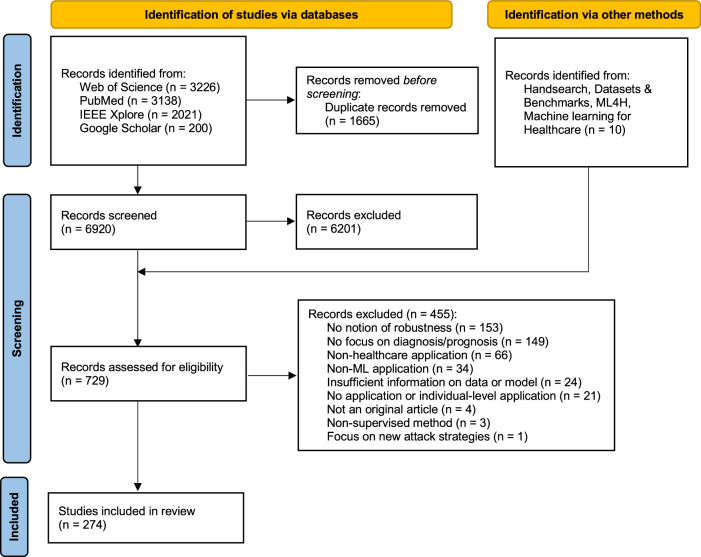
- The review included 274 eligible records from 8585 initially retrieved records; 190 (69%) were journal articles and 81 (30%) were from conferences, workshops, or symposiums.
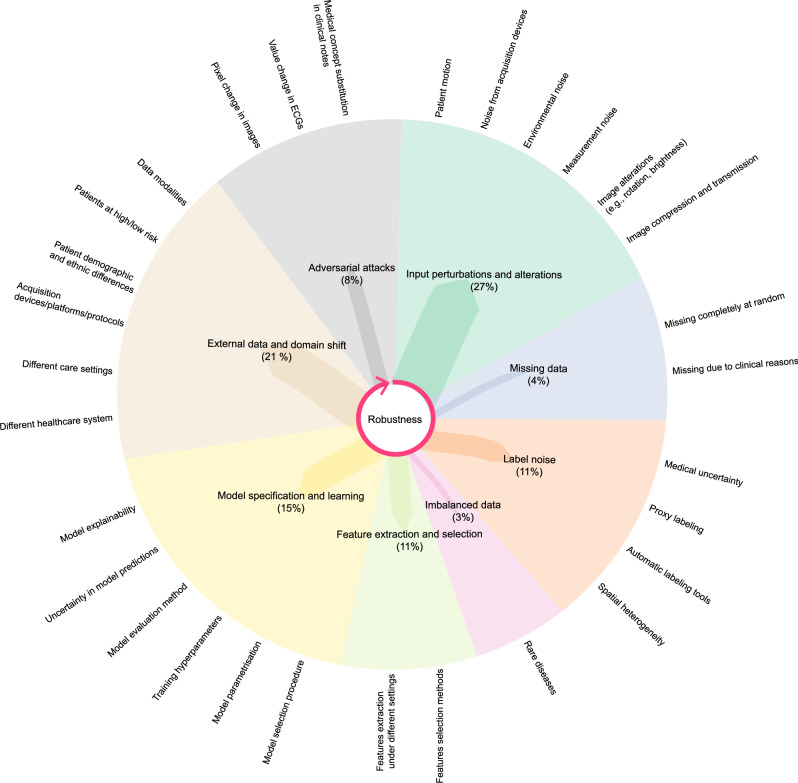
- Across 526 extracted combinations, the authors identified 8 robustness concepts: input perturbations and alterations, missing data, label noise, imbalanced data, feature extraction and selection, model specification and learning, external data and domain shift, and adversarial attacks.
- The most frequently addressed concept was input perturbations and alterations (142/526, 27%), while imbalanced data was the least commonly tackled (15/526, 3%).
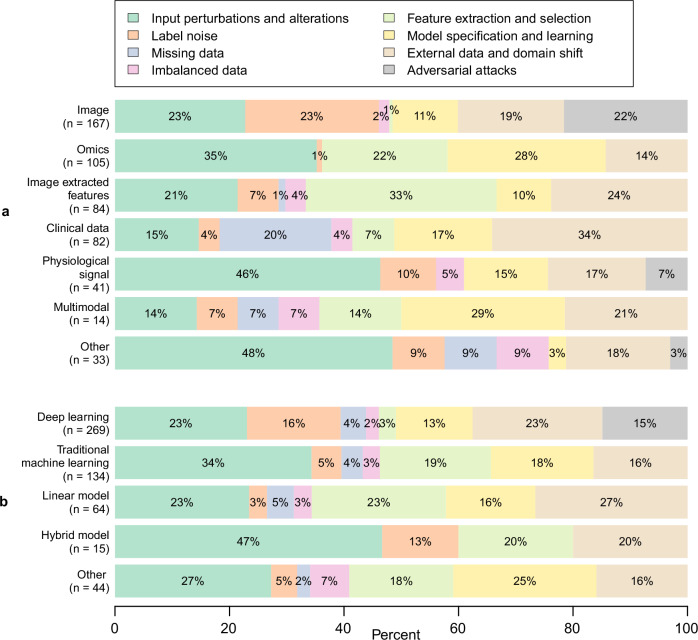
- Robustness concepts varied by data and model: feature extraction/selection was mainly emphasized in image-derived data (33%) and omics (22%); adversarial attacks were mainly tackled in image (22%) and physiological signal data (7%); missing data was mostly addressed in clinical data (20%); deep learning applications covered the most concepts (8) and hybrid models the fewest (4).
Methods
- This was a scoping review conducted and reported per Joanna Briggs Institute methodology and PRISMA-ScR, with a protocol uploaded on Open Science Framework.
- The authors searched PubMed, IEEE Xplore, and Web of Science (search date: 1 March 2023), plus grey literature sources (Google Scholar, conference/workshop websites) and reference lists; they included English records with abstracts on supervised or semi-supervised ML models for healthcare decision support.
- Data extraction captured medical application, model, data type, notion of robustness, and robustness metrics; extracted records were categorized by medical specialty, model class, and data type, then robustness notions were grouped into general concepts through iterative reviewer discussion.
Limitations
- The paper states it was not meant to provide or assess methods for “robustifying” a model; it only maps robustness concepts.
- The review is mostly restricted to studies using the terms “robust,” “noise,” and “perturbation”; the authors note that using other terms (e.g., stability, resilience, reliability, vulnerability) might have yielded different studies.
- The review is temporally limited and does not include more recent foundation-model studies published after the search date.
- Evident from the text: the search was limited to English-language records with abstracts, and the screening/search strategy may therefore have missed relevant non-English or abstractless studies.
Model-written summary. Check it against the paper before relying on it.
Integrity signals
Registry
Cites
Statistics
Figures
Verification
Claims the paper makes
8 Valid · 0 Not valid · 10 Not checked · 43 Own results and interpretations
The cited sources support only part of this claim — read each source’s verdict below.
In the paper
“studies that evaluate the robustness to various data distributions through external validation inherently address the generalizability of the model19–22.”
§ A scoping review of robustness concepts for machine learning in healthcare > Discussion
What the sources say
- Not checked — no full text of the sourcecites [19] Kyung, S. et al. Improved performance and robustness of multi-task representation learning with consistency loss between pretexts for intracranial hemorrhage identification in head CT. Med. Image Anal. 81, 102489 (2022). 35939912 source
- Not checked — no full text of the sourcecites [20] Valliani, A. A. et al. Robust Prediction of Non-home Discharge After Thoracolumbar Spine Surgery With Ensemble Machine Learning and Validation on a Nationwide Cohort. World Neurosurg. 165, e83–e91 (2022). 35654334 source
- Supportedcites [21] Huo, J., Wu, L. & Zang, Y. Development and Validation of a Robust Immune-Related Prognostic Signature for Gastric Cancer. J. Immunol. Res. 2021, 5554342 (2021). 34007851 PMC8110424 source
Section 2.4 reports external validation in three independent cohorts. The Results (§3.4) describe consistent findings across those cohorts, and the Discussion says the risk score showed “universal applicability via internal and external validation.” Together, these support the cited paper as an example of using external validation to assess robustness and generalizability. (LLM, conf=0.85)
- Partly supportedcites [22] Zhang, W. et al. A Novel and Robust Prognostic Model for Hepatocellular Carcinoma Based on Enhancer RNAs-Regulated Genes. Front. Oncol. 12, 849242 (2022). 35646665 PMC9133429 sourceExperimental — accuracy not yet measured
Methods §2.2 says the authors used an external HCC dataset to assess the model’s predictive capability and generalization, and Discussion §4 links its external-validation performance to robustness. The paper does not report testing robustness across various data distributions; Discussion §4 also says a multicenter study is needed to further establish generalizability. Page numbers were not provided in our copy. (LLM, conf=0.82)
plainstates a cause- Asserted: passes — The authors put it forward as true.
- Checkable: passes — It can be checked against evidence.
- Load-bearing: unclear — It is unclear whether the paper’s conclusions depend on it.
- Based: passes — The paper gives a reason why it holds.
The cited sources support only part of this claim — read each source’s verdict below.
In the paper
“the large number based on omics can be ascribed to The Cancer Genome Atlas Program (TCGA), a publicly available collection of genomes that was developed mainly for cancer-related research42.”
§ A scoping review of robustness concepts for machine learning in healthcare > Discussion
What the sources say
- Partly supportedcites [42] Weinstein, J. N. et al. The Cancer Genome Atlas Pan-Cancer Analysis Project. Nat. Genet. 45, 1113–1120 (2013). 24071849 PMC3919969 sourceExperimental — accuracy not yet measured
The Pan-Cancer Project section describes TCGA’s cancer-focused datasets across genomic, epigenomic, transcriptional and proteomic platforms. From Many Tumours to the Individual Patient says the datasets are publicly available and a resource for cancer analysis. It does not establish that TCGA accounts for the large number of omics-based applications. (LLM, conf=0.85)
plainstates a cause- Asserted: passes — The authors put it forward as true.
- Checkable: passes — It can be checked against evidence.
- Load-bearing: unclear — It is unclear whether the paper’s conclusions depend on it.
- Based: passes — The paper gives a reason why it holds.
- Partly supported
The cited sources support only part of this claim — read each source’s verdict below.
In the paper
“addressing the robustness of the model to specific minority groups directly relates to the notion of fairness23–25.”
§ A scoping review of robustness concepts for machine learning in healthcare > Discussion
What the sources say
- Partly supportedcites [23] Guan, Y. et al. Assessment of the timeliness and robustness for predicting adult sepsis. iScience 24, 102106 (2021). 33659874 PMC7895752 sourceExperimental — accuracy not yet measured
The Results section evaluates sepsis-model performance across age, gender, and racial groups, including a small Asian subgroup for which performance was slightly worse (page unavailable). That supports the subgroup-robustness part of the claim, but our copy does not explicitly connect this evaluation to fairness. (LLM, conf=0.82)
- Not checked — no full text of the sourcecites [24] Khoshnevisan, F. & Chi, M. Unifying Domain Adaptation and Domain Generalization for Robust Prediction Across Minority Racial Groups. in Machine Learning and Knowledge Discovery in Databases. Research Track (eds. Oliver, N., Pérez-Cruz, F., Kramer, S., Read, J. & Lozano, J. A.) 521–537 (Springer International Publishing, Cham, 2021). 10.1007/978-3-030-86486-6_32. source
- Partly supportedcites [25] Lu, Y. et al. Robust Speech and Natural Language Processing Models for Depression Screening. in 2020 IEEE Signal Processing in Medicine and Biology Symposium (SPMB) 1–5 (2020). 10.1109/SPMB50085.2020.9353611. sourceExperimental — accuracy not yet measured
Our copy does carry the robustness-across-subgroups element: the Introduction states the goal of assessing how models 'will generalize over specific speaker and temporal variables', Section IV and Table 2 report per-subset AUCs broken down by ethnicity (Caucasian, African American, Hispanic, Asian American, Mixed), age, gender and location, with significantly lower acoustic-model performance for Hispanic speakers and the 26-35 age group (p<0.05, DeLong test). However, nothing in our copy connects this subgroup robustness to the notion of 'fairness' — searches for fairness, bias, equity, disparate impact and minority-group framing returned no passage using or discussing that concept; the paper's own vocabulary is robustness, generalization and consistency. The fairness linkage asserted in the citing sentence is therefore not attributable to this source (it is carried, if at all, by the other citations in the 23-25 group). (LLM, conf=0.68)
plainstates an association- Asserted: passes — The authors put it forward as true.
- Checkable: passes — It can be checked against evidence.
- Load-bearing: unclear — It is unclear whether the paper’s conclusions depend on it.
- Based: passes — The paper gives a reason why it holds.
- Partly supported
The cited sources support only part of this claim — read each source’s verdict below.
In the paper
“Studies addressing missing data were not limited to a particular missingness mechanism (e.g., missing completely at random, missing at random, missing not at random)31,32.”
§ A scoping review of robustness concepts for machine learning in healthcare > Discussion
What the sources say
- Partly supportedcites [31] Çallı, E. et al. Deep learning with robustness to missing data: A novel approach to the detection of COVID-19. PloS One 16, e0255301 (2021). 34329354 PMC8323880 sourceExperimental — accuracy not yet measured
The Data and methods > Data section (page unavailable) describes experiments with random subsets of inputs and two clinically motivated subsets, so the study did not examine only randomly selected missing inputs. It does not classify those scenarios as missing completely at random, missing at random, or missing not at random, or establish robustness across those mechanisms. (LLM, conf=0.78)
- Not checked yetcites [32] Ramoni, M., Sebastiani, P. & Dybowski, R. Robust outcome prediction for intensive-care patients. Methods Inf. Med. 40, 39–45 (2001). 11310158 source
Checked before — its earlier verdict is held back until a new check runs.
plain- Asserted: passes — The authors put it forward as true.
- Checkable: passes — It can be checked against evidence.
- Load-bearing: unclear — It is unclear whether the paper’s conclusions depend on it.
- Based: passes — The paper gives a reason why it holds.
- Partly supported
The cited sources support only part of this claim — read each source’s verdict below.
In the paper
“Label noise can also derive from human uncertainty when using the consensus of multiple annotators, often needed due to the absence of a pathologically confirmed diagnosis label, thereby introducing inherent uncertainty35–37.”
§ A scoping review of robustness concepts for machine learning in healthcare > Discussion
What the sources say
- Partly supportedcites [35] Ju, L. et al. Improving Medical Images Classification With Label Noise Using Dual-Uncertainty Estimation. IEEE Trans. Med. Imaging 41, 1533–1546 (2022). 34995185 sourceExperimental — accuracy not yet measured
The core of the claim is well covered: our copy states that label noise in medical images is 'normally derived from the disagreement on annotations from multiple doctors' (I. Introduction, p. 1) and that 'by applying aggregation methods such as average voting on a sample with high disagreement among annotators, it tends to generate noisy training labels' (B. Dual-uncertainty Estimation, p. 3), with majority-vote ground-truth construction carrying higher uncertainty (C. Gleason 2019, p. 7). However, the qualifier that consensus is 'often needed due to the absence of a pathologically confirmed diagnosis label' is not stated anywhere in our copy — the paper motivates majority-vote/aggregation as handling observer variability and builds a separate 'golden standard' test set, but searched phrases ('pathologically confirmed', 'gold standard reason for majority vote', 'no pathology-confirmed label') return no passage giving that rationale. That unattributed-to-source clause keeps this short of confirmed. (LLM, conf=0.72)
- Not checked — no full text of the sourcecites [36] Peng, T. et al. Noise Robust Learning with Hard Example Aware for Pathological Image classification. in 2020 IEEE 6th International Conference on Computer and Communications (ICCC) 1903–1907 (2020). 10.1109/ICCC51575.2020.9344937. source
- Supportedcites [37] Hekler, A. et al. Effects of Label Noise on Deep Learning-Based Skin Cancer Classification. Front. Med. 7, 177 (2020). PMC7218064 32435646 source
The Introduction says that non-biopsy-verified training images are often labeled by a consensus of several dermatologists and that this introduces high label noise. It also identifies inter- and intra-rater variability as a source of label noise. The paper’s own study used biopsy-verified images, but the claim describes the broader practice the Introduction discusses. (LLM, conf=0.92)
plainstates a cause- Asserted: passes — The authors put it forward as true.
- Checkable: passes — It can be checked against evidence.
- Load-bearing: unclear — It is unclear whether the paper’s conclusions depend on it.
- Based: passes — The paper gives a reason why it holds.
- Partly supported
29 more claims
Create a free account to see all 61 claims and to verify the 9 references still open.
- It may state two separate claims as one. 19
- Probably not a substantial claim. 14
Claims other papers make about this one
Each is checked against this paper’s own text: does it say what the citing paper says it does?
In the citing paper
“Even the most accurate AI model will fail if oncologists cannot use it effectively [139,140,141].”
From Artificial Intelligence in Clinical Oncology: From Productivity Enhancement to Creative Discovery (2025) · cites this paper as [140]
In the citing paper
“A study protocol was uploaded on Open Science Framework51.”
From A scoping review of robustness concepts for machine learning in healthcare (2025) · cites this paper as [51]
Citations
Cites
PRISMA Extension for Scoping Reviews (PRISMA-ScR): Checklist and Explanation
Tricco, A. C., Lillie, E., Zarin, W., O'Brien, K. K., Colquhoun, H., Levac, D., Moher, D., Peters, M. D. J., Horsley, T., Weeks, L., et al. (2018) · Annals of Internal Medicine · doi:10.7326/m18-0850 · Cited by 43,565
Scoping studies: towards a methodological framework
Arksey, H., & O'Malley, L. (2005) · International Journal of Social Research Methodology · doi:10.1080/1364557032000119616 · Cited by 36,742 · cited 1×
“Given the need to clarify the concept of machine learning robustness and identify the key characteristics related to that concept, we decided to conduct a scoping review 16 – 18 .”
Dermatologist-level classification of skin cancer with deep neural networks
Esteva, A., Kuprel, B., Novoa, R. A., Ko, J., Swetter, S. M., Blau, H. M., & Thrun, S. (2017) · Nature · doi:10.1038/nature21056 · Cited by 14,362
Munn, Z., Peters, M. D. J., Stern, C., Tufanaru, C., McArthur, A., & Aromataris, E. (2018) · BMC Medical Research Methodology · doi:10.1186/s12874-018-0611-x · Cited by 11,385
High-performance medicine: the convergence of human and artificial intelligence
Topol, E. J. (2019) · Nature Medicine · doi:10.1038/s41591-018-0300-7 · Cited by 10,450
The cancer genome atlas pan-cancer analysis project
The Cancer Genome Atlas Research Network, Weinstein, J. N., Collisson, E. A., Mills, G. B., Shaw, K. R. M., Ozenberger, B. A., Ellrott, K., Shmulevich, I., Sander, C., & Stuart, J. M. (2013) · Nature Genetics · doi:10.1038/ng.2764 · Cited by 9,092
Guidance for conducting systematic scoping reviews
Peters, M. D. J., Godfrey, C. M., Khalil, H., McInerney, P., Parker, D., & Soares, C. B. (2015) · International Journal of Evidence-Based Healthcare · doi:10.1097/xeb.0000000000000050 · Cited by 7,472
Wang, X., Peng, Y., Lu, L., Lu, Z., Bagheri, M., & Summers, R. M. (2017) · 2017 IEEE Conference on Computer Vision and Pattern Recognition (CVPR) · doi:10.1109/cvpr.2017.369 · Cited by 4,616 · cited 1×
“For instance, the ChestX-ray8 dataset, a publicly available dataset of 108,948 chest X-rays covering eight diseases 41 , contributes to the high number of applications in pulmonology.”
Zech, J. R., Badgeley, M. A., Liu, M., Costa, A. B., Titano, J. J., & Oermann, E. K. (2018) · PLOS Medicine · doi:10.1371/journal.pmed.1002683 · Cited by 1,719 · cited 1×
“Hence, their apparent performance does not take into account external sources of perturbations and variations that can affect the model behaviour 8,9 .”
Doubly robust estimation of causal effects
Funk, M. J., Westreich, D., Wiesen, C., Stürmer, T., Brookhart, M. A., & Davidian, M. (2011) · American Journal of Epidemiology · doi:10.1093/aje/kwq439 · Cited by 1,158 · cited 1×
“Records about treatment recommendations were excluded if the notion tackled by the study was related to so-called “ doubly-robust ” methods 52 .”
Nagendran, M., Chen, Y., Lovejoy, C. A., Gordon, A. C., Komorowski, M., Harvey, H., Topol, E. J., Ioannidis, J. P. A., Collins, G. S., & Maruthappu, M. (2020) · BMJ · doi:10.1136/bmj.m689 · Cited by 1,152
Adversarial attacks on medical machine learning
Finlayson, S. G., Bowers, J. D., Ito, J., Zittrain, J. L., Beam, A. L., & Kohane, I. S. (2019) · Science · doi:10.1126/science.aaw4399 · Cited by 1,088 · cited 3×
“Applications based on hybrid models addressed the smallest number of concepts(4),whileapplicationsbasedon deeplearning coveredthemost(8).”
Machine Learning Testing: Survey, Landscapes and Horizons
Zhang, J. M., Harman, M., Ma, L., & Liu, Y. (2022) · IEEE Transactions on Software Engineering · doi:10.1109/tse.2019.2962027 · Cited by 897 · cited 1×
“Resilience of ML models to variations and perturbations due to the environment in which the model operates is commonly referred to as robustness 11 .”
AI for radiographic COVID-19 detection selects shortcuts over signal
DeGrave, A. J., Janizek, J. D., & Lee, S.-I. (2021) · Nature Machine Intelligence · doi:10.1038/s42256-021-00338-7 · Cited by 631
Wu, E., Wu, K., Daneshjou, R., Ouyang, D., Ho, D. E., & Zou, J. (2021) · Nature Medicine · doi:10.1038/s41591-021-01312-x · Cited by 494 · cited 1×
“However, they are usually not assessed prospectively or under actual clinical work fl ow conditions 6,7 .”
Causality matters in medical imaging
Castro, D. C., Walker, I., & Glocker, B. (2020) · Nature Communications · doi:10.1038/s41467-020-17478-w · Cited by 364 · cited 1×
“It ’ s important to note that different choices in our approach could have resulted in a different classi fi cation 48 .”
Pathologist-level interpretable whole-slide cancer diagnosis with deep learning
Zhang, Z., Chen, P., McGough, M., Xing, F., Wang, C., Bui, M., Xie, Y., Sapkota, M., Cui, L., Dhillon, J., et al. (2019) · Nature Machine Intelligence · doi:10.1038/s42256-019-0052-1 · Cited by 311 · cited 1×
“AI-enabled medical devices for decision support, and more precisely the ML models within these medical devices, have shown comparable performance — and sometimes even better performance — than experts for different tasks 3 – 5 .”
Causality matters in medical imaging
Castro, D. C., Walker, I. D., & Glocker, B. (2020) · RePEc: Research Papers in Economics · Cited by 288
Exploring Large-scale Public Medical Image Datasets
Oakden-Rayner, L. (2020) · Academic Radiology · doi:10.1016/j.acra.2019.10.006 · Cited by 250 · cited 1×
“For large data, it is often infeasible to perform the data labelling by human annotators, thus resorting to tools from natural language processing (NLP) to automatically infer labels for the data, creating noise in the process 38 .”
A scoping review describes methods used to identify, prioritize and display gaps in health research
Nyanchoka, L., Tudur-Smith, C., Thu, V. N., Iversen, V., Tricco, A. C., & Porcher, R. (2019) · Journal of Clinical Epidemiology · doi:10.1016/j.jclinepi.2019.01.005 · Cited by 198 · cited 1×
“Given the need to clarify the concept of machine learning robustness and identify the key characteristics related to that concept, we decided to conduct a scoping review 16 – 18 .”
Self-citationImproving Medical Images Classification With Label Noise Using Dual-Uncertainty Estimation
Ju, L., Wang, X., Wang, L., Mahapatra, D., Zhao, X., Zhou, Q., Liu, T., & Ge, Z. (2022) · IEEE Transactions on Medical Imaging · doi:10.1109/tmi.2022.3141425 · Cited by 128 · cited 1×
“Labelnoisecanalsoderive from human uncertainty when using the consensus of multiple anno-tators, often needed due to the absence of a pathologically con fi rmed diagnosis label, thereby introducing inherent uncertainty 35 – 37 .”
Beyond generalization: a theory of robustness in machine learning
Freiesleben, T., & Grote, T. (2023) · Synthese · doi:10.1007/s11229-023-04334-9 · Cited by 106 · cited 1×
“Another study in 2023 proposed a general de fi nition for robustness from a causal perspective and they did not focus on healthcare 47 .”
Pham, T.-C., Luong, C.-M., Hoang, V.-D., & Doucet, A. (2021) · Scientific Reports · doi:10.1038/s41598-021-96707-8 · Cited by 101
Robust phase-based texture descriptor for classification of breast ultrasound images
Cai, L., Wang, X., Wang, Y., Guo, Y., Yu, J., & Wang, Y. (2015) · BioMedical Engineering OnLine · doi:10.1186/s12938-015-0022-8 · Cited by 94
MultiBench: Multiscale Benchmarks for Multimodal Representation Learning
Liang, P. P., Lyu, Y., Fan, X., Wu, Z., Cheng, Y., Wu, J., Chen, L., Wu, P., Lee, M. A., Zhu, Y., et al. (2021) · arXiv · doi:10.48550/arxiv.2107.07502 · Cited by 85 · cited 1×
“One study based on multimodality discussed robustnessinsettingswhereanentiremodalitywasmissing 33 .”
Tackling Overfitting in Boosting for Noisy Healthcare Data
Park, Y., & Ho, J. C. (2019) · IEEE Transactions on Knowledge and Data Engineering · doi:10.1109/tkde.2019.2959988 · Cited by 78
Suter, Y., Knecht, U., Alão, M. N. R. F., Valenzuela, W., Hewer, E., Schucht, P., Wiest, R., & Reyes, M. (2020) · Cancer Imaging · doi:10.1186/s40644-020-00329-8 · Cited by 67
Secure and robust machine learning for healthcare: A survey
Qayyum, A., Qadir, J., Bilal, M., & Al-Fuqaha, A. (2021) · IEEE Reviews in Biomedical Engineering · doi:10.1109/rbme.2020.3013489 · Cited by 59 · cited 1×
“A study published in 2020 explored notions of robustness in healthcare but did not examine how these concepts varied based on the type of data and predictive model used 46 .”
Secure and Robust Machine Learning for Healthcare: A Survey
Qayyum, A., Qadir, J., Bilal, M., & Al-Fuqaha, A. (2020) · arXiv · doi:10.48550/arxiv.2001.08103 · Cited by 59
Effects of Label Noise on Deep Learning-Based Skin Cancer Classification
Hekler, A., Kather, J. N., Krieghoff-Henning, E., Utikal, J. S., Meier, F., Gellrich, F. F., Upmeier zu Belzen, J., French, L., Schlager, J. G., Ghoreschi, K., et al. (2020) · Frontiers in Medicine · doi:10.3389/fmed.2020.00177 · Cited by 58
Joel, M. Z., Umrao, S., Chang, E., Choi, R., Yang, D. X., Duncan, J. S., Omuro, A., Herbst, R., Krumholz, H. M., & Aneja, S. (2022) · JCO Clinical Cancer Informatics · doi:10.1200/cci.21.00170 · Cited by 51 · cited 1×
“Thisisexplainedbythe natureofadversarialattacksbeingperturbationsthatmaintainthe “ visual ” structure (from a human perspective) of the data as close as possible to the originaldata, whichismoresuitedforimageandECGthanfortabulardata, for instance 28,29 .”
Combination of loss functions for robust breast cancer prediction
Hajiabadi, H., Babaiyan, V., Zabihzadeh, D., & Hajiabadi, M. (2020) · Computers & Electrical Engineering · doi:10.1016/j.compeleceng.2020.106624 · Cited by 46 · cited 1×
“It could also be addressed from the model perspective, where strategies to mitigate the impact of label noise may include developing models that are inherently robust to such noise, or by adapting model architectures and training strategies to correct noisy labels during training 44,45 .”
Massafra, R., Comes, M. C., Bove, S., Didonna, V., Gatta, G., Giotta, F., Fanizzi, A., Forgia, D. L., Latorre, A., Pastena, M. I., et al. (2022) · Journal of Personalized Medicine · doi:10.3390/jpm12060953 · Cited by 40
Lekadir, K., Feragen, A., Fofanah, A. J., Frangi, A. F., Buyx, A., Emelie, A., Lara, A., Porras, A. R., Chan, A., Navarro, A., et al. (2023) · arXiv (Cornell University) · doi:10.48550/arxiv.2309.12325 · Cited by 39 · cited 1×
“Similarly,theFUTURE-AIframeworkthatproposedaguidelinefortrustworthy AIinhealthcare,considersrobustnessasanessentialprinciple — onparwith fairness and explainability — in achieving trustworthy AI in healthcare 13 .”
Algorithmovigilance, lessons from pharmacovigilance
Balendran, A., Benchoufi, M., Evgeniou, T., & Ravaud, P. (2024) · npj Digital Medicine · doi:10.1038/s41746-024-01237-y · Cited by 34
Self-citationDealing with Robustness of Convolutional Neural Networks for Image Classification
Arcaini, P., Bombarda, A., Bonfanti, S., & Gargantini, A. (2020) · IEEE International Conference on Artificial Intelligence Testing (AITest) · doi:10.1109/aitest49225.2020.00009 · Cited by 34 · cited 1×
“…features 53 Robustness to plausible alteration encountered in medical setting: horizontal and vertical translation/rotation/brightness variation/zoom/ Gaussian noise/blur addition/JPEG compression 54 Robustness to outliers in gene expression data 55 Missing data Part of the input is not available.”
Kyung, S., Shin, K., Jeong, H., Kim, K. D., Park, J., Cho, K., Lee, J. H., Hong, G., & Kim, N. (2022) · Medical Image Analysis · doi:10.1016/j.media.2022.102489 · Cited by 32
Ma, L., & Liang, L. (2022) · Computers in Biology and Medicine · doi:10.1016/j.compbiomed.2022.105345 · Cited by 26
Iori, M., Castelnuovo, C. D., Verzellesi, L., Meglioli, G., Lippolis, D. G., Nitrosi, A., Monelli, F., Besutti, G., Trojani, V., Bertolini, M., et al. (2022) · Applied Sciences · doi:10.3390/app12083903 · Cited by 26
Robustness Analysis of Deep Learning-Based Lung Cancer Classification Using Explainable Methods
Malafaia, M., Silva, F., Neves, I., Pereira, T., & Oliveira, H. P. (2022) · IEEE Access · doi:10.1109/access.2022.3214824 · Cited by 25 · cited 1×
“Assessingtherobustnessofamodel ’ slearnedfeaturestoensure the absence of spurious correlations is also intricately linked to model explainability 26,27 .”
Valliani, A. A., Kim, N. C., Martini, M. L., Gal, J. S., Neifert, S. N., Feng, R., Geng, E. A., Kim, J. S., Cho, S. K., Oermann, E. K., et al. (2022) · World Neurosurgery · doi:10.1016/j.wneu.2022.05.105 · Cited by 21
Sample Specific Generalized Cross Entropy for Robust Histology Image Classification
Kurian, N. C., Meshram, P. S., Patil, A., Patel, S., & Sethi, A. (2021) · 2021 IEEE 18th International Symposium on Biomedical Imaging (ISBI) · doi:10.1109/isbi48211.2021.9434169 · Cited by 19
Development and Validation of a Robust Immune-Related Prognostic Signature for Gastric Cancer
Huo, J., Wu, L., & Zang, Y. (2021) · Journal of Immunology Research · doi:10.1155/2021/5554342 · Cited by 16
Re-thinking and Re-labeling LIDC-IDRI for Robust Pulmonary Cancer Prediction
Zhang, H., Gu, X., Zhang, M., Yu, W., Chen, L., Wang, Z., Yao, F., Gu, Y., & Yang, G. (2022) · Lecture notes in computer science · doi:10.1007/978-3-031-16760-7_5 · Cited by 16
L2,1-Extreme Learning Machine: An Efficient Robust Classifier for Tumor Classification
Ren, L.-R., Gao, Y.-L., Liu, J., Zhu, R., & Kong, X.-Z. (2020) · Computational Biology and Chemistry · doi:10.1016/j.compbiolchem.2020.107368 · Cited by 15
Robust Outcome Prediction for Intensive-Care Patients
Sebastiani, P., Dybowski, R., & Ramoni, M. (2001) · Methods of Information in Medicine · doi:10.1055/s-0038-1634462 · Cited by 12
Potapenko, I., Kristensen, M., Thiesson, B., Ilginis, T., Lykke Sørensen, T., Nouri Hajari, J., Fuchs, J., Hamann, S., & la Cour, M. (2022) · Acta Ophthalmologica · doi:10.1111/aos.14895 · Cited by 11 · cited 1×
“Label noise can stem from training on proxy labels, for instance, derivinglabelsfromtreatmentprescriptions 34 .”
Vargason, T., Roth, E., Grivas, G., Ferina, J., Frye, R. E., & Hahn, J. (2020) · Research in Autism · doi:10.1016/j.rasd.2020.101644 · Cited by 10
Robust Speech and Natural Language Processing Models for Depression Screening
Lu, Y., Harati, A., Rutowski, T., Oliveira, R., Chlebek, P., & Shriberg, E. (2020) · 2020 IEEE Signal Processing in Medicine and Biology Symposium (SPMB) · doi:10.1109/spmb50085.2020.9353611 · Cited by 9
Khoshnevisan, F., & Chi, M. (2021) · Lecture Notes in Computer Science · doi:10.1007/978-3-030-86486-6_32 · Cited by 9
A Robust Personalized Classification Method for Breast Cancer Metastasis Prediction
Adnan, N., Najnin, T., & Ruan, J. (2022) · Cancers · doi:10.3390/cancers14215327 · Cited by 8
Assessment of the timeliness and robustness for predicting adult sepsis
Guan, Y., Wang, X., Chen, X., Yi, D., Chen, L., & Jiang, X. (2021) · iScience · doi:10.1016/j.isci.2021.102106 · Cited by 7 · cited 1×
“Similarly, addressing the robustness of the model to speci fi c minority groups directly relates to the notion of fairness 23 – 25 .”
Clancy, K., Wu, S., Zhang, L., Mohamed, A. A., Aboutalib, S., & Berg, W. A. (2019) · SPIE Medical Imaging: Computer-Aided Diagnosis · doi:10.1117/12.2512942 · Cited by 6
Deep learning with robustness to missing data: A novel approach to the detection of COVID-19
Çallı, E., Murphy, K., Kurstjens, S., Samson, T., Herpers, R., Smits, H., Rutten, M., & van Ginneken, B. (2021) · PLOS ONE · doi:10.1371/journal.pone.0255301 · Cited by 6
Moen, T. R., Ferrero, A., & McCollough, C. H. (2018) · Academic Radiology · doi:10.1016/j.acra.2018.08.010 · Cited by 6
BAW: learning from class imbalance and noisy labels with batch adaptation weighted loss
Pan, S., Sheng, B., He, G., Li, H., & Xue, G. (2022) · Multimedia Tools and Applications · doi:10.1007/s11042-022-12323-2 · Cited by 5
Evaluating neural network robustness for melanoma classification using mutual information
O'Brien, M., Bukowski, J., Hager, G., Pezeshk, A., & Unberath, M. (2022) · Medical Imaging 2022: Image Processing · doi:10.1117/12.2612192 · Cited by 4
A Modulation Layer to Increase Neural Network Robustness Against Data Quality Issues
Abdelhack, M., Zhang, J., Tripathi, S., Fritz, B. A., Felsky, D., Avidan, M. S., Chen, Y., & King, C. R. (2023) · Transactions on machine learning research · doi:10.48550/arxiv.2107.08574 · Cited by 4
How Robust is Your Automatic Diagnosis Model?
Wang, K., Wang, G., Chen, N., & Chen, T. (2019) · 2019 IEEE International Conference on Bioinformatics and Biomedicine (BIBM) · doi:10.1109/bibm47256.2019.8983217 · Cited by 3 · cited 2×
“Only one study addressed adversarial attacks for clinical notes by applying transformations such as medical concept substitution, word replacement, or adverb removal 30 .”
Noise Robust Learning with Hard Example Aware for Pathological Image classification
Peng, T., Zhu, C., Luo, Y., Liu, J., Wang, Y., & Jin, M. (2020) · 2020 IEEE 6th International Conference on Computer and Communications (ICCC) · doi:10.1109/iccc51575.2020.9344937 · Cited by 3
Zhang, W., Chen, K., Tian, W., Zhang, Q., Sun, L., Wang, Y., Liu, M., & Zhang, Q. (2022) · Frontiers in Oncology · doi:10.3389/fonc.2022.849242 · Cited by 2 · cited 1×
“For instance, studies that evaluate the robustness to 19 – 22 .”
Research works printed but not linked: 2
- Saab, K. et al. Reducing Reliance on Spurious Features in Medical Image Classification with Spatial Specificity. in Proceedings of the 7th Machine Learning for Healthcare Conference 760–784 (PMLR, 2022).
- Balendran, A. Machine learning robustness concepts in healthcare: a scoping review protcol. https://osf.io/xrqpb/?view_only=945f3c9f8f7346869418ebf5f788ed3f. PMC11742061 39824951
Cited by
AI-Driven Real-Time Monitoring of Cardiovascular Conditions With Wearable Devices: Scoping Review
Abedi, A., Verma, A., Jain, D., Kaetheeswaran, J., Chui, C., Lankarany, M., & Khan, S. S. (2025) · JMIR mhealth and uhealth · doi:10.2196/73846 · Cited by 45
“Balendran et al [50] conducted a scoping review to explore robustness concepts in the application of machine learning models in health care.”
Gangwal, A., & Lavecchia, A. (2026) · Wiley Interdisciplinary Reviews Computational Molecular Science · doi:10.1002/wcms.70072 · Cited by 13
Artificial Intelligence in Clinical Oncology: From Productivity Enhancement to Creative Discovery
Kuno, M., Osumi, H., Udagawa, S., Yoshikawa, K., Ooki, A., Shinozaki, E., Ishikawa, T., Oba, J., Yamaguchi, K., & Sakurada, K. (2025) · Current Oncology · doi:10.3390/curroncol32110588 · Cited by 7
Xue, M., Yang, J., Wang, H., Yan, Z., Chen, X., Gao, W., Luo, R., Lv, X., & Ye, Z. (2025) · Journal of Anesthesia and Translational Medicine · doi:10.1016/j.jatmed.2025.06.003 · Cited by 10
Eisenhofer, G., Peitzsch, M., Mantik, K., Schulze, M., Constantinescu, G. A., Lu, Z. X., Remde, H., Fuß, C. T., Williams, T. A., Gruber, S., et al. (2025) · Clinical Chemistry and Laboratory Medicine (CCLM) · doi:10.1515/cclm-2025-0200 · Cited by 9
Metadata
- Authors
- Balendran, A., Beji, C., Bouvier, F., Khalifa, O., Evgeniou, T., Ravaud, P., & Porcher, R.
- Affiliations
- Inserm (FR)
- INSEAD (FR)
- Corresponding author
- Balendran, Alan
- Venue
- npj Digital Medicine
- Published
- 2025-01-17
- Volume
- 8
- Issue
- 1
- Pages
- 38-38
- ISSN
- 2398-6352 (ISSN-L)
- PMC
- PMC11742061
- OpenAlex
- W4406494794
- Cited by
- 43
- References
- 68
- Citations by year
- 2026: 25 · 2025: 18
- FWCI
- 10.28
- Type
- journal article
- Language
- en
- Open access
- gold
- doi.org
- Licence
- cc-by
- creativecommons.org/licenses/by/4.0 (tdm)
- creativecommons.org/licenses/by/4.0 (vor)
- Locations
- npj Digital Medicine (publishedVersion, cc-by)
- PubMed Central (publishedVersion, cc-by)
- PubMed (publishedVersion)
- HAL (submittedVersion)
- DOAJ (DOAJ: Directory of Open Access Journals) (submittedVersion, cc-by-sa)
- Funders
- Bpifrance
- Agence Nationale de la Recherche (ANR-23-IACL-0008, ANR-19-P3IA-0001)
- Topics
- Health Sciences › Medicine › Health Informatics › Artificial Intelligence in Healthcare and Education
- Physical Sciences › Computer Science › Artificial Intelligence › Machine Learning in Healthcare
- Physical Sciences › Computer Science › Artificial Intelligence › Adversarial Robustness in Machine Learning
- Keywords
- robustness, machine learning, artificial intelligence, health care, model stability, generalizability, model validation, model deployment, interpretability
About these checks
Registry, retraction, Cites and statistics results are computed, not judged, with one exception: a printed reference that no index lists is read once by a model before it counts as a citation error. Claims are extracted by a model and kept only when their quote appears verbatim in the text; each cited source is then checked, with a model’s help, for whether it says what the claim relies on. Those verdicts can be wrong — read the claim’s quote and the cited source before relying on one.
The claim verdicts this report counts are experimental: their accuracy is not yet measured.
A language model drew the claims from the paper on 2026-10-10, under version 3 of the claim definition (model deepseek-v4.1-flash, prompt extract-v3).
A second model labelled each claim on 2026-10-10 (model jev-1.13-20260917, definition revision gold-guideline-v0.2).
Cited sources are checked with a language model’s help (gpt-6-sol and qwen3.8-omni-flash).
Statistics and arithmetic are recomputed, not judged.
Confidence bands are shown only for fields calibrated on our annotated test set. None is calibrated yet, so no band is shown.
What counts as a claim ›How we measure confidence ›How we check this ›
Are you an author, or do you see a problem with this page? Request a review
Data sources
Bibliographic data: Semantic Scholar, OpenAlex, Crossref.
Contains information from the Semantic Scholar Academic Graph Datasets, made available under the ODC Attribution License (ODC-BY 1.0).
Semantic Scholar’s data is described in: Kinney, R., et al. (2023). The Semantic Scholar Open Data Platform. arXiv:2301.10140.
