

Newly discovered Synechococcus sp. PCC 11901 is a robust cyanobacterial strain for high biomass production
Open accessPublished version of a preprint
The DOI matches its Crossref record; 63 of the 65 references it cites were found in a registry or an index.
Abstract
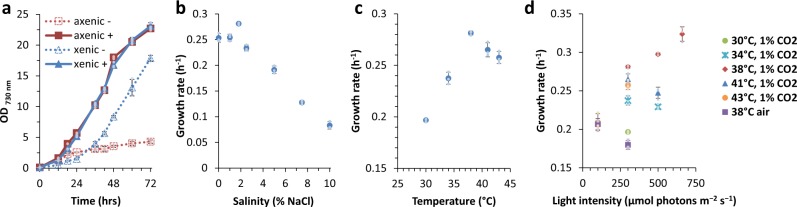
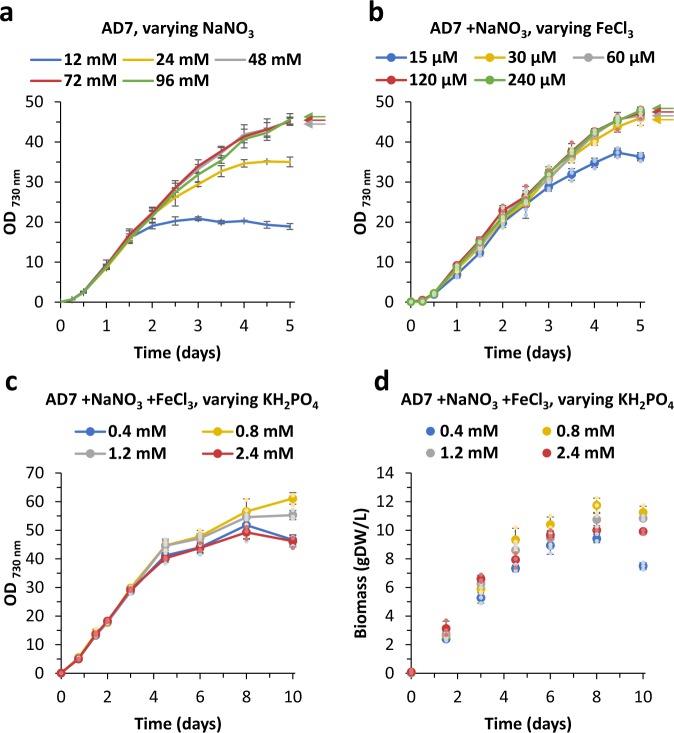
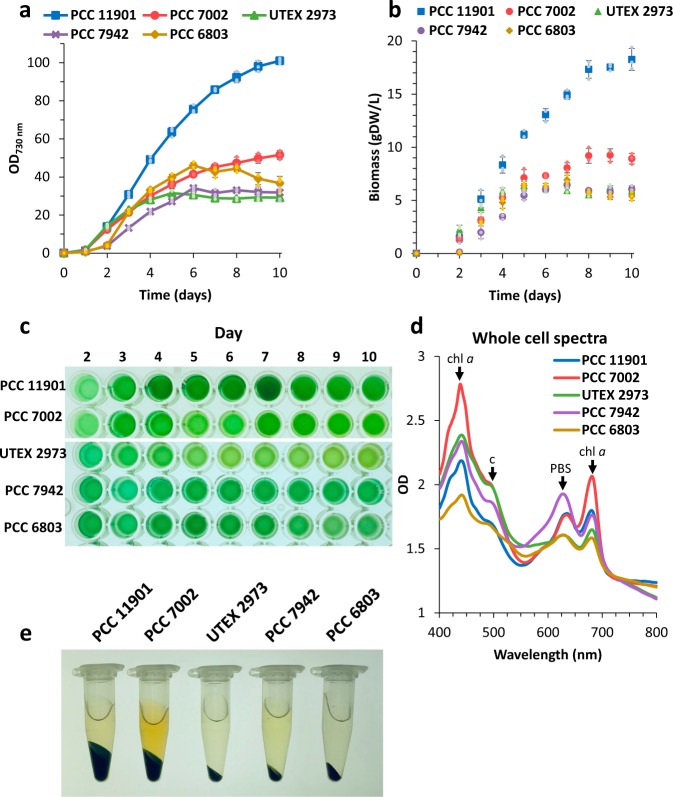
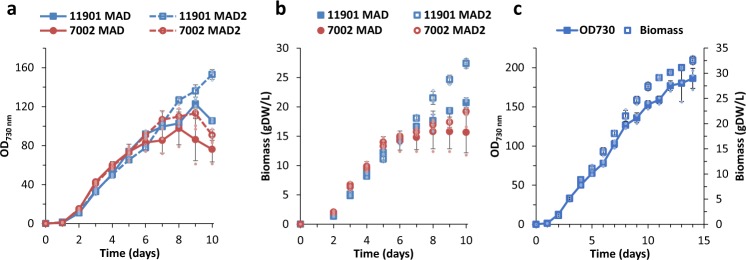
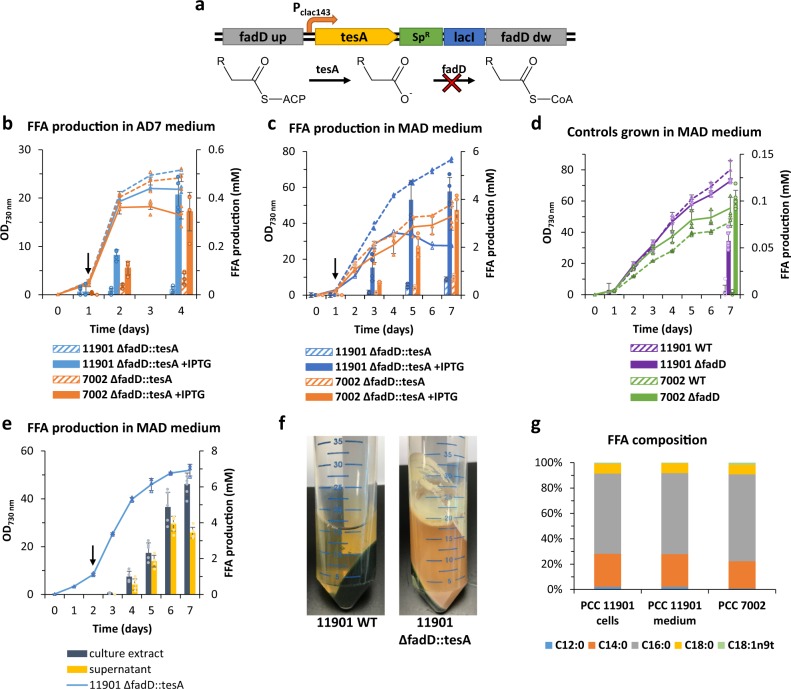
Cyanobacteria, which use solar energy to convert carbon dioxide into biomass, are potential solar biorefineries for the sustainable production of chemicals and biofuels. However, yields obtained with current strains are still uncompetitive compared to existing heterotrophic production systems. Here we report the discovery and characterization of a new cyanobacterial strain, Synechococcus sp. PCC 11901, with promising features for green biotechnology. It is naturally transformable, has a short doubling time of ≈2 hours, grows at high light intensities and in a wide range of salinities and accumulates up to ≈33 g dry cell weight per litre when cultured in a shake-flask system using a modified growth medium − 1.7 to 3 times more than other strains tested under similar conditions. As a proof of principle, PCC 11901 engineered to produce free fatty acids yielded over 6 mM (1.5 g L −1 ), an amount comparable to that achieved by similarly engineered heterotrophic organisms.
Overview
The claims and statistics of this paper haven’t been checked yet.
Free: it reads the open-access text and checks the first 5 claims that cite a source we can check. Create a free account to check every claim.
Integrity signals
Registry
Cites
Statistics
Figures
Verification
Claims the paper makes
The claims and statistics of this paper haven’t been checked yet.
Free: it reads the open-access text and checks the first 5 claims that cite a source we can check. Create a free account to check every claim.
Claims other papers make about this one
Each is checked against this paper’s own text: does it say what the citing paper says it does?
The source backs part of the claim, not all of it — or backs it for a different population, condition or comparison.
In the citing paper
“This slower growth can extend cultivation periods and diminish volumetric productivity, presenting challenges for industrial application [197].”
From Cyanobacteria as a Photosynthetic Chassis for Metabolic Pathway Engineering with Heterologous Gene Expression (2026) · cites this paper as [197]
Experimental — accuracy not yet measuredThe cited source says what the claim attributes to it.
In the citing paper
“Combined with these are new CRISPR-cas based technologies for precision genome editing and gene regulation in microalgae (Lu et al., 2021; Pattharaprachayakul et al., 2020) and the discovery of faster growing and more robust species that offer the next generation of cell platforms (e.g. W ł odarczyk et al., 2020).”
From Cyanobacteria and microalgae in supporting human habitation on Mars (2022) · cites this paper as Włodarczyk et al., 2020
The check wasn’t confident either way, so it gives no verdict — never disputed.
In the citing paper
“As a result, their growth rates are often significantly lower than those of rapidly growing heterotrophic bacteria cultivated on organic carbon substrates.”
From Cyanobacteria as a Photosynthetic Chassis for Metabolic Pathway Engineering with Heterologous Gene Expression (2026) · cites this paper as [197]
Experimental — accuracy not yet measured
Self-check
Percentages, sums and reported differences re-computed from the paper’s own numbers.
The self-check needs the paper’s full text.
Citations
Cites
Nonhybrid, finished microbial genome assemblies from long-read SMRT sequencing data
Chin, C.-S., Alexander, D. H., Marks, P., Klammer, A. A., Drake, J., Heiner, C., Clum, A., Copeland, A., Huddleston, J., Eichler, E. E., et al. (2013) · Nature Methods · doi:10.1038/nmeth.2474 · Cited by 4,029
Purification and properties of unicellular blue-green algae (order Chroococcales)
Stanier, R. Y., Kunisawa, R., Mandel, M., & Cohen-Bazire, G. (1971) · Bacteriological Reviews · doi:10.1128/br.35.2.171-205.1971 · Cited by 3,691
A large-scale evaluation of algorithms to calculate average nucleotide identity
Yoon, S.-H., Ha, S.-M., Lim, J., Kwon, S., & Chun, J. (2017) · Antonie van Leeuwenhoek · doi:10.1007/s10482-017-0844-4 · Cited by 3,632
When will fossil fuel reserves be diminished?
Shafiee, S., & Topal, E. (2009) · Energy Policy · doi:10.1016/j.enpol.2008.08.016 · Cited by 2,061
Critical Evaluation of Two Primers Commonly Used for Amplification of Bacterial 16S rRNA Genes
Frank, J. A., Reich, C. I., Sharma, S., Weisbaum, J. S., Wilson, B. A., & Olsen, G. J. (2008) · Applied and Environmental Microbiology · doi:10.1128/aem.02272-07 · Cited by 1,912
The CGView Server: a comparative genomics tool for circular genomes
Grant, J. R., & Stothard, P. (2008) · Nucleic Acids Research · doi:10.1093/nar/gkn179 · Cited by 1,477
Purification and properties of unicellular blue-green algae (order Chroococcales).
Stanier, R. Y., Kunisawa, R., Mandel, M., et al. (1971) · Bacteriological Reviews · doi:10.1128/mmbr.35.2.171-205.1971 · Cited by 1,455
Circlator: automated circularization of genome assemblies using long sequencing reads
Hunt, M., Silva, N. D., Otto, T. D., Parkhill, J., Keane, J. A., & Harris, S. R. (2015) · Genome Biology · doi:10.1186/s13059-015-0849-0 · Cited by 1,184
Fatty acid production in genetically modified cyanobacteria
Liu, X., Sheng, J., & Curtiss III, R. (2011) · Proceedings of the National Academy of Sciences · doi:10.1073/pnas.1103014108 · Cited by 532
Microbial production of vitamin B12: a review and future perspectives
Fang, H., Kang, J., & Zhang, D. (2017) · Microbial Cell Factories · doi:10.1186/s12934-017-0631-y · Cited by 463
Cited by
Items 101–194 of 194
Zhang, T., Li, S., Chen, L., Zhang, W., & Sun, T. (2024) · ACS Sustainable Chemistry & Engineering · doi:10.1021/acssuschemeng.4c04497 · Cited by 6
Rohr, T., & Rudroff, F. (2025) · Green Chemistry · doi:10.1039/d5gc00905g · Cited by 7
Metabolic engineering of fast growing cyanobacteria for phototrophic production of 2,3-butanediol
Srivastava, V., & Wangikar, P. P. (2024) · Biochemical Engineering Journal · doi:10.1016/j.bej.2024.109439 · Cited by 6
Biosynthesis of Fatty Acid Derivatives by Cyanobacteria: From Basics to Biofuel Production
Kawahara, A., & Hihara, Y. (2021) · Wiley eBooks · doi:10.1002/9783527824908.ch11 · Cited by 8
Interfacing solar energy with bacterial metabolism for sustainable chemical synthesis
Trotter, C. L., Clouston, K., Steele, J. F. C., Marlow, L., & Wallace, S. C. (2026) · Nature Reviews Clean Technology · doi:10.1038/s44359-025-00141-2 · Cited by 6
“Although identification of fast-growing strains can improve productivity 308 , their major contribution will be in accelerating design–build–test–learn cycles for bioengineering 309 .”
Lindberg, P., Kenkel, A., & Bühler, K. (2023) · Advances in biochemical engineering, biotechnology · doi:10.1007/10_2023_217 · Cited by 7
Gao, H. C., Wang, Y., Huang, Z., Yu, F., Hu, X., Ning, D., & Xu, X. (2024) · Frontiers in Microbiology · doi:10.3389/fmicb.2024.1409771 · Cited by 5
“…value-added chemicals, such as isoprene (Gao et al., 2016), ethanol (Kopka et al., 2017), PHB (Koch et al., 2020), astaxanthin (Diao et al., 2020), limonene (Lin et al., 2017), squalene (Choi et al., 2017), amino acids (Korosh et al., 2017; Brey et al., 2020), fatty acids (Włodarczyk et al., 2020).”
BackgroundWang, Z.-Q., Yang, Y., Zhang, J., Zeng, X., & Zhang, C. (2023) · Communications Biology · doi:10.1038/s42003-023-05012-9 · Cited by 5
Cyanobacteria for Marine-Based Biomolecules
Abdi, G., Barwant, M. M., Ingle, K. P., Tarighat, M. A., Wani, A. W., Abdulraheem, M. I., & Khalangre, A. B. (2023) · Springer eBooks · doi:10.1007/978-981-19-7911-8_10 · Cited by 6
Bio‐Sprayed/Threaded Microalgae Remain Viable and Indistinguishable from Controls
Cui, J., Eddaoudi, A., Purton, S., & Jayasinghe, S. N. (2024) · Small · doi:10.1002/smll.202402611 · Cited by 4
Biotechnological Applications of Cyanobacteria: Synechocystis and Synechococcus Strains
Bolay, P., Toepel, J., & Bühler, B. (2025) · Advances in biochemical engineering, biotechnology · doi:10.1007/10_2025_282 · Cited by 6
Cyanobacteria fouling in photobioreactors: current status and future perspectives for prevention
Talluri, S. N. L., Rittschof, D., Winter, R. M., & Salem, D. R. (2025) · Biofouling · doi:10.1080/08927014.2025.2499107 · Cited by 5
Marine cyanobacterial biomass is an efficient feedstock for fungal bioprocesses
Gupta, J. K., Jain, K. K., Kaushal, M., Upton, D. J., Joshi, M. D., Pachauri, P., Wood, A. J., Yazdani, S. S., & Srivastava, S. (2024) · Biotechnology for Biofuels and Bioproducts · doi:10.1186/s13068-024-02469-6 · Cited by 5
“Alternatively, recently identified marine cyanobacterial strains [35] that show higher basal biomass productivity or glycogen content [36] than Synechococcus sp. PCC 7002 could be employed to further increase biomass productivity.”
BackgroundXie, H., Kukil, K., Lindberg, P., Miao, R., & Lindblad, P. C. (2022) · Clean Energy Production Technologies · doi:10.1007/978-981-16-8090-8_3 · Cited by 6
Kamoku, C., Cooper, C., Straub, A., Miller, N., & Nielsen, D. R. (2024) · Synthetic biology and engineering · doi:10.35534/sbe.2024.10014 · Cited by 4
Spadavecchia, V., Ballottari, M., Betterle, N., Ceschi, E., Galletti, P., Montalbetti, L., Pezzolesi, L., Perinelli, D. R., Samorì, C., & TIECCO, M. (2026) · Journal of Molecular Liquids · doi:10.1016/j.molliq.2026.129357 · Cited by 3
Outdoor semi-continuous cultivation of Synechococcus sp. for enhanced carotenoid production
Thaher, M. I., Das, P., AbdulQuadir, M., Khan, S., Kashem, A. H. M., Alghasal, G., Al-Merekhi, M., Dalgamouni, T., Hawari, A. H., Sayadi, S., et al. (2024) · Algal Research · doi:10.1016/j.algal.2024.103657 · Cited by 3
Krimech, A., Cherifi, O., Helamieh, M., Wulf, M., Krohn, I., Nachtigall, K., Hejjaj, A., Naaila, O., Zidan, K., Oudra, B., et al. (2022) · Desalination and Water Treatment · doi:10.5004/dwt.2022.28379 · Cited by 3
Qian, M., Han, X. J., Liu, J., Xu, P., & Tao, F. (2023) · Bioengineering · doi:10.3390/bioengineering10111329 · Cited by 3
Tiwari, D., Kumar, N., Bongirwar, R., & Shukla, P. (2024) · World Journal of Microbiology and Biotechnology · doi:10.1007/s11274-024-04064-1 · Cited by 4
“Further media supplementation with enhanced N, P, Fe, trace minerals, and cobalamin concentrations showed enhanced biomass accumulation (19 g DW L − 1 ) (Włodarczyk et al. 2020).”
Producing Value-Added Products from Organic Bioresources via Photo-BioCatalytic Processes
Magri, S., & Cannella, D. (2022) · Biofuels and biorefineries · doi:10.1007/978-981-16-6162-4_8 · Cited by 4
Simkovsky, R., & Carcellar, F. (2023) · Elsevier eBooks · doi:10.1016/b978-0-323-99982-3.00002-x · Cited by 3
Stressing cyanobacteria for enhanced production of bulk and value-added chemicals
Mo, G., Xu, X., Sun, H., Sun, J., Mao, S., Cui, J., Luan, G., & Lü, X. (2025) · Algal Research · doi:10.1016/j.algal.2025.104095 · Cited by 3
Jain, V. S., Bingi, G. G., Ganjave, S. D., Pandey, R., Sunder, A. V., & Wangikar, P. P. (2025) · Process Biochemistry · doi:10.1016/j.procbio.2025.08.002 · Cited by 2
Trends in cyanobacterial Phycobiliproteins - structure, function, and applications: A review
Mikkili, I., Borugadda, S., & Kanaparthy, A. (2025) · International Journal of Biological Macromolecules · doi:10.1016/j.ijbiomac.2025.148517 · Cited by 4
Carbon capture, storage, and utilization in cyanobacteria
Majhi, B. K. (2026) · Carbon Resources Conversion · doi:10.1016/j.crcon.2025.100388 · Cited by 2
Harnessing engineered cyanobacteria for next-generation therapeutics
Bhardwaj, A., & Mishra, A. K. (2026) · Archives of Microbiology · doi:10.1007/s00203-026-04790-0 · Cited by 2
“Although engineered cyanobacteria currently lag behind E. coli and yeast in growth rate, volumetric productivity, and industrial track record, they possess attributes that distinguish them as niche-specific production platforms (Włodarczyk et al. 2020 ).”
Overexpression of β-carboxysomes increases photosynthesis and growth in Synechocystis sp. PCC 6803
Hu, J., Zhao, K., Chen, Y., Ge, X., Yang, J., Dykes, G. F., Shi, J. W., & Liu, L. (2026) · PLANT PHYSIOLOGY · doi:10.1093/plphys/kiag261 · Cited by 2
“…be further enhanced by alleviating common constraints in high-carbon conditions, specifically nutrient availability and light intensity, we evaluated cell growth under more favorable conditions, including nutrient-enriched medium, elevated CO 2 , and optimized illumination (Włodarczyk et al. 2020).”
McNelly, R., Cruces, A. V., Lea‐Smith, D. J., Seung, D., & Webster, M. (2023) · New Phytologist · doi:10.1111/nph.19296 · Cited by 2
Deshpande, A., Marsing, M., Singla, V., Ibrahim, I. M., Puthiyaveetil, S., & Morgan, J. A. (2025) · The Plant Journal · doi:10.1111/tpj.70129 · Cited by 3
Cengic, I., & Hudson, E. P. (2025) · ACS Synthetic Biology · doi:10.1021/acssynbio.5c00320 · Cited by 2
Cyanobacteria as a renewable resource for biofuel production
Sahasrabuddhe, D., Sengupta, A., Sengupta, S., Mishra, V., & Wangikar, P. P. (2022) · Elsevier eBooks · doi:10.1016/b978-0-323-88427-3.00006-4 · Cited by 5
Threats, Challenges and Issues of Large-Scale Cyanobacterial Cultivation
Kumar, A., Mishra, B., & Singh, M. (2024) · Springer eBooks · doi:10.1007/978-3-031-45523-0_10 · Cited by 5
The renal capsule, a vibrant and adaptive cell environment of the kidney in homeostasis and agingPreprint
Korin, B., Avraham, S., Moncada, R. M., Ho, T., Tleugabulova, M. C., Menon, H., Darmanis, S., Liang, Y., Modrusan, Z. D., Chalouni, C. M., et al. (2023) · bioRxiv (Cold Spring Harbor Laboratory) · doi:10.1101/2023.05.11.540033 · Cited by 2
Walshe, J., & Saha, S. K. (2026) · Current Issues in Molecular Biology · doi:10.3390/cimb48060638 · Cited by 1
Temperature-induced zeaxanthin overproduction in Synechococcus elongatus PCC 7942
Casazza, A. P., Lombardi, A., Menin, B., & Santabarbara, S. (2022) · Photochemical & Photobiological Sciences · doi:10.1007/s43630-022-00352-7 · Cited by 2
“PCC 11901 [13], expecting to bring a significant improvement in cyanobacterial-based biotechnological applications.”
BackgroundMicroalgae Organisms in Capturing Carbon Dioxide: Mechanism and Application
Zhao, L. (2023) · Highlights in Science Engineering and Technology · doi:10.54097/hset.v73i.13098 · Cited by 2
“In summary, the biomass accumulated by all strains under high light irradiation has slightly decreased which influences the growth rate [27].”
BackgroundGinn, B. L. C., Merican, F., Praiboon, J., Maneekat, S., & Muangmai, N. (2025) · Diversity · doi:10.3390/d17050319 · Cited by 1
Long, B., Ramos, A., Yuan, J. S., & Dai, S. Y. (2025) · Algal Research · doi:10.1016/j.algal.2025.104285 · Cited by 1
Miroshnichenko, E. S., Zheleznova, S. N., Ignateva, D., Naumov, I. V., Dimov, S., Kapranov, S. V., & Gevorgiz, R. G. (2026) · Journal of Applied Phycology · doi:10.1007/s10811-025-03781-w · Cited by 1
Rational engineering to enhance C8-fatty acid biosynthesis in Picosynechococcus sp. PCC 7002
Zuniga, B. E., Abraham, J. P., Jaroensuk, J., Cansino-Loeza, B., Hasenour, C. M., Weidenbach, S. A., Williams, R. B., Zavala, V. M., Allen, D. K., Pfleger, B. F., et al. (2026) · Metabolic Engineering · doi:10.1016/j.ymben.2026.03.014 · Cited by 1
CyanOperon: An Operon Building Expansion for the CyanoGate MoClo Toolkit
Astbury, M. J., Osorio, A. A. S., Victoria, A. J., & McCormick, A. J. (2026) · ACS Synthetic Biology · doi:10.1021/acssynbio.6c00162 · Cited by 2
Nishimoto, K., Furushima, T., Kadowaki, T., Jimbo, H., Yamamoto, N., Ikeda, K., Takatani, N., Aichi, M., Omata, T., & Nishiyama, Y. (2026) · Biotechnology for Biofuels and Bioproducts · doi:10.1186/s13068-026-02768-0 · Cited by 1
“…in aas and expresses the E. coli ‘tesA gene [20]; Synechocystis sp. PCC 6803 with multiple genetic modifications that include aas deficiency and the expression of the E. coli ‘tesA gene [12]; and Synechococcus sp. PCC 11901 that is deficient in aas and expresses the E. coli ‘tesA gene [35].”
Capturing microalgae within aerosols provides carbon capture bio-functionality
Elghazy, E., Davies, M. M. J., Farr, N. T. H., Rodenburg, C., Willmott, J. R., & Pandhal, J. (2025) · Journal of CO2 Utilization · doi:10.1016/j.jcou.2025.103024 · Cited by 2
Kamoku, C., Bhavaraju, P., Travis, C., Taquillo, L., & Nielsen, D. R. (2025) · Metabolic Engineering · doi:10.1016/j.ymben.2025.04.008 · Cited by 1
Enhanced fumarate production using high-density cultivation of Synechocystis sp. PCC 6803
Iseki, K., Iijima, H., Ohneda, S., & Osanai, T. (2026) · Microbial Cell Factories · doi:10.1186/s12934-026-02956-5 · Cited by 1
“Among freshwater cyanobacteria, Synechocystis 6803 achieved the highest biomass, reaching 6.9 g cell dry weight/L [34], although the optimal medium composition depends on the target product.”
InfluentialToward Sustainability: Intensification of Light‐Driven Whole Cell Biocatalysis
Malihan‐Yap, L., de María, P. D., & Kourist, R. (2026) · ChemBioChem · doi:10.1002/cbic.70320 · Cited by 1
“Under optimal growth conditions of 38°C and 1% v/v CO 2 , it exhibited a doubling time of 2.14 h at the aforementioned high light intensity reaching a biomass yield of 33 g DCW L − 1 [150].”
InfluentialCyanobacteria Biotechnology: Challenges and Prospects
Khan, A. Z., Zhao, X., Bai, F., Mustafa, H. H., & Liu, C. (2024) · Springer eBooks · doi:10.1007/978-3-031-45523-0_13 · Cited by 1
Sukkasam, N., Kaewbai-ngam, J., Leksingto, J., In-na, P., Nootong, K., Incharoensakdi, A., Hallam, S., & Monshupanee, T. (2024) · Plant Molecular Biology · doi:10.1007/s11103-024-01484-3 · Cited by 1
“This involved measuring the absorbance at 620 nm, following the method described by Włodarczyk et al. (2020).”
Samson, S. O., Serafin‐Lewańczuk, M., Brzezińska‐Rodak, M., Klimek‐Ochab, M., & Żymańczyk–Duda, E. (2024) · Symmetry · doi:10.3390/sym16121676 · Cited by 1
Salvagnini, C., Gasparotto, E., Lucato, V., Bergantino, E., Ballottari, M., Barbera, E., Betterle, N., & Sforza, E. (2025) · Biotechnology and Bioengineering · doi:10.1002/bit.70024 · Cited by 2
Progresses of engineering microbial chassis for one-carbon biotransformation
Shen, Y., Cai, P., & Zhou, Y. J. (2025) · Chinese Science Bulletin (Chinese Version) · doi:10.1360/tb-2025-0119 · Cited by 1
Li, S., Sun, T., Liu, D., Zhang, T. A., Chen, L., & Zhang, W. (2026) · Plant Biotechnology Journal · doi:10.1111/pbi.70702 · Cited by 1
“The high-density cultivation of Syn2973 is conducted in 100 mL flat-bottom glass tubes with a diameter of 30 mm, in a volume of 60 mL of 5 × BG optimized medium (Włodarczyk et al. 2020).”
Improving cyanobacteria productivity: From theory to assay
Shabestary, K. (2020) · KTH Publication Database DiVA (KTH Royal Institute of Technology)
Dynamics of a harvested cyanobacteria-fish model with modified Holling type Ⅳ functional response
Huang, S., Yu, H., Dai, C., Ma, Z., Wang, Q., & Zhao, M. Z. (2023) · Mathematical Biosciences & Engineering · doi:10.3934/mbe.2023561
Additional file 1 of Long-term patterns of an interconnected core marine microbiota
Krabberød, A. K., Deutschmann, I. M., Bjorbækmo, M. F. M., Balagué, V., Giner, C. R., Ferrera, I., Garcés, E., Massana, R., Gasol, J. M., & Logares, R. (2022) · Figshare · doi:10.6084/m9.figshare.19728416
Cho, B. A., Moreno-Cabezuelo, J. Á., Mills, L. A., del Rio-Chanona, A., Lea‐Smith, D. J., & Zhang, D. (2024) · Computer-aided chemical engineering/Computer aided chemical engineering · doi:10.1016/b978-0-443-28824-1.50420-8
Delzenne, T. O., & Claessen, D. (2025) · HardwareX · doi:10.1016/j.ohx.2025.e00649
“This has opened possibilities for renewable biosynthesis of a variety of valuable compounds, including ethanol [7], fatty acids [8,9], sucrose [10], and bioplastics [11].”
What would a hypothetical supercyanobacterium look like?
Pěnčík, O., Koláčková, M., Molnárová, K., & Húska, D. (2025) · Trends in biotechnology · doi:10.1016/j.tibtech.2025.04.006
Microalga-Based Electricity Production
Alrashidi, W. (2025) · IntechOpen eBooks · doi:10.5772/intechopen.1011653
Cyanobacteria: A Biological Chassis for Industrial Applications
Majhi, B. K. (2025) · IntechOpen eBooks · doi:10.5772/intechopen.1012978 · Cited by 2
Additional file 14 of Long-term patterns of an interconnected core marine microbiota
Krabberød, A. K., Deutschmann, I. M., Bjorbækmo, M. F. M., Balagué, V., Giner, C. R., Ferrera, I., Garcés, E., Massana, R., Gasol, J. M., & Logares, R. (2022) · Figshare · doi:10.6084/m9.figshare.19728413
Additional file 12 of Long-term patterns of an interconnected core marine microbiota
Krabberød, A. K., Deutschmann, I. M., Bjorbækmo, M. F. M., Balagué, V., Giner, C. R., Ferrera, I., Garcés, E., Massana, R., Gasol, J. M., & Logares, R. (2022) · Figshare · doi:10.6084/m9.figshare.19728407
Additional file 13 of Long-term patterns of an interconnected core marine microbiota
Krabberød, A. K., Deutschmann, I. M., Bjorbækmo, M. F. M., Balagué, V., Giner, C. R., Ferrera, I., Garcés, E., Massana, R., Gasol, J. M., & Logares, R. (2022) · Figshare · doi:10.6084/m9.figshare.19728410
Additional file 8 of Long-term patterns of an interconnected core marine microbiota
Krabberød, A. K., Deutschmann, I. M., Bjorbækmo, M. F. M., Balagué, V., Giner, C. R., Ferrera, I., Garcés, E., Massana, R., Gasol, J. M., & Logares, R. (2022) · Figshare · doi:10.6084/m9.figshare.19728437
Additional file 1 of Marine cyanobacterial biomass is an efficient feedstock for fungal bioprocesses
Gupta, J. K., Jain, K. K., Kaushal, M., Upton, D. J., Joshi, M. D., Pachauri, P., Wood, A. J., Yazdani, S. S., & Srivastava, S. (2024) · Figshare · doi:10.6084/m9.figshare.26680454
Additional file 2 of Long-term patterns of an interconnected core marine microbiota
Krabberød, A. K., Deutschmann, I. M., Bjorbækmo, M. F. M., Balagué, V., Giner, C. R., Ferrera, I., Garcés, E., Massana, R., Gasol, J. M., & Logares, R. (2022) · Figshare · doi:10.6084/m9.figshare.19728419
Additional file 3 of Long-term patterns of an interconnected core marine microbiota
Krabberød, A. K., Deutschmann, I. M., Bjorbækmo, M. F. M., Balagué, V., Giner, C. R., Ferrera, I., Garcés, E., Massana, R., Gasol, J. M., & Logares, R. (2022) · Figshare · doi:10.6084/m9.figshare.19728422
Additional file 5 of Long-term patterns of an interconnected core marine microbiota
Krabberød, A. K., Deutschmann, I. M., Bjorbækmo, M. F. M., Balagué, V., Giner, C. R., Ferrera, I., Garcés, E., Massana, R., Gasol, J. M., & Logares, R. (2022) · Figshare · doi:10.6084/m9.figshare.19728428
Additional file 11 of Long-term patterns of an interconnected core marine microbiota
Krabberød, A. K., Deutschmann, I. M., Bjorbækmo, M. F. M., Balagué, V., Giner, C. R., Ferrera, I., Garcés, E., Massana, R., Gasol, J. M., & Logares, R. (2022) · Figshare · doi:10.6084/m9.figshare.19728404
Additional file 10 of Long-term patterns of an interconnected core marine microbiota
Krabberød, A. K., Deutschmann, I. M., Bjorbækmo, M. F. M., Balagué, V., Giner, C. R., Ferrera, I., Garcés, E., Massana, R., Gasol, J. M., & Logares, R. (2022) · Research Online (Edith Cowan University) · doi:10.6084/m9.figshare.19728401
Additional file 4 of Long-term patterns of an interconnected core marine microbiota
Krabberød, A. K., Deutschmann, I. M., Bjorbækmo, M. F. M., Balagué, V., Giner, C. R., Ferrera, I., Garcés, E., Massana, R., Gasol, J. M., & Logares, R. (2022) · Figshare · doi:10.6084/m9.figshare.19728425
Additional file 7 of Long-term patterns of an interconnected core marine microbiota
Krabberød, A. K., Deutschmann, I. M., Bjorbækmo, M. F. M., Balagué, V., Giner, C. R., Ferrera, I., Garcés, E., Massana, R., Gasol, J. M., & Logares, R. (2022) · Figshare · doi:10.6084/m9.figshare.19728434
Additional file 6 of Long-term patterns of an interconnected core marine microbiota
Krabberød, A. K., Deutschmann, I. M., Bjorbækmo, M. F. M., Balagué, V., Giner, C. R., Ferrera, I., Garcés, E., Massana, R., Gasol, J. M., & Logares, R. (2022) · Figshare · doi:10.6084/m9.figshare.19728431
Additional file 9 of Long-term patterns of an interconnected core marine microbiota
Krabberød, A. K., Deutschmann, I. M., Bjorbækmo, M. F. M., Balagué, V., Giner, C. R., Isabel, F., Garcés, E., Massana, R., Gasol, J. M., & Logares, R. (2022) · Figshare · doi:10.6084/m9.figshare.19728440
Bioactive compounds from blue–green microalgae
Rahman, M. R., & Hellgardt, K. (2026) · Elsevier eBooks · doi:10.1016/b978-0-443-26502-0.00016-1
Mondal, S., Alford, J. T., Kutzner, C., Forchhammer, K., & Doello, S. (2026) · Frontiers in Plant Science · doi:10.3389/fpls.2026.1812316
“The strain Synechococcus sp. UTEX 3153 is a fast-growing marine cyanobacterium with industrial potential for which no transformation protocol has been established so far (W ł odarczyk et al., 2020).”
InfluentialHybrid biophysical systems for atmospheric CO 2 capture
Agbo, P., Varghese, J. O., Henning, R. K., Kanady, J. S., & Ram, A. (2026) · Journal of Physics Energy · doi:10.1088/2515-7655/ae61f4 · Cited by 1
“The shape and dimensions of typical Synechococcus bacteria, such as the model organism PCC 7002, are readily approximated as ellipsoids with long and short axes of 2 and ∼ 1 µ m, respectively [41].”
InfluentialKato, Y., Tsuji, A., Haraguchi, Y., Shimizu, T., Kondo, A., & Hasunuma, T. (2026) · Metabolic Engineering Communications · doi:10.1016/j.mec.2026.e00284
“…× 10 (cid:0) 5 M H 3 BO 3 , 9.24 × 10 (cid:0) 6 M MnCl 2 ⋅ 4H 2 O, 2.30 × 10 (cid:0) 6 M ZnCl 2 , 5.29 × 10 (cid:0) 6 M Na 2 MoO 4 ⋅ 2H 2 O, 3.16 × 10 (cid:0) 7 M CuSO 4 ⋅ 5H 2 O, 1.68 × 10 (cid:0) 7 M CoCl 2 ⋅ 6H 2 O, and 9.00 × 10 (cid:0) 9 M vitamin B12) was used (W ł odarczyk et al., 2020).”
InfluentialMoreno-Cabezuelo, J. Á., Booth, A., Lin, D., Gathani, K., Kim, D. S., & Sagaram, U. S. (2026) · Biomolecules · doi:10.3390/biom16060870
“Originally isolated from the Johor river estuary in Singapore and characterised as a fast-growing, halotolerant strain [14], PCC 11901 exhibits a doubling time of approximately two hours and sustains growth to cell densities exceeding 33 g dry cell weight (DCW) L − 1 [14,15].”
InfluentialExploring the biology of cyanobacteria in life support systems on Mars
Rodrigues, D., & McCormick, A. J. (2026) · Frontiers in Astronomy and Space Sciences · doi:10.3389/fspas.2026.1853934
Bajpai, P. (2026) · Elsevier eBooks · doi:10.1016/b978-0-443-44839-3.00001-x
Kato, A., Takatani, N., Maeda, S.-I., Aichi, M., & Omata, T. (2026) · Biotechnology for Biofuels and Bioproducts · doi:10.1186/s13068-026-02782-2
“However, the yield of extracellular FFA is generally low, about 0.1 g per gram of dry cell weight (DCW) [11, 12, 16].”
InfluentialEmploying Nanotechnology to Enhance Ethanol Production in Two Synechococcus elongatus Strains
Schirmacher, A. M., Russo, D. A., Furch, A. C. U., & Zedler, J. A. Z. (2026) · ChemBioChem · doi:10.1002/cbic.70480
Anbu, E., & Odukkathil, G. (2026) · Bioresource Technology Reports · doi:10.1016/j.biteb.2026.102958
Potential of Microalgal Biomass Production in Coastal Deserts for Carbon Dioxide Removal
Leonard, W., McClure, D. D., Ng, K. S., & Yang, A. (2026) · Environmental Science & Technology · doi:10.1021/acs.est.6c08729
Chou, Y.-C., Diankristanti, P. A., & Ng, I. (2026) · Chemical Engineering Journal · doi:10.1016/j.cej.2026.181109
Zhang, P., Zhang, J., Zhang, T., Peng, Y., & Tong, Y. W. (2026) · ACS Sustainable Chemistry & Engineering · doi:10.1021/acssuschemeng.6c05229
A methylome-guided toolkit for genetic engineering of the fast-growing cyanobacterium UTEX 3222Preprint
Lin, D., Booth, A., Gill, A., Aung, M. M., Kim, D. S., & Sagaram, U. S. (2026) · bioRxiv (Cold Spring Harbor Laboratory) · doi:10.64898/2026.09.15.751560
Lai, T., Amosu, E. O., Raphael, J., McCubbin, T., Marcellin, E., Paulsen, I. T., & Cullen, A. (2026) · ACS Synthetic Biology · doi:10.1021/acssynbio.6c00175
Cyanobacteria: A sustainable platform for high-value biopharmaceutical protein production
Majhi, B. K. (2026) · Journal of Pharmaceutical Analysis · doi:10.1016/j.jpha.2026.101807
Pan, C., Chen, H., Zhang, M., He, S., & Lin, Z. (2026) · Chemical Science · doi:10.1039/d6sc06370e
Metadata
- Authors
- Włodarczyk, A., Selão, T. T., Norling, B., & Nixon, P. J.
- Affiliations
- University of Technology Sydney (AU)
- University of Nottingham (GB)
- Nanyang Technological University (SG)
- Corresponding author
- Włodarczyk, Artur
- Nixon, Peter J.
- Venue
- Communications Biology
- Published
- 2020-05-07
- Volume
- 3
- Issue
- 1
- Pages
- 215-215
- ISSN
- 2399-3642 (ISSN-L)
- PMC
- PMC7205611
- OpenAlex
- W3021029089
- Cited by
- 192
- References
- 63
- Citations by year
- 2026: 30 · 2025: 28 · 2024: 31 · 2023: 26 · 2022: 43 · 2021: 18 · 2020: 13
- FWCI
- 4.93
- Type
- journal article
- Language
- en
- Open access
- gold
- doi.org
- Licence
- cc-by
- creativecommons.org/licenses/by/4.0 (tdm)
- creativecommons.org/licenses/by/4.0 (vor)
- Locations
- Communications Biology (publishedVersion, cc-by)
- bioRxiv (Cold Spring Harbor Laboratory) (acceptedVersion, cc-by)
- PubMed Central (publishedVersion, cc-by)
- PubMed (publishedVersion)
- DR-NTU (Nanyang Technological University) (submittedVersion, cc-by)
- UTS ePRESS (University of Technology Sydney) (submittedVersion, other-oa)
- Spiral (Imperial College London) (submittedVersion, cc-by)
- Funders
- Nanyang Technological University (M4081714)
- Topics
- Physical Sciences › Energy › Renewable Energy, Sustainability and the Environment › Algal biology and biofuel production
- Life Sciences › Biochemistry, Genetics and Molecular Biology › Molecular Biology › Microbial Metabolic Engineering and Bioproduction
- Physical Sciences › Environmental Science › Environmental Chemistry › Aquatic Ecosystems and Phytoplankton Dynamics
- Keywords
- cyanobacteria, free fatty acid production, biofuels, doubling time, salt tolerance, high light, strain characterization, bio-based chemicals
- MeSH terms
- Biotechnology, Biomass, Synechococcus, Biofuels, Metabolic Engineering
About these checks
Registry, retraction, Cites and statistics results are computed, not judged, with one exception: a printed reference that no index lists is read once by a model before it counts as a citation error. Claims are extracted by a model and kept only when their quote appears verbatim in the text; each cited source is then checked, with a model’s help, for whether it says what the claim relies on. Those verdicts can be wrong — read the claim’s quote and the cited source before relying on one.
Statistics and arithmetic are recomputed, not judged.
Confidence bands are shown only for fields calibrated on our annotated test set. None is calibrated yet, so no band is shown.
What counts as a claim ›How we measure confidence ›How we check this ›
Are you an author, or do you see a problem with this page? Request a review
Data sources
Bibliographic data: Semantic Scholar, OpenAlex, Crossref.
Contains information from the Semantic Scholar Academic Graph Datasets, made available under the ODC Attribution License (ODC-BY 1.0).
Semantic Scholar’s data is described in: Kinney, R., et al. (2023). The Semantic Scholar Open Data Platform. arXiv:2301.10140.
