

The DOI matches its Crossref record; 87 of the 87 references it cites were found in a registry or an index.
NEBULA is a fast negative binomial mixed model for differential or co-expression analysis of large-scale multi-subject single-cell data
Open accessPublished version of a preprint
Abstract
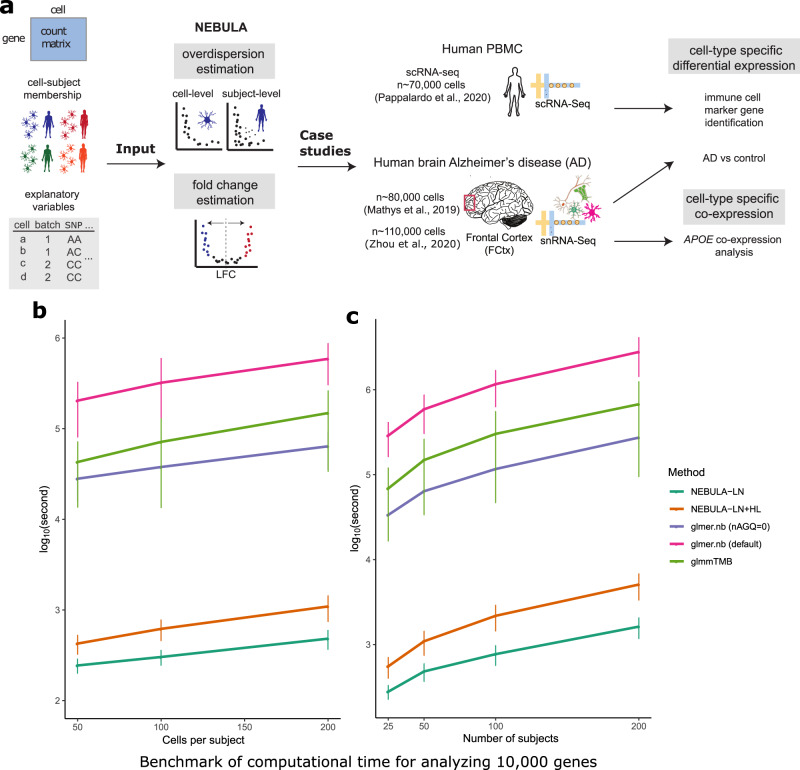
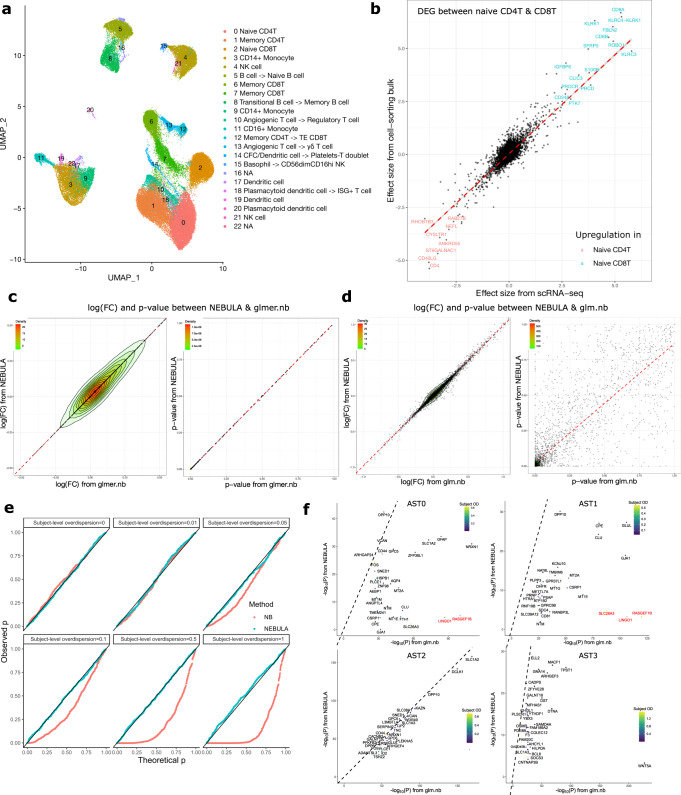
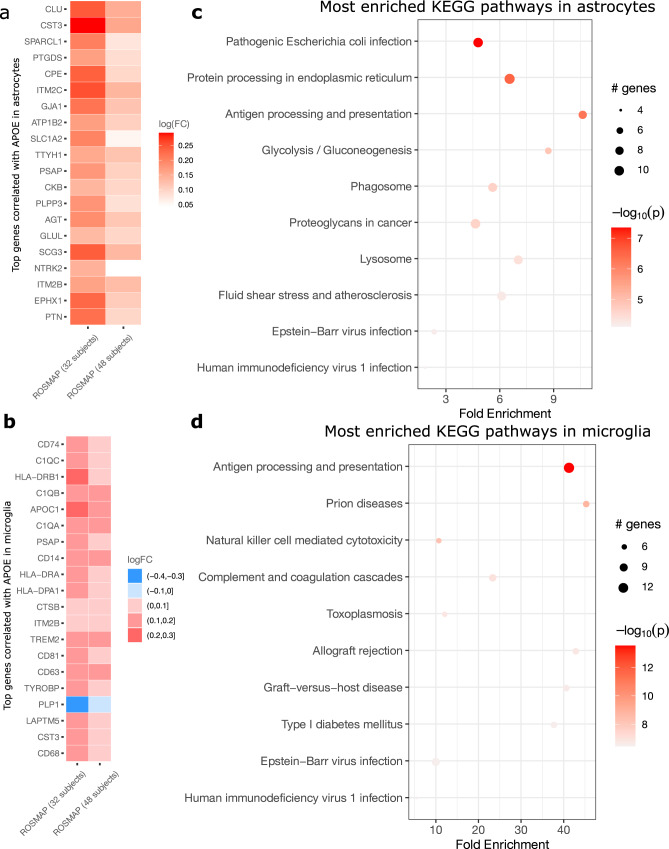
The increasing availability of single-cell data revolutionizes the understanding of biological mechanisms at cellular resolution. For differential expression analysis in multi-subject single-cell data, negative binomial mixed models account for both subject-level and cell-level overdispersions, but are computationally demanding. Here, we propose an efficient NEgative Binomial mixed model Using a Large-sample Approximation (NEBULA). The speed gain is achieved by analytically solving high-dimensional integrals instead of using the Laplace approximation. We demonstrate that NEBULA is orders of magnitude faster than existing tools and controls false-positive errors in marker gene identification and co-expression analysis. Using NEBULA in Alzheimer’s disease cohort data sets, we found that the cell-level expression of APOE correlated with that of other genetic risk factors (including CLU, CST3, TREM2 , C1q, and ITM2B ) in a cell-type-specific pattern and an isoform-dependent manner in microglia. NEBULA opens up a new avenue for the broad application of mixed models to large-scale multi-subject single-cell data.
Overview
The claims and statistics of this paper haven’t been checked yet.
Run the check — free, no account needed. It reads the open-access text and checks the sources it cites.
Integrity signals
Registry
Cites
Statistics
Figures
Verification
Claims the paper makes
The claims and statistics of this paper haven’t been checked yet.
Run the check — free, no account needed. It reads the open-access text and checks the sources it cites.
Claims other papers make about this one
Each is checked against this paper’s own text: does it say what the citing paper says it does?
The cited source says what the claim attributes to it.
In the citing paper
“Per-gene expression levels per cell type were modeled as a negative binomial model with random effects that model both within-individual and between-individual effects, as implemented in the R package NEBULA (version 1.2.1)40”
From APOE4 impairs myelination via cholesterol dysregulation in oligodendrocytes (2022) · cites this paper as [40]
Self-check
Percentages, sums and reported differences re-computed from the paper’s own numbers.
The self-check needs the paper’s full text.
Citations
Cites
Moderated estimation of fold change and dispersion for RNA-seq data with DESeq2
Love, M. I., Huber, W., & Anders, S. (2014) · Genome Biology · doi:10.1186/s13059-014-0550-8 · Cited by 95,106
Fitting Linear Mixed-Effects Models Using lme4
Bates, D., Mächler, M., Bolker, B., & Walker, S. (2015) · Journal of Statistical Software · doi:10.18637/jss.v067.i01 · Cited by 86,835
Mollie, E. B., Kristensen, K., van Benthem, K. J., Magnússon, Á., Casper, W. B., Nielsen, A., Hans, J. S., Maechler, M., & Benjamin, M. B. (2017) · The R Journal · doi:10.32614/rj-2017-066 · Cited by 13,350
Integrating single-cell transcriptomic data across different conditions, technologies, and species
Butler, A., Hoffman, P., Smibert, P., Papalexi, E., & Satija, R. (2018) · Nature Biotechnology · doi:10.1038/nbt.4096 · Cited by 13,174
A scaling normalization method for differential expression analysis of RNA-seq data
Robinson, M. D., & Oshlack, A. (2010) · Genome Biology · doi:10.1186/gb-2010-11-3-r25 · Cited by 7,876
Numerical Methods for Unconstrained Optimization and Nonlinear Equations
Dennis, J. E., & Schnabel, R. B. (1996) · Society for Industrial and Applied Mathematics eBooks · doi:10.1137/1.9781611971200 · Cited by 7,673
Robust estimation of a location parameter
Huber, P. J. (1964) · The Annals of Mathematical Statistics · doi:10.1214/aoms/1177703732 · Cited by 7,228
Highly parallel genome-wide expression profiling of individual cells using nanoliter droplets.
Macosko, E. Z., Basu, A., Satija, R., Nemesh, J., Shekhar, K., Goldman, M., Tirosh, I., Bialas, A. R., Kamitaki, N., Martersteck, E. M., et al. (2015) · Cell · doi:10.1016/j.cell.2015.05.002 · Cited by 7,110
UMAP: Uniform Manifold Approximation and Projection for Dimension Reduction
McInnes, L., Healy, J., & Melville, J. (2018) · arXiv · doi:10.48550/arxiv.1802.03426 · Cited by 7,101
A Limited Memory Algorithm for Bound Constrained Optimization
Byrd, R. H., Lu, P., Nocedal, J. M., & Zhu, C. (1995) · SIAM Journal on Scientific Computing · doi:10.1137/0916069 · Cited by 6,267
Research works printed but not linked: 1
- Huber, P. J. Robust Statistics. (John Wiley & Sons, 2004).
Cited by
Sorted by citations
ApoE in Alzheimer’s disease: pathophysiology and therapeutic strategies
Raulin, A.-C., Doss, S. V., Trottier, Z. A., Ikezu, T. C., Bu, G., & Liu, C.-C. (2022) · Molecular Neurodegeneration · doi:10.1186/s13024-022-00574-4 · Cited by 756
Comparison and evaluation of statistical error models for scRNA-seq
Choudhary, S., & Satija, R. (2022) · Genome Biology · doi:10.1186/s13059-021-02584-9 · Cited by 634
APOE4 impairs myelination via cholesterol dysregulation in oligodendrocytes
Blanchard, J. W., Akay, L. A., Davila-Velderrain, J., von Maydell, D., Mathys, H., Davidson, S. M., Effenberger, A., Chen, C.-Y., Maner-Smith, K., Hajjar, I., et al. (2022) · Nature · doi:10.1038/s41586-022-05439-w · Cited by 496
“Genetic diversity may confound the effects of APOE4 observed on human post-mortem brain tissue.”
InfluentialSelf-citationIntegrated multimodal cell atlas of Alzheimer’s disease
Gabitto, M. I., Travaglini, K. J., Rachleff, V. M., Kaplan, E. S., Long, B., Ariza, J., Ding, Y., Mahoney, J. T., Dee, N., Goldy, J., et al. (2024) · Nature Neuroscience · doi:10.1038/s41593-024-01774-5 · Cited by 397
Single-cell multiregion dissection of Alzheimer’s disease
Mathys, H., Boix, C. A., Akay, L. A., Xia, Z., Davila-Velderrain, J., Ng, A. P., Jiang, X., Abdelhady, G., Galani, K., Mantero, J., et al. (2024) · Nature · doi:10.1038/s41586-024-07606-7 · Cited by 343
Self-citation
Metadata
- Authors
- He, L., Davila-Velderrain, J., Sumida, T. S., Hafler, D. A., Kellis, M., & Kulminski, A. M.
- Affiliations
- Duke University (US)
- Yale University (US)
- Broad Institute (US)
- Corresponding author
- He, Liang
- Kellis, Manolis
- Kulminski, Alexander M.
- Venue
- Communications Biology
- Published
- 2021-05-26
- Volume
- 4
- Issue
- 1
- Pages
- 629-629
- ISSN
- 2399-3642 (ISSN-L)
- PMC
- PMC8155058
- OpenAlex
- W3164861786
- Cited by
- 181
- References
- 85
- Citations by year
- 2026: 42 · 2025: 40 · 2024: 48 · 2023: 27 · 2022: 19 · 2021: 4
- FWCI
- 8.67
- Type
- journal article
- Language
- en
- Open access
- gold
- doi.org
- Locations
- Communications Biology (publishedVersion, cc-by)
- bioRxiv (Cold Spring Harbor Laboratory) (acceptedVersion, cc-by-nc-nd)
- PubMed Central (publishedVersion, cc-by)
- PubMed (publishedVersion)
- DOAJ (DOAJ: Directory of Open Access Journals) (submittedVersion, cc-by-sa)
- DSpace@MIT (Massachusetts Institute of Technology) (submittedVersion, cc-by-nc)
- Funders
- National Institutes of Health (5r01ag070488-05, UL1TR001863)
- National Institute on Aging (R01-AG070488, R01AG017917, AG058002, R01AG030146, R01AG058002, R01AG062335, R01AG036836, RF1AG054012, R01AG065477, R01AG048015, U01AG046152, R01AG036042, R01AG015819, P30AG010161, RF1AG062377, U01AG032984, U01AG061356, RC2AG036547, U01AG046161, R01AG061853, RF1AG057473, R01AG067151)
- National Institute of Mental Health (U01MH119509, R01MH109978)
- National Cancer Institute (R01CA227473, P50CA121974)
- National Institute of Allergy and Infectious Diseases (R01AI072222, P01AI073748, U24AI118672, P01AI039671, U19AI089992)
- National Institute of Neurological Disorders and Stroke (R25NS079193, U01NS110453, UG3NS115064)
- National Center for Advancing Translational Sciences
- Topics
- Life Sciences › Biochemistry, Genetics and Molecular Biology › Molecular Biology › Single-cell and spatial transcriptomics
- Life Sciences › Biochemistry, Genetics and Molecular Biology › Molecular Biology › Gene expression and cancer classification
- Life Sciences › Biochemistry, Genetics and Molecular Biology › Molecular Biology › Gene Regulatory Network Analysis
- Keywords
- nebulae, differential expression analysis, co-expression analysis, large sample approximation, computational efficiency, marker gene identification, Alzheimer's disease, apolipoprotein E, microglia, cell type-specific gene expression, isoform expression, genetic risk factors
- MeSH terms
- Alzheimer Disease, Apolipoproteins E, Humans, Models, Statistical, Gene Expression, Binomial Distribution, Microglia, Computational Biology, Gene Expression Profiling, Single-Cell Analysis
About these checks
Registry, retraction, Cites and statistics results are computed, not judged, with one exception: a printed reference that no index lists is read once by a model before it counts as a citation error. Claims are extracted by a model and kept only when their quote appears verbatim in the text; each cited source is then checked, with a model’s help, for whether it says what the claim relies on. Those verdicts can be wrong — read the claim’s quote and the cited source before relying on one.
Statistics and arithmetic are recomputed, not judged.
Confidence bands are shown only for fields calibrated on our annotated test set. None is calibrated yet, so no band is shown.
What counts as a claim ›How we measure confidence ›How we check this ›
Are you an author, or do you see a problem with this page? Request a review
