

Systemic GLP-1R agonist treatment reverses mouse glial and neurovascular cell transcriptomic aging signatures in a genome-wide manner
Open accessThe DOI matches its Crossref record; 37 of the 37 references it cites were found in a registry or an index.
Abstract
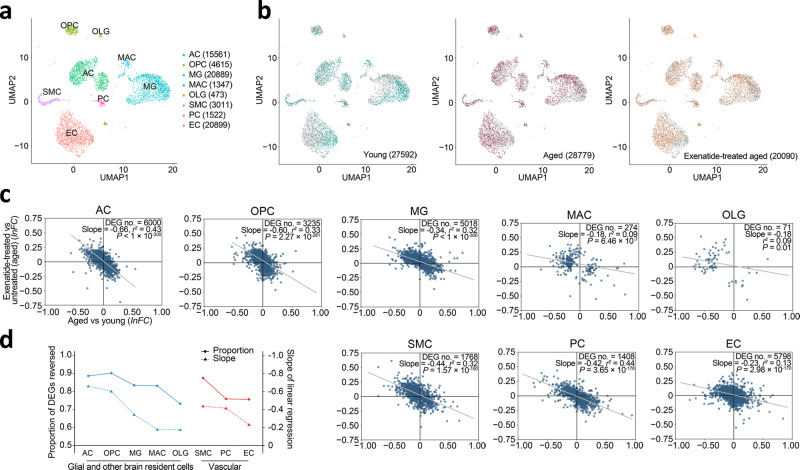
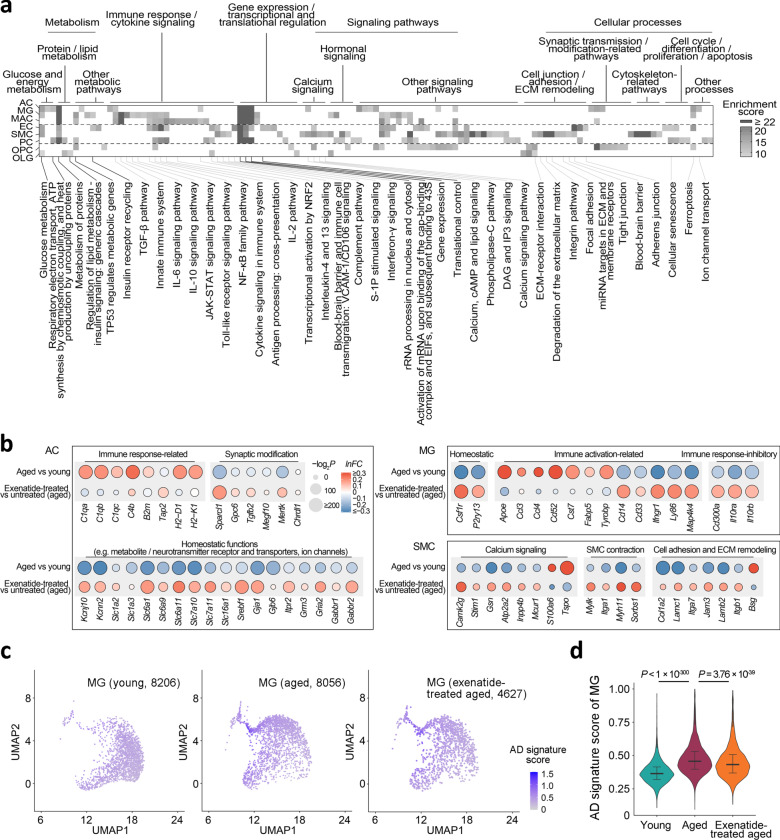
Pharmacological reversal of brain aging is a long-sought yet challenging strategy for the prevention and treatment of age-related neurodegeneration, due to the diverse cell types and complex cellular pathways impacted by the aging process. Here, we report the genome-wide reversal of transcriptomic aging signatures in multiple major brain cell types, including glial and mural cells, by systemic glucagon-like peptide-1 receptor (GLP-1R) agonist (GLP-1RA) treatment. The age-related expression changes reversed by GLP-1RA encompass both shared and cell type-specific functional pathways that are implicated in aging and neurodegeneration. Concomitantly, Alzheimer’s disease (AD)-associated transcriptomic signature in microglia that arises from aging is reduced. These results show the feasibility of reversing brain aging by pharmacological means, provide mechanistic insights into the neurological benefits of GLP-1RAs, and imply that GLP-1R agonism may be a generally applicable pharmacological intervention for patients at risk of age-related neurodegeneration.
Overview
The claims and statistics of this paper haven’t been checked yet.
Free: it reads the open-access text and checks the first 5 claims that cite a source we can check. Create a free account to check every claim.
Integrity signals
Registry
Cites
Statistics
Figures
Verification
Claims the paper makes
The claims and statistics of this paper haven’t been checked yet.
Free: it reads the open-access text and checks the first 5 claims that cite a source we can check. Create a free account to check every claim.
Claims other papers make about this one
Each is checked against this paper’s own text: does it say what the citing paper says it does?
The source backs part of the claim, not all of it — or backs it for a different population, condition or comparison.
In the citing paper
“They are involved in multiple biological pathways that could be beneficial in AD including improvement of BBB integrity and vascular health, promotion of homeostasis in microglia and astrocytes, positive effects on adaptative immune cells (including natural killer cells and activated regulatory T cells), improvement of synaptic viability, and neuroprotection [17–26].”
From evoke and evoke+: design of two large-scale, double-blind, placebo-controlled, phase 3 studies evaluating efficacy, safety, and tolerability of semaglutide in early-stage symptomatic Alzheimer’s disease (2025) · cites this paper as [20]
Experimental — accuracy not yet measuredIn the citing paper
“GLP-1 RAs reverse transcriptomic ageing signatures in multiple major brain cell types, including glial cells and neurovascular cells.407”
From Antiageing strategy for neurodegenerative diseases: from mechanisms to clinical advances (2025) · cites this paper as [407]
Self-check
Percentages, sums and reported differences re-computed from the paper’s own numbers.
The self-check needs the paper’s full text.
Citations
Cites
Integrating single-cell transcriptomic data across different conditions, technologies, and species
Butler, A., Hoffman, P., Smibert, P., Papalexi, E., & Satija, R. (2018) · Nature Biotechnology · doi:10.1038/nbt.4096 · Cited by 13,174
UMAP: Uniform Manifold Approximation and Projection
McInnes, L., Healy, J., Saul, N., & Großberger, L. (2018) · Journal of Open Source Software · doi:10.21105/joss.00861 · Cited by 9,826
A Unique Microglia Type Associated with Restricting Development of Alzheimer’s Disease
Keren-Shaul, H., Spinrad, A., Weiner, A., Matcovitch-Natan, O., Dvir-Szternfeld, R., Ulland, T. K., David, E., Baruch, K., Lara-Astaiso, D., Toth, B., et al. (2017) · Cell · doi:10.1016/j.cell.2017.05.018 · Cited by 5,493
Zhang, Y., Chen, K., Sloan, S. A., Bennett, M. L., Scholze, A. R., O'Keeffe, S., Phatnani, H. P., Guarnieri, P., Caneda, C., Ruderisch, N., et al. (2014) · The Journal of Neuroscience · doi:10.1523/jneurosci.1860-14.2014 · Cited by 4,875
Cell types in the mouse cortex and hippocampus revealed by single-cell RNA-seq
Zeisel, A., Muñoz-Manchado, A. B., Codeluppi, S., Lönnerberg, P., La Manno, G., Juréus, A., Marques, S., Munguba, H., He, L., Betsholtz, C., et al. (2015) · Science · doi:10.1126/science.aaa1934 · Cited by 3,124
Molecular Architecture of the Mouse Nervous System
Zeisel, A., Hochgerner, H., Lönnerberg, P., Johnsson, A., Memic, F., van der Zwan, J., Häring, M., Braun, E., Borm, L. E., La Manno, G., et al. (2018) · Cell · doi:10.1016/j.cell.2018.06.021 · Cited by 2,552
Hammond, T. R., Dufort, C., Dissing-Olesen, L., Giera, S., Young, A., Wysoker, A., Walker, A. J., Segel, M., Nemesh, J., Saunders, A., et al. (2018) · doi:10.1101/406140 · Cited by 2,225
A molecular atlas of cell types and zonation in the brain vasculature
Vanlandewijck, M., He, L., Mäe, M. A., Andrae, J., Ando, K., Del Gaudio, F., Nahar, K., Lebouvier, T., Laviña, B., Gouveia, L., et al. (2018) · Nature · doi:10.1038/nature25739 · Cited by 1,892
A single-cell transcriptomic atlas characterizes ageing tissues in the mouse
The Tabula Muris Consortium, Almanzar, N., Antony, J., Baghel, A. S., Bakerman, I., Bansal, I., Barres, B. A., Beachy, P. A., Berdnik, D., Bilen, B., et al. (2020) · Nature · doi:10.1038/s41586-020-2496-1 · Cited by 1,247
Block of A1 astrocyte conversion by microglia is neuroprotective in models of Parkinson’s disease
Yun, S. P., Kam, T.-I., Panicker, N., Kim, S., Oh, Y., Park, J.-S., Kwon, S.-H., Park, Y. J., Karuppagounder, S. S., Park, H., et al. (2018) · Nature Medicine · doi:10.1038/s41591-018-0051-5 · Cited by 1,123
Self-citation
Cited by
Human trials exploring anti-aging medicines
Guarente, L., Sinclair, D. A., & Kroemer, G. (2024) · Cell Metabolism · doi:10.1016/j.cmet.2023.12.007 · Cited by 244
Metabolic landscape in cardiac aging: insights into molecular biology and therapeutic implications
Xie, S., Xu, S.-C., Deng, W., & Tang, Q. (2023) · Signal Transduction and Targeted Therapy · doi:10.1038/s41392-023-01378-8 · Cited by 177
“Likewise, glucagon-like peptide 1 receptor (GLP1R) agonists are also ascertained to reverse aging and neurodegeneration at a genetic level.(310) However, their role and precise mechanism in cardiac aging remain to be further explored.”
BackgroundAntiageing strategy for neurodegenerative diseases: from mechanisms to clinical advances
Jiang, Q., Liu, J., Huang, S., Wang, X.-Y., Chen, X., Liu, G.-H., Ye, K., Song, W., Masters, C. L., Wang, J., et al. (2025) · Signal Transduction and Targeted Therapy · doi:10.1038/s41392-025-02145-7 · Cited by 165
Self-citationCummings, J. L., Atri, A., Feldman, H. H., Hansson, O., Sano, M., Knop, F. K., Johannsen, P., León, T., & Scheltens, P. (2025) · Alzheimer's Research & Therapy · doi:10.1186/s13195-024-01666-7 · Cited by 168
Cummings, J. L., Atri, A., Sano, M., Zetterberg, H., Scheltens, P., Knop, F. K., Johannsen, P., Wichmann, C. A., Abschneider, R. M., Leon, T., et al. (2026) · The Lancet · doi:10.1016/s0140-6736(26)00459-9 · Cited by 110
Vascular cognitive impairment and dementia: Mechanisms, treatment, and future directions
Mok, V., Cai, Y., & Markus, H. S. (2024) · International Journal of Stroke · doi:10.1177/17474930241279888 · Cited by 135
“103,104 To date, there are limited data based on RCTs evaluating the effects of anti-diabetic agents upon SVD progression.”
BackgroundSelf-citationRole of glucagon-like peptide-1 receptor agonists in Alzheimer’s disease and Parkinson’s disease
Hong, C.-T., Chen, J.-H., & Hu, C.-J. (2024) · Journal of Biomedical Science · doi:10.1186/s12929-024-01090-x · Cited by 78
“Additionally, aging leads to a reduction in AD-associated transcriptomic signatures in the microglia [69].”
BackgroundObesity accelerates cardiovascular ageing
Ruperez, C., Madeo, F., de Cabo, R., Kroemer, G., & Abdellatif, M. (2025) · European Heart Journal · doi:10.1093/eurheartj/ehaf216 · Cited by 73
“166,257 Epidemiological evidence also supports a potential protective role of GLP-1RAs against dementia and cognitive dysfunction.”
Vergès, B., Aboyans, V., Angoulvant, D., Boutouyrie, P., Cariou, B., Hyafil, F., Mohammedi, K., & Amarenco, P. (2022) · Cardiovascular Diabetology · doi:10.1186/s12933-022-01686-3 · Cited by 72
“multiple glial and vascular cell types of the brain is pharmacologically achievable with GLP-1RA treatment [98].”
BackgroundLabarta-Bajo, L., & Allen, N. J. (2025) · Neuron · doi:10.1016/j.neuron.2024.12.010 · Cited by 69
Glucagon-like peptide 1 receptor activation: anti-inflammatory effects in the brain
Diz-Chaves, Y., Mastoor, Z., Spuch, C., Lamas, J. A., González-Matías, L. C., & Mallo, F. (2023) · Neural Regeneration Research · doi:10.4103/1673-5374.389626 · Cited by 46
“However, in vitro and in vivo studies have demonstrated that its metabolite, GLP-1(9–36), reduces glucose production alone or induced by positive allosteric modulators (Elahi et al., 2008; Willard et al., 2021) and has protective effects in neuronal and microglial cell lines (Li et al., 2021).”
BackgroundNassar, M., Nassar, O., Abosheaishaa, H. M., & Misra, A. (2024) · Journal of Endocrinological Investigation · doi:10.1007/s40618-024-02466-4 · Cited by 35
“Studies have noted the dual role of these agents in potentially mitigating has been found to reverse aging signatures in brain cells, suggesting its utility in addressing age-related neurodegeneration [ 94].”
Brain aging and rejuvenation at single-cell resolution
Sun, E., Nagvekar, R., Pogson, A. N., & Brunet, A. (2025) · Neuron · doi:10.1016/j.neuron.2024.12.007 · Cited by 39
Kreiner, F. F., von Scholten, B. J., Kurtzhals, P., & Gough, S. C. L. (2023) · Aging Cell · doi:10.1111/acel.13818 · Cited by 29
“…indicated a neuroprotective role for GLP- 1, and current evidence points towards reduced inflammation as the common denominator for the benefits in Alzheimer's disease and other neurological disorders (Cai et al., 2018; Li et al., 2021; Nørgaard et al., 2022; Yun et al., 2018; Zhao et al., 2020).”
BackgroundCurrent and Future Treatments of Vascular Cognitive Impairment
Ip, B. Y. M., Ko, H., Lam, B. Y. K., Au, L. W. C., Lau, A. Y. L., Huang, J., Kwok, A. J., Leng, X., Cai, Y., Leung, T. W. H., et al. (2024) · Stroke · doi:10.1161/strokeaha.123.044174 · Cited by 32
“202,203 Further studies are needed to substantiate these findings, especially among patients without diabetes.”
BackgroundSelf-citationConquering Insulin Network Dysfunctions in Alzheimer’s Disease: Where Are We Today?
de la Monte, S. M. (2024) · Journal of Alzheimer s Disease · doi:10.3233/jad-240069 · Cited by 30
“Apart from reducing neu-roinflammation associated with neurodegeneration in experimental animal models [166, 167], GLP-1RA treatment with exenatide reversed age-related brain endothelial cell transcriptomic changes and BBB leakage [48, 158].”
InfluentialBody-wide multi-omic counteraction of aging with GLP-1R agonism
Huang, J., Kwok, A. J., Li, J. C. Y., Chiu, C. L. H., Ip, B. Y. M., Tung, L. Y., Chan, R. C. H., Chan, D. T.-M., Wang, Z., Zheng, X., et al. (2025) · Cell Metabolism · doi:10.1016/j.cmet.2025.10.014 · Cited by 38
Self-citationXia, M., Li, C., Zhang, Y., Wang, T., Zhang, C., Zhou, J., Zhu, X., Hong, H., Li, H., Qian, Z., et al. (2025) · Redox Biology · doi:10.1016/j.redox.2025.103857 · Cited by 23
“Recent studies have suggested that activation of the GLP-1R can modulate cellular senescence [48].”
Corraliza-Gómez, M., Vargas-Soria, M., & García-Alloza, M. (2025) · Molecular Neurodegeneration · doi:10.1186/s13024-025-00894-1 · Cited by 16
Huang, B., Zhang, J., Wang, J., Chau, S. W. H., Chan, J. W. Y., Yu, M. W. M., Li, S. X., Zhou, L. N., Mok, V., Wing, Y. K., et al. (2022) · Journal of Sleep Research · doi:10.1111/jsr.13791 · Cited by 15
“…emerging biomarker of RBD and PD, was thought to be the degeneration of serotonergic and noradrenergic neurones from the raphe nuclei and locus coeruleus (Lin et al., 2015), and these two nuclei were also reported as the earliest affected brain structures in patients with PD (Braak et al., 2003).”
BackgroundSelf-citationHuai, J., Chang, E.-E., Zhu, Y., Ma, W., Lv, T.-S., Sun, J., & Zhou, X. (2025) · Frontiers in Cell and Developmental Biology · doi:10.3389/fcell.2025.1701406 · Cited by 19
Obesity and lifespan, a complex tango
Díaz‐Ruiz, A., Price, N. L., Ferrucci, L., & de Cabo, R. (2023) · Science Translational Medicine · doi:10.1126/scitranslmed.adh1175 · Cited by 12
“There have been recent reports on the protective roles of GLP-1 RAs against multiple age-related diseases, including reversal of brain aging and prevention against sarcopenic obesity ( 54 , 55 ).”
BackgroundSun, J., Fu, X., Liu, Y., Wang, T., Zhao, X., Cui, R., & Yang, W. (2025) · Journal of Cellular and Molecular Medicine · doi:10.1111/jcmm.70630 · Cited by 9
“GLP-1RAs ameliorate neurodegenerative diseases associated with microglia-mediated inflammation [19].”
Semaglutide attenuates neuroinflammation in male mice
Rausch, D. M., Ludwig, M. Q., Bentsen, M. A., Hansen, S. N., Secher, A., Holst, D., Moreno, J., Das, V., Egerod, K. L., Bjerregaard, A.-M., et al. (2026) · Nature Communications · doi:10.1038/s41467-026-74038-4 · Cited by 10
“GLP-1RAs demonstrate broad anti-in fl ammatory properties 16 – 19, 21, 28 – 31 , UnderstandinghowGLP-1receptoractivationresolvescentraland peripheral in fl ammation has broad implications.”
Glp-1 Mimetics and Autophagy in Diabetic Milieu: State-of-the-Art
Yaribeygi, H., Maleki, M., Santos, R. D., Jamialahmadi, T., & Sahebkar, A. (2024) · Current Diabetes Reviews · doi:10.2174/0115733998276570231222105959 · Cited by 8
Wu, J., Geng, C., Liu, L., & Tang, Y. (2025) · Medicine Plus · doi:10.1016/j.medp.2025.100112 · Cited by 9
High-resolution omics of vascular ageing and inflammatory pathways in neurodegeneration
Kwok, A. J., Lu, J., Huang, J., Ip, B. Y. M., Mok, V., Lai, H. M., & Ko, H. (2023) · Seminars in Cell and Developmental Biology · doi:10.1016/j.semcdb.2023.06.005 · Cited by 7
Self-citationFunctional and multi-omic aging rejuvenation with GLP-1R agonismPreprint
Huang, J., Kwok, A. J., Li, J. C. Y., Chiu, C. L. H., Ip, B. Y. M., Tung, L. Y., Zheng, X., Chow, H. T., Lo, M. P. S., Li, Z., et al. (2024) · bioRxiv (Cold Spring Harbor Laboratory) · doi:10.1101/2024.05.06.592653 · Cited by 6
Self-citationEldik, L. J. V., Siemers, E., Collins, E. C., Gold, M., Henley, D. B., Johannsen, P., Möbius, H. J., Shulman, M. B., Zhou, J., Carrillo, M. C., et al. (2024) · Alzheimer s & Dementia Translational Research & Clinical Interventions · doi:10.1002/trc2.70014 · Cited by 7
Hanna, S., Sethiadi, J., Ali, Q., & Sinha, S. (2025) · Cancers · doi:10.3390/cancers17162600 · Cited by 7
Fundamental role of brain-organ interaction in behavior-driven holistic homeostasis
Liu, X.-A., Li, X., Shen, P., Cong, B., & Wang, L. (2024) · Fundamental Research · doi:10.1016/j.fmre.2024.09.005 · Cited by 10
“GLP-1RA has also been demonstrated to exert protective effects on the cardiovascular [ 121 , 122 ], renal [ 123 ] and central nervous systems [ 124–126 ].”
Bobok, N., & Halushko, O. A. (2025) · Problems of ageing and longevity (Ukraine) · doi:10.71012/pro-ageing-2025-4-05 · Cited by 1
Semaglutide Attenuates Neuroinflammation in MicePreprint
Belmont-Rausch, D. M., Ludwig, M. Q., Bentsen, M. A., Hansen, S. N., Secher, A., Holst, D., Moreno, J., Das, V., Egerod, K. L., Bjerregaard, A.-M., et al. (2026) · bioRxiv (Cold Spring Harbor Laboratory) · doi:10.64898/2026.01.10.698763 · Cited by 1
“Mechanistic work has demonstrated that GLP-1R activation can restore homeostasis in microglia and astrocytes 16–20 , reduce oxidative stress 21–24 , increase blood-brain barrier integrity 19,25,26 , improve vascular health 21,27 , and attenuate peripheral inflammation 21,28–31 .”
Cao, K., Bai, L., Zhang, D., Zhang, Y.-H., Gong, R., Yan, T., Pan, Y., Cheng, Y., & Jiang, Z.-H. (2025) · bioRxiv (Cold Spring Harbor Laboratory) · doi:10.1101/2025.03.24.644848
“Therapeutic agents such as metformin 6 , rapamycin 7 , NAD + precursors 8 , spermidine 9 , taurine 10 , senolytics 11 , GLP-1 agonists 12 have been shown to slow aging process and extend lifespan in worms, flies, and mice, and some of these substances have entered clinical trials for validation.”
InfluentialDecoupling AMPK from fatty acid synthesis allows maintenance of fitness late in life
Hadj‐Moussa, H., Ulusan, M., Horkai, D., Mirza, M. K. A., & Houseley, J. M. (2026) · eLife · doi:10.7554/elife.111611.3
Wang, H., Ko, H., Leung, T. W. H., Huang, J., Sai, J., Yu, L., Li, H., Zhang, J., Cao, Q., Zang, W., et al. (2025) · medRxiv · doi:10.1101/2025.05.04.25326940
Self-citationAvances en la investigación sobre longevidad: focos actuales y perspectivas futuras
Monje, L. F. C. (2024) · Medicina · doi:10.56050/01205498.2337
Research Progress of GLP-1 Receptor Agonists in the Treatment of Alzheimer’s Disease
勾, 琳. (2025) · Advances in Clinical Medicine · doi:10.12677/acm.2025.15123625
Zarei, M., & Hajiani, Y. (2026) · Diabetology & Metabolic Syndrome · doi:10.1186/s13098-026-02196-y
“The principal remaining gap is confirmation in adequately powered, disease-specific randomized trials capable of defining optimal timing, patient selection, and clinically meaningful neurological endpoints beyond cardiometabolic outcomes, which are currently lacking [228, 232, 233].”
Liu, A., Guo, W., Li, J., Zhang, T., & Xu, D. (2026) · Animal Models and Experimental Medicine · doi:10.1002/ame2.70276
Murugadoss, K., Venkatakrishnan, A., & Soundararajan, V. (2026) · npj Metabolic Health and Disease · doi:10.1038/s44324-026-00131-3
“…have established that the GLP-1 receptor plays important roles in hypothalamic homeostatic circuits, hindbraininteroceptivepathways,andreward-linkedstriatalsystems,while peripheraltissuessuchasheart,vasculature,gut,andendocrineorgansmay addadditionalon-targetorcontext-dependenteffects 10 – 17 .”
Can GLP-1 drugs slow ageing? Mouse study shows promise
Lenharo, M. (2026) · Nature · doi:10.1038/d41586-026-02757-1
Metadata
- Authors
- Li, Z., Chen, X., Vong, J. S. L., Zhao, L., Huang, J., Yan, L. Y. C., Ip, B., Wing, Y. K., Lai, H.-M., Mok, V. C. T., & Ko, H.
- Affiliations
- Chinese University of Hong Kong (HK)
- Corresponding author
- Mok, Vincent C. T.
- Ko, Ho
- ORCID
- Venue
- Communications Biology
- Published
- 2021-06-02
- Volume
- 4
- Issue
- 1
- Pages
- 656-656
- ISSN
- 2399-3642 (ISSN-L)
- PMC
- PMC8172568
- OpenAlex
- W3164467445
- Cited by
- 42
- References
- 37
- Citations by year
- 2026: 8 · 2025: 16 · 2024: 11 · 2023: 5 · 2022: 2
- FWCI
- 1.61
- Type
- journal article
- Language
- en
- Open access
- gold
- doi.org
- Licence
- cc-by
- creativecommons.org/licenses/by/4.0 (tdm)
- creativecommons.org/licenses/by/4.0 (vor)
- Locations
- Communications Biology (publishedVersion, cc-by)
- PubMed Central (publishedVersion, cc-by)
- PubMed (publishedVersion)
- DOAJ (DOAJ: Directory of Open Access Journals) (submittedVersion, cc-by-sa)
- Funders
- Croucher Foundation (CIA20CU01)
- University Grants Committee (AoE/M-604/16)
- Chinese University of Hong Kong (FIA2017/B/01, FIA2020/B/01)
- Topics
- Life Sciences › Biochemistry, Genetics and Molecular Biology › Aging › Genetics, Aging, and Longevity in Model Organisms
- Life Sciences › Neuroscience › Neurology › Neuroinflammation and Neurodegeneration Mechanisms
- Life Sciences › Biochemistry, Genetics and Molecular Biology › Molecular Biology › Single-cell and spatial transcriptomics
- Keywords
- GLP-1 receptor agonists, brain aging, age-related neurodegeneration, microglia, glial cells, mural cells, Alzheimer's disease, cell type-specific gene expression
- MeSH terms
- Glucagon-Like Peptide-1 Receptor, Exenatide, Glucagon-Like Peptide-1 Receptor Agonists, Aging, Alzheimer Disease, Animals, Brain, Feasibility Studies, Humans, Male, Mice, Inbred C57BL, Neuroglia, Cellular Senescence, Neurodegenerative Diseases, Mice, Transcriptome
About these checks
Registry, retraction, Cites and statistics results are computed, not judged, with one exception: a printed reference that no index lists is read once by a model before it counts as a citation error. Claims are extracted by a model and kept only when their quote appears verbatim in the text; each cited source is then checked, with a model’s help, for whether it says what the claim relies on. Those verdicts can be wrong — read the claim’s quote and the cited source before relying on one.
Statistics and arithmetic are recomputed, not judged.
Confidence bands are shown only for fields calibrated on our annotated test set. None is calibrated yet, so no band is shown.
What counts as a claim ›How we measure confidence ›How we check this ›
Are you an author, or do you see a problem with this page? Request a review
Data sources
Bibliographic data: Semantic Scholar, OpenAlex, Crossref.
Contains information from the Semantic Scholar Academic Graph Datasets, made available under the ODC Attribution License (ODC-BY 1.0).
Semantic Scholar’s data is described in: Kinney, R., et al. (2023). The Semantic Scholar Open Data Platform. arXiv:2301.10140.
