

Systemic GLP-1R agonist treatment reverses mouse glial and neurovascular cell transcriptomic aging signatures in a genome-wide manner
Open accessThe DOI matches its Crossref record; 37 of the 37 references it cites were found in a registry or an index.
Abstract
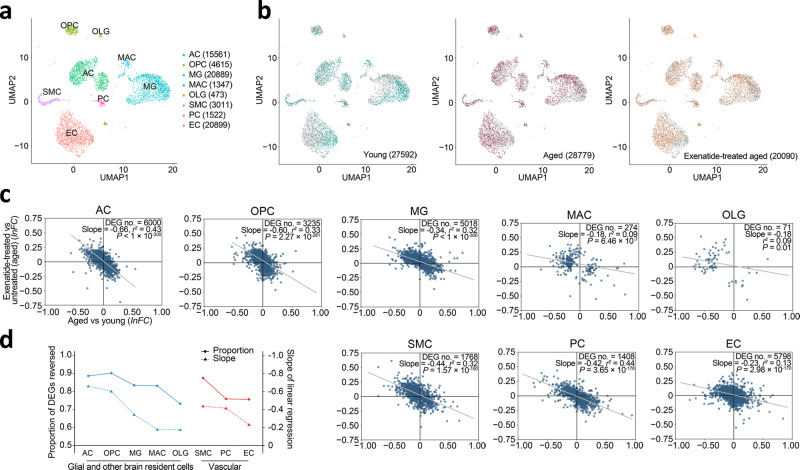
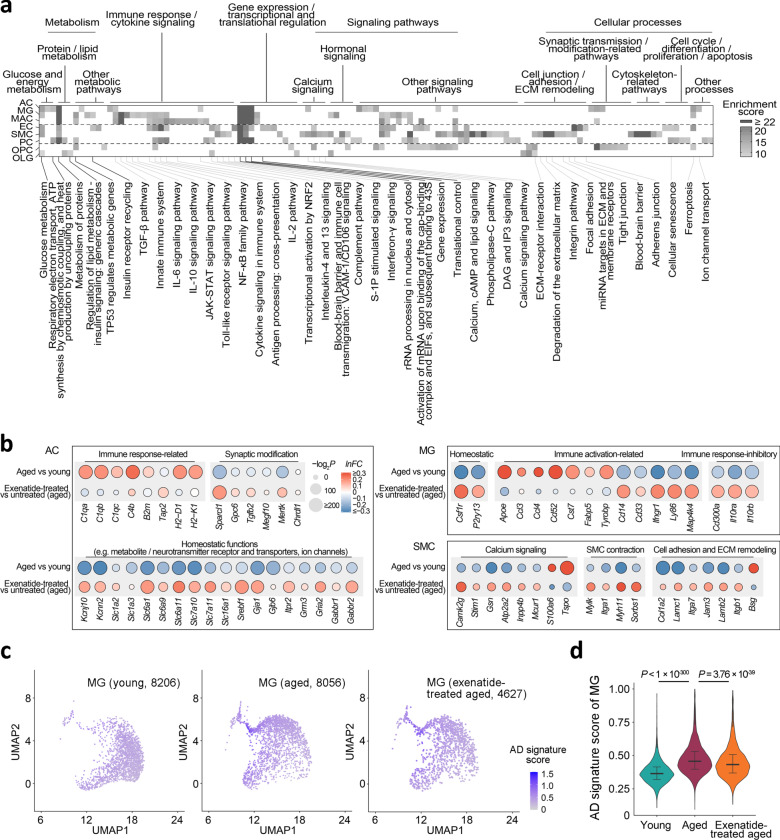
Pharmacological reversal of brain aging is a long-sought yet challenging strategy for the prevention and treatment of age-related neurodegeneration, due to the diverse cell types and complex cellular pathways impacted by the aging process. Here, we report the genome-wide reversal of transcriptomic aging signatures in multiple major brain cell types, including glial and mural cells, by systemic glucagon-like peptide-1 receptor (GLP-1R) agonist (GLP-1RA) treatment. The age-related expression changes reversed by GLP-1RA encompass both shared and cell type-specific functional pathways that are implicated in aging and neurodegeneration. Concomitantly, Alzheimer’s disease (AD)-associated transcriptomic signature in microglia that arises from aging is reduced. These results show the feasibility of reversing brain aging by pharmacological means, provide mechanistic insights into the neurological benefits of GLP-1RAs, and imply that GLP-1R agonism may be a generally applicable pharmacological intervention for patients at risk of age-related neurodegeneration.
Overview
The claims and statistics of this paper haven’t been checked yet.
Free: it reads the open-access text and checks the first 5 claims that cite a source we can check. Create a free account to check every claim.
Integrity signals
Registry
Cites
Statistics
Figures
Verification
Claims the paper makes
The claims and statistics of this paper haven’t been checked yet.
Free: it reads the open-access text and checks the first 5 claims that cite a source we can check. Create a free account to check every claim.
Claims other papers make about this one
Each is checked against this paper’s own text: does it say what the citing paper says it does?
The source backs part of the claim, not all of it — or backs it for a different population, condition or comparison.
In the citing paper
“They are involved in multiple biological pathways that could be beneficial in AD including improvement of BBB integrity and vascular health, promotion of homeostasis in microglia and astrocytes, positive effects on adaptative immune cells (including natural killer cells and activated regulatory T cells), improvement of synaptic viability, and neuroprotection [17–26].”
From evoke and evoke+: design of two large-scale, double-blind, placebo-controlled, phase 3 studies evaluating efficacy, safety, and tolerability of semaglutide in early-stage symptomatic Alzheimer’s disease (2025) · cites this paper as [20]
Experimental — accuracy not yet measuredIn the citing paper
“GLP-1 RAs reverse transcriptomic ageing signatures in multiple major brain cell types, including glial cells and neurovascular cells.407”
From Antiageing strategy for neurodegenerative diseases: from mechanisms to clinical advances (2025) · cites this paper as [407]
Self-check
Percentages, sums and reported differences re-computed from the paper’s own numbers.
The self-check needs the paper’s full text.
Citations
Cites
Integrating single-cell transcriptomic data across different conditions, technologies, and species
Butler, A., Hoffman, P., Smibert, P., Papalexi, E., & Satija, R. (2018) · Nature Biotechnology · doi:10.1038/nbt.4096 · Cited by 13,174
UMAP: Uniform Manifold Approximation and Projection
McInnes, L., Healy, J., Saul, N., & Großberger, L. (2018) · Journal of Open Source Software · doi:10.21105/joss.00861 · Cited by 9,826
A Unique Microglia Type Associated with Restricting Development of Alzheimer’s Disease
Keren-Shaul, H., Spinrad, A., Weiner, A., Matcovitch-Natan, O., Dvir-Szternfeld, R., Ulland, T. K., David, E., Baruch, K., Lara-Astaiso, D., Toth, B., et al. (2017) · Cell · doi:10.1016/j.cell.2017.05.018 · Cited by 5,493
Zhang, Y., Chen, K., Sloan, S. A., Bennett, M. L., Scholze, A. R., O'Keeffe, S., Phatnani, H. P., Guarnieri, P., Caneda, C., Ruderisch, N., et al. (2014) · The Journal of Neuroscience · doi:10.1523/jneurosci.1860-14.2014 · Cited by 4,875
Cell types in the mouse cortex and hippocampus revealed by single-cell RNA-seq
Zeisel, A., Muñoz-Manchado, A. B., Codeluppi, S., Lönnerberg, P., La Manno, G., Juréus, A., Marques, S., Munguba, H., He, L., Betsholtz, C., et al. (2015) · Science · doi:10.1126/science.aaa1934 · Cited by 3,124
Molecular Architecture of the Mouse Nervous System
Zeisel, A., Hochgerner, H., Lönnerberg, P., Johnsson, A., Memic, F., van der Zwan, J., Häring, M., Braun, E., Borm, L. E., La Manno, G., et al. (2018) · Cell · doi:10.1016/j.cell.2018.06.021 · Cited by 2,552
Hammond, T. R., Dufort, C., Dissing-Olesen, L., Giera, S., Young, A., Wysoker, A., Walker, A. J., Segel, M., Nemesh, J., Saunders, A., et al. (2018) · doi:10.1101/406140 · Cited by 2,225
A molecular atlas of cell types and zonation in the brain vasculature
Vanlandewijck, M., He, L., Mäe, M. A., Andrae, J., Ando, K., Del Gaudio, F., Nahar, K., Lebouvier, T., Laviña, B., Gouveia, L., et al. (2018) · Nature · doi:10.1038/nature25739 · Cited by 1,892
A single-cell transcriptomic atlas characterizes ageing tissues in the mouse
The Tabula Muris Consortium, Almanzar, N., Antony, J., Baghel, A. S., Bakerman, I., Bansal, I., Barres, B. A., Beachy, P. A., Berdnik, D., Bilen, B., et al. (2020) · Nature · doi:10.1038/s41586-020-2496-1 · Cited by 1,247
Block of A1 astrocyte conversion by microglia is neuroprotective in models of Parkinson’s disease
Yun, S. P., Kam, T.-I., Panicker, N., Kim, S., Oh, Y., Park, J.-S., Kwon, S.-H., Park, Y. J., Karuppagounder, S. S., Park, H., et al. (2018) · Nature Medicine · doi:10.1038/s41591-018-0051-5 · Cited by 1,123
Self-citationAthauda, D., Maclagan, K., Skene, S. S., Bajwa-Joseph, M., Letchford, D., Chowdhury, K., Hibbert, S., Budnik, N., Zampedri, L., Dickson, J., et al. (2017) · The Lancet · doi:10.1016/s0140-6736(17)31585-4 · Cited by 889
Single-cell transcriptomic profiling of the aging mouse brain
Ximerakis, M., Lipnick, S. L., Innes, B. T., Simmons, S. K., Adiconis, X., Dionne, D., Mayweather, B. A., Nguyen, L., Niziolek, Z., Ozek, C., et al. (2019) · Nature Neuroscience · doi:10.1038/s41593-019-0491-3 · Cited by 736
The aging astrocyte transcriptome from multiple regions of the mouse brain.
Boisvert, M. M., Erikson, G. A., Shokhirev, M. N., & Allen, N. J. (2018) · Cell Reports · doi:10.1016/j.celrep.2017.12.039 · Cited by 702
Gejl, M., Gjedde, A., Egefjord, L., Møller, A., Hansen, S. B., Vang, K., Rodell, A., Brændgaard, H., Gottrup, H., Schacht, A., et al. (2016) · Frontiers in Aging Neuroscience · doi:10.3389/fnagi.2016.00108 · Cited by 480
Cork, S. C., Richards, J. E., Holt, M. K., Gribble, F. M., Reimann, F., & Trapp, S. (2015) · Molecular Metabolism · doi:10.1016/j.molmet.2015.07.008 · Cited by 478
Immune cell regulation of glia during CNS injury and disease
Greenhalgh, A. D., David, S., & Bennett, F. C. (2020) · Nature Reviews Neuroscience · doi:10.1038/s41583-020-0263-9 · Cited by 396
The pro-remyelination properties of microglia in the central nervous system
Lloyd, A. F., & Miron, V. E. (2019) · Nature Reviews Neurology · doi:10.1038/s41582-019-0184-2 · Cited by 381
Elmore, M. R. P., Hohsfield, L. A., Kramár, E. A., Soreq, L., Lee, R. J., Pham, S. T., Najafi, A. R., Spangenberg, E. E., Wood, M. A., West, B. L., et al. (2018) · Aging Cell · doi:10.1111/acel.12832 · Cited by 380
Probabilistic cell-type assignment of single-cell RNA-seq for tumor microenvironment profiling
Zhang, A. W., O’Flanagan, C., Chavez, E. A., Lim, J. L. P., Ceglia, N., McPherson, A., Wiens, M., Walters, P., Chan, T., Hewitson, B., et al. (2019) · Nature Methods · doi:10.1038/s41592-019-0529-1 · Cited by 375
Cukierman-Yaffe, T., Gerstein, H. C., Colhoun, H. M., Diaz, R., García-Pérez, L.-E., Lakshmanan, M., Bethel, A., Xavier, D., Probstfield, J., Riddle, M. C., et al. (2020) · The Lancet Neurology · doi:10.1016/s1474-4422(20)30173-3 · Cited by 300
Ben-Ari Fuchs, S., Lieder, I., Stelzer, G., Mazor, Y., Buzhor, E., Kaplan, S., Bogoch, Y., Plaschkes, I., Shitrit, A., Rappaport, N., et al. (2016) · OMICS: A Journal of Integrative Biology · doi:10.1089/omi.2015.0168 · Cited by 260
Brain Endothelial Cells Are Exquisite Sensors of Age-Related Circulatory Cues
Chen, M. B., Yang, A. C., Yousef, H., Lee, D., Chen, W., Schaum, N., Lehallier, B., Quake, S. R., & Wyss-Coray, T. (2020) · Cell Reports · doi:10.1016/j.celrep.2020.03.012 · Cited by 233
Diabetes medications and risk of Parkinson’s disease: a cohort study of patients with diabetes
Brauer, R., Wei, L., Ma, T., Athauda, D., Girges, C., Vijiaratnam, N., Auld, G., Whittlesea, C., Wong, I., & Foltynie, T. (2020) · Brain · doi:10.1093/brain/awaa262 · Cited by 233
Structural basis for GLP-1 receptor activation by LY3502970, an orally active nonpeptide agonist
Kawai, T., Sun, B., Yoshino, H., Feng, D., Suzuki, Y., Fukazawa, M., Nagao, S., Wainscott, D. B., Showalter, A. D., Droz, B. A., et al. (2020) · Proceedings of the National Academy of Sciences · doi:10.1073/pnas.2014879117 · Cited by 231
Holt, M. K., Richards, J. E., Cook, D. R., Brierley, D. I., Williams, D. L., Reimann, F., Gribble, F. M., & Trapp, S. (2019) · Diabetes · doi:10.2337/db18-0729 · Cited by 212
A Small-Molecule Oral Agonist of the Human Glucagon-like Peptide-1 Receptor
Griffith, D. A., Edmonds, D. J., Fortin, J.-P., Kalgutkar, A. S., Kuzmiski, J. B., Loria, P. M., Saxena, A. R., Bagley, S. W., Buckeridge, C., Curto, J. M., et al. (2022) · Journal of Medicinal Chemistry · doi:10.1021/acs.jmedchem.1c01856 · Cited by 192
Activation of the GLP-1 receptor by a non-peptidic agonist
Zhao, P., Liang, Y.-L., Belousoff, M. J., Deganutti, G., Fletcher, M. M., Willard, F. S., Bell, M. G., Christe, M. E., Sloop, K. W., Inoue, A., et al. (2020) · Nature · doi:10.1038/s41586-019-1902-z · Cited by 164
Altered hippocampal transcript profile accompanies an age-related spatial memory deficit in mice
Verbitsky, M., Yonan, A. L., Malleret, G., Kandel, E. R., Gilliam, T. C., & Pavlidis, P. (2004) · Learning & Memory · doi:10.1101/lm.68204 · Cited by 158
Age-Dependent Neurovascular Dysfunction and Damage in a Mouse Model of Cerebral Amyloid Angiopathy
Park, L., Koizumi, K., El Jamal, S., Zhou, P., Previti, M. L., Van Nostrand, W. E., Carlson, G., & Iadecola, C. (2014) · Stroke · doi:10.1161/strokeaha.114.005179 · Cited by 128
Zhao, L., Li, Z., Vong, J. S. L., Chen, X., Lai, H.-M., Yan, L. Y. C., Huang, J., Sy, S. K. H., Tian, X., Huang, Y., et al. (2020) · Nature Communications · doi:10.1038/s41467-020-18249-3 · Cited by 126
Self-citationCai, H.-Y., Yang, J.-T., Wang, Z.-J., Zhang, J., Yang, W., Wu, M.-N., & Qi, J.-S. (2018) · Biochemical and Biophysical Research Communications · doi:10.1016/j.bbrc.2017.11.114 · Cited by 108
Glia: victims or villains of the aging brain?
Salas, I. H., Burgado, J., & Allen, N. J. (2020) · Neurobiology of Disease · doi:10.1016/j.nbd.2020.105008 · Cited by 93
de Fiebre, N. C., Sumien, N., Forster, M. J., & de Fiebre, C. M. (2006) · AGE · doi:10.1007/s11357-006-9027-3 · Cited by 63
Yang, W., Zhou, X., & Ma, T. (2019) · Frontiers in Aging Neuroscience · doi:10.3389/fnagi.2019.00246 · Cited by 43
Hamieh, A. M., Camperos, E., Hernier, A. M., & Castagné, V. (2020) · Brain Research · doi:10.1016/j.brainres.2020.147173 · Cited by 34
A small-molecule oral agonist of the human glucagon-like peptide-1 receptorPreprint
Griffith, D. A., Edmonds, D. J., Fortin, J.-P., et al. (2020) · bioRxiv (Cold Spring Harbor Laboratory) · doi:10.1101/2020.09.29.319483 · Cited by 28
Author Correction: Tumour lineage shapes BRCA-mediated phenotypes
Jonsson, P., Bandlamudi, C., Cheng, M. L., Srinivasan, P., Chavan, S. S., Friedman, N. D., Rosen, E. Y., Richards, A. L., Bouvier, N., Selçuklu, S. D., et al. (2019) · Nature · doi:10.1038/s41586-019-1839-2 · Cited by 20
Cited by
Human trials exploring anti-aging medicines
Guarente, L., Sinclair, D. A., & Kroemer, G. (2024) · Cell Metabolism · doi:10.1016/j.cmet.2023.12.007 · Cited by 244
Metabolic landscape in cardiac aging: insights into molecular biology and therapeutic implications
Xie, S., Xu, S.-C., Deng, W., & Tang, Q. (2023) · Signal Transduction and Targeted Therapy · doi:10.1038/s41392-023-01378-8 · Cited by 177
“Likewise, glucagon-like peptide 1 receptor (GLP1R) agonists are also ascertained to reverse aging and neurodegeneration at a genetic level.(310) However, their role and precise mechanism in cardiac aging remain to be further explored.”
BackgroundAntiageing strategy for neurodegenerative diseases: from mechanisms to clinical advances
Jiang, Q., Liu, J., Huang, S., Wang, X.-Y., Chen, X., Liu, G.-H., Ye, K., Song, W., Masters, C. L., Wang, J., et al. (2025) · Signal Transduction and Targeted Therapy · doi:10.1038/s41392-025-02145-7 · Cited by 165
Self-citationCummings, J. L., Atri, A., Feldman, H. H., Hansson, O., Sano, M., Knop, F. K., Johannsen, P., León, T., & Scheltens, P. (2025) · Alzheimer's Research & Therapy · doi:10.1186/s13195-024-01666-7 · Cited by 168
Cummings, J. L., Atri, A., Sano, M., Zetterberg, H., Scheltens, P., Knop, F. K., Johannsen, P., Wichmann, C. A., Abschneider, R. M., Leon, T., et al. (2026) · The Lancet · doi:10.1016/s0140-6736(26)00459-9 · Cited by 110
Metadata
- Authors
- Li, Z., Chen, X., Vong, J. S. L., Zhao, L., Huang, J., Yan, L. Y. C., Ip, B., Wing, Y. K., Lai, H.-M., Mok, V. C. T., & Ko, H.
- Affiliations
- Chinese University of Hong Kong (HK)
- Corresponding author
- Mok, Vincent C. T.
- Ko, Ho
- ORCID
- Venue
- Communications Biology
- Published
- 2021-06-02
- Volume
- 4
- Issue
- 1
- Pages
- 656-656
- ISSN
- 2399-3642 (ISSN-L)
- PMC
- PMC8172568
- OpenAlex
- W3164467445
- Cited by
- 42
- References
- 37
- Citations by year
- 2026: 8 · 2025: 16 · 2024: 11 · 2023: 5 · 2022: 2
- FWCI
- 1.61
- Type
- journal article
- Language
- en
- Open access
- gold
- doi.org
- Licence
- cc-by
- creativecommons.org/licenses/by/4.0 (tdm)
- creativecommons.org/licenses/by/4.0 (vor)
- Locations
- Communications Biology (publishedVersion, cc-by)
- PubMed Central (publishedVersion, cc-by)
- PubMed (publishedVersion)
- DOAJ (DOAJ: Directory of Open Access Journals) (submittedVersion, cc-by-sa)
- Funders
- Croucher Foundation (CIA20CU01)
- University Grants Committee (AoE/M-604/16)
- Chinese University of Hong Kong (FIA2017/B/01, FIA2020/B/01)
- Topics
- Life Sciences › Biochemistry, Genetics and Molecular Biology › Aging › Genetics, Aging, and Longevity in Model Organisms
- Life Sciences › Neuroscience › Neurology › Neuroinflammation and Neurodegeneration Mechanisms
- Life Sciences › Biochemistry, Genetics and Molecular Biology › Molecular Biology › Single-cell and spatial transcriptomics
- Keywords
- GLP-1 receptor agonists, brain aging, age-related neurodegeneration, microglia, glial cells, mural cells, Alzheimer's disease, cell type-specific gene expression
- MeSH terms
- Glucagon-Like Peptide-1 Receptor, Exenatide, Glucagon-Like Peptide-1 Receptor Agonists, Aging, Alzheimer Disease, Animals, Brain, Feasibility Studies, Humans, Male, Mice, Inbred C57BL, Neuroglia, Cellular Senescence, Neurodegenerative Diseases, Mice, Transcriptome
About these checks
Registry, retraction, Cites and statistics results are computed, not judged, with one exception: a printed reference that no index lists is read once by a model before it counts as a citation error. Claims are extracted by a model and kept only when their quote appears verbatim in the text; each cited source is then checked, with a model’s help, for whether it says what the claim relies on. Those verdicts can be wrong — read the claim’s quote and the cited source before relying on one.
Statistics and arithmetic are recomputed, not judged.
Confidence bands are shown only for fields calibrated on our annotated test set. None is calibrated yet, so no band is shown.
What counts as a claim ›How we measure confidence ›How we check this ›
Are you an author, or do you see a problem with this page? Request a review
Data sources
Bibliographic data: Semantic Scholar, OpenAlex, Crossref.
Contains information from the Semantic Scholar Academic Graph Datasets, made available under the ODC Attribution License (ODC-BY 1.0).
Semantic Scholar’s data is described in: Kinney, R., et al. (2023). The Semantic Scholar Open Data Platform. arXiv:2301.10140.
