

Enhancing kcat prediction through residue-aware attention mechanism and pre-trained representations
Open accessPublished version of a preprint
The DOI matches its Crossref record; 32 of the 32 references it cites were found in a registry or an index.
Abstract
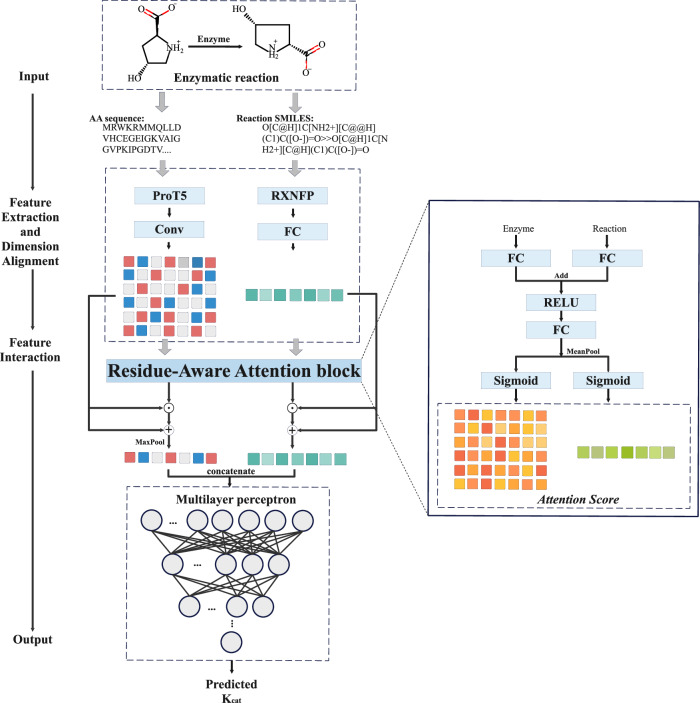
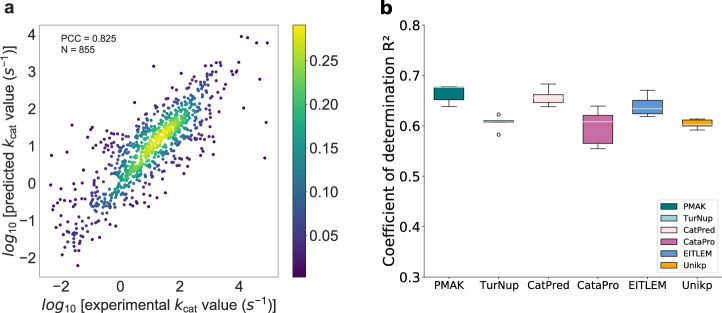
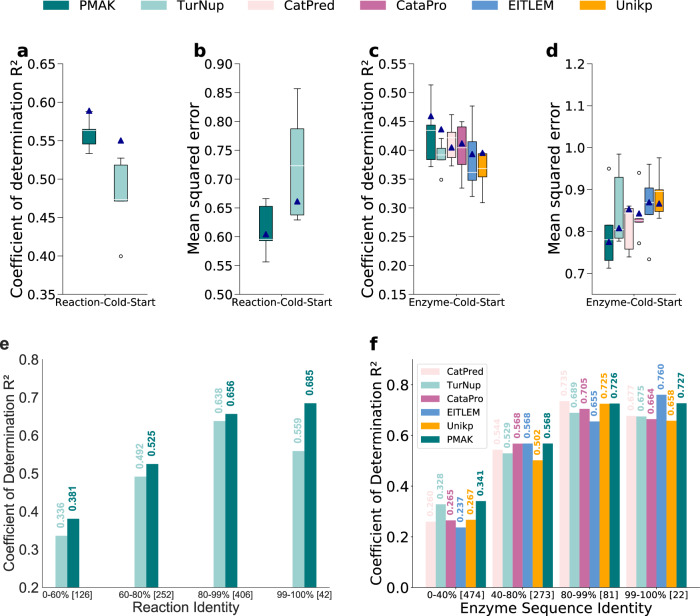
The turnover number (kcat) is a critical parameter in enzyme kinetics, representing the maximum number of substrate molecules an enzyme can convert to product per unit time under optimal conditions. While kcat reflects an enzyme's catalytic efficiency and plays a central role in understanding enzyme activity, existing computational models for predicting this parameter often face significant limitations. Most models rely solely on substrate information, overlooking the integral role of the reaction itself in predicting kcat. The only model that attempts to incorporate reaction information, TurNuP, still falls short in both predictive accuracy and interpretability. To address these challenges, we propose PMAK, a deep learning model that leverages pre-trained representation learning and a residue-aware attention mechanism. By incorporating both enzyme sequences and reaction details, PMAK generates robust representations, effectively capturing the complex interplay between enzyme and reaction, and offering superior accuracy and generalization compared to existing methods. Specifically, PMAK achieved an average R2 improvement of approximately 16.9% and 10.0% over TurNup under new reaction setting and new enzyme setting in five-fold cross-validation, respectively. Besides, our approach provides valuable insights into the key features driving enzyme catalysis, making it a more interpretable solution for enzymatic reaction prediction.
Overview
The claims and statistics of this paper haven’t been checked yet.
Free: it reads the open-access text and checks the first 5 claims that cite a source we can check. Create a free account to check every claim.
Integrity signals
Registry
Cites
Statistics
Figures
Verification
Claims the paper makes
The claims and statistics of this paper haven’t been checked yet.
Free: it reads the open-access text and checks the first 5 claims that cite a source we can check. Create a free account to check every claim.
Self-check
Percentages, sums and reported differences re-computed from the paper’s own numbers.
The self-check needs the paper’s full text.
Citations
Cites
XGBoost: A Scalable Tree Boosting System
Chen, T., & Guestrin, C. (2016) · Proceedings of the 22nd ACM SIGKDD International Conference on Knowledge Discovery and Data Mining · doi:10.1145/2939672.2939785 · Cited by 54,569
UniProt: a worldwide hub of protein knowledge
The UniProt Consortium (2019) · Nucleic Acids Research · doi:10.1093/nar/gky1049 · Cited by 7,698
Rives, A., Meier, J., Sercu, T., Goyal, S., Lin, Z., Liu, J., Guo, D., Ott, M., Zitnick, C. L., Ma, J., et al. (2021) · Proceedings of the National Academy of Sciences · doi:10.1073/pnas.2016239118 · Cited by 3,286
ProtTrans: Toward Understanding the Language of Life Through Self-Supervised Learning
Elnaggar, A., Heinzinger, M., Dallago, C., Rehawi, G., Wang, Y., Jones, L., Gibbs, T., Feher, T., Angerer, C., Steinegger, M., et al. (2022) · IEEE Transactions on Pattern Analysis and Machine Intelligence · doi:10.1109/tpami.2021.3095381 · Cited by 2,329
UniRef clusters: a comprehensive and scalable alternative for improving sequence similarity searches
Suzek, B. E., Wang, Y., Huang, H., McGarvey, P. B., Wu, C. H., & the UniProt Consortium (2015) · Bioinformatics · doi:10.1093/bioinformatics/btu739 · Cited by 1,928 · cited 2×
“ProT5-XL-Uniref50 and ESM1b are both trained on the large-scale UniRef50 33 protein sequence database and are commonly applied in protein-related prediction tasks, while ESM 1 b ts is an adaptation of the ESM1b model speci fi cally optimized by Kroll et al. for enzyme-substrate association…”
BRENDA, the ELIXIR core data resource in 2021: new developments and updates
Chang, A., Jeske, L., Ulbrich, S., Hofmann, J., Koblitz, J., Schomburg, I., Neumann-Schaal, M., Jahn, D., & Schomburg, D. (2021) · Nucleic Acids Research · doi:10.1093/nar/gkaa1025 · Cited by 789
Deep learning-based kcat prediction enables improved enzyme-constrained model reconstruction
Li, F., Yuan, L., Lu, H., Li, G., Chen, Y., Engqvist, M. K. M., Kerkhoven, E. J., & Nielsen, J. (2022) · Nature Catalysis · doi:10.1038/s41929-022-00798-z · Cited by 466
Pre-Trained Language Models and Their Applications
Wang, H., Li, J., Wu, H., Hovy, E., & Sun, Y. (2023) · Engineering · doi:10.1016/j.eng.2022.04.024 · Cited by 385
Interpretable bilinear attention network with domain adaptation improves drug–target prediction
Bai, P., Miljković, F., John, B., & Lu, H. (2023) · Nature Machine Intelligence · doi:10.1038/s42256-022-00605-1 · Cited by 362
Mapping the space of chemical reactions using attention-based neural networks
Schwaller, P., Probst, D., Vaucher, A. C., Nair, V. H., Kreutter, D., Laino, T., & Reymond, J.-L. (2021) · Nature Machine Intelligence · doi:10.1038/s42256-020-00284-w · Cited by 356
Davidi, D., Noor, E., Liebermeister, W., Bar-Even, A., Flamholz, A., Tummler, K., Barenholz, U., Goldenfeld, M., Shlomi, T., & Milo, R. (2016) · Proceedings of the National Academy of Sciences · doi:10.1073/pnas.1514240113 · Cited by 266 · cited 1×
“Escherichiacoli byutilizing fl uxdataandproteomicsdataunder31different growth conditions 6 .”
UniKP: a unified framework for the prediction of enzyme kinetic parameters
Yu, H., Deng, H., He, J., Keasling, J. D., & Luo, X. (2023) · Nature Communications · doi:10.1038/s41467-023-44113-1 · Cited by 226
Heckmann, D., Lloyd, C. J., Mih, N., Ha, Y., Zielinski, D. C., Haiman, Z. B., Desouki, A. A., Lercher, M. J., & Palsson, B. O. (2018) · Nature Communications · doi:10.1038/s41467-018-07652-6 · Cited by 218
SABIO-RK: an updated resource for manually curated biochemical reaction kinetics
Wittig, U., Rey, M., Weidemann, A., Kania, R., & Müller, W. (2018) · Nucleic Acids Research · doi:10.1093/nar/gkx1065 · Cited by 204
A general model to predict small molecule substrates of enzymes based on machine and deep learning
Kroll, A., Ranjan, S., Engqvist, M. K. M., & Lercher, M. J. (2023) · Nature Communications · doi:10.1038/s41467-023-38347-2 · Cited by 193
Turnover number predictions for kinetically uncharacterized enzymes using machine and deep learning
Kroll, A., Rousset, Y., Hu, X.-P., Liebrand, N. A., & Lercher, M. J. (2023) · Nature Communications · doi:10.1038/s41467-023-39840-4 · Cited by 186
Reaction classification and yield prediction using the differential reaction fingerprint DRFP
Probst, D., Schwaller, P., & Reymond, J.-L. (2022) · Digital Discovery · doi:10.1039/d1dd00006c · Cited by 178
Robust enzyme discovery and engineering with deep learning using CataPro
Wang, Z., Xie, D., Wu, D., Luo, X., Wang, S., Li, Y., Yang, Y., Li, W., & Zheng, L. (2025) · Nature Communications · doi:10.1038/s41467-025-58038-4 · Cited by 164
CatPred: a comprehensive framework for deep learning in vitro enzyme kinetic parameters
Boorla, V. S., & Maranas, C. D. (2025) · Nature Communications · doi:10.1038/s41467-025-57215-9 · Cited by 162
Madhavan, A., Arun, K. B., Binod, P., et al. (2020) · Bioresource Technology · doi:10.1016/j.biortech.2020.124617 · Cited by 148
Machine learning-enabled retrobiosynthesis of molecules
Yu, T., Boob, A. G., Volk, M., Liu, X., Cui, H., & Zhao, H. (2023) · Nature Catalysis · doi:10.1038/s41929-022-00909-w · Cited by 133
Pokusaeva, V. O., Usmanova, D. R., Putintseva, E. V., Espinar, L., Sarkisyan, K. S., Mishin, A. S., Bogatyreva, N. S., Ivankov, D. N., Akopyan, A. V., Avvakumov, S. Y., et al. (2019) · PLOS Genetics · doi:10.1371/journal.pgen.1008079 · Cited by 112
Chan, Y. H., Venev, S. V., Zeldovich, K. B., & Matthews, C. R. (2017) · Nature Communications · doi:10.1038/ncomms14614 · Cited by 54
EITLEM-Kinetics: A deep-learning framework for kinetic parameter prediction of mutant enzymes
Shen, X., Cui, Z., Long, J., Zhang, S., Chen, B., & Tan, T. (2024) · Chem Catalysis · doi:10.1016/j.checat.2024.101094 · Cited by 52
DLKcat cannot predict meaningful k cat values for mutants and unfamiliar enzymes
Kroll, A., & Lercher, M. J. (2024) · Biology Methods and Protocols · doi:10.1093/biomethods/bpae061 · Cited by 50
DLTKcat: deep learning-based prediction of temperature-dependent enzyme turnover rates
Qiu, S., Zhao, S., & Yang, A. (2023) · Briefings in Bioinformatics · doi:10.1093/bib/bbad506 · Cited by 43
Assignment of EC Numbers to Enzymatic Reactions with Reaction Difference Fingerprints
Hu, Q.-N., Zhu, H. J., Li, X., et al. (2012) · PLoS ONE · doi:10.1371/journal.pone.0052901 · Cited by 37
Yu, H., & Luo, X. (2022) · Briefings in Bioinformatics · doi:10.1093/bib/bbac476 · Cited by 21
Cai, Y., Zhang, W., Dou, Z., Wang, C., Yu, W., & Wang, L. (2025) · Computational Biology and Chemistry · doi:10.1016/j.compbiolchem.2024.108327 · Cited by 15
Self-citationGELKcat: An Integration Learning of Substrate Graph with Enzyme Embedding for Kcat prediction
Du, B.-X., Yu, H., Zhu, B., Long, Y., Wu, M., & Shi, J. (2023) · IEEE International Conference on Bioinformatics and Biomedicine (BIBM) · doi:10.1109/bibm58861.2023.10385630 · Cited by 10
ML helps predict enzyme turnover rates
Boorla, V. S., Upadhyay, V., & Maranas, C. D. (2022) · Nature Catalysis · doi:10.1038/s41929-022-00827-x · Cited by 4
Cai (2025) · Zenodo (CERN European Organization for Nuclear Research) · doi:10.5281/zenodo.18027738 · Cited by 1
Research works printed but not linked: 5
- Stephanopoulos, G., Nielsen, J. & Lee, S. Y. (Eds.). Metabolic Engineering: Concepts and Applications. (Wiley - VCH: Weinheim, Germany, 2021).
- Meier, J. et al. Language models enable zero-shot prediction of the effects of mutations on protein function. Adv. Neural Inf. Process. Syst. 34, 29287–29303 (2021).
- Lin, Z. et al. Language models of protein sequences at the scale of evolution enable accurate structure prediction. BioRxiv 2022, 500902 (2022).
- Landrum, G. Rdkit documentation. Release 1, 4 (2013).
- Kenton, J. D. M.-W. C. & Toutanova, L. K. Bert: Pre-training of deep bidirectional transformers for language understanding. In Proceedings of naacL-HLT, vol. 1, 2 (Minneapolis, Minnesota, 2019).
Metadata
- Authors
- Cai, Y., Ge, F., Zhang, C., Chen, H., Qi, X., Liao, X., & Wang, L.
- Affiliations
- Tianjin University of Science and Technology (CN)
- University of Science and Technology of China (CN)
- Chinese Academy of Sciences (CN)
- Corresponding author
- Liao, Xiaoping
- Wang, Lin
- Venue
- Communications Biology
- Published
- 2026-01-22
- Volume
- 9
- Issue
- 1
- Pages
- 273-273
- ISSN
- 2399-3642 (ISSN-L)
- PMC
- PMC12917189
- OpenAlex
- W7125399703
- Cited by
- 2
- References
- 32
- Citations by year
- 2026: 2
- FWCI
- 4.13
- Type
- journal article
- Language
- en
- Open access
- gold
- doi.org
- Licence
- cc-by-nc-nd
- creativecommons.org/licenses/by-nc-nd/4.0 (tdm)
- creativecommons.org/licenses/by-nc-nd/4.0 (vor, 27 d)
- Locations
- Communications Biology (publishedVersion, cc-by-nc-nd)
- Research Square (acceptedVersion, cc-by)
- PubMed (publishedVersion)
- PubMed Central (publishedVersion, cc-by-nc-nd)
- DOAJ (DOAJ: Directory of Open Access Journals) (submittedVersion, cc-by-sa)
- Funders
- National Natural Science Foundation of China (12326611, 61603273)
- Chinese Academy of Sciences (XDC0120201)
- Topics
- Life Sciences › Biochemistry, Genetics and Molecular Biology › Molecular Biology › Machine Learning in Bioinformatics
- Life Sciences › Pharmacology, Toxicology and Pharmaceutics › Drug Discovery › Computational Drug Discovery Methods
- Life Sciences › Biochemistry, Genetics and Molecular Biology › Molecular Biology › Enzyme Catalysis and Immobilization
- Keywords
- enzyme kinetics, catalytic efficiency, pre-trained representations
- MeSH terms
- Deep Learning, Enzymes, Kinetics, Computational Biology
About these checks
Registry, retraction, Cites and statistics results are computed, not judged, with one exception: a printed reference that no index lists is read once by a model before it counts as a citation error. Claims are extracted by a model and kept only when their quote appears verbatim in the text; each cited source is then checked, with a model’s help, for whether it says what the claim relies on. Those verdicts can be wrong — read the claim’s quote and the cited source before relying on one.
Statistics and arithmetic are recomputed, not judged.
Confidence bands are shown only for fields calibrated on our annotated test set. None is calibrated yet, so no band is shown.
What counts as a claim ›How we measure confidence ›How we check this ›
Are you an author, or do you see a problem with this page? Request a review
Data sources
Bibliographic data: Semantic Scholar, OpenAlex, Crossref.
Contains information from the Semantic Scholar Academic Graph Datasets, made available under the ODC Attribution License (ODC-BY 1.0).
Semantic Scholar’s data is described in: Kinney, R., et al. (2023). The Semantic Scholar Open Data Platform. arXiv:2301.10140.
