

The DOI matches its Crossref record; 71 of the 72 references it cites were found in a registry or an index; 11 of the 50 sources its claims cite were checked for support.
Turnover number predictions for kinetically uncharacterized enzymes using machine and deep learning
Open accessPublished version of a preprint
Abstract
The turnover number k cat , a measure of enzyme efficiency, is central to understanding cellular physiology and resource allocation. As experimental k cat estimates are unavailable for the vast majority of enzymatic reactions, the development of accurate computational prediction methods is highly desirable. However, existing machine learning models are limited to a single, well-studied organism, or they provide inaccurate predictions except for enzymes that are highly similar to proteins in the training set. Here, we present TurNuP, a general and organism-independent model that successfully predicts turnover numbers for natural reactions of wild-type enzymes. We constructed model inputs by representing complete chemical reactions through differential reaction fingerprints and by representing enzymes through a modified and re-trained Transformer Network model for protein sequences. TurNuP outperforms previous models and generalizes well even to enzymes that are not similar to proteins in the training set. Parameterizing metabolic models with TurNuP-predicted k cat values leads to improved proteome allocation predictions. To provide a powerful and convenient tool for the study of molecular biochemistry and physiology, we implemented a TurNuP web server.
Overview
CoChat Summary
## TL;DR
TurNuP is a machine/deep learning model that predicts enzyme turnover numbers (kcat) from enzyme sequence and full reaction information, and it outperforms prior methods on the paper’s held-out test sets. On the authors’ final test set of 4,271 data points, the combined model reached \(R^2 = 0.44\) with mean absolute deviation 0.69 on the \(\log_{10}\) scale, corresponding to a 4.8-fold average deviation from measured values.
## Key findings
- The final curated dataset contained 4,271 data points, with 2,977 unique reactions and 2,827 unique enzymes; the train/test split was 80%/20% with no identical enzyme sequences in both splits.
- Using reaction information alone, the best reaction fingerprint model achieved \(R^2 = 0.38\), MSE = 0.89, and Pearson \(r = 0.62\) on the test set.
- Using enzyme information alone, the best enzyme representation achieved \(R^2 = 0.37\), MSE = 0.91, and \(r = 0.61\) on the test set.
- The final TurNuP ensemble of enzyme and reaction models achieved \(R^2 = 0.44\), MSE = 0.81, and \(r = 0.67\) on the test set; adding extra features like \(K_M\) and reaction flux did not improve performance (\(R^2 = 0.39\) with those added features).
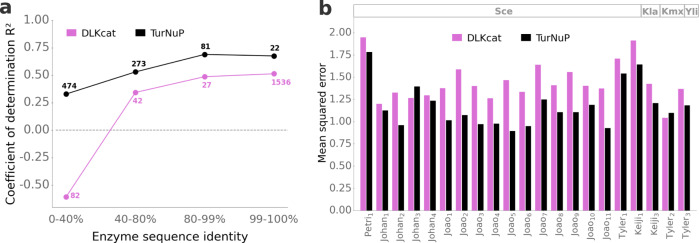
- TurNuP performed better than DLKcat across all enzyme-sequence-identity bins, with reported significance levels of \(p = 4.3 \times 10^{-11}\), 0.0017, 0.00037, and 0.048 for the four sequence-identity groups.
- Using TurNuP-derived kcat values in yeast proteome allocation modeling improved predictions in 19 of 21 environment-species combinations, with mean squared errors improving by about 18% on average.
## Methods
- The authors compiled kcat measurements from BRENDA, UniProt, and Sabio-RK, mapped them to enzyme sequences and reaction identities, removed non-wild-type/non-natural reactions, duplicates, incomplete records, and outliers, and log-transformed kcat values.
- They trained and compared gradient boosting models using different inputs: reaction fingerprints (structural, difference, DRFP), enzyme representations (ESM-1b and a fine-tuned ESM-1b-based representation), and combinations of these.
- Model development used fivefold cross-validation for hyperparameter search and a held-out test set; performance was assessed with \(R^2\), MSE, Pearson \(r\), and nonparametric tests for model comparisons.
## Limitations
- The paper states that the training data are small and noisy; it reports an average deviation of 5.7-fold between two kcat measurements for the same enzyme-reaction pair and notes database errors and varying assay conditions as contributors.
- The authors state they could not include experimental conditions such as pH and temperature for most data points because these are generally unavailable in the databases; this likely limits accuracy.
- Evident from the text: the model was trained only on natural reactions of wild-type enzymes, so the authors say it should not be used for non-natural reactions or enzyme mutants.
Model-written summary. Check it against the paper before relying on it.
Integrity signals
Registry
Cites
Statistics
Figures



Verification
Claims the paper makes
7 Valid · 0 Not valid · 27 Not checked · 101 Own results and interpretations
The cited sources support only part of this claim — read each source’s verdict below.
In the paper
“In genome-scale kinetic models of cellular metabolism, this issue is typically addressed by either sampling missing k cat values or fitting them to large datasets 7 , 8 , 12 , 13 .”
What the sources say
- Partly supportedcites [7] Khodayari, A. & Maranas, C. D. A genome-scale escherichia coli kinetic metabolic model k-ecoli457 satisfying flux data for multiple mutant strains. Nat. Commun. 7, 1–12 (2016). sourceExperimental — accuracy not yet measured
The Abstract describes parameter sampling in kinetic models, and Methods > Estimation of k-ecoli457 parameters describes fitting model parameters to multiple mutant-strain flux datasets. Results > Comparison of predicted Michaelis–Menten parameters reports estimated kcat values. The paper supports these approaches as examples, but does not establish that they are the typical ways to address specifically missing kcat values. (LLM, conf=0.83)
- Partly supportedcites [8] Ebrahim, A. et al. Multi-omic data integration enables discovery of hidden biological regularities. Nat. Commun. 7, 1–9 (2016). sourceExperimental — accuracy not yet measured
The Methods sections on sampling and iterative simulation describe randomly initializing effective turnover rates (keff) and updating them using experimental proteomics data. But the paper distinguishes its in vivo keff estimates from in vitro enzyme kinetic parameters; it does not establish that sampling or fitting missing kcat values is typical practice across genome-scale kinetic models. No page numbers were available in our copy. (LLM, conf=0.84)
- Not checked yetcites [12] Saa, P. A. & Nielsen, L. K. Formulation, construction and analysis of kinetic models of metabolism: a review of modelling frameworks. Biotechnol. Adv. 35, 981–1003 (2017). source
plain- Asserted: passes — The authors put it forward as true.
- Checkable: passes — It can be checked against evidence.
- Load-bearing: passes — The paper’s conclusions depend on it.
- Based: passes — The paper gives a reason why it holds.
- Partly supported
The cited sources support only part of this claim — read each source’s verdict below.
In the paper
“It has been shown that the resulting representations contain rich information about the structure and the function of the proteins 17 , 32 , 33 .”
What the sources say
- Partly supportedcites [17] Rives, A. et al. Biological structure and function emerge from scaling unsupervised learning to 250 million protein sequences. Proc. Natl Acad. Sci. USA 118, e2016239118 (2021). sourceExperimental — accuracy not yet measured
The Linear Projections section (Figs. 4–5 and Table 3; page not provided) shows that ESM-1b representations contain information about secondary structure and residue contacts. The Prediction of Mutational Effects section supports a connection between learned representations and protein function, but its functional results use a 34-layer Transformer rather than ESM-1b specifically. The claim’s ESM-1b-specific functional component is therefore not established by these passages. (LLM, conf=0.85)
- Partly supportedcites [32] Kroll, A., Ranjan, S., Engqvist, M. K. & Lercher, M. J. A general model to predict small molecule substrates of enzymes based on machine and deep learning. Nat. Commun. 14, 2787 (2023). sourceExperimental — accuracy not yet measured
The Results section (“Fine-tuning of a state-of-the-art protein embedding model”; page unavailable) says ESM-1b representations store local and global sequence information. The paper also uses these representations to predict enzyme substrates, supporting a connection to function, but our copy does not establish that they contain information about protein structure. (LLM, conf=0.82)
- Supportedcites [33] Goldman, S., Das, R., Yang, K. K. & Coley, C. W. Machine learning modeling of family wide enzyme-substrate specificity screens. PLoS Comput. Biol. 18, 1–20 (2022). source
The Results (Models; page not provided) identify ESM-1b as the representation used and report its performance on contact prediction and prediction of the functional effects of sequence variations. These support the paraphrase that its representations contain information about protein structure and function. (LLM, conf=0.90)
plain- Asserted: passes — The authors put it forward as true.
- Checkable: passes — It can be checked against evidence.
- Load-bearing: passes — The paper’s conclusions depend on it.
- Based: passes — The paper gives a reason why it holds.
- Partly supported
The cited sources support only part of this claim — read each source’s verdict below.
In the paper
“The model achieved a coefficient of determination R 2 ≈ 0.34 on a test set.”
What the sources say
- Partly supportedcites [14] Heckmann, D. et al. Machine learning applied to enzyme turnover numbers reveals protein structural correlates and improves metabolic models. Nat. Commun. 9, 5252 (2018). sourceExperimental — accuracy not yet measured
In Results, under “Training predictive models of enzyme turnover numbers” (Fig. 2 caption; page unavailable), the paper says it measured R² on an independent test set. Our copy does not give a test-set R² of approximately 0.34; the nearby values 0.31 and 0.76 are cross-validation averages, not test-set results. (LLM, conf=0.78)
plain- Asserted: passes — The authors put it forward as true.
- Checkable: passes — It can be checked against evidence.
- Load-bearing: unclear — It is unclear whether the paper’s conclusions depend on it.
- Based: passes — The paper gives a reason why it holds.
- Partly supported
Every source the paper cites for this claim was checked and supports it.
In the paper
“In our study on predicting the substrate scope of enzymes 32 , we found that prediction performance depends strongly on the sequence similarity between a target enzyme and enzymes in the training set”
What the sources say
- Supportedcites [32] Kroll, A., Ranjan, S., Engqvist, M. K. & Lercher, M. J. A general model to predict small molecule substrates of enzymes based on machine and deep learning. Nat. Commun. 14, 2787 (2023). source
In Results (‘Good predictions even for unseen enzymes’), the paper compares ESP performance across enzyme sequence-identity ranges and concludes that using more similar enzymes during training improves prediction quality. Accuracy rises from 89% at 0–40% identity to 95% at 60–80%, although performance remains good even at low identity. (LLM, conf=0.90)
boostedstates an association- Asserted: passes — The authors put it forward as true.
- Checkable: passes — It can be checked against evidence.
- Load-bearing: passes — The paper’s conclusions depend on it.
- Based: passes — The paper gives a reason why it holds.
- Supported
The cited sources support only part of this claim — read each source’s verdict below.
In the paper
“Its coefficient of determination ( R 2 = 0.44) is higher than that of Heckmann et al. ( R 2 ≈ 0.34) 14”
What the sources say
- Partly supportedcites [14] Heckmann, D. et al. Machine learning applied to enzyme turnover numbers reveals protein structural correlates and improves metabolic models. Nat. Commun. 9, 5252 (2018). sourceExperimental — accuracy not yet measured
Our copy never reports an R² of 0.34 for Heckmann et al.; the closest stated value is in Results > 'Training predictive models of enzyme turnover numbers', which gives average cross-validated R²s of 0.76 for kapp,max and 0.31 for kcat in vitro (Fig. 2; test-set R²s are shown only as points in Fig. 2, not tabulated in the text). The attributed magnitude 0.34 therefore does not match the source's stated 0.31, and the claim also drops the qualifier that bounds the number: the paper reports two different model performances, and only the lower (kcat in vitro) one sits below TurNuP's 0.44 — the kapp,max model at 0.76 is well above it. The direction of the comparison is thus partly supported (a stated R² below 0.44 exists for the in vitro kcat models), but the specific value and the unstated target quantity are not. (LLM, conf=0.75)
plain- Asserted: passes — The authors put it forward as true.
- Checkable: passes — It can be checked against evidence.
- Load-bearing: passes — The paper’s conclusions depend on it.
- Based: passes — The paper gives a reason why it holds.
- Partly supported
75 more claims · 1 with their cited sources checked
Create a free account to see all 135 claims and to verify the 39 references still open.
- It may state two separate claims as one. 30
- Probably not a substantial claim. 24
- The quote only partly states this claim. 2
Self-check
Percentages, sums and reported differences re-computed from the paper’s own numbers.
Each contradiction between two passages listed here was confirmed by an independent check.
Rated minor: it would not touch a result — a value no result rests on, a p-value that stays on the same side of the significance level, or a conflict that is clerical, resolved elsewhere in the paper, or outside its own findings.
In the paper
“we trained two gradient-boosting models to predict k cat , each with one of the reaction fingerprints as the only input.”
“We performed a fivefold CV with a random grid search for hyperparameter optimization for all three models.”
Rated minor: it would not touch a result — a value no result rests on, a p-value that stays on the same side of the significance level, or a conflict that is clerical, resolved elsewhere in the paper, or outside its own findings.
In the paper
“We partitioned the enzymes in the test set based on their maximal sequence identity to enzymes in the test set, resulting in four subsets with 0–40%, 40–80%, 80–99%, and 99–100% maximal sequence identity, respectively.”
“it decreases to R 2 = 0.33 for enzymes with a maximal sequence identity below 40%.”
Citations
Cites
XGBoost: A Scalable Tree Boosting System
Chen, T., & Guestrin, C. (2016) · Proceedings of the 22nd ACM SIGKDD International Conference on Knowledge Discovery and Data Mining · doi:10.1145/2939672.2939785 · Cited by 54,569
SciPy 1.0: fundamental algorithms for scientific computing in Python
Virtanen, P., Gommers, R., Oliphant, T. E., Haberland, M., Reddy, T., Cournapeau, D., Burovski, E., Peterson, P., Weckesser, W., Bright, J., et al. (2020) · Nature Methods · doi:10.1038/s41592-019-0686-2 · Cited by 38,430
KEGG: Kyoto Encyclopedia of Genes and Genomes
Kanehisa, M. (2000) · Nucleic Acids Research · doi:10.1093/nar/28.1.27 · Cited by 37,077
PyTorch: An Imperative Style, High-Performance Deep Learning Library
Paszke, A., Gross, S., Massa, F., Lerer, A., Bradbury, J., Chanan, G., Killeen, T., Lin, Z., Gimelshein, N., Antiga, L., et al. (2019) · arXiv · doi:10.48550/arxiv.1912.01703 · Cited by 31,473 · cited 1×
“We created the enzyme representations using the deep learning library PyTorch 43 .”
MethodKEGG: Kyoto Encyclopedia of Genes and Genomes
Ogata, H., Goto, S., Sato, K., Fujibuchi, W., Bono, H., & Kanehisa, M. (1999) · Nucleic Acids Research · doi:10.1093/nar/27.1.29 · Cited by 31,232
SciPy 1.0: fundamental algorithms for scientific computing in Python
Virtanen, P., Gommers, R., Oliphant, T. E., Haberland, M., Reddy, T., Cournapeau, D., Burovski, E., Peterson, P., Weckesser, W., Bright, J., et al. (2019) · Apollo - University of Cambridge Repository · doi:10.17863/cam.64134 · Cited by 10,460
EMBOSS: the European molecular biology open software suite.
Rice, P., Longden, I., & Bleasby, A. (2000) · Trends in Genetics · doi:10.1016/s0168-9525(00)02024-2 · Cited by 9,466 · cited 1×
“To achieve this, we calculated for every test sequence the maximal pairwise sequence identity compared to all sequences in the training set using the Needleman-Wunsch algorithm from the software package EMBOSS 52 .”
MethodUniProt: a worldwide hub of protein knowledge
The UniProt Consortium (2019) · Nucleic Acids Research · doi:10.1093/nar/gky1049 · Cited by 7,698
Extended-Connectivity Fingerprints
Rogers, D., & Hahn, M. (2010) · Journal of Chemical Information and Modeling · doi:10.1021/ci100050t · Cited by 7,524
Graph neural networks: A review of methods and applications
Zhou, J., Cui, G., Hu, S., Zhang, Z., Yang, C., Liu, Z., Wang, L., Li, C., & Sun, M. (2020) · AI Open · doi:10.1016/j.aiopen.2021.01.001 · Cited by 6,880
Research works printed but not linked: 5
- Friedman, J. H.The Elements Of Statistical Learning: Data Mining, Inference, And Prediction (Springer Open, New York, 2017).
- Vaswani, A. et al. Attention is all you need. Adv. Neural Inf. Process. Syst. 30, 5998–6008 (2017).
- Bergstra, J., Yamins, D. & Cox, D. Making a science of model search: Hyperparameter optimization in hundreds of dimensions for vision architectures. In Proc. 30th International Conference on Machine Learning, vol. 28 of Proceedings of Machine Learning Research, 115–123 (PMLR, Atlanta, 2013).
- Pedregosa, F. et al. Scikit-learn: Machine learning in Python. J. Mach. Learn. Res. 12, 2825–2830 (2011).
- Abadi, M. et al. Tensorflow: a system for large-scale machine learning. In 12th USENIX Symposium on Operating Systems Design and Implementation (OSDI 16), 265–283 (2016).
Cited by
Navigating the landscape of enzyme design: from molecular simulations to machine learning
Zhou, J., & Huang, M. (2024) · Chemical Society Reviews · doi:10.1039/d4cs00196f · Cited by 191
Robust enzyme discovery and engineering with deep learning using CataPro
Wang, Z., Xie, D., Wu, D., Luo, X., Wang, S., Li, Y., Yang, Y., Li, W., & Zheng, L. (2025) · Nature Communications · doi:10.1038/s41467-025-58038-4 · Cited by 160
“For instance, TurNup utilized the fi ne-tuned esm-1b vectors and differential reaction fi ngerprints as representations of enzyme-catalyzed reactions to predict the k cat value of natural reactions of wild-type enzymes 42 .”
CatPred: a comprehensive framework for deep learning in vitro enzyme kinetic parameters
Boorla, V. S., & Maranas, C. D. (2025) · Nature Communications · doi:10.1038/s41467-025-57215-9 · Cited by 134
Current status and emerging frontiers in enzyme engineering: An industrial perspective
Ndochinwa, O. G., Wang, Q., Amadi, C. O., Nwagu, T. N., Nnamchi, C. I., Okeke, E. S., & Moneke, A. N. (2024) · Heliyon · doi:10.1016/j.heliyon.2024.e32673 · Cited by 131
“The majority of known enzymes, in fact, have catalytic rates that fall into a very narrow range of values [6].”
BackgroundHarnessing generative AI to decode enzyme catalysis and evolution for enhanced engineering
Xie, W. J., & Warshel, A. (2023) · National Science Review · doi:10.1093/nsr/nwad331 · Cited by 69
“Aside from physics-based models, predicting the effects of mutations on enzyme activity using supervised learning is currently unfeasible, largely because of the limited data on enzyme turnover numbers [52 ].”
Metadata
- Authors
- Kroll, A., Rousset, Y., Hu, X.-P., Liebrand, N. A., & Lercher, M. J.
- Affiliations
- Heinrich Heine University Düsseldorf (DE)
- Corresponding author
- Lercher, Martin J.
- Venue
- Nature Communications
- Published
- 2023-07-12
- Volume
- 14
- Issue
- 1
- Pages
- 4139-4139
- ISSN
- 2041-1723 (ISSN-L)
- PMC
- PMC10338564
- OpenAlex
- W4384023735
- Cited by
- 186
- References
- 72
- Citations by year
- 2026: 53 · 2025: 80 · 2024: 45 · 2023: 8
- FWCI
- 16.43
- Type
- journal article
- Language
- en
- Open access
- gold
- doi.org
- Licence
- cc-by
- creativecommons.org/licenses/by/4.0 (tdm)
- creativecommons.org/licenses/by/4.0 (vor)
- Locations
- Nature Communications (publishedVersion, cc-by)
- PubMed Central (publishedVersion, cc-by)
- PubMed (publishedVersion)
- DOAJ (DOAJ: Directory of Open Access Journals) (submittedVersion, cc-by-sa)
- Funders
- Deutsche Forschungsgemeinschaft (CRC 1310 + EXC 2048/1 (Project ID: 390686111))
- Topics
- Life Sciences › Biochemistry, Genetics and Molecular Biology › Molecular Biology › Machine Learning in Bioinformatics
- Life Sciences › Biochemistry, Genetics and Molecular Biology › Molecular Biology › Microbial Metabolic Engineering and Bioproduction
- Life Sciences › Biochemistry, Genetics and Molecular Biology › Molecular Biology › Protein Structure and Dynamics
- Keywords
- turnover number, proteome allocation, enzyme kinetics, web server
- MeSH terms
- Machine Learning, Deep Learning, Amino Acid Sequence, Electric Power Supplies, Proteome
About these checks
Registry, retraction, Cites and statistics results are computed, not judged, with one exception: a printed reference that no index lists is read once by a model before it counts as a citation error. Claims are extracted by a model and kept only when their quote appears verbatim in the text; each cited source is then checked, with a model’s help, for whether it says what the claim relies on. Those verdicts can be wrong — read the claim’s quote and the cited source before relying on one.
The claim verdicts this report counts are experimental: their accuracy is not yet measured.
A language model drew the claims from the paper on 2026-10-11, under version 3 of the claim definition (model deepseek-v4.1-flash, prompt extract-v3).
A second model labelled each claim on 2026-10-11 (model jev-1.13-20260917, definition revision gold-guideline-v0.2).
Cited sources are checked with a language model’s help (gpt-6-sol and qwen3.8-omni-flash).
Statistics and arithmetic are recomputed, not judged.
Confidence bands are shown only for fields calibrated on our annotated test set. None is calibrated yet, so no band is shown.
What counts as a claim ›How we measure confidence ›How we check this ›
Are you an author, or do you see a problem with this page? Request a review
How to cite
Cite CoChat for the checks on this page, and the paper for its own findings.
- This page
- CoChat. (2026). Citation check: Turnover number predictions for kinetically uncharacterized enzymes using machine and deep learning. https://app.cochat.ai/papers/10.1038/s41467-023-39840-4
- The paper
- Kroll, A., Rousset, Y., Hu, X.-P., Liebrand, N. A., & Lercher, M. J. (2023). Turnover number predictions for kinetically uncharacterized enzymes using machine and deep learning. Nature Communications. https://doi.org/10.1038/s41467-023-39840-4
Data sources
Bibliographic data: Semantic Scholar, OpenAlex, Crossref.
Contains information from the Semantic Scholar Academic Graph Datasets, made available under the ODC Attribution License (ODC-BY 1.0).
Semantic Scholar’s data is described in: Kinney, R., et al. (2023). The Semantic Scholar Open Data Platform. arXiv:2301.10140.
