

From attribution maps to human-understandable explanations through Concept Relevance Propagation
Open accessThe DOI matches its Crossref record; 72 of the 72 references it cites were found in a registry or an index.
Abstract
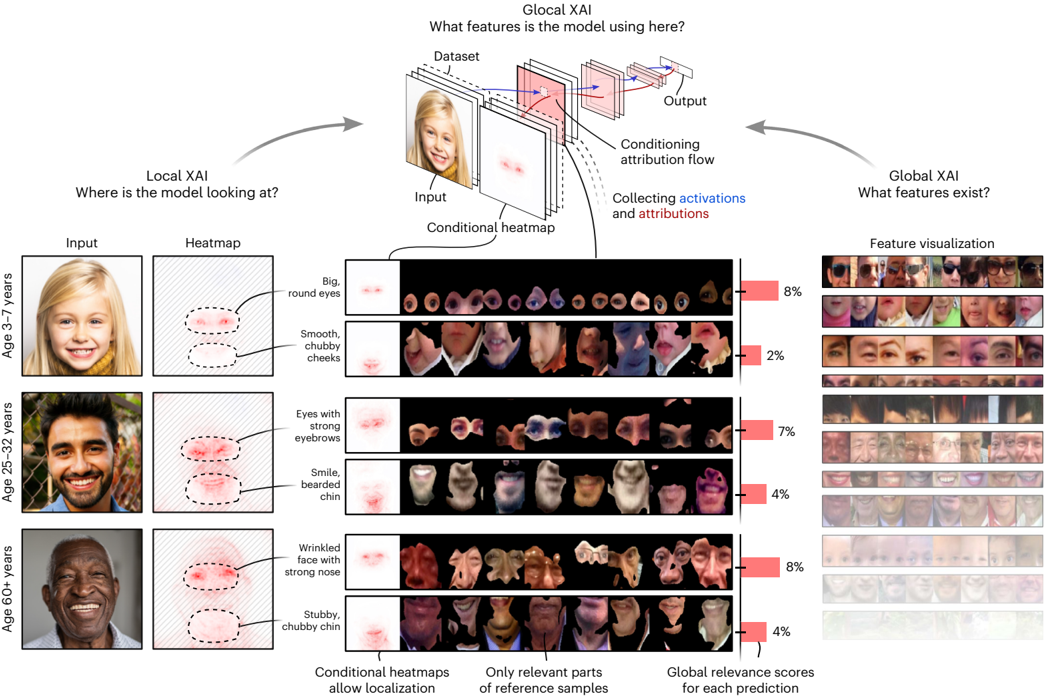
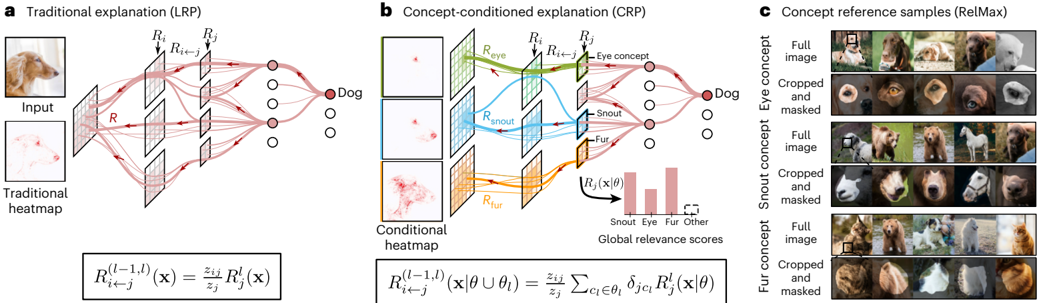
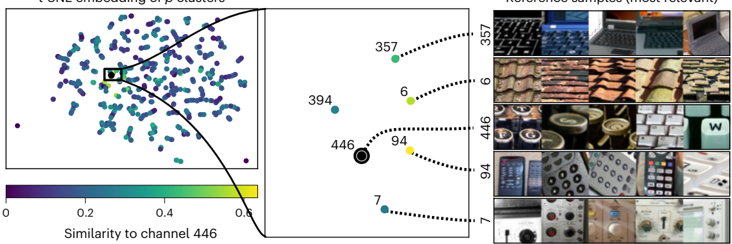
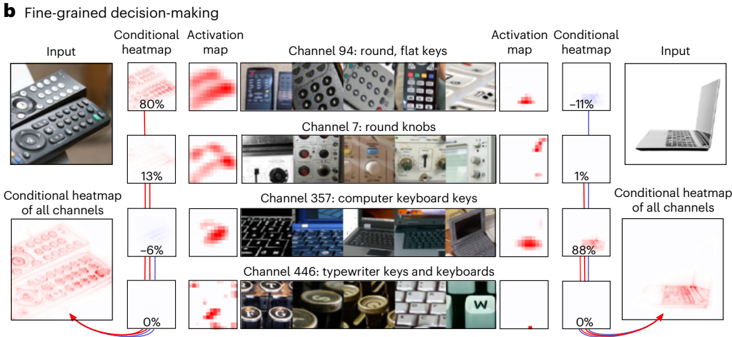
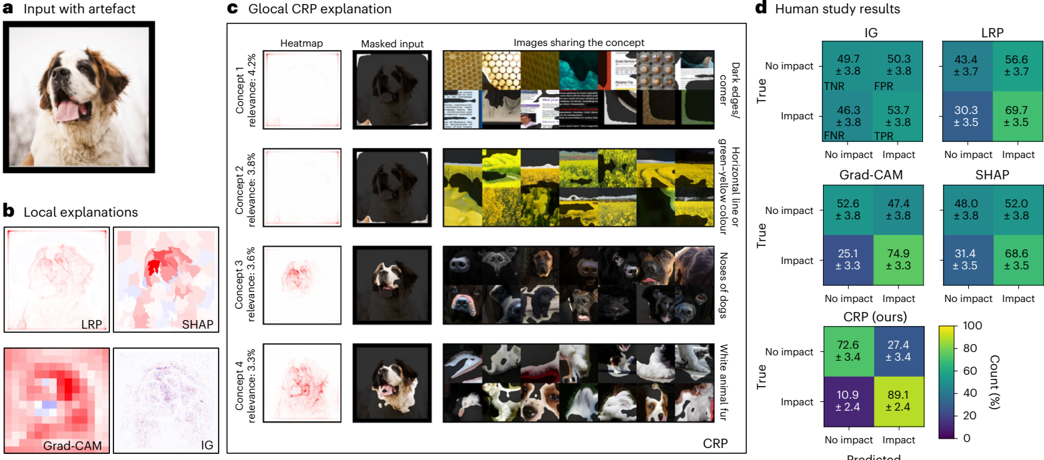
The field of explainable artificial intelligence (XAI) aims to bring transparency to today’s powerful but opaque deep learning models. While local XAI methods explain individual predictions in the form of attribution maps, thereby identifying ‘where’ important features occur (but not providing information about ‘what’ they represent), global explanation techniques visualize what concepts a model has generally learned to encode. Both types of method thus provide only partial insights and leave the burden of interpreting the model’s reasoning to the user. Here we introduce the Concept Relevance Propagation (CRP) approach, which combines the local and global perspectives and thus allows answering both the ‘where’ and ‘what’ questions for individual predictions. We demonstrate the capability of our method in various settings, showcasing that CRP leads to more human interpretable explanations and provides deep insights into the model’s representation and reasoning through concept atlases, concept-composition analyses, and quantitative investigations of concept subspaces and their role in fine-grained decision-making.
Overview
The claims and statistics of this paper haven’t been checked yet.
Free: it reads the open-access text and checks the first 5 claims that cite a source we can check. Create a free account to check every claim.
Integrity signals
Registry
Cites
Statistics
Figures
Verification
Claims the paper makes
The claims and statistics of this paper haven’t been checked yet.
Free: it reads the open-access text and checks the first 5 claims that cite a source we can check. Create a free account to check every claim.
Claims other papers make about this one
Each is checked against this paper’s own text: does it say what the citing paper says it does?
The source backs part of the claim, not all of it — or backs it for a different population, condition or comparison.
In the citing paper
“The only approach combining human involvement with quantitative methods was by Achtibat et al. [1], where users were asked to assess if the model relied on artifacts in the prediction process.”
From Study on the Helpfulness of Explainable Artificial Intelligence (2024) · cites this paper as [1]
Experimental — accuracy not yet measuredThe cited source says what the claim attributes to it.
In the citing paper
“This approach is a very interesting step in the right direction for quantitative XAI user-studies, but also focused on a sub-task, namely detection of model bias.”
From Study on the Helpfulness of Explainable Artificial Intelligence (2024) · cites this paper as [1]
Self-check
Percentages, sums and reported differences re-computed from the paper’s own numbers.
The self-check needs the paper’s full text.
Citations
Cites
Deep Residual Learning for Image Recognition
He, K., Zhang, X., Ren, S., & Sun, J. (2016) · 2016 IEEE Conference on Computer Vision and Pattern Recognition (CVPR) · doi:10.1109/cvpr.2016.90 · Cited by 235,474
LeCun, Y., Bengio, Y., & Hinton, G. (2015) · Nature · doi:10.1038/nature14539 · Cited by 84,126
Gradient-based learning applied to document recognition
Lecun, Y., Bottou, L., Bengio, Y., & Haffner, P. (1998) · Proceedings of the IEEE · doi:10.1109/5.726791 · Cited by 58,805
ImageNet Large Scale Visual Recognition Challenge
Russakovsky, O., Deng, J., Su, H., Krause, J., Satheesh, S., Ma, S., Huang, Z., Karpathy, A., Khosla, A., Bernstein, M., et al. (2015) · International Journal of Computer Vision · doi:10.1007/s11263-015-0816-y · Cited by 39,380
PyTorch: An Imperative Style, High-Performance Deep Learning Library
Paszke, A., Gross, S., Massa, F., Lerer, A., Bradbury, J., Chanan, G., Killeen, T., Lin, Z., Gimelshein, N., Antiga, L., et al. (2019) · arXiv · doi:10.48550/arxiv.1912.01703 · Cited by 31,473
Grad-CAM: Visual Explanations from Deep Networks via Gradient-Based Localization
Selvaraju, R. R., Cogswell, M., Das, A., Vedantam, R., Parikh, D., & Batra, D. (2017) · 2017 IEEE International Conference on Computer Vision (ICCV) · doi:10.1109/iccv.2017.74 · Cited by 24,513
A Unified Approach to Interpreting Model Predictions
Lundberg, S., & Lee, S.-I. (2017) · arXiv · doi:10.48550/arxiv.1705.07874 · Cited by 23,707
"Why Should I Trust You?": Explaining the Predictions of Any Classifier
Ribeiro, M. T., Singh, S., & Guestrin, C. (2016) · Proceedings of the 22nd ACM SIGKDD International Conference on Knowledge Discovery and Data Mining · doi:10.1145/2939672.2939778 · Cited by 17,555
Neural Machine Translation by Jointly Learning to Align and Translate
Bahdanau, D., Cho, K., & Bengio, Y. (2014) · arXiv · doi:10.48550/arxiv.1409.0473 · Cited by 16,213
Visualizing and understanding convolutional networks
Zeiler, M. D., & Fergus, R. (2014) · Lecture Notes in Computer Science · doi:10.1007/978-3-319-10590-1_53 · Cited by 15,839 · cited 1×
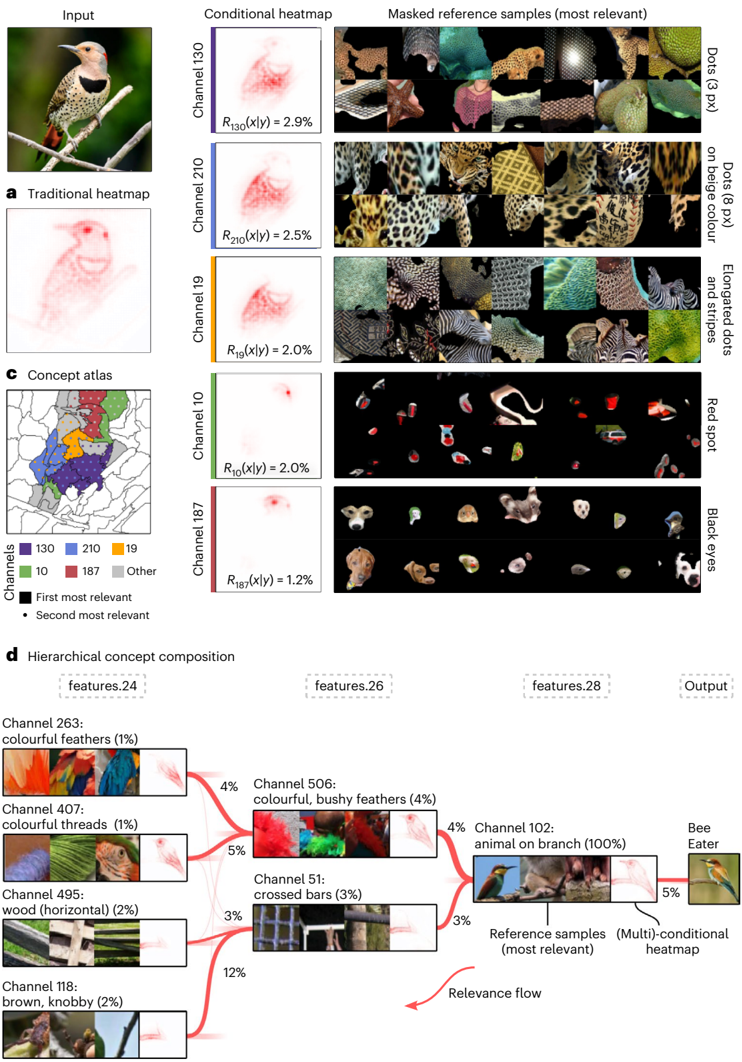
“210 and 130), ‘red spot’ (10), ‘black eyes’ (187) and ‘stripes-like’ (19).”
Research works printed but not linked: 4
- 11. Goodman, B. & Flaxman, S. European Union regulations on algorithmic decision-making and a 'right to explanation'. AI Mag. 38, 50-57 (2017).
- 18. Murdoch, W. J., Liu, P. J. & Yu, B. Beyond word importance: contextual decomposition to extract interactions from LSTMs. In 6th International Conference on Learning Representations (ICLR, 2018).
- 22. Erhan, D., Bengio, Y., Courville, A. & Vincent, P. Visualizing higher- layer features of a deep network. Univ. Montreal 1341, 1 (2009).
- 36. Nguyen, A., Dosovitskiy, A., Yosinski, J., Brox, T. & Clune, J. Synthesizing the preferred inputs for neurons in neural networks via deep generator networks. Adv. Neural Inf. Process. Syst. 29, 3387-3395 (2016).
Cited by
Items 101–200 of 238
Be Reliable: An Interpretable Attribute-Oriented Representation Learning Framework
Fang, Z., Du, S., Zou, Y., Tan, Y., Song, N., & Wang, S. (2025) · IEEE Transactions on Neural Networks and Learning Systems · doi:10.1109/tnnls.2025.3618290 · Cited by 9
“Recently, processing raw data explicitly with generic priors has motivated an interpretable approach to design deep models [15], [16].”
Towards Safer and Understandable Driver Intention Prediction
Karuppasamy, M., Gangisetty, S., Rai, S. N., Masone, C., & Jawahar, C. V. (2025) · IEEE/CVF International Conference on Computer Vision (ICCV) · doi:10.1109/iccv51701.2025.02354 · Cited by 5
“Prior works, including concept bottleneck models [14, 19], and concept relevance propagation [1], use fixed human-understandable concepts for decision-making, offering interpretability but failing to model temporal inputs [15].”
Artificial intelligence–based retinal imaging for brain health assessment: a scoping review
Ran, A. R., Zhu, Z., Cheng, K. H. L., Ng, C. F., Choi, O. Y. M., He, Q., Zheng, C., Hu, W., Hu, X., Chan, V. T. T., et al. (2026) · The Lancet Digital Health · doi:10.1016/j.landig.2026.101020 · Cited by 5
Tinauer, C., Damulina, A., Sackl, M., Soellradl, M., Achtibat, R., Dreyer, M., Pahde, F., Lapuschkin, S., Schmidt, R., Ropele, S., et al. (2024) · Communications in computer and information science · doi:10.1007/978-3-031-63797-1_11 · Cited by 6
“By applying RelMax [1], with the objective to maximize the relevance criterion, we ranked the test inputs for each concept channel.”
MethodInfluentialSelf-citationLowe, R., Ulan, M., Bui, T. H., Adell, A., Labaien, J., & Brando, A. (2025) · IEEE International Conference on Software Architecture Companion (ICSA-C) · doi:10.1109/icsa-c65153.2025.00079 · Cited by 4
“…e.g. Shap [28], or the model-specific method Layerwise Relevance Propagation [29] (and more recently suggested Concept Relevance Propagation [30]) can be utilized to clarify model feature representations of data for the objects identified in bounding boxes (an object-detection XAI approach…”
Explaining Deep Neural Networks for Bearing Fault Detection with Vibration Concepts
Decker, T. W., Lebacher, M., & Tresp, V. (2023) · IEEE International Conference on Industrial Informatics (INDIN) · doi:10.1109/indin51400.2023.10218170 · Cited by 4
FaceX: Understanding Face Attribute Classifiers through Summary Model Explanations
Sarridis, I., Koutlis, C., Papadopoulos, S., & Diou, C. (2024) · International Conference on Multimedia Retrieval · doi:10.1145/3652583.3658007 · Cited by 5
“Similarly, Concept Relevance Propagation (CRP) [1] visualizes only a few reference samples for each class.”
BackgroundNear Hit and Near Miss Example Explanations for Model Revision in Binary Image Classification
Finzel, B., Knoblach, J., Thaler, A. M., & Schmid, U. (2024) · Lecture notes in computer science · doi:10.1007/978-3-031-77738-7_22 · Cited by 7
Han, S.-H., & Choi, H.-J. (2025) · Computer Vision and Image Understanding · doi:10.1016/j.cviu.2025.104370 · Cited by 6
XpertAI: Uncovering Regression Model Strategies for Sub-manifolds
Letzgus, S., Müller, K., & Montavon, G. (2025) · Communications in computer and information science · doi:10.1007/978-3-032-08327-2_19 · Cited by 6
“These can be obtained in a supervised manner [22,50], in an unsupervised manner [46,9], or by directly inspecting neurons [49,51,2].”
Contrastive Pretraining for Visual Concept Explanations of Socioeconomic Outcomes
Obadić, I., Levering, A., Pennig, L., Oliveira, D. A. B., Marcos, D., & Zhu, X. X. (2024) · IEEE/CVF Conference on Computer Vision and Pattern Recognition Workshops (CVPRW) · doi:10.1109/cvprw63382.2024.00062 · Cited by 6
“While saliency maps identify relevant regions in the image by highlighting raw pixels, they do not provide additional insights into the high-level semantics the model extracted for its inference [2].”
BackgroundFine-Grained Domain Generalization With Feature Structuralization
Yu, W. W. H., Chen, D., Wang, Q., & Hu, Q. (2025) · IEEE Transactions on Multimedia · doi:10.1109/tmm.2025.3607716 · Cited by 7
“Researches in the explainability field show that features or tokens behave as distinct semantics [17], [18], [19], [20], which implies that commonalities and specificities can be disentan-gled from the learned features.”
InfluentialInterpretable ML for Imbalanced DataPreprint
Dablain, D. A., Bellinger, C., Krawczyk, B., Aha, D. W., & Chawla, N. V. (2022) · arXiv (Cornell University) · doi:10.48550/arxiv.2212.07743 · Cited by 4
Interpretability in Activation Space Analysis of Transformers: A Focused SurveyPreprint
Vijayakumar, S. (2023) · arXiv (Cornell University) · doi:10.48550/arxiv.2302.09304 · Cited by 5
A Guided Tour of Post-hoc XAI Techniques in Image Segmentation
Hasany, S. N., Mériaudeau, F., & Petitjean, C. (2024) · Communications in computer and information science · doi:10.1007/978-3-031-63797-1_9 · Cited by 3
Radke, T., Fuchs, S., Wilms, C., Polkova, I., & Rautenhaus, M. (2025) · Geoscientific model development · doi:10.5194/gmd-18-1017-2025 · Cited by 5
SegClarity: An Attribution-Based XAI Workflow for Evaluating Historical Document Layout Models
Brini, I., Rahal, N., Mehri, M., Ingold, R., & Amara, N. E. B. (2025) · Journal of Imaging · doi:10.3390/jimaging11120424 · Cited by 3
Tang, J., Cao, L., Xu, G., & Li, M. (2026) · ACS Applied Materials & Interfaces · doi:10.1021/acsami.6c05353 · Cited by 3
Interpretable deep learning enables reliable and label-efficient fluorescence imaging
Chen, M., Jin, L., Xuan, X., Yang, D., CHENG, Y., & Zhang, J. (2026) · Pattern Recognition · doi:10.1016/j.patcog.2025.113037 · Cited by 3
Bareeva, D., Dreyer, M., Pahde, F., Samek, W., & Lapuschkin, S. (2024) · IEEE/CVF Conference on Computer Vision and Pattern Recognition Workshops (CVPRW) · doi:10.1109/cvprw63382.2024.00357 · Cited by 8
“…relevance Correction is only initiated if the artifact has been identified as relevant for the prediction. attributions for input [4] or latent [1, 15] features Prediction strategy A sample is categorized into one of the known prediction sub-strategies (clusters), e.g . based on activations…”
BackgroundSelf-citationquanda: An Interpretability Toolkit for Training Data Attribution EvaluationPreprint
Bareeva, D., Yolcu, G. Ü., Hedström, A., Schmolenski, N., Wiegand, T., Samek, W., & Lapuschkin, S. (2024) · arXiv (Cornell University) · doi:10.48550/arxiv.2410.07158 · Cited by 5
Self-citationInter-hospital transferability of AI: A case study on phase recognition in cholecystectomy
Renz-Kiefel, L., Lünse, S., Mantke, R., Eisert, P., Hilsmann, A., & Wisotzky, E. L. (2025) · Computers in Biology and Medicine · doi:10.1016/j.compbiomed.2025.110235 · Cited by 4
Wu, H., Li, B., Tian, L., Dong, C., & Liao, W. (2025) · Engineering Applications of Artificial Intelligence · doi:10.1016/j.engappai.2025.111009 · Cited by 2
PCBEAR: Pose Concept Bottleneck for Explainable Action Recognition
Lee, J., Lee, W., Park, G.-M., Kim, S., & Choi, J. (2025) · IEEE/CVF Conference on Computer Vision and Pattern Recognition Workshops (CVPRW) · doi:10.1109/cvprw67362.2025.00253 · Cited by 6
“Concept-based explanations enhance interpretability by linking model predictions to human-understandable concepts [2].”
Gorgun, A., Schiele, B., & Fischer, J. (2025) · IEEE/CVF International Conference on Computer Vision (ICCV) · doi:10.1109/iccv51701.2025.00419 · Cited by 5
“Future directions include automatic selection of neurons or neuron sets for circuit visualization, for example using CRP [1], integration of ViT-specific visualization via At-tnLRP [2], and extending our analysis to CLIP-based ViT models to better understand multimodal representations.”
Granular Concept Circuits: Toward a Fine-Grained Circuit Discovery for Concept Representations
Kwon, D., Lee, S., & Choi, J. (2025) · IEEE/CVF International Conference on Computer Vision (ICCV) · doi:10.1109/iccv51701.2025.00227 · Cited by 6
“The idea that highly activated neurons carry significant information about the input query is well-supported by prior studies [1, 3, 20].”
Guidotti, R., Schmid, U., & Longo, L. (2025) · Communications in computer and information science · doi:10.1007/978-3-032-08330-2 · Cited by 2
On Background Bias of Post-Hoc Concept Embeddings in Computer Vision DNNs
Schwalbe, G., Mikriukov, G., Heinert, E., Gerolymatos, S., Keser, M., Knoll, A., Rottmann, M., & Mütze, A. (2025) · Communications in computer and information science · doi:10.1007/978-3-032-08330-2_3 · Cited by 3
Gopal, G. V., Kalaivani, K. S., Ramakrishna, K. V. S. S., Srinivasulu, S., & Motupalli, R. (2025) · Expert Systems with Applications · doi:10.1016/j.eswa.2025.131069 · Cited by 2
Alharith, R., zhang, J., Ibrahim, A. O., & Wu, Z. (2026) · International Journal of Computer Vision · doi:10.1007/s11263-025-02647-5 · Cited by 3
Artificial intelligence-powered biomedical imaging: Recent achievements and challenges
Ebadi, A., & Wong, A. (2026) · Current Opinion in Biomedical Engineering · doi:10.1016/j.cobme.2026.100650 · Cited by 5
AI solutions for evolutionary genomics of nonmodel species
DeGiorgio, M., Arnab, S. P., & Fumagalli, M. (2026) · Evolution Letters · doi:10.1093/evlett/qrag004 · Cited by 2
“A potential new direction for explainable AI models in evolutionary genomics would be to embrace recent advances in bridging the gap between local and global explainable AI ( Achtibat et al., 2023 ).”
Lou, P., Zhu, Y., Chia, N., Kumari, R., Yang, W., Wang, Y., Novotny, B. C., Winham, S. J., Guo, R., Goode, E. L., et al. (2026) · npj Digital Medicine · doi:10.1038/s41746-026-02741-z · Cited by 3
A Systematic Review of Explainable Convolutional Neural Networks for Image Classification
Hasić, V., & Krivić, S. (2026) · Expert Systems · doi:10.1111/exsy.70279 · Cited by 2
Bridging the gap: Explainable AI for advancing Earth System Science
Huang, F., Jiang, S., Shangguan, W., Li, L., Zhang, Y., Zhang, R., Li, Q., Li, D., & Dai, Y. (2026) · Science China Earth Sciences · doi:10.1007/s11430-025-1898-3 · Cited by 2
“For example, “ glocal XAI ” , an integrated method, offers both channel-level information and feature importance, providing deep insights into a model ’ s representations, reasoning processes, and fine-grained decision-making (Achtibat et al., 2023).”
iBRAHIMOĞLU, N., Demirezen, M. U., & Yıldız, F. (2026) · Cluster Computing · doi:10.1007/s10586-026-06537-4 · Cited by 3
Enhancing Ensemble Learning Using Explainable CNN for Spoof Fingerprints
Reza, N., & Jung, H. Y. (2023) · Sensors · doi:10.3390/s24010187 · Cited by 2
Locally Testing Model Detections for Semantic Global Concepts
Motzkus, F., Mikriukov, G., Hellert, C., & Schmid, U. (2024) · Communications in computer and information science · doi:10.1007/978-3-031-63787-2_8 · Cited by 3
GameTable Working Group 1 meeting report on search, planning, learning, and explainability
Soemers, D. J. N. J., Kowalski, J., Piette, É., Morenville, A., & Crist, W. (2024) · ICGA Journal · doi:10.3233/icg-240251 · Cited by 4
Sparse Explanations of Neural Networks Using Pruned Layer-Wise Relevance Propagation
Sarmiento, P. Y., Witzke, S., Klein, N., & Renard, B. Y. (2024) · Lecture notes in computer science · doi:10.1007/978-3-031-70359-1_20 · Cited by 2
Revealing Similar Semantics Inside CNNs: An Interpretable Concept-Based Comparison of Feature Spaces
Mikriukov, G., Schwalbe, G., Hellert, C., & Bade, K. (2025) · Communications in computer and information science · doi:10.1007/978-3-031-74630-7_1 · Cited by 2
Ignesti, G., Martinelli, M., & Moroni, D. (2024) · Pattern Recognition and Image Analysis · doi:10.1134/s1054661824700974 · Cited by 3
Explainable AI 2.0: Conceptual Shifts and New Requirements
Averkin, A. N., & Volkov, E. N. (2025) · IEEE International Conference on Soft Computing and Measurements (SCM) · doi:10.1109/scm66446.2025.11060242 · Cited by 2
Beyond Accuracy: Ensuring Correct Predictions With Correct Rationales
Li, T., Ma, M., & Peng, X. (2024) · neural information processing systems · doi:10.52202/079017-1367 · Cited by 12
CE-FAM: Concept-Based Explanation via Fusion of Activation Maps
Kuroki, M., & Yamasaki, T. (2025) · IEEE/CVF International Conference on Computer Vision (ICCV) · doi:10.1109/iccv51701.2025.00139 · Cited by 5
“CRP [1] quantifies concept contributions by summing relevance scores conditioned on each concept.”
Explainable Embeddings with Distance Explainer
Meijer, C., & Bos, P. (2026) · Communications in computer and information science · doi:10.48550/arxiv.2505.15516 · Cited by 2
“In general, quantifying the input’s features’ effect on the model output is called attribution (Achtibat et al., 2023).”
VisionLogic: Discovering and Grounding Decision-Relevant Visual ConceptsPreprint
Geng, C., Jiang, Y., Zhang, L., Wang, Z., Ye, H., Zhang, M., Xu, J., & Si, X. (2025) · arXiv (Cornell University) · doi:10.48550/arxiv.2503.10547 · Cited by 2
“Among them, concept-based explanations (Nguyen et al., 2016; Bau et al., 2017; Kim et al., 2018; Ghorbani et al., 2019; Fel et al., 2023; Achtibat et al., 2023) have attracted particular interest because they uncover high-level semantic concepts rather than only providing low-level attribution maps…”
Müller, R. (2025) · arXiv (Cornell University) · doi:10.48550/arxiv.2506.17936 · Cited by 3
“Instead, they can also show what the AI has seen in these areas, and thus help uncover the representations learned by these complex models (Achtibat et al., 2023; Bau et al., 2017; Dreyer et al., 2025; Fel et al., 2023).”
Nonparametric Identification of Latent ConceptsPreprint
Zheng, Y.-J., Xie, S.-A., & Zhang, K. (2025) · International Conference on Machine Learning · doi:10.48550/arxiv.2510.00136 · Cited by 3
Unraveling Block Maxima Forecasting Models with Counterfactual Explanation
Deng, Y., Galib, A. H., Tan, P., & Luo, L. (2024) · ACM SIGKDD Conference on Knowledge Discovery and Data Mining (KDD) · doi:10.1145/3637528.3671923 · Cited by 1
Generating Human-Interpretable Rules from Convolutional Neural Networks
Pears, R., & Sharma, A. K. (2025) · Information · doi:10.3390/info16030230 · Cited by 1
Jeong, S., Kim, H., & Song, Y. (2025) · IEEE Access · doi:10.1109/access.2025.3565638 · Cited by 1
“Several studies have attempted to address the mystery surrounding mid-level features in DNNs, focusing on gradient-based analyses that reinterpret gradients to extract meaningful characteristics at a human-recognition level [2], [10].”
Ma, J., Weicken, E., Pahde, F., Weitz, K., Lapuschkin, S., Samek, W., & Wiegand, T. (2025) · Bundesgesundheitsblatt - Gesundheitsforschung - Gesundheitsschutz · doi:10.1007/s00103-025-04101-w · Cited by 1
Self-citationChhetri, A., Korhonen, J., Gyawali, P., & Bhattarai, B. (2025) · Lecture notes in computer science · doi:10.1007/978-3-032-05127-1_34 · Cited by 4
Safer Skin Lesion Classification with Global Class Activation Probability Map Evaluation and SafeML
Paxton, K., Aslansefat, K., Akagić, A., Thakker, D., & Papadopoulos, Y. I. (2025) · Lecture notes in computer science · doi:10.1007/978-3-032-05073-1_10 · Cited by 1
Gu, Y., Li, X., Bu, Y., Deng, W., Chen, D., Zhao, H., & Xu, W. (2025) · Environment and Planning B Urban Analytics and City Science · doi:10.1177/23998083251381520 · Cited by 1
“Explainable AI is developed to enhance the interpretability of DL-based features (Achtibat et al., 2023; Dreyer et al., 2024).”
Glocal Explanations of Expected Goal Models in Football
Çavuş, M., Stańdo, A., & Biecek, P. (2025) · Communications in computer and information science · doi:10.1007/978-3-032-08333-3_1 · Cited by 1
Conceptualizing Uncertainty: A Concept-Based Approach to Explaining Uncertainty
Roberts, I., Schulz, A., Schröder, S., Hinder, F., & Hammer, B. (2026) · Lecture notes in computer science · doi:10.1007/978-3-032-38407-2_20 · Cited by 1
Measuring Contextual Reliance of Object Detection Models: A Black Box Explainability Method
Vonderhaar, L., Elvira, T., & Ochoa, O. (2026) · International Journal of Artificial Intelligence Tools · doi:10.1142/s0218213026400051 · Cited by 1
Qi, R., Liu, G., Zhang, J., & Hsiao, J. H. (2026) · International Journal of Human-Computer Studies · doi:10.1016/j.ijhcs.2026.103773 · Cited by 2
Jyothy, V. A., Pai, M. L., PA, S. E., & Jaleel, U. C. A. (2026) · Journal of Cheminformatics · doi:10.1186/s13321-026-01206-5 · Cited by 1
“…the limitations of post-hoc methods, which integrate transparency into training by aligning latent axes with predefined, domain-relevant concepts via orthogonal rotations, enabling disentangled feature learning, stable concept-level traceability and improved mechanistic alignment [1, 7, 8, 25, 34].”
InfluentialAttanasio, C., Vilone, G., Holzinger, A., & Longo, L. (2026) · International Journal of Human-Computer Interaction · doi:10.1080/10447318.2026.2675436 · Cited by 1
Muzellec, S., Alghetaa, Y. K., Kornblith, S., & Kar, K. (2026) · Communications Psychology · doi:10.1038/s44271-026-00502-y · Cited by 1
Bu, Y., Gu, Y., Zhao, H., Wu¹, X., Deng, W., & Li, X. (2026) · npj Heritage Science · doi:10.1038/s40494-026-02784-1 · Cited by 1
How to Evaluate and Refine Your CAM
Domeniconi, L., Stramiglio, A., Lombardi, M., & Salti, S. (2026) · Lecture notes in computer science · doi:10.1007/978-3-032-31663-9_36 · Cited by 1
Nasr, S., Ren, Z. X., Murindanyi, S., & Johnson, D. (2026) · Communications in computer and information science · doi:10.1007/978-981-92-4529-1_10 · Cited by 2
Schut, D. E., Wood, R. M., Schouten, R. E., van Liere, R., van Leeuwen, T., & Batenburg, K. J. (2026) · Journal of Imaging · doi:10.3390/jimaging12070331 · Cited by 1
“XAI heatmaps can be calculated in many ways, for example, by using gradients [17,19,43,44], internal activations of the network [20,45], local surrogate models [46], input perturbations [47–49], and propagating scores through the network back to the inputs [50,51].”
Assessing the Models with Resampled Data Using Explainable Artificial Intelligence Techniques
Mathew, R. M., Gunasundari, R., & Lal, S. P. (2024) · Journal of Soft Computing and Data Mining · doi:10.30880/jscdm.2024.05.01.002 · Cited by 1
Advances in AI-Enhanced Biomedical Imaging for Cancer Immunology
Yim, W. W., Wee, F. Y. T., Ho, Z. Y., Feng, X., Zhang, M., Lee, S., Zlobec, I., Yeong, J. P.-S., & Lau, M. C. (2024) · World Scientific Annual Review of Cancer Immunology · doi:10.1142/s2972389224300044 · Cited by 1
Towards Better Generalization and Interpretability in Unsupervised Concept-Based Models
Santis, F. D., Bich, P., Ciravegna, G., Barbiero, P., Cerquitelli, T., & Giordano, D. (2025) · Lecture notes in computer science · doi:10.1007/978-3-032-06066-2_28 · Cited by 2
Estimation of Concept Explanations Should be Uncertainty AwarePreprint
Piratla, V., Heo, J., Collins, K. M., Singh, S., & Weller, A. (2023) · arXiv (Cornell University) · doi:10.48550/arxiv.2312.08063 · Cited by 2
“Achtibat et al. (2022) championed an explanation method that provides explanation highlighting important feature (answering “where”) and what concepts are used for prediction thereby combining the strengths of global and local explanation methods.”
MethodRestyling Unsupervised Concept Based Interpretable Networks with Generative Models
Parekh, J., Bouniot, Q., Mozharovskyi, P., Newson, A., & d’Alché–Buc, F. (2025) · International Conference on Learning Representations · doi:10.48550/arxiv.2407.01331 · Cited by 1
Sharma, A. K. (2024) · University of North Texas Digital Library (University of North Texas) · doi:10.12794/metadc2356140 · Cited by 1
Delzer, O., & Bender, S. (2026) · arXiv (Cornell University) · doi:10.48550/arxiv.2604.04518 · Cited by 1
Sparks of explainability : recent advancements in explaining large vision models
Fel, T. (2024) · theses.fr (ABES) · doi:10.70675/2306eab0z8851z470cz9dc4z01481861fb3e · Cited by 4
Model Guidance via Explanations Turns Image Classifiers into Segmentation Models
Yu, X., Franzen, J., Samek, W., Höhne, M., & Kainmueller, D. (2024) · Communications in computer and information science · doi:10.1007/978-3-031-63797-1_7
Self-citationDrawing Attributions From Evolved Counterfactuals
Jakubík, J., & Kwaśnicka, H. (2024) · Genetic and Evolutionary Computation Conference Companion (GECCO Companion) · doi:10.1145/3638530.3664122 · Cited by 1
Multimodal spectroscopic and imaging methods for skin diagnostics
Kukk, A. F., Wu, D., Panzer, R., Emmert, S., & Roth, B. (2024) · Conference on Lasers and Electro-Optics · doi:10.1364/cleo_at.2024.jw3e.1
Kim, Y., Han, S., Han, S., & Kwak, N. (2024) · arXiv (Cornell University) · doi:10.48550/arxiv.2409.01610 · Cited by 1
Risiken und Chancen für den Einsatz von KI im Unternehmen
Greiner, R., Böck, M., & Rashedi, J. (2024) · Quick Guide · doi:10.1007/978-3-658-44306-1_3
Liu, Z., Zhang, F., Song, W., Li, X., & Wei, W. (2024) · arXiv (Cornell University) · doi:10.48550/arxiv.2411.18343
Where You See Is What You Know: A Visual-Semantic Conceptual Explainer
Zhu, L., Kong, X., Li, R., & Guo, G. (2024) · ACM International Conference on Multimedia in Asia (MMAsia) · doi:10.1145/3696409.3700190 · Cited by 1
Towards Explainability of Affordance Learning in Robot Vision
Mirnateghi, N., Islam, S. M. S., & Shah, S. A. A. (2024) · International Conference on Digital Image Computing: Techniques and Applications (DICTA) · doi:10.1109/dicta63115.2024.00085
“While indicating ‘where’ the necessary information is in the input space, such singular visualization maps may not clarify ‘what’ information they entail and whether this information represents a unique characteristic or an overlapping set of features [13].”
A unified concept-based system for local, global, and misclassification explanations
Aghaeipoor, F., Asgarian, D., & Sabokrou, M. (2025) · Neurocomputing · doi:10.1016/j.neucom.2025.129761
Wang, Y., Kannappan, S., Bai, F., Gibson, S. J., & Solomon, C. J. (2025) · Pattern Recognition Letters · doi:10.1016/j.patrec.2025.03.032
You’ve Got the Wrong Outfit: Evaluating Deep Learning Paradigms on Digit and Fashion Recognition
Ignesti, G., Martinelli, M., & Moroni, D. (2025) · Lecture notes in computer science · doi:10.1007/978-3-031-87663-9_17 · Cited by 2
Measuring the Impact of Scene Level Objects: A Novel Method for Quantitative Explanations
Vonderhaar, L., Elvira, T., & Ochoa, O. (2025) · Proceedings of the ... International Florida Artificial Intelligence Research Society Conference · doi:10.32473/flairs.38.1.138922
Ordoñez, A., Dahl, F. A., Brautaset, O., & Eikvil, L. (2025) · Lecture notes in computer science · doi:10.1007/978-3-031-95838-0_35 · Cited by 1
The Human Equation: Culture, Biology and Sustainability
von Ohain, E. P. (2025) · Springer eBooks · doi:10.1007/978-3-031-89824-2_4
Duric, A., Tørresen, J., Riegler, M. A., & Hammer, H. L. (2025) · Proceedings - IEEE Symposium on Computer-Based Medical Systems · doi:10.1109/cbms65348.2025.00125
Explaining and Interpreting Generative AI
Samek, W. (2025) · Oxford University Press eBooks · doi:10.1093/oxfordhb/9780198940272.013.0005
Self-citationSharma, A., & Paing, M. P. (2025) · International Conference on Electrical Engineering/Electronics, Computer, Telecommunications and Information Technology (ECTI-CON) · doi:10.1109/ecti-con64996.2025.11100359
“Additionally, we plan to incorporate Concept Relevance Propagation (CRP) [36], an improved version of LRP, to generate more accurate heatmaps.”
Kaidashova, Y., Finzel, B., & Schmid, U. (2025) · Lecture notes in computer science · doi:10.1007/978-3-032-02813-6_3
An Explainable AI (XAI) Approach to Assessing the Significance of Color in Object Detection
Dawoud, M., Ashour, M., Idris, N., & Mashaly, M. E. (2025) · Intelligent Methods, Systems, and Applications (IMSA) · doi:10.1109/imsa65733.2025.11167746
“Concept Relevance Propagation (CRP) [16] maps latent features to human-interpretable concepts, enabling semantic insights.”
Global Properties from Local Explanations with Concept Explanation Clusters
Haedecke, E., Akila, M., & von Rueden, L. (2025) · Communications in computer and information science · doi:10.1007/978-3-032-08317-3_1 · Cited by 1
Post-hoc Concept Disentanglement: From Correlated to Isolated Concept Representations
Erogullari, E., Lapuschkin, S., Samek, W., & Pahde, F. (2025) · Communications in computer and information science · doi:10.1007/978-3-032-08317-3_4 · Cited by 1
Self-citationWebXAII: an open-source web framework to study human-XAI interactionPreprint
Leguy, J., Jean, P.-A., Figueroa, F. T., & Harispe, S. (2025) · arXiv.org · doi:10.48550/arxiv.2506.14777
“Most recently Concept Relevance Propagation ( CRP ) [16] attributes this relevance to high-level concepts rather than individual features.”
Development and validation of cancer markers based on multiparametric MRI and machine learning
García-Ruiz, A. (2024) · Dipòsit Digital de la Universitat de Barcelona (Universitat de Barcelona)
Towards Responsible Multimodal Modeling for Mental Healthcare
Kaya, H., & Soğancıoğlu, G. (2025) · Lecture notes in computer science · doi:10.1007/978-3-032-07956-5_1 · Cited by 1
FLEXtime: Filterbank Learning to Explain Time Series
Brüsch, T., Wickstrøm, K., Schmidt, M. N., Jenssen, R., & Alstrøm, T. S. (2025) · Communications in computer and information science · doi:10.1007/978-3-032-08330-2_12
“Although recent years have seen an abundance of explainability methods developed for images [1,26,33,42,58], time series have been overlooked to a higher degree [22].”
Metadata
- Authors
- Achtibat, R., Dreyer, M., Eisenbraun, I., Bosse, S., Wiegand, T., Samek, W., & Lapuschkin, S.
- Affiliations
- Fraunhofer Institute for Telecommunications, Heinrich Hertz Institute (DE)
- Corresponding author
- Samek, Wojciech
- Lapuschkin, Sebastian
- ORCID
- Venue
- Nature Machine Intelligence
- Published
- 2023-09-20
- Volume
- 5
- Issue
- 9
- Pages
- 1006-1019
- ISSN
- 2522-5839 (ISSN-L)
- OpenAlex
- W4386897466
- Semantic Scholar
- c2fbc8ad4e2403c795529c2606e4686f5a571215
- Cited by
- 181
- References
- 45
- Citations by year
- 2026: 43 · 2025: 71 · 2024: 57 · 2023: 10
- FWCI
- 16.02
- Type
- journal article
- Language
- en
- Open access
- hybrid
- doi.org
- Licence
- cc-by
- creativecommons.org/licenses/by/4.0 (tdm)
- creativecommons.org/licenses/by/4.0 (vor)
- Locations
- Nature Machine Intelligence (publishedVersion, cc-by)
- arXiv (Cornell University) (submittedVersion)
- Fraunhofer-Publica (Fraunhofer-Gesellschaft) (submittedVersion)
- arXiv (Cornell University)
- Funders
- Fraunhofer-Gesellschaft
- Karl-Franzens-Universität Graz
- Medizinische Universität Graz
- Topics
- Physical Sciences › Computer Science › Artificial Intelligence › Explainable Artificial Intelligence (XAI)
- Physical Sciences › Computer Science › Software › Software Testing and Debugging Techniques
- Physical Sciences › Computer Science › Computer Vision and Pattern Recognition › Advanced Neural Network Applications
- Keywords
- explainable AI, attribution maps, local and global explanations, concept composition, deep learning model interpretability
About these checks
Registry, retraction, Cites and statistics results are computed, not judged, with one exception: a printed reference that no index lists is read once by a model before it counts as a citation error. Claims are extracted by a model and kept only when their quote appears verbatim in the text; each cited source is then checked, with a model’s help, for whether it says what the claim relies on. Those verdicts can be wrong — read the claim’s quote and the cited source before relying on one.
Statistics and arithmetic are recomputed, not judged.
Confidence bands are shown only for fields calibrated on our annotated test set. None is calibrated yet, so no band is shown.
What counts as a claim ›How we measure confidence ›How we check this ›
Are you an author, or do you see a problem with this page? Request a review
Data sources
Bibliographic data: Semantic Scholar, OpenAlex, Crossref.
Contains information from the Semantic Scholar Academic Graph Datasets, made available under the ODC Attribution License (ODC-BY 1.0).
Semantic Scholar’s data is described in: Kinney, R., et al. (2023). The Semantic Scholar Open Data Platform. arXiv:2301.10140.
