

From attribution maps to human-understandable explanations through Concept Relevance Propagation
Open accessThe DOI matches its Crossref record; 72 of the 72 references it cites were found in a registry or an index.
Abstract
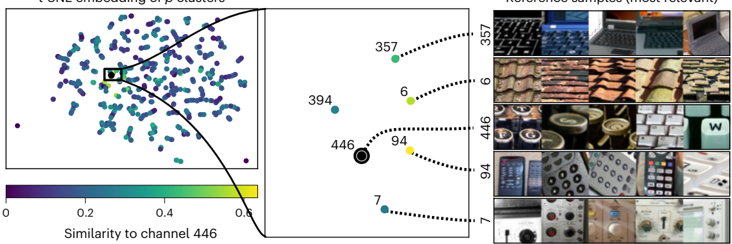
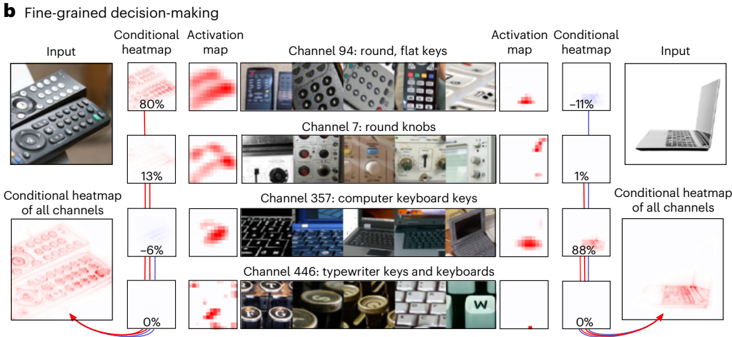
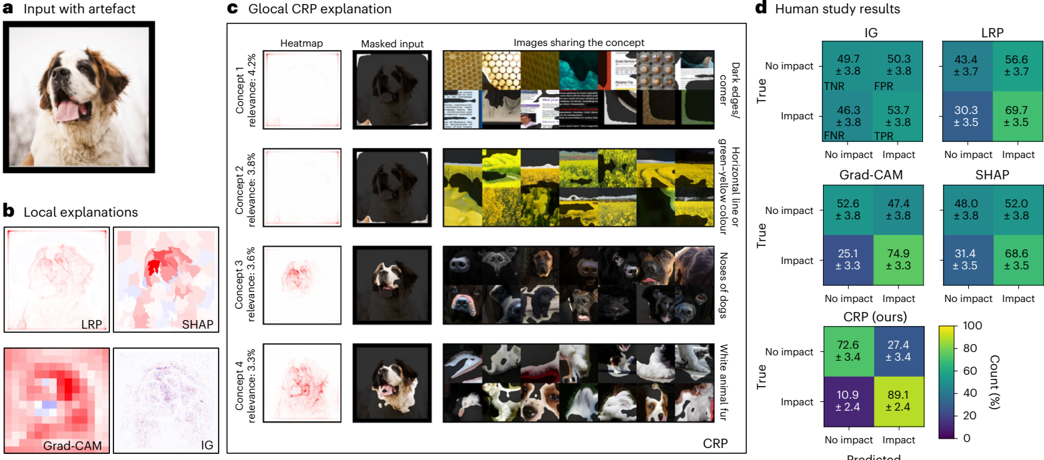
The field of explainable artificial intelligence (XAI) aims to bring transparency to today’s powerful but opaque deep learning models. While local XAI methods explain individual predictions in the form of attribution maps, thereby identifying ‘where’ important features occur (but not providing information about ‘what’ they represent), global explanation techniques visualize what concepts a model has generally learned to encode. Both types of method thus provide only partial insights and leave the burden of interpreting the model’s reasoning to the user. Here we introduce the Concept Relevance Propagation (CRP) approach, which combines the local and global perspectives and thus allows answering both the ‘where’ and ‘what’ questions for individual predictions. We demonstrate the capability of our method in various settings, showcasing that CRP leads to more human interpretable explanations and provides deep insights into the model’s representation and reasoning through concept atlases, concept-composition analyses, and quantitative investigations of concept subspaces and their role in fine-grained decision-making.
Overview
The claims and statistics of this paper haven’t been checked yet.
Free: it reads the open-access text and checks the first 5 claims that cite a source we can check. Create a free account to check every claim.
Integrity signals
Registry
Cites
Statistics
Figures
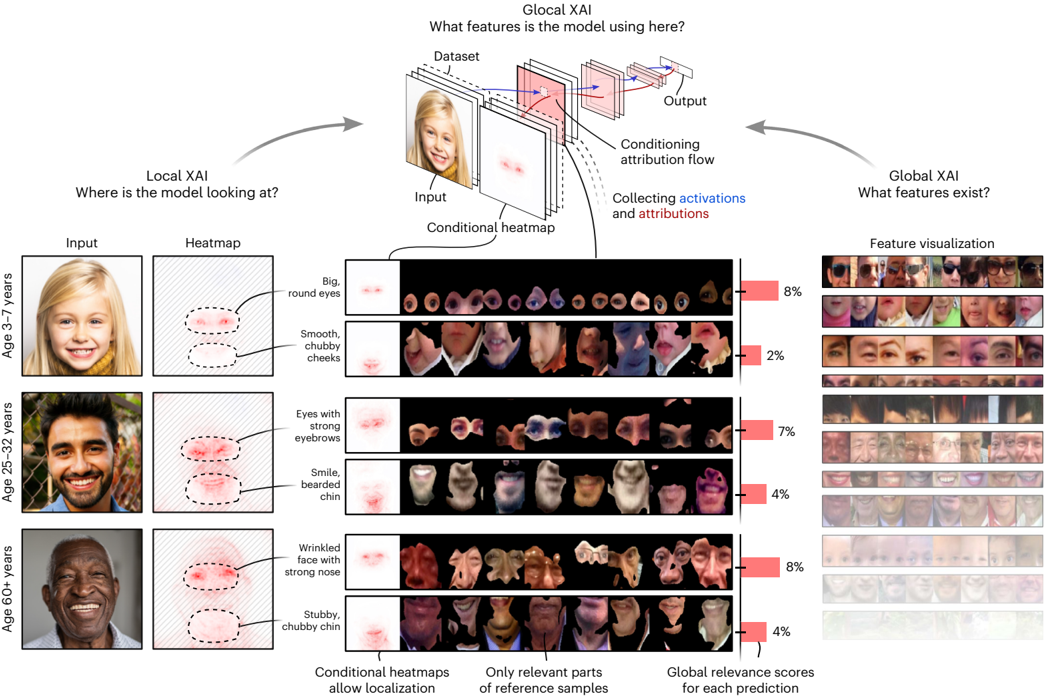
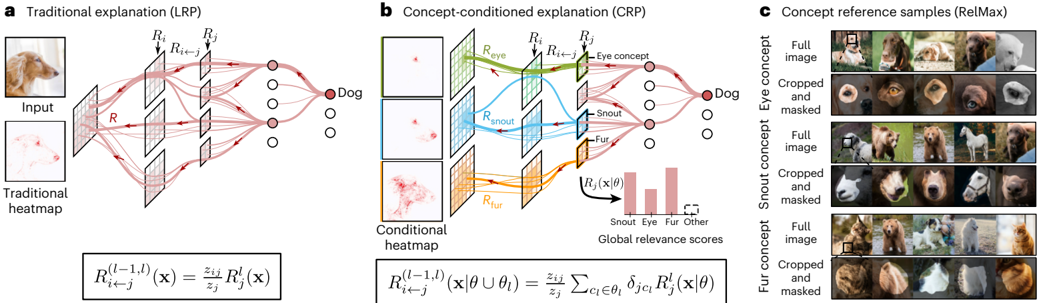
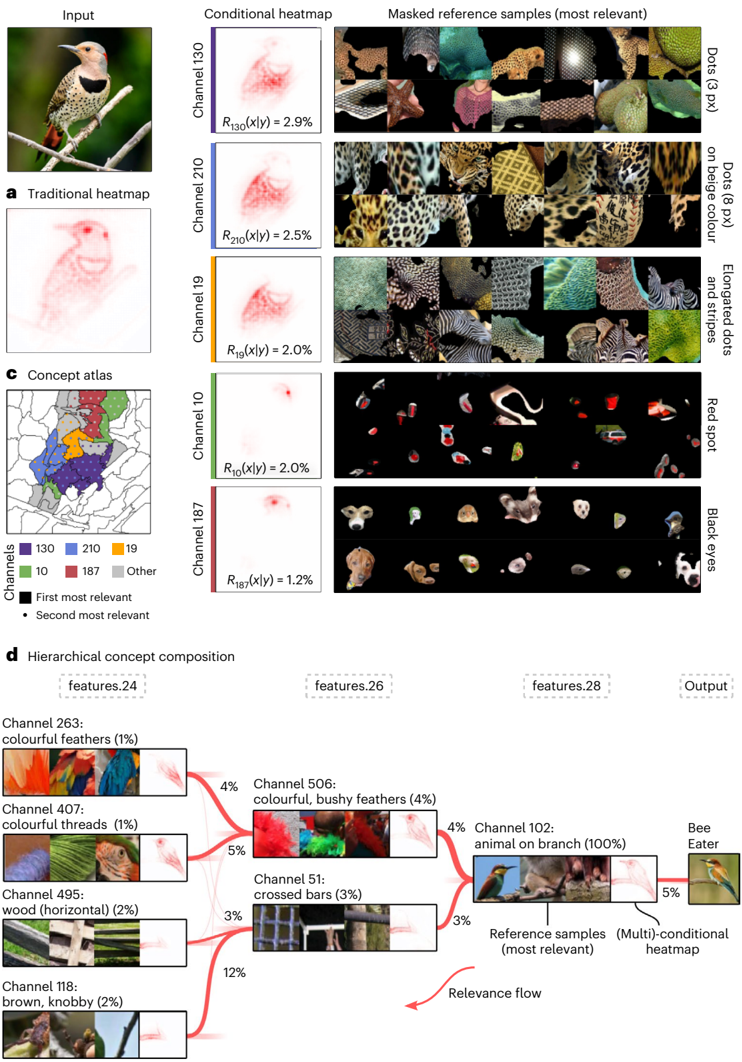
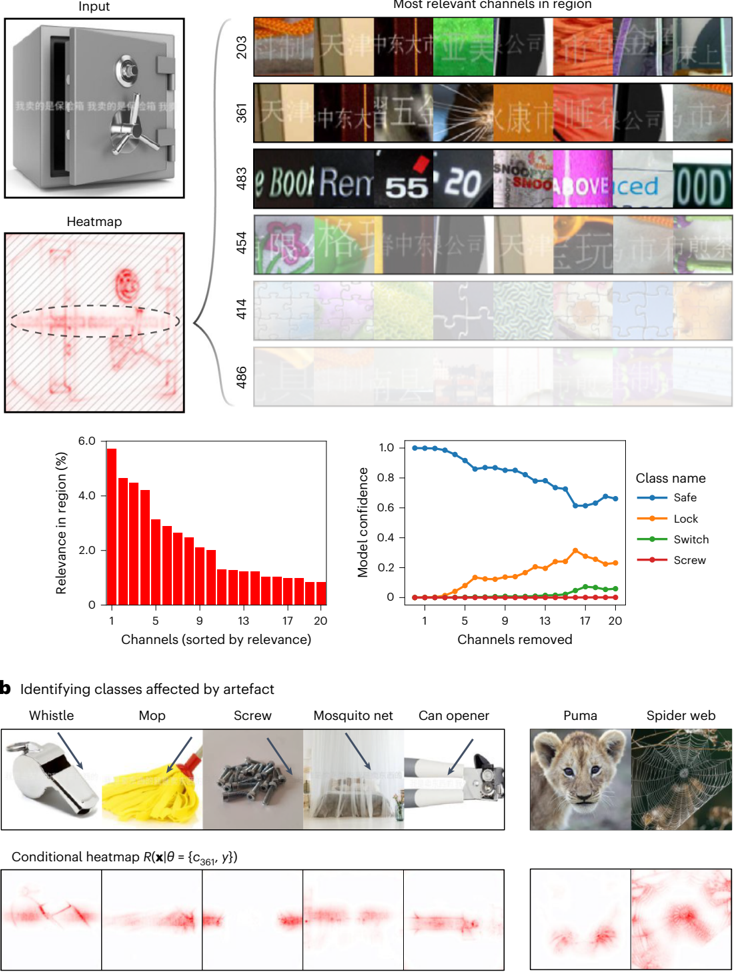
Verification
Claims the paper makes
The claims and statistics of this paper haven’t been checked yet.
Free: it reads the open-access text and checks the first 5 claims that cite a source we can check. Create a free account to check every claim.
Claims other papers make about this one
Each is checked against this paper’s own text: does it say what the citing paper says it does?
The source backs part of the claim, not all of it — or backs it for a different population, condition or comparison.
In the citing paper
“The only approach combining human involvement with quantitative methods was by Achtibat et al. [1], where users were asked to assess if the model relied on artifacts in the prediction process.”
From Study on the Helpfulness of Explainable Artificial Intelligence (2024) · cites this paper as [1]
Experimental — accuracy not yet measuredThe cited source says what the claim attributes to it.
In the citing paper
“This approach is a very interesting step in the right direction for quantitative XAI user-studies, but also focused on a sub-task, namely detection of model bias.”
From Study on the Helpfulness of Explainable Artificial Intelligence (2024) · cites this paper as [1]
Self-check
Percentages, sums and reported differences re-computed from the paper’s own numbers.
The self-check needs the paper’s full text.
Citations
Cites
Deep Residual Learning for Image Recognition
He, K., Zhang, X., Ren, S., & Sun, J. (2016) · 2016 IEEE Conference on Computer Vision and Pattern Recognition (CVPR) · doi:10.1109/cvpr.2016.90 · Cited by 235,474
LeCun, Y., Bengio, Y., & Hinton, G. (2015) · Nature · doi:10.1038/nature14539 · Cited by 84,126
Gradient-based learning applied to document recognition
Lecun, Y., Bottou, L., Bengio, Y., & Haffner, P. (1998) · Proceedings of the IEEE · doi:10.1109/5.726791 · Cited by 58,805
ImageNet Large Scale Visual Recognition Challenge
Russakovsky, O., Deng, J., Su, H., Krause, J., Satheesh, S., Ma, S., Huang, Z., Karpathy, A., Khosla, A., Bernstein, M., et al. (2015) · International Journal of Computer Vision · doi:10.1007/s11263-015-0816-y · Cited by 39,380
PyTorch: An Imperative Style, High-Performance Deep Learning Library
Paszke, A., Gross, S., Massa, F., Lerer, A., Bradbury, J., Chanan, G., Killeen, T., Lin, Z., Gimelshein, N., Antiga, L., et al. (2019) · arXiv · doi:10.48550/arxiv.1912.01703 · Cited by 31,473
Grad-CAM: Visual Explanations from Deep Networks via Gradient-Based Localization
Selvaraju, R. R., Cogswell, M., Das, A., Vedantam, R., Parikh, D., & Batra, D. (2017) · 2017 IEEE International Conference on Computer Vision (ICCV) · doi:10.1109/iccv.2017.74 · Cited by 24,513
A Unified Approach to Interpreting Model Predictions
Lundberg, S., & Lee, S.-I. (2017) · arXiv · doi:10.48550/arxiv.1705.07874 · Cited by 23,707
"Why Should I Trust You?": Explaining the Predictions of Any Classifier
Ribeiro, M. T., Singh, S., & Guestrin, C. (2016) · Proceedings of the 22nd ACM SIGKDD International Conference on Knowledge Discovery and Data Mining · doi:10.1145/2939672.2939778 · Cited by 17,555
Neural Machine Translation by Jointly Learning to Align and Translate
Bahdanau, D., Cho, K., & Bengio, Y. (2014) · arXiv · doi:10.48550/arxiv.1409.0473 · Cited by 16,213
Visualizing and understanding convolutional networks
Zeiler, M. D., & Fergus, R. (2014) · Lecture Notes in Computer Science · doi:10.1007/978-3-319-10590-1_53 · Cited by 15,839 · cited 1×
“210 and 130), ‘red spot’ (10), ‘black eyes’ (187) and ‘stripes-like’ (19).”
Research works printed but not linked: 4
- 11. Goodman, B. & Flaxman, S. European Union regulations on algorithmic decision-making and a 'right to explanation'. AI Mag. 38, 50-57 (2017).
- 18. Murdoch, W. J., Liu, P. J. & Yu, B. Beyond word importance: contextual decomposition to extract interactions from LSTMs. In 6th International Conference on Learning Representations (ICLR, 2018).
- 22. Erhan, D., Bengio, Y., Courville, A. & Vincent, P. Visualizing higher- layer features of a deep network. Univ. Montreal 1341, 1 (2009).
- 36. Nguyen, A., Dosovitskiy, A., Yosinski, J., Brox, T. & Clune, J. Synthesizing the preferred inputs for neurons in neural networks via deep generator networks. Adv. Neural Inf. Process. Syst. 29, 3387-3395 (2016).
Cited by
Items 201–238 of 238
Dacoronias-Marina, M., & Đurović, M. (2025) · Law, governance and technology series · doi:10.1007/978-3-031-98406-8_13 · Cited by 1
Müller, R., & Klausing, W. (2026) · arXiv (Cornell University) · doi:10.48550/arxiv.2602.02298
“Empirical studies have shown that such concept-based XAI can actually help people detect AI biases (Achtibat et al., 2023; Adebayo et al., 2022; Colin et al., 2022; Qi et al., 2021).”
Med-SegLens: Latent-Level Model Diffing for Interpretable Medical Image SegmentationPreprint
Ahmed, S. J., Mohammed, E. A., & Bidgoli, A. A. (2026) · arXiv (Cornell University) · doi:10.48550/arxiv.2602.10508 · Cited by 1
Counterfactual-Aware Diffusion Models
Ambrogio, F., Fè, F., Sigillo, L., Grassucci, E., & Comminiello, D. (2026) · Smart innovation, systems and technologies · doi:10.1007/978-981-95-4076-1_27
Explaining Convolutional Neural Networks via a Concise and Hierarchical Approach
Pan, J., Zhu, X., Zhang, H., Li, S. Z., & Lei, Z. (2025) · IEEE International Joint Conference on Biometrics (IJCB) · doi:10.1109/ijcb65343.2025.11410885
“This section begins with a review of the CRP [1] method and describes the specifics for adopting hierarchical clustering [18] and the connection between concepts and neurons.”
InfluentialThe Limitations of Image Features from Satellite Imagery Training Datasets
Algire, C., Israel, S. A., & Palaniappan, K. (2026) · Lecture notes in computer science · doi:10.1007/978-3-032-18474-0_30
Kasmi, G. (2024) · theses.fr (ABES) · doi:10.70675/370cb136zf495z4962z96e0z5f83c7836b58 · Cited by 5
Atienza, N. (2025) · theses.fr (ABES) · doi:10.70675/81053b26z6d53z4f04zacc2zb3dd0156bba4 · Cited by 1
Dahl, A., Leonardsen, E. H., Alnæs, D., Westlye, L. T., & Initiative, T. F. L. D. N. (2026) · bioRxiv (Cold Spring Harbor Laboratory) · doi:10.64898/2026.04.16.718661
“The relevance maps indicate regions of the brain that most strongly contribute to an individual’s value for a dimension from a given timepoint (baseline or two-year follow-up) 15 .”
Interpreting Visual Cortex Via Deep Neural Network Neuron Explanation
Zhu, Q., Du, C., & He, H. (2026) · IEEE International Conference on Acoustics Speech and Signal Processing · doi:10.1109/icassp55912.2026.11463096
Explainable AI Insights Into EEG Classification and Its Alignment to Neural Correlates
Eilts, H., Ivucic, G., Koenen, N., Wright, M. N., Schultz, T., & Putze, F. (2026) · Human Brain Mapping · doi:10.1002/hbm.70528 · Cited by 1
“This approach is similar to that of Nagarajan et al. (2023), who considered the mean relevance per channel computed via LRP across subject-independent models and visualized this using topographic maps.”
InfluentialKim, Y., Han, S., & Kwak, N. (2026) · IEEE Transactions on Pattern Analysis and Machine Intelligence · doi:10.1109/tpami.2026.3688582 · Cited by 1
“While CRP [24] provides high-resolution relevance maps, it remains logit-dependent and often requires predefined concept dictionaries, resulting in fragmented, class-specific views rather than a dataset-wide mechanistic understanding.”
Gipiškis, R. (2025) · doi:10.15388/vu.thesis.781 · Cited by 1
黄, 菲., 蒋, 世., 上官, 微., 李, 璐., 张, 叶., Zhang, R., Li, Q., 李, 丹., & 戴, 永. (2026) · SCIENTIA SINICA Terrae · doi:10.1360/n072025-0316
When Accuracy Lies: Detecting Data-Induced Bias in Visual Inspection withAggregated XAIPreprint
Nieberl, M., Zeiser, A., & Timinger, H. (2026) · SSRN Electronic Journal · doi:10.2139/ssrn.6910416
XAI2Brain: A Perspective on Mechanistic Interpretability for Brain–AI Alignment
Jiang, R., Zhou, Y., Wang, B., Angelov, P. P., & Ni, Q. (2026) · Machine Learning and Knowledge Extraction · doi:10.3390/make8060167
“Methods such as Concept Relevance Propagation (CRP) and Concept Activation Vectors (CAVs) [40,41] attempt to associate latent neural representations with human-understandable concepts.”
Understanding How MLLMs Describe Artworks Using Token Activation Maps
Fanelli, N., Marinis, P. D., Scaringi, R., Cetinić, E., Vessio, G., & Castellano, G. (2026) · Lecture notes in computer science · doi:10.1007/978-3-032-39385-2_9
Khandagale, S. D., & Patil, S. M. (2026) · International Journal of Computer Information Systems and Industrial Management Applications · doi:10.70917/ijcisim-2026-2917
Balamurugan, V., Patil, R. S., Kumar, T. R., Chhabra, P., Shekh, A. M., & Anuradha, S. (2026) · International Conference on Computing, Communication, Security and Intelligent Systems (IC3SIS) · doi:10.1109/ic3sis69949.2026.11608326
“The most recent explainable AI studies have tried to resolve this problem by using attention visualization and linguistic attribution, but most of them do not include a structural representation of semantic flow between sentences [12].”
Decomposing decisions: causal concept explanations for deep learning models
Khalid, M. I., & Mi, J. (2026) · Journal of Experimental & Theoretical Artificial Intelligence · doi:10.1080/0952813x.2026.2701277
“TCAV measures sensitivity to predefined concepts (Kim et al., 2018), Non-negative Matrix Factorisation supports unsupervised part-based decomposition (Lee & Seung, 1999), CRAFT recursively discovers concepts from intermediate representations (Fel et al., 2023), and Concept Relevance Propagation connects global concept…”
Gumpfer, N., Guckert, M., Sossalla, S. T., Aßmus, B., & Hannig, J. (2026) · arXiv (Cornell University) · doi:10.48550/arxiv.2607.24035 · Cited by 1
Towards Explaining Classification Models in Security with Sparse Autoencoders
Breuer, N. O., Linhardt, L., Normann, P., & Arp, D. (2026) · IEEE European Symposium on Security and Privacy Workshops (EuroS&PW) · doi:10.1109/eurospw72509.2026.00041
“While early works have produced widely used attribution methods, mapping classification outputs to input dimensions [10], [12], [13], attention has since shifted to concept-based explanations, uncovering higher-level concepts used by machine learning models [14]–[16].”
Concept Learning: Understanding and Extracting Domain-specific concepts in medical Observations
Silva, M. G. (2024) · Portuguese National Funding Agency for Science, Research and Technology (RCAAP Project by FCT)
Challenges in Evaluating Explanation Methods for Static and Evolving Data
Stefanowski, J. (2026) · Communications in computer and information science · doi:10.1007/978-3-032-36806-5_1
Concept-based explanation of gene expression prediction from H&E imagesPreprint
Muench, A., Thielmann, J., Achtibat, R., Dreyer, M., Bischoff, P., Forsythe, C., Parand, H., Walter, T., Horst, D., Lapuschkin, S., et al. (2026) · arXiv (Cornell University) · doi:10.48550/arxiv.2608.16669
Self-citationA Feasibility Study of Concept-Based XAI Classification Methods on Chart Images
Knize, J., Davila, K., & Song, M. (2026) · Lecture notes in computer science · doi:10.1007/978-3-032-36207-0_5
TDHook: A Unified Framework for Composing Interpretability Methods
Poupart, Y. (2026) · Lecture notes in computer science · doi:10.1007/978-3-032-37685-5_34
Uncovering neural decisions: How textual interpretation bridges AI and clinical reasoningPreprint
Lu, H. J. (2026) · Research Square · doi:10.21203/rs.3.rs-10368446/v1
Data-Centric ML for Regulatory Compliance: A Survey and Taxonomy
Brajovic, D., & Huber, M. F. (2026) · Lecture notes in networks and systems · doi:10.1007/978-3-032-32732-1_43
Hybrid multimodal late fusion frameworks for bvFTD classification in imbalanced dementia datasets
Ramedani, M., Terli, J. C., Singh, D. S., Peters, O., Hellmann‐Regen, J., Priller, J., Spruth, E. J., Spottke, A. E., Boehlen, A., Weydt, P., et al. (2026) · Frontiers in Aging Neuroscience · doi:10.3389/fnagi.2026.1892568
Designer Concept Based Classification for Explainable Artificial Intelligence
Swinn, A., & Grześ, M. (2026) · Lecture notes in networks and systems · doi:10.1007/978-3-032-23396-7_40
A Unifying Framework of Concept-based Explainable AI with Completeness GuaranteesPreprint
Kůr, V., Kukučka, A., Brázdil, T., & Musil, V. (2026) · arXiv (Cornell University) · doi:10.48550/arxiv.2609.34750
“CRP similarly treats channels as concept representations (Achtibat et al., 2023).”
Backx, S., Meyberg, S., Soğancıoğlu, G., & Kaya, H. (2026) · INTERNATIONAL CONFERENCE ON MULTIMODAL INTERACTION · doi:10.1145/3776574.3831229
“Although CRP is generally class-specific, in our binary classification problem, the relevances are inverted for our 2 classes, e.g., if a concept has a relevance of 5 for the depressed class, it will have a relevance of -5 for the non-depressed class.”
InfluentialFLToM: Robust Federated Learning with Theory-of-Mind Structure
Xiao, T., Yang, L., Guo, S., Wang, Q., & Hu, Q. (2026) · doi:10.1109/cvprf71909.2026.00244
“We apply concept relevance propagation (CRP) using the RelMax algorithm [1] to provide insights about the inter-connections between beliefs and defense results.”
Ren, Y., & Wu, J. (2026) · Discover Computing · doi:10.1007/s10791-026-10721-w
“…𝑏𝑏𝑖𝑖𝑖𝑖𝑖 quantifies which input channels the encoder and prediction head relied on to produce the score 𝑟𝑟 𝑖𝑖𝑖𝑖𝑖 ; it is a model attribution, obtained from attention weights and input gradients, and not an explanation of the psychological mechanism that produced the student’s behavior.”
Localizing predictive concepts encoded in neural representations via hierarchical testingPreprint
Huryn, V., Simnacher, M., Berend, J., Samek, W., Lippert, C., Greven, S., & Ohler, U. (2026) · arXiv (Cornell University) · doi:10.48550/arxiv.2610.41046
“For a rejected pair ( C, G ) , we visualize which input patterns the units in C detect by conditional attribution maps [Achtibat et al., 2023].”
InfluentialSelf-citationExplainable AI for Sequential Decision-Making
Baier, H., Keane, M. T., Sreedharan, S., Tulli, S., & Verma, A. (2026) · Springer eBooks · doi:10.1007/978-3-031-61050-9_46-1
Metadata
- Authors
- Achtibat, R., Dreyer, M., Eisenbraun, I., Bosse, S., Wiegand, T., Samek, W., & Lapuschkin, S.
- Affiliations
- Fraunhofer Institute for Telecommunications, Heinrich Hertz Institute (DE)
- Corresponding author
- Samek, Wojciech
- Lapuschkin, Sebastian
- ORCID
- Venue
- Nature Machine Intelligence
- Published
- 2023-09-20
- Volume
- 5
- Issue
- 9
- Pages
- 1006-1019
- ISSN
- 2522-5839 (ISSN-L)
- OpenAlex
- W4386897466
- Semantic Scholar
- c2fbc8ad4e2403c795529c2606e4686f5a571215
- Cited by
- 181
- References
- 45
- Citations by year
- 2026: 43 · 2025: 71 · 2024: 57 · 2023: 10
- FWCI
- 16.02
- Type
- journal article
- Language
- en
- Open access
- hybrid
- doi.org
- Licence
- cc-by
- creativecommons.org/licenses/by/4.0 (tdm)
- creativecommons.org/licenses/by/4.0 (vor)
- Locations
- Nature Machine Intelligence (publishedVersion, cc-by)
- arXiv (Cornell University) (submittedVersion)
- Fraunhofer-Publica (Fraunhofer-Gesellschaft) (submittedVersion)
- arXiv (Cornell University)
- Funders
- Fraunhofer-Gesellschaft
- Karl-Franzens-Universität Graz
- Medizinische Universität Graz
- Topics
- Physical Sciences › Computer Science › Artificial Intelligence › Explainable Artificial Intelligence (XAI)
- Physical Sciences › Computer Science › Software › Software Testing and Debugging Techniques
- Physical Sciences › Computer Science › Computer Vision and Pattern Recognition › Advanced Neural Network Applications
- Keywords
- explainable AI, attribution maps, local and global explanations, concept composition, deep learning model interpretability
About these checks
Registry, retraction, Cites and statistics results are computed, not judged, with one exception: a printed reference that no index lists is read once by a model before it counts as a citation error. Claims are extracted by a model and kept only when their quote appears verbatim in the text; each cited source is then checked, with a model’s help, for whether it says what the claim relies on. Those verdicts can be wrong — read the claim’s quote and the cited source before relying on one.
Statistics and arithmetic are recomputed, not judged.
Confidence bands are shown only for fields calibrated on our annotated test set. None is calibrated yet, so no band is shown.
What counts as a claim ›How we measure confidence ›How we check this ›
Are you an author, or do you see a problem with this page? Request a review
Data sources
Bibliographic data: Semantic Scholar, OpenAlex, Crossref.
Contains information from the Semantic Scholar Academic Graph Datasets, made available under the ODC Attribution License (ODC-BY 1.0).
Semantic Scholar’s data is described in: Kinney, R., et al. (2023). The Semantic Scholar Open Data Platform. arXiv:2301.10140.
