

The DOI matches its Crossref record; 59 of the 59 references it cites were found in a registry or an index.
Embodied large language models enable robots to complete complex tasks in unpredictable environments
Open accessPublished version of a preprint
Abstract
Completing complex tasks in unpredictable settings challenges robotic systems, requiring a step change in machine intelligence. Sensorimotor abilities are considered integral to human intelligence. Thus, biologically inspired machine intelligence might usefully combine artificial intelligence with robotic sensorimotor capabilities. Here we report an embodied large-language-model-enabled robot (ELLMER) framework, utilizing GPT-4 and a retrieval-augmented generation infrastructure, to enable robots to complete long-horizon tasks in unpredictable settings. The method extracts contextually relevant examples from a knowledge base, producing action plans that incorporate force and visual feedback and enabling adaptation to changing conditions. We tested ELLMER on a robot tasked with coffee making and plate decoration; these tasks consist of a sequence of sub-tasks from drawer opening to pouring, each benefiting from distinct feedback types and methods. We show that the ELLMER framework allows the robot to complete the tasks. This demonstration marks progress towards scalable, efficient and ‘intelligent robots’ able to complete complex tasks in uncertain environments.
Overview
The claims and statistics of this paper haven’t been checked yet.
Run the check — free, no account needed. It reads the open-access text and checks the sources it cites.
Integrity signals
Registry
Cites
Statistics
Figures
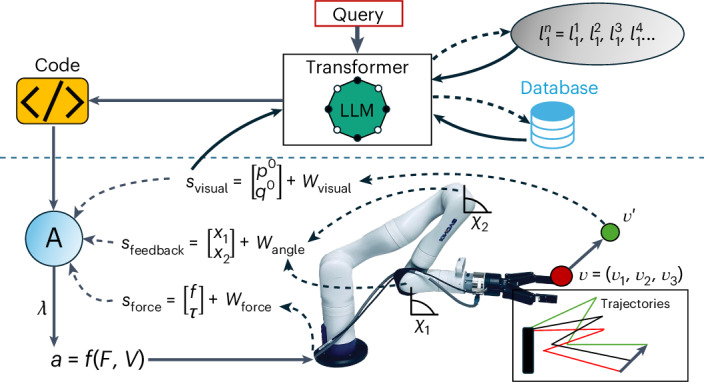
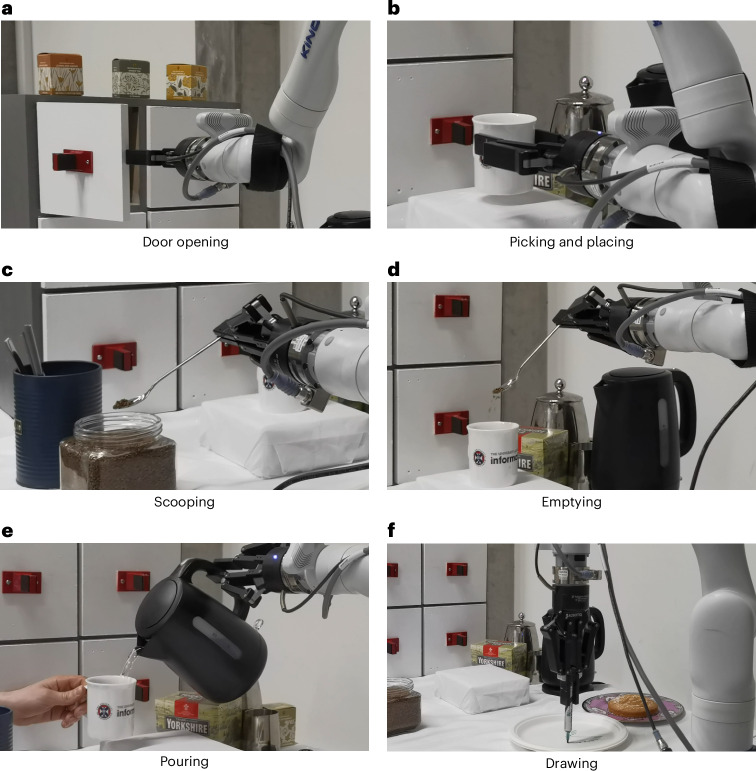
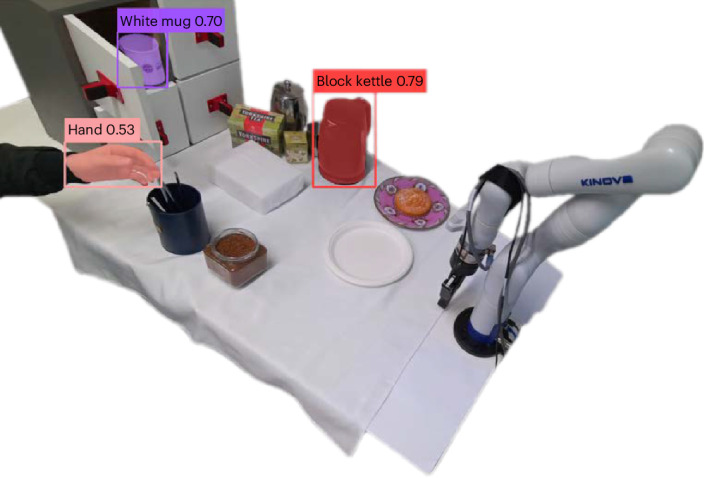
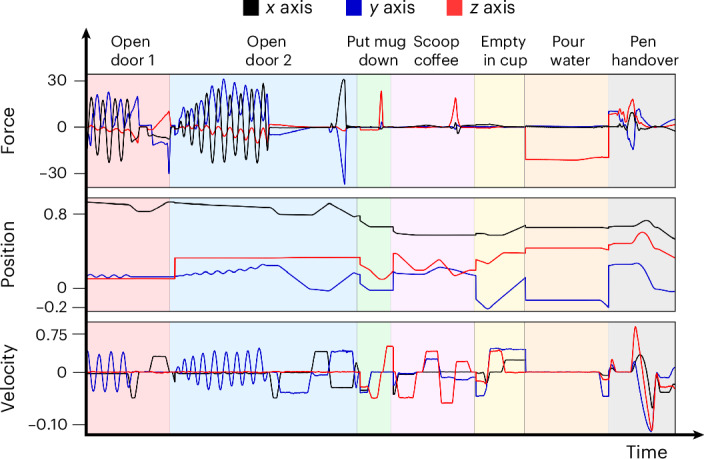
Verification
Claims the paper makes
The claims and statistics of this paper haven’t been checked yet.
Run the check — free, no account needed. It reads the open-access text and checks the sources it cites.
Claims other papers make about this one
Each is checked against this paper’s own text: does it say what the citing paper says it does?
The source backs part of the claim, not all of it — or backs it for a different population, condition or comparison.
In the citing paper
“In such environments, agents must process continuous, high-bandwidth sensory streams, such as video frames, audio signals, and proprioception, under real-time and memory constraints (Black et al., 2025; Bjorck et al., 2025; Mon-Williams et al., 2025).”
From A Survey of Agent Memory in the Second Half: Towards Self-Evolving and Long-Horizon Agents (2026) · cites this paper as Mon-Williams et al., 2025
Experimental — accuracy not yet measured
Self-check
Percentages, sums and reported differences re-computed from the paper’s own numbers.
The self-check needs the paper’s full text.
Citations
Cites
Kirillov, A., Mintun, E., Ravi, N., Mao, H., Rolland, C., Gustafson, L., Xiao, T., Whitehead, S., Berg, A. C., Lo, W.-Y., et al. (2023) · 2023 IEEE/CVF International Conference on Computer Vision (ICCV) · doi:10.1109/iccv51070.2023.00371 · Cited by 11,953
US Environmental Protection Agency
Liu, X. (1998) · Choice Reviews Online · doi:10.5860/choice.35-4455 · Cited by 5,887
Six views of embodied cognition
Wilson, M. (2002) · Psychonomic Bulletin & Review · doi:10.3758/bf03196322 · Cited by 4,782
Retrieval-Augmented Generation for Knowledge-Intensive NLP Tasks
Lewis, P., Perez, E., Piktus, A., Petroni, F., Karpukhin, V., Goyal, N., Küttler, H., Lewis, M., Yih, W.-T., Rocktäschel, T., et al. (2020) · arXiv · doi:10.48550/arxiv.2005.11401 · Cited by 3,101
Zero-shot text-to-image generation
Ramesh, A., Pavlov, M., Goh, G., Gray, S., Voss, C., Radford, A., Chen, M., & Sutskever, I. (2021) · arXiv · doi:10.48550/arxiv.2102.12092 · Cited by 2,417
Grounding DINO: Marrying DINO with Grounded Pre-training for Open-Set Object Detection
Liu, S., Zeng, Z., Ren, T., Li, F., Zhang, H., Yang, J., Jiang, Q., Li, C., Yang, J., Su, H., et al. (2025) · Lecture Notes in Computer Science · doi:10.1007/978-3-031-72970-6_3 · Cited by 2,074
The grand challenges of Science Robotics
Yang, G.-Z., Bellingham, J., Dupont, P. E., Fischer, P., Floridi, L., Full, R., Jacobstein, N., Kumar, V., McNutt, M., Merrifield, R., et al. (2018) · Science Robotics · doi:10.1126/scirobotics.aar7650 · Cited by 1,177
Trends and challenges in robot manipulation
Billard, A., & Kragić, D. (2019) · Science · doi:10.1126/science.aat8414 · Cited by 1,007
An embodied cognitive science?
Clark, A. (1999) · Trends in Cognitive Sciences · doi:10.1016/s1364-6613(99)01361-3 · Cited by 781
Code as Policies: Language Model Programs for Embodied Control
Liang, J., Huang, W., Xia, F., Xu, P., Hausman, K., Ichter, B., Florence, P., & Zeng, A. (2023) · 2023 IEEE International Conference on Robotics and Automation (ICRA) · doi:10.1109/icra48891.2023.10160591 · Cited by 767
Do As I Can, Not As I Say: Grounding Language in Robotic Affordances
Ahn, M., Brohan, A., Brown, N., Chebotar, Y., Cortes, O., David, B., Finn, C., Fu, C., Gopalakrishnan, K., Hausman, K., et al. (2022) · arXiv · doi:10.48550/arxiv.2204.01691 · Cited by 624
ProgPrompt: Generating Situated Robot Task Plans using Large Language Models
Singh, I., Blukis, V., Mousavian, A., Goyal, A., Xu, D., Tremblay, J., Fox, D., Thomason, J., & Garg, A. (2023) · 2023 IEEE International Conference on Robotics and Automation (ICRA) · doi:10.1109/icra48891.2023.10161317 · Cited by 613
PaLM-E: An Embodied Multimodal Language Model
Driess, D., Xia, F., Sajjadi, M. S. M., Lynch, C., Chowdhery, A., Ichter, B., Wahid, A., Tompson, J., Vuong, Q., Yu, T., et al. (2023) · arXiv · doi:10.48550/arxiv.2303.03378 · Cited by 591
ChatGPT for Robotics: Design Principles and Model Abilities
Vemprala, S. H., Bonatti, R., Bucker, A., & Kapoor, A. (2024) · IEEE Access · doi:10.1109/access.2024.3387941 · Cited by 570
An integrated GPU power and performance model
Hong, S., & Kim, H. (2010) · Proceedings - International Symposium on Computer Architecture/Proceedings · doi:10.1145/1815961.1815998 · Cited by 486
LLM-Planner: Few-Shot Grounded Planning for Embodied Agents with Large Language Models
Song, C. H., Sadler, B. M., Wu, J., Chao, W.-L., Washington, C., & Su, Y. (2023) · 2023 IEEE/CVF International Conference on Computer Vision (ICCV) · doi:10.1109/iccv51070.2023.00280 · Cited by 435
Towards Reasoning in Large Language Models: A Survey
Huang, J., & Chang, K. C.-C. (2023) · Findings of the Association for Computational Linguistics: ACL 2023 · doi:10.18653/v1/2023.findings-acl.67 · Cited by 428
Managing extreme AI risks amid rapid progress
Bengio, Y., Hinton, G., Yao, A., Song, D., Abbeel, P., Darrell, T., Harari, Y. N., Zhang, Y.-Q., Xue, L., Shalev-Shwartz, S., et al. (2024) · Science · doi:10.1126/science.adn0117 · Cited by 349
Smart industrial robot control trends, challenges and opportunities within manufacturing
Arents, J., & Greitans, M. (2022) · Applied Sciences · doi:10.3390/app12020937 · Cited by 338
Large language models for human–robot interaction: A review
Zhang, C., Chen, J., Li, J., Peng, Y., & Mao, Z. (2023) · Biomimetic Intelligence and Robotics · doi:10.1016/j.birob.2023.100131 · Cited by 309
Inner Monologue: Embodied Reasoning through Planning with Language Models
Huang, W., Xia, F., Xiao, T., Chan, H., Liang, J., Florence, P., Zeng, A., Tompson, J., Mordatch, I., Chebotar, Y., et al. (2022) · arXiv · doi:10.48550/arxiv.2207.05608 · Cited by 287
RT-2: Vision-Language-Action Models Transfer Web Knowledge to Robotic Control
Brohan, A., Brown, N., Carbajal, J., Chebotar, Y., Chen, X., Choromanski, K., Ding, T., Driess, D., Dubey, A., Finn, C., et al. (2023) · arXiv · doi:10.48550/arxiv.2307.15818 · Cited by 276
Dynamic movement primitives in robotics: A tutorial survey
Saveriano, M., Abu-Dakka, F. J., Kramberger, A., & Peternel, L. (2023) · The International Journal of Robotics Research · doi:10.1177/02783649231201196 · Cited by 267
CLIPort: What and Where Pathways for Robotic Manipulation
Shridhar, M., Manuelli, L., & Fox, D. (2021) · arXiv · doi:10.48550/arxiv.2109.12098 · Cited by 223
Socratic Models: Composing Zero-Shot Multimodal Reasoning with Language
Zeng, A., Attarian, M., Ichter, B., Choromanski, K., Wong, A., Welker, S., Tombari, F., Purohit, A., Ryoo, M., Sindhwani, V., et al. (2022) · arXiv · doi:10.48550/arxiv.2204.00598 · Cited by 205
Task and Motion Planning with Large Language Models for Object Rearrangement
Ding, Y. F., Zhang, X., Paxton, C., & Zhang, S. (2023) · IEEE/RSJ International Conference on Intelligent Robots and Systems (IROS) · doi:10.1109/iros55552.2023.10342169 · Cited by 196
A Survey of Zero-shot Generalisation in Deep Reinforcement Learning
Kirk, R., Zhang, A., Grefenstette, E., & Rocktäschel, T. (2023) · Journal of Artificial Intelligence Research · doi:10.1613/jair.1.14174 · Cited by 193
Efficient Model Learning from Joint-Action Demonstrations for Human-Robot Collaborative Tasks
Nikolaidis, S., Ramakrishnan, R., Gu, K., & Shah, J. (2015) · Cited by 189
On the use of simulation in robotics: Opportunities, challenges, and suggestions for moving forward
Choi, H., Crump, C., Duriez, C., Elmquist, A., Hager, G., Han, D., Hearl, F., Hodgins, J., Jain, A., Leve, F., et al. (2021) · Proceedings of the National Academy of Sciences · doi:10.1073/pnas.1907856118 · Cited by 162
DROID: A Large-Scale In-The-Wild Robot Manipulation Dataset
Khazatsky, A., Pertsch, K., Nair, S., Balakrishna, A., Dasari, S., Karamcheti, S., Nasiriany, S., Srirama, M., Chen, L., Ellis, K., et al. (2024) · Robotics: Science and Systems XX · doi:10.15607/rss.2024.xx.120 · Cited by 159
Movement templates for learning of hitting and batting
Kober, J., Mülling, K., Krömer, O., Lampert, C. H., Schölkopf, B., & Peters, J. (2010) · 2010 IEEE International Conference on Robotics and Automation · doi:10.1109/robot.2010.5509672 · Cited by 152
Toward next-generation learned robot manipulation
Cui, J., & Trinkle, J. (2021) · Science Robotics · doi:10.1126/scirobotics.abd9461 · Cited by 127
Skills for physical artificial intelligence
Miriyev, A., & Kovač, M. (2020) · Nature Machine Intelligence · doi:10.1038/s42256-020-00258-y · Cited by 100
Grounding Language with Visual Affordances over Unstructured Data
Mees, O., Diaz, J. L. B., & Burgard, W. (2023) · Proceedings - IEEE International Conference on Robotics and Automation/Proceedings · doi:10.1109/icra48891.2023.10160396 · Cited by 100
Efficient Model Learning from Joint-Action Demonstrations for Human-Robot Collaborative Tasks
Nikolaidis, S., Ramakrishnan, R., Gu, K., & Shah, J. (2015) · ACM/IEEE International Conference on Human-Robot Interaction (HRI) · doi:10.1145/2696454.2696455 · Cited by 98
Cui, Y., Karamcheti, S., Palleti, R., Shivakumar, N., Liang, P., & Sadigh, D. (2023) · ACM/IEEE International Conference on Human-Robot Interaction (HRI) · doi:10.1145/3568162.3578623 · Cited by 85
Concept2Robot: Learning manipulation concepts from instructions and human demonstrations
Shao, L., Migimatsu, T., Zhang, Q., Yang, K., & Bohg, J. (2021) · The International Journal of Robotics Research · doi:10.1177/02783649211046285 · Cited by 81
VoxPoser: Composable 3D Value Maps for Robotic Manipulation with Language Models
Huang, W., Wang, C., Zhang, R., Li, Y., Wu, J., & Fei-Fei, L. (2023) · arXiv · doi:10.48550/arxiv.2307.05973 · Cited by 81
Hierarchical Diffusion Policy for Kinematics-Aware Multi-Task Robotic Manipulation
Ma, X., Patidar, S., Haughton, I., & James, S. (2024) · IEEE Computer Society Conference on Computer Vision and Pattern Recognition/Proceedings - IEEE Computer Society Conference on Computer Vision and Pattern Recognition/Proceedings · doi:10.1109/cvpr52733.2024.01712 · Cited by 80
What matters in language conditioned robotic imitation learning over unstructured data
Mees, O., Hermann, L., & Burgard, W. (2022) · IEEE Robotics and Automation Letters · doi:10.1109/lra.2022.3196123 · Cited by 77
How can LLMs transform the robotic design process?
Stella, F., Santina, C. D., & Hughes, J. (2023) · Nature Machine Intelligence · doi:10.1038/s42256-023-00669-7 · Cited by 73
Force-based robot learning of pouring skills using parametric hidden Markov models
Rozo, L. D., Jiménez, P., & Carme Torras, A. (2013) · International Workshop on Robot Motion and Control · doi:10.1109/romoco.2013.6614613 · Cited by 71
LOCATE: Localize and Transfer Object Parts for Weakly Supervised Affordance Grounding
Li, G., Jampani, V., Sun, D., & Sevilla-Lara, L. (2023) · IEEE Computer Society Conference on Computer Vision and Pattern Recognition/Proceedings - IEEE Computer Society Conference on Computer Vision and Pattern Recognition/Proceedings · doi:10.1109/cvpr52729.2023.01051 · Cited by 56
Self-citationEmbodied inference and spatial cognition
Friston, K. J. (2012) · Cognitive Processing · doi:10.1007/s10339-012-0519-z · Cited by 46
Toward Grounded Commonsense Reasoning
Kwon, M., Hu, H., Myers, V., Karamcheti, S., Dragan, A. D., & Sadigh, D. (2024) · Proceedings - IEEE International Conference on Robotics and Automation/Proceedings · doi:10.1109/icra57147.2024.10611218 · Cited by 41
Explainable Hierarchical Imitation Learning for Robotic Drink Pouring
Zhang, D., Li, Q., Zheng, Y., Wei, L., Zhang, D., & Zhang, Z. (2021) · IEEE Transactions on Automation Science and Engineering · doi:10.1109/tase.2021.3138280 · Cited by 38
Validating Robotics Simulators on Real-World Impacts
Acosta, B., Yang, W., & Posa, M. (2022) · IEEE Robotics and Automation Letters · doi:10.1109/lra.2022.3174367 · Cited by 36
Robot gaining accurate pouring skills through self-supervised learning and generalization
Huang, Y., Wilches, J., & Sun, Y. (2020) · Robotics and Autonomous Systems · doi:10.1016/j.robot.2020.103692 · Cited by 34
One-Shot Open Affordance Learning with Foundation Models
Li, G., Sun, D., Sevilla-Lara, L., & Jampani, V. (2024) · IEEE Computer Society Conference on Computer Vision and Pattern Recognition/Proceedings - IEEE Computer Society Conference on Computer Vision and Pattern Recognition/Proceedings · doi:10.1109/cvpr52733.2024.00298 · Cited by 32
Self-citationDINOBot: Robot Manipulation via Retrieval and Alignment with Vision Foundation Models
Palo, N. D., & Johns, E. (2024) · Proceedings - IEEE International Conference on Robotics and Automation/Proceedings · doi:10.1109/icra57147.2024.10610923 · Cited by 30
Analysing deep reinforcement learning agents trained with domain randomisation
Dai, T., Arulkumaran, K., Gerbert, T., Tukra, S., Behbahani, F., & Bharath, A. A. (2022) · Neurocomputing · doi:10.1016/j.neucom.2022.04.005 · Cited by 28
Ferrandis, J. D. A., Moura, J., & Vijayakumar, S. (2023) · IEEE/RSJ International Conference on Intelligent Robots and Systems (IROS) · doi:10.1109/iros55552.2023.10341629 · Cited by 16
Preference-Conditioned Language-Guided Abstraction
Peng, A., Bobu, A., Li, B. Z., Sumers, T. R., Sucholutsky, I., Kumar, N., Griffiths, T. L., & Shah, J. (2024) · ACM/IEEE International Conference on Human-Robot Interaction (HRI) · doi:10.1145/3610977.3634930 · Cited by 9
Intelligence research should not be held back by its past
(2017) · Nature · doi:10.1038/nature.2017.22021 · Cited by 9
Online Estimation of Articulated Objects with Factor Graphs using Vision and Proprioceptive Sensing
Buchanan, R., Röfer, A., Moura, J., Valada, A., & Vijayakumar, S. (2024) · Proceedings - IEEE International Conference on Robotics and Automation/Proceedings · doi:10.1109/icra57147.2024.10610590 · Cited by 5
A behavioural transformer for effective collaboration between a robot and a non-stationary human
Mon-Williams, R., Stouraitis, T., & Vijayakumar, S. (2023) · IEEE RO-MAN · doi:10.1109/ro-man57019.2023.10309643 · Cited by 3
Self-citationCausalSim: A Causal Framework for Unbiased Trace-Driven SimulationPreprint
Alomar, A., Hamadanian, P., Nasr-Esfahany, A., Agarwal, A., Alizadeh, M., & Devavrat Shah, B. (2022) · arXiv (Cornell University) · doi:10.48550/arxiv.2201.01811 · Cited by 3
ruaridhmon/ELLMER: v1.0.0: Initial Release
ruaridhmon (2024) · Zenodo (CERN European Organization for Nuclear Research) · doi:10.5281/zenodo.14483538 · Cited by 1
Research works printed but not linked: 8
- Hussein, A., Gaber, M. M., Elyan, E. & Jayne, C. Imitation learning: a survey of learning methods. ACM Comput. Surv. 50, 21:1–21:35 (2017).
- Shridhar, M., Manuelli, L. & Fox, D. Perceiver-Actor: a multi-task transformer for robotic manipulation. In Proc. 6th Conference on Robot Learning 785–799 (PMLR, 2023).
- Huang, W., Abbeel, P., Pathak, D. & Mordatch, I. Language models as zero-shot planners: extracting actionable knowledge for embodied agents. In Proc. 39th International Conference on Machine Learning 9118–9147 (PMLR, 2022).
- Belkhale, S., Cui, Y. & Sadigh, D. Data quality in imitation learning. In Advances in Neural Information Processing Systems (NeurIPS) 80375–80395 (Curran Associates, 2024).
- Chang, J., Uehara, M., Sreenivas, D., Kidambi, R. & Sun, W. Mitigating covariate shift in imitation learning via offline data with partial coverage. In Advances in Neural Information Processing Systems 965–979 (Curran Associates, 2021).
- Nair, S., Rajeswaran, A., Kumar, V., Finn, C. & Gupta, A. R3M: a universal visual representation for robot manipulation. In Proc. 6th Conference on Robot Learning Vol. 205, 892–909 (PMLR, 2022).
- Hong, J., Levine, S. & Dragan, A. Learning to influence human behavior with offline reinforcement learning. In Advances in Neural Information Processing Systems (NeurIPS) 36094–36105 (Curran Associates, 2024).
- OpenAI. GPT-4 technical report. Preprint at http://arxiv.org/abs/2303.08774 (2024). · arXiv
Cited by
Sorted by citations
Zheng, X., Jiang, Y., Mete, M., Li, J., Watanabe, I., Yamada, T., & Paik, J. K. (2025) · Science Robotics · doi:10.1126/scirobotics.adx1519 · Cited by 38
Big Data and AI‐Powered Modeling: A Pathway to Sustainable Precision Animal Nutrition
Zhang, S., Lai, C., Zhao, J.-B., & Wang, J.-J. (2025) · Advancement of science · doi:10.1002/advs.202507564 · Cited by 20
Tong, X., Li, K., & Bao, J. (2025) · Robotics and Computer-Integrated Manufacturing · doi:10.1016/j.rcim.2025.103169 · Cited by 14
Roumeliotis, K. I., Sapkota, R., Karkee, M., & Tselikas, N. D. (2026) · IEEE Access · doi:10.1109/access.2026.3662282 · Cited by 13
Intelligent generation of 3D disassembly processes driven by multimodal large language models
Zhao, Y., Chen, L., Yu, H., & Zheng, Y. (2026) · Journal of Manufacturing Systems · doi:10.1016/j.jmsy.2026.04.032 · Cited by 13
Metadata
- Authors
- Mon-Williams, R., Li, G., Long, R., Du, W., & Lucas, C. G.
- Affiliations
- Princeton University (US)
- University of Edinburgh (GB)
- The Alan Turing Institute (GB)
- Corresponding author
- Mon-Williams, Ruaridh
- Li, Gen
- Venue
- Nature Machine Intelligence
- Published
- 2025-03-19
- Volume
- 7
- Issue
- 4
- Pages
- 592-601
- ISSN
- 2522-5839 (ISSN-L)
- PMC
- PMC12088599
- OpenAlex
- W4408555470
- Cited by
- 132
- References
- 58
- Citations by year
- 2026: 94 · 2025: 38
- FWCI
- 48.49
- Type
- journal article
- Language
- en
- Open access
- hybrid
- doi.org
- Locations
- Nature Machine Intelligence (publishedVersion, cc-by)
- Research Square (acceptedVersion, cc-by)
- PubMed Central (publishedVersion, cc-by)
- PubMed (publishedVersion)
- Edinburgh Research Explorer (University of Edinburgh) (submittedVersion, cc-by)
- Funders
- RCUK | Engineering and Physical Sciences Research Council (EP/L016834/1, EP/S023208/1)
- Topics
- Physical Sciences › Engineering › Control and Systems Engineering › Robot Manipulation and Learning
- Physical Sciences › Computer Science › Artificial Intelligence › AI-based Problem Solving and Planning
- Physical Sciences › Computer Science › Artificial Intelligence › Reinforcement Learning in Robotics
- Keywords
- unpredictable environments, GPT-4, retrieval-augmented generation, sensorimotor feedback, force feedback, visual feedback, action planning, long-horizon tasks, intelligent robots
About these checks
Registry, retraction, Cites and statistics results are computed, not judged, with one exception: a printed reference that no index lists is read once by a model before it counts as a citation error. Claims are extracted by a model and kept only when their quote appears verbatim in the text; each cited source is then checked, with a model’s help, for whether it says what the claim relies on. Those verdicts can be wrong — read the claim’s quote and the cited source before relying on one.
Statistics and arithmetic are recomputed, not judged.
Confidence bands are shown only for fields calibrated on our annotated test set. None is calibrated yet, so no band is shown.
What counts as a claim ›How we measure confidence ›How we check this ›
Are you an author, or do you see a problem with this page? Request a review
