

The DOI matches its Crossref record; 69 of the 69 references it cites were found in a registry or an index.
Agricultural input shocks affect crop yields more in the high-yielding areas of the world
Open accessPublished version of a preprint
Abstract
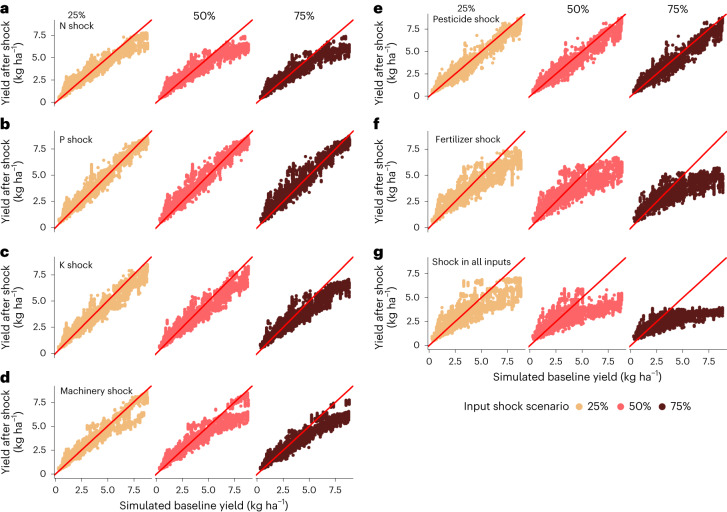
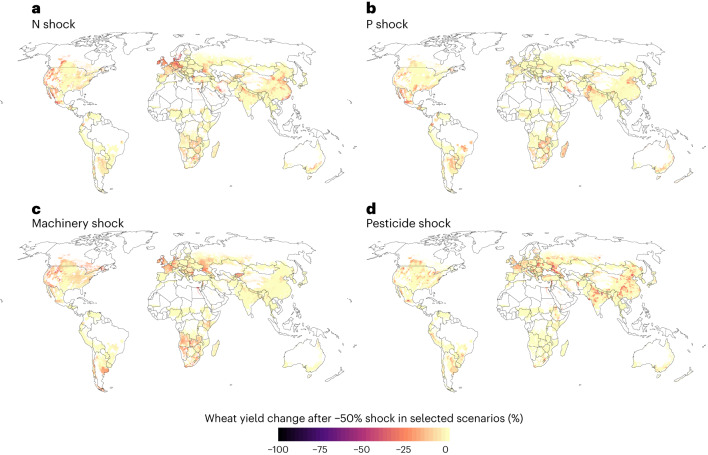
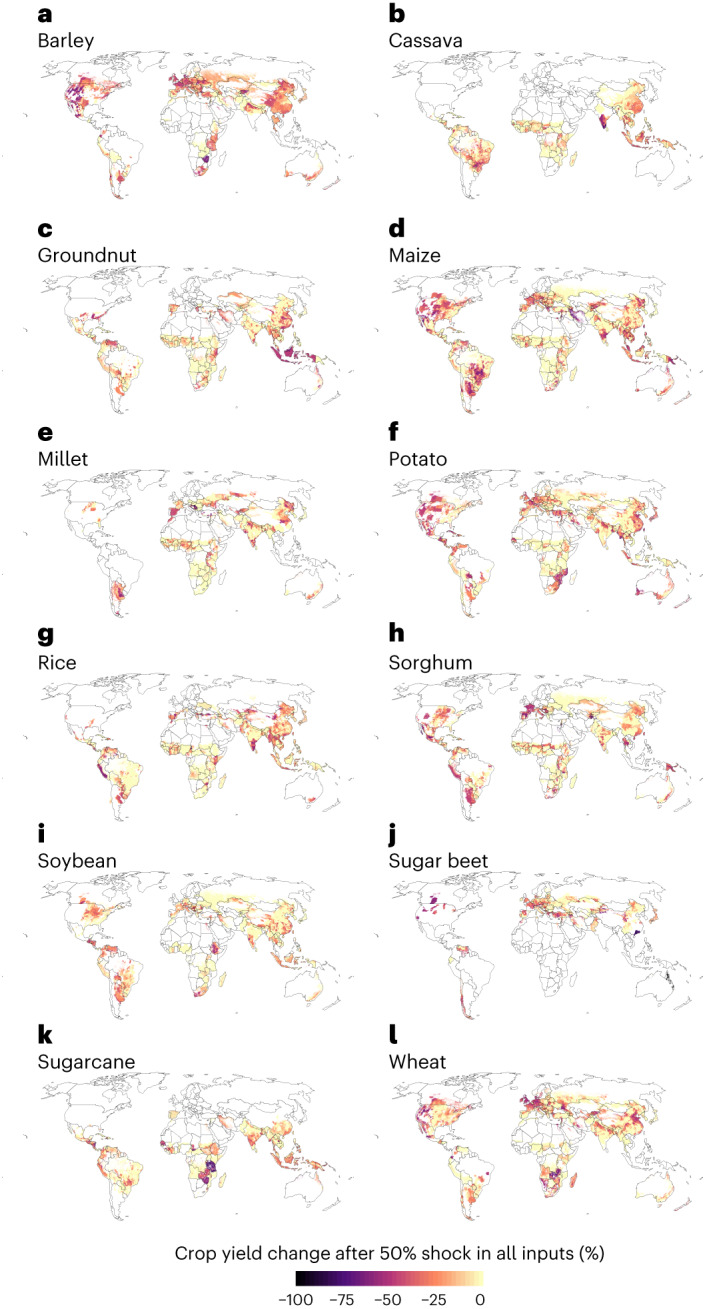
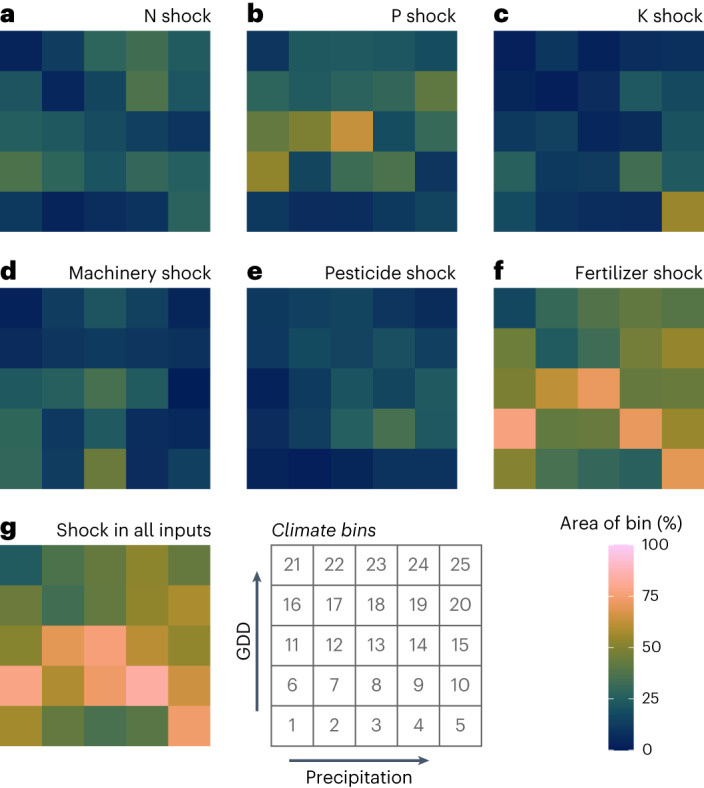
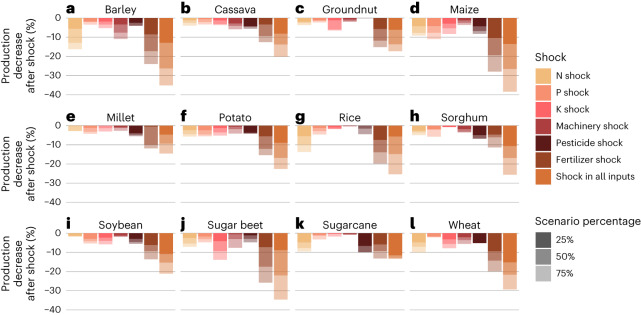
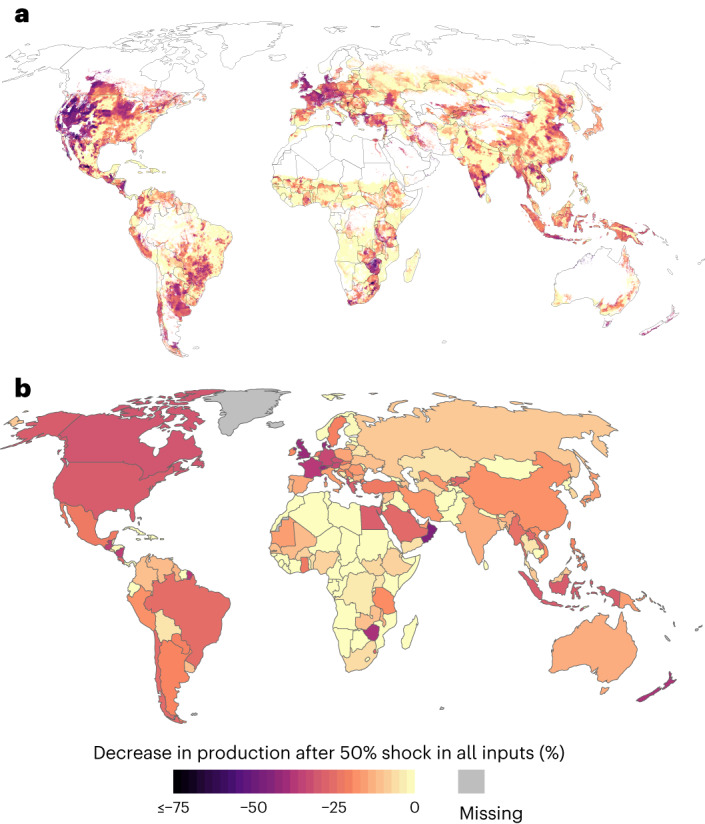
The industrialization of agriculture has led to an increasing dependence on non-locally sourced agricultural inputs. Hence, shocks in the availability of agricultural inputs can be devastating to food crop production. There is also a pressure to decrease the use of synthetic fertilizers and pesticides in many areas. However, the combined impact of the agricultural input shocks on crop yields has not yet been systematically assessed globally. Here we modelled the effects of agricultural input shocks using a random forest machine learning algorithm. We show that shocks in fertilizers cause the most drastic yield losses. Under the scenario of 50% shock in all studied agricultural inputs, global maize production could decrease up to 26%, and global wheat production up to 21%, impacting particularly the high-yielding ‘breadbasket’ areas of the world. Our study provides insights into global food system resilience and can be useful for preparing for potential future shocks or agricultural input availability decreases at local and global scales.
Overview
The claims and statistics of this paper haven’t been checked yet.
Run the check — free, no account needed. It reads the open-access text and checks the sources it cites.
Integrity signals
Registry
Cites
Statistics
Figures
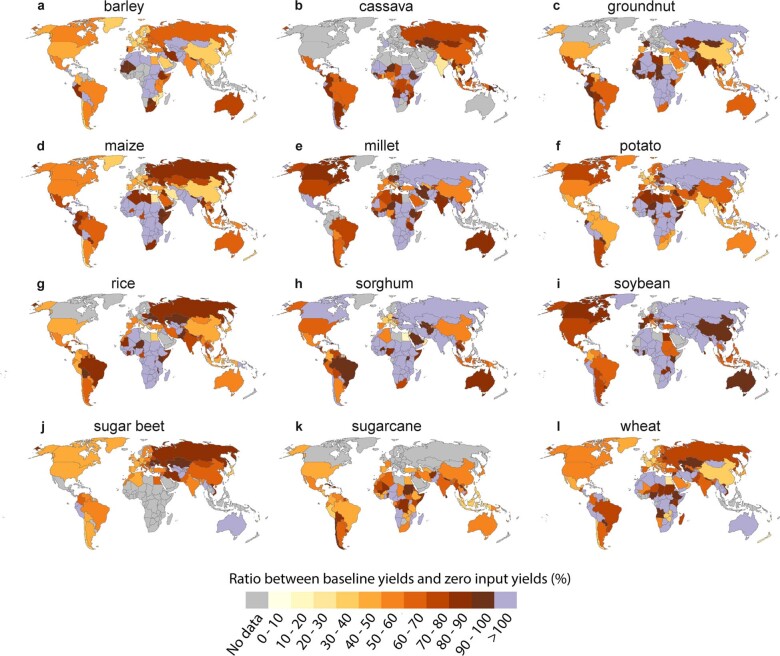
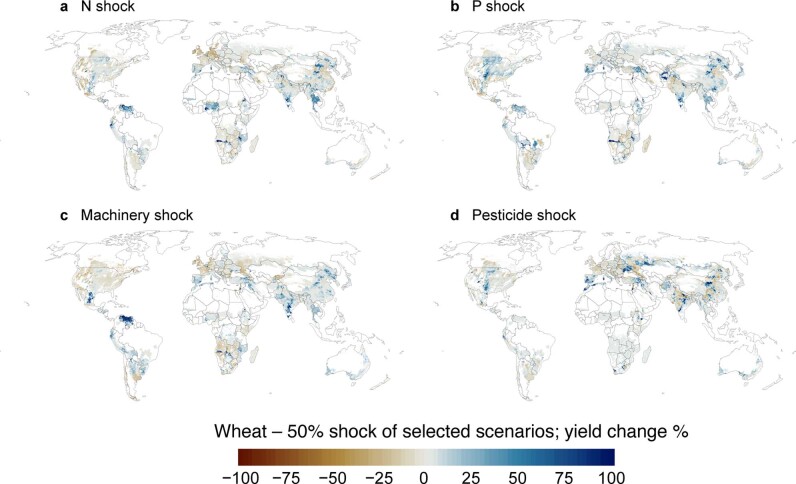
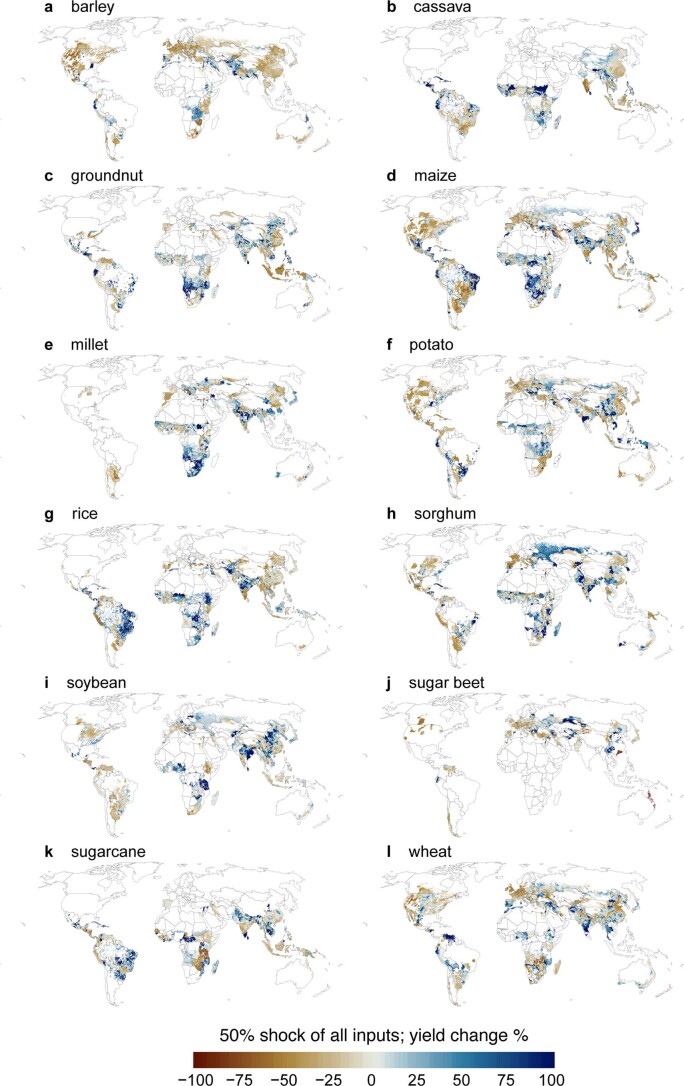
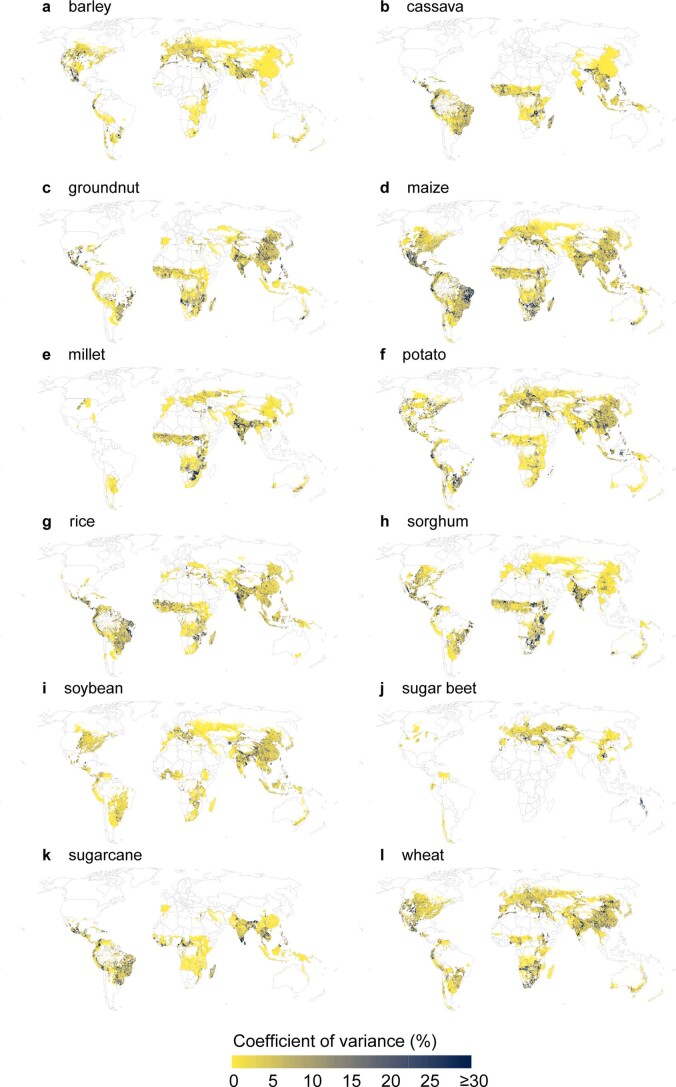
Verification
Claims the paper makes
The claims and statistics of this paper haven’t been checked yet.
Run the check — free, no account needed. It reads the open-access text and checks the sources it cites.
Self-check
Percentages, sums and reported differences re-computed from the paper’s own numbers.
The self-check needs the paper’s full text.
Citations
Cites
Breiman, L. (2001) · Machine Learning · doi:10.1023/a:1010933404324 · Cited by 133,538 · cited 2×
“We used a random forest machine learning model 10 to conduct the assessment.”
BackgroundMethodClassification and Regression by randomForest
Liaw, A. I., & Wiener, M. C. (2007) · Cited by 18,594
WorldClim 2: new 1‐km spatial resolution climate surfaces for global land areas
Fick, S. E., & Hijmans, R. J. (2017) · International Journal of Climatology · doi:10.1002/joc.5086 · Cited by 16,088
Model Evaluation Guidelines for Systematic Quantification of Accuracy in Watershed Simulations
Moriasi, D. N., Arnold, J. G., Liew, M. W. V., Bingner, R. L., Harmel, R. D., & Veith, T. L. (2007) · Transactions of the ASABE · doi:10.13031/2013.23153 · Cited by 13,446 · cited 3×
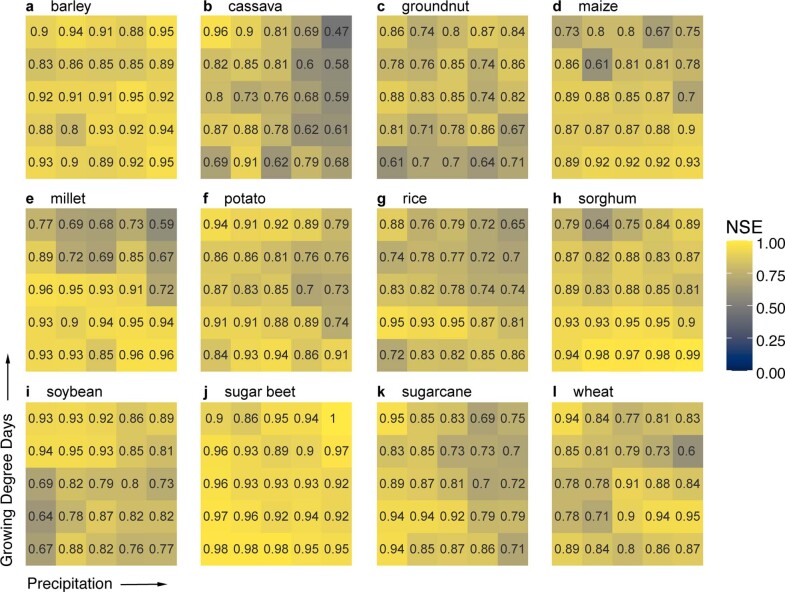
“3), indicating good or very good model performance 21 , respectively.”
BackgroundInfluentialClassification And Regression Trees
Breiman, L., Friedman, J. H., Olshen, R. A., & Stone, C. J. (2017) · doi:10.1201/9781315139470 · Cited by 11,417
How a century of ammonia synthesis changed the world
Erisman, J. W., Sutton, M. A., Galloway, J. N., Klimont, Z., & Winiwarter, W. (2008) · Nature Geoscience · doi:10.1038/ngeo325 · Cited by 4,630
Closing yield gaps through nutrient and water management
Mueller, N. D., Gerber, J., Johnston, M., Ray, D. K., Ramankutty, N., & Foley, J. A. (2012) · Nature · doi:10.1038/nature11420 · Cited by 2,942 · cited 10×
“…aspect that could have affected the model performances is some details of the model input data: for a wheat climate bin with 28,000 observations, there are only 30 unique values for N rate or P rate, and furthermore, many of the fertilizer rates are known only at subnational or county level 12 .”
BackgroundMethodResultInfluentialSoilGrids 2.0: producing soil information for the globe with quantified spatial uncertainty
de Sousa, L. M., Poggio, L., Batjes, N. H., Heuvelink, G. B. M., Kempen, B., Ribeiro, E., & Rossiter, D. G. (2021) · SOIL · doi:10.5194/soil-7-217-2021 · Cited by 2,776 · cited 2×
“For that we used organic carbon density (hg m −3 ) from SoilGrid v2 35 for the topsoil (0–30 cm).”
MethodHyperparameters and tuning strategies for random forest
Probst, P., Wright, M. N., & Boulesteix, A. (2019) · Wiley Interdisciplinary Reviews Data Mining and Knowledge Discovery · doi:10.1002/widm.1301 · Cited by 2,319 · cited 1×
“Random forest can be adjusted with different hyperparameter values 45 .”
BackgroundMonfreda, C., Ramankutty, N., & Foley, J. A. (2008) · Global Biogeochemical Cycles · doi:10.1029/2007gb002947 · Cited by 1,895 · cited 1×
“Yield data (t ha −1 ) were sourced from Monfreda et al. 27 .”
Method
Research works printed but not linked: 2
- Dall’Erba, S., Chen, Z. & Nava, N. J. U.S. Interstate trade will mitigate the negative impact of climate change on crop profit. Am. J. Agric. Econ. 103, 1721–1741 (2021).
- O’Hara, J. K., Mulik, K. & Gurian-Sherman, D. Agricultural production impacts of higher phosphate fertilizer prices. J Int. Agric. Trade Dev. 9, 233–253 (2015).
Cited by
Sorted by citations
Reducing chemical inputs in agriculture requires a system change
Brunelle, T., Chakir, R., Carpentier, A., Dorin, B., Goll, D. S., Guilpart, N., Maggi, F., Makowski, D., Nesme, T., Roosen, J., et al. (2024) · Communications Earth & Environment · doi:10.1038/s43247-024-01533-1 · Cited by 168
Bisinella, V., Schmidt, S., Varling, A. S., Laner, D., & Christensen, T. H. (2023) · Waste Management · doi:10.1016/j.wasman.2023.11.021 · Cited by 90
Ayadi, R., Forouheshfar, Y., & Moghadas, O. (2025) · Frontiers in Climate · doi:10.3389/fclim.2025.1585331 · Cited by 71
Ren, C., He, L., & Rosa, L. (2025) · Nature Food · doi:10.1038/s43016-024-01107-6 · Cited by 35
“N stands as a pivotal element for optimal crop growth, and shocks in fertilizer application can result in severe yield losses 44 .”
Reshaping Agriculture Eco-efficiency in China: From Greenhouse Gas Perspective
Wang, G., Zhao, M., Zhao, B., Liu, X., & Wang, Y. (2025) · Ecological Indicators · doi:10.1016/j.ecolind.2025.113268 · Cited by 35
Cai, B., Shi, F., Geremew, B., et al. (2025) · Frontiers in Agronomy · doi:10.3389/fagro.2025.1665444 · Cited by 28
Li, L., Lü, C., Winiwarter, W., Tian, H., Canadell, J. G., Ito, A., Jain, A. K., Kou‐Giesbrecht, S., Pan, S., Pan, N., et al. (2024) · Global Change Biology · doi:10.1111/gcb.17472 · Cited by 25
“Although sufficient N fertilizer application is essential for food supply (Ahvo et al., 2023 ), overfertilization gives rise to N pollution leading to annual global economic costs of around 200–2000 billion US$ (Kanter, Winiwarter, et al., 2020 ; Sutton et al., 2013 ), especially for the financial…”
Yang, S., Jiang, G., & Yu, H. (2025) · Land Use Policy · doi:10.1016/j.landusepol.2025.107821 · Cited by 22
Global soybean trade dynamics: Drivers, impacts, and sustainability
Peng, D., Zhang, H., Zhang, Y., Yu, L., Chen, M., Chen, J. M., You, L., Li, P., Liu, J., Zhang, X., et al. (2025) · The Innovation · doi:10.1016/j.xinn.2025.101124 · Cited by 25
Iizumi, T., Sakai, T., Masaki, Y., Oyoshi, K., Takimoto, T., Shiogama, H., Imada, Y., & Makowski, D. (2025) · PNAS Nexus · doi:10.1093/pnasnexus/pgaf099 · Cited by 20
Food trade disruption after global catastrophes
Jehn, F. U., Gajewski, Ł. G., Hedlund, J., Arnscheidt, C. W., Xia, L., Wunderling, N., & Denkenberger, D. (2025) · Earth System Dynamics · doi:10.5194/esd-16-1585-2025 · Cited by 18
Li, P., Fan, J., Yang, J., et al. (2025) · Environmental Science & Technology · doi:10.1021/acs.est.5c10842 · Cited by 12
Research on the impact of climate change on food security in Africa
Liu, J., Wu, J., Jiang, D., Chen, S., Hao, M., Ding, F., Wu, G., & Liang, H. (2025) · Scientific Reports · doi:10.1038/s41598-025-14560-5 · Cited by 11
“Ahvo et al. 18 used the random forest algorithm to simulate the impact of agricultural inputs, revealing its significant impact on crop yields in major production regions around the world.”
Digital economy and rural household resilience: Evidence from China
Jiang-hong, X., Wang, C., Yin, X., & Wang, W. (2024) · Agricultural Economics (Zemědělská ekonomika) · doi:10.17221/317/2023-agricecon · Cited by 15
Dependency on imported agricultural inputs—global trade patterns and recent trends
Sandström, V., Huan‐Niemi, E., Niemi, J., & Kummu, M. (2024) · Environmental Research Food Systems · doi:10.1088/2976-601x/ad325e · Cited by 10
Self-citationThe state of global catastrophic risk research: a bibliometric review
Jehn, F. U., Engler, J., Arnscheidt, C. W., Wache, M., Ilin, E., Cook, L., Sundaram, L. S., Hanusch, F., & Kemp, L. (2025) · Earth System Dynamics · doi:10.5194/esd-16-1053-2025 · Cited by 12
“…the following – Food security after global shocks : The University of Helsinki conducts research into global food shocks that are on a scale relevant to GCR (Ahvo et al., 2023; Sand-ström et al., 2024) and quite similar to some of the existing GCR food security research (Moersdorf et al., 2024 .”
Global food security rests on the Strait of Hormuz
Zamani, O., & Farzanegan, M. R. (2026) · Nature Food · doi:10.1038/s43016-026-01340-1 · Cited by 9
Bai, X., Zhang, J., Lyu, Y., Fleskens, L., Cui, Z., Liu, X., Zeng, X., Ritsema, C. J., & Zhang, F. S. (2025) · Journal of Environmental Management · doi:10.1016/j.jenvman.2025.126460 · Cited by 8
It's time to consider global catastrophic food failures
Wescombe, N. J., Martínez, J. B. G., Jehn, F. U., Wunderling, N., Tzachor, A., Sandström, V., Cassidy, M., Ainsworth, R., & Denkenberger, D. (2025) · Global Food Security · doi:10.1016/j.gfs.2025.100880 · Cited by 12
Self-citationDeng, J., Liu, K., Tian, N., Feng, X., Wei, Z., Zhao, Q., Zhang, J., Peng, T., Harrison, M. T., Huang, L., et al. (2025) · npj Sustainable Agriculture · doi:10.1038/s44264-025-00059-z · Cited by 7
“In recent years, the agricultural ecological footprint has gained signi fi cant attention as a measure of the sustainability of agriculture 13,14 .”
Water Scarcity Risks in Ammonia Fertilizer Production Pose a Threat to Global Food Security
Rosa, L., Citrini, A., Terlouw, T., & Mingolla, S. (2025) · Environmental Science & Technology · doi:10.1021/acs.est.5c14489 · Cited by 7
Zhan, L., Huang, X., Xu, Z., et al. (2025) · Agriculture · doi:10.3390/agriculture15020176 · Cited by 5
Han, G., & Liu, T. (2025) · Frontiers in Sustainable Food Systems · doi:10.3389/fsufs.2025.1557321 · Cited by 5
Risk of successive hot-pluvial extremes on crop yield loss over global breadbasket regions
Kabtih, A. K., & Qian, C. (2025) · Communications Earth & Environment · doi:10.1038/s43247-025-02989-5 · Cited by 8
“The fi eld of machine learning provides a variety of advanced statistical models that are increasingly used for more accurate estimations of relationships between yield and climate extremes 12,50,51 .”
Suciu, N., Trevisan, M., Fragkoulis, G., et al. (2026) · Environmental Research · doi:10.1016/j.envres.2026.123805 · Cited by 4
Global food security under a sustainability perspective: Assessment, challenges, and strategies
Li, S., Zhang, Z., Xu, J., Han, J., Zhuang, H., Cui, X., Cai, H., Xiao, C., Yang, S., & Tao, F. (2026) · Geography and sustainability · doi:10.1016/j.geosus.2026.100495 · Cited by 5
Xiao, G., Xin, L., Wang, X., et al. (2024) · Land Degradation and Development · doi:10.1002/ldr.5375 · Cited by 4
Where regenerative farming practices could increase yields: a global assessment
Hounkpatin, O., Giorgi, E. D., Jalava, M., Poelert, J., West, P. C., & Kummu, M. (2026) · npj Sustainable Agriculture · doi:10.1038/s44264-026-00131-2 · Cited by 3
Self-citationLand degradation is associated with larger crop yield gaps across global croplands
Hadi, H., Ray, D. K., Borrelli, P., Gerber, J., Shokri, N., Roman, S., & Wuepper, D. (2026) · Nature Food · doi:10.1038/s43016-026-01382-5 · Cited by 3
“A previous high-resolution study also finds that crop yields in the high-yielding areas of the world are more sensitive to shocks in agricultural inputs 36 .”
Analysis of factors influencing farmers’ adoption of desert locust control methods in Kenya
Lumumba, B. O., Otieno, D. J., & Nyikal, R. A. (2025) · Frontiers in Sustainable Food Systems · doi:10.3389/fsufs.2025.1518276 · Cited by 2
Abate, M. C., Cai, B., Albert, T., Woldemariam, A. A., Zeng, R., Addis, A. K., Long, W., & Kassaye, M. (2025) · Frontiers in Sustainable Food Systems · doi:10.3389/fsufs.2025.1619447 · Cited by 2
Microbial alternatives for sustainable insecticide use, a Canadian perspective
Molligan, J., & Pérez‐López, E. (2025) · Sustainable Microbiology · doi:10.1093/sumbio/qvaf014 · Cited by 2
“Agriculture’s heavy reliance on synthetic pesticides has been well documented (Tudi et al. 2021 , Ahvo et al. 2023 , Met-calfe et al. 2024 ).”
Wang, C., Gao, Z., Shi, X., et al. (2026) · Resources Conservation and Recycling · doi:10.1016/j.resconrec.2026.108876 · Cited by 2
Liang, J., Pan, S., Xia, N., et al. (2026) · Journal of Geographical Sciences · doi:10.1007/s11442-026-2461-5 · Cited by 2
Arita, S., & Steinbach, S. (2026) · Journal of the Science of Food and Agriculture · doi:10.1002/jsfa.70737 · Cited by 2
Li, Z., Sahotra, H., Ahmad, S., Wang, W., Yang, Z., Wu, P., Khan, E., & Zhuo, L. (2025) · Water Resources Research · doi:10.1029/2024wr039169 · Cited by 5
“Many studies indicate that an R 2 value greater than 0.5 is considered a satisfactory model, greater than 0.65 is considered a good model, and greater than 0.75 is considered an excellent model (Ahvo et al., 2023; Gao et al., 2021).”
InfluentialYang, X., Yao, Y., Fan, Y., & Sandström, V. (2025) · Agricultural Systems · doi:10.1016/j.agsy.2025.104558 · Cited by 2
Self-citationLaunch of the global preharvest crop forecast of climate-induced yield variations
Iizumi, T., & Shin, Y. (2025) · Climate Research · doi:10.3354/cr01751 · Cited by 1
Zhao, Z., Xu, L., Ma, H., Zhang, X., & Tang, L. (2025) · Agriculture · doi:10.3390/agriculture15161761 · Cited by 1
Wang, Y., Yu, D., Wang, S., et al. (2025) · Frontiers in Sustainable Food Systems · doi:10.3389/fsufs.2025.1669065 · Cited by 1
Bedasa, Y., Gemechu, A., & Bedemo, A. (2025) · Cogent Food & Agriculture · doi:10.1080/23311932.2025.2569983 · Cited by 1
“…that the amount of fertilizer used in the production of maize and the area under maize are highly responsive to maize productivity. according to ahvo et al. (2023), fertilizer shocks cause the greatest yield losses and the greatest variation in yield response among areas with low agricultural…”
Zhang, G., Song, J., Li, T., et al. (2025) · Soil and Tillage Research · doi:10.1016/j.still.2025.106994 · Cited by 1
Wang, C., Faye, B., Rosenstock, T. S., & Webber, H. A. (2026) · Environmental Research Letters · doi:10.1088/1748-9326/ae3dff · Cited by 1
“Evidence from high-yield ‘breadbasket’ regions shows that disruptions in input availability can trigger large yield losses (Ahvo et al 2023).”
Rong, L., Jia, Q., Gong, K., Duan, F., Li, X., Li, C., Liu, P., Lu, D., Zhao, G., Yao, N., et al. (2026) · Journal of Integrative Agriculture · doi:10.1016/j.jia.2026.02.005 · Cited by 1
Coffie, M., Nunoo, J., Sekyi, S., et al. (2026) · Environment Development and Sustainability · doi:10.1007/s10668-025-07241-w · Cited by 1
Lu, Y., Wang, Y., Yu, J., Zhao, X., Wang, Z., & Xi, B. (2026) · Agricultural Ecology and Environment · doi:10.48130/aee-0026-0005 · Cited by 1
Deng, G., Jiang, H., Ma, S., Wen, Y., He, C., & Sheng, L. (2026) · CATENA · doi:10.1016/j.catena.2026.110269 · Cited by 1
Ding, W., Sun, T., & Zhang, J. (2026) · Sensors International · doi:10.1016/j.sintl.2026.100393 · Cited by 1
Monteiro, L., Hinge, M., Blouin, S., et al. (2026) · Sustainability · doi:10.3390/su18136552 · Cited by 1
Hounkpatin, O., Piipponen, J., Giorgi, E. D., Jalava, M., Poelert, J., & Kummu, M. (2026) · Agronomy for Sustainable Development · doi:10.1007/s13593-026-01133-7 · Cited by 1
“For example, climate indicators can be sourced from different platforms at a global scale such as CHELSA (Karger et al. 2017), CHIRPS (Funk et al. 2015), and the aridity index (Ahvo et al. 2023).”
Self-citationAn, F., Ren, S., Liu, X., Liu, S., & Cui, J. (2026) · Systems · doi:10.3390/systems14080938 · Cited by 1
A pro-natural product design strategy affords ester-based green fungicide candidates
Lei, P., Yuan, H., Lu, X., et al. (2026) · Science Advances · doi:10.1126/sciadv.aej0610 · Cited by 1
“By managing harmful biotic stresses from pests, pathogens, and weeds, they underpin stable and high crop yields ( 3 – 5 ).”
Lumumba, B. O., David, J. O., & Nyikal, R. A. (2024) · SSRN Electronic Journal · doi:10.2139/ssrn.4865271 · Cited by 1
Xiao, G., Xin, L., Wang, X., Li, X., & Tan, M. (2024) · SSRN Electronic Journal · doi:10.2139/ssrn.4797222
Nie, M., Gu, Y., Long, Z., et al. (2024) · SSRN Electronic Journal · doi:10.2139/ssrn.4847546
Hughes, K., Dharmasena, S., & Martin, D. E. (2024) · SSRN Electronic Journal · doi:10.2139/ssrn.4868351
Global huge grain production potential adapted to future climate changePreprint
Liu, X., Liu, Y., & Chen, Z. (2024) · Research Square · doi:10.21203/rs.3.rs-4743316/v1
Honeybees: An Adaptive and Resilient Solution for Sustainable Global Food Security
Kirdat, D. A., Waykar, B. B., & Gawali, A. R. (2025) · Sustainable landscape planning and natural resources management · doi:10.1007/978-3-031-75405-0_16
Targeting regenerative farming practices to increase crop yields globallyPreprint
Hounkpatin, O., Giorgi, E. D., Jalava, M., Poelert, J., West, P. C., & Kummu, M. (2025) · Research Square · doi:10.21203/rs.3.rs-6409921/v1
Self-citationWaste Treatment Technologies for Sustainable Agriculture
Kartika, K., Harsonowati, W., Nurrahma, A. H. I., Latifah, E., Ridwan, R., Lestari, P., Arifin, Z., & Krismawati, A. (2025) · Sustainable landscape planning and natural resources management · doi:10.1007/978-3-031-82536-1_8
Fang, Y., & Huang, X. (2025) · Ecological civilization · doi:10.70322/ecolciviliz.2025.10020
The Effect of Climate Risk on China‘s Agri-food Trade
Song, T. (2025) · Central European Economic Journal · doi:10.2478/ceej-2025-0013
Abagisa, R. A., Abebe, Y. A., Obsa, B. T., Yusuf, M. M., & Abebe, T. M. (2026) · International Journal of Agronomy · doi:10.1155/ioa/8437238
A statistical analysis of inter-state disparities in agricultural development across India
Mahal, A. K., SINGH, P., KUMAR, S., et al. (2026) · The Indian Journal of Agricultural Sciences · doi:10.56093/ijas.v96i01.157913
Herviyanti, H., Pakpahan, F. M., Darfis, I., Satria, R., Maulana, A., Emalinda, O., & Kasim, M. (2026) · IOP Conference Series Earth and Environmental Science · doi:10.1088/1755-1315/1591/1/012024
“A 15% increase in fertilizer prices results in a 10% decrease in profits, unable to significantly reduce fertilizer doses due to drastic yield reductions [8][9].”
Roberts, S. A., Winkler, K., Rounsevell, M., et al. (2026) · SSRN Electronic Journal · doi:10.2139/ssrn.6461843
Optimizing import patterns to reduce the environmental effects and risks of China’s grain imports
Wang, J., Fei, L., Yibin, W., et al. (2026) · Geography and sustainability · doi:10.1016/j.geosus.2026.100465
Embodied Urea in Final Use: Mapping Transnational Agricultural Dependencies
Gill, M. Y., Liu, Y., Li, X., et al. (2026) · Earth Systems and Environment · doi:10.1007/s41748-026-01197-1
“%) aligns with severe shocks (≈ 50% reduction) in high-input cereal systems char - acteristic of major urea-importing economies, where adaptive flexibility is constrained (Ahvo et al. 2023).”
Zheng, X., Chen, Y., Qi, X., & Zhong, T. (2026) · Sustainability · doi:10.3390/su18136763
Li, Y., Liu, S., Wu, X., et al. (2026) · iScience · doi:10.1016/j.isci.2026.116802
Regional disparity in the improvement of cultivated land quality in China since the 1980s
Bai, X., Zhang, J., Cui, Z., Fleskens, L., Lyu, Y., Sun, W., Liu, X., Goulding, K. W. T., Ritsema, C. J., & Zhang, F. S. (2026) · 中国科学通报:英文版 · doi:10.1016/j.scib.2026.07.053
Chiboub, I., & Sadok, H. (2026) · SSRN Electronic Journal · doi:10.2139/ssrn.7067638
Hao, M., Liu, J., Jiang, D., et al. (2026) · Resources Environment and Sustainability · doi:10.1016/j.resenv.2026.100379
Liu, X., Chen, Z., Liu, Z., et al. (2026) · Agricultural Water Management · doi:10.1016/j.agwat.2026.110793
Assessing upper bounds for solar-powered controlled environment agriculture on existing cropland
Roberts, S. A., Winkler, K., Rounsevell, M., Saxena, A., Marcelis, L. F. M., & Fuchs, R. (2026) · Frontiers in Sustainable Food Systems · doi:10.3389/fsufs.2026.1945186
Food-System Stress Testing: Prediction Tasks Under Alternative Outcome Definitions
An, F., Ren, S., Liu, X., et al. (2026) · Mathematics · doi:10.3390/math14193441
Zhao, X., Su, B., Gao, B., et al. (2026) · ACS Applied Polymer Materials · doi:10.1021/acsapm.6c02805
Zhang, R., Guan, M., Zhao, Z., et al. (2026) · Journal of Cleaner Production · doi:10.1016/j.jclepro.2026.149736
Metadata
- Authors
- Ahvo, A., Heino, M., Sandström, V., Chrisendo, D., Jalava, M., & Kummu, M.
- Affiliations
- Aalto University (FI)
- Corresponding author
- Kummu, Matti
- Venue
- Nature Food
- Published
- 2023-11-09
- Volume
- 4
- Issue
- 12
- Pages
- 1037-1046
- ISSN
- 2662-1355 (ISSN-L)
- PMC
- PMC10727984
- OpenAlex
- W4388523335
- Cited by
- 78
- References
- 69
- Citations by year
- 2026: 34 · 2025: 33 · 2024: 10 · 2023: 1
- FWCI
- 19.80
- Type
- journal article
- Language
- en
- Open access
- hybrid
- doi.org
- Locations
- Nature Food (publishedVersion, cc-by)
- Research Square (acceptedVersion, cc-by)
- PubMed (publishedVersion)
- PubMed Central (submittedVersion, cc-by)
- Aaltodoc (Aalto University) (submittedVersion, cc-by)
- Apollo (University of Cambridge) (submittedVersion, cc-by)
- Funders
- European Commission (HORIZON2020, 819202)
- Academy of Finland (339834)
- Aalto-Yliopisto
- China Scholarship Council
- Maa- ja Vesitekniikan Tuki Ry
- Topics
- Life Sciences › Agricultural and Biological Sciences › Agronomy and Crop Science › Climate change impacts on agriculture
- Social Sciences › Economics, Econometrics and Finance › Economics and Econometrics › Agricultural risk and resilience
- Social Sciences › Economics, Econometrics and Finance › Economics and Econometrics › Economics of Agriculture and Food Markets
- Keywords
- crop yield, fertilizer availability, pesticide availability, maize production, wheat production, food system resilience, global food security, mineral fertilizers
- MeSH terms
- Crop Production, Agriculture, Fertilizers, Pesticides, Crops, Agricultural
About these checks
Registry, retraction, Cites and statistics results are computed, not judged, with one exception: a printed reference that no index lists is read once by a model before it counts as a citation error. Claims are extracted by a model and kept only when their quote appears verbatim in the text; each cited source is then checked, with a model’s help, for whether it says what the claim relies on. Those verdicts can be wrong — read the claim’s quote and the cited source before relying on one.
Statistics and arithmetic are recomputed, not judged.
Confidence bands are shown only for fields calibrated on our annotated test set. None is calibrated yet, so no band is shown.
What counts as a claim ›How we measure confidence ›How we check this ›
Are you an author, or do you see a problem with this page? Request a review
