

The DOI matches its Crossref record; 69 of the 69 references it cites were found in a registry or an index.
Agricultural input shocks affect crop yields more in the high-yielding areas of the world
Open accessPublished version of a preprint
Abstract
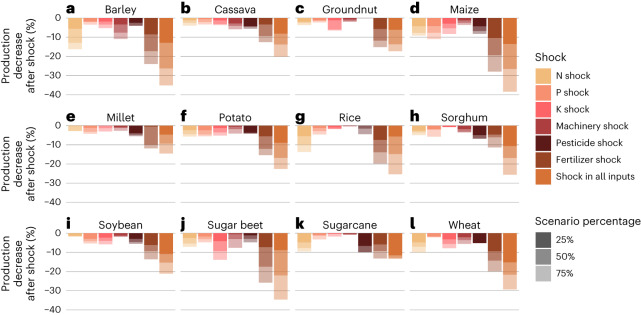
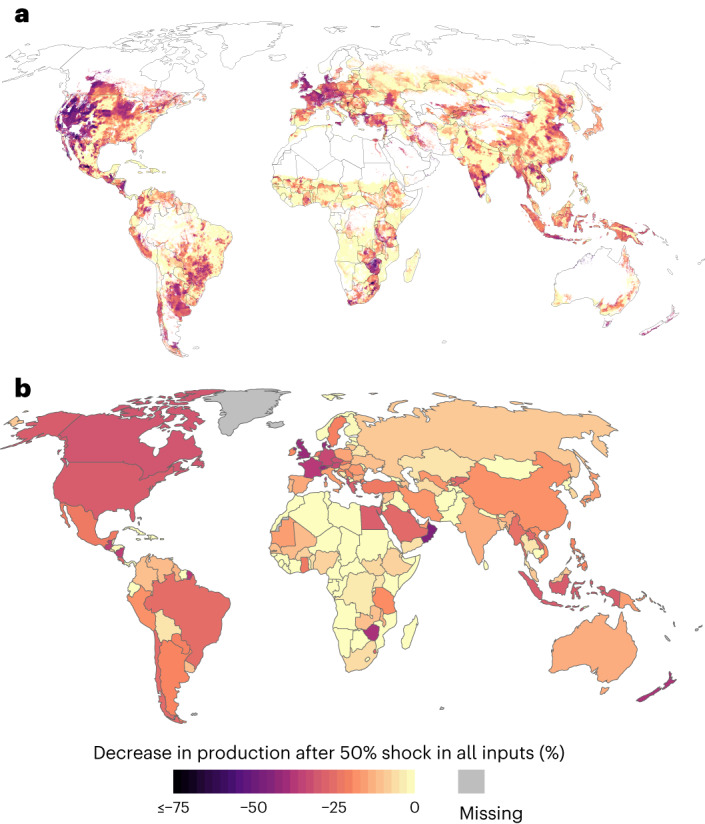
The industrialization of agriculture has led to an increasing dependence on non-locally sourced agricultural inputs. Hence, shocks in the availability of agricultural inputs can be devastating to food crop production. There is also a pressure to decrease the use of synthetic fertilizers and pesticides in many areas. However, the combined impact of the agricultural input shocks on crop yields has not yet been systematically assessed globally. Here we modelled the effects of agricultural input shocks using a random forest machine learning algorithm. We show that shocks in fertilizers cause the most drastic yield losses. Under the scenario of 50% shock in all studied agricultural inputs, global maize production could decrease up to 26%, and global wheat production up to 21%, impacting particularly the high-yielding ‘breadbasket’ areas of the world. Our study provides insights into global food system resilience and can be useful for preparing for potential future shocks or agricultural input availability decreases at local and global scales.
Overview
The claims and statistics of this paper haven’t been checked yet.
Run the check — free, no account needed. It reads the open-access text and checks the sources it cites.
Integrity signals
Registry
Cites
Statistics
Figures
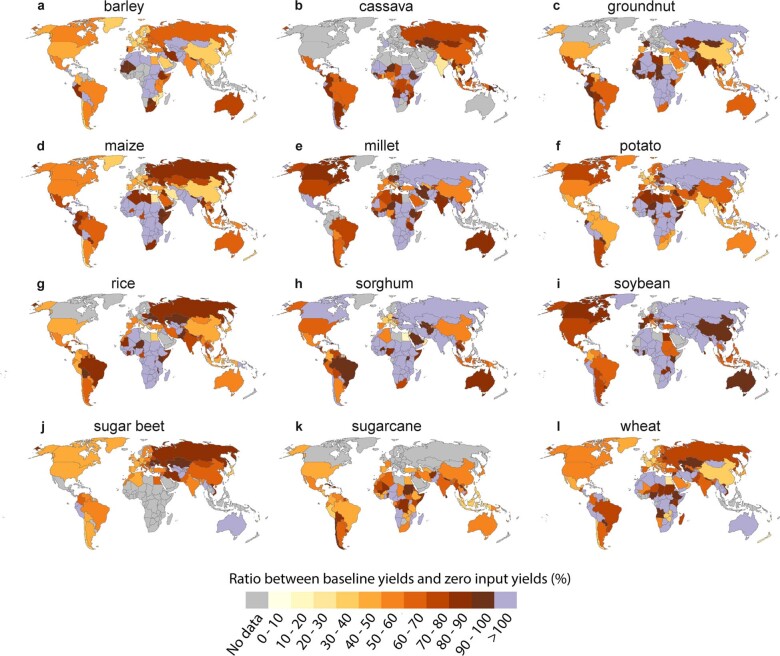
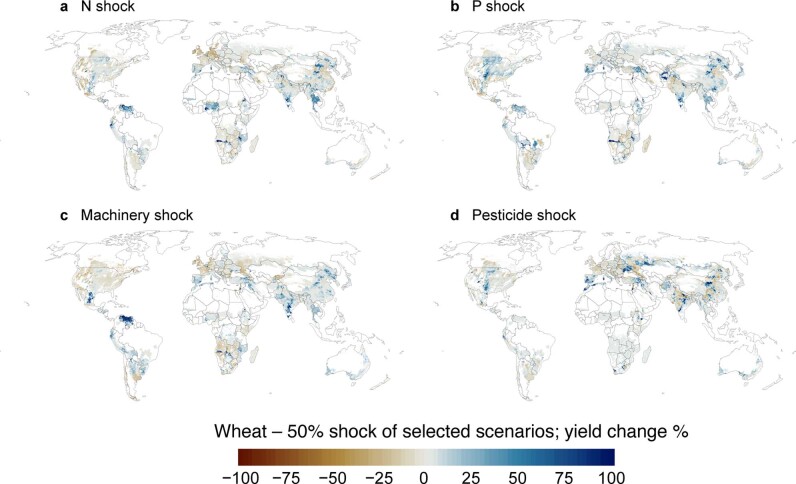
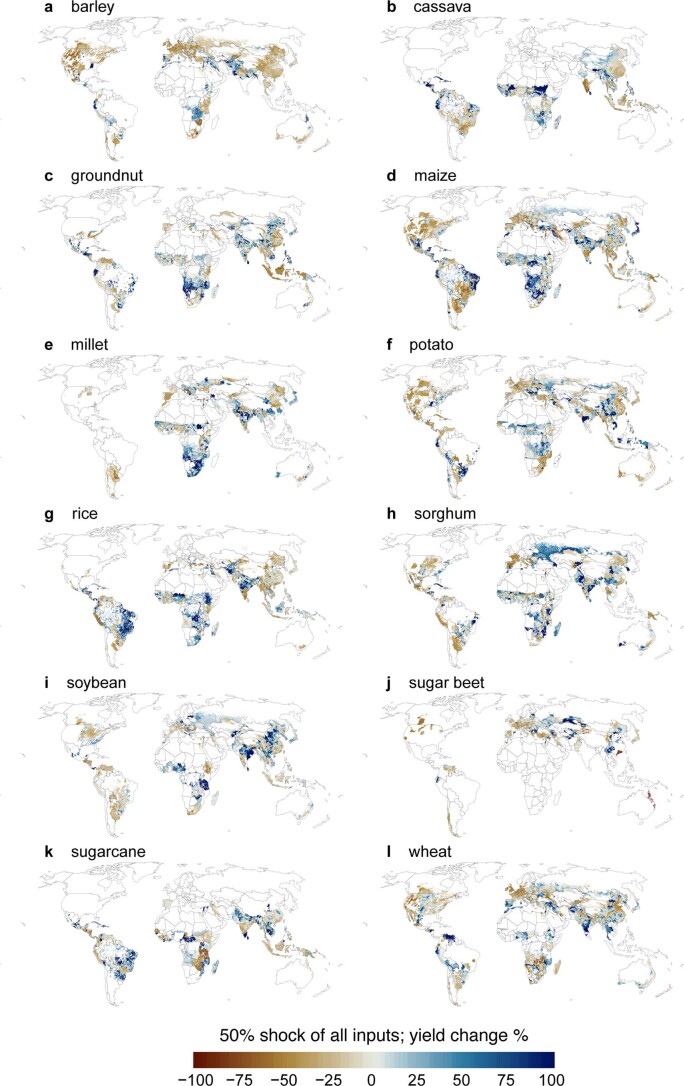
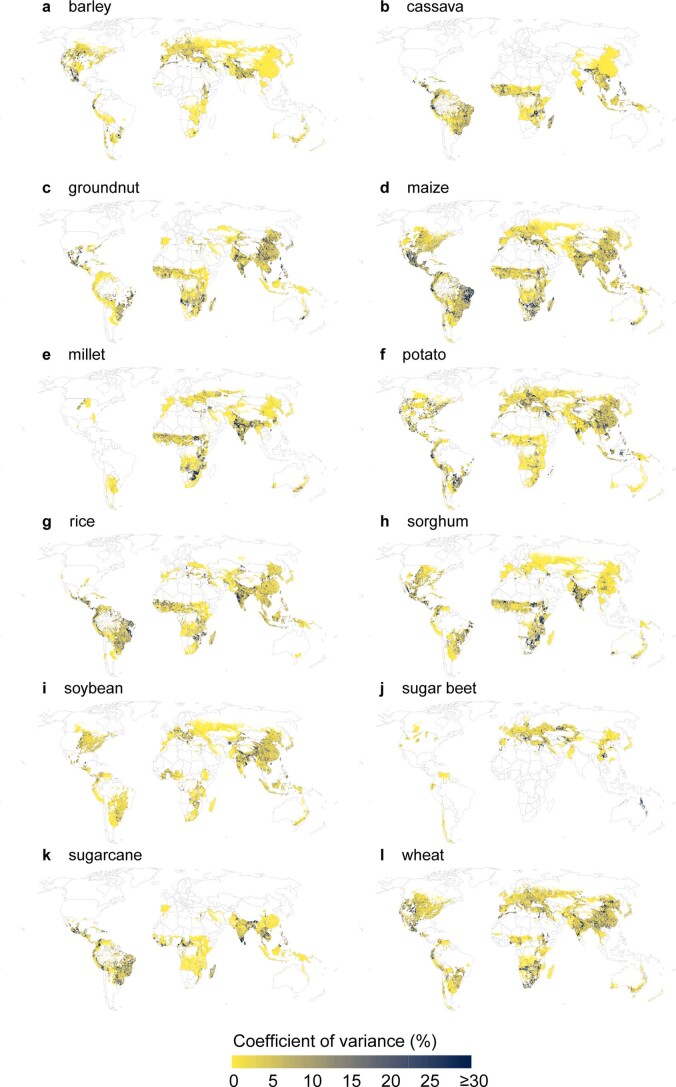
Verification
Claims the paper makes
The claims and statistics of this paper haven’t been checked yet.
Run the check — free, no account needed. It reads the open-access text and checks the sources it cites.
Self-check
Percentages, sums and reported differences re-computed from the paper’s own numbers.
The self-check needs the paper’s full text.
Citations
Cites
Breiman, L. (2001) · Machine Learning · doi:10.1023/a:1010933404324 · Cited by 133,538 · cited 2×
“We used a random forest machine learning model 10 to conduct the assessment.”
BackgroundMethodClassification and Regression by randomForest
Liaw, A. I., & Wiener, M. C. (2007) · Cited by 18,594
WorldClim 2: new 1‐km spatial resolution climate surfaces for global land areas
Fick, S. E., & Hijmans, R. J. (2017) · International Journal of Climatology · doi:10.1002/joc.5086 · Cited by 16,088
Model Evaluation Guidelines for Systematic Quantification of Accuracy in Watershed Simulations
Moriasi, D. N., Arnold, J. G., Liew, M. W. V., Bingner, R. L., Harmel, R. D., & Veith, T. L. (2007) · Transactions of the ASABE · doi:10.13031/2013.23153 · Cited by 13,446 · cited 3×
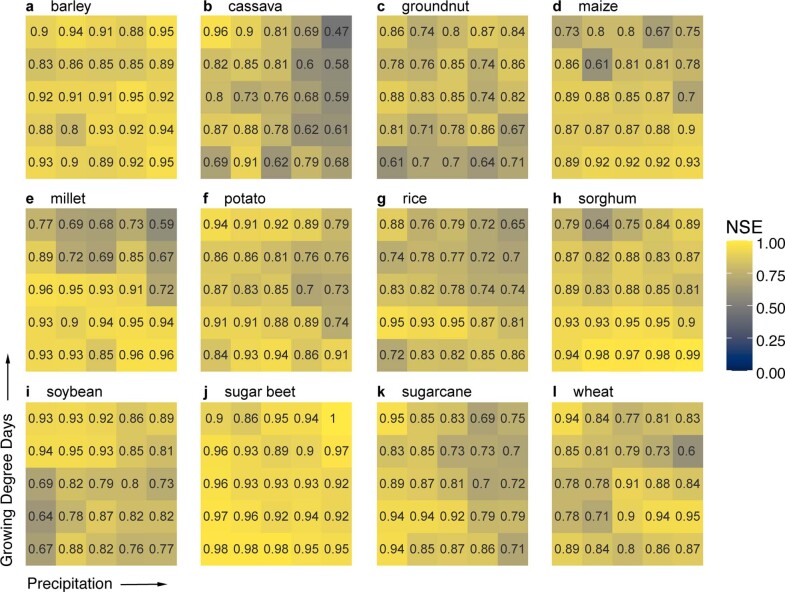
“3), indicating good or very good model performance 21 , respectively.”
BackgroundInfluentialClassification And Regression Trees
Breiman, L., Friedman, J. H., Olshen, R. A., & Stone, C. J. (2017) · doi:10.1201/9781315139470 · Cited by 11,417
How a century of ammonia synthesis changed the world
Erisman, J. W., Sutton, M. A., Galloway, J. N., Klimont, Z., & Winiwarter, W. (2008) · Nature Geoscience · doi:10.1038/ngeo325 · Cited by 4,630
Closing yield gaps through nutrient and water management
Mueller, N. D., Gerber, J., Johnston, M., Ray, D. K., Ramankutty, N., & Foley, J. A. (2012) · Nature · doi:10.1038/nature11420 · Cited by 2,942 · cited 10×
“…aspect that could have affected the model performances is some details of the model input data: for a wheat climate bin with 28,000 observations, there are only 30 unique values for N rate or P rate, and furthermore, many of the fertilizer rates are known only at subnational or county level 12 .”
BackgroundMethodResultInfluentialSoilGrids 2.0: producing soil information for the globe with quantified spatial uncertainty
de Sousa, L. M., Poggio, L., Batjes, N. H., Heuvelink, G. B. M., Kempen, B., Ribeiro, E., & Rossiter, D. G. (2021) · SOIL · doi:10.5194/soil-7-217-2021 · Cited by 2,776 · cited 2×
“For that we used organic carbon density (hg m −3 ) from SoilGrid v2 35 for the topsoil (0–30 cm).”
MethodHyperparameters and tuning strategies for random forest
Probst, P., Wright, M. N., & Boulesteix, A. (2019) · Wiley Interdisciplinary Reviews Data Mining and Knowledge Discovery · doi:10.1002/widm.1301 · Cited by 2,319 · cited 1×
“Random forest can be adjusted with different hyperparameter values 45 .”
BackgroundMonfreda, C., Ramankutty, N., & Foley, J. A. (2008) · Global Biogeochemical Cycles · doi:10.1029/2007gb002947 · Cited by 1,895 · cited 1×
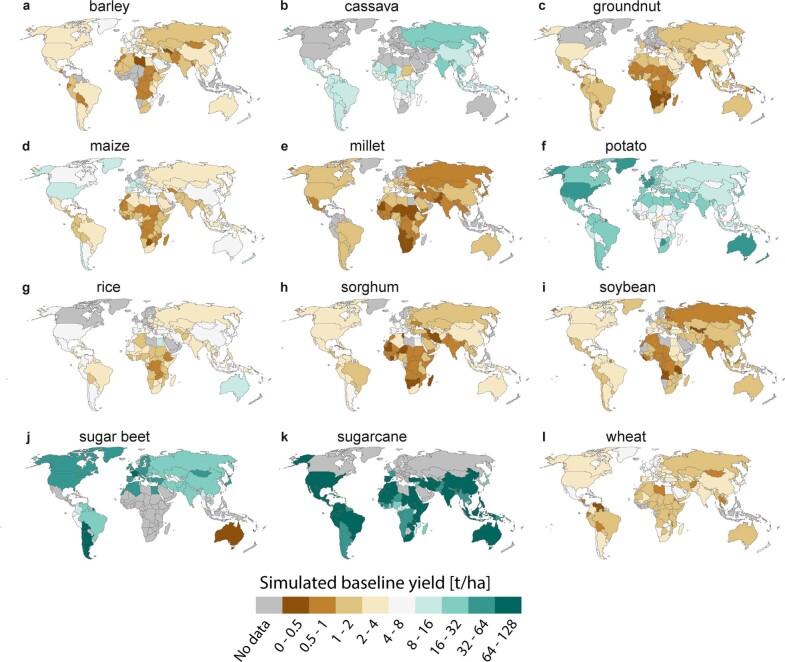
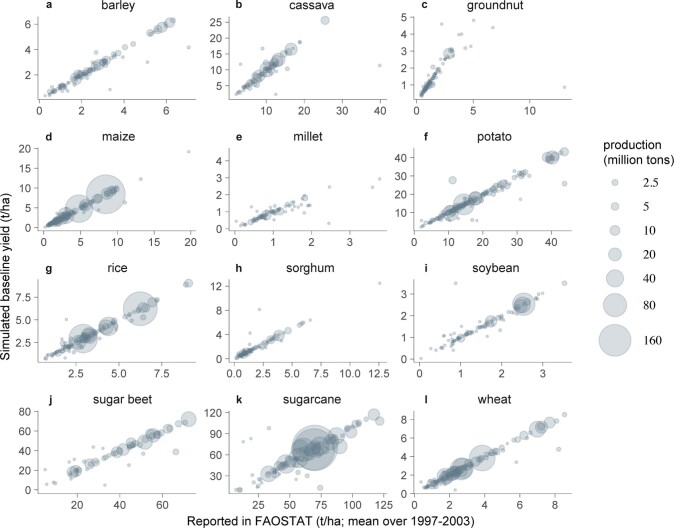
“Yield data (t ha −1 ) were sourced from Monfreda et al. 27 .”
Method
Research works printed but not linked: 2
- Dall’Erba, S., Chen, Z. & Nava, N. J. U.S. Interstate trade will mitigate the negative impact of climate change on crop profit. Am. J. Agric. Econ. 103, 1721–1741 (2021).
- O’Hara, J. K., Mulik, K. & Gurian-Sherman, D. Agricultural production impacts of higher phosphate fertilizer prices. J Int. Agric. Trade Dev. 9, 233–253 (2015).
Cited by
Sorted by citations
Reducing chemical inputs in agriculture requires a system change
Brunelle, T., Chakir, R., Carpentier, A., Dorin, B., Goll, D. S., Guilpart, N., Maggi, F., Makowski, D., Nesme, T., Roosen, J., et al. (2024) · Communications Earth & Environment · doi:10.1038/s43247-024-01533-1 · Cited by 168
Bisinella, V., Schmidt, S., Varling, A. S., Laner, D., & Christensen, T. H. (2023) · Waste Management · doi:10.1016/j.wasman.2023.11.021 · Cited by 90
Ayadi, R., Forouheshfar, Y., & Moghadas, O. (2025) · Frontiers in Climate · doi:10.3389/fclim.2025.1585331 · Cited by 71
Ren, C., He, L., & Rosa, L. (2025) · Nature Food · doi:10.1038/s43016-024-01107-6 · Cited by 35
“N stands as a pivotal element for optimal crop growth, and shocks in fertilizer application can result in severe yield losses 44 .”
Reshaping Agriculture Eco-efficiency in China: From Greenhouse Gas Perspective
Wang, G., Zhao, M., Zhao, B., Liu, X., & Wang, Y. (2025) · Ecological Indicators · doi:10.1016/j.ecolind.2025.113268 · Cited by 35
Metadata
- Authors
- Ahvo, A., Heino, M., Sandström, V., Chrisendo, D., Jalava, M., & Kummu, M.
- Affiliations
- Aalto University (FI)
- Corresponding author
- Kummu, Matti
- Venue
- Nature Food
- Published
- 2023-11-09
- Volume
- 4
- Issue
- 12
- Pages
- 1037-1046
- ISSN
- 2662-1355 (ISSN-L)
- PMC
- PMC10727984
- OpenAlex
- W4388523335
- Cited by
- 78
- References
- 69
- Citations by year
- 2026: 34 · 2025: 33 · 2024: 10 · 2023: 1
- FWCI
- 19.80
- Type
- journal article
- Language
- en
- Open access
- hybrid
- doi.org
- Locations
- Nature Food (publishedVersion, cc-by)
- Research Square (acceptedVersion, cc-by)
- PubMed (publishedVersion)
- PubMed Central (submittedVersion, cc-by)
- Aaltodoc (Aalto University) (submittedVersion, cc-by)
- Apollo (University of Cambridge) (submittedVersion, cc-by)
- Funders
- European Commission (HORIZON2020, 819202)
- Academy of Finland (339834)
- Aalto-Yliopisto
- China Scholarship Council
- Maa- ja Vesitekniikan Tuki Ry
- Topics
- Life Sciences › Agricultural and Biological Sciences › Agronomy and Crop Science › Climate change impacts on agriculture
- Social Sciences › Economics, Econometrics and Finance › Economics and Econometrics › Agricultural risk and resilience
- Social Sciences › Economics, Econometrics and Finance › Economics and Econometrics › Economics of Agriculture and Food Markets
- Keywords
- crop yield, fertilizer availability, pesticide availability, maize production, wheat production, food system resilience, global food security, mineral fertilizers
- MeSH terms
- Crop Production, Agriculture, Fertilizers, Pesticides, Crops, Agricultural
About these checks
Registry, retraction, Cites and statistics results are computed, not judged, with one exception: a printed reference that no index lists is read once by a model before it counts as a citation error. Claims are extracted by a model and kept only when their quote appears verbatim in the text; each cited source is then checked, with a model’s help, for whether it says what the claim relies on. Those verdicts can be wrong — read the claim’s quote and the cited source before relying on one.
Statistics and arithmetic are recomputed, not judged.
Confidence bands are shown only for fields calibrated on our annotated test set. None is calibrated yet, so no band is shown.
What counts as a claim ›How we measure confidence ›How we check this ›
Are you an author, or do you see a problem with this page? Request a review
