

Extended life cycle assessment reveals the spatially-explicit water scarcity footprint of a lithium-ion battery storage
Open accessThe DOI matches its Crossref record; 46 of the 46 references it cites were found in a registry or an index.
Abstract
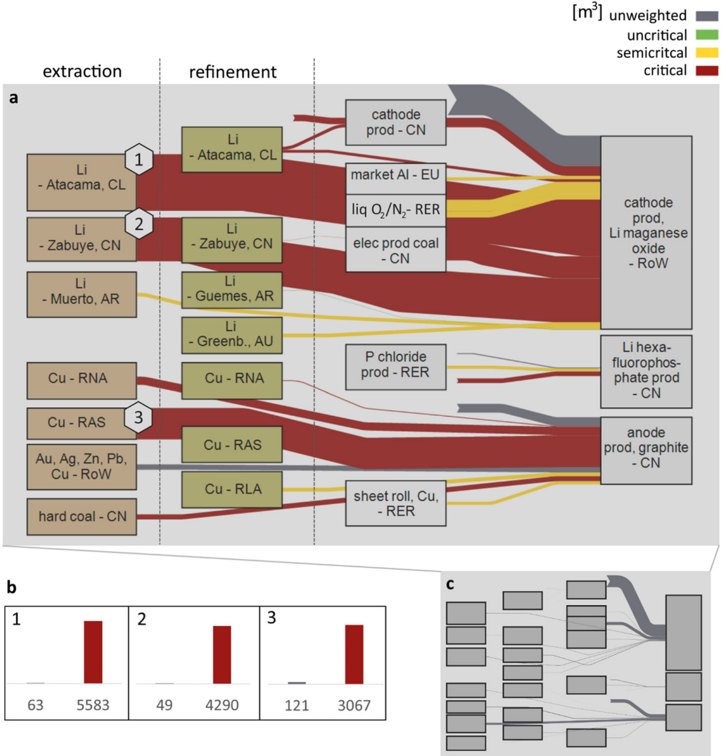
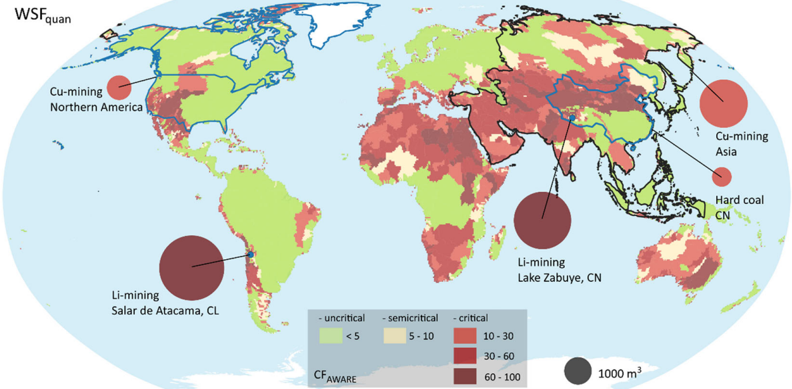
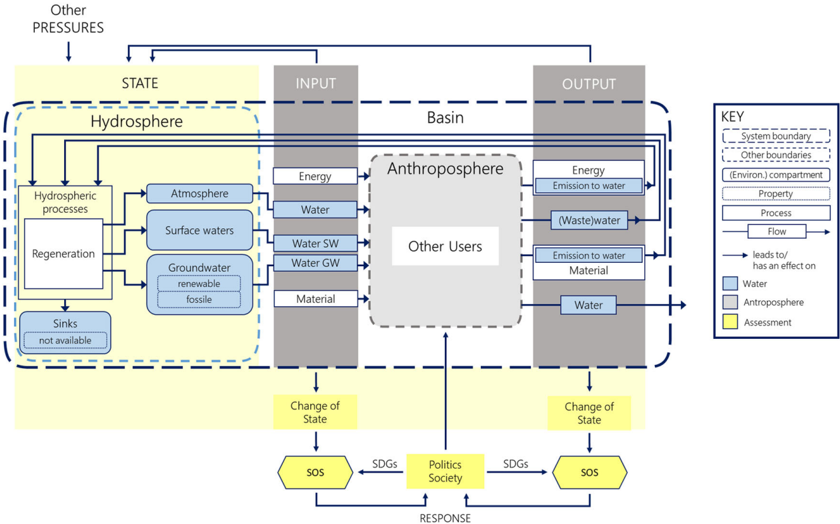
The life cycle water scarcity footprint is a tool to evaluate anthropogenic contributions to regional water scarcity along global supply chains. Here, we complement it by a classification of the risk from human water use, a comprehensive conceptualisation of water use and a spatially-explicit impact assessment to a midpoint approach that assesses the risk of on-site and remote freshwater scarcity. For a 2 MWh Lithium-ion battery storage, the quantitative Water Scarcity Footprint, comprising physically used water, accounts for 33,155 regionally weighted m 3 with highest contributions from Chilean lithium mining. The qualitative Water Scarcity Footprint, the virtual volume required to dilute pollutant emissions to safe concentrations, is approximately determined to 52 million m 3 of regionally weighted demineralised water with highest contributions from copper and aluminium mining operations. As mining operations seem to have the highest impact, we recommend to consider the spatially-explicit water scarcity footprint for assessment of global material supply.
Overview
The claims and statistics of this paper haven’t been checked yet.
Free: it reads the open-access text and checks the first 5 claims that cite a source we can check. Create a free account to check every claim.
Integrity signals
Registry
Cites
Statistics
Figures
Verification
Claims the paper makes
The claims and statistics of this paper haven’t been checked yet.
Free: it reads the open-access text and checks the first 5 claims that cite a source we can check. Create a free account to check every claim.
Claims other papers make about this one
Each is checked against this paper’s own text: does it say what the citing paper says it does?
The source backs part of the claim, not all of it — or backs it for a different population, condition or comparison.
In the citing paper
“Research in life cycle assessment (LCA) of Li chemical production is focused on specific sites characterized by unique geological and technological conditions.21−27”
From Current and Future Impacts of Lithium Carbonate from Brines: A Global Regionalized Life Cycle Assessment Model (2025) · cites this paper as [25]
Experimental — accuracy not yet measuredThe source backs part of the claim, not all of it — or backs it for a different population, condition or comparison.
In the citing paper
“For example, Schomberg et al.25 report additional LCI for Hombre Muerto, Uyuni, and Silver Peak by using linear adaptions of the LCI39 based on the Li concentration of the brine.”
From Current and Future Impacts of Lithium Carbonate from Brines: A Global Regionalized Life Cycle Assessment Model (2025) · cites this paper as Schomberg et al.25
Experimental — accuracy not yet measuredThe source backs part of the claim, not all of it — or backs it for a different population, condition or comparison.
In the citing paper
“Water footprinting based on life cycle assessment (LCA) is an appropriate tool for assessing water-related environmental impacts (e.g., water scarcity impacts) along a product's life cycle [29] and has been widely used in the lithium mining context [26,28,30-37].”
From Toward a Localized Water Footprint of Lithium Brine Extraction: A Case Study from the Salar de Atacama (2025) · cites this paper as [30]
Experimental — accuracy not yet measuredThe cited source says what the claim attributes to it.
In the citing paper
“Consequently, our site-specific LCI converge from them.25”
From Current and Future Impacts of Lithium Carbonate from Brines: A Global Regionalized Life Cycle Assessment Model (2025) · cites this paper as Schomberg et al.25
The cited source says what the claim attributes to it.
In the citing paper
“They found that a 2 MWh LIB resulted in a 33.155 regionally weighted m 3 WSF, with highest contributions from Chilean lithium, but WSF results at a lithium battery chemical scale were not presented and as such are not present in Table 3.”
From Life cycle assessment and water use impacts of lithium production from salar deposits: Challenges and opportunities (2024) · cites this paper as Schomberg et al. (2021)
8 more claims about this paper
Create a free account to see every claim other papers make about this one.
Self-check
Percentages, sums and reported differences re-computed from the paper’s own numbers.
The self-check needs the paper’s full text.
Citations
Cites
The ecoinvent database version 3 (part I): overview and methodology
Wernet, G., Bauer, C., Steubing, B., Reinhard, J., Moreno-Ruiz, E., & Weidema, B. (2016) · The International Journal of Life Cycle Assessment · doi:10.1007/s11367-016-1087-8 · Cited by 5,564
The green, blue and grey water footprint of crops and derived crop products
Mekonnen, M. M., & Hoekstra, A. Y. (2011) · Hydrology and Earth System Sciences · doi:10.5194/hess-15-1577-2011 · Cited by 2,866
Assessing the Environmental Impacts of Freshwater Consumption in LCA
Pfister, S., Koehler, A., & Hellweg, S. (2009) · Environmental Science & Technology · doi:10.1021/es802423e · Cited by 1,321
Meshram, P., Pandey, B. D., & Mankhand, T. R. (2014) · Hydrometallurgy · doi:10.1016/j.hydromet.2014.10.012 · Cited by 982
Future long-term changes in global water resources driven by socio-economic and climatic changes
ALCAMO, J., FLÖRKE, M., & MÄRKER, M. (2007) · Hydrological Sciences Journal · doi:10.1623/hysj.52.2.247 · Cited by 929
Self-citationLithium availability and future production outlooks
Vikström, H., Davidsson, S., & Höök, M. (2013) · Applied Energy · doi:10.1016/j.apenergy.2013.04.005 · Cited by 926
Ay, H. (2003) · Medical Entomology and Zoology · Cited by 856
Boulay, A.-M., Bare, J., Benini, L., Berger, M., Lathuillière, M. J., Manzardo, A., Margni, M., Motoshita, M., Núñez, M., Pastor, A. V., et al. (2018) · The International Journal of Life Cycle Assessment · doi:10.1007/s11367-017-1333-8 · Cited by 849
Chapagain, A. K., Hoekstra, A. Y., Savenije, H. H. G., & Gautam, R. (2006) · Ecological Economics · doi:10.1016/j.ecolecon.2005.11.027 · Cited by 835
Ridoutt, B. G., & Pfister, S. (2010) · Global Environmental Change · doi:10.1016/j.gloenvcha.2009.08.003 · Cited by 632
Flörke, M., Kynast, E., Bärlund, I., Eisner, S., Wimmer, F., & Alcamo, J. (2013) · Global Environmental Change · doi:10.1016/j.gloenvcha.2012.10.018 · Cited by 580
Self-citationAccounting for environmental flow requirements in global water assessments
(2014) · doi:10.5194/hess-18-5041-2014 · Cited by 513
The Water Footprint Assessment Manual
Aldaya, M. M., Chapagain, A. K., Hoekstra, A. Y., & Mekonnen, M. M. (2012) · Routledge eBooks · doi:10.4324/9781849775526 · Cited by 501
THE GREEN, BLUE AND GREY WATER FOOTPRINT OF FARM ANIMALS AND ANIMAL PRODUCTS
Mekonnen, M. M., Hoekstra, A. Y., & Mekonnen, M. M. (2010) · Cited by 436
Gerbens-Leenes, P. W., Hoekstra, A. Y., & van der Meer, T. (2009) · Ecological Economics · doi:10.1016/j.ecolecon.2008.07.013 · Cited by 436
ALCAMO, J., DÖLL, P., HENRICHS, T., KASPAR, F., LEHNER, B., RÖSCH, T., & SIEBERT, S. (2003) · Hydrological Sciences Journal · doi:10.1623/hysj.48.3.339.45278 · Cited by 425
Applying cumulative exergy demand (CExD) indicators to the ecoinvent database
Bösch, M. E., Hellweg, S., Huijbregts, M. A. J., & Frischknecht, R. (2007) · The International Journal of Life Cycle Assessment · doi:10.1065/lca2006.11.282 · Cited by 348
Review of methods addressing freshwater use in life cycle inventory and impact assessment
Kounina, A., Margni, M., Bayart, J.-B., Boulay, A.-M., Berger, M., Bulle, C., Frischknecht, R., Koehler, A., Milà i Canals, L., Motoshita, M., et al. (2013) · The International Journal of Life Cycle Assessment · doi:10.1007/s11367-012-0519-3 · Cited by 334
Milà i Canals, L., Chenoweth, J., Chapagain, A., Orr, S., Antón, A., & Clift, R. (2009) · The International Journal of Life Cycle Assessment · doi:10.1007/s11367-008-0030-z · Cited by 321
Quality matters for water scarcity
van Vliet, M. T. H., Flörke, M., & Wada, Y. (2017) · Nature Geoscience · doi:10.1038/ngeo3047 · Cited by 309
Self-citationThe blue water footprint of electricity from hydropower
Mekonnen, M. M., & Hoekstra, A. Y. (2012) · Hydrology and Earth System Sciences · doi:10.5194/hess-16-179-2012 · Cited by 280
Regional Characterization of Freshwater Use in LCA: Modeling Direct Impacts on Human Health
Boulay, A.-M., Bulle, C., Bayart, J.-B., Deschênes, L., & Margni, M. (2011) · Environmental Science & Technology · doi:10.1021/es1030883 · Cited by 227
Ridoutt, B. G., & Pfister, S. (2013) · The International Journal of Life Cycle Assessment · doi:10.1007/s11367-012-0458-z · Cited by 179
Berger, M., van der Ent, R., Eisner, S., Bach, V., & Finkbeiner, M. (2014) · Environmental Science & Technology · doi:10.1021/es404994t · Cited by 164
Scarcity-weighted fossil fuel footprint of China at the provincial level
Wang, H., Wang, G., Qi, J., Schandl, H., Li, Y., Feng, C., Yang, X., Wang, Y., Wang, X., & Liang, S. (2019) · Applied Energy · doi:10.1016/j.apenergy.2019.114081 · Cited by 148
Hanafiah, M. M., Xenopoulos, M. A., Pfister, S., Leuven, R. S. E. W., & Huijbregts, M. A. J. (2011) · Environmental Science & Technology · doi:10.1021/es1039634 · Cited by 143
Quantifying system uncertainty of life cycle assessment based on Monte Carlo simulation
Hung, M.-L., & Ma, H. (2008) · The International Journal of Life Cycle Assessment · doi:10.1007/s11367-008-0034-8 · Cited by 140
Virtual scarce water embodied in inter-provincial electricity transmission in China
Zhang, C., Zhong, L., Liang, S., Sanders, K. T., Wang, J., & Xu, M. (2016) · Applied Energy · doi:10.1016/j.apenergy.2016.11.052 · Cited by 136
Motoshita, M., Itsubo, N., & Inaba, A. (2010) · The International Journal of Life Cycle Assessment · doi:10.1007/s11367-010-0236-8 · Cited by 119
Categorizing water for LCA inventory
Boulay, A., Bouchard, C. R., Bulle, C., Deschênes, L., & Margni, M. D. (2011) · The International Journal of Life Cycle Assessment · doi:10.1007/s11367-011-0300-z · Cited by 109
Okadera, T., Geng, Y., Fujita, T., Dong, H., Liu, Z., Yoshida, N., & Kanazawa, T. (2015) · Energy Policy · doi:10.1016/j.enpol.2014.12.029 · Cited by 92
From water to energy: The virtual water content and water footprint of biofuel consumption in Spain
Galán, E., & Alonso, E. V. (2009) · Energy Policy · doi:10.1016/j.enpol.2009.11.015 · Cited by 89
Zelm, R. V., Schipper, A. M., Rombouts, M., Snepvangers, J., & Huijbregts, M. A. J. (2011) · Environmental Science & Technology · doi:10.1021/es102383v · Cited by 81
Water footprint for energy production and supply in Thailand
Okadera, T., Chontanawat, J., & Gheewala, S. H. (2014) · Energy · doi:10.1016/j.energy.2014.03.113 · Cited by 80
Comparing Electrical Energy Storage Technologies Regarding Their Material and Carbon Footprint
Mostert, C., Ostrander, B., Bringezu, S., & Kneiske, T. M. (2018) · Energies · doi:10.3390/en11123386 · Cited by 76
Self-citationScarcity-weighted global land and metal footprints
Vivanco, D. F., Sprecher, B., & Hertwich, E. G. (2017) · Ecological Indicators · doi:10.1016/j.ecolind.2017.08.004 · Cited by 51
The Water Impact Index: a simplified single-indicator approach for water footprinting
Bayart, J.-B., Worbe, S., Grimaud, J., & Aoustin, E. (2014) · The International Journal of Life Cycle Assessment · doi:10.1007/s11367-014-0732-3 · Cited by 40
Lee, J. S., Lee, M. H., Chun, Y.-Y., & Lee, K.-M. (2018) · Water · doi:10.3390/w10030341 · Cited by 27
Hydrology and surface morphology of the Bonneville Salt Flats and Pilot Valley playa, Utah
Lines, G. C. (1977) · Antarctica A Keystone in a Changing World · doi:10.3133/ofr7818 · Cited by 26
LCA Characterisation of Freshwater Use on Human Health and Through Compensation
Boulay, A., Bulle, C., Deschênes, L., & Margni, M. D. (2011) · Springer eBooks · doi:10.1007/978-94-007-1899-9_19 · Cited by 25
Jursová, S., Burchart-Korol, D., & Pustějovská, P. (2019) · Environments · doi:10.3390/environments6030038 · Cited by 25
Hydrology and surface morphology of the Bonneville Salt Flats and Pilot Valley Playa, Utah
Lines, G. C. (1979) · doi:10.3133/wsp2057 · Cited by 13
Margarido, F., Vieceli, N., Durão, F. O., Guimarães, C., & Nogueira, C. A. (2014) · Portuguese National Funding Agency for Science, Research and Technology (RCAAP Project by FCT) · Cited by 11
Data to calculate a spatially-explicit water scarcity footprint in LCA
Schomberg, A. C. (2020) · Data Archiving and Networked Services (DANS) · doi:10.17632/34vzndtmfj.1 · Cited by 1
Self-citationData to calculate a spatially-explicit water scarcity footprint in LCA
Schomberg, A. C. (2020) · Data Archiving and Networked Services (DANS) · doi:10.17632/34vzndtmfj · Cited by 1
Self-citation
Research works printed but not linked: 4
- 19. European Commission. EU SDG Indicator Set 2018 Result of the Review in Preparation of the 2018 Edition of the Eu Sdg Monitoring Report. (2018).
- 28. Braga, P., França, S. & Junior, C. How big is the lithium market in Brazil? Impc 2014, 1-10 (2014).
- 30. Margarido, F., Vieceli, N., Durão, F., Guimarães, C. & Nogueira, C. A. Minero- metallurgical processes for lithium recovery from pegmatitic ores. Comun. Geológicas. 101, 795-798 (2014).
- 34. IPCC), I. P. on C. C. Guidelines for National Greenhouse Gas Inventories Chapter 3 of Volume 1. (2006).
Cited by
Lai, X., Chen, Q., Tang, X., Zhou, Y., Gao, F., Guo, Y., Bhagat, R., & Zheng, Y. (2022) · eTransportation · doi:10.1016/j.etran.2022.100169 · Cited by 566
Life‐Cycle Assessment Considerations for Batteries and Battery Materials
Porzio, J., & Scown, C. D. (2021) · Advanced Energy Materials · doi:10.1002/aenm.202100771 · Cited by 305
Kelly, J. C., Wang, M., Dai, Q., & Winjobi, O. (2021) · Resources, Conservation and Recycling · doi:10.1016/j.resconrec.2021.105762 · Cited by 288
Li, H., Li, H., Lai, Y., Yang, Z., Yang, Q., Liu, Y., Zheng, Z., Liu, Y., Sun, Y., Zhong, B., et al. (2022) · Advanced Energy Materials · doi:10.1002/aenm.202102181 · Cited by 235
Gupta, J., Bai, X., Liverman, D. M., Rockström, J., Qin, D., Stewart-Koster, B., Rocha, J. C., Jacobson, L., Abrams, J. F., Andersen, L. S., et al. (2024) · The Lancet Planetary Health · doi:10.1016/s2542-5196(24)00042-1 · Cited by 197
Self-citation
Metadata
- Authors
- Schomberg, A. C., Bringezu, S., & Flörke, M.
- Affiliations
- University of Kassel (DE)
- Ruhr University Bochum (DE)
- Corresponding author
- Schomberg, Anna C.
- Venue
- Communications Earth & Environment
- Published
- 2021-01-12
- Volume
- 2
- Issue
- 1
- ISSN
- 2662-4435 (ISSN-L)
- OpenAlex
- W3126337041
- Cited by
- 95
- References
- 45
- Citations by year
- 2026: 10 · 2025: 25 · 2024: 19 · 2023: 16 · 2022: 18 · 2021: 7
- FWCI
- 4.85
- Type
- journal article
- Language
- en
- Open access
- gold
- doi.org
- Licence
- cc-by
- creativecommons.org/licenses/by/4.0 (tdm)
- creativecommons.org/licenses/by/4.0 (vor)
- Locations
- Communications Earth & Environment (publishedVersion, cc-by)
- Informationszentrum Lebenswissenschaften (ZB MED) (submittedVersion, cc-by)
- Kobra (Universitätsbibliothek Kassel) (cc-by)
- Funders
- Bundesministerium für Bildung und Forschung (02WGR1430A)
- Topics
- Physical Sciences › Environmental Science › Environmental Engineering › Environmental Impact and Sustainability
- Physical Sciences › Environmental Science › Water Science and Technology › Water-Energy-Food Nexus Studies
- Physical Sciences › Environmental Science › Environmental Engineering › Sustainability and Ecological Systems Analysis
- Keywords
- water scarcity footprint, lithium-ion battery storage, water consumption, lithium mining, copper mining, virtual water, material supply chain, freshwater scarcity
About these checks
Registry, retraction, Cites and statistics results are computed, not judged, with one exception: a printed reference that no index lists is read once by a model before it counts as a citation error. Claims are extracted by a model and kept only when their quote appears verbatim in the text; each cited source is then checked, with a model’s help, for whether it says what the claim relies on. Those verdicts can be wrong — read the claim’s quote and the cited source before relying on one.
Statistics and arithmetic are recomputed, not judged.
Confidence bands are shown only for fields calibrated on our annotated test set. None is calibrated yet, so no band is shown.
What counts as a claim ›How we measure confidence ›How we check this ›
Are you an author, or do you see a problem with this page? Request a review
Data sources
Bibliographic data: Semantic Scholar, OpenAlex, Crossref.
Contains information from the Semantic Scholar Academic Graph Datasets, made available under the ODC Attribution License (ODC-BY 1.0).
Semantic Scholar’s data is described in: Kinney, R., et al. (2023). The Semantic Scholar Open Data Platform. arXiv:2301.10140.
