

A two-step workflow based on plasma p-tau217 to screen for amyloid β positivity with further confirmatory testing only in uncertain cases
Open accessThe DOI matches its Crossref record; 68 of the 68 references it cites were found in a registry or an index.
Abstract
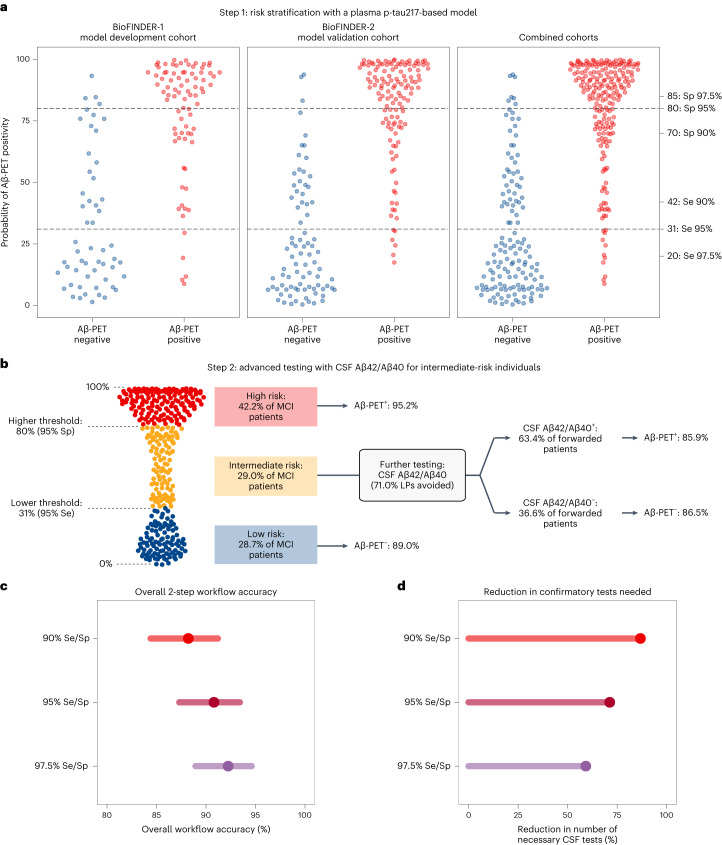
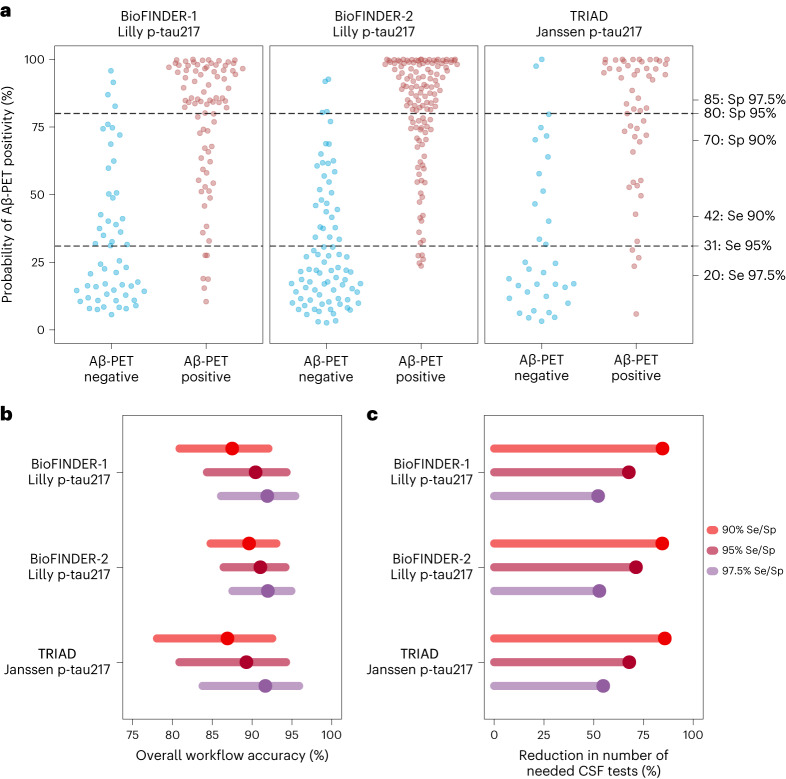
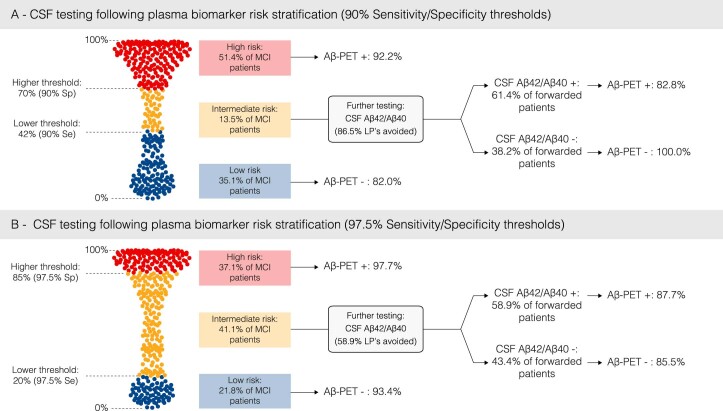
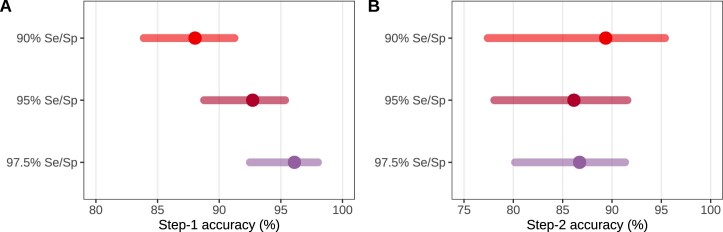
Cost-effective strategies for identifying amyloid-β (Aβ) positivity in patients with cognitive impairment are urgently needed with recent approvals of anti-Aβ immunotherapies for Alzheimer’s disease (AD). Blood biomarkers can accurately detect AD pathology, but it is unclear whether their incorporation into a full diagnostic workflow can reduce the number of confirmatory cerebrospinal fluid (CSF) or positron emission tomography (PET) tests needed while accurately classifying patients. We evaluated a two-step workflow for determining Aβ-PET status in patients with mild cognitive impairment (MCI) from two independent memory clinic-based cohorts (n = 348). A blood-based model including plasma tau protein 217 (p-tau217), age and APOE ε4 status was developed in BioFINDER-1 (area under the curve (AUC) = 89.3%) and validated in BioFINDER-2 (AUC = 94.3%). In step 1, the blood-based model was used to stratify the patients into low, intermediate or high risk of Aβ-PET positivity. In step 2, we assumed referral only of intermediate-risk patients to CSF Aβ42/Aβ40 testing, whereas step 1 alone determined Aβ-status for low- and high-risk groups. Depending on whether lenient, moderate or stringent thresholds were used in step 1, the two-step workflow overall accuracy for detecting Aβ-PET status was 88.2%, 90.5% and 92.0%, respectively, while reducing the number of necessary CSF tests by 85.9%, 72.7% and 61.2%, respectively. In secondary analyses, an adapted version of the BioFINDER-1 model led to successful validation of the two-step workflow with a different plasma p-tau217 immunoassay in patients with cognitive impairment from the TRIAD cohort (n = 84). In conclusion, using a plasma p-tau217-based model for risk stratification of patients with MCI can substantially reduce the need for confirmatory testing while accurately classifying patients, offering a cost-effective strategy to detect AD in memory clinic settings.
Overview
The claims and statistics of this paper haven’t been checked yet.
Free: it reads the open-access text and checks the first 5 claims that cite a source we can check. Create a free account to check every claim.
Integrity signals
Registry
Cites
Statistics
Figures
Verification
Claims the paper makes
The claims and statistics of this paper haven’t been checked yet.
Free: it reads the open-access text and checks the first 5 claims that cite a source we can check. Create a free account to check every claim.
Claims other papers make about this one
Each is checked against this paper’s own text: does it say what the citing paper says it does?
The source backs part of the claim, not all of it — or backs it for a different population, condition or comparison.
In the citing paper
“A 3-range approach demonstrated high negative and positive concordance with Aβ status, with approximately 20% of individuals in an intermediate zone that would require confirmatory CSF or PET, as previously proposed.41”
From Diagnostic Accuracy of a Plasma Phosphorylated Tau 217 Immunoassay for Alzheimer Disease Pathology (2024) · cites this paper as [41]
Experimental — accuracy not yet measuredThe source backs part of the claim, not all of it — or backs it for a different population, condition or comparison.
In the citing paper
“For example, recent evidence suggests that a three-range method leads to higher accuracy to identify amyloid PET positivity in individuals with MCI56.”
From Diagnosis of Alzheimer's disease using plasma biomarkers adjusted to clinical probability (2024) · cites this paper as [56]
Experimental — accuracy not yet measuredThe cited source says what the claim attributes to it.
In the citing paper
“We next applied a 3-range approach,41 creating lower (95% sensitivity, <0.4 pg/mL) and upper (95% specificity, >0.63 pg/mL) reference points in WRAP (Table 2 and eFigure 11 in Supplement 1).”
From Diagnostic Accuracy of a Plasma Phosphorylated Tau 217 Immunoassay for Alzheimer Disease Pathology (2024) · cites this paper as [41]
The cited source says what the claim attributes to it.
In the citing paper
“Notably, the two-cutoffs approach is currently employed for the FDA-approved CSF Lumipulse test42,43 and has been suggested for AD BBMs17,55, especially when very high accuracy is needed.”
From Highly accurate blood test for Alzheimer's disease is similar or superior to clinical cerebrospinal fluid tests (2024) · cites this paper as [55]
Self-check
Percentages, sums and reported differences re-computed from the paper’s own numbers.
The self-check needs the paper’s full text.
Citations
Cites
McKhann, G. M., Knopman, D. S., Chertkow, H., Hyman, B. T., Jack, C. R., Kawas, C. H., Klunk, W. E., Koroshetz, W. J., Manly, J. J., Mayeux, R., et al. (2011) · Alzheimer's & Dementia · doi:10.1016/j.jalz.2011.03.005 · Cited by 18,657
NIA‐AA Research Framework: Toward a biological definition of Alzheimer's disease
Jack, C. R., Bennett, D. A., Blennow, K., Carrillo, M. C., Dunn, B., Haeberlein, S. B., Holtzman, D. M., Jagust, W., Jessen, F., Karlawish, J., et al. (2018) · Alzheimer's & Dementia · doi:10.1016/j.jalz.2018.02.018 · Cited by 10,537
Self-citationHarrell (2015) · Springer Series in Statistics · doi:10.1007/978-3-319-19425-7 · Cited by 6,878
Lecanemab in early Alzheimer's disease
van Dyck, C. H., Swanson, C. J., Aisen, P., Bateman, R. J., Chen, C., Gee, M., Kanekiyo, M., Li, D., Reyderman, L., Cohen, S., et al. (2023) · New England Journal of Medicine · doi:10.1056/nejmoa2212948 · Cited by 5,678 · cited 2×
“The inclusion criteria for recruitment of patients with MCI for BioFINDER-2 were as follows: (1) aged 40–100 years; (2) referred to the memory clinics due to cognitive symptoms; (3) MMSE score of 24–30 points; (4) did not fulfill the criteria for any dementia (major neurocognitive disorder) according to the Diagnostic…”
MethodNichols, E., Steinmetz, J. D., Vollset, S. E., Fukutaki, K., Chalek, J., Abd-Allah, F., Abdoli, A., Abualhasan, A., Abu-Gharbieh, E., Akram, T. T., et al. (2022) · The Lancet Public Health · doi:10.1016/s2468-2667(21)00249-8 · Cited by 5,575
Differential Diagnosis of Glomerular Disease: A Systematic and Inclusive Approach
Hebert, L. A., Parikh, S., Prosek, J., Nadasdy, T., & Rovin, B. H. (2013) · American Journal of Nephrology · doi:10.1159/000354390 · Cited by 4,376
Restriction isotyping of human apolipoprotein E by gene amplification and cleavage with HhaI.
Hixson, J., & Vernier, D. (1990) · Journal of Lipid Research · doi:10.1016/s0022-2275(20)43176-1 · Cited by 2,933
DSM-IV: Diagnostic and Statistical Manual of Mental Disorders
Bell, C. C. (1994) · JAMA: The Journal of the American Medical Association · doi:10.1001/jama.1994.03520100096046 · Cited by 2,610
Levey, A. S., de Jong, P. E., Coresh, J., El Nahas, M., Astor, B. C., Matsushita, K., Gansevoort, R. T., Kasiske, B. L., & Eckardt, K.-U. (2011) · Kidney International · doi:10.1038/ki.2010.483 · Cited by 2,345
Donanemab in Early Alzheimer’s Disease
Mintun, M. A., Lo, A. C., Duggan Evans, C., Wessels, A. M., Ardayfio, P. A., Andersen, S. W., Shcherbinin, S., Sparks, J., Sims, J. R., Brys, M., et al. (2021) · New England Journal of Medicine · doi:10.1056/nejmoa2100708 · Cited by 1,728
Cited by
Items 201–267 of 267
Ellis, R. J., Airaud, A., Jasodanand, V. H., Kowshik, S. S., Bellitti, M., Kolachalama, V. B., Estiri, H., Glymour, M. M., Dufouil, C., Sperling, R. A., et al. (2025) · medRxiv · doi:10.1101/2025.11.19.25340533 · Cited by 1
Beament, M., Wiltshire, K., Belder, C. R. S., Abel, E., Hart, M., Heslegrave, A. J., Lunn, M. P., Rosa-Grilo, M., Swann, O., Schott, J. M., et al. (2026) · Alzheimer's Research & Therapy · doi:10.1186/s13195-026-02180-8
“Reducing the proportion of individuals within the ‘grey zone’ would facilitate the clinical implementation of BBM testing [38, 39].”
Disease Management on Alzheimer’s Disease and Dementias
Lee, V. (2023) · Journal of Neuro and Oncology Research · doi:10.46889/jnor.2023.3301
Masters, C. L., Gomes, L. J., Holford, N., Krishnadas, N., Kurrle, S., Pond, D. C., Roth, C., Rowe, C. C., Sachdev, P. S., Short, C., et al. (2024) · SSRN Electronic Journal · doi:10.2139/ssrn.4846669 · Cited by 1
Which plasma pTau217 assay should I use in clinical practice? Pandora’s box demystified
Toniolo, S. (2025) · Brain · doi:10.1093/brain/awaf007
Marqueurs biologiques des maladies neurodégénératives
Vrillon, A., Aveneau, C., & Paquet, C. (2025) · Encyclopédie médico-chirurgicale. Neurologie · doi:10.1016/s0246-0378(25)48607-2
Imaging Markers of Amyloid and Tau in Alzheimer Disease
Tarawneh, R. M. (2025) · Springer eBooks · doi:10.1007/978-3-031-80849-4_20
Preclinical dementia rating scores are associated with plasma phosphorylated tau‐217
Huang, Q., Jonaitis, E. M., Studer, R. L., Wilson, R. E., Reyes, R. E. R., Zetterberg, H., Du, L., Hermann, B. P., Johnson, S. C., & Langhough, R. E. (2025) · Alzheimer s & Dementia Diagnosis Assessment & Disease Monitoring · doi:10.1002/dad2.70179
“In addition, Ashton et al. 19 introduced a three-range approach 28 based on receiver operating characteristics curve (ROC) analyses relative to amyloid PET positivity that establishes lower ( < 0.4 pg/mL, representing presumed amyloid negative) and upper ( > 0.63 pg/mL, indicating presumed amyloid…”
InfluentialNeurodegeneration and Precision Medicine: Innovative Approaches in Alzheimer’s Disease Therapy
Ornelas, R., Rojas, A. M. T., Medina, P., Araujo, J. E. G., Valdez, G., Palacio, J. M. V., Aparicio, J. G. P., & López, L. F. J. (2025) · IECCMEXICO · doi:10.64784/009
Howe, M. D., Britton, K. J., Joyce, H. E., Menard, W. E., Emrani, S., Kunicki, Z. J., Faust, M. A., Dawson, B. C., Riddle, M. C., Huey, E. D., et al. (2024) · Figshare · doi:10.6084/m9.figshare.26744891
Self-citationHowe, M. D., Britton, K. J., Joyce, H. E., Menard, W. E., Emrani, S., Kunicki, Z. J., Faust, M. A., Dawson, B. C., Riddle, M. C., Huey, E. D., et al. (2024) · Figshare · doi:10.6084/m9.figshare.26744888
Self-citationHowe, M. D., Britton, K. J., Joyce, H. E., Menard, W. E., Emrani, S., Kunicki, Z. J., Faust, M. A., Dawson, B. C., Riddle, M. C., Huey, E. D., et al. (2024) · Figshare · doi:10.6084/m9.figshare.26744885
Self-citationArranz, J., Zhu, N., Rubio‐Guerra, S., Rodríguez‐Baz, Í., Ferrer, R., Carmona‐Iragui, M., Barroeta, I., Illán‐Gala, I., Santos‐Santos, M., Fortea, J., et al. (2024) · Figshare · doi:10.6084/m9.figshare.26739393
Howe, M. D., Britton, K. J., Joyce, H. E., Menard, W. E., Emrani, S., Kunicki, Z. J., Faust, M. A., Dawson, B. C., Riddle, M. C., Huey, E. D., et al. (2024) · Figshare · doi:10.6084/m9.figshare.26744894
Self-citationHowe, M. D., Britton, K. J., Joyce, H. E., Menard, W. E., Emrani, S., Kunicki, Z. J., Faust, M. A., Dawson, B. C., Riddle, M. C., Huey, E. D., et al. (2024) · Figshare · doi:10.6084/m9.figshare.26744876
Self-citationHowe, M. D., Britton, K. J., Joyce, H. E., Menard, W. E., Emrani, S., Kunicki, Z. J., Faust, M. A., Dawson, B. C., Riddle, M. C., Huey, E. D., et al. (2024) · Figshare · doi:10.6084/m9.figshare.26197490
Self-citationHowe, M. D., Britton, K. J., Joyce, H. E., Menard, W. E., Emrani, S., Kunicki, Z. J., Faust, M. A., Dawson, B. C., Riddle, M. C., Huey, E. D., et al. (2024) · Figshare · doi:10.6084/m9.figshare.26744897
Self-citationHowe, M. D., Britton, K. J., Joyce, H. E., Menard, W. E., Emrani, S., Kunicki, Z. J., Faust, M. A., Dawson, B. C., Riddle, M. C., Huey, E. D., et al. (2024) · Figshare · doi:10.6084/m9.figshare.26197457
Self-citationHowe, M. D., Britton, K. J., Joyce, H. E., Menard, W. E., Emrani, S., Kunicki, Z. J., Faust, M. A., Dawson, B. C., Riddle, M. C., Huey, E. D., et al. (2024) · Figshare · doi:10.6084/m9.figshare.26744900
Self-citationHowe, M. D., Britton, K. J., Joyce, H. E., Menard, W. E., Emrani, S., Kunicki, Z. J., Faust, M. A., Dawson, B. C., Riddle, M. C., Huey, E. D., et al. (2024) · Figshare · doi:10.6084/m9.figshare.26744879
Self-citationMarcatori biologici delle malattie neurodegenerative
Vrillon, A., Aveneau, C., & Paquet, C. (2025) · EMC - Neurologia · doi:10.1016/s1634-7072(25)51074-7
BPA Improved the Cognitive Dysfunction of Patients with CTEPHPreprint
Gong, S.-G., Sun, Y.-Y., He, J., Wu, W.-H., Zhao, Q., Liu, P., Li, J.-L., Li, H., Luo, C., Qiu, H., et al. (2025) · medRxiv · doi:10.2139/ssrn.5702452
Huang, Y.-Y., Li, L.-L., Yao, R., Dong, J. Z., Gan, Y., Chen, Y., Chen, K., Chen, S.-F., Yuan, M.-Y., Xin, J.-W., et al. (2026) · The Innovation · doi:10.1016/j.xinn.2026.101272
Blood-based emerging biomarkers in early detection and diagnosis of Alzheimer’s disease
Anand, T., & Kumar, A. (2026) · International review of neurobiology · doi:10.1016/bs.irn.2026.01.002
Mathematical models of cognition: from active inference to clinical applications
Maramotti, R. (2026) · Institutional Research Information System University of Ferrara (University of Ferrara)
Plasma biomarkers of neurodegeneration across the spectrum of brain health
Cooper, J. G. (2026) · cIRcle (University of British Columbia)
Eratne, D., Kang, M. J., Malpas, C. B., Dang, C., Santillo, A. F., Zetterberg, H., Velakoulis, D., & The MiND Study Group (2026) · Alzheimer s & Dementia · doi:10.1002/alz.71375
Gallingani, C., Maramotti, R., Carbone, C., Vinceti, G., Cossutti, S., Iacovino, N., Ballotta, D., Salemme, S., Urbano, T., Bedin, R., et al. (2026) · GeroScience · doi:10.1007/s11357-026-02296-7
Naini, S. M., Mantyh, W. G., Waldron, E. J., Satin, D. J., Basso, M. R., Garland, M. M., McManimen, S. L., & Whiteside, D. M. (2026) · Journal of Clinical and Experimental Neuropsychology · doi:10.1080/13803395.2026.2681010
“…such as neuroimaging (e.g., brain MRI), neuropsychological evaluations, and other neurodiagnostic measures (e.g., PET or CSF testing), especially when BBMs fall in the indeterminate range, which should automatically prompt a multi-step verification (Ashton et al., 2024; Brum et al., 2023).”
Clinical Impact and Prognostic Value of Alzheimer Disease Biomarkers in the Very Old
Ceriello, C., Torres, O. H., Rubio‐Guerra, S., Castro, J. G., Selma‐González, J., Sala, I., Sánchez‐Saudinós, M. B., Videla, L., Vera-Campuzano, E., Arranz, J., et al. (2026) · Neurology · doi:10.1212/wnl.0000000000218180
O'Hara‐Veintimilla, K., Melbye, E. L., Borda, M. G., Mallinson, P. A. C., Sunde, A. L., Leuzy, A., van der Giezen, M., Masci, P. G., Seyoum, Y., Moyano, B. P., et al. (2026) · medRxiv · doi:10.64898/2026.06.16.26355748
Duan, Y., Fu, Y., Wu, Z., Zheng, W., Lv, G., Chen, L., Wu, J., Han, Z., Dai, Q., 顾全胜, et al. (2026) · Brain Health · doi:10.1002/brh2.70008
Age predicts Alzheimer's in Down syndrome better than MRI, plasma, or cognition
Kennedy, J. T., Wisch, J. K., Handen, B. L., Hartley, S. L., Brickman, A. M., Lee, J. H., Krinsky‐McHale, S. J., Lai, F., Rosas, H. D., Head, E., et al. (2026) · Alzheimer s & Dementia · doi:10.1002/alz.71661
Neuroimaging Epicenters as Vulnerable Nodes in Plasma p-tau217/Aβ42-Positive Alzheimer’s Disease
Li, Q., Liu, Y., Chen, Q., Li, X., Zhu, Y., Deng, Q., Zhang, X., Chen, F., Zhang, Y., Ge, D., et al. (2026) · Research · doi:10.34133/research.1392
“In this 2-step triage workflow, high-throughput plasma prescreening identifies at-risk individuals [ 47 , 48 ], followed by NVI calculation from routine T1-weighted magnetic resonance imaging (MRI) to refine individualized prognosis and trial enrichment without the logistical burden of widespread…”
Le diagnostic sanguin de la maladie d’Alzheimer : utopie ou dystopie ?
Planche, V. (2026) · Bulletin de l Académie Nationale de Médecine · doi:10.1016/j.banm.2026.05.033
Plasma Alzheimer Biomarkers and Diagnostic Decision-Making in Memory Clinics
Vigneswaran, S., Verberk, I. M. W., Boonkamp, L., Veld, L. I. ‘., Simmelink, M. J. A., Antwi‐Berko, D., van Unen, L., Rousset, R. Z., Claessen, T., Zwan, M. D., et al. (2026) · JAMA Network Open · doi:10.1001/jamanetworkopen.2026.28864
Jiang, M., Lan, G., Zhu, J., Zhang, L., Li, A., He, Z., Zhu, Y., Zhou, X., Liang, L., Gao, N., et al. (2026) · Annals of Neurology · doi:10.1002/ana.78322
Xie, B., Zhang, W., Zhang, Y., Liu, L., You, J., & Li, Q. (2026) · Frontiers in Aging Neuroscience · doi:10.3389/fnagi.2026.1852137
Yuan, C., Zhang, H., Chen, X., Zhu, L., Wang, Z., Wang, Y., & Ge, S. (2026) · Neurological Sciences · doi:10.1007/s10072-026-09322-8
Fotouhi, M., Chui, H. C., Choupan, J., Jahanshad, N., Cen, S., Varghese, B. A., Ringman, J. M., Schneider, L. S. S., & Sheikh‐Bahaei, N. (2026) · Brain Communications · doi:10.1093/braincomms/fcag312
“31-33 There is a clear and growing need to recognize the sources of variability and heterogeneity inherent in data collected from large cohorts in the field of Alzheimer’s disease.”
Chen, X., Jiang, W., Wang, L., Han, B., Yu, D., Li, G., Sun, J., Liu, X., Xie, Y., & Zhangx, G. (2026) · Clinica Chimica Acta · doi:10.1016/j.cca.2026.121300
Denkinger, M. N., Brum, W. S., Leuzy, A., Singh, A., Marques, T. M., Ghisays, V., Protas, H. D., Su, Y., Atri, A., Beach, T. G., et al. (2026) · Alzheimer s & Dementia · doi:10.1002/alz.71773 · Cited by 3
Self-citationDoes CSF testing add value after an indeterminate plasma p-tau217 result?Preprint
Bernardi, E., Arranz, J., Rubio‐Guerra, S., Castro, J. G., Maure‐Blesa, L., Rodríguez‐Baz, Í., Peris‐Subiza, J., Selma‐González, J., Vera-Campuzano, E., Vaqué‐Alcázar, L., et al. (2026) · Research Square · doi:10.21203/rs.3.rs-10754560/v1
Fayisa, D. K., Faizan, M., Wu, W.-C., Chen, J.-K., & Liu, C. (2026) · Microchemical Journal · doi:10.1016/j.microc.2026.120229
FDG-PET in Cognitive Impairment and Dementia
Hong, J., & Silverman, D. H. S. (2026) · PET Clinics · doi:10.1016/j.cpet.2026.07.001
Bao, R., Zhang, S., Wang, F., Cheng, W., Zhang, T., & Ding, W. (2026) · Research Square · doi:10.21203/rs.3.rs-10895317/v1
“Magnetic resonance imaging (MRI)-derived and cognitive measures can inform brain vulnerability and prognosis [11, 12], whereas pTau217 workflows have mainly added blood biomarkers, demographics, or apolipoprotein E (APOE) genotype [9, 13].”
Sánchez‐Soblechero, A., Villarejo‐Galende, A., Carreras, M. T., García, Á. B., Puertas, C., Bullido, Y. F., Vieira, A., Gundín, I., Blanco-Palmero, V. A., González‐Sánchez, M., et al. (2026) · Journal of Alzheimer s Disease · doi:10.1177/13872877261487171
Real‐world utility of plasma GFAP and NfL in early‐onset AD and FTD
Chatterjee, P., Ivanic, S., Southon, A. G., McCarthy, C., Patel, S. K., Christensen, M., Darby, D., Bush, A. I., Ayton, S., Mielke, M. M., et al. (2026) · Alzheimer s & Dementia Diagnosis Assessment & Disease Monitoring · doi:10.1002/dad2.70490
Stricker, N. H., Boots, E. A., Taylor, R. L., Fan, W. Z., Frank, R. D., Christianson, T. J. H., Stricker, J. L., Kremers, W. K., Machulda, M. M., Aduen, P. A., et al. (2026) · medRxiv · doi:10.64898/2026.09.20.26362296
Torrigiani, E. G., Cianca, D., Gaetani, L., Nardi, G., Paoletti, F. P., Chiasserini, D., Parnetti, L., Gammaitoni, L., Neri, I., & Bellomo, G. (2026) · Frontiers in Aging Neuroscience · doi:10.3389/fnagi.2026.1922577
“…procedures and developing interpretative frameworks, such as three-tiered cutoff systems based on gold-standard biomarkers of AD (CSF and nuclear medicine biomarkers) with two reference thresholds that, respectively, maximize sensitivity and specificity (Schindler et al., 2024; Brum et al., 2023).”
Ho, B., & Yang, Y.-H. (2026) · Neurodegenerative Disease Management · doi:10.1080/17582024.2026.2734618
Pascual‐Lucas, M., Sarasa, L., Fandos, N., Loscos, J., Romero, J., Sánchez, A., Terencio, J., Ortega‐Madueño, I., Cárdenas, M. C., Valenciano, F. C., et al. (2026) · Frontiers in Aging Neuroscience · doi:10.3389/fnagi.2026.1918304
“Patients falling within this indeterminate range cannot be confidently classified as positive or negative, and therefore, require confirmatory CSF analysis or amyloid PET imaging (Brum et al., 2023).”
Morbelli, S. D., Brendel, M., Tolboom, N., Drzezga, A. E., Janelidze, S., Joie, R. L., Roccatagliata, L., Agosta, F., Arbizu, J., Boccalini, C., et al. (2026) · The EANM Journal · doi:10.1016/j.eanmj.2026.100250
Self-citationShateri, A., & Rezaei, S. (2026) · Romanian Journal of Neurology · doi:10.37897/rjn.2026.3.7
“…and imaging data to improve diagnostic and prognostic accuracy beyond what any single analyte can achieve, including multicohort diagnostic models trained on blood-based digital biomarker panels [37] and two-step screening work-flows designed to triage individuals for confirmato - ry testing [38].”
Trudel, L., Therriault, J., Ghisays, V., Macedo, A. C., Gauthier, S. G., Vitali, P., Benedet, A. L., Zetterberg, H., Su, Y., Singh, A., et al. (2026) · Brain Communications · doi:10.1093/braincomms/fcag376
Self-citationDing, L., Zheng, M., Wang, S., Liu, W., Liang, Y., Xie, S., Yang, T., Sheng, D., Wang, S., Sheng, J., et al. (2026) · Alzheimer s & Dementia · doi:10.1002/alz.71915
Benussi, A., Agosta, F., Agnello, L., Alfano, A. R., Altini, M., Antico, A., Basilico, S., Bellelli, G., Bonanni, L., Bottini, G., et al. (2026) · The Journal of Prevention of Alzheimer s Disease · doi:10.1016/j.tjpad.2026.100685
“…intermediate and a high probability of AD pathology, with the intermediate group referred for further confirmation by CSF analysis or amyloid PET [64,67]; when these cut-offs are calibrated for a positive predictive value above 95%, the great majority of patients fall into the low-or…”
Vidyanti, A. N., Prawiroharjo, P., Syafrita, Y., Prodjohardjono, A., Rahmadini, A., Hidayatun, P. I. R., Rahman, R., Divina, E., Permata, R. I., Tazkia, A. A., et al. (2026) · Journal of Alzheimer s Disease · doi:10.1177/13872877261497299
Huang, Y., Huang, L., Cui, L., Pan, F., Xie, F., Guo, H., Guo, Q., & Initiative, F. T. A. D. N. (2026) · Alzheimer s & Dementia · doi:10.1002/alz.71922
“This interpretation is consistent with two-step workflows that retain confirmatory testing for uncertain or higher risk cases, 38 and with recommendations that p-tau217 cutpoints be tailored to the assay platform and intended use.”
APOE ε4 accelerates plasma p-tau217 trajectory: a Bayesian joint longitudinal analysis of ADNI
Chu, K.-Y. (2026) · Neurological Sciences · doi:10.1007/s10072-026-09435-0
Gong, X., Liu, X., & Liu, S. (2026) · ACS Sensors · doi:10.1021/acssensors.6c02653
Choi, W., & Ko, P. (2026) · Brain Sciences · doi:10.3390/brainsci16111161
李双双, Huang, L., & Guo, Q. (2026) · Aging Medicine · doi:10.1002/agm2.70112
“Unlike the traditional pathway in which cognitive assessment precedes laboratory testing, Brum et al. [55] proposed a stepwise strategy in which plasma p-tau217 measurement is performed as the initial step.”
Sun, B., Gu, M., Maher, A., DuBois, K. N., Kanaan, N. M., Bross, J. R., Koeppe, R., Persad, C. C., Murphey, Y. L., Kavcic, V., et al. (2026) · Alzheimer s & Dementia · doi:10.1002/alz.71931
Syrjanen, J. A., Figdore, D. J., Griswold, M. E., Wiste, H. J., Dierkhising, R., Kremers, W. K., Lachner, C., Graff‐Radford, N. R., Day, G. S., Graff‐Radford, J., et al. (2026) · Alzheimer s & Dementia · doi:10.1002/alz.71946
Sanchez, E., Connon, P., Pasternak, M. M., Abrahão, A., Keith, J. L., Dilliott, A. A., Baril, A., Frank, A., Lang, A. E., Pollock, B. G., et al. (2026) · medRxiv · doi:10.64898/2026.11.06.26367445
Metadata
- Authors
- Brum, W. S., Cullen, N. C., Janelidze, S., Ashton, N. J., Zimmer, E. R., Therriault, J., Benedet, A. L., Rahmouni, N., Tissot, C., Stevenson, J., Servaes, S., Triana-Baltzer, G., Kolb, H. C., Palmqvist, S., Stomrud, E., Rosa-Neto, P., Blennow, K., & Hansson, O.
- Affiliations
- Universidade Federal do Rio Grande do Sul (BR)
- Lund University (SE)
- King's College London (GB)
- McGill University Research Centre for Studies in Aging (CA)
- Janssen Research & Development (United States) (US)
- Sahlgrenska University Hospital (SE)
- Corresponding author
- Brum, Wagner S.
- Hansson, Oskar
- ORCID
- Venue
- Nature Aging
- Published
- 2023-08-31
- Volume
- 3
- Issue
- 9
- Pages
- 1079-1090
- ISSN
- 2662-8465 (ISSN-L)
- PMC
- PMC10501903
- OpenAlex
- W4386324919
- Semantic Scholar
- ca67c8b05364e8cc826dce1b5ad48616a84b36c5
- Cited by
- 248
- References
- 65
- Citations by year
- 2026: 68 · 2025: 98 · 2024: 74 · 2023: 8
- FWCI
- 50.50
- Type
- journal article
- Language
- en
- Open access
- hybrid
- doi.org
- Licence
- cc-by
- creativecommons.org/licenses/by/4.0 (tdm)
- creativecommons.org/licenses/by/4.0 (vor)
- Locations
- Nature Aging (publishedVersion, cc-by)
- PubMed Central (publishedVersion, cc-by)
- PubMed (publishedVersion)
- LA Referencia (Red Federada de Repositorios Institucionales de Publicaciones Científicas) (submittedVersion, cc-by-nc-sa)
- Lund University Publications (Lund University) (submittedVersion)
- Funders
- Alzheimer's Association (ZEN-21-848495, MOP-11-51-31, 159815, 2021 Zenith Award, NIRP-12-259245, RFN 152985, #NIRG‐12‐92090, 34874, 33397, 162303)
- Cure Alzheimer's Fund
- Fondation Brain Canada (ZEN-21-848495, 2020-VICO-279314, 34874, 33397)
- Stiftelsen för Gamla Tjänarinnor
- Weston Brain Institute (MOP-11-51-31, NIRP‐12‐259245)
- Australian Government (2022-Projekt0080)
- Consortium canadien en neurodégénérescence associée au vieillissement (MOP-11-51-31)
- Coordenação de Aperfeiçoamento de Pessoal de Nível Superior (MOP-11-51-31, 88887.596742/2020-00, 88887, NIRP-12-259245, RFN 152985, 159815, 2020-00, 162303, NIRG-12-92090)
- Lunds Universitet (AF-980907)
- Hjärnfonden (ALZ2022-0006), FO2021-0293, FO2017‑0243, FO2017, ZEN-21-848495, ALFGBG-715986, #ALFGBG-965240, 1412/22)
- Knut och Alice Wallenbergs Stiftelse (2017‐0383, 2022-Projekt0080, 2022-00775, AF-980907, 2022-1259, FO2021-0293, 2020-O000028, 1412/22)
- Vetenskapsrådet (ALFGBG-965240, ALZ2022-0006, ERAPERMED2021-184, 2017-00915, (#ALFGBG-715986, 2022-00775, ZEN-21-848495, 2022-Projekt0080, FO2021-0293, AF-980907, 1412/22, 2020-O000028, 2017-00383, FO2017-0243, 2022-1259)
- Konung Gustaf V:s och Drottning Victorias Frimurarestiftelse (2020-O000028, FO2017-0243)
- Skånes universitetssjukhus (2022-1259, 2020-O000028, 2022-Projekt0080)
- Parkinsonfonden (1412/22)
- Canadian Institutes of Health Research (#MOP-11-51-31, 33397, NIRP-12-259245, NIRG-12-92090, 152985, 159815, RFN 152,985, 162303, 92090)
- Topics
- Health Sciences › Medicine › Psychiatry and Mental health › Dementia and Cognitive Impairment Research
- Life Sciences › Neuroscience › Cellular and Molecular Neuroscience › Alzheimer's disease research and treatments
- Health Sciences › Medicine › Oncology › Cancer-related cognitive impairment studies
- Keywords
- plasma p-tau217, Alzheimer's disease, mild cognitive impairment, blood biomarkers, risk stratification, APOE ε4, cost-effective diagnosis, memory clinics
- MeSH terms
- Alzheimer Disease, Blood Proteins, Humans, Tomography, X-Ray Computed, Amyloid beta-Peptides, Workflow
About these checks
Registry, retraction, Cites and statistics results are computed, not judged, with one exception: a printed reference that no index lists is read once by a model before it counts as a citation error. Claims are extracted by a model and kept only when their quote appears verbatim in the text; each cited source is then checked, with a model’s help, for whether it says what the claim relies on. Those verdicts can be wrong — read the claim’s quote and the cited source before relying on one.
Statistics and arithmetic are recomputed, not judged.
Confidence bands are shown only for fields calibrated on our annotated test set. None is calibrated yet, so no band is shown.
What counts as a claim ›How we measure confidence ›How we check this ›
Are you an author, or do you see a problem with this page? Request a review
Data sources
Bibliographic data: Semantic Scholar, OpenAlex, Crossref.
Contains information from the Semantic Scholar Academic Graph Datasets, made available under the ODC Attribution License (ODC-BY 1.0).
Semantic Scholar’s data is described in: Kinney, R., et al. (2023). The Semantic Scholar Open Data Platform. arXiv:2301.10140.
