

Polyethylene degradation and assimilation by the marine yeast Rhodotorula mucilaginosa
Open accessThe DOI matches its Crossref record; 89 of the 90 references it cites were found in a registry or an index; 8 of the 14 sources its claims cite were checked for support.
Abstract
Ocean plastic pollution is a severe environmental problem but most of the plastic that has been released to the ocean since the 1950s is unaccounted for. Although fungal degradation of marine plastics has been suggested as a potential sink mechanism, unambiguous proof of plastic degradation by marine fungi, or other microbes, is scarce. Here we applied stable isotope tracing assays with 13C-labeled polyethylene to measure biodegradation rates and to trace the incorporation of plastic-derived carbon into individual cells of the yeast Rhodotorula mucilaginosa, which we isolated from the marine environment. 13C accumulation in the CO2 pool during 5-day incubation experiments with R. mucilaginosa and UV-irradiated 13C-labeled polyethylene as a sole energy and carbon source translated to degradation rates of 3.8% yr−1 of the initially added substrate. Furthermore, nanoSIMS measurements revealed substantial incorporation of polyethylene-derived carbon into fungal biomass. Our results demonstrate the potential of R. mucilaginosa to mineralize and assimilate carbon from plastics and suggest that fungal plastic degradation may be an important sink for polyethylene litter in the marine environment.
Overview
CoChat Summary
TL;DR
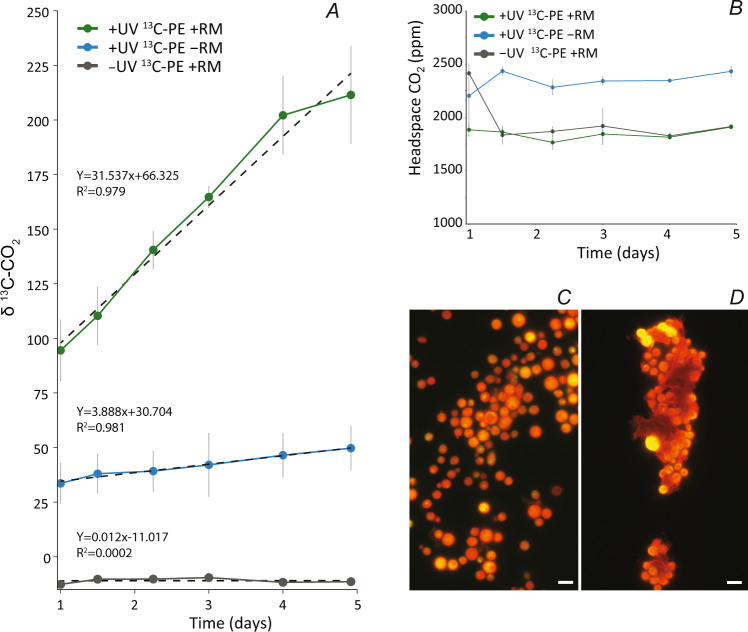
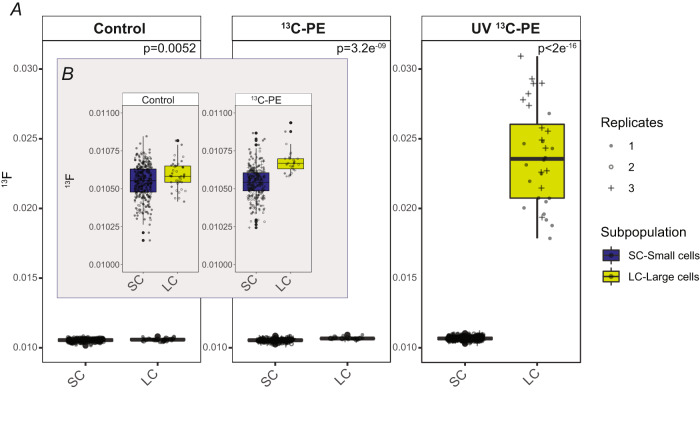
Using 13C-labeled polyethylene and nanoSIMS, this study shows the marine yeast *Rhodotorula mucilaginosa* can mineralize UV-treated polyethylene and incorporate plastic-derived carbon into its biomass. Net degradation was 0.01% d–1 (3.8% yr–1) of the initially added polyethylene, with the strongest 13C enrichment in larger cells exposed to UV-treated polyethylene.
Key findings
- Incubations with UV-treated 13C-polyethylene and *R. mucilaginosa* increased δ13C-CO2 by 117‰ over 5 days, with a linear increase of 31.5‰ d–1, Δ13F of 0.000345 d–1, average ∑CO2 of 57.7 µmol, and Δ13Cex of 0.0199 µmol d–1. Net *R. mucilaginosa*-mediated polyethylene degradation was 0.01% d–1, or 3.8% yr–1; with cell counts of 3.32 × 10⁵ ± 1.27 × 10⁴ ml–1, this equaled 6.05 × 10⁻⁵ nmol polyethylene cell–1 d–1 or 0.022 nmol polyethylene cell–1 yr–1.
- Uninoculated UV-treated controls increased δ13C by 3.9‰ d–1, Δ13F 0.000043 d–1, ∑CO2 151.7 µmol, and Δ13Cex 0.0064 µmol d–1, attributed to ongoing radical chain reactions. With untreated polyethylene and *R. mucilaginosa*, δ13C increased only 0.01‰ d–1, Δ13F was 0.0000001 d–1, ∑CO2 was 48.2 µmol, and Δ13Cex was 0.000006 µmol d–1.
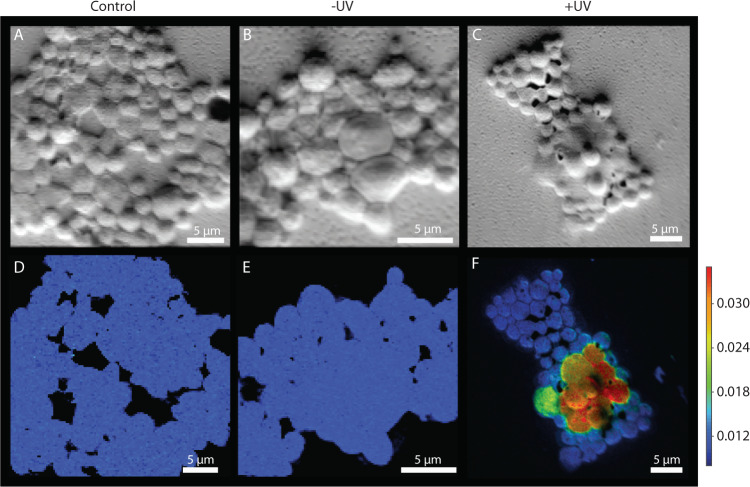
- nanoSIMS measured 1144 regions of interest/cells. Controls had mean 13F-values of 0.0105 and 0.0106; untreated 13C-polyethylene gave small cells 0.0105 and large cells 0.0107 (p < 0.001); UV-treated 13C-polyethylene gave small cells 0.0107 and large cells 0.024 (p < 0.001 versus all other groups).
- In incubations with sucrose-based medium plus UV-treated 13C-polyethylene, cells were slightly 13C-enriched at 13F-values of ~0.012, lower and more homogenous than with polyethylene as sole carbon source; no incorporation was recorded when 13C-polyethylene was not UV-treated in that setup.
Methods
- *R. mucilaginosa* was isolated from a 350 L laboratory seawater microcosm containing plastic items mostly retrieved from the North Sea. Two assays used sealed bottles with ~1–2 mg 13C-labeled polyethylene (≥99% 13C), either UV-treated or untreated, as sole energy and organic carbon source after starvation, or with sucrose-based medium (10% of total liquid volume, 90% seawater). Both assays included three treatments in triplicates: 13C-polyethylene + *R. mucilaginosa*, UV-treated 13C-polyethylene + *R. mucilaginosa*, and uninoculated control with UV-treated 13C-polyethylene; incubations were <1 week.
- Degradation was quantified from headspace CO2 by gas chromatography with quadrupole mass spectrometry and flame ionization detection, and isotopic composition by GC-IRMS; pH and dissolved inorganic carbon were used to calculate total CO2 per bottle, excess 13C, and mineralization rates. Assimilation was measured by nanoSIMS on individual cells and processed with Look@NanoSIMS, using inoculum cells as controls; statistical comparisons used Dunn’s Kruskal–Wallis test with Bonferroni correction.
Limitations
- Stated: the authors did not measure photooxidation products other than CO2, so they cannot determine which compounds *R. mucilaginosa* utilized. They also state that degradation of virgin (-UV) polymer needs further confirmation regarding molecular weight distribution and short-chain impurities.
- Stated: the detection limit is determined by background CO2 and added 13C-substrate; for a setup resembling theirs (0.1 mmol ∑CO2, 1 mg of 99 atom % 13C-labeled polyethylene), degradation of ~0.002% of added polyethylene is detectable.
- Evident from the text: the experiments are short (<1 week) laboratory incubations with a single isolated yeast and artificial seawater/microcosm conditions, with UV doses corresponding to ~50 and ~125 days of sea-surface UV irradiation in subtropical and temperate regions; no natural marine community or long-term field validation is presented.
Model-written summary. Check it against the paper before relying on it.
Integrity signals
Registry
Cites
Statistics
Figures
Verification
Claims the paper makes
4 Valid · 0 Not valid · 1 Not checked · 27 Own results and interpretations
A result the paper reports from its own data — it cites no other source for it, so there is none to check. The quote shows it is in the paper.
In the paper
“In contrast, during the same time interval, the δ13C-CO2 values increased by 16‰ in the experiments where the UV-treated 13C-polyethylene was incubated without R. mucilaginosa.”
§ Polyethylene degradation and assimilation by the marine yeast Rhodotorula mucilaginosa > Results > Polyethylene degradation rates
plainstates a cause- Asserted: passes — The authors put it forward as true.
- Checkable: passes — It can be checked against evidence.
- Load-bearing: passes — The paper’s conclusions depend on it.
- Based: passes — The paper gives a reason why it holds.
A result the paper reports from its own data — it cites no other source for it, so there is none to check. The quote shows it is in the paper.
In the paper
“The δ13C-CO2 values did not increase in incubations with untreated 13C-polyethylene and R. mucilaginosa.”
§ Polyethylene degradation and assimilation by the marine yeast Rhodotorula mucilaginosa > Results > Polyethylene degradation rates
plain- Asserted: passes — The authors put it forward as true.
- Checkable: passes — It can be checked against evidence.
- Load-bearing: passes — The paper’s conclusions depend on it.
- Based: passes — The paper gives a reason why it holds.
A result the paper reports from its own data — it cites no other source for it, so there is none to check. The quote shows it is in the paper.
In the paper
“13C accumulation in the CO2 pool during 5-day incubation experiments with R. mucilaginosa and UV-irradiated 13C-labeled polyethylene as a sole energy and carbon source translated to degradation rates of 3.8% yr–1 of the initially added substrate.”
- Also stated in: § Polyethylene degradation rates · plain
“Hence, the net R. mucilaginosa mediated polyethylene degradation amounts to 0.01% d–1, or 3.8% yr–1.”
- Also stated in: § Degradation of 13C-polyethylene · plain
“Mineralization rates of UV-treated polyethylene with R. mucilaginosa amounted to 0.01% d–1; extrapolated, this translates to degradation rates of 3.8% yr–1 of the initially added polyethylene.”
§ Polyethylene degradation and assimilation by the marine yeast Rhodotorula mucilaginosa > Abstract
plainstates a cause- Asserted: passes — The authors put it forward as true.
- Checkable: passes — It can be checked against evidence.
- Load-bearing: passes — The paper’s conclusions depend on it.
- Based: passes — The paper gives a reason why it holds.
- Rests on an assumption not shown here.
- Also stated in: § Polyethylene degradation rates · plain
A result the paper reports from its own data — it cites no other source for it, so there is none to check. The quote shows it is in the paper.
In the paper
“No incorporation of the 13C to R. mucilaginosa cells was recorded in incubations where the 13C-polyethylene was not UV-treated.”
§ Polyethylene degradation and assimilation by the marine yeast Rhodotorula mucilaginosa > Results > nanoSIMS
plain- Asserted: passes — The authors put it forward as true.
- Checkable: passes — It can be checked against evidence.
- Load-bearing: passes — The paper’s conclusions depend on it.
- Based: passes — The paper gives a reason why it holds.
A result the paper reports from its own data — it cites no other source for it, so there is none to check. The quote shows it is in the paper.
In the paper
“Based on linear regression analysis, the increase in δ13C in incubations with UV-treated 13C-polyethylene and with R. mucilaginosa was 31.5‰ d–1 (Fig. 1A).”
§ Polyethylene degradation and assimilation by the marine yeast Rhodotorula mucilaginosa > Results > Polyethylene degradation rates
plainstates a cause- Asserted: passes — The authors put it forward as true.
- Checkable: passes — It can be checked against evidence.
- Load-bearing: passes — The paper’s conclusions depend on it.
- Based: passes — The paper gives a reason why it holds.
11 more claims
Create a free account to see all 32 claims and to verify the 1 reference still open.
- Probably not a substantial claim. 8
- It may state two separate claims as one. 6
- The quote only partly states this claim. 2
Claims other papers make about this one
Each is checked against this paper’s own text: does it say what the citing paper says it does?
The source backs part of the claim, not all of it — or backs it for a different population, condition or comparison.
In the citing paper
“Also, a PE mineralization rate of 0.01%/day was observed by the marine yeast Rhodotorula mucilaginosa (Vaksmaa et al., 2023)”
From Mineralization of 13C-labeled polyethylene by marine Bacillus velezensis MT9 (2026) · cites this paper as Vaksmaa et al., 2023
Experimental — accuracy not yet measuredThe source backs part of the claim, not all of it — or backs it for a different population, condition or comparison.
In the citing paper
“Subsequently, smaller degradation products, such as long and short-chain alkanes, compounds containing carbonyl groups, oligomers, micro and nano plastics, may undergo biomineralization by microbes (Vaksmaa et al., 2023).”
From Mineralization of 13C-labeled polyethylene by marine Bacillus velezensis MT9 (2026) · cites this paper as Vaksmaa et al., 2023
Experimental — accuracy not yet measuredThe source backs part of the claim, not all of it — or backs it for a different population, condition or comparison.
In the citing paper
“Hence the detection limits are comparable and our method demonstrates a sensitivity within the same magnitude as the other authors who utilized IRMS (Vaksmaa et al., 2023).”
From Mineralization of 13C-labeled polyethylene by marine Bacillus velezensis MT9 (2026) · cites this paper as Vaksmaa et al., 2023
Experimental — accuracy not yet measuredThe cited source says what the claim attributes to it.
In the citing paper
“In this study, the PE used is labelled with 13 C stable isotope and as direct consequence, the ability of the isolate to use the plastic substrate as energy source is reflected by an increment of the 13 CO2 as terminal oxidation product in the carbonate pool (Goudriaan et al., 2023; Maier et al., 2026; Vaksmaa et al., 2023).”
From Mineralization of 13C-labeled polyethylene by marine Bacillus velezensis MT9 (2026) · cites this paper as Vaksmaa et al., 2023
The cited source says what the claim attributes to it.
In the citing paper
“Only recent studies assessed unambig uously the PE mineralization by Rhodococcus ruber strain C208 (Goudriaan et al., 2023), a marine yeast Rhodototula mucilaginosa (Vaksmaa et al., 2023) and a marine mould Parengyodontium album (Vaksmaa et al., 2024) using stable isotope tracing assay with 13 C-labelled polyethylene.”
From Mineralization of 13C-labeled polyethylene by marine Bacillus velezensis MT9 (2026) · cites this paper as Vaksmaa et al., 2023
Citations
Cites
Production, use, and fate of all plastics ever made
Geyer, R., Jambeck, J. R., & Law, K. L. (2017) · Science Advances · doi:10.1126/sciadv.1700782 · Cited by 18,606 · cited 1×
“Ocean plastic pollution is an environmental problem of exponentially increasing magnitude [1 – 6].”
Plastic waste inputs from land into the ocean
Jambeck, J. R., Geyer, R., Wilcox, C., Siegler, T. R., Perryman, M., Andrady, A., Narayan, R., & Law, K. L. (2015) · Science · doi:10.1126/science.1260352 · Cited by 13,163 · cited 1×
“Thus, an unknown sink mechanism apparently removes detectable plastic debris from the ocean surface [2, 21].”
Microplastics in the marine environment
Andrady, A. L. (2011) · Marine Pollution Bulletin · doi:10.1016/j.marpolbul.2011.05.030 · Cited by 8,105 · cited 1×
“Also, labeled 13 C-polyethylene has been used to trace plastic-derived carbon in food webs of a boreal-lake and arti fi cial humic waters [73].”
Eriksen, M., Lebreton, L. C. M., Carson, H. S., Thiel, M., Moore, C. J., Borerro, J. C., Galgani, F., Ryan, P. G., & Reisser, J. (2014) · PLoS ONE · doi:10.1371/journal.pone.0111913 · Cited by 4,710
River plastic emissions to the world’s oceans
Lebreton, L. C. M., van der Zwet, J., Damsteeg, J.-W., Slat, B., Andrady, A., & Reisser, J. (2017) · Nature Communications · doi:10.1038/ncomms15611 · Cited by 4,011
Degradation rates of plastics in the environment
Chamas, A., Moon, H., Zheng, J., Qiu, Y., Tabassum, T., Jang, J. H., Abu-Omar, M., Scott, S. L., & Suh, S. (2020) · ACS Sustainable Chemistry & Engineering · doi:10.1021/acssuschemeng.9b06635 · Cited by 3,463 · cited 1×
“The chemical con fi g-uration of the used polymers, for example, the degree of crosslinking, crystallinity, and the addition of additives, as well as the size of the plastic particles and environmental/incubation conditions, likely affect microbial degradation [54].”
Life in the “plastisphere”: microbial communities on plastic marine debris
Zettler, E. R., Mincer, T. J., & Amaral-Zettler, L. A. (2013) · Environmental Science & Technology · doi:10.1021/es401288x · Cited by 3,368
A bacterium that degrades and assimilates poly(ethylene terephthalate)
Yoshida, S., Hiraga, K., Takehana, T., Taniguchi, I., Yamaji, H., Maeda, Y., Toyohara, K., Miyamoto, K., Kimura, Y., & Oda, K. (2016) · Science · doi:10.1126/science.aad6359 · Cited by 3,367 · cited 1×
“For example, the terrestrial bacterium Ideonella sakaiensis hydrolyzes polyethylene terephthalate [26 – 28], while Rhodococcus ruber strain C208 has been found to degrade polyethylene (PE) and polystyrene (PS) [29 – 31].”
Plastic debris in the open ocean
Cózar, A., Echevarría, F., González-Gordillo, J. I., Irigoien, X., Úbeda, B., Hernández-León, S., Palma, Á. T., Navarro, S., García-de-Lomas, J., Ruiz, A., et al. (2014) · Proceedings of the National Academy of Sciences · doi:10.1073/pnas.1314705111 · Cited by 3,133 · cited 1×
“Current estimates of the total amount of plastic at the ocean surface only account for less than 1% of the estimated amount of all plastics that have ever been released into the sea [20, 21].”
Kurtzman, C. P., & Lodder, J. (1972) · Mycologia · doi:10.2307/3758036 · Cited by 3,081
The global threat from plastic pollution
MacLeod, M., Arp, H. P. H., Tekman, M. B., & Jahnke, A. (2021) · Science · doi:10.1126/science.abg5433 · Cited by 2,951 · cited 1×
“Ocean plastic pollution is an environmental problem of exponentially increasing magnitude [1 – 6].”
Evidence that the Great Pacific Garbage Patch is rapidly accumulating plastic
Lebreton, L., Slat, B., Ferrari, F., Sainte-Rose, B., Aitken, J., Marthouse, R., Hajbane, S., Cunsolo, S., Schwarz, A., Levivier, A., et al. (2018) · Scientific Reports · doi:10.1038/s41598-018-22939-w · Cited by 1,839
A global inventory of small floating plastic debris
van Sebille, E., Wilcox, C., Lebreton, L., Maximenko, N., Hardesty, B. D., van Franeker, J. A., Eriksen, M., Siegel, D., Galgani, F., & Law, K. L. (2015) · Environmental Research Letters · doi:10.1088/1748-9326/10/12/124006 · Cited by 1,713
Untapped potential: exploiting fungi in bioremediation of hazardous chemicals
Harms, H., Schlosser, D., & Wick, L. Y. (2011) · Nature Reviews Microbiology · doi:10.1038/nrmicro2519 · Cited by 1,111
Plastics in the Marine Environment
Law, K. L. (2017) · Annual Review of Marine Science · doi:10.1146/annurev-marine-010816-060409 · Cited by 1,059
Program developed for CO{sub 2} system calculations
Lewis, E., Wallace, D., & Allison, L. J. (1998) · doi:10.2172/639712 · Cited by 884
Seafloor microplastic hotspots controlled by deep-sea circulation
Kane, I. A., Clare, M. A., Miramontes, E., Wogelius, R., Rothwell, J. J., Garreau, P., & Pohl, F. (2020) · Science · doi:10.1126/science.aba5899 · Cited by 810
Dissolved organic carbon leaching from plastics stimulates microbial activity in the ocean
Romera-Castillo, C., Pinto, M., Langer, T. M., Álvarez-Salgado, X. A., & Herndl, G. J. (2018) · Nature Communications · doi:10.1038/s41467-018-03798-5 · Cited by 753 · cited 2×
“This might be an abiotic process, such as fragmentation to micro and nanoscale particles [21] or photode-gradation, which destabilizes the polymer structure [22] and causes leaching of dissolved organic carbon [3, 23 – 25].”
Biodegradation of polyethylene microplastics by the marine fungus Zalerion maritimum
Paço, A., Duarte, K., da Costa, J. P., Santos, P. S. M., Pereira, R., Pereira, M. E., Freitas, A. C., Duarte, A. C., & Rocha-Santos, T. A. P. (2017) · Science of The Total Environment · doi:10.1016/j.scitotenv.2017.02.017 · Cited by 724
Cai, L., Wang, J., Peng, J., Wu, Z., & Tan, X. (2018) · Science of The Total Environment · doi:10.1016/j.scitotenv.2018.02.079 · Cited by 575 · cited 1×
“Nevertheless, this will need further con fi rmation in future studies addressing molecular weight distribution of the polymer and the degree to which it contains short-chain impurities.”
Oberbeckmann, S., Osborn, A. M., & Duhaime, M. B. (2016) · PLOS ONE · doi:10.1371/journal.pone.0159289 · Cited by 572
Zhang, J., Gao, D., Li, Q., Zhao, Y., Li, L., Lin, H., Bi, Q., & Zhao, Y. (2020) · Science of The Total Environment · doi:10.1016/j.scitotenv.2019.135931 · Cited by 570
Choy, C. A., Robison, B. H., Gagne, T. O., Erwin, B., Firl, E., Halden, R. U., Hamilton, J. A., Katija, K., Lisin, S. E., Rolsky, C., et al. (2019) · Scientific Reports · doi:10.1038/s41598-019-44117-2 · Cited by 560
Biodegradation of synthetic polymers in soils: Tracking carbon into CO 2 and microbial biomass
Zumstein, M. T., Schintlmeister, A., Nelson, T. F., Baumgartner, R., Woebken, D., Wagner, M., Kohler, H.-P. E., McNeill, K., & Sander, M. (2018) · Science Advances · doi:10.1126/sciadv.aas9024 · Cited by 547
Colonization, biofilm formation and biodegradation of polyethylene by a strain of Rhodococcus ruber
(Orr), I. G., Hadar, Y., & Sivan, A. (2004) · Applied Microbiology and Biotechnology · doi:10.1007/s00253-004-1584-8 · Cited by 539
High concentrations of plastic hidden beneath the surface of the Atlantic Ocean
Pabortsava, K., & Lampitt, R. S. (2020) · Nature Communications · doi:10.1038/s41467-020-17932-9 · Cited by 499
Structure of the plastic-degrading Ideonella sakaiensis MHETase bound to a substrate
Palm, G. J., Reisky, L., Böttcher, D., Müller, H., Michels, E. A. P., Walczak, M. C., Berndt, L., Weiss, M. S., Bornscheuer, U. T., & Weber, G. (2019) · Nature Communications · doi:10.1038/s41467-019-09326-3 · Cited by 491
Marine Fungi: Their Ecology and Molecular Diversity
Richards, T. A., Jones, M. D. M., Leonard, G., & Bass, D. (2012) · Annual Review of Marine Science · doi:10.1146/annurev-marine-120710-100802 · Cited by 478 · cited 1×
“At least parts of the vast amounts of plastic litter in the ocean may thus serve as a carbon source for fungi and possibly other microbes, too.”
The rise in ocean plastics evidenced from a 60-year time series
Ostle, C., Thompson, R. C., Broughton, D., Gregory, L., Wootton, M., & Johns, D. G. (2019) · Nature Communications · doi:10.1038/s41467-019-09506-1 · Cited by 469
Degradation of polyethylene by a fungus, Penicillium simplicissimum YK
Yamada-Onodera, K., Mukumoto, H., Katsuyaya, Y., Saiganji, A., & Tani, Y. (2001) · Polymer Degradation and Stability · doi:10.1016/s0141-3910(01)00027-1 · Cited by 442 · cited 1×
“The ability of R. mucilaginosa to utilize plastic-derived carbon in the presence of other, high-energy-yielding carbon substrates also indicates that fungal plastic degradation can indeed proceed in the natural environment.”
Marine microbe-mediated biodegradation of low- and high-density polyethylenes
Sudhakar, M., Doble, M., Murthy, P. S., & Venkatesan, R. (2008) · International Biodeterioration & Biodegradation · doi:10.1016/j.ibiod.2007.07.011 · Cited by 441
Delacuvellerie, A., Cyriaque, V., Gobert, S., Benali, S., & Wattiez, R. (2019) · Journal of Hazardous Materials · doi:10.1016/j.jhazmat.2019.120899 · Cited by 422
Biofilm development of the polyethylene-degrading bacterium rhodococcus ruber
Sivan, A., Szanto, M., & Pavlov, V. (2006) · Applied Microbiology and Biotechnology · doi:10.1007/s00253-005-0259-4 · Cited by 415
Zhu, L., Zhao, S., Bittar, T. B., Stubbins, A., & Li, D. (2020) · Journal of Hazardous Materials · doi:10.1016/j.jhazmat.2019.121065 · Cited by 394 · cited 2×
“This might be an abiotic process, such as fragmentation to micro and nanoscale particles [21] or photode-gradation, which destabilizes the polymer structure [22] and causes leaching of dissolved organic carbon [3, 23 – 25].”
Identification of chain scission products released to water by plastic exposed to ultraviolet light
Gewert, B., Plassmann, M., Sandblom, O., & MacLeod, M. (2018) · Environmental Science & Technology Letters · doi:10.1021/acs.estlett.8b00119 · Cited by 389
The missing ocean plastic sink: Gone with the rivers
Weiss, L., Ludwig, W., Heussner, S., Canals, M., Ghiglione, J.-F., Estournel, C., Constant, M., & Kerhervé, P. (2021) · Science · doi:10.1126/science.abe0290 · Cited by 372
Evaluation of HDPE and LDPE degradation by fungus, implemented by statistical optimization
Ojha, N., Pradhan, N., Singh, S., Barla, A., Shrivastava, A., Khatua, P., Rai, V., & Bose, S. (2017) · Scientific Reports · doi:10.1038/srep39515 · Cited by 361 · cited 1×
“The ability of R. mucilaginosa to utilize plastic-derived carbon in the presence of other, high-energy-yielding carbon substrates also indicates that fungal plastic degradation can indeed proceed in the natural environment.”
Temporal dynamics of bacterial and fungal colonization on plastic debris in the North Sea
De Tender, C., Devriese, L. I., Haegeman, A., Maes, S., Vangeyte, J., Cattrijsse, A., Dawyndt, P., & Ruttink, T. (2017) · Environmental Science & Technology · doi:10.1021/acs.est.7b00697 · Cited by 355
Biofilm formation and partial biodegradation of polystyrene by the actinomycete Rhodococcus ruber
Mor, R., & Sivan, A. (2008) · Biodegradation · doi:10.1007/s10532-008-9188-0 · Cited by 347
The fate of plastic in the ocean environment – a minireview
Wayman, C., & Niemann, H. (2021) · Environmental Science: Processes & Impacts · doi:10.1039/d0em00446d · Cited by 325 · cited 3×
“This might be an abiotic process, such as fragmentation to micro and nanoscale particles [21] or photode-gradation, which destabilizes the polymer structure [22] and causes leaching of dissolved organic carbon [3, 23 – 25].”
Self-citationBiodegradation of plastic polymers by fungi: a brief review
Srikanth, M., Sandeep, T. S. R. S., Sucharitha, K., & Godi, S. (2022) · Bioresources and Bioprocessing · doi:10.1186/s40643-022-00532-4 · Cited by 319 · cited 1×
“Fungi harbor powerful enzymatic machineries comprising, for example, manganese peroxidases, lignin peroxidases, and laccases [36 – 38], which have also been linked to plastic degradation [39, 40].”
Microplastics alter composition of fungal communities in aquatic ecosystems
Kettner, M. T., Rojas‐Jimenez, K., Oberbeckmann, S., Labrenz, M., & Grossart, H. (2017) · Environmental Microbiology · doi:10.1111/1462-2920.13891 · Cited by 282
Sørensen, L., Groven, A. S., Hovsbakken, I. A., Del Puerto, O., Krause, D. F., Sarno, A., & Booth, A. M. (2021) · Science of The Total Environment · doi:10.1016/j.scitotenv.2020.143170 · Cited by 278
Sunlight converts polystyrene to carbon dioxide and dissolved organic carbon
Ward, C. P., Armstrong, C. J., Walsh, A. N., Jackson, J. H., & Reddy, C. M. (2019) · Environmental Science & Technology Letters · doi:10.1021/acs.estlett.9b00532 · Cited by 253 · cited 3×
“This might be an abiotic process, such as fragmentation to micro and nanoscale particles [21] or photode-gradation, which destabilizes the polymer structure [22] and causes leaching of dissolved organic carbon [3, 23 – 25].”
Global simulations of marine plastic transport show plastic trapping in coastal zones
Onink, V., Jongedijk, C. E., Hoffman, M. J., van Sebille, E., & Laufkötter, C. (2021) · Environmental Research Letters · doi:10.1088/1748-9326/abecbd · Cited by 240 · cited 1×
“However, uncertainty exists on the importance of individual pathways through which plastic is transported from land to the ocean [7 – 11], how much plastic remains in coastal areas [12], the open ocean surface [13, 14], the mid-water column [15 – 17], or sinks to the ocean fl oor [18, 19].”
A marine fungus Alternaria alternata FB1 efficiently degrades polyethylene
Gao, R., Liu, R., & Sun, C. (2022) · Journal of Hazardous Materials · doi:10.1016/j.jhazmat.2022.128617 · Cited by 235
Degradation of abiotically aged LDPE films containing pro-oxidant by bacterial consortium
Roy, P. K., Titus, S., Surekha, P., Tulsi, E., Deshmukh, C., & Rajagopal, C. (2008) · Polymer Degradation and Stability · doi:10.1016/j.polymdegradstab.2008.07.016 · Cited by 223
Polyethylene degradation by lignin-degrading fungi and manganese peroxidase
Iiyoshi, Y., Tsutsumi, Y., & Nishida, T. (1998) · Journal of Wood Science · doi:10.1007/bf00521967 · Cited by 222
Look@NanoSIMS – a tool for the analysis of nanoSIMS data in environmental microbiology
Polerecky, L., Adam, B., Milucka, J., Musat, N., Vagner, T., & Kuypers, M. M. M. (2012) · Environmental Microbiology · doi:10.1111/j.1462-2920.2011.02681.x · Cited by 221 · cited 1×
“NanoSIMS data were processed and analyzed using Look@NanoSIMS [62].”
Self-citationFragmentation of plastic objects in a laboratory seawater microcosm
Gerritse, J., Leslie, H. A., de Tender, C. A., Devriese, L. I., & Vethaak, A. D. (2020) · Scientific Reports · doi:10.1038/s41598-020-67927-1 · Cited by 220 · cited 1×
“In brief, Rhodotorula mucilaginosa (Supplementary Table S1) was isolated from a 350 L laboratory seawater microcosm containing a variety of plastic items mostly retrieved from the North Sea [58].”
Self-citationNanoSIMS for biological applications: Current practices and analyses
Nuñez, J., Renslow, R., Cliff, J. B., & Anderton, C. R. (2018) · Biointerphases · doi:10.1116/1.4993628 · Cited by 211 · cited 1×
“Nevertheless, many different fungi colonize plastic marine debris [49, 51, 74, 75] and thus potentially have access to plastic as a carbon source.”
First evidence of plastic fallout from the North Pacific Garbage Patch
Egger, M., Sulu-Gambari, F., & Lebreton, L. (2020) · Scientific Reports · doi:10.1038/s41598-020-64465-8 · Cited by 195
The eukaryotic life on microplastics in Brackish ecosystems
Kettner, M. T., Oberbeckmann, S., Labrenz, M., & Grossart, H.-P. (2019) · Frontiers in Microbiology · doi:10.3389/fmicb.2019.00538 · Cited by 185 · cited 1×
“With the aid of stable isotope assays, we provide unambiguous proof that the fungus Rhodotorula mucilaginosa uses polyethylene-derived carbon for cellular incorporation and energy gain.”
Tanasupawat, S., Takehana, T., Yoshida, S., Hiraga, K., & Oda, K. (2016) · International Journal of Systematic and Evolutionary Microbiology · doi:10.1099/ijsem.0.001058 · Cited by 179
Yeasts in high Arctic glaciers: the discovery of a new habitat for eukaryotic microorganisms
Butinar, L., Spencer-Martins, I., & Gunde-Cimerman, N. (2007) · Antonie van Leeuwenhoek · doi:10.1007/s10482-006-9117-3 · Cited by 177 · cited 1×
“At least parts of the vast amounts of plastic litter in the ocean may thus serve as a carbon source for fungi and possibly other microbes, too.”
Brunner, I., Fischer, M., Rüthi, J., Stierli, B., & Frey, B. (2018) · PLOS ONE · doi:10.1371/journal.pone.0202047 · Cited by 175
Biodegradation of thermally treated high-density polyethylene (HDPE) by Klebsiella pneumoniae CH001
Awasthi, S., Srivastava, P., Singh, P., Tiwary, D., & Mishra, P. K. (2017) · 3 Biotech · doi:10.1007/s13205-017-0959-3 · Cited by 166
Sowmya, H. V., Ramalingappa, Krishnappa, M., & Thippeswamy, B. (2015) · Environment, Development and Sustainability · doi:10.1007/s10668-014-9571-4 · Cited by 162 · cited 1×
“With respect to plastic degradation, multiple Aspergillus and Penicillium species, isolated from soils and gut microbiomes, were shown to degrade polyethylene [41 – 46].”
Microbial colonization of microplastics in the Caribbean Sea
Dudek, K. L., Cruz, B. N., Polidoro, B., & Neuer, S. (2020) · Limnology and Oceanography Letters · doi:10.1002/lol2.10141 · Cited by 162 · cited 1×
“Though fungi are common plastic colonizers in the ocean [47 – 51], only two species, Zalerion maritimum [52] and Alternaria alternata [53], have been identi fi ed as polyethylene degraders in the marine realm.”
The potential role of marine fungi in plastic degradation – a review
Zeghal, E., Vaksmaa, A., Vielfaure, H., Boekhout, T., & Niemann, H. (2021) · Frontiers in Marine Science · doi:10.3389/fmars.2021.738877 · Cited by 155 · cited 1×
“Fungi harbor powerful enzymatic machineries comprising, for example, manganese peroxidases, lignin peroxidases, and laccases [36 – 38], which have also been linked to plastic degradation [39, 40].”
Self-citationDegradation of polyester polyurethane by Aspergillus sp. strain S45 isolated from soil
Osman, M., Satti, S. M., Luqman, A., Hasan, F., Shah, Z., & Shah, A. A. (2018) · Journal of Polymers and the Environment · doi:10.1007/s10924-017-0954-0 · Cited by 140
Biodegradation of low density polyethylene (LDPE) by mangrove fungi from the Red Sea Coast
Ameen, F., Moslem, M., Hadi, S., & Al-Sabri, A. E. (2015) · Progress in Rubber, Plastics and Recycling Technology · doi:10.1177/147776061503100204 · Cited by 137
Microbial Communities on Plastic Polymers in the Mediterranean Sea
Vaksmaa, A., Knittel, K., Abdala Asbun, A., Goudriaan, M., Ellrott, A., Witte, H. J., Vollmer, I., Meirer, F., Lott, C., Weber, M., et al. (2021) · Frontiers in Microbiology · doi:10.3389/fmicb.2021.673553 · Cited by 129 · cited 1×
“In addition, scanning electron microscopy or laser scanning confocal microscopy has been applied to visualize ongoing plastic fragmentation and bio fi lm formation on the plastic surface [56, 57].”
Self-citationLacerda, A. L. D. F., Proietti, M. C., Secchi, E. R., & Taylor, J. D. (2020) · Molecular Ecology · doi:10.1111/mec.15444 · Cited by 129
Munir, E., Harefa, R. S. M., Priyani, N., & Suryanto, D. (2018) · IOP Conference Series: Earth and Environmental Science · doi:10.1088/1755-1315/126/1/012145 · Cited by 126
Krause, S., Molari, M., Gorb, E. V., Gorb, S. N., Kossel, E., & Haeckel, M. (2020) · Scientific Reports · doi:10.1038/s41598-020-66361-7 · Cited by 125
Taipale, S. J., Peltomaa, E., Kukkonen, J. V. K., Kainz, M. J., Kautonen, P., & Tiirola, M. (2019) · Scientific Reports · doi:10.1038/s41598-019-55990-2 · Cited by 115
Brandão, L. R., Libkind, D., Vaz, A. B. M., Espírito Santo, L. C., Moliné, M., de García, V., van Broock, M., & Rosa, C. A. (2011) · FEMS Microbiology Ecology · doi:10.1111/j.1574-6941.2010.01030.x · Cited by 106 · cited 1×
“At least parts of the vast amounts of plastic litter in the ocean may thus serve as a carbon source for fungi and possibly other microbes, too.”
An Introduction to Isotopic Calculations
Hayes, J. (2004) · doi:10.1575/1912/27058 · Cited by 104
Yeast Biodiversity in Freshwater, Marine and Deep-Sea Environments
Nagahama, T. (2006) · Springer eBooks · doi:10.1007/3-540-30985-3_12 · Cited by 103 · cited 1×
“Most produced and discarded plastic types such as polyethylene and polypropylene fl oat at the ocean surface and will consequently be subjected to photooxidation so that fungal degradation can commence there.”
Bioremediation potential of hydrocarbon-utilizing fungi from select marine niches of India
Barnes, N. M., Khodse, V. B., Lotlikar, N. P., Meena, R. M., & Damare, S. R. (2018) · 3 Biotech · doi:10.1007/s13205-017-1043-8 · Cited by 92 · cited 1×
“Furthermore, fungi are ef fi cient degraders of various complex hydrocarbons, including polycyclic aromatic hydrocarbons [33], oil, and alkanes [34, 35] — i.e., compounds that to some extent chemically resemble plastic.”
Hou, L., Xi, J., Chen, X., Li, X., Ma, W., Lu, J., Xu, J., & Lin, Y. B. (2019) · Journal of Hazardous Materials · doi:10.1016/j.jhazmat.2019.120774 · Cited by 88
Khan, S., Ali, S. A., & Ali, A. S. (2023) · Environmental Technology · doi:10.1080/09593330.2022.2027025 · Cited by 86
Quantifying the fragmentation of polypropylene upon exposure to accelerated weathering
Meides, N., Mauel, A., Menzel, T., Altstädt, V., Ruckdäschel, H., Senker, J., & Strohriegl, P. (2022) · Microplastics and Nanoplastics · doi:10.1186/s43591-022-00042-2 · Cited by 68 · cited 1×
“In addition, scanning electron microscopy or laser scanning confocal microscopy has been applied to visualize ongoing plastic fragmentation and bio fi lm formation on the plastic surface [56, 57].”
Yeast performance in wastewater treatment: case study ofRhodotorula mucilaginosa
Jarboui, R., Baati, H., Fetoui, F., et al. (2012) · Environmental Technology · doi:10.1080/09593330.2011.603753 · Cited by 62
Microbial Degradation of Marine Plastics: Current State and Future Prospects
Vaksmaa, A., Hernando-Morales, V., Zeghal, E., & Niemann, H. (2021) · Biotechnology for Sustainable Environment · doi:10.1007/978-981-16-1955-7_5 · Cited by 50 · cited 1×
“The most commonly applied methods for investigating microbial plastic degradation include measuring the weight loss of polymers gravimetrically or determining polymer oxidation with Fourier-transform infrared spectroscopy [55].”
Self-citationZheng, C., Zhou, J., Wang, J., et al. (2009) · Journal of Hazardous Materials · doi:10.1016/j.jhazmat.2009.02.029 · Cited by 48 · cited 1×
“At least parts of the vast amounts of plastic litter in the ocean may thus serve as a carbon source for fungi and possibly other microbes, too.”
Woosley, R. J. (2020) · Marine Chemistry · doi:10.1016/j.marchem.2020.103914 · Cited by 47
Muthukumar, T. (2014) · Journal of Microbial & Biochemical Technology · doi:10.4172/1948-5948.1000131 · Cited by 38
Verma, N., & Gupta, S. (2019) · SN Applied Sciences · doi:10.1007/s42452-019-0746-3 · Cited by 37
Microplastics: All up in the air?
Liss, P. S. (2020) · Marine Pollution Bulletin · doi:10.1016/j.marpolbul.2020.110952 · Cited by 24 · cited 1×
“However, uncertainty exists on the importance of individual pathways through which plastic is transported from land to the ocean [7 – 11], how much plastic remains in coastal areas [12], the open ocean surface [13, 14], the mid-water column [15 – 17], or sinks to the ocean fl oor [18, 19].”
Xu, J. Z., Zhang, J. L., Hu, K. H., & Zhang, W. G. (2013) · Microbial Biotechnology · doi:10.1111/j.1751-7915.2012.00365.x · Cited by 22
Jarboui, R., Magdich, S., Ayadi, R. J., et al. (2012) · Environmental Technology · doi:10.1080/09593330.2012.710404 · Cited by 20
Satellite remote sensing of ultraviolet irradiance on the ocean surface
Li, T., Pan, D., Bai, Y., Li, G., He, X., Chen, C. A., Gao, K., Liu, D., & Lei, H. (2015) · Acta Oceanologica Sinica · doi:10.1007/s13131-015-0690-z · Cited by 20 · cited 1×
“In this work, we present data from short ( 1 week) experimental assays that allowed us to quantitatively measure plastic mineralization rates.”
Fungal diversity of the hypersaline Inland Sea in Qatar
Fotedar, R., Kolecka, A., Boekhout, T., et al. (2018) · Botanica Marina · doi:10.1515/bot-2018-0048 · Cited by 20 · cited 1×
“At least parts of the vast amounts of plastic litter in the ocean may thus serve as a carbon source for fungi and possibly other microbes, too.”
Self-citationMicrobial Degradation of Polyaromatic Hydrocarbons
Kadri, T., Cuprys, A., Rouissi, T., & Brar, S. K. (2019) · Microorganisms for Sustainability · doi:10.1007/978-981-13-7904-8_5 · Cited by 9 · cited 1×
“Furthermore, fungi are ef fi cient degraders of various complex hydrocarbons, including polycyclic aromatic hydrocarbons [33], oil, and alkanes [34, 35] — i.e., compounds that to some extent chemically resemble plastic.”
Rahim, M. B. H. A., Syed, M. A., & Shukor, M. Y. (2011) · Journal of Basic Microbiology · doi:10.1002/jobm.201100116 · Cited by 6
Investigation of surface alteration of microplastics by using UV irradiation
Ainali, N. M., Lambropoulou, D. A., & Bikiaris, D. N. (2020) · Proceedings of The First International Conference on “Green” Polymer Materials 2020 · doi:10.3390/cgpm2020-07217 · Cited by 6
The yeasts of fresh water and sewage.
An, H., & Hagler, L. C. M. (1978) · PubMed · Cited by 5
Kurtzman, C. P. (2011) · The Yeasts · doi:10.1016/b978-0-444-52149-1.00038-0
Cited by
The distribution of subsurface microplastics in the ocean
Zhao, S., Kvale, K. F., Zhu, L., Zettler, E. R., Egger, M., Mincer, T. J., Amaral-Zettler, L. A., Lebreton, L., Niemann, H., Nakajima, R., et al. (2025) · Nature · doi:10.1038/s41586-025-08818-1 · Cited by 307
“Microplastic-C, utilized by marine microbes alongside metabolites and organic debris released by microbial processes 97,98 , can influence biogeochemical cycles, such as nitrification and denitrification 98 .”
Self-citationBiodegradation of Typical Plastics: From Microbial Diversity to Metabolic Mechanisms
Lv, S., Li, Y., Zhao, S., & Shao, Z. (2024) · International Journal of Molecular Sciences · doi:10.3390/ijms25010593 · Cited by 174
“For example, the marine red yeast Rhodotorula mucilaginosa isolated from plastic debris in the North Sea can efficiently degrade PE using an isotopically labelled method [86].”
MethodBocci, V., Galafassi, S., Levantesi, C., Crognale, S., Amalfitano, S., Congestri, R., Matturro, B., Rossetti, S., & Pippo, F. D. (2024) · Frontiers in Microbiology · doi:10.3389/fmicb.2024.1395401 · Cited by 88
“…community as a whole “degradation unit” (Jacquin et al., 2019; Yuan et al., 2020; Eronen-Rasimus et al., 2022; Joshi et al., 2022; Taipale et al., 2022; Cai et al., 2023; Maheswaran et al., 2023; Miao et al., 2023; Niu et al., 2023; Vaksmaa et al., 2023; Yu et al., 2023; Zhu et al., 2023).”
Biodegradation of polyethylene by the marine fungus Parengyodontium album
Vaksmaa, A., Vielfaure, H., Polerecky, L., Kienhuis, M. V. M., van der Meer, M. T. J., Pflüger, T., Egger, M., & Niemann, H. (2024) · Science of The Total Environment · doi:10.1016/j.scitotenv.2024.172819 · Cited by 52
Self-citationLee, Y.-K., Badalge, N. D. K., He, W., Guo, H., & Hur, J. (2024) · Water Research · doi:10.1016/j.watres.2024.122867 · Cited by 43
Metadata
- Authors
- Vaksmaa, A., Polerecky, L., Dombrowski, N., Kienhuis, M. V. M., Posthuma, I., Gerritse, J., Boekhout, T., & Niemann, H.
- Affiliations
- Royal Netherlands Institute for Sea Research (NL)
- Department of Earth Sciences, Faculty of Geosciences, Utrecht University , Utrecht, The Netherlands
- Utrecht University (NL)
- Deltares (NL)
- King Saud University (SA)
- Corresponding author
- Vaksmaa, Annika
- ORCID
- Venue
- ISME Communications
- Publisher
- Oxford University Press (OUP)
- Published
- 2023-07-10
- Volume
- 3
- Issue
- 1
- Pages
- 68-68
- ISSN
- 2730-6151 (ISSN-L)
- PMC
- PMC10330194
- OpenAlex
- W4383682900
- Semantic Scholar
- cbbcc5437a92f18601445f7bb2bfff45f5de1bb7
- Cited by
- 73
- References
- 89
- Citations by year
- 2026: 22 · 2025: 24 · 2024: 24 · 2023: 3
- FWCI
- 4.87
- Type
- journal article
- Language
- en
- Open access
- gold
- doi.org
- Licence
- cc-by
- creativecommons.org/licenses/by/4.0/ (vor, 198 d)
- creativecommons.org/licenses/by/4.0 (tdm)
- creativecommons.org/licenses/by/4.0 (vor)
- Locations
- ISME Communications (publishedVersion, cc-by)
- PubMed Central (publishedVersion, cc-by)
- PubMed (publishedVersion)
- Flanders Marine Institute (Flanders Marine Institute) (submittedVersion, other-oa)
- Utrecht University Repository (Utrecht University) (submittedVersion, other-oa)
- Funders
- Universiteit Utrecht
- Nederlandse Organisatie voor Wetenschappelijk Onderzoek (OCENW.XS21.4.079, 175.010.200, OCENW.XS2.018, 175.010.2009.011, VI.Veni.212.029)
- H2020 European Research Council (772923)
- Topics
- Physical Sciences › Environmental Science › Pollution › Microplastics and Plastic Pollution
- Physical Sciences › Environmental Science › Pollution › Microbial bioremediation and biosurfactants
- Physical Sciences › Materials Science › Biomaterials › biodegradable polymer synthesis and properties
- Keywords
- polyethylene degradation, Rhodotorula mucilaginosa, marine fungi, plastic biodegradation, marine plastic pollution, plastic debris, carbon assimilation, biodegradation rate, marine microorganisms
About these checks
Registry, retraction, Cites and statistics results are computed, not judged, with one exception: a printed reference that no index lists is read once by a model before it counts as a citation error. Claims are extracted by a model and kept only when their quote appears verbatim in the text; each cited source is then checked, with a model’s help, for whether it says what the claim relies on. Those verdicts can be wrong — read the claim’s quote and the cited source before relying on one.
The claim verdicts this report counts are experimental: their accuracy is not yet measured.
A language model drew the claims from the paper on 2026-09-29, under version 3 of the claim definition (model deepseek-v4.1-flash, prompt extract-v3).
A second model labelled each claim on 2026-09-29 (model jev-1.13-20260917, definition revision gold-guideline-v0.2).
Statistics and arithmetic are recomputed, not judged.
Confidence bands are shown only for fields calibrated on our annotated test set. None is calibrated yet, so no band is shown.
What counts as a claim ›How we measure confidence ›How we check this ›
Are you an author, or do you see a problem with this page? Request a review
Data sources
Bibliographic data: Semantic Scholar, OpenAlex, Crossref.
Contains information from the Semantic Scholar Academic Graph Datasets, made available under the ODC Attribution License (ODC-BY 1.0).
Semantic Scholar’s data is described in: Kinney, R., et al. (2023). The Semantic Scholar Open Data Platform. arXiv:2301.10140.
