

Large language models could change the future of behavioral healthcare: a proposal for responsible development and evaluation
Open accessPublished version of a preprint
The DOI matches its Crossref record; 85 of the 85 references it cites were found in a registry or an index.
Abstract
Large language models (LLMs) such as Open AI’s GPT-4 (which power ChatGPT) and Google’s Gemini, built on artificial intelligence, hold immense potential to support, augment, or even eventually automate psychotherapy. Enthusiasm about such applications is mounting in the field as well as industry. These developments promise to address insufficient mental healthcare system capacity and scale individual access to personalized treatments. However, clinical psychology is an uncommonly high stakes application domain for AI systems, as responsible and evidence-based therapy requires nuanced expertise. This paper provides a roadmap for the ambitious yet responsible application of clinical LLMs in psychotherapy. First, a technical overview of clinical LLMs is presented. Second, the stages of integration of LLMs into psychotherapy are discussed while highlighting parallels to the development of autonomous vehicle technology. Third, potential applications of LLMs in clinical care, training, and research are discussed, highlighting areas of risk given the complex nature of psychotherapy. Fourth, recommendations for the responsible development and evaluation of clinical LLMs are provided, which include centering clinical science, involving robust interdisciplinary collaboration, and attending to issues like assessment, risk detection, transparency, and bias. Lastly, a vision is outlined for how LLMs might enable a new generation of studies of evidence-based interventions at scale, and how these studies may challenge assumptions about psychotherapy.
Overview
The claims and statistics of this paper haven’t been checked yet.
Free: it reads the open-access text and checks the first 5 claims that cite a source we can check. Create a free account to check every claim.
Integrity signals
Registry
Cites
Statistics
Figures
Verification
Claims the paper makes
The claims and statistics of this paper haven’t been checked yet.
Free: it reads the open-access text and checks the first 5 claims that cite a source we can check. Create a free account to check every claim.
Claims other papers make about this one
Each is checked against this paper’s own text: does it say what the citing paper says it does?
The source backs part of the claim, not all of it — or backs it for a different population, condition or comparison.
In the citing paper
“Current literature tends to advocate for a cautious approach, in which near-term clinical generative AI applications are limited to implementations of evidence-based therapies (such as CBT)52, with a clinician in the loop52, and models constrained to scripted responses as far as possible42.”
From “It happened to be the perfect thing”: experiences of generative AI chatbots for mental health (2024) · cites this paper as [52]
Experimental — accuracy not yet measured
Self-check
Percentages, sums and reported differences re-computed from the paper’s own numbers.
The self-check needs the paper’s full text.
Citations
Cites
Vaswani, A., Shazeer, N., Parmar, N., Uszkoreit, J., Jones, L., Gomez, A. N., Kaiser, L., & Polosukhin, I. (2017) · arXiv · doi:10.48550/arxiv.1706.03762 · Cited by 120,404 · cited 1×
“The advent of large language models, enabled by a combination of the deep learning technique transformers 25 and increases in computing power, has opened new possibilities 26 .”
BackgroundDiagnostic and Statistical Manual of Mental Disorders
American Psychiatric Association (2013) · doi:10.1176/appi.books.9780890425596 · Cited by 116,369
A Mathematical Theory of Communication
Shannon, C. E. (1948) · Bell System Technical Journal · doi:10.1002/j.1538-7305.1948.tb01338.x · Cited by 88,486
BERT: Pre-training of Deep Bidirectional Transformers for Language Understanding
Devlin, J., Chang, M.-W., Lee, K., & Toutanova, K. (2018) · arXiv · doi:10.48550/arxiv.1810.04805 · Cited by 73,173
Deep reinforcement learning from human preferences
Christiano, P., Leike, J., Brown, T. B., Martic, M., Legg, S., & Amodei, D. (2017) · arXiv · doi:10.48550/arxiv.1706.03741 · Cited by 7,379
On the Dangers of Stochastic Parrots: Can Language Models Be Too Big? 🦜
Bender, E. M., Gebru, T., McMillan-Major, A., & Shmitchell, S. (2021) · Proceedings of the 2021 ACM Conference on Fairness, Accountability, and Transparency · doi:10.1145/3442188.3445922 · Cited by 6,988
ELIZA—a computer program for the study of natural language communication between man and machine
Weizenbaum, J. (1966) · Communications of the ACM · doi:10.1145/365153.365168 · Cited by 4,452
The answer is 17 years, what is the question: understanding time lags in translational research
Morris, Z. S., Wooding, S., & Grant, J. (2011) · Journal of the Royal Society of Medicine · doi:10.1258/jrsm.2011.110180 · Cited by 3,340 · cited 1×
“However, the traditional approach to developing and testing therapeutic interventions is slow, contributing to signi fi cant time lags in translational research 53 , and fails to deliver insights at the level of the individual.”
BackgroundDefining empirically supported therapies.
Chambless, D. L., & Hollon, S. D. (1998) · Journal of Consulting and Clinical Psychology · doi:10.1037/0022-006x.66.1.7 · Cited by 3,067
On the Opportunities and Risks of Foundation Models
Bommasani, R., Hudson, D. A., Adeli, E., Altman, R., Arora, S., von Arx, S., Bernstein, M. S., Bohg, J., Bosselut, A., Brunskill, E., et al. (2021) · arXiv · doi:10.48550/arxiv.2108.07258 · Cited by 2,676 · cited 1×
“The advent of large language models, enabled by a combination of the deep learning technique transformers 25 and increases in computing power, has opened new possibilities 26 .”
Background
Research works printed but not linked: 3
- Markov AA Essai d’une recherche statistique sur le texte du roman “Eugene Onegin” illustrant la liaison des epreuve en chain (‘Example of a statistical investigation of the text of “Eugene Onegin” illustrating the dependence between samples in chain’) Izvistia Imperatorskoi Akad. Nauk Bull. L’Academie Imp. Sci. St-Petersbourg 1913 7 153 162
- Jurafsky, D. & Martin, J. H. N-gram language models. in Speech and language processing: An introduction to natural language processing, computational linguistics, and speech recognition (Pearson Prentice Hall, 2009).
- Norden, J. G. & Shah, N. R. What AI in health care can learn from the long road to autonomous vehicles. NEJM Catal. Innov. Care Deliv. 10.1056/CAT.21.0458 (2022). · doi:10.1056/cat.21.0458
Cited by
Items 301–396 of 396
Poray, L. V., & Kellmeyer, P. (2026) · PiD - Psychotherapie im Dialog · doi:10.1055/a-2643-2338
Super, I., Bawa, H., & Asan, O. (2026) · JMIR Medical Informatics · doi:10.2196/91652 · Cited by 1
“For the successful and effective implementation of innovative technologies, it is essential to establish user trust and usability by engaging and understanding end users during human-computer interactions [13].”
The mind’s compass: semantic control as the guiding mechanism of affordance management
Montefinese, M., Pietro, I. D., Viviani, G., & Ambrosini, E. (2026) · Behavioral and Brain Sciences · doi:10.1017/s0140525x2510318x
Large language models as experimental systems in human psychopathology: a modelling study
Wekenborg, M., Michels, E. A. M., Kurze, G. F., Kropp, M. L., Wolf, F., Harzbecker, J., Wiest, I. C., & Kather, J. N. (2026) · The Lancet Digital Health · doi:10.1016/j.landig.2026.101014 · Cited by 1
Wang, B., & Hua, X. (2026) · Cluster Computing · doi:10.1007/s10586-026-06141-6
The implications of AI chatbots built on large language models for youth mental health
LaMonica, H. M., Hickie, I. B., Poulsen, A., Song, Y. J. C., de Haan, Z., Capon, W., Turner, A., Gorban, C., Scott, E. M., & Iorfino, F. (2026) · AI and Ethics · doi:10.1007/s43681-026-01199-9
“AI chatbots are likely to serve as assistants to clinicians by conducting assessments or offering clients basic psychoeducation and collaborating with clinicians by recommending options for interventions [20].”
InfluentialZazueta, L., Covarrubias, B. L. L., Cota, C. X. N., Vázquez-Briseño, M., Hipólito, J. I. N., Romo-Cárdenas, G. S., & Avilés-Rodríguez, G. J. (2026) · Healthcare · doi:10.3390/healthcare14131865
EmphAI: An VLM-Based System for Feedback on Non-Verbal Communication in Clinical Training
Wasi, A. T., Faisal, W., & Islam, M. R. (2026) · Communications in computer and information science · doi:10.1007/978-3-032-29788-4_4
Begum, A., Manisha, R. L., & Sudhakar, M. (2026) · International Journal of Research and Review · doi:10.52403/ijrr.20260610
Lalk, C., Steinbrenner, T., & Rubel, J. (2026) · Die Psychotherapie · doi:10.1007/s00278-026-00860-2
Entwicklung eines KI-gestützten Systems zur Bewertung klinischer Basisfertigkeiten
Vehlen, A., Bommer, J., Riebschläger, D., Hierse, J., Eberhardt, S. T., Maerz, C., & Lutz, W. (2026) · Die Psychotherapie · doi:10.1007/s00278-026-00859-9 · Cited by 1
Qadir, S., Ni, C., Vaidya, M. S., Ryu, H., Mulvaney, S. A., Kantarcıoğlu, M., Novak, L. L., Malin, B., Rose, S. L., & Yin, Z. (2026) · ACM Conference on Fairness, Accountability, and Transparency (FAccT) · doi:10.1145/3805689.3806456 · Cited by 1
Moya-Sánchez, D. N. (2026) · AI in neuroscience. · doi:10.1177/2997979x261465520
“Stade et al., 14 in a framework paper on LLM deployment in behavioral health, argued that the therapeutic potential of LLMs will be realized only under conditions of structured deployment, clinician oversight, and explicit delineation of model role boundaries.”
de Lira, P. P. M., Dias, L. T., & Queiroz, J. L. D. S. (2026) · Revista de Geopolítica · doi:10.56238/revgeov17n7-010
From Alliance to Nexus: Rethinking Digital Therapeutic Relationships
Cadena, D. B., Walther, J. U., & Brünahl, C. A. (2026) · JMIR Mental Health · doi:10.2196/89378 · Cited by 2
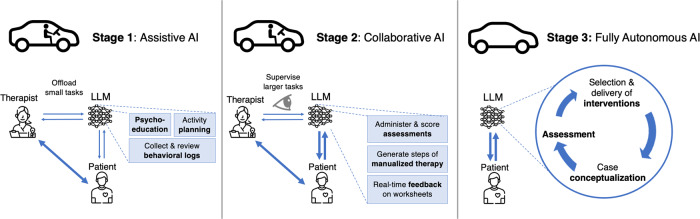
“It is worth noting that, to reach this level, the AI system must already have attained the third stage of integration described by Stade et al [47], meaning that it is fully autonomous and capable of full-range clinical interventions without human supervision.”
Leveraging Large Language Models for Dream Analysis
Srivastava, A. K., Haque, M. A., & Ahmad, T. (2026) · Procedia Computer Science · doi:10.1016/j.procs.2026.05.142
You must not fool yourself: Feynman, neurodiversity, and honest AI in digital mental health
RUTTENBERG, D. (2026) · Frontiers in Digital Health · doi:10.3389/fdgth.2026.1819411 · Cited by 2
“The promise is genuine: AI could democratise access to mental health support and surface patterns invisible to unaided judgment (3).”
Wislocki, K. E., Stoeckl, S. E., Sami, S., & Schueller, S. M. (2026) · JMIR Mental Health · doi:10.2196/preprints.106984
Walther, M., Taubner, S., & Gertz, M. (2026) · Die Psychotherapie · doi:10.1007/s00278-026-00866-w
All too perfect: bias and aspiration in persona generation with LLMs
Corrêa, N. K., Mallmann, R., Kaczér, D., Mai, F., Ilievska, A., & Mönig, J. M. (2026) · Artificial Intelligence Review · doi:10.1007/s10462-026-11641-3
Maqutu, L. (2026) · AI & Society · doi:10.1007/s00146-026-03182-8 · Cited by 2
“These systems can deliver elements of psychotherapy through AI chatbots or assist clinicians by generating treatment recommendations (Stade et al. 2024: 2).”
Clinical Risks of Generative AI in Psychotherapy: A Systematic Review
Ech-Cheikh, S., Kharmoum, N., Hamdouni, Y. E., & Ziti, S. (2026) · Lecture notes in networks and systems · doi:10.1007/978-3-032-30563-3_50
Künstliche Intelligenz und Individuelle Unterschiede
Schödel, R., Altgassen, E., Back, M. D., Buss, M., Bühner, M., Etzel, J. M., Goecke, B., Grinschgl, S., Grunenberg, E., Hätscher, O., et al. (2026) · Psychologische Rundschau · doi:10.1026/0033-3042/a000766
Development of the Sleepy Chatbot as an Interactive Medium for Sleep Quality Monitoring
Budianto, K., & Eliyani (2026) · International Conference on Enterprise and Industrial System (ICOEINS) · doi:10.1109/icoeins69996.2026.11605812
“The methodology follows common practices in digital health and human – computer interaction (HCI) research, emphasizing usability, interaction quality, and user-centered system design [5][11].”
L'uso dell'intelligenza artificiale nella riflessione clinica. Il rischio della collusione gentile
Signorini, S. (2026) · PSICOTERAPIA E SCIENZE UMANE · doi:10.3280/pu2026-002003
Dakuru, M., Lam, S. S., & Elluri, L. (2026) · Lecture notes in networks and systems · doi:10.1007/978-3-032-24360-7_26
Super, I., Rezaeian, O., & Asan, O. (2026) · International Journal of Medical Informatics · doi:10.1016/j.ijmedinf.2026.106648
ACE-GoT: Affective and Contextual Expansion via Graph-of-Thought for Emotional Support Conversations
Xue, C.-S., Chen, H.-Y., Wu, C., & Chen, C. (2026) · IEEE Access · doi:10.1109/access.2026.3720767
“Given this growing demand, Artificial Intelligence dialogue systems have emerged as promising tools for providing accessible psychological assistance [8], [9], [10].”
da Silva, I. S., & Fernandes, M. G. (2026) · Revista de Geopolítica · doi:10.56238/revgeov17n8-023
Gazi, V., Adamaki, A., & Papachristou, C. (2026) · AI and Ethics · doi:10.1007/s43681-026-01280-3
Łabuz, M., Szczęsny, P., & Mika-Łabuz, K. (2026) · Ethics and Information Technology · doi:10.1007/s10676-026-09917-x · Cited by 3
“The impact of generative AI on psychology has been analyzed in the works of Demszky et al. (2023), Abdurahman et al. (2024), Ma et al. (2024), Salah et al. (2024), Stade et al. (2024), Heinz et al. (2025), Moore et al. (2025), and Na et al. (2025).”
InfluentialSupplementary Material for Evaluating AI-Based Mental Health Interventions
Sharma, A. (2026) · ACM eBooks · doi:10.1145/3749728.3749737
Human–AI Collaboration to Empower People Seeking Support
Sharma, A. (2026) · ACM eBooks · doi:10.1145/3749728.3749732
(2026) · ACM eBooks · doi:10.1145/3749728.3749738
(2026) · ACM eBooks · doi:10.1145/3749728.3749739
Supplementary Materials for Human–AI Collaboration to Empower People Providing Support
Sharma, A. (2026) · ACM eBooks · doi:10.1145/3749728.3749735
Human–AI Collaboration to Empower People Providing Support
Sharma, A. (2026) · ACM eBooks · doi:10.1145/3749728.3749731
Sharma, A. (2026) · ACM eBooks · doi:10.1145/3749728.3749730
(2026) · ACM eBooks · doi:10.1145/3749728.3749729
Supplementary Materials for Human–AI Collaboration to Empower People Seeking Support
Sharma, A. (2026) · ACM eBooks · doi:10.1145/3749728.3749736
(2026) · ACM eBooks · doi:10.1145/3749728.3749734
Travelbee and relational AI: A triadic model for nursing
Neves, H. L., Sousa, J. P., Seguro, J. M., Bernardes, R. A., Caldeira, S., Shapira, R., Oliveira, I., Coelho, A., & Parola, V. S. D. O. (2026) · Nursing Outlook · doi:10.1016/j.outlook.2026.102878
Kamaleddin, M. A., Mirjalili, M., Barzegar, R., Le, N. T., Cote, Z., Winkler, O., Burback, L., Zhang, Y., Zai͏̈ane, O. R., Monson, C. M., et al. (2026) · JMIR Medical Education · doi:10.2196/92964 · Cited by 1
“…LLMs could support psychotherapy training and research, but that this is a high-stakes domain requiring transparent rubrics, careful evaluation, human oversight, and attention to safety, bias, and the distinction between superficially empathic language and model-concordant clinical practice [28].”
Challenges of the Digital Age for Psychology as a Science and Profession: An Ongoing Conversation
Carvalho, R. G. G. (2026) · European Psychologist · doi:10.1027/1016-9040/a000591
Ma, H., Liu, Z., Pei, R., Yang, Z., Zhang, Y., & Piao, M. (2026) · Research Square · doi:10.21203/rs.3.rs-10312446/v1
Liu, J., & Zhang, X. (2026) · International Journal of Healthcare Information Systems and Informatics · doi:10.4018/ijhisi.419518
Cross, S. P. M., Titov, N., Dear, B. F., Gleeson, J., & Álvarez‐Jiménez, M. (2026) · JMIR Mental Health · doi:10.2196/103712 · Cited by 2
“These complex and sensitive interactions require integrated judgment about severity, safety, containment, escalation, and accountability [2,4].”
InfluentialHaber, Y., Refoua, E., Yirmiya, K., Rafaeli, E., Yinon, D., Atzil–Slonim, D., Fonagy, P., Meinlschmidt, G., Hadar‐Shoval, D., Simon, T., et al. (2026) · doi:10.2196/preprints.110192
Cardozo, F., Brown, E. C., Mejía‐Trujillo, J., Balise, R. R., Cañizares, C., Pérez‐Gómez, A., George, S. M. S., & Gabbay, V. (2026) · JMIR AI · doi:10.2196/95964
“Recent advances in generative AI, specifically large language models (LLMs) [12], offer a qualitatively different approach [13].”
InfluentialParri, L. A., Lau, R., & Addy, K. B. E. (2026) · JMIR Formative Research · doi:10.2196/95939
“…both that AI-assisted decision-making depends on users having accurate mental models of what AI systems can and cannot do, and that large language model–based behavioral health care represents a distinct and high-stakes development rather than a simple extension of existing teletherapy [49,50].”
Zhu, N., Gu, Y., Liu, X., Li, C., Yang, C., Wang, H., & Chen, C. (2026) · doi:10.2196/preprints.110577
Fang, H., Huang, Z., Zhu, L., Dai, Q., Hong, M., Guo, H., & Wang, E. (2026) · Frontiers in Public Health · doi:10.3389/fpubh.2026.1874822 · Cited by 1
Jewell, C. C., McAlister, K. L., Deliberto, T. L., Wallis, T., Winns, G., & Huberty, J. (2026) · JMIR AI · doi:10.2196/99950 · Cited by 1
“As patterns are detected, as semantic context is updated, and as state-responsive memory is triggered, clinical judgment about what constitutes a meaningful signal, a genuine pattern, or a genuine risk indicator needs to be embedded in the system’s logic and reviewed over time [2].”
InfluentialEthical evaluation of AI-supported mental health applications
Deveci, E., & Ekmekçi, P. E. (2026) · Frontiers in Psychiatry · doi:10.3389/fpsyt.2026.1870948
Yang, H., Chang, F., Liu, Z., Zhang, W., & Cai, J. (2026) · Technology in Society · doi:10.1016/j.techsoc.2026.103535
Zhang, R., Schulz, P. J., Tay, I. Q., Lim, C., Lee, J., & Goh, W. W. B. (2026) · doi:10.2196/preprints.110795
Xie, W., Xiang, C., Wu, F., & Chen, X. (2026) · Frontiers in Psychiatry · doi:10.3389/fpsyt.2026.1922251
“This paper therefore positions GenAI as a human-supervised learning infrastructure rather than a system for child monitoring, diagnosis, institutional evaluation, or autonomous readiness decisions, consistent with responsible behavioral-health AI and WHO guidance (4, 7, 8).”
InfluentialPerry, A., & Cameron, C. D. (2026) · Cambridge University Press eBooks · doi:10.1017/9781009639057.009
Precision without participation: why precision psychiatry needs Collaborative/Therapeutic Assessment
Aschieri, F., Sun, Q., & Finn, S. E. (2026) · BJPsych Bulletin · doi:10.1192/bjb.2026.10278
Gönültaş, M., Kul, A., & Arslan, G. (2026) · International Journal of Human-Computer Interaction · doi:10.1080/10447318.2026.2727768
Khan, N., Sheibani, N., Sequeira, L., Gauvreau, S., Palachi, A., Naveed, A., Shearkhani, S., Ensan, F., Raman, P., & Milligan, K. (2026) · doi:10.2196/preprints.109043
Assessing Mental Health Counseling Interventions with LLMs
Naher, N., Langfus, J. A., Pfiffner, L. J., & Sukthankar, G. (2025) · IEEE/WIC/ACM International Conference on Web Intelligence and Intelligent Agent Technology (WI-IAT) · doi:10.1109/wi-iat67162.2025.00068
“Meanwhile, proposals like the one from [12] emphasize the need for responsible evaluation frameworks, suggesting that mental health-specific benchmarks and hybrid workflows could guide safe integration into behavioral healthcare.”
Oh, J., Cho, H., Pang, S., Heo, S., & Lee, J. (2026) · doi:10.2196/preprints.111409
Matsuda, S., Karasawa, H., & Sugawara, D. (2026) · Single Case in the Social Sciences · doi:10.15763/issn.1936-9298.2026.3.1.56-67
“Looking ahead, and consistent with recent recommendations regarding the responsible use of large language models in clinical research (Stade et al., 2024), future work could (i) develop automated scoring pipelines for thought-record quality, (ii) conduct quantitative language analyses of the…”
Dritsas, E., & Τρίγκα, Μ. (2026) · Neurocomputing · doi:10.1016/j.neucom.2026.135207
Hilty, D. M., ELNahas, G., Mphil, S. J., Mucić, D., Vukojević, J., Halbreich, U. M., Riese, H., Gentry, M. T., Gkouvas, N., Gaur, V., et al. (2026) · Journal of Technology in Behavioral Science · doi:10.1007/s41347-026-00708-1
Zhou, C., Wu, H., Li, G., & CHEN, Y. (2026) · Frontiers in Psychology · doi:10.3389/fpsyg.2026.1915597
“However, recent evaluations indicate that conversational fluency does not necessarily guarantee reliability, factual accuracy, or appropriate support, particularly in health-related contexts (Ji et al., 2023; Langston et al., 2024; Stade et al., 2024).”
The Rise of Large Language Models (LLMs) and Their Impact on Healthcare
Higgins, O., & Wilson, R. L. (2026) · Springer eBooks · doi:10.1007/978-3-032-32552-5_4
Richter, E., Schöniger, K., Schulze, M., Frede, L., Moeller, K., Redlich, R., & Spitzer, M. (2026) · doi:10.2196/preprints.112596
Toward a Living Meta-Framework for Evaluating Generative AI in Mental Health
Golden, A., & Aboujaoude, E. N. (2026) · JMIR AI · doi:10.2196/89211
“Third, these qualities may improve engagement, as users are more likely to continue interacting with systems that feel responsive and attuned [8,13].”
Tahseen, H. (2026) · BJPsych Bulletin · doi:10.1192/bjb.2026.10290
Talk to Me Kindly: Designing AI Companions to Foster Positive Self-Talk in Young Adults
Gedeus, A.-K., Wagener, N., Li, Y., Bai, Y., Felver, J. C., Difede, J., Yoon, S., & Taylor, A. M. (2026) · Nordic Conference on Human-Computer Interaction · doi:10.1145/3829807.3829873
Toward a Framework for Assessing Patient-Facing Gen AI Tools in Mental Healthcare
Durneva, P., & Ghorbanie, H. (2026) · International Journal of Medical Informatics · doi:10.1016/j.ijmedinf.2026.106741
Governance and accountability in compassionate AI: a normative framework for responsible design
Tachu, B., Ighade, A., & Yogeeswaran, G. (2026) · AI and Ethics · doi:10.1007/s43681-026-01412-9
Ethische Aspekte zur KI-Anwendung in der Psychotherapie
Schürmann, J. M., Sedláková, J., & Trachsel, M. (2026) · Psychotherapie-Wissenschaft · doi:10.30820/1664-9583-2026-2-17
“…und psychotherapeutische KI-Systeme operieren in einem spezifischen klinischen und ethischen Kontext, der durch die Vulnerabilität der Patient:innen, die zentrale Bedeutung der therapeutischen Beziehung und die Komplexität psychischer Phänomene geprägt ist (Fiske et al., 2019; Stade et al., 2024).”
InfluentialHaez, S. G., Consolandi, M., & Dragoni, M. (2026) · ACM Transactions on Intelligent Systems and Technology · doi:10.1145/3838184
Psychotherapy remains a human endeavor: Human therapy is valued more than AI-integrated therapyPreprint
Xu, C., & Kim, T. T. (2026) · medRxiv · doi:10.64898/2026.09.29.26364234
Liu, Y., Mu, J., Li, Y., Ke, Y., & Zhang, Y. (2026) · Frontiers in Psychology · doi:10.3389/fpsyg.2026.1926092
“Yet AI responses often mix emotional validation, advice, reappraisal, and Socratic questioning in the same message, so it is difficult to tell which component is linked to belief change, affect reduction, or reframing (Malgaroli et al., 2023; Li et al., 2023; Stade et al., 2024).”
Responsible AI Framework in Healthcare: a People, Process and Technology Perspective
Erin, E., Isa, S. M., Andryani, N. A. C., & Mauritsius, T. (2026) · International Conference on ICT for Smart Society (ICISS) · doi:10.1109/iciss71466.2026.11715260
Liability and Standard of Care in AI-Driven Psychiatric Practice: European Viewpoint
Madeira, L., Pereira, C. A., Schouler‐Ocak, M., Samochowiec, J., Galderisi, S., & da Costa, M. P. (2026) · Journal of Medical Internet Research · doi:10.2196/99894
“…technical transparency, but psychiatric systems should provide intelligible reasoning, confidence limits, performance boundaries, and warnings when extrapolating from weakly matched data; otherwise, clinicians may not have sufficient or adequate outputs to support interpretation [4,15,28,30,31].”
Thakkar, S., Bhatt, P., & Parekh, H. (2026) · Counselling and Psychotherapy Research · doi:10.1002/capr.70237
Chen, Y., Li, Y., Xiong, Y., Ji, S., Ding, X. X., Deng, Y., & Fan, Y. (2026) · Digital Health · doi:10.1177/20552076261495459
Sun, Y., Tao, L., Yu, H., Wang, Y., Zheng, K., Chen, H., Nan, S., Shen, M., & Lu, X. (2026) · Journal of Biomedical Informatics · doi:10.1016/j.jbi.2026.105108
Zhang, D., Zhou, L., Wang, Z., Zhang, E., & Pan, Y. (2026) · ENGINEERING Management · doi:10.1007/s42524-026-6108-0
Xiao, Q., & Chen, Y. (2026) · The Design Journal · doi:10.1080/14606925.2026.2743670
Moya, M. O. C., Cabrera, L. H., Ramírez, L. M., González, M. A. G., Pazos, A. A., Feitó, L. B. F., & Pernas, G. G. (2026) · SAP Social AI · doi:10.62486/sai2026109
Hlynsson, J. I., Andersson, G., & Carlbring, P. (2026) · Internet Interventions · doi:10.1016/j.invent.2026.101012
Omigbodun, F. T. (2026) · Journal of Medicine Surgery and Public Health · doi:10.1016/j.glmedi.2026.100258
Chen, X., Li, X., Yin, L., Zhu, H., Xiao, Z., & Peng, Y. J. (2026) · Systems · doi:10.3390/systems14101327
Fulmer, R., Xiong, Y., Zhai, Y., Lee, J., Nkya, G., & Naugle, R. (2026) · Frontiers in Psychology · doi:10.3389/fpsyg.2026.1998626
Problematic engagement with generative AI measurement drivers contexts and outcomes
Raman, R., Kowalski, R., Nedungadi, P., & Achuthan, K. (2026) · Social Sciences & Humanities Open · doi:10.1016/j.ssaho.2026.103890
Generative AI Chatbot Responses to Suicide and Self-Harm: A Systematic Review (Preprint)
Kelly, D. A., Franz, P. J., Gutman, A., Sleiman, M., Dorsky, J., Singh, H., Appel, W., Wyatt, S. M., Low, D. M., Stirman, S. W., et al. (2026) · Journal of Medical Internet Research · doi:10.2196/103517 · Cited by 2
Self-citationLiu, Y., Xu, K., Zhao, S., Li, D., Zhang, Y., Chen, J., & Wu, Y. (2026) · doi:10.2196/preprints.113358
Large language models for computational social science
Xu, F., Shao, C., Chen, L., Zeng, Q., Chen, Z., Sukiennik, N., Wang, J., Gao, C., Wang, H., Lian, J., et al. (2026) · Nature Human Behaviour · doi:10.1038/s41562-026-02539-9 · Cited by 2
Xie, S., Meshes, E., Jennings, A. M., & Messer, A. (2026) · Behavior Analysis in Practice · doi:10.1007/s40617-026-01239-0
Metadata
- Authors
- Stade, E. C., Stirman, S. W., Ungar, L. H., Boland, C. L., Schwartz, H. A., Yaden, D. B., Sedoc, J., DeRubeis, R. J., Willer, R., & Eichstaedt, J. C.
- Affiliations
- VA Palo Alto Health Care System (US)
- University of Pennsylvania (US)
- Stony Brook University (US)
- Johns Hopkins University (US)
- New York University (US)
- Stanford University (US)
- Corresponding author
- Stade, Elizabeth C.
- Eichstaedt, Johannes C.
- ORCID
- Venue
- npj Mental Health Research
- Published
- 2024-04-02
- Volume
- 3
- Issue
- 1
- Pages
- 12-12
- ISSN
- 2731-4251 (ISSN-L)
- PMC
- PMC10987499
- OpenAlex
- W4393397034
- Semantic Scholar
- 82dcef936d139b6ce8a6198a2de9c597b28b4ded
- Cited by
- 391
- References
- 78
- Citations by year
- 2026: 182 · 2025: 152 · 2024: 54
- FWCI
- 36.35
- Type
- journal article
- Language
- en
- Open access
- gold
- doi.org
- Licence
- cc-by
- creativecommons.org/licenses/by/4.0 (tdm)
- creativecommons.org/licenses/by/4.0 (vor)
- Locations
- npj Mental Health Research (publishedVersion, cc-by)
- PubMed Central (publishedVersion, cc-by)
- PubMed (publishedVersion)
- DOAJ (DOAJ: Directory of Open Access Journals) (submittedVersion)
- PsyArXiv (OSF Preprints) (submittedVersion)
- PsyArXiv (OSF Preprints) (submittedVersion, cc-by)
- Funders
- National Institute of Mental Health (RF1-MH128785, R01-MH125702)
- Stanford Institute for Human-Centered Artificial Intelligence, Stanford University
- Topics
- Health Sciences › Medicine › Health Informatics › Artificial Intelligence in Healthcare and Education
- Social Sciences › Psychology › Applied Psychology › Digital Mental Health Interventions
- Physical Sciences › Computer Science › Artificial Intelligence › Ethics and Social Impacts of AI
- Keywords
- large language models, psychotherapy, behavioral health services, responsible AI development, AI evaluation, risk detection, algorithmic bias, transparency, clinical psychology training, evidence-based interventions, access to mental health care
About these checks
Registry, retraction, Cites and statistics results are computed, not judged, with one exception: a printed reference that no index lists is read once by a model before it counts as a citation error. Claims are extracted by a model and kept only when their quote appears verbatim in the text; each cited source is then checked, with a model’s help, for whether it says what the claim relies on. Those verdicts can be wrong — read the claim’s quote and the cited source before relying on one.
Statistics and arithmetic are recomputed, not judged.
Confidence bands are shown only for fields calibrated on our annotated test set. None is calibrated yet, so no band is shown.
What counts as a claim ›How we measure confidence ›How we check this ›
Are you an author, or do you see a problem with this page? Request a review
Data sources
Bibliographic data: Semantic Scholar, OpenAlex, Crossref.
Contains information from the Semantic Scholar Academic Graph Datasets, made available under the ODC Attribution License (ODC-BY 1.0).
Semantic Scholar’s data is described in: Kinney, R., et al. (2023). The Semantic Scholar Open Data Platform. arXiv:2301.10140.
