

Discrimination exposure impacts unhealthy processing of food cues: crosstalk between the brain and gut
Open accessThe DOI matches its Crossref record; 129 of the 129 references it cites were found in a registry or an index.
Abstract
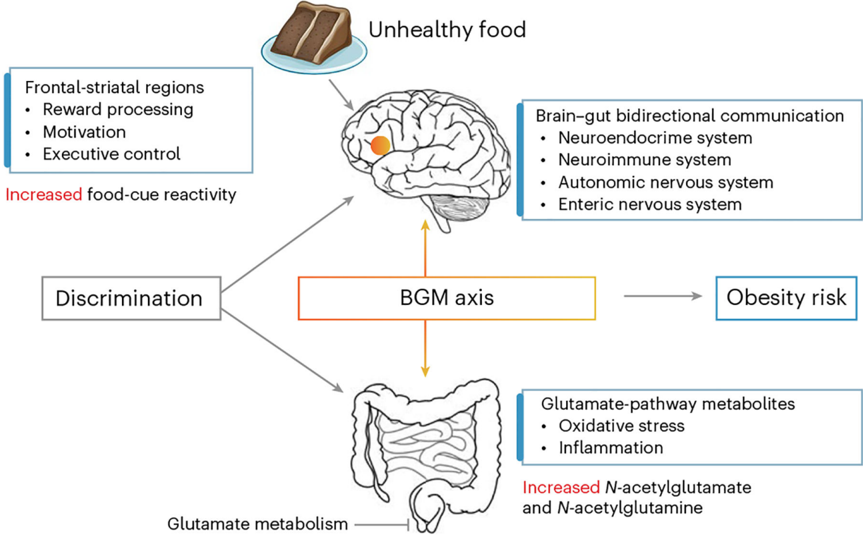
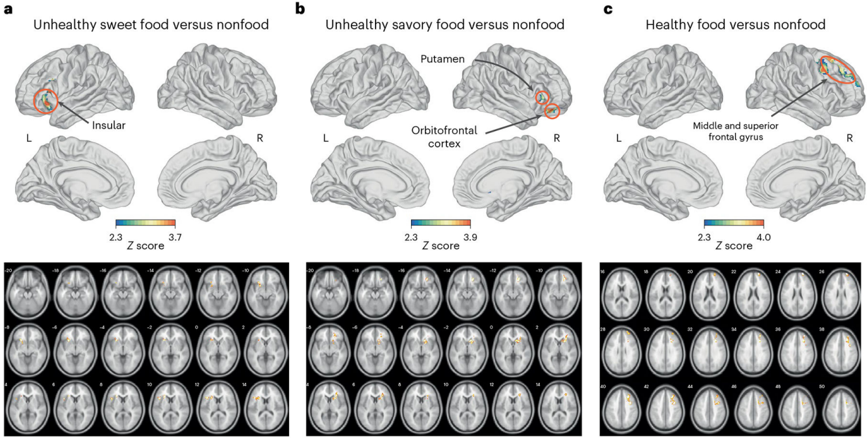
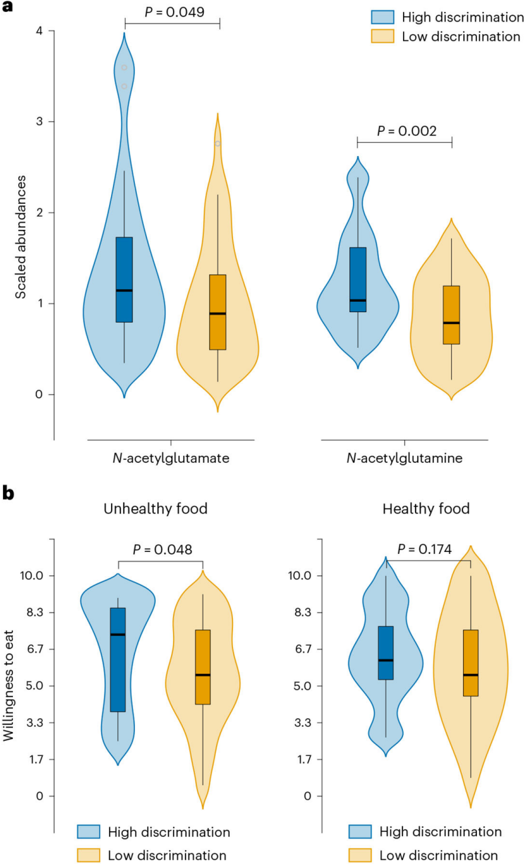
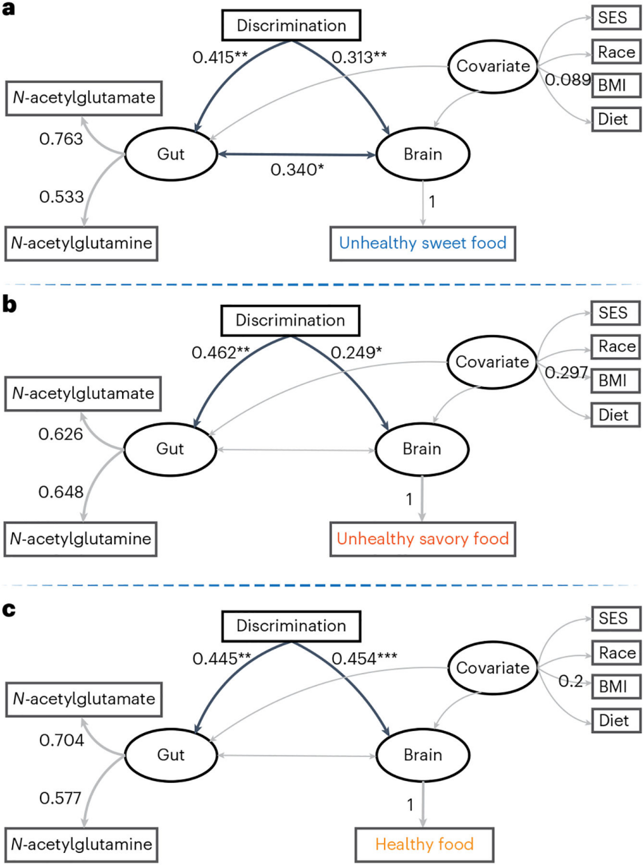
Experiences of discrimination are associated with adverse health outcomes, including obesity. However, the mechanisms by which discrimination leads to obesity remain unclear. Utilizing multi-omics analyses of neuroimaging and fecal metabolites, we investigated the impact of discrimination exposure on brain reactivity to food images and associated dysregulations in the brain–gut–microbiome system. We show that discrimination is associated with increased food-cue reactivity in frontal-striatal regions involved in reward, motivation and executive control; altered glutamate-pathway metabolites involved in oxidative stress and inflammation as well as preference for unhealthy foods. Associations between discrimination-related brain and gut signatures were skewed towards unhealthy sweet foods after adjusting for age, diet, body mass index, race and socioeconomic status. Discrimination, as a stressor, may contribute to enhanced food-cue reactivity and brain–gut–microbiome disruptions that can promote unhealthy eating behaviors, leading to increased risk for obesity. Treatments that normalize these alterations may benefit individuals who experience discrimination-related stress.
Overview
The claims and statistics of this paper haven’t been checked yet.
Free: it reads the open-access text and checks the first 5 claims that cite a source we can check. Create a free account to check every claim.
Integrity signals
Registry
Cites
Statistics
Figures
Verification
Claims the paper makes
The claims and statistics of this paper haven’t been checked yet.
Free: it reads the open-access text and checks the first 5 claims that cite a source we can check. Create a free account to check every claim.
Claims other papers make about this one
Each is checked against this paper’s own text: does it say what the citing paper says it does?
The check wasn’t confident either way, so it gives no verdict — never disputed.
In the citing paper
“like that experienced within food insecure households and by individuals from minority groups who face day-to-day discrimination, both of which have been shown to experience increased levels of food cue reactivity compared to those living in food secure households and those who report lower levels of experienced discrimination [112,113]”
From What Is Food Noise? A Conceptual Model of Food Cue Reactivity (2023) · cites this paper as [113]
Experimental — accuracy not yet measuredIn the citing paper
“like that experienced within food insecure households and by individuals from minority groups who face day-to-day discrimination, both of which have been shown to experience increased levels of food cue reactivity compared to those living in food secure households and those who report lower levels of experienced discrimination [112,113]”
From What Is Food Noise? A Conceptual Model of Food Cue Reactivity (2023) · cites this paper as [113]
In the citing paper
“the distinction between constant and transient influencers can be blurred in situations where transient influencers that can increase food cue reactivity, such as stress, might become chronic”
From What Is Food Noise? A Conceptual Model of Food Cue Reactivity (2023) · cites this paper as [113]
Self-check
Percentages, sums and reported differences re-computed from the paper’s own numbers.
The self-check needs the paper’s full text.
Citations
Cites
Controlling the False Discovery Rate: A Practical and Powerful Approach to Multiple Testing
Benjamini, Y., & Hochberg, Y. (1995) · Journal of the Royal Statistical Society Series B: Statistical Methodology · doi:10.1111/j.2517-6161.1995.tb02031.x · Cited by 109,482 · cited 2×
“Multiple comparisons were corrected for using the FDR method 127 .”
Methodlavaan : An R Package for Structural Equation Modeling
Rosseel, Y. (2012) · Journal of Statistical Software · doi:10.18637/jss.v048.i02 · Cited by 27,955
Advances in functional and structural MR image analysis and implementation as FSL
Smith, S. M., Jenkinson, M., Woolrich, M. W., Beckmann, C. F., Behrens, T. E. J., Johansen-Berg, H., Bannister, P. R., De Luca, M., Drobnjak, I., Flitney, D. E., et al. (2004) · NeuroImage · doi:10.1016/j.neuroimage.2004.07.051 · Cited by 13,630 · cited 3×
“Functional data were aligned to the structural image of each participant and then registered into Montreal Neurological Institute (MNI) standard space using affine transformation through FSL’s Linear Image Registration Tool (FLIRT).”
MethodInfluentialPhysiology and neurobiology of stress and adaptation: central role of the brain
McEwen, B. S. (2007) · Physiological Reviews · doi:10.1152/physrev.00041.2006 · Cited by 5,429 · cited 1×
“Overlap in neurobiological pathways linked to stress and energy homeostasis may underlie the co-occurrence of dysregulated feeding behaviors and stress responses, both of which can contribute to obesity 16,34 .”
BackgroundPrevalence of Obesity and Trends in the Distribution of Body Mass Index Among US Adults, 1999-2010
Flegal, K. M., Carroll, M. D., Kit, B. K., & Ogden, C. L. (2012) · JAMA · doi:10.1001/jama.2012.39 · Cited by 5,385 · cited 1×
“In response to food cues, stress could result in the deactivation of frontal executive modulation and potentiate brain activity in limbic regions, eliciting a bias towards unhealthy energy-dense foods 17,18 .”
BackgroundAdler, N. E., Epel, E. S., Castellazzo, G., & Ickovics, J. R. (2000) · Health Psychology · doi:10.1037/0278-6133.19.6.586 · Cited by 5,080 · cited 9×
“Pearson’s correlations were used to assess the associations between the gut metabolites and key psychosocial variables (for example, SES) that showed significant differences between the high and low discrimination groups.”
MethodInfluentialRacial Differences in Physical and Mental Health: Socio-economic Status, Stress and Discrimination
Williams, D. R., Yu, Y., Jackson, J. S., & Anderson, N. B. (1997) · Journal of Health Psychology · doi:10.1177/135910539700200305 · Cited by 4,786 · cited 8×
“Because there is no consensus on the cut-offs of the EDS, scores were dichotomized to categorize participants into two groups— high discrimination exposure (EDS > 10, n = 50) and low discrimination exposure (EDS ≤ 10, n = 57)—based on the median score of this sample, as used in previous studies 33,120–122 .”
MethodInfluentialNormal gut microbiota modulates brain development and behavior
Heijtz, R. D., Wang, S., Anuar, F., Qian, Y., Björkholm, B., Samuelsson, A., Hibberd, M. L., Forssberg, H., & Pettersson, S. (2011) · Proceedings of the National Academy of Sciences · doi:10.1073/pnas.1010529108 · Cited by 3,228 · cited 1×
“Previous studies suggested that gut-induced alterations in CNS neurochemicals may be sex-specific 111,112 .”
BackgroundRacism as a Determinant of Health: A Systematic Review and Meta-Analysis
Paradies, Y., Ben, J., Denson, N., Elias, A., Priest, N., Pieterse, A., Gupta, A., Kelaher, M., & Gee, G. (2015) · PLOS ONE · doi:10.1371/journal.pone.0138511 · Cited by 2,610
Self-citationKessler, R. C., Mickelson, K. D., & Williams, D. R. (1999) · Journal of Health and Social Behavior · doi:10.2307/2676349 · Cited by 2,228
Research works printed but not linked: 2
- J. Obes 2013, 140743 (2013). [PubMed: 23691282]
- Little, T. D. Longitudinal Structural Equation Modeling (Guilford Press, 2013).
Cited by
What Is Food Noise? A Conceptual Model of Food Cue Reactivity
Hayashi, D., Edwards, C., Emond, J. A., Gilbert-Diamond, D., Butt, M., Rigby, A., & Masterson, T. D. (2023) · Nutrients · doi:10.3390/nu15224809 · Cited by 80
“…households and by individuals from minority groups who face day-to-day discrimination, both of which have been shown to experience increased levels of food cue reactivity compared to those living in food secure households and those who report lower levels of experienced discrimination [112,113].”
BackgroundSocial Isolation, Brain Food Cue Processing, Eating Behaviors, and Mental Health Symptoms
Zhang, X., Ravichandran, S., Gee, G. C., Dong, T. S., Beltrán‐Sánchez, H., Wang, M. C., Kilpatrick, L. A., Labus, J. S., Vaughan, A., & Gupta, A. (2024) · JAMA Network Open · doi:10.1001/jamanetworkopen.2024.4855 · Cited by 51
Self-citationComputational whole-body-exposome models for global precision brain health
Ibáñez, A. M., Duran-Aniotz, C. A., Migeot, J., Báez, S., Fittipaldi, S., Coronel‐Oliveros, C., Eyre, H. A., Udeh‐Momoh, C. T., Zetterberg, H., Alladi, S., et al. (2025) · Nature Communications · doi:10.1038/s41467-025-67448-3 · Cited by 33
“Gut microbiome health is sensitive to exposome in fl uences and is a crucial predictor of brain health 66 .”
Neuroprotection provided by polyphenols and flavonoids in photoreceptor degenerative diseases
de Lima-Vasconcellos, T. H., dos Santos, G. B., Móvio, M. I., Donnici, G. K., Badin, G. M., de Araújo, D. R., & Kihara, A. H. (2025) · Neural Regeneration Research · doi:10.4103/nrr.nrr-d-24-01638 · Cited by 16
“…with a reduced intake of fruits and vegetables, may contribute to a higher susceptibility to diseases and neurodegeneration, once a healthy diet is crucial for the prevention of several diseases (Aidoo et al., 2023; Nagata et al., 2024; Zhang et al., 2023c; Dong et al., 2024; Whelan et al., 2024).”
Agirman, G., Quicho, M. N. B., Connelley, K. K., Zhang, X., Lynch, J. B., Ha, S. M., Schmidt, H. M., Özcan, E., Liang, A. X., Yu, K. B., et al. (2025) · Cell Host & Microbe · doi:10.1016/j.chom.2025.10.019 · Cited by 9
Self-citationBiopsychosocial and Environmental Factors That Impact Brain-Gut-Microbiome Interactions in Obesity
Sood, R., Kilpatrick, L. A., Keefer, L., & Church, A. (2025) · Clinical Gastroenterology and Hepatology · doi:10.1016/j.cgh.2025.07.045 · Cited by 7
“50 The effects of discrimination extend to dysregulating the BGM system.”
Self-citationGut Feelings: The Critical Role of Interoception in Obesity and Disorders of Gut–Brain Interaction
Chang, L., Thaiss, C. A., Knight, Z. A., & Khalsa, S. S. (2025) · Gastroenterology · doi:10.1053/j.gastro.2025.04.002 · Cited by 9
Conceptual Framework for Nutritional Psychology as a New Field of Research
Stroebele‐Benschop, N., Hedrih, V., Behairy, S., Pervaiz, N., & Morphew-Lu, E. (2025) · Behavioral Sciences · doi:10.3390/bs15081007 · Cited by 6
“On the other hand, experiencing chronic discrimination and high levels of unfair treatment even seem to be associated with an increased willingness to eat unhealthy foods (Zhang et al., 2023).”
A New Era in the Medical Management of Obesity
Porterfield, F., Fatima, A., Boaventura, B. C. B., Madhar, A., Srivastava, G., & Stanford, F. C. (2026) · Annual Review of Medicine · doi:10.1146/annurev-med-043024-125437 · Cited by 3
Contemplative Practices as a Form of Stress Management for Patients with Kidney Disease
Bruce, M. A., Thorpe, R. J., Schneider, R. H., Hercz, A. E., Williams, S. F., & Norris, K. C. (2025) · Clinical Journal of the American Society of Nephrology · doi:10.2215/cjn.0000000829 · Cited by 4
Zhang, X., Dong, T. S., Gee, G. C., Kilpatrick, L. A., Beltrán‐Sánchez, H., Wang, M. C., Vaughan, A., & Church, A. (2025) · Gut Microbes · doi:10.1080/19490976.2025.2566978 · Cited by 2
“43,44 Given the multimodal nature of the data (neuroimaging, microbiome, metabolomics, psychosocial measures), this sample provides a balance between feasibility and statistical power.”
Self-citationRajagopalan, R. M., D’Antonio, M., & Fujimura, J. H. (2024) · The Hastings Center Report · doi:10.1002/hast.4927 · Cited by 4
Connectome-wide brain signature during fast-food advertisement exposure predicts BMI at 2 years
Papantoni, A., Gearhardt, A. N., Yokum, S., Hoover, L. V., Finn, E. S., Shearrer, G. E., Taillie, L. S., Shaikh, S. R., Meyer, K. A., & Burger, K. S. (2025) · Social Cognitive and Affective Neuroscience · doi:10.1093/scan/nsaf018 · Cited by 2
“There is evidence to suggest that lower socioeconomic status is associated with altered neural responses to food cues in reward processing and executive control regions (Zhang et al. 2023), with socioeconomic status influencing the relationship between brain food cue reactivity and weight.”
Nguyen, U., Hahm, H. C., Boateng, S., Tran, P. K., Rajesh, G., & Cozier, Y. C. (2025) · International Journal of Environmental Research and Public Health · doi:10.3390/ijerph22050661 · Cited by 2
“…of self-report discrimination on brain activity in response to food images, Zhang et al. found that discrimination was associated with increased food-cue reactivity in the regions of the brain involved in reward, motivation, and execution control and led to a preference for unhealthy foods [45].”
Socio-economic status modulates the link between vagal tone and chocolate consumption
Weick, M., & Vasiljevic, M. (2025) · Food Quality and Preference · doi:10.1016/j.foodqual.2025.105491 · Cited by 1
Guers, J. J., Heffernan, K. S., & Campbell, S. C. (2025) · Reviews in Cardiovascular Medicine · doi:10.31083/rcm26430 · Cited by 1
“[ 236], investigated the impact of discrimination exposure on brain reactivity to food images and associated dysregulations in the brain– gut–microbiome axis.”
Grobman, B., Rifas‐Shiman, S. L., Aris, I. M., Perng, W., Chavarro, J. E., Juraschek, S. P., Oken, E., Hivert, M., & Zhang, M. (2025) · BMJ Public Health · doi:10.1136/bmjph-2025-003303 · Cited by 1
“40 In our current study, when accounting for weight and physical appearance as perceived reasons for experiencing discrimination, the association of the overall WEDS score with BMI and obesity was attenuated to non-significance, although being treated with less courtesy or respect, receiving poorer…”
Johnson, T. A., Kan, A. K., Bonner, L. B., Horn, L. V., Kershaw, K. N., Grobman, W. A., Lindsay, K. L., Debbink, M. P., Mercer, B. M., Haas, D. M., et al. (2024) · Journal of the Academy of Nutrition and Dietetics · doi:10.1016/j.jand.2024.11.007 · Cited by 1
Moving Forward to Disentangle the Role of the Brain in Human Obesity
Hesse, S. (2024) · Brain Sciences · doi:10.3390/brainsci14121245
Baek, S., & Yoon, J. (2025) · Nutrients · doi:10.3390/nu17233643
“Chronic stress induced by discrimination can influence neural activity in the prefrontal regions involved in impulse regulation and limbic regions associated with reward processing, thereby modulating appetitive responses [19,37,38].”
Metadata
- Authors
- Zhang, X., Wang, H., Kilpatrick, L. A., Dong, T. S., Gee, G. C., Labus, J. S., Osadchiy, V., Beltran-Sanchez, H., Wang, M. C., Vaughan, A., & Gupta, A.
- Affiliations
- University of California, Los Angeles (US)
- Corresponding author
- Gupta, Arpana
- ORCID
- Venue
- Nature Mental Health
- Published
- 2023-10-02
- Volume
- 1
- Issue
- 11
- Pages
- 841-852
- ISSN
- 2731-6076 (ISSN-L)
- PMC
- PMC10718506
- OpenAlex
- W4387267062
- Semantic Scholar
- 6bc2baa2a8d158f7943055e3f4bfd2967f929a08
- Cited by
- 20
- References
- 128
- Citations by year
- 2026: 1 · 2025: 14 · 2024: 4 · 2023: 1
- FWCI
- 5.83
- Type
- journal article
- Language
- en
- Open access
- hybrid
- doi.org
- Licence
- cc-by
- creativecommons.org/licenses/by/4.0 (tdm)
- creativecommons.org/licenses/by/4.0 (vor)
- Locations
- Nature Mental Health (publishedVersion, cc-by)
- PubMed (publishedVersion)
- PubMed Central (acceptedVersion, cc-by)
- eScholarship (California Digital Library) (submittedVersion, cc-by)
- Funders
- U.S. Department of Health & Human Services | NIH | National Institute on Minority Health and Health Disparities (R01 MD015904)
- U.S. Department of Health & Human Services | NIH | National Institute of Diabetes and Digestive and Kidney Diseases (R03 DK121025, K23 DK106528)
- Topics
- Social Sciences › Psychology › Clinical Psychology › Eating Disorders and Behaviors
- Life Sciences › Neuroscience › Endocrine and Autonomic Systems › Regulation of Appetite and Obesity
- Social Sciences › Sociology and Political Science › Racial and Ethnic Identity Research
- Keywords
- food cue reactivity, gut-brain axis, obesity, gut microbiota metabolites, glutamate pathway, oxidative stress, inflammation, sweet food preference, stress, reward and motivation, executive function, multi-omics
About these checks
Registry, retraction, Cites and statistics results are computed, not judged, with one exception: a printed reference that no index lists is read once by a model before it counts as a citation error. Claims are extracted by a model and kept only when their quote appears verbatim in the text; each cited source is then checked, with a model’s help, for whether it says what the claim relies on. Those verdicts can be wrong — read the claim’s quote and the cited source before relying on one.
Statistics and arithmetic are recomputed, not judged.
Confidence bands are shown only for fields calibrated on our annotated test set. None is calibrated yet, so no band is shown.
What counts as a claim ›How we measure confidence ›How we check this ›
Are you an author, or do you see a problem with this page? Request a review
Data sources
Bibliographic data: Semantic Scholar, OpenAlex, Crossref.
Contains information from the Semantic Scholar Academic Graph Datasets, made available under the ODC Attribution License (ODC-BY 1.0).
Semantic Scholar’s data is described in: Kinney, R., et al. (2023). The Semantic Scholar Open Data Platform. arXiv:2301.10140.
