

Discrimination exposure impacts unhealthy processing of food cues: crosstalk between the brain and gut
Open accessThe DOI matches its Crossref record; 129 of the 129 references it cites were found in a registry or an index.
Abstract
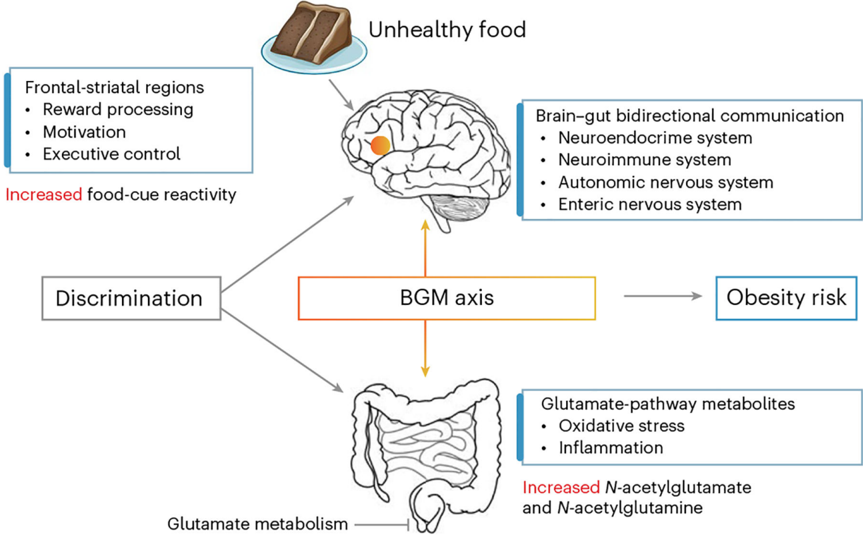
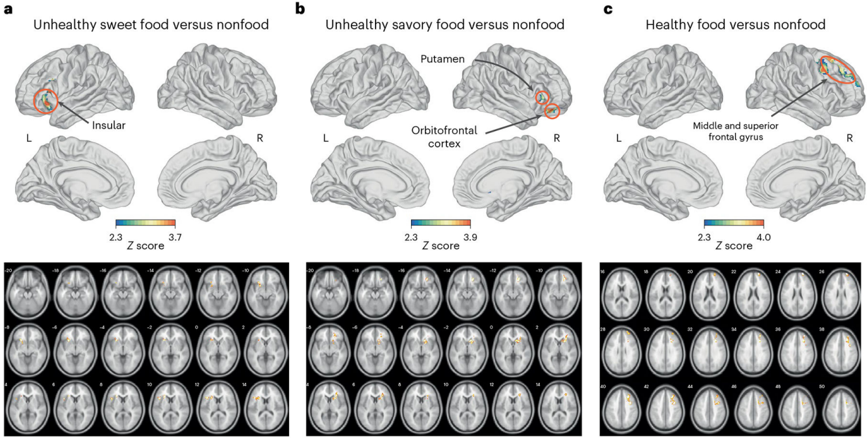
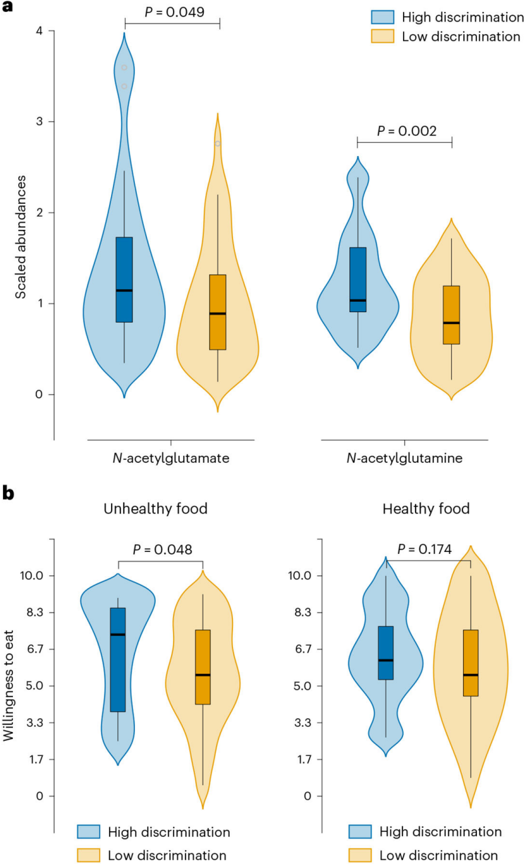
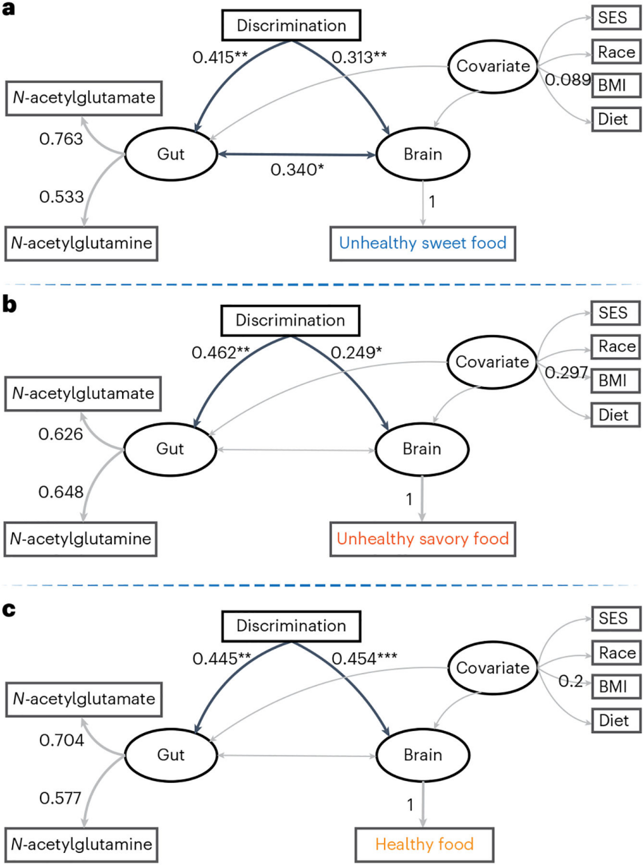
Experiences of discrimination are associated with adverse health outcomes, including obesity. However, the mechanisms by which discrimination leads to obesity remain unclear. Utilizing multi-omics analyses of neuroimaging and fecal metabolites, we investigated the impact of discrimination exposure on brain reactivity to food images and associated dysregulations in the brain–gut–microbiome system. We show that discrimination is associated with increased food-cue reactivity in frontal-striatal regions involved in reward, motivation and executive control; altered glutamate-pathway metabolites involved in oxidative stress and inflammation as well as preference for unhealthy foods. Associations between discrimination-related brain and gut signatures were skewed towards unhealthy sweet foods after adjusting for age, diet, body mass index, race and socioeconomic status. Discrimination, as a stressor, may contribute to enhanced food-cue reactivity and brain–gut–microbiome disruptions that can promote unhealthy eating behaviors, leading to increased risk for obesity. Treatments that normalize these alterations may benefit individuals who experience discrimination-related stress.
Overview
The claims and statistics of this paper haven’t been checked yet.
Free: it reads the open-access text and checks the first 5 claims that cite a source we can check. Create a free account to check every claim.
Integrity signals
Registry
Cites
Statistics
Figures
Verification
Claims the paper makes
The claims and statistics of this paper haven’t been checked yet.
Free: it reads the open-access text and checks the first 5 claims that cite a source we can check. Create a free account to check every claim.
Claims other papers make about this one
Each is checked against this paper’s own text: does it say what the citing paper says it does?
The check wasn’t confident either way, so it gives no verdict — never disputed.
In the citing paper
“like that experienced within food insecure households and by individuals from minority groups who face day-to-day discrimination, both of which have been shown to experience increased levels of food cue reactivity compared to those living in food secure households and those who report lower levels of experienced discrimination [112,113]”
From What Is Food Noise? A Conceptual Model of Food Cue Reactivity (2023) · cites this paper as [113]
Experimental — accuracy not yet measuredIn the citing paper
“like that experienced within food insecure households and by individuals from minority groups who face day-to-day discrimination, both of which have been shown to experience increased levels of food cue reactivity compared to those living in food secure households and those who report lower levels of experienced discrimination [112,113]”
From What Is Food Noise? A Conceptual Model of Food Cue Reactivity (2023) · cites this paper as [113]
In the citing paper
“the distinction between constant and transient influencers can be blurred in situations where transient influencers that can increase food cue reactivity, such as stress, might become chronic”
From What Is Food Noise? A Conceptual Model of Food Cue Reactivity (2023) · cites this paper as [113]
Self-check
Percentages, sums and reported differences re-computed from the paper’s own numbers.
The self-check needs the paper’s full text.
Citations
Cites
Controlling the False Discovery Rate: A Practical and Powerful Approach to Multiple Testing
Benjamini, Y., & Hochberg, Y. (1995) · Journal of the Royal Statistical Society Series B: Statistical Methodology · doi:10.1111/j.2517-6161.1995.tb02031.x · Cited by 109,482 · cited 2×
“Multiple comparisons were corrected for using the FDR method 127 .”
Methodlavaan : An R Package for Structural Equation Modeling
Rosseel, Y. (2012) · Journal of Statistical Software · doi:10.18637/jss.v048.i02 · Cited by 27,955
Advances in functional and structural MR image analysis and implementation as FSL
Smith, S. M., Jenkinson, M., Woolrich, M. W., Beckmann, C. F., Behrens, T. E. J., Johansen-Berg, H., Bannister, P. R., De Luca, M., Drobnjak, I., Flitney, D. E., et al. (2004) · NeuroImage · doi:10.1016/j.neuroimage.2004.07.051 · Cited by 13,630 · cited 3×
“Functional data were aligned to the structural image of each participant and then registered into Montreal Neurological Institute (MNI) standard space using affine transformation through FSL’s Linear Image Registration Tool (FLIRT).”
MethodInfluentialPhysiology and neurobiology of stress and adaptation: central role of the brain
McEwen, B. S. (2007) · Physiological Reviews · doi:10.1152/physrev.00041.2006 · Cited by 5,429 · cited 1×
“Overlap in neurobiological pathways linked to stress and energy homeostasis may underlie the co-occurrence of dysregulated feeding behaviors and stress responses, both of which can contribute to obesity 16,34 .”
BackgroundPrevalence of Obesity and Trends in the Distribution of Body Mass Index Among US Adults, 1999-2010
Flegal, K. M., Carroll, M. D., Kit, B. K., & Ogden, C. L. (2012) · JAMA · doi:10.1001/jama.2012.39 · Cited by 5,385 · cited 1×
“In response to food cues, stress could result in the deactivation of frontal executive modulation and potentiate brain activity in limbic regions, eliciting a bias towards unhealthy energy-dense foods 17,18 .”
BackgroundAdler, N. E., Epel, E. S., Castellazzo, G., & Ickovics, J. R. (2000) · Health Psychology · doi:10.1037/0278-6133.19.6.586 · Cited by 5,080 · cited 9×
“Pearson’s correlations were used to assess the associations between the gut metabolites and key psychosocial variables (for example, SES) that showed significant differences between the high and low discrimination groups.”
MethodInfluentialRacial Differences in Physical and Mental Health: Socio-economic Status, Stress and Discrimination
Williams, D. R., Yu, Y., Jackson, J. S., & Anderson, N. B. (1997) · Journal of Health Psychology · doi:10.1177/135910539700200305 · Cited by 4,786 · cited 8×
“Because there is no consensus on the cut-offs of the EDS, scores were dichotomized to categorize participants into two groups— high discrimination exposure (EDS > 10, n = 50) and low discrimination exposure (EDS ≤ 10, n = 57)—based on the median score of this sample, as used in previous studies 33,120–122 .”
MethodInfluentialNormal gut microbiota modulates brain development and behavior
Heijtz, R. D., Wang, S., Anuar, F., Qian, Y., Björkholm, B., Samuelsson, A., Hibberd, M. L., Forssberg, H., & Pettersson, S. (2011) · Proceedings of the National Academy of Sciences · doi:10.1073/pnas.1010529108 · Cited by 3,228 · cited 1×
“Previous studies suggested that gut-induced alterations in CNS neurochemicals may be sex-specific 111,112 .”
BackgroundRacism as a Determinant of Health: A Systematic Review and Meta-Analysis
Paradies, Y., Ben, J., Denson, N., Elias, A., Priest, N., Pieterse, A., Gupta, A., Kelaher, M., & Gee, G. (2015) · PLOS ONE · doi:10.1371/journal.pone.0138511 · Cited by 2,610
Self-citationKessler, R. C., Mickelson, K. D., & Williams, D. R. (1999) · Journal of Health and Social Behavior · doi:10.2307/2676349 · Cited by 2,228
Self-Control in Decision-Making Involves Modulation of the vmPFC Valuation System
Hare, T. A., Camerer, C. F., & Rangel, A. (2009) · Science · doi:10.1126/science.1168450 · Cited by 1,928 · cited 1×
“The dlPFC has been implicated in food-choice-related self-control over appetitive food cravings 65,66 and is associated with more effortful exertion of self-control in response to food-cue-induced cravings in obesity 67 .”
BackgroundDe Filippis, F., Pellegrini, N., Vannini, L., Jeffery, I. B., La Storia, A., Laghi, L., Serrazanetti, D. I., Di Cagno, R., Ferrocino, I., Lazzi, C., et al. (2016) · Gut · doi:10.1136/gutjnl-2015-309957 · Cited by 1,638 · cited 1×
“All participants provided written informed consent.”
Gut microbiome and serum metabolome alterations in obesity and after weight-loss intervention
Liu, R., Hong, J., Xu, X., Feng, Q., Zhang, D., Gu, Y., Shi, J., Zhao, S., Liu, W., Wang, X., et al. (2017) · Nature Medicine · doi:10.1038/nm.4358 · Cited by 1,501 · cited 1×
“The abundance of gut glutamate-fermenting microbiota (Bacteroides thetaiotaomicron) is decreased in individuals with obesity and inversely correlated with serum glutamate levels; weight loss through bariatric surgery can partially reverse such alterations 69 .”
BackgroundChronic stress and obesity: a new view of “comfort food”
Dallman, M. F., Pecoraro, N., Akana, S. F., la Fleur, S. E., Gomez, F., Houshyar, H., Bell, M. E., Bhatnagar, S., Laugero, K. D., & Manalo, S. (2003) · Proceedings of the National Academy of Sciences · doi:10.1073/pnas.1934666100 · Cited by 1,369 · cited 1×
“Greater desire for sweet taste is associated with higher levels of stress to a greater extent among young Black adults than among similarly aged White adults 91,92 .”
BackgroundSeeman, T. E. (1997) · Archives of Internal Medicine · doi:10.1001/archinte.1997.00440400111013 · Cited by 1,368
Evans, A. M., DeHaven, C. D., Barrett, T., Mitchell, M., & Milgram, E. (2009) · Analytical Chemistry · doi:10.1021/ac901536h · Cited by 1,333 · cited 2×
“Raw data were curated by mass spectrometry using specialized software as previously described 129 .”
MethodDong, X.-X., Wang, Y., & Qin, Z.-H. (2009) · Acta Pharmacologica Sinica · doi:10.1038/aps.2009.24 · Cited by 1,297 · cited 1×
“No significant discrimination-related differences were found in the comparison of unhealthy savory foods versus healthy savory foods.”
BackgroundGlutamine: Metabolism and Immune Function, Supplementation and Clinical Translation
Cruzat, V., Macedo Rogero, M., Noel Keane, K., Curi, R., & Newsholme, P. (2018) · Nutrients · doi:10.3390/nu10111564 · Cited by 1,261 · cited 1×
“Dysregulation of glutamate metabolism plays an important role in inflammatory processes of the central nervous system (CNS) that are associated with stress-related disorders (for example, depression and anxiety) and obesity 40–43 .”
BackgroundGlutamine: Metabolism and Immune Function, Supplementation and Clinical Translation
Cruzat, V., Macedo Rogero, M., Noel Keane, K., Curi, R., & Newsholme, P. (2018) · doi:10.20944/preprints201809.0459.v1 · Cited by 1,261
Stress & the gut-brain axis: Regulation by the microbiome
Foster, J. A., Rinaman, L., & Cryan, J. F. (2017) · Neurobiology of Stress · doi:10.1016/j.ynstr.2017.03.001 · Cited by 1,150 · cited 1×
“Stress could promote unhealthy food choices 83 , particularly for sweet foods 84,85 , which could adversely influence the systemic homeostasis within the BGM system, resulting in inflammation in the CNS and an increased risk of obesity and stress-related neuropsychiatric complications 86–89 .”
BackgroundKelly, J. R., Kennedy, P. J., Cryan, J. F., Dinan, T. G., Clarke, G., & Hyland, N. P. (2015) · Frontiers in Cellular Neuroscience · doi:10.3389/fncel.2015.00392 · Cited by 1,110
Epel, E., Lapidus, R., McEwen, B., & Brownell, K. (2001) · Psychoneuroendocrinology · doi:10.1016/s0306-4530(00)00035-4 · Cited by 1,060 · cited 1×
“Stress could promote unhealthy food choices 83 , particularly for sweet foods 84,85 , which could adversely influence the systemic homeostasis within the BGM system, resulting in inflammation in the CNS and an increased risk of obesity and stress-related neuropsychiatric complications 86–89 .”
BackgroundBrain-gut-microbe communication in health and disease
Grenham, S., Clarke, G., Cryan, J. F., & Dinan, T. G. (2011) · Frontiers in Physiology · doi:10.3389/fphys.2011.00094 · Cited by 952 · cited 1×
“In addition, given that discrimination may modulate the crosstalk between the brain and gut microbiome system 49 , we predicted that important interactions between discrimination-related neural reactivity to unhealthy sweet-tasting (sugar-rich) foods due to their unique rewarding and analgesic…”
BackgroundStress and Food Choice: A Laboratory Study
Oliver, G., Wardle, J., & Gibson, E. L. (2000) · Psychosomatic Medicine · doi:10.1097/00006842-200011000-00016 · Cited by 879 · cited 1×
“Accordingly, discrimination, as a stressor, could promote more consumption of sweet food relative to that for highly savory food 93,94 .”
BackgroundPsychosocial stress reversibly disrupts prefrontal processing and attentional control
Liston, C., McEwen, B. S., & Casey, B. J. (2009) · Proceedings of the National Academy of Sciences · doi:10.1073/pnas.0807041106 · Cited by 859 · cited 1×
“…in prefrontal regions associated with executive control and emotion/impulse regulation as well as in limbic regions involved in reward processing and appetitive responses, providing a neural basis for the impact of chronic stress in modulating food-reward processing and cravings 19,35–37 .”
BackgroundChronic Stress Causes Frontostriatal Reorganization and Affects Decision-Making
Dias-Ferreira, E., Sousa, J. C., Melo, I., Morgado, P., Mesquita, A. R., Cerqueira, J. J., Costa, R. M., & Sousa, N. (2009) · Science · doi:10.1126/science.1171203 · Cited by 858
Understanding how discrimination can affect health
Williams, D. R., Lawrence, J. A., Davis, B. A., & Vu, C. (2019) · Health Services Research · doi:10.1111/1475-6773.13222 · Cited by 853
Health Benefits of the Mediterranean Diet: Metabolic and Molecular Mechanisms
Tosti, V., Bertozzi, B., & Fontana, L. (2018) · The Journals of Gerontology: Series A · doi:10.1093/gerona/glx227 · Cited by 762
Prefrontal–striatal pathway underlies cognitive regulation of craving
Kober, H., Mende-Siedlecki, P., Kross, E. F., Weber, J., Mischel, W., Hart, C. L., & Ochsner, K. N. (2010) · Proceedings of the National Academy of Sciences · doi:10.1073/pnas.1007779107 · Cited by 695 · cited 1×
“The dlPFC has been implicated in food-choice-related self-control over appetitive food cravings 65,66 and is associated with more effortful exertion of self-control in response to food-cue-induced cravings in obesity 67 .”
Backgroundvan der Laan, L. N., de Ridder, D. T. D., Viergever, M. A., & Smeets, P. A. M. (2011) · NeuroImage · doi:10.1016/j.neuroimage.2010.11.055 · Cited by 601
Inflammation, glutamate, and glia: a trio of trouble in mood disorders
Haroon, E., Miller, A. H., & Sanacora, G. (2017) · Neuropsychopharmacology · doi:10.1038/npp.2016.199 · Cited by 584 · cited 1×
“Exposure to stress is associated with attenuated sweet taste 104 .”
BackgroundDopamine and Cognitive Control in Prefrontal Cortex
Ott, T., & Nieder, A. (2019) · Trends in Cognitive Sciences · doi:10.1016/j.tics.2018.12.006 · Cited by 530 · cited 1×
“Individuals with greater exposure to discrimination also had altered brain responses in the superior frontal gyrus, which partially belongs to the dlPFC, a brain region associated with executive control, reward appraisal and food-cue-induced craving modulation 60–62 .”
BackgroundA Nationwide Study of Discrimination and Chronic Health Conditions Among Asian Americans
Gee, G. C., Spencer, M. S., Chen, J., & Takeuchi, D. (2007) · American Journal of Public Health · doi:10.2105/ajph.2006.091827 · Cited by 483
Self-citationMicrobiota-derived metabolites as drivers of gut–brain communication
Ahmed, H., Leyrolle, Q., Koistinen, V., Kärkkäinen, O., Layé, S., Delzenne, N., & Hanhineva, K. (2022) · Gut Microbes · doi:10.1080/19490976.2022.2102878 · Cited by 462 · cited 1×
“The existing literature demonstrates the key role of microbiota-derived metabolites and their derivatives in gut–brain communication 70 .”
BackgroundFood and drug cues activate similar brain regions: A meta-analysis of functional MRI studies
Tang, D. W., Fellows, L. K., Small, D. M., & Dagher, A. (2012) · Physiology & Behavior · doi:10.1016/j.physbeh.2012.03.009 · Cited by 453 · cited 1×
“These frontal-striatal regions have been linked to food-cue reactivity and play a key role in controlling feeding behavior in response to reward and hedonic aspects of food 54–56 .”
BackgroundBowerman, K. L., Rehman, S. F., Vaughan, A., Lachner, N., Budden, K. F., Kim, R. Y., Wood, D. L. A., Gellatly, S. L., Shukla, S. D., Wood, L. G., et al. (2020) · Nature Communications · doi:10.1038/s41467-020-19701-0 · Cited by 425 · cited 1×
“N-acetylglutamate is both a host-and microbial-derived metabolite, and is altered in patients with chronic obstructive pulmonary disease and progressive inflammatory lung disease 68 .”
BackgroundSelf-citationKelly, J. R., Allen, A. P., Temko, A., Hutch, W., Kennedy, P. J., Farid, N., Murphy, E., Boylan, G., Bienenstock, J., Cryan, J. F., et al. (2017) · Brain, Behavior, and Immunity · doi:10.1016/j.bbi.2016.11.018 · Cited by 355 · cited 1×
“Previous studies suggested that gut-induced alterations in CNS neurochemicals may be sex-specific 111,112 .”
BackgroundMadison, A., & Kiecolt-Glaser, J. K. (2019) · Current Opinion in Behavioral Sciences · doi:10.1016/j.cobeha.2019.01.011 · Cited by 352 · cited 1×
“Stress facilitates gut dysbiosis and increases gut-barrier permeability, producing an inflammatory response and a leaky gut 38 .”
BackgroundGlutamatergic Signaling Along The Microbiota-Gut-Brain Axis
Baj, A., Moro, E., Bistoletti, M., Orlandi, V., Crema, F., & Giaroni, C. (2019) · International Journal of Molecular Sciences · doi:10.3390/ijms20061482 · Cited by 331 · cited 1×
“Modulation of glutamatergic receptor activity along the BGM axis may influence gut and brain functions and participate in the pathogenesis of local and brain disorders, such as anxiety and depressive disorders 107 .”
BackgroundBreton, J., Tennoune, N., Lucas, N., Francois, M., Legrand, R., Jacquemot, J., Goichon, A., Guérin, C., Peltier, J., Pestel-Caron, M., et al. (2016) · Cell Metabolism · doi:10.1016/j.cmet.2015.10.017 · Cited by 321 · cited 1×
“Stress-induced unhealthy dietary patterns could result in gut dysbiosis and prompt dysregulated eating behaviors catering to the needs of dominant bacterial species 39 .”
BackgroundThe gut–brain axis mediates sugar preference
Tan, H.-E., Sisti, A. C., Jin, H., Vignovich, M., Villavicencio, M., Tsang, K. S., Goffer, Y., & Zuker, C. S. (2020) · Nature · doi:10.1038/s41586-020-2199-7 · Cited by 312 · cited 2×
“No significant discrimination-related differences were found in the comparison of unhealthy savory foods versus healthy savory foods.”
BackgroundStress, Food, and Inflammation: Psychoneuroimmunology and Nutrition at the Cutting Edge
Kiecolt-Glaser, J. K. (2010) · Psychosomatic Medicine · doi:10.1097/psy.0b013e3181dbf489 · Cited by 310 · cited 1×
“Stress could promote unhealthy food choices 83 , particularly for sweet foods 84,85 , which could adversely influence the systemic homeostasis within the BGM system, resulting in inflammation in the CNS and an increased risk of obesity and stress-related neuropsychiatric complications 86–89 .”
BackgroundThe neurobiology of food intake in an obesogenic environment
Berthoud, H.-R. (2012) · Proceedings of the Nutrition Society · doi:10.1017/s0029665112000602 · Cited by 303 · cited 2×
“…in prefrontal regions associated with executive control and emotion/impulse regulation as well as in limbic regions involved in reward processing and appetitive responses, providing a neural basis for the impact of chronic stress in modulating food-reward processing and cravings 19,35–37 .”
BackgroundInflammation, Glutamate, and Glia in Depression:A Literature Review
McNally, L., Bhagwagar, Z., & Hannestad, J. (2008) · CNS Spectrums · doi:10.1017/s1092852900016734 · Cited by 289
Maier, S. U., Makwana, A. B., & Hare, T. A. (2015) · Neuron · doi:10.1016/j.neuron.2015.07.005 · Cited by 270 · cited 1×
“These results suggest that stress may lead to exaggerated brain responses associated with reward processing and motivation as well as compromised frontal processes associated with self-regulation in response to unhealthy foods 18,57–59 .”
BackgroundCognitive and Neural Bases of Multi-Attribute, Multi-Alternative, Value-based Decisions
Busemeyer, J. R., Gluth, S., Rieskamp, J., & Turner, B. M. (2019) · Trends in Cognitive Sciences · doi:10.1016/j.tics.2018.12.003 · Cited by 267
Grier, S. A., & Kumanyika, S. K. (2008) · American Journal of Public Health · doi:10.2105/ajph.2007.115626 · Cited by 266 · cited 1×
“In addition, discrimination together with the disproportionate level of exposure to targeted marketing of unhealthy foods (especially high-fat high-sugar foods) in Black and Latino consumers may exacerbate the adverse health effects and worsen health disparities 99,100 .”
BackgroundBrain–gut–microbiome interactions in obesity and food addiction
Gupta, A., Osadchiy, V., & Mayer, E. A. (2020) · Nature Reviews Gastroenterology & Hepatology · doi:10.1038/s41575-020-0341-5 · Cited by 262
Self-citationStress influences appetite and comfort food preferences in college women
Kandiah, J., Yake, M., Jones, J., & Meyer, M. (2006) · Nutrition Research · doi:10.1016/j.nutres.2005.11.010 · Cited by 254 · cited 1×
“Accordingly, discrimination, as a stressor, could promote more consumption of sweet food relative to that for highly savory food 93,94 .”
BackgroundGlutamine Links Obesity to Inflammation in Human White Adipose Tissue
Petrus, P., Lecoutre, S., Dollet, L., Wiel, C., Sulen, A., Gao, H., Tavira, B., Laurencikiene, J., Rooyackers, O., Checa, A., et al. (2020) · Cell Metabolism · doi:10.1016/j.cmet.2019.11.019 · Cited by 254 · cited 1×
“Circulating glutamate is also associated with excess abdominal adipose tissue in obesity, which is potentially related to expression of the GLUL gene (encoding glutamate-ammonia ligase) and inflammatory genes in adipose tissue 81,82 .”
BackgroundCerebral low-molecular metabolites influenced by intestinal microbiota: a pilot study
Matsumoto, M., Kibe, R., Ooga, T., Aiba, Y., Sawaki, E., Koga, Y., & Benno, Y. (2013) · Frontiers in Systems Neuroscience · doi:10.3389/fnsys.2013.00009 · Cited by 227 · cited 1×
“Gastrointestinal metabolite signatures have demonstrated that alterations in the gut microbiota are closely correlated with alterations in gut and brain glutamate levels 71,72 , suggesting gut-modulated CNS glutamatergic neurotransmission.”
BackgroundRole of addiction and stress neurobiology on food intake and obesity
Sinha, R. (2018) · Biological Psychology · doi:10.1016/j.biopsycho.2017.05.001 · Cited by 211 · cited 1×
“Overlap in neurobiological pathways linked to stress and energy homeostasis may underlie the co-occurrence of dysregulated feeding behaviors and stress responses, both of which can contribute to obesity 16,34 .”
BackgroundNew perspectives in glutamate and anxiety
Riaza Bermudo-Soriano, C., Perez-Rodriguez, M. M., Vaquero-Lorenzo, C., & Baca-Garcia, E. (2012) · Pharmacology Biochemistry and Behavior · doi:10.1016/j.pbb.2011.04.010 · Cited by 207 · cited 1×
“Glutamate may also be involved in the biological mechanisms underlying depression, anxiety-related disorders and obesity risk 42,79,80 .”
BackgroundElucidating the underlying components of food valuation in the human orbitofrontal cortex
Suzuki, S., Cross, L., & O’Doherty, J. P. (2017) · Nature Neuroscience · doi:10.1038/s41593-017-0008-x · Cited by 206 · cited 1×
“The vmPFC, along with the adjacent medial part of the orbitofrontal cortex, encodes the pleasantness or value of taste and flavor 101,102 , including the perception of carbohydrate content in food cues 103 .”
BackgroundRacial Disparities in Obesity Treatment
Byrd, A. S., Toth, A. T., & Stanford, F. C. (2018) · Current Obesity Reports · doi:10.1007/s13679-018-0301-3 · Cited by 204 · cited 1×
“Discrimination can also alter the gut microbiome 33 .”
BackgroundYip, T. (2018) · Current Directions in Psychological Science · doi:10.1177/0963721417739348 · Cited by 200 · cited 1×
“Stress-induced unhealthy dietary patterns could result in gut dysbiosis and prompt dysregulated eating behaviors catering to the needs of dominant bacterial species 39 .”
BackgroundTryon, M. S., Carter, C. S., DeCant, R., & Laugero, K. D. (2013) · Physiology & Behavior · doi:10.1016/j.physbeh.2013.08.010 · Cited by 191 · cited 2×
“These results suggest that stress may lead to exaggerated brain responses associated with reward processing and motivation as well as compromised frontal processes associated with self-regulation in response to unhealthy foods 18,57–59 .”
BackgroundSharma, S., Malarcher, A. M., Giles, W. H., & Myers, G. L. (2004) · PubMed · Cited by 188
Perceived everyday discrimination and psychological distress: does social support matter?
Ajrouch, K. J., Reisine, S., Lim, S., Sohn, W., & Ismail, A. (2010) · Ethnicity & Health · doi:10.1080/13557858.2010.484050 · Cited by 185 · cited 1×
“…there is no consensus on the cut-offs of the EDS, scores were dichotomized to categorize participants into two groups—high discrimination exposure (EDS > 10, n = 50) and low discrimination exposure (EDS ≤ 10, n = 57)—based on the median score of this sample, as used in previous studies 33,120–122 .”
MethodA mechanism for value-guided choice based on the excitation-inhibition balance in prefrontal cortex
Jocham, G., Hunt, L. T., Near, J., & Behrens, T. E. J. (2012) · Nature Neuroscience · doi:10.1038/nn.3140 · Cited by 183 · cited 1×
“Frontal glutamate plays an important role in reward-guided decision-making in humans 108 and modulates fronto-limbic connectivity 109 .”
BackgroundWise, P. M., Nattress, L., Flammer, L. J., & Beauchamp, G. K. (2015) · American Journal of Clinical Nutrition · doi:10.3945/ajcn.115.112300 · Cited by 172 · cited 1×
“It is also possible that this attenuation of sweet perception is a result of increased consumption of sweet food, as higher dietary sugar intake has been found to decrease the perceived sweetness of sweet food 105 .”
BackgroundA pathway map of glutamate metabolism
Yelamanchi, S. D., Jayaram, S., Thomas, J. K., Gundimeda, S., Khan, A. A., Singhal, A., Keshava Prasad, T. S., Pandey, A., Somani, B. L., & Gowda, H. (2016) · Journal of Cell Communication and Signaling · doi:10.1007/s12079-015-0315-5 · Cited by 172 · cited 1×
“Glutamate, the major excitatory neurotransmitter in the CNS, is a non-essential amino acid associated with numerous stress responses 76 .”
BackgroundRose, J. E., McClernon, F. J., Froeliger, B., Behm, F. M., Preudʼhomme, X., & Krystal, A. D. (2011) · Biological Psychiatry · doi:10.1016/j.biopsych.2011.05.031 · Cited by 157 · cited 1×
“The abundance of gut glutamate-fermenting microbiota (Bacteroides thetaiotaomicron) is decreased in individuals with obesity and inversely correlated with serum glutamate levels; weight loss through bariatric surgery can partially reverse such alterations 69 .”
BackgroundHigh-fat or high-sugar diets as trigger inflammation in the microbiota-gut-brain axis
Jamar, G., Ribeiro, D. A., & Pisani, L. P. (2021) · Critical Reviews in Food Science and Nutrition · doi:10.1080/10408398.2020.1747046 · Cited by 157 · cited 3×
“Stress could promote unhealthy food choices 83 , particularly for sweet foods 84,85 , which could adversely influence the systemic homeostasis within the BGM system, resulting in inflammation in the CNS and an increased risk of obesity and stress-related neuropsychiatric complications 86–89 .”
BackgroundChildhood adversity impact on gut microbiota and inflammatory response to stress during pregnancy
Hantsoo, L., Jašarević, E., Criniti, S., McGeehan, B., Tanes, C., Sammel, M. D., Elovitz, M. A., Compher, C., Wu, G., & Epperson, C. N. (2019) · Brain, Behavior, and Immunity · doi:10.1016/j.bbi.2018.11.005 · Cited by 156 · cited 1×
“Stress in turn influences the bidirectional communication between the brain and gut via pathways involving the vagus nerve, immune-inflammatory mechanisms, altered microbial metabolites, neurotransmitters and the hypothalamic– pituitary–adrenal axis 23–27 .”
BackgroundHaroon, E., & Miller, A. H. (2016) · Current Topics in Behavioral Neurosciences · doi:10.1007/7854_2016_40 · Cited by 153 · cited 2×
“Inflammatory cytokines can influence glutamate metabolism through effects on astrocytes and microglia 80 .”
BackgroundInflammation‐driven brain and gut barrier dysfunction in stress and mood disorders
Doney, E., Cadoret, A., Dion‐Albert, L., Lebel, M., & Ménard, C. (2021) · European Journal of Neuroscience · doi:10.1111/ejn.15239 · Cited by 151
How the brain reacts to social stress (exclusion) – A scoping review
Wang, H., Braun, C., & Enck, P. (2017) · Neuroscience & Biobehavioral Reviews · doi:10.1016/j.neubiorev.2017.05.012 · Cited by 150
Self-citationAn fMRI Investigation of Attributing Negative Social Treatment to Racial Discrimination
Masten, C. L., Telzer, E. H., & Eisenberger, N. I. (2011) · Journal of Cognitive Neuroscience · doi:10.1162/jocn.2010.21520 · Cited by 137
Factors contributing to individual differences in sucrose preference.
Pepino, M. Y. (2005) · Chemical Senses · doi:10.1093/chemse/bjh243 · Cited by 129 · cited 1×
“Interestingly, racial and ethnic differences in sweet preference have also been observed 90 .”
BackgroundSchiavone, S., Colaianna, M., & Curtis, L. (2015) · Current Pharmaceutical Design · doi:10.2174/1381612821666150105143358 · Cited by 129
The relationship between opioid and sugar intake: Review of evidence and clinical applications
Mysels, M., & Sullivan, M. (2018) · Journal of Opioid Management · doi:10.5055/jom.2010.0043 · Cited by 124 · cited 1×
“Furthermore, the consumption of sweet-tasting food increases pain tolerance via the endogenous opioid system in the brain 51 .”
BackgroundAppetite regulation during food cue exposure: A comparison of normal-weight and obese women
Scharmüller, W., Übel, S., Ebner, F., & Schienle, A. (2012) · Neuroscience Letters · doi:10.1016/j.neulet.2012.04.063 · Cited by 124 · cited 1×
“The dlPFC has been implicated in food-choice-related self-control over appetitive food cravings 65,66 and is associated with more effortful exertion of self-control in response to food-cue-induced cravings in obesity 67 .”
BackgroundProbiotics for the treatment of depressive symptoms: An anti-inflammatory mechanism?
Park, C., Brietzke, E., Rosenblat, J. D., Musial, N., Zuckerman, H., Ragguett, R.-M., Pan, Z., Rong, C., Fus, D., & McIntyre, R. S. (2018) · Brain, Behavior, and Immunity · doi:10.1016/j.bbi.2018.07.006 · Cited by 123 · cited 1×
“All participants provided written informed consent.”
Gut microbiota of mice putatively modifies amino acid metabolism in the host brain
Kawase, T., Nagasawa, M., Ikeda, H., Yasuo, S., Koga, Y., & Furuse, M. (2017) · British Journal of Nutrition · doi:10.1017/s0007114517000678 · Cited by 119 · cited 1×
“Gastrointestinal metabolite signatures have demonstrated that alterations in the gut microbiota are closely correlated with alterations in gut and brain glutamate levels 71,72 , suggesting gut-modulated CNS glutamatergic neurotransmission.”
BackgroundSchiffman, S. S., Graham, B. G., Sattely‐Miller, E. A., & Peterson-Dancy, M. (2000) · Nutrition · doi:10.1016/s0899-9007(00)00403-2 · Cited by 117 · cited 2×
“African Americans have shown heightened and sustained desire for intense sweet tastes, as well as greater perceived stress, relative to White Americans 91 .”
BackgroundCui, W., Ning, Y., Hong, W., Wang, J., Liu, Z., & Li, M. D. (2018) · Molecular Neurobiology · doi:10.1007/s12035-018-1306-3 · Cited by 109 · cited 8×
“Gastrointestinal metabolite signatures have demonstrated that alterations in the gut microbiota are closely correlated with alterations in gut and brain glutamate levels 71,72 , suggesting gut-modulated CNS glutamatergic neurotransmission.”
BackgroundInfluentialN-Acetyl-Aspartyl-Glutamate in Brain Health and Disease
Morland, C., & Nordengen, K. (2022) · International Journal of Molecular Sciences · doi:10.3390/ijms23031268 · Cited by 106 · cited 1×
“N-acetyl-l-aspartyl-l-glutamate, a dipeptide that is most abundant in the brain, acts as a neuromodulator at glutamatergic synapses, inhibiting excessive glutamate signaling 74 .”
BackgroundSmaller Hippocampal Volume Among Black and Latinx Youth Living in High-Stigma Contexts
Hatzenbuehler, M. L., Weissman, D. G., McKetta, S. C., Lattanner, M. R., Ford, J. V., Barch, D. M., & McLaughlin, K. A. (2021) · Journal of the American Academy of Child & Adolescent Psychiatry · doi:10.1016/j.jaac.2021.08.017 · Cited by 104
Fani, N., Carter, S. E., Harnett, N. G., Ressler, K. J., & Bradley, B. (2021) · JAMA Psychiatry · doi:10.1001/jamapsychiatry.2021.1480 · Cited by 102 · cited 1×
“Brain pathways associated with discrimination-related stress responses include reward and cognitive control networks 7,8,28–33 .”
BackgroundClark, U. S., Miller, E. R., & Hegde, R. R. (2018) · Biological Psychiatry: Cognitive Neuroscience and Neuroimaging · doi:10.1016/j.bpsc.2017.11.011 · Cited by 100 · cited 2×
“Discrimination, a type of psychosocial stressor 7,8 , is an environmental risk factor for various adverse health outcomes 9–15 .”
BackgroundPathways of Association from Stress to Obesity in Early Childhood
Miller, A. L., & Lumeng, J. C. (2018) · Obesity · doi:10.1002/oby.22155 · Cited by 99 · cited 1×
“Individuals who experience discrimination present heightened stress responses 20–22 .”
BackgroundOh, S., & Betz, A. L. (1991) · Stroke · doi:10.1161/01.str.22.7.915 · Cited by 97 · cited 1×
“Prolonged presence of glutamate can induce excitotoxicity and oxidative stress, two of the major mechanisms responsible for neuronal damage 78 .”
BackgroundOkamoto, M., & Dan, I. (2012) · Seminars in Cell and Developmental Biology · doi:10.1016/j.semcdb.2012.11.001 · Cited by 97 · cited 1×
“The vmPFC, along with the adjacent medial part of the orbitofrontal cortex, encodes the pleasantness or value of taste and flavor 101,102 , including the perception of carbohydrate content in food cues 103 .”
BackgroundJackson, C. L., Szklo, M., Yeh, H., Wang, N., Dray‐Spira, R., Thorpe, R. J., & Brancati, F. L. (2013) · Journal of Obesity · doi:10.1155/2013/140743 · Cited by 97
Duncan, N. W., Wiebking, C., Tiret, B., Marjańska, M., Hayes, D. J., Lyttleton, O., Doyon, J., & Northoff, G. (2013) · PLoS ONE · doi:10.1371/journal.pone.0060312 · Cited by 95 · cited 1×
“Frontal glutamate plays an important role in reward-guided decision-making in humans 108 and modulates fronto-limbic connectivity 109 .”
BackgroundThe impact of discrimination on allostatic load in adults: An integrative review of literature
Miller, H. N., LaFave, S., Marineau, L., Stephens, J., & Thorpe, R. J. (2021) · Journal of Psychosomatic Research · doi:10.1016/j.jpsychores.2021.110434 · Cited by 95 · cited 1×
“Individuals who experience discrimination present heightened stress responses 20–22 .”
BackgroundFood cue reactivity in food addiction: A functional magnetic resonance imaging study
LaFata, E. M., Yokum, S., Jahn, A., & Gearhardt, A. N. (2019) · Physiology & Behavior · doi:10.1016/j.physbeh.2019.112574 · Cited by 93 · cited 1×
“Studies have also shown that those with higher levels of food addiction (that is, addiction-like loss-of-control eating behaviors) exhibited altered food-cue reactivity to unhealthy foods in the superior frontal gyrus 64 .”
BackgroundJett, J. D., Bulin, S. E., Hatherall, L. C., McCartney, C. M., & Morilak, D. A. (2017) · Neuroscience · doi:10.1016/j.neuroscience.2017.01.017 · Cited by 92 · cited 1×
“Glutamate is also involved in executive control and reward processing, two functions that are highly relevant to the processing of food cues 47,48 .”
BackgroundExposure to acute stress is associated with attenuated sweet taste
Al'absi, M., Nakajima, M., Hooker, S., Wittmers, L., & Cragin, T. (2012) · Psychophysiology · doi:10.1111/j.1469-8986.2011.01289.x · Cited by 89 · cited 1×
“Exposure to stress is associated with attenuated sweet taste 104 .”
BackgroundFritz, B. M., Muñoz, B., Yin, F., Bauchle, C., & Atwood, B. K. (2018) · Neuroscience · doi:10.1016/j.neuroscience.2017.12.036 · Cited by 84 · cited 1×
“In mice, a high-fat high-sugar diet alters glutamate transmission in the dorsal striatum, a core region implicated in food motivation and reward processing 110 .”
BackgroundKim, Y. S., Yang, H. Y., Kim, A.-J., & Lim, Y. (2012) · Nutrition · doi:10.1016/j.nut.2012.08.005 · Cited by 79 · cited 1×
“Stress could promote unhealthy food choices 83 , particularly for sweet foods 84,85 , which could adversely influence the systemic homeostasis within the BGM system, resulting in inflammation in the CNS and an increased risk of obesity and stress-related neuropsychiatric complications 86–89 .”
BackgroundMaltz, R. M., Keirsey, J., Kim, S. C., Mackos, A. R., Gharaibeh, R. Z., Moore, C. C., Xu, J., Somogyi, A., & Bailey, M. T. (2019) · Journal of Pediatric Gastroenterology and Nutrition · doi:10.1097/mpg.0000000000002226 · Cited by 78
Ohla, K., Toepel, U., le Coutre, J., & Hudry, J. (2012) · PLoS ONE · doi:10.1371/journal.pone.0032434 · Cited by 75 · cited 1×
“The vmPFC, along with the adjacent medial part of the orbitofrontal cortex, encodes the pleasantness or value of taste and flavor 101,102 , including the perception of carbohydrate content in food cues 103 .”
BackgroundÁvila, P. R. M., Fiorot, M., Michels, M., Dominguini, D., Abatti, M. R., Vieira, A. A. D. S., de Moura, A. B., Behenck, J. P., Borba, L. A., Botelho, M. E. M., et al. (2020) · Journal of Affective Disorders · doi:10.1016/j.jad.2020.08.013 · Cited by 60 · cited 1×
“Stress in turn influences the bidirectional communication between the brain and gut via pathways involving the vagus nerve, immune-inflammatory mechanisms, altered microbial metabolites, neurotransmitters and the hypothalamic – pituitary–adrenal axis 23–27 .”
BackgroundNeural control of feeding behavior: Overview and clinical correlations
Benarroch, E. E. (2010) · Neurology · doi:10.1212/wnl.0b013e3181df0a3f · Cited by 57
High-fat diet-induced obesity and impairment of brain neurotransmitter pool
Labban, R. S. M., Alfawaz, H., Almnaizel, A. T., Hassan, W. M., Bhat, R. S., Moubayed, N. M., Bjørklund, G., & El-Ansary, A. (2020) · Translational Neuroscience · doi:10.1515/tnsci-2020-0099 · Cited by 57 · cited 2×
“No significant discrimination-related differences were found in the comparison of unhealthy savory foods versus healthy savory foods.”
BackgroundAcute stress potentiates brain response to milkshake as a function of body weight and chronic stress
Rudenga, K. J., Sinha, R., & Small, D. M. (2013) · International Journal of Obesity · doi:10.1038/ijo.2012.39 · Cited by 56 · cited 2×
“No significant discrimination-related differences were found in the comparison of unhealthy savory foods versus healthy savory foods.”
BackgroundDecomposing Racial Disparities in Obesity Prevalence
Singleton, C. R., Affuso, O., & Sen, B. (2015) · American Journal of Preventive Medicine · doi:10.1016/j.amepre.2015.08.004 · Cited by 56 · cited 1×
“Racial disparities in obesity persist in America, with minority subgroups experiencing disproportionally higher rates of obesity and obesity-related morbidities 1–5 .”
BackgroundAnderson, G. (2019) · Progress in Neuro-Psychopharmacology and Biological Psychiatry · doi:10.1016/j.pnpbp.2019.109782 · Cited by 54 · cited 1×
“Stress can upregulate the amygdala κ -opioid receptor, inducing dysphoria, and modulate the μ-opioid receptor to regulate reward processes 97,98 .”
BackgroundBourdon, A. K., Spano, G. M., Marshall, W., Bellesi, M., Tononi, G., Serra, P. A., Baghdoyan, H. A., Lydic, R., Campagna, S. R., & Cirelli, C. (2018) · Scientific Reports · doi:10.1038/s41598-018-29511-6 · Cited by 53 · cited 1×
“N-acetylglutamate N-acetylglutamate has also been implicated in the brain sleep–wake cycle 75 .”
BackgroundThe Racialized Marketing of Unhealthy Foods and Beverages: Perspectives and Potential Remedies
Barnhill, A., Ramírez, A. S., Ashe, M., Berhaupt‐Glickstein, A., Freudenberg, N., Grier, S. A., Watson, K. E., & Kumanyika, S. (2022) · The Journal of Law Medicine & Ethics · doi:10.1017/jme.2022.8 · Cited by 52 · cited 1×
“In addition, discrimination together with the disproportionate level of exposure to targeted marketing of unhealthy foods (especially high-fat high-sugar foods) in Black and Latino consumers may exacerbate the adverse health effects and worsen health disparities 99,100 .”
BackgroundEarly life adversity predicts brain-gut alterations associated with increased stress and mood
Coley, E. J. L., Mayer, E. A., Osadchiy, V., Chen, Z., Subramanyam, V., Zhang, Y., Hsiao, E. Y., Gao, K., Bhatt, R. R., Dong, T. S., et al. (2021) · Neurobiology of Stress · doi:10.1016/j.ynstr.2021.100348 · Cited by 51 · cited 2×
“No significant discrimination-related differences were found in the comparison of unhealthy savory foods versus healthy savory foods.”
BackgroundSelf-citationLyu, Z., & Jackson, T. (2016) · Frontiers in Behavioral Neuroscience · doi:10.3389/fnbeh.2016.00188 · Cited by 49 · cited 1×
“These results suggest that stress may lead to exaggerated brain responses associated with reward processing and motivation as well as compromised frontal processes associated with self-regulation in response to unhealthy foods 18,57–59 .”
BackgroundAcademic stress and personality interact to increase the neural response to high-calorie food cues
Neseliler, S., Tannenbaum, B., Zacchia, M., Larcher, K., Coulter, K., Lamarche, M., Marliss, E. B., Pruessner, J., & Dagher, A. (2017) · Appetite · doi:10.1016/j.appet.2017.05.016 · Cited by 49
Perceived discrimination: Associations with physical and cognitive function in older adults.
Shankar, A., & Hinds, P. (2017) · Health Psychology · doi:10.1037/hea0000522 · Cited by 48
Perceived racial discrimination and eating habits: a systematic review and conceptual models
Rodrigues, Y. E., Fanton, M., Novossat, R. S., & Canuto, R. (2022) · Nutrition Reviews · doi:10.1093/nutrit/nuac001 · Cited by 47 · cited 1×
“Perceived day-to-day racial discrimination is known to be linked to unhealthy eating habits 106 , which can trigger inflammation in the BGM system, as implicated in obesity pathogenesis 86 .”
BackgroundBrown, K. L., Graham, A. K., Perera, R. A., & LaRose, J. G. (2022) · International Journal of Eating Disorders · doi:10.1002/eat.23820 · Cited by 47 · cited 1×
“A recent study revealed a link between racial discrimination and maladaptive eating behaviors (for example, overeating and loss-of-control eating) in young Black women, potentially as a way to cope with stress 63 .”
BackgroundBeatty Moody, D. L., Chang, Y., Brown, C., Bromberger, J. T., & Matthews, K. A. (2018) · Psychosomatic Medicine · doi:10.1097/psy.0000000000000516 · Cited by 46 · cited 2×
“…is no consensus on the cut-offs of the EDS, scores were dichotomized to categorize participants into two groups— high discrimination exposure (EDS > 10, n = 50) and low discrimination exposure (EDS ≤ 10, n = 57)—based on the median score of this sample, as used in previous studies 33,120–122 .”
MethodResidency and Racial/Ethnic Differences in Weight Status and Lifestyle Behaviors Among US Youth
Kenney, M. K., Wang, J., & Iannotti, R. (2013) · The Journal of Rural Health · doi:10.1111/jrh.12034 · Cited by 45
Sugars and Sweet Taste: Addictive or Rewarding?
Greenberg, D., & Peter, J. V. S. (2021) · International Journal of Environmental Research and Public Health · doi:10.3390/ijerph18189791 · Cited by 43
Dong, T. S., Gee, G. C., Beltrán‐Sánchez, H., Wang, M. D., Osadchiy, V., Kilpatrick, L. A., Chen, Z., Subramanyam, V., Zhang, Y., Guo, Y., et al. (2022) · Biological Psychiatry · doi:10.1016/j.biopsych.2022.10.011 · Cited by 43 · cited 7×
“The untargeted analyses conducted in this previous study did not reveal significant changes in the metabolome related to discrimination 33 , which could be attributed to not accounting for key confounding variables.”
BackgroundMethodInfluentialSelf-citationGöbel, H., Tronnier, V. M., & Münte, T. F. (2017) · International Journal of Obesity · doi:10.1038/ijo.2017.150 · Cited by 39 · cited 1×
“Thus, brain-targeted treatments (for example, brain stimulation) that could dampen an overactive food-reward system or enhance frontal control could potentially be used as a neuromodulatory tool to normalize altered brain circuits associated with discrimination exposure 113 .”
MethodOsadchiy, V., Mayer, E. A., Gao, K., Labus, J. S., Naliboff, B. D., Tillisch, K., Chang, L., Jacobs, J. P., Hsiao, E. Y., & Gupta, A. (2020) · Translational Psychiatry · doi:10.1038/s41398-020-01071-2 · Cited by 38 · cited 1×
“Fecal collection and processing was conducted on a subsample of participants (n = 62) as previously described 128 and detailed in Supplementary Methods.”
MethodSelf-citationProduction of psychoactive metabolites by gut bacteria
Wiley, N. C., Cryan, J. F., Dinan, T. G., Ross, R. P., & Stanton, C. (2021) · Modern trends in psychiatry · doi:10.1159/000510419 · Cited by 37
Frontal glutamate and reward processing in adolescence and adulthood
Gleich, T., Lorenz, R. C., Pöhland, L., Raufelder, D., Deserno, L., Beck, A., Heinz, A., Kühn, S., & Gallinat, J. (2014) · Brain Structure and Function · doi:10.1007/s00429-014-0844-3 · Cited by 36 · cited 2×
“Glutamate is also involved in executive control and reward processing, two functions that are highly relevant to the processing of food cues 47,48 .”
BackgroundGregoski, M. J., Buxbaum, S. G., Kapuku, G. K., Dong, Y., Zhu, H., Davis, M. C., Gonto, K., & Treiber, F. A. (2013) · Annals of Behavioral Medicine · doi:10.1007/s12160-013-9472-z · Cited by 34
Darbor, K. E., Lench, H. C., & Carter‐Sowell, A. R. (2016) · PLoS ONE · doi:10.1371/journal.pone.0166931 · Cited by 29 · cited 2×
“Sweet-tasting foods present an analgesic effect; individuals consume more sweet foods after acute physical pain 50 .”
BackgroundThe Use of Functional Magnetic Resonance Imaging in the Study of Appetite and Obesity
Neseliler, S., Han, J.-E., & Dagher, A. (2017) · CRC Press eBooks · doi:10.1201/9781315120171-6 · Cited by 29
Beccia, A. L., Jesdale, W. M., & Lapane, K. L. (2020) · Annals of Epidemiology · doi:10.1016/j.annepidem.2020.03.012 · Cited by 29 · cited 1×
“Participants were excluded if their EDS score was zero due to their distinct nature in reporting discrimination (unwilling or unable to report) 123 .”
BackgroundBastos, J. L., Celeste, R. K., Silva, D. A. S., Priest, N., & Paradies, Y. (2015) · Social Psychiatry and Psychiatric Epidemiology · doi:10.1007/s00127-015-1108-0 · Cited by 27
Gordon, J. L., Johnson, J. L., Nau, S., Mechlin, B., & Girdler, S. S. (2016) · Psychosomatic Medicine · doi:10.1097/psy.0000000000000385 · Cited by 26 · cited 1×
“Extensive research has high-lighted variations in the opioidergic system in the context of racial discrimination stress and its effect on pain perception 95,96 .”
BackgroundN-acetyl-l-glutamate in brain: Assay, levels, and regional and subcellular distribution
Alonso, E., Garc�a-P�rez, M. A., Bueso, J., & Rubio, V. (1991) · Neurochemical Research · doi:10.1007/bf00965688 · Cited by 23 · cited 1×
“N -acetylglutamate may play a role in regulating N -acetyl-l-aspartyl-l-glutamate and brain function 73 .”
BackgroundMeyer, C. S., Schreiner, P. J., Lim, K. O., Battapady, H. D., & Launer, L. J. (2019) · American Journal of Epidemiology · doi:10.1093/aje/kwy282 · Cited by 23
Kim, S., Im, E., Liu, J., & Ulrich, C. M. (2020) · Annals of Behavioral Medicine · doi:10.1093/abm/kaaa008 · Cited by 21 · cited 1×
“Stress-induced unhealthy dietary patterns could result in gut dysbiosis and prompt dysregulated eating behaviors catering to the needs of dominant bacterial species 39 .”
BackgroundVargas, T., & Mittal, V. A. (2021) · Development and Psychopathology · doi:10.1017/s0954579421000638 · Cited by 21
Letzen, J. E., Mun, C. J., Kuwabara, H., Burton, E., Boring, B. L., Walls, T., Speed, T. J., Wong, D. F., & Campbell, C. M. (2019) · Pain · doi:10.1097/j.pain.0000000000001759 · Cited by 15 · cited 1×
“Extensive research has highlighted variations in the opioidergic system in the context of racial discrimination stress and its effect on pain perception 95,96 .”
BackgroundMaltais‐Payette, I., Vijay, J., Simon, M.-M., Corbeil, J., Brière, F., Grundberg, E., & Tchernof, A. (2022) · Amino Acids · doi:10.1007/s00726-022-03181-1 · Cited by 8 · cited 1×
“Circulating glutamate is also associated with excess abdominal adipose tissue in obesity, which is potentially related to expression of the GLUL gene (encoding glutamate-ammonia ligase) and inflammatory genes in adipose tissue 81,82 .”
BackgroundVarastehmoradi, B., Smith, K. L., Müller, H. K., Elfving, B., Sánchez, C., & Wegener, G. (2023) · European Neuropsychopharmacology · doi:10.1016/j.euroneuro.2023.03.010 · Cited by 8 · cited 1×
“Stress can upregulate the amygdala κ -opioid receptor, inducing dysphoria, and modulate the μ-opioid receptor to regulate reward processes 97,98 .”
Background
Research works printed but not linked: 2
- J. Obes 2013, 140743 (2013). [PubMed: 23691282]
- Little, T. D. Longitudinal Structural Equation Modeling (Guilford Press, 2013).
Cited by
What Is Food Noise? A Conceptual Model of Food Cue Reactivity
Hayashi, D., Edwards, C., Emond, J. A., Gilbert-Diamond, D., Butt, M., Rigby, A., & Masterson, T. D. (2023) · Nutrients · doi:10.3390/nu15224809 · Cited by 80
“…households and by individuals from minority groups who face day-to-day discrimination, both of which have been shown to experience increased levels of food cue reactivity compared to those living in food secure households and those who report lower levels of experienced discrimination [112,113].”
BackgroundSocial Isolation, Brain Food Cue Processing, Eating Behaviors, and Mental Health Symptoms
Zhang, X., Ravichandran, S., Gee, G. C., Dong, T. S., Beltrán‐Sánchez, H., Wang, M. C., Kilpatrick, L. A., Labus, J. S., Vaughan, A., & Gupta, A. (2024) · JAMA Network Open · doi:10.1001/jamanetworkopen.2024.4855 · Cited by 51
Self-citationComputational whole-body-exposome models for global precision brain health
Ibáñez, A. M., Duran-Aniotz, C. A., Migeot, J., Báez, S., Fittipaldi, S., Coronel‐Oliveros, C., Eyre, H. A., Udeh‐Momoh, C. T., Zetterberg, H., Alladi, S., et al. (2025) · Nature Communications · doi:10.1038/s41467-025-67448-3 · Cited by 33
“Gut microbiome health is sensitive to exposome in fl uences and is a crucial predictor of brain health 66 .”
Neuroprotection provided by polyphenols and flavonoids in photoreceptor degenerative diseases
de Lima-Vasconcellos, T. H., dos Santos, G. B., Móvio, M. I., Donnici, G. K., Badin, G. M., de Araújo, D. R., & Kihara, A. H. (2025) · Neural Regeneration Research · doi:10.4103/nrr.nrr-d-24-01638 · Cited by 16
“…with a reduced intake of fruits and vegetables, may contribute to a higher susceptibility to diseases and neurodegeneration, once a healthy diet is crucial for the prevention of several diseases (Aidoo et al., 2023; Nagata et al., 2024; Zhang et al., 2023c; Dong et al., 2024; Whelan et al., 2024).”
Agirman, G., Quicho, M. N. B., Connelley, K. K., Zhang, X., Lynch, J. B., Ha, S. M., Schmidt, H. M., Özcan, E., Liang, A. X., Yu, K. B., et al. (2025) · Cell Host & Microbe · doi:10.1016/j.chom.2025.10.019 · Cited by 9
Self-citation
Metadata
- Authors
- Zhang, X., Wang, H., Kilpatrick, L. A., Dong, T. S., Gee, G. C., Labus, J. S., Osadchiy, V., Beltran-Sanchez, H., Wang, M. C., Vaughan, A., & Gupta, A.
- Affiliations
- University of California, Los Angeles (US)
- Corresponding author
- Gupta, Arpana
- ORCID
- Venue
- Nature Mental Health
- Published
- 2023-10-02
- Volume
- 1
- Issue
- 11
- Pages
- 841-852
- ISSN
- 2731-6076 (ISSN-L)
- PMC
- PMC10718506
- OpenAlex
- W4387267062
- Semantic Scholar
- 6bc2baa2a8d158f7943055e3f4bfd2967f929a08
- Cited by
- 20
- References
- 128
- Citations by year
- 2026: 1 · 2025: 14 · 2024: 4 · 2023: 1
- FWCI
- 5.83
- Type
- journal article
- Language
- en
- Open access
- hybrid
- doi.org
- Licence
- cc-by
- creativecommons.org/licenses/by/4.0 (tdm)
- creativecommons.org/licenses/by/4.0 (vor)
- Locations
- Nature Mental Health (publishedVersion, cc-by)
- PubMed (publishedVersion)
- PubMed Central (acceptedVersion, cc-by)
- eScholarship (California Digital Library) (submittedVersion, cc-by)
- Funders
- U.S. Department of Health & Human Services | NIH | National Institute on Minority Health and Health Disparities (R01 MD015904)
- U.S. Department of Health & Human Services | NIH | National Institute of Diabetes and Digestive and Kidney Diseases (R03 DK121025, K23 DK106528)
- Topics
- Social Sciences › Psychology › Clinical Psychology › Eating Disorders and Behaviors
- Life Sciences › Neuroscience › Endocrine and Autonomic Systems › Regulation of Appetite and Obesity
- Social Sciences › Sociology and Political Science › Racial and Ethnic Identity Research
- Keywords
- food cue reactivity, gut-brain axis, obesity, gut microbiota metabolites, glutamate pathway, oxidative stress, inflammation, sweet food preference, stress, reward and motivation, executive function, multi-omics
About these checks
Registry, retraction, Cites and statistics results are computed, not judged, with one exception: a printed reference that no index lists is read once by a model before it counts as a citation error. Claims are extracted by a model and kept only when their quote appears verbatim in the text; each cited source is then checked, with a model’s help, for whether it says what the claim relies on. Those verdicts can be wrong — read the claim’s quote and the cited source before relying on one.
Statistics and arithmetic are recomputed, not judged.
Confidence bands are shown only for fields calibrated on our annotated test set. None is calibrated yet, so no band is shown.
What counts as a claim ›How we measure confidence ›How we check this ›
Are you an author, or do you see a problem with this page? Request a review
Data sources
Bibliographic data: Semantic Scholar, OpenAlex, Crossref.
Contains information from the Semantic Scholar Academic Graph Datasets, made available under the ODC Attribution License (ODC-BY 1.0).
Semantic Scholar’s data is described in: Kinney, R., et al. (2023). The Semantic Scholar Open Data Platform. arXiv:2301.10140.
