

HiAER-spike software-hardware reconfigurable platform for event-driven neuromorphic computing at scale
Open accessThe DOI matches its Crossref record; 20 of the 20 references it cites were found in a registry or an index; 5 of the 12 sources its claims cite were checked for support.
Abstract
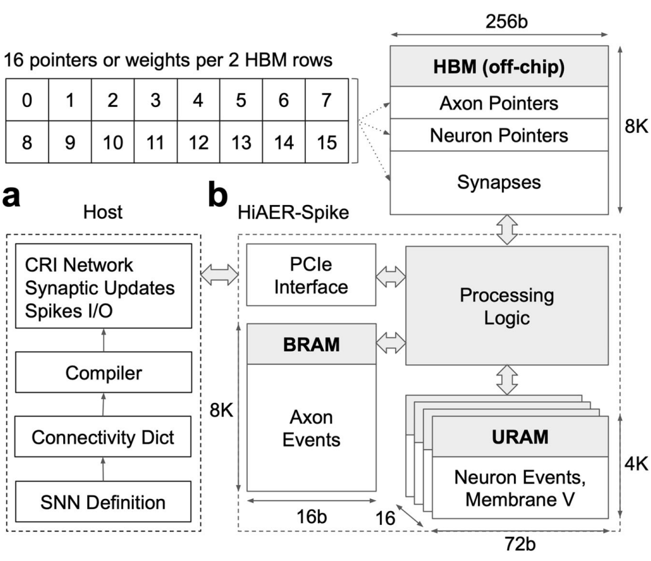
In this work, we present HiAER-Spike, a modular, reconfigurable, event-driven neuromorphic computing platform designed to execute large spiking neural networks with up to 160 million neurons and 40 billion synapses - roughly twice the neurons of a mouse brain at faster than real time. This system, assembled at the UC San Diego Supercomputer Center, comprises a co-designed hard- and software stack that is optimized for run-time massively parallel processing and hierarchical address-event routing (HiAER) of spikes while promoting memory-efficient network storage and execution. The architecture efficiently handles both sparse connectivity and sparse activity for robust and low-latency event-driven inference for both edge and cloud computing. A Python programming interface to HiAER-Spike, agnostic to hardware-level detail, shields the user from complexity in the configuration and execution of general spiking neural networks with minimal constraints in topology. The system is made easily available over a web portal for use by the wider community. In the following, we provide an overview of the hard- and software stack, explain the underlying design principles, demonstrate some of the system’s capabilities, and solicit feedback from the broader neuromorphic community. Examples are shown demonstrating HiAER-Spike’s capabilities for event-driven vision on benchmark CIFAR-10, DVS event-based gesture, MNIST, and Pong tasks.
Overview
CoChat Summary
TL;DR
HiAER-Spike is a modular, reconfigurable FPGA-based event-driven neuromorphic platform hosted at the San Diego Supercomputer Center and accessible via the Neuroscience Gateway, designed to scale to 160 million neurons and 40 billion synapses. Initial single-core benchmarks demonstrate conversion and execution of MLPs, LeNet-5, and spiking CNNs on MNIST, DVS Gesture, CIFAR-10, and Pong with low reported energy and latency.
Key findings
- Planned full system: 40 FPGAs, each intended to support up to 4 million neurons and 1 billion synapses, yielding up to 160 million neurons and 40 billion synapses total — more than twice the neurons of a typical mouse brain and at faster-than-real-time simulation speed. The paper’s experiments use only a single core on one FPGA.
- MNIST: all LeNet-5 variants and the larger MLP variant achieved over 97% test accuracy; all MLP and LeNet-5 variants with input size (1, 28, 28) achieved identical PyTorch and HiAER-Spike test accuracies. Table 3 reports HiAER-Spike at 138 neurons: 96.59% accuracy, 1.1 μJ, 4.2 μs; and at 5814 neurons: 98.14% accuracy, 17.1 μJ, 48.6 μs.
- DVS Gesture: converted HiAER-Spike versus post-quantization SpikingJelly test accuracies ranged from perfect match to a 1.74% discrepancy. The largest deployed spiking CNN had 109,615 neurons, occupying approximately 86% of a single-core system and approximately 0.07% of anticipated maximum system capacity. Table 4 reports HiAER-Spike at 1115 neurons: 54.51% accuracy, 79.8 μJ, 184.9 μs; and at 17,709 neurons: 68.75% accuracy, 510.7 μJ, 1156.2 μs.
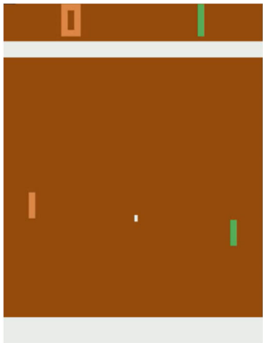
- CIFAR-10 and Pong: CIFAR-10 HiAER-Spike accuracy was 80.49% versus 82.56% software, with 4770.7 μJ and 10,508.5 μs; Pong score was 20.36 versus 20.74 software, with 149.3 μJ and 425.7 μs. For DVS Gesture spiking CNNs, scaling regressions were Energy (μJ) = 0.0294x − 30.293 (R² = 0.994) and Latency (μs) = 0.0658x − 53.031 (R² = 0.995), where x is neuron count, with n = 5.
Methods
- Design: modular, reconfigurable, event-driven neuromorphic platform using FPGA-based computing architecture, hierarchical address-event routing (HiAER), and a co-designed hardware/software stack. Synaptic connectivity is stored in HBM using adjacency lists; spike events and membrane potentials use on-chip BRAM/URAM. The software interface is implemented in C++ and Python via the `hs_api` library and is accessible through the Neuroscience Gateway portal.
- Data/sample: trained MLPs, LeNet-5 variants, and spiking CNNs using PyTorch and SpikingJelly on binarized MNIST, DVS Gesture, CIFAR-10, and a DVS-based Pong task. Networks were quantized to 16-bit integers and converted to run on a single core of one HiAER-Spike FPGA card.
- Analysis: compared software and HiAER-Spike inference accuracy; approximated energy from the number of HBM accesses reported by the FPGA and latency from FPGA-reported clock cycles; performed linear regressions for energy and latency scaling within a single core.
Limitations
- Stated: initial benchmarks use only a single operational core on one FPGA; accuracy generally lower than other platforms; the primary goal was to test and demonstrate the hardware design, software interface, and conversion methods rather than optimize accuracy; DVS Gesture used binarized and downsampled inputs of (2, 63, 63) and (2, 90, 90) rather than full (2, 128, 128) inputs; the frame accumulation method may be improvable; scaling regressions are limited to a small sample size (n = 5); hardware microarchitecture details are deferred to a future manuscript.
- Evident from the text: no multi-core, multi-FPGA, or full-system scaling results are reported; cross-platform comparisons differ in model size, number of time steps, and input preprocessing, so accuracy, energy, and latency comparisons are not controlled.
Model-written summary. Check it against the paper before relying on it.
Integrity signals
Registry
Cites
Statistics
Figures




Verification
Claims the paper makes
3 Valid · 2 Not valid · 5 Not checked · 48 Own results and interpretations
The cited sources support only part of this claim — read each source’s verdict below.
In the paper
“To be able to deploy networks at such scale, we have developed a network partitioning and resource allocation algorithm that assigns SNN simulation jobs to servers, FPGA boards, and cores as required to meet the user ' s requirements 10 .”
What the sources say
- Partly supportedcites [10] Mysore, N., Hota, G., Deiss, S. R., Pedroni, B. U. & Cauwenberghs, G. Hierarchical network connectivity and partitioning for reconfigurable large-scale neuromorphic systems. Front. Neurosci. 15, https://doi.org/10.3389/fnins.2021.797654 (2022). sourceExperimental — accuracy not yet measured
Section 2.2 describes an algorithm that partitions an SNN and maps neurons to cores, while the Introduction says the partitioning can account for hardware constraints and space provided by the user. It does not describe assigning simulation jobs to servers or FPGA boards; the Discussion describes testing the method on FPGA hardware as future work. No page numbers are available in our copy. (LLM, conf=0.88)
plainstates a cause- Asserted: passes — The authors put it forward as true.
- Checkable: passes — It can be checked against evidence.
- Load-bearing: passes — The paper’s conclusions depend on it.
- Based: passes — The paper gives a reason why it holds.
- Partly supported
A result the paper reports from its own data — it cites no other source for it, so there is none to check. The quote shows it is in the paper.
In the paper
“All MLP and LeNet-5 variants with input size (1, 28, 28) achieved identical test accuracies on PyTorch and HiAER-Spike, validating the conversion pipeline and capabilities of the hardware.”
plain- Asserted: passes — The authors put it forward as true.
- Checkable: passes — It can be checked against evidence.
- Load-bearing: passes — The paper’s conclusions depend on it.
- Based: passes — The paper gives a reason why it holds.
A result the paper reports from its own data — it cites no other source for it, so there is none to check. The quote shows it is in the paper.
In the paper
“All LeNet-5 variants and the larger MLP variant achieved over 97% test accuracy.”
plain- Asserted: passes — The authors put it forward as true.
- Checkable: passes — It can be checked against evidence.
- Load-bearing: unclear — It is unclear whether the paper’s conclusions depend on it.
- Based: passes — The paper gives a reason why it holds.
A result the paper reports from its own data — it cites no other source for it, so there is none to check. The quote shows it is in the paper.
In the paper
“Adding more convolutional layers and more channels led to better test accuracies at the cost of higher energy consumption and latency per gesture instance.”
plainstates a cause- Asserted: passes — The authors put it forward as true.
- Checkable: passes — It can be checked against evidence.
- Load-bearing: unclear — It is unclear whether the paper’s conclusions depend on it.
- Based: passes — The paper gives a reason why it holds.
A result the paper states — it cites no source for it, so there is none to check. The quote shows it is in the paper.
In the paper
“In most instances, where reported, other platforms used a signi fi cantly greater number of time steps per inference, which tends to increase the accuracy of SNNs.”
plainstates a cause- Asserted: passes — The authors put it forward as true.
- Checkable: passes — It can be checked against evidence.
- Load-bearing: unclear — It is unclear whether the paper’s conclusions depend on it.
- Based: passes — The paper gives a reason why it holds.
14 more claims
Create a free account to see all 58 claims and every source verdict.
- Probably not a substantial claim. 24
- It may state two separate claims as one. 22
Citations
Cites
Human-level control through deep reinforcement learning
Mnih, V., Kavukcuoglu, K., Silver, D., Rusu, A. A., Veness, J., Bellemare, M. G., Graves, A., Riedmiller, M., Fidjeland, A. K., Ostrovski, G., et al. (2015) · Nature · doi:10.1038/nature14236 · Cited by 30,357
A Low Power, Fully Event-Based Gesture Recognition System
Amir, A., Taba, B., Berg, D., Melano, T., McKinstry, J., Di Nolfo, C., Nayak, T., Andreopoulos, A., Garreau, G., Mendoza, M., et al. (2017) · 2017 IEEE Conference on Computer Vision and Pattern Recognition (CVPR) · doi:10.1109/cvpr.2017.781 · Cited by 1,017 · cited 1×
“We trained these networks on the IBM DVSGesture dataset [19], which contains clips of 11 different gestures (corresponding to our network’s 11 outputs) under 3 different lighting conditions recorded using a DVS camera.”
: Cellular scaling rules for rodent brains.
Herculano-Houzel, S., Mota, B., & Lent, R. (2006) · Proceedings of the National Academy of Sciences · doi:10.1073/pnas.0604911103 · Cited by 579 · cited 1×
“…aim for each FPGA to support up to four million neurons and one billion synapses, yielding a total capacity of up to 160 million neurons and 40 billion synapses for the entire system - more than twice the number of neurons of a typical mouse brain [9] and at faster-than real-time simulation speed.”
SpiNNaker: A 1-W 18-Core System-on-Chip for Massively-Parallel Neural Network Simulation
Painkras, E., Plana, L. A., Garside, J., Temple, S., Galluppi, F., Patterson, C., Lester, D. R., Brown, A. D., & Furber, S. B. (2013) · IEEE Journal of Solid-State Circuits · doi:10.1109/jssc.2013.2259038 · Cited by 530
Cellular scaling rules for primate brains.
Herculano-Houzel, S., Collins, C. E., Wong, P., & Kaas, J. H. (2007) · Proceedings of the National Academy of Sciences · doi:10.1073/pnas.0611396104 · Cited by 422
Rethinking the performance comparison between SNNS and ANNS
Deng, L., Wu, Y., Hu, X., Liang, L., Ding, Y., Li, G., Zhao, G., Li, P., & Xie, Y. (2020) · Neural Networks · doi:10.1016/j.neunet.2019.09.005 · Cited by 343 · cited 1×
“In the field of event-based sensing, particularly with dynamic vision sensors (DVS), this has proven to be a powerful [1] and highly energy efficient mode of computing.”
The BrainScaleS-2 Accelerated Neuromorphic System With Hybrid Plasticity
Pehle, C., Billaudelle, S., Cramer, B., Kaiser, J., Schreiber, K., Stradmann, Y., Weis, J., Leibfried, A., Müller, E., & Schemmel, J. (2022) · Frontiers in Neuroscience · doi:10.3389/fnins.2022.795876 · Cited by 233 · cited 1×
“The upgraded platform, BrainScaleS-2, supports more complex neuron and synapse models [5].”
Massa, R., Marchisio, A., Martina, M., & Shafique, M. (2020) · International Joint Conference on Neural Networks (IJCNN) · doi:10.1109/ijcnn48605.2020.9207109 · Cited by 157
Hierarchical Address Event Routing for Reconfigurable Large-Scale Neuromorphic Systems
Park, J., Yu, T., Joshi, S., Maier, C., & Cauwenberghs, G. (2017) · IEEE Transactions on Neural Networks and Learning Systems · doi:10.1109/tnnls.2016.2572164 · Cited by 118 · cited 1×
“…in turn, contains multiple SNN cores that will run fully in parallel with dedicated interfaces to the on-module HBM. Multiple layers of multicast address-event routing schemes (Network on Chip, FireFly, and Ethernet) [7, 8] will allow spikes to travel efficiently between cores, FPGAs, and servers.”
Self-citationNeural inference at the frontier of energy, space, and time
Modha, D. S., Akopyan, F., Andreopoulos, A., Appuswamy, R., Arthur, J. V., Cassidy, A. S., Datta, P., DeBole, M. V., Esser, S. K., Otero, C. O., et al. (2023) · Science · doi:10.1126/science.adh1174 · Cited by 115 · cited 1×
“IBM recently introduced their NorthPole chip, an evolution of their True North design [6].”
Research works printed but not linked: 2
- Davies, M. et al. Taking neuromorphic computing to the next level with Loihi2. Intel. Labs’ Loihi 2, 1–7 (2021).
- Esser, S. K., Appuswamy, R., Merolla, P., Arthur, J. V. & Modha, D. S. Backpropagation for energy-efficient neuromorphic computing. Adv. Neural Inform. Process. Syst. 28, (2015).
Metadata
- Authors
- Frank, G., Hota, G., Wang, K., Deng, C., Arora, K., Vins, D., Uppal, A., Olajide, O., Yoshimoto, K., Wang, Q., Yamaoka, M., Leugering, J., Deiss, S., Gibb, L., & Cauwenberghs, G.
- Affiliations
- University of California San Diego (US)
- Fujitsu (Japan) (JP)
- Forschungszentrum Jülich (DE)
- Corresponding author
- Frank, Gwenevere
- Gibb, Leif
- Cauwenberghs, Gert
- ORCID
- Venue
- npj Unconventional Computing
- Published
- 2026-05-04
- Volume
- 3
- Issue
- 1
- ISSN
- 3004-8672 (ISSN-L)
- OpenAlex
- W7160205547
- Cited by
- 0
- References
- 17
- FWCI
- 0.00
- Type
- journal article
- Language
- en
- Open access
- hybrid
- doi.org
- Licence
- cc-by
- creativecommons.org/licenses/by/4.0 (tdm)
- creativecommons.org/licenses/by/4.0 (vor)
- Locations
- npj Unconventional Computing (publishedVersion, cc-by)
- arXiv (Cornell University) (submittedVersion, cc-by-nc-sa)
- arXiv (Cornell University)
- Funders
- National Science Foundation (NS-1823366, CCF-2208771)
- Office of Naval Research (N00014-24-1-2127)
- Topics
- Physical Sciences › Engineering › Electrical and Electronic Engineering › Advanced Memory and Neural Computing
- Physical Sciences › Computer Science › Hardware and Architecture › Parallel Computing and Optimization Techniques
- Physical Sciences › Mathematics › Theoretical Computer Science › DNA and Biological Computing
- Keywords
- neuromorphic computing, spiking neural networks, event-driven computing, reconfigurable hardware platform, hardware-software co-design, sparse connectivity, event-based vision, web portal
About these checks
Registry, retraction, Cites and statistics results are computed, not judged, with one exception: a printed reference that no index lists is read once by a model before it counts as a citation error. Claims are extracted by a model and kept only when their quote appears verbatim in the text; each cited source is then checked, with a model’s help, for whether it says what the claim relies on. Those verdicts can be wrong — read the claim’s quote and the cited source before relying on one.
The claim verdicts this report counts are experimental: their accuracy is not yet measured.
A language model drew the claims from the paper on 2026-10-10, under version 3 of the claim definition (model deepseek-v4.1-flash, prompt extract-v3).
A second model labelled each claim on 2026-10-10 (model jev-1.13-20260917, definition revision gold-guideline-v0.2).
Cited sources are checked with a language model’s help (gpt-6-sol).
Statistics and arithmetic are recomputed, not judged.
Confidence bands are shown only for fields calibrated on our annotated test set. None is calibrated yet, so no band is shown.
What counts as a claim ›How we measure confidence ›How we check this ›
Are you an author, or do you see a problem with this page? Request a review
How to cite
Cite CoChat for the checks on this page, and the paper for its own findings.
- This page
- CoChat. (2026). Citation check: HiAER-spike software-hardware reconfigurable platform for event-driven neuromorphic computing at scale. https://app.cochat.ai/papers/10.1038/s44335-026-00062-8
- The paper
- Frank, G., Hota, G., Wang, K., Deng, C., Arora, K., Vins, D., Uppal, A., Olajide, O., Yoshimoto, K., Wang, Q., Yamaoka, M., Leugering, J., Deiss, S., Gibb, L., & Cauwenberghs, G. (2026). HiAER-spike software-hardware reconfigurable platform for event-driven neuromorphic computing at scale. npj Unconventional Computing. https://doi.org/10.1038/s44335-026-00062-8
Data sources
Bibliographic data: Semantic Scholar, OpenAlex, Crossref.
Contains information from the Semantic Scholar Academic Graph Datasets, made available under the ODC Attribution License (ODC-BY 1.0).
Semantic Scholar’s data is described in: Kinney, R., et al. (2023). The Semantic Scholar Open Data Platform. arXiv:2301.10140.
