

The DOI matches its Crossref record; 59 of the 59 references it cites were found in a registry or an index.
Regulatory potential for concerted modulation of Nrf2- and Nfkb1-mediated gene expression in inflammation and carcinogenesis
Open accessAbstract
Many studies have implicated nuclear factor E2-related factor 2 (Nrf2) and nuclear factor-kappaB1 (Nfkb1) in inflammation and cancer. However, the regulatory potential for crosstalk between these two important transcription factors in inflammation and carcinogenesis has not been explored. To delineate conserved transcription factor-binding site signatures, we performed bioinformatic analyses on the promoter regions of human and murine Nrf2 and Nfkb1. We performed multiple sequence alignment of Nrf2 and Nfkb1 genes in five mammalian species - human, chimpanzee, dog, mouse and rat - to explore conserved biological features. We constructed a canonical regulatory network for concerted modulation of Nrf2 and Nfkb1 involving several members of the mitogen-activated protein kinase (MAPK) family and present a putative model for concerted modulation of Nrf2 and Nfkb1 in inflammation/carcinogenesis. Our results reflect potential for putative crosstalk between Nrf2 and Nfkb1 modulated through the MAPK cascade that may influence inflammation-associated etiopathogenesis of cancer. Taken together, the elucidation of potential relationships between Nrf2 and Nfkb1 may help to better understand transcriptional regulation, as well as transcription factor networks, associated with the etiopathogenesis of inflammation and cancer.
Overview
The claims and statistics of this paper haven’t been checked yet.
Run the check — free, no account needed. It reads the open-access text and checks the sources it cites.
Integrity signals
Registry
Cites
Statistics
Figures
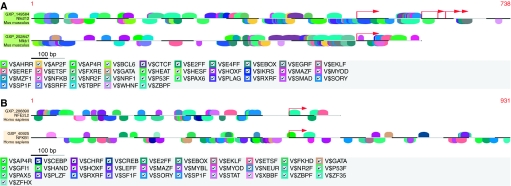
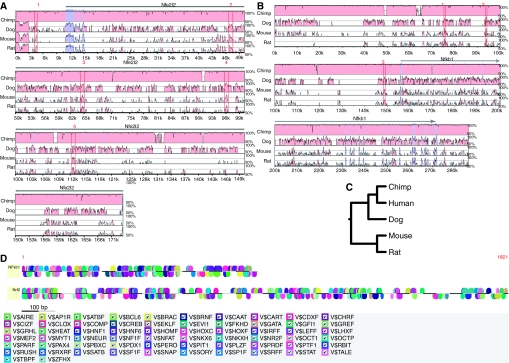
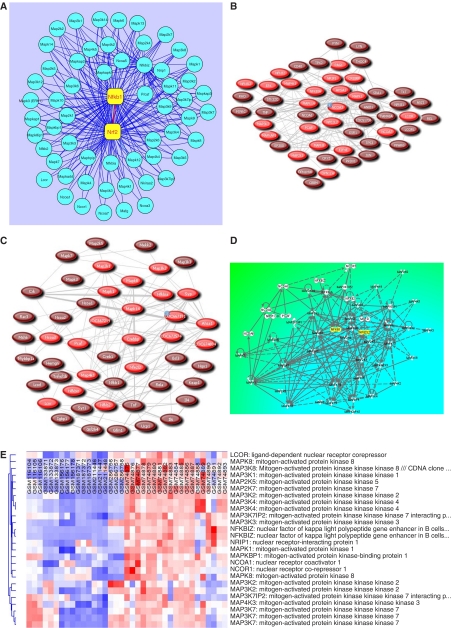
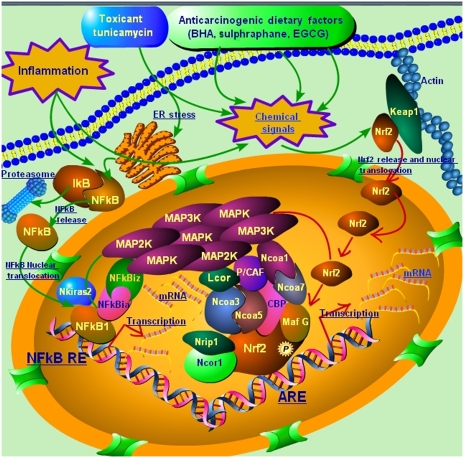
Verification
Claims the paper makes
The claims and statistics of this paper haven’t been checked yet.
Run the check — free, no account needed. It reads the open-access text and checks the sources it cites.
Claims other papers make about this one
Each is checked against this paper’s own text: does it say what the citing paper says it does?
In the citing paper
“In addition, decreased levels of Nrf2, a transcription factor negatively regulated by NF-κB (Liu et al., 2008) that is involved in antioxidants response mechanisms (Nair et al., 2008), have been reported in the brains of AD patients (Ramsey et al., 2007).”
From Exploring the Therapeutic Potential of Phytochemicals in Alzheimer’s Disease: Focus on Polyphenols and Monoterpenes (2022) · cites this paper as Nair et al., 2008
Self-check
Percentages, sums and reported differences re-computed from the paper’s own numbers.
The self-check needs the paper’s full text.
Citations
Cites
Cytoscape: A software Environment for integrated models of biomolecular interaction networks
Shannon, P., Markiel, A., Ozier, O., Baliga, N. S., Wang, J. T., Ramage, D., Amin, N., Schwikowski, B., & Ideker, T. (2003) · Genome Research · doi:10.1101/gr.1239303 · Cited by 51,888
Coussens, L. M., & Werb, Z. (2002) · Nature · doi:10.1038/nature01322 · Cited by 15,111
Inflammation and cancer: back to Virchow?
Balkwill, F., & Mantovani, A. (2001) · The Lancet · doi:10.1016/s0140-6736(00)04046-0 · Cited by 7,746
NF-κB: linking inflammation and immunity to cancer development and progression
Karin, M., & Greten, F. R. (2005) · Nature reviews. Immunology · doi:10.1038/nri1703 · Cited by 3,175
Model-based analysis of oligonucleotide arrays: Expression index computation and outlier detection.
Li, C., & Wong, W. H. (2001) · Proceedings of the National Academy of Sciences · doi:10.1073/pnas.98.1.31 · Cited by 3,133
Quandt, K., Frech, K., Karas, H., Wingender, E., & Werner, T. (1995) · Nucleic Acids Research · doi:10.1093/nar/23.23.4878 · Cited by 2,587
MatInspector and beyond: promoter analysis based on transcription factor binding sites
Cartharius, K., Frech, K., Grote, K., Klocke, B., Haltmeier, M., Klingenhoff, A., Frisch, M., Bayerlein, M., & Werner, T. (2005) · Computer applications in the biosciences · doi:10.1093/bioinformatics/bti473 · Cited by 2,003
LAGAN and Multi-LAGAN: Efficient tools for large-scale multiple alignment of genomic DNA
Brudno, M., Do, C. B., Cooper, G. M., Kim, M. F., Davydov, E., Program, N. C. S., Green, E. D., Sidow, A., & Batzoglou, S. (2003) · Genome Research · doi:10.1101/gr.926603 · Cited by 1,115
Ramos-Gomez, M., Kwak, M.-K., Dolan, P. M., Itoh, K., Yamamoto, M., Talalay, P., & Kensler, T. W. (2001) · Proceedings of the National Academy of Sciences · doi:10.1073/pnas.051618798 · Cited by 1,102
Li, C., & Wong, W. H. (2001) · Genome biology · doi:10.1186/gb-2001-2-8-research0032 · Cited by 977
A literature network of human genes for high-throughput analysis of gene expression
Jenssen, T.-K., Lægreid, A., Komorowski, J., & Hovig, E. J. (2001) · Nature Genetics · doi:10.1038/88213 · Cited by 839
Clements, C. M., McNally, R. S., Conti, B. J., Mak, T. W., & Ting, J. P.-Y. (2006) · Proceedings of the National Academy of Sciences · doi:10.1073/pnas.0607260103 · Cited by 818
Activation of Nrf2-antioxidant signaling attenuates NFκB-inflammatory response and elicits apoptosis
Li, W., Khor, T. O., Xu, C., Shen, G., Jeong, W.-S., Yu, S., & Kong, A.-N. (2008) · Biochemical Pharmacology · doi:10.1016/j.bcp.2008.07.017 · Cited by 738
Self-citationLiu, G.-H., Qu, J., & Shen, X. (2008) · Biochimica et Biophysica Acta (BBA) - Molecular Cell Research · doi:10.1016/j.bbamcr.2008.01.002 · Cited by 697 · cited 2×
“Further, as constitutively active NF-kB occurs in many inflammatory and tumour tissues (Liu et al, 2008), and as Nrf2 is implicated in the etiopathogenesis of many cancers and inflammation-associated conditions (Nair et al, 2007a), we elected to select these two important transcriptional regulators…”
BackgroundTargeting JNK for therapeutic benefit: from junk to gold?
Manning, A. M., & Davis, R. J. (2003) · Nature Reviews Drug Discovery · doi:10.1038/nrd1132 · Cited by 585
Nrf2-Deficient Mice Have an Increased Susceptibility to Dextran Sulfate Sodium–Induced Colitis
Khor, T. O., Huang, M., Kwon, K. H., Chan, J. Y., Reddy, B. S., & Kong, A. T. (2006) · Cancer Research · doi:10.1158/0008-5472.can-06-3562 · Cited by 530
Self-citationA literature network of human genes for high-throughput analysis of gene expression
Jenssen, T.-K., Lægreid, A., Komorowski, J., et al. (2001) · Nature Genetics · doi:10.1038/ng0501-21 · Cited by 487
Chronic Inflammation: A Common and Important Factor in the Pathogenesis of Neoplasia
Schottenfeld, D., & Beebe‐Dimmer, J. (2006) · CA A Cancer Journal for Clinicians · doi:10.3322/canjclin.56.2.69 · Cited by 476
Yu, R., Chen, C., Mo, Y.-Y., Hebbar, V., Owuor, E. D., Tan, T., & Kong, A.-N. T. (2000) · Journal of Biological Chemistry · doi:10.1074/jbc.m004037200 · Cited by 341
Self-citationXu, C., Shen, G., Chen, C., Gélinas, C., & Kong, A. T. (2005) · Oncogene · doi:10.1038/sj.onc.1208656 · Cited by 302
Self-citationJeong, W., Kim, I., Hu, R., & Kong, A. T. (2004) · Pharmaceutical Research · doi:10.1023/b:pham.0000022413.43212.cf · Cited by 264
Self-citationHu, R., XU, C., Shen, G., JAIN, M., Khor, T. O., Gopalkrishnan, A., LIN, W., REDDY, B., CHAN, J., & KONG, A. (2006) · Cancer Letters · doi:10.1016/j.canlet.2005.11.050 · Cited by 241
Self-citationNrf2 mediates cancer protection but not prolongevity induced by caloric restriction
Pearson, K. J., Lewis, K. N., Price, N. L., Chang, J. W., Perez, E., Cascajo, M. V., Tamashiro, K. L., Poosala, S., Csiszár, A., Ungvari, Z. I., et al. (2008) · Proceedings of the National Academy of Sciences · doi:10.1073/pnas.0712162105 · Cited by 238
Osburn, W. O., Karim, B. O., Dolan, P. M., Liu, G., Yamamoto, M. P., Huso, D. L., & Kensler, T. W. (2007) · International Journal of Cancer · doi:10.1002/ijc.22943 · Cited by 197
Regulation of Nrf2 Transactivation Domain Activity
Shen, G., Hebbar, V., Nair, S., Xu, C., Li, W., Lin, W., Keum, Y.-S., Han, J., Gallo, M. A., & Kong, A.-N. T. (2004) · Journal of Biological Chemistry · doi:10.1074/jbc.m401368200 · Cited by 194
Self-citationNFKB and NFKBI polymorphisms in relation to susceptibility of tumour and other diseases.
Sun, X.-F., & Zhang, H. (2007) · PubMed · doi:10.14670/hh-22.1387 · Cited by 185
Shen, G., Xu, C., Hu, R., Jain, M. R., Gopalkrishnan, A., Nair, S., Huang, M., Chan, J. Y., & Kong, A. T. (2006) · Molecular Cancer Therapeutics · doi:10.1158/1535-7163.mct-05-0293 · Cited by 179
Self-citationMining for regulatory programs in the cancer transcriptome
Rhodes, D. R., Sundaram, S. K., Mahavisno, V., Barrette, T. R., Ghosh, D., & Chinnaiyan, A. M. (2005) · Nature Genetics · doi:10.1038/ng1578 · Cited by 166
Nair, S., Wenge, L. I., & Kong, A. T. (2007) · Acta Pharmacologica Sinica · doi:10.1111/j.1745-7254.2007.00549.x · Cited by 163
Self-citationShen, G., Xu, C., Hu, R., Jain, M. R., Nair, S., Lin, W., Yang, C. S., Chan, J. Y., & Kong, A.-N. T. (2005) · Pharmaceutical Research · doi:10.1007/s11095-005-7546-8 · Cited by 159
Self-citationCancer chemoprevention: scientific promise, clinical uncertainty
Sporn, M. B., & Liby, K. T. (2005) · Nature Clinical Practice Oncology · doi:10.1038/ncponc0319 · Cited by 157
Nrf2 Possesses a Redox-sensitive Nuclear Exporting Signal in the Neh5 Transactivation Domain
Li, W., Yu, S., & Kong, A.-N. T. (2006) · Journal of Biological Chemistry · doi:10.1074/jbc.m602746200 · Cited by 157
Self-citationHu, R., Xu, C., Shen, G., Jain, M. R., Khor, T. O., Gopalkrishnan, A., Lin, W., Reddy, B. S., Chan, J. Y., & Kong, A. T. (2006) · Life Sciences · doi:10.1016/j.lfs.2006.06.019 · Cited by 148
Self-citationPuthia, M., Lu, J., & Tan, K. S. W. (2007) · Eukaryotic Cell · doi:10.1128/ec.00371-07 · Cited by 139
Nrf2 Transcriptionally Activates the mafG Gene through an Antioxidant Response Element
Katsuoka, F., Motohashi, H., Engel, J. D., & Yamamoto, M. P. (2004) · Journal of Biological Chemistry · doi:10.1074/jbc.m411451200 · Cited by 129
Yuan, X., Xu, C., Pan, Z., Keum, Y., Kim, J. H., Shen, G., Yu, S., Oo, K. T., Ma, J., & Kong, A. T. (2006) · Molecular Carcinogenesis · doi:10.1002/mc.20234 · Cited by 128
Self-citationProfita, M., Bonanno, A., Siena, L., Ferraro, M., Montalbano, A. M., Pompeo, F., Riccobono, L., Pieper, M. P., & Gjomarkaj, M. (2008) · European Journal of Pharmacology · doi:10.1016/j.ejphar.2007.12.029 · Cited by 120
How molecular profiling could revolutionize drug discovery
Stoughton, R. B., & Friend, S. H. (2005) · Nature Reviews Drug Discovery · doi:10.1038/nrd1696 · Cited by 118
Phosphoprotein levels, MAPK activities and NFκB expression are affected by fisetin
de Sousa, R. R. R., Queiroz, K. C. S., de Souza, A. C. S., Gurgueira, S. A., Augusto, A. C., Miranda, M. A., Peppelenbosch, M. P., Ferreira, C. V., & Aoyama, H. (2007) · Journal of Enzyme Inhibition and Medicinal Chemistry · doi:10.1080/14756360601162063 · Cited by 118
The NF-κB pathway blockade by the IKK inhibitor PS1145 can overcome Imatinib resistance
Cilloni, D., Messa, F., Arruga, F., Defilippi, I., Morotti, A., Messa, E., Carturan, S., Giugliano, E., Pautasso, M., Bracco, E., et al. (2005) · Leukemia · doi:10.1038/sj.leu.2403998 · Cited by 116
Tliba, O., Cidlowski, J. A., & Amrani, Y. (2005) · Molecular Pharmacology · doi:10.1124/mol.105.019679 · Cited by 103
Xu, J., Chavis, J. A., Racke, M. K., & Drew, P. D. (2006) · Journal of Neuroimmunology · doi:10.1016/j.jneuroim.2006.04.019 · Cited by 98
Keum, Y., Han, Y., Liew, C. V., Kim, J. H., Xu, C., Yuan, X., Shakarjian, M. P., Chong, S., & Kong, A. T. (2006) · Pharmaceutical Research · doi:10.1007/s11095-006-9094-2 · Cited by 98
Self-citationNrf2 Possesses a Redox-insensitive Nuclear Export Signal Overlapping with the Leucine Zipper Motif
Li, W., Jain, M. R., Chen, C., Yue, X., Hebbar, V., Zhou, R., & Kong, A.-N. T. (2005) · Journal of Biological Chemistry · doi:10.1074/jbc.m410601200 · Cited by 95
Self-citationSignalling platforms that modulate the inflammatory response: new targets for drug development
McCulloch, C. A., Downey, G. P., & El-Gabalawy, H. S. (2006) · Nature Reviews Drug Discovery · doi:10.1038/nrd2109 · Cited by 90
Role of nuclear factor κb in synovial inflammation
Müller‐Ladner, U., Gay, R. E., & Gay, S. (2002) · Current Rheumatology Reports · doi:10.1007/s11926-002-0066-1 · Cited by 66
Prawan, A., Keum, Y.-S., Khor, T. O., Yu, S., Nair, S., Li, W., Hu, L., & Kong, A. T. (2007) · Pharmaceutical Research · doi:10.1007/s11095-007-9370-9 · Cited by 65
Self-citationNair, S., Xu, C., Shen, G., Hebbar, V., Gopalakrishnan, A., Hu, R., Jain, M. R., Lin, W., Keum, Y.-S., Liew, C. V., et al. (2006) · Pharmaceutical Research · doi:10.1007/s11095-006-9099-x · Cited by 63
Self-citationNair, S., XU, C., Shen, G., Hebbar, V., Gopalakrishnan, A., Hu, R., JAIN, M., Liew, C. V., CHAN, J., & KONG, A. (2006) · Toxicology Letters · doi:10.1016/j.toxlet.2006.10.012 · Cited by 60
Self-citationMcDonnell, T. J., Chari, N. S., Cho‐Vega, J. H., Troncoso, P., Wang, X., Bueso-Ramos, C., Coombes, K. R., Brisbay, S. M., Lopez, R., Prendergast, G. C., et al. (2008) · BMC Medical Genomics · doi:10.1186/1755-8794-1-1 · Cited by 57
Umannová, L., Machala, M., Topinka, J., Nováková, Z. V., Milcová, A., Kozubı́k, A., & Vondráček, J. (2008) · Mutation research. Fundamental and molecular mechanisms of mutagenesis · doi:10.1016/j.mrfmmm.2008.02.001 · Cited by 52
Kim, H., Yang, E., Lee, J., Kim, S. H., Shin, J., Park, J. Y., Choi, S. J., Kim, S., & Choi, I. (2008) · Immunology · doi:10.1111/j.1365-2567.2007.02799.x · Cited by 45
Inciting inflammation: the RAGE about tumor promotion
Dougan, M. L., & Dranoff, G. (2008) · The Journal of Experimental Medicine · doi:10.1084/jem.20080136 · Cited by 44
Pharmacokinetics, Pharmacodynamics and Drug Metabolism
Barve, A., Khor, T. O., Nair, S., Lin, W., Yu, S., Jain, M. R., Chan, J. Y., & Kong, A. T. (2008) · Journal of Pharmaceutical Sciences · doi:10.1002/jps.21311 · Cited by 43
Self-citationMurakami, A., Song, M.-Y., & Ohigashi, H. (2007) · Biofactors · doi:10.1002/biof.5520300101 · Cited by 30
Prediction of synergistic transcription factors by function conservation
Hu, Z., Hu, B., & Collins, J. F. (2007) · Genome biology · doi:10.1186/gb-2007-8-12-r257 · Cited by 25
Sheahan, S., Bellamy, C. O. C., Dunbar, D. R., Harrison, D. J., & Prost, S. (2007) · BMC Cancer · doi:10.1186/1471-2407-7-215 · Cited by 23
Non-coding sequence retrieval system for comparative genomic analysis of gene regulatory elements
Doh, S. T., Zhang, Y., Temple, M. H., & Cai, L. (2007) · BMC Bioinformatics · doi:10.1186/1471-2105-8-94 · Cited by 15
Self-citationFionda, C., Nappi, F., Piccoli, M., Frati, L., Santoni, A., & Cippitelli, M. (2007) · Molecular Pharmacology · doi:10.1124/mol.107.038042 · Cited by 13
Cited by
Sorted by citations
Brigelius-Flohé, R., & Maiorino, M. (2013) · Biochimica et Biophysica Acta (BBA) - General Subjects · doi:10.1016/j.bbagen.2012.11.020 · Cited by 1,904
NRF2, a Transcription Factor for Stress Response and Beyond
He, F., Ru, X., & Wen, T. (2020) · International Journal of Molecular Sciences · doi:10.3390/ijms21134777 · Cited by 1,820
The Nrf2 cell defence pathway: Keap1-dependent and -independent mechanisms of regulation
Bryan, H. K., Olayanju, A., Goldring, C. E., & Park, B. K. (2012) · Biochemical Pharmacology · doi:10.1016/j.bcp.2012.11.016 · Cited by 1,047
Buendía, I., Michalska, P., Navarro, E., Gameiro‐Ros, I., Egea, J., & Leon, R. M. (2015) · Pharmacology & Therapeutics · doi:10.1016/j.pharmthera.2015.11.003 · Cited by 698
When NRF2 Talks, Who's Listening?
Wakabayashi, N., Slocum, S. L., Skoko, J. J., Shin, S., & Kensler, T. W. (2010) · Antioxidants & Redox Signaling · doi:10.1089/ars.2010.3216 · Cited by 595
Metadata
- Authors
- Nair, S., Doh, S. T., Chan, J. Y., Kong, A.-N., & Cai, L.
- Affiliations
- Rutgers, The State University of New Jersey (US)
- University of California, Irvine (US)
- Corresponding author
- Cai, L
- Venue
- British Journal of Cancer
- Published
- 2008-12
- Volume
- 99
- Issue
- 12
- Pages
- 2070-2082
- ISSN
- 0007-0920 (ISSN-L)
- 1532-1827
- PMC
- PMC2607222
- OpenAlex
- W2059649811
- Cited by
- 167
- References
- 58
- Citations by year
- 2026: 8 · 2025: 9 · 2024: 6 · 2023: 7 · 2022: 11 · 2021: 8 · 2020: 13 · 2019: 13 · 2018: 10 · 2017: 16 · 2016: 13 · 2015: 11 · 2014: 7 · 2013: 8 · 2012: 10
- FWCI
- 2.20
- Type
- journal article
- Language
- en
- Open access
- hybrid
- doi.org
- Licence
- cc-by-nc-sa
- www.springer.com/tdm (unspecified)
- Locations
- British Journal of Cancer (publishedVersion, cc-by-nc-sa)
- PubMed Central (publishedVersion, cc-by)
- PubMed (publishedVersion)
- Rutgers University Community Repository (Rutgers University) (submittedVersion)
- eScholarship (California Digital Library) (submittedVersion, cc-by)
- Funders
- National Institutes of Health
- National Cancer Institute (CA133675, R01CA094828, R21CA133675)
- National Institute of Environmental Health Sciences (P30ES005022)
- Topics
- Life Sciences › Biochemistry, Genetics and Molecular Biology › Molecular Biology › Genomics, phytochemicals, and oxidative stress
- Life Sciences › Biochemistry, Genetics and Molecular Biology › Cancer Research › NF-κB Signaling Pathways
- Life Sciences › Biochemistry, Genetics and Molecular Biology › Molecular Biology › Signaling Pathways in Disease
- Keywords
- Nrf2, NFKB1, transcription factor crosstalk, inflammation, carcinogenesis, MAPK signaling, transcription factor binding sites, promoter analysis, transcriptional regulation, inflammation-associated cancer
- MeSH terms
- Amino Acid Sequence, Animals, Binding Sites, Cell Transformation, Neoplastic, Humans, Inflammation, Molecular Sequence Data, Gene Expression Regulation, Neoplastic, Sequence Alignment, Conserved Sequence, Computational Biology, Microarray Analysis, NF-E2-Related Factor 2, Mice, Rats, NF-kappa B p50 Subunit
About these checks
Registry, retraction, Cites and statistics results are computed, not judged, with one exception: a printed reference that no index lists is read once by a model before it counts as a citation error. Claims are extracted by a model and kept only when their quote appears verbatim in the text; each cited source is then checked, with a model’s help, for whether it says what the claim relies on. Those verdicts can be wrong — read the claim’s quote and the cited source before relying on one.
Statistics and arithmetic are recomputed, not judged.
Confidence bands are shown only for fields calibrated on our annotated test set. None is calibrated yet, so no band is shown.
What counts as a claim ›How we measure confidence ›How we check this ›
Are you an author, or do you see a problem with this page? Request a review
