

The DOI matches its Crossref record; 42 of the 42 references it cites were found in a registry or an index.
Relationship between telomere shortening, genetic instability, and site of tumour origin in colorectal cancers
Open accessAbstract
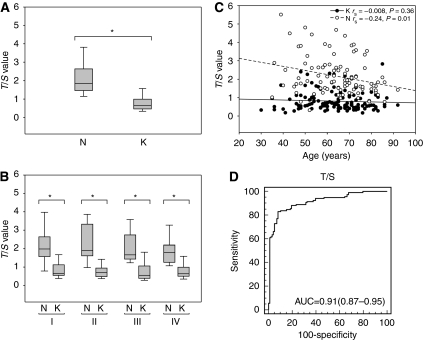
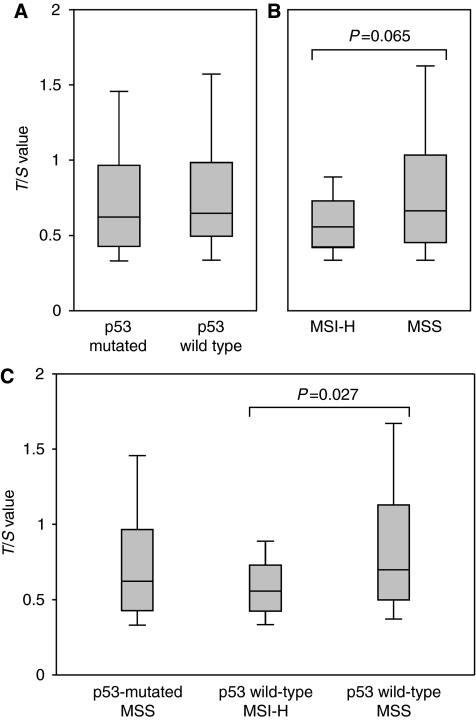
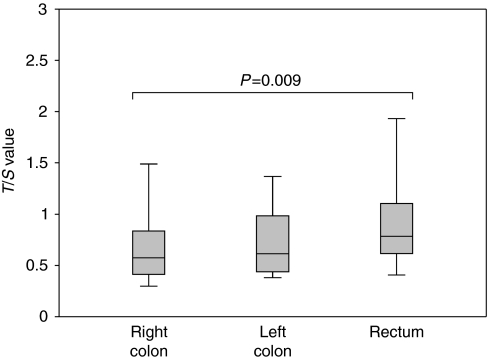
BACKGROUND: Telomeres, located at chromosome ends, are progressively shortened during each cell cycle by replication-dependent loss of DNA termini. Although maintenance of telomere length is critical for cell-replicative potential and tumourigenesis, the erosion of telomeres can lead to genetic instability, a pivotal mechanism in the neoplastic process. PATIENTS AND METHODS: A total of 118 colorectal cancer (CRC) samples (53 right-colon, 30 left-colon, and 35 rectal tumours) and corresponding adjacent non-cancerous tissues were evaluated for telomere length, p53 mutation, and microsatellite instability (MSI). Telomere length was estimated by real-time PCR. RESULTS: Telomeres were significantly shorter in CRCs than in adjacent tissues, regardless of tumour stage and grade, site, or genetic alterations (P<0.0001). Moreover, in normal tissues, but not in tumours, telomere length inversely correlated with age (r=-0.24, P=0.017). Telomere length in CRCs did not differ with tumour progression or p53 status; however, in CRCs carrying the wild-type p53, telomeres were significantly shorter in tumours with MSI than in those with stable microsatellites (P=0.027). Furthermore, telomere length differed according to tumour location, being longer in rectal cancers (P=0.03). CONCLUSIONS: These findings suggest that telomere shortening is a key initial event in colorectal carcinogenesis. The extent of telomere erosion is related to tumour origin site and may be influenced by the mismatch repair pathway.
Overview
The claims and statistics of this paper haven’t been checked yet.
Run the check — free, no account needed. It reads the open-access text and checks the sources it cites.
Integrity signals
Registry
Cites
Statistics
Figures
Verification
Claims the paper makes
The claims and statistics of this paper haven’t been checked yet.
Run the check — free, no account needed. It reads the open-access text and checks the sources it cites.
Claims other papers make about this one
Each is checked against this paper’s own text: does it say what the citing paper says it does?
In the citing paper
“Regarding TL and tumor location, while earlier findings suggested that rectal cancers had a tendency to bear longer telomeres [200], a formal correlation between TL and tumor location is still debated.”
From Current and Future Trends of Colorectal Cancer Treatment: Exploring Advances in Immunotherapy (2024) · cites this paper as [200]
Self-check
Percentages, sums and reported differences re-computed from the paper’s own numbers.
The self-check needs the paper’s full text.
Citations
Cites
(2002) · Springer eBooks · doi:10.1007/978-1-4757-3656-4 · Cited by 6,375
Boland, C. R., Thibodeau, S. N., Hamilton, S. R., Sidransky, D., Eshleman, J. R., Burt, R. W., Meltzer, S. J., Rodrı́guez-Bigas, M. A., Fodde, R., Ranzani, G. N., et al. (1998) · PubMed · Cited by 4,087
Telomere measurement by quantitative PCR
Cawthon, R. (2002) · Nucleic Acids Research · doi:10.1093/nar/30.10.e47 · Cited by 3,550
Clues to the Pathogenesis of Familial Colorectal Cancer
Aaltonen, L. A., Peltomäki, P., Leach, F. S., Sistonen, P., Pylkkänen, L., Mecklin, J., Järvinen, H., Powell, S. M., Jen, J., Hamilton, S. R., et al. (1993) · Science · doi:10.1126/science.8484121 · Cited by 2,683
AJCC Cancer Staging Manual. 6th ed
Greene, F., Page, D., Id, F., Fritz, J., Balch, C., & Haller, D. (2002) · Cited by 2,324
Telomere reduction in human colorectal carcinoma and with ageing
Hastie, N. D., Dempster, M., Dunlop, M. G., Thompson, A. M., Green, D. K., & Allshire, R. C. (1990) · Nature · doi:10.1038/346866a0 · Cited by 1,650
Telomeres and human disease: ageing, cancer and beyond
Blasco, M. A. (2005) · Nature Reviews Genetics · doi:10.1038/nrg1656 · Cited by 1,434
Genomic and Epigenetic Instability in Colorectal Cancer Pathogenesis
Grady, W. M., & Carethers, J. M. (2008) · Gastroenterology · doi:10.1053/j.gastro.2008.07.076 · Cited by 991
Telomeres and telomerase: the path from maize, Tetrahymena and yeast to human cancer and aging
Blackburn, E. H., Greider, C. W., & Szostak, J. W. (2006) · Nature Medicine · doi:10.1038/nm1006-1133 · Cited by 880
Telomeres and telomerase in cancer
Artandi, S. E., & DePinho, R. A. (2010) · Carcinogenesis · doi:10.1093/carcin/bgp268 · Cited by 823
Are there two sides to colorectal cancer?
Iacopetta, B. J. (2002) · International Journal of Cancer · doi:10.1002/ijc.10635 · Cited by 781
Telomere and telomerase in stem cells
Hiyama, E., & Hiyama, K. (2007) · British Journal of Cancer · doi:10.1038/sj.bjc.6603671 · Cited by 573
Deficient mismatch repair system in patients with sporadic advanced colorectal cancer
Koopman, M., Kortman, G. A. M., Mekenkamp, L. J., Ligtenberg, M. J. L., Hoogerbrugge, N., Antonini, N. F., Punt, C. J. A., & van Krieken, J. H. (2009) · British Journal of Cancer · doi:10.1038/sj.bjc.6604867 · Cited by 521
Molecular Classification and Correlates in Colorectal Cancer
Ogino, S., & Goel, A. (2007) · Journal of Molecular Diagnostics · doi:10.2353/jmoldx.2008.070082 · Cited by 474
Association between chromosomal instability and prognosis in colorectal cancer: a meta-analysis
Walther, A., Houlston, R. S., & Tomlinson, I. P. M. (2008) · Gut · doi:10.1136/gut.2007.135004 · Cited by 368
Kim, G. P., Colangelo, L. H., Wieand, H. S., Paik, S., Kirsch, I. R., Wolmark, N., & Allegra, C. J. (2007) · Journal of Clinical Oncology · doi:10.1200/jco.2006.05.8172 · Cited by 341
Two colons‐two cancers: Paradigm shift and clinical implications
Gervaz, P., Bucher, P., & Morel, P. (2004) · Journal of Surgical Oncology · doi:10.1002/jso.20156 · Cited by 311
Telomere Length Abnormalities Occur Early in the Initiation of Epithelial Carcinogenesis
Meeker, A. K., Hicks, J. L., Iacobuzio-Donahue, C. A., Montgomery, E. A., Westra, W. H., Chan, T. Y., Ronnett, B. M., & De Marzo, A. M. (2004) · Clinical Cancer Research · doi:10.1158/1078-0432.ccr-0984-03 · Cited by 306
Hypermethylator Phenotype in Sporadic Colon Cancer: Study on a Population-Based Series of 582 Cases
Barault, L., Charon‐Barra, C., Jooste, V., de la Vega, M. F., Martin, L., Roignot, P., Rat, P., Bouvier, A., Laurent‐Puig, P., Faivre, J., et al. (2008) · Cancer Research · doi:10.1158/0008-5472.can-08-1171 · Cited by 285
Colorectal cancer, one entity or three
Li, F., & Lai, M.-D. (2009) · Journal of Zhejiang University SCIENCE B · doi:10.1631/jzus.b0820273 · Cited by 274
A Quantitative Real-Time PCR Method for Absolute Telomere Length
O’Callaghan, N. J., Dhillon, V. S., Thomas, P., & Fenech, M. F. (2008) · BioTechniques · doi:10.2144/000112761 · Cited by 258
Balancing instability: dual roles for telomerase and telomere dysfunction in tumorigenesis
Hackett, J. A., & Greider, C. W. (2002) · Oncogene · doi:10.1038/sj.onc.1205061 · Cited by 249
Engelhardt, M. M., Drullinsky, P. R., Guillem, J. G., & Moore, M. A. S. (1997) · PubMed · Cited by 189
Bechter, O. E., Zou, Y. S., Walker, W., Wright, W. E., & Shay, J. W. (2004) · Cancer Research · doi:10.1158/0008-5472.can-04-0323 · Cited by 188
Gertler, R., Rosenberg, R., Stricker, D., Friederichs, J., Hoos, A., Werner, M., Ulm, K., Holzmann, B., Nekarda, H., & Siewert, J.-R. (2004) · Journal of Clinical Oncology · doi:10.1200/jco.2004.09.160 · Cited by 180
Risques, R. A., Lai, L. A., Brentnall, T. A., Li, L., Feng, Z., Gallaher, J. L., Mandelson, M. T., Potter, J. D., Bronner, M. P., & Rabinovitch, P. S. (2008) · Gastroenterology · doi:10.1053/j.gastro.2008.04.008 · Cited by 179
Genetic and epigenetic modulation of telomerase activity in development and disease
Liu, L., Lai, S. R., Andrews, L. G., & Tollefsbol, T. O. (2004) · Gene · doi:10.1016/j.gene.2004.06.011 · Cited by 123
Ogino, S., Nosho, K., Irahara, N., Shima, K., Baba, Y., Kirkner, G. J., Meyerhardt, J. A., & Fuchs, C. S. (2009) · Journal of Clinical Oncology · doi:10.1200/jco.2009.22.8858 · Cited by 121
Garcia‐Aranda, C., de Juan, C., Diaz‐Lopez, A., Sanchez‐Pernaute, A., Torres, A., Diaz‐Rubio, E., Balibrea, J., Benito, M., & Iniesta, P. (2006) · Cancer · doi:10.1002/cncr.21625 · Cited by 105
Terrin, L., Rampazzo, E., Pucciarelli, S., Agostini, M., Bertorelle, R., Esposito, G., DelBianco, P., Nitti, D., & De Rossi, A. (2008) · Clinical Cancer Research · doi:10.1158/1078-0432.ccr-08-0478 · Cited by 91
Self-citationTelomere Length in the Colon Declines with Age: a Relation to Colorectal Cancer?
O'Sullivan, J. N., Risques, R. A., Mandelson, M. T., Chen, L., Brentnall, T. A., Bronner, M. P., MacMillan, M. P., Feng, Z., Siebert, J. R., Potter, J. D., et al. (2006) · Cancer Epidemiology Biomarkers & Prevention · doi:10.1158/1055-9965.epi-05-0542 · Cited by 78
Terrin, L., Trentin, L., Degan, M., Corradini, I., Bertorelle, R., Carli, P., Maschio, N., Bo, M. D., Noventa, F., Gattei, V., et al. (2007) · Leukemia · doi:10.1038/sj.leu.2404607 · Cited by 66
Self-citationRaynaud, C. M., Jang, S. J., Nuciforo, P. G., Lantuéjoul, S., Brambilla, E. M., Mounier, N., Olaussen, K. A., André, F., Morat, L., Sabatier, L., et al. (2008) · Annals of Oncology · doi:10.1093/annonc/mdn405 · Cited by 65
Perera, S. A., Maser, R. S., Xia, H., McNamara, K. L., Protopopov, A. I., Chen, L., Hezel, A. F., Kim, C. F., Bronson, R. T., Castrillón, D. H., et al. (2008) · Carcinogenesis · doi:10.1093/carcin/bgn050 · Cited by 59
Association of p53 Gene and Protein Alterations with Metastases in Colorectal Cancer
Bertorelle, R., Esposito, G., Mistro, A. D., Belluco, C., Nitti, D., Lise, M., & Chieco-Bianchi, L. (1995) · The American Journal of Surgical Pathology · doi:10.1097/00000478-199504000-00008 · Cited by 57
Self-citationGene Dosage by Quantitative Real-Time PCR
Boulay, J., Reuter, J., Ritschard, R., Terracciano, L., Herrmann, R., & Rochlitz, C. F. (1999) · BioTechniques · doi:10.2144/99272bm03 · Cited by 52
Telomere shortening and the clinicopathologic characteristics of human colorectal carcinomas
Takagi, S., Kinouchi, Y., Hiwatashi, N., Chida, M., Nagashima, F., Takahashi, S., Negoro, K., Shimosegawa, T., & Toyota, T. (1999) · Cancer · doi:10.1002/(sici)1097-0142(19991015)86:8 · Cited by 47
Nishikura, K., Erikson, J., ar-Rushdi, A., Huebner, K., & Croce, C. M. (1985) · Proceedings of the National Academy of Sciences · doi:10.1073/pnas.82.9.2900 · Cited by 38
Katayama, S., Shiota, G., Oshimura, M., & Kawasaki, H. (1999) · Journal of Cancer Research and Clinical Oncology · doi:10.1007/s004320050294 · Cited by 31
Pucciarelli, S., Agostini, M., Viel, A., Bertorelle, R., Russo, V. M., Toppan, P., & Lise, M. (2003) · Diseases of the Colon & Rectum · doi:10.1007/s10350-004-6546-9 · Cited by 25
Self-citationRelationship between microsatellite instability and telomere shortening in colorectal cancer
Takagi, S., Kinouchi, Y., Hiwatashi, N., Nagashima, F., Chida, M., Takahashi, S., Negoro, K., Shimosegawa, T., & Toyota, T. (2000) · Diseases of the Colon & Rectum · doi:10.1007/bf02237220 · Cited by 24
Rosti, G., Giorgi, U. D., Frassineti, G. L., Ciucci, G., Spinolo, L., Flamini, E., Giovannini, N., Monti, M., Zumaglini, F., & Marangolo, M. (2004) · Journal of Clinical Oncology · doi:10.1200/jco.2004.22.14_suppl.807 · Cited by 1
Cited by
Sorted by citations
Genomic Instability and Cancer
Dai, Y. Y. W. (2014) · Journal of Carcinogenesis & Mutagenesis · doi:10.4172/2157-2518.1000165 · Cited by 264
Ardekani, G. S., Jafarnejad, S. M., Tan, L., Saeedi, A., & Li, G. (2012) · PLoS ONE · doi:10.1371/journal.pone.0047054 · Cited by 231
Eisenberg, D. T. A. (2010) · American Journal of Human Biology · doi:10.1002/ajhb.21127 · Cited by 215
Telomere Shortening and Alzheimer’s Disease
Cai, Z., Yan, L., & Ratka, A. (2012) · NeuroMolecular Medicine · doi:10.1007/s12017-012-8207-9 · Cited by 121
Oikonomou, E., Koustas, E., Goulielmaki, M., & Pintzas, A. (2014) · Oncotarget · doi:10.18632/oncotarget.2555 · Cited by 113
Metadata
- Authors
- Rampazzo, E., Bertorelle, R., Serra, L., Terrin, L., Candiotto, C., Pucciarelli, S., Bianco, P. D., Nitti, D., & De Rossi, A.
- Affiliations
- University of Padua (IT)
- Istituto Oncologico Veneto (IT)
- Venue
- British Journal of Cancer
- Published
- 2010-04
- Volume
- 102
- Issue
- 8
- Pages
- 1300-1305
- ISSN
- 0007-0920 (ISSN-L)
- 1532-1827
- PMC
- PMC2856015
- OpenAlex
- W2003751750
- Cited by
- 125
- References
- 42
- Citations by year
- 2026: 3 · 2025: 1 · 2024: 9 · 2023: 6 · 2022: 4 · 2021: 6 · 2020: 6 · 2019: 7 · 2018: 9 · 2017: 4 · 2016: 6 · 2015: 14 · 2014: 16 · 2013: 11 · 2012: 13
- FWCI
- 7.36
- Type
- journal article
- Language
- en
- Open access
- hybrid
- doi.org
- Licence
- cc-by-nc-sa
- www.springer.com/tdm (unspecified)
- Locations
- British Journal of Cancer (publishedVersion, cc-by-nc-sa)
- PubMed Central (publishedVersion, cc-by-nc-sa)
- PubMed (publishedVersion)
- Padua Research Archive (University of Padova) (submittedVersion, cc-by-nc-sa)
- Funders
- Ministero della Salute
- Associazione Italiana per la Ricerca sul Cancro
- Topics
- Life Sciences › Biochemistry, Genetics and Molecular Biology › Cell Biology › Telomeres, Telomerase, and Senescence
- Health Sciences › Medicine › Pathology and Forensic Medicine › Genetic factors in colorectal cancer
- Health Sciences › Medicine › Oncology › Cancer-related Molecular Pathways
- Keywords
- telomere shortening, colorectal cancer, genomic instability, microsatellite instability, TP53 mutation, rectal cancer, right-sided colon cancer, left-sided colon cancer, DNA mismatch repair, carcinogenesis, telomere length
- MeSH terms
- Adult, Aged, Aged, 80 and over, Female, Humans, Intestinal Mucosa, Male, Middle Aged, Colorectal Neoplasms, Telomere, Telomerase, Genomic Instability
About these checks
Registry, retraction, Cites and statistics results are computed, not judged, with one exception: a printed reference that no index lists is read once by a model before it counts as a citation error. Claims are extracted by a model and kept only when their quote appears verbatim in the text; each cited source is then checked, with a model’s help, for whether it says what the claim relies on. Those verdicts can be wrong — read the claim’s quote and the cited source before relying on one.
Statistics and arithmetic are recomputed, not judged.
Confidence bands are shown only for fields calibrated on our annotated test set. None is calibrated yet, so no band is shown.
What counts as a claim ›How we measure confidence ›How we check this ›
Are you an author, or do you see a problem with this page? Request a review
