

Solving Quantum Ground-State Problems with Nuclear Magnetic Resonance
Open accessThe DOI matches its Crossref record; 37 of the 38 references it cites were found in a registry or an index.
Abstract
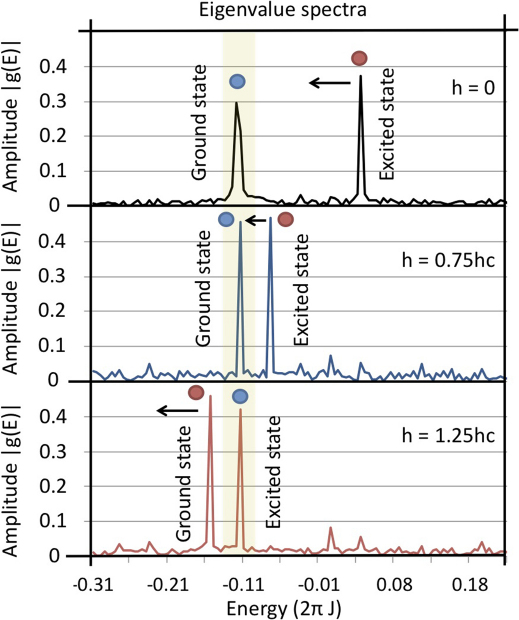
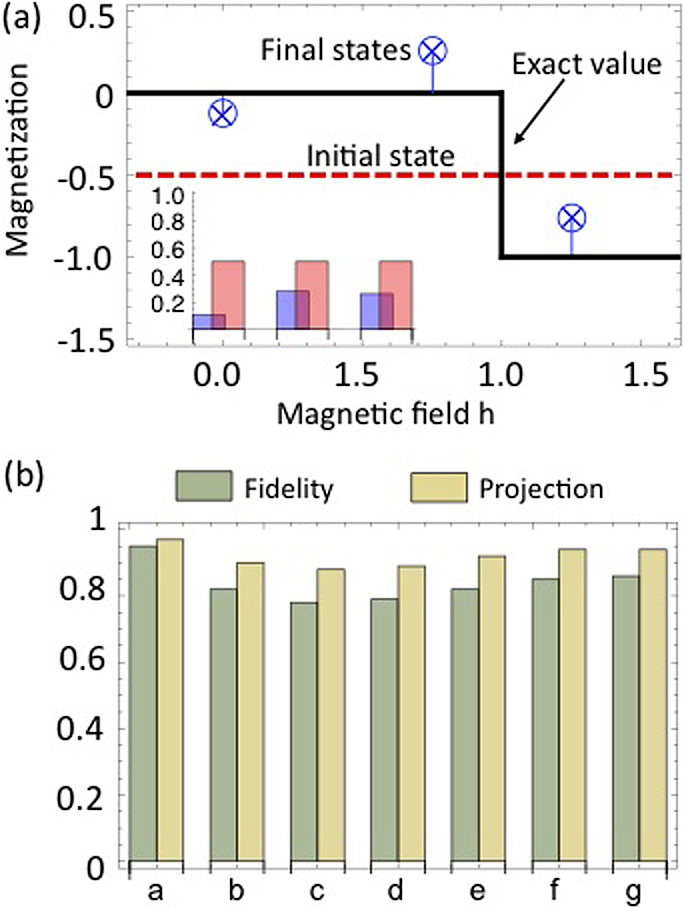
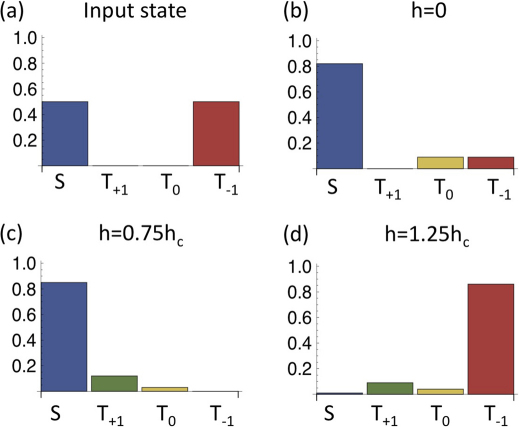
Quantum ground-state problems are computationally hard problems for general many-body Hamiltonians; there is no classical or quantum algorithm known to be able to solve them efficiently. Nevertheless, if a trial wavefunction approximating the ground state is available, as often happens for many problems in physics and chemistry, a quantum computer could employ this trial wavefunction to project the ground state by means of the phase estimation algorithm (PEA). We performed an experimental realization of this idea by implementing a variational-wavefunction approach to solve the ground-state problem of the Heisenberg spin model with an NMR quantum simulator. Our iterative phase estimation procedure yields a high accuracy for the eigenenergies (to the 10⁻⁵ decimal digit). The ground-state fidelity was distilled to be more than 80%, and the singlet-to-triplet switching near the critical field is reliably captured. This result shows that quantum simulators can better leverage classical trial wave functions than classical computers.
Overview
The claims and statistics of this paper haven’t been checked yet.
Free: it reads the open-access text and checks the first 5 claims that cite a source we can check. Create a free account to check every claim.
Integrity signals
Registry
Cites
Statistics
Figures




Verification
Claims the paper makes
The claims and statistics of this paper haven’t been checked yet.
Free: it reads the open-access text and checks the first 5 claims that cite a source we can check. Create a free account to check every claim.
Claims other papers make about this one
Each is checked against this paper’s own text: does it say what the citing paper says it does?
The source backs part of the claim, not all of it — or backs it for a different population, condition or comparison.
In the citing paper
“In fact, locating these eigenvalues can be achieved by the phase estimation method utilizing one extra ancilla qubit12 corresponding, in our case, to one additional ion.”
From From transistor to trapped-ion computers for quantum chemistry (2014) · cites this paper as [12]
Experimental — accuracy not yet measured
Self-check
Percentages, sums and reported differences re-computed from the paper’s own numbers.
The self-check needs the paper’s full text.
Citations
Cites
Simulating physics with computers
Feynman, R. P. (1982) · International Journal of Theoretical Physics · doi:10.1007/bf02650179 · Cited by 7,691
Ladd, T. D., Jelezko, F., Laflamme, R., Nakamura, Y., Monroe, C., & O’Brien, J. L. (2010) · Nature · doi:10.1038/nature08812 · Cited by 3,592
Solution of the Schrödinger equation by a spectral method
Feit, M. D., Fleck, J. A., & Steiger, A. (1982) · Journal of Computational Physics · doi:10.1016/0021-9991(82)90091-2 · Cited by 3,368
Nobel Lecture: Electronic structure of matter—wave functions and density functionals
Kohn, W. (1999) · Reviews of Modern Physics · doi:10.1103/revmodphys.71.1253 · Cited by 2,637
Molecular Electronic‐Structure Theory
Helgaker, T., Jørgensen, P., & Olsen, J. (2000) · doi:10.1002/9781119019572 · Cited by 2,594
Brucker, P. (1995) · Scheduling Algorithms · doi:10.1007/978-3-662-03088-2_3 · Cited by 2,289
Molecular electronic-structure theory
Ratner, M. A. (2000) · Cited by 1,565
Simulated Quantum Computation of Molecular Energies
Aspuru-Guzik, A., Dutoi, A. D., Love, P. J., & Head-Gordon, M. (2005) · Science · doi:10.1126/science.1113479 · Cited by 1,418
Self-citationClassical and Quantum Computation
Kitaev, A., Shen, A., & Vyalyi, M. (2002) · Graduate Studies in Mathematics · doi:10.1090/gsm/047 · Cited by 1,387
On the computational complexity of Ising spin glass models
Barahona, F. (1982) · Journal of Physics A: Mathematical and General · doi:10.1088/0305-4470/15/10/028 · Cited by 1,306 · cited 1×
“The Ising model with nonuniform couplings is an example of an NP -problem (more precisely, NP -complete”
MethodBasis set selection for molecular calculations
Davidson, E. R., & Feller, D. (1986) · Chemical Reviews · doi:10.1021/cr00074a002 · Cited by 888 · cited 1×
“Given any trial state | p T 〉, the performance of the algorithm depends on the overlap | a 0 | 2 , which can be maximized using many classical methods, such as using advanced basis set”
MethodQuantum Algorithm Providing Exponential Speed Increase for Finding Eigenvalues and Eigenvectors
Abrams, D. S., & Lloyd, S. (1999) · Physical Review Letters · doi:10.1103/physrevlett.83.5162 · Cited by 817
Towards quantum chemistry on a quantum computer
Lanyon, B. P., Whitfield, J. D., Gillett, G. G., Goggin, M. E., Almeida, M. P., Kassal, I., Biamonte, J. D., Mohseni, M., Powell, B. J., Barbieri, M., et al. (2010) · Nature Chemistry · doi:10.1038/nchem.483 · Cited by 796
Self-citationQuantum simulation of frustrated Ising spins with trapped ions
Kim, K., Chang, M.-S., Korenblit, S., Islam, R., Edwards, E. E., Freericks, J. K., Lin, G.-D., Duan, L.-M., & Monroe, C. (2010) · Nature · doi:10.1038/nature09071 · Cited by 750
Matrix product states represent ground states faithfully
Verstraete, F., & Cirac, J. I. (2006) · Physical Review B · doi:10.1103/physrevb.73.094423 · Cited by 730
An Introduction to Quantum Computing
Kaye, P., Laflamme, R., & Mosca, M. (2006) · Oxford University Press eBooks · doi:10.1093/oso/9780198570004.001.0001 · Cited by 714 · cited 1×
“Specifically, it was shown that for any quantum state | p 〉 = S k a k | e k 〉 which has a finite overlap | a k | 2 (or fidelity) with the eigenstates | e k 〉 of a simulated Hamiltonian, H , the phase estimation algorith”
BackgroundThe Complexity of the Local Hamiltonian Problem
Kempe, J., Kitaev, A., & Regev, O. (2006) · SIAM Journal on Computing · doi:10.1137/s0097539704445226 · Cited by 648
Simulation of electronic structure Hamiltonians using quantum computers
Whitfield, J. D., Biamonte, J., & Aspuru-Guzik, A. (2011) · Molecular Physics · doi:10.1080/00268976.2011.552441 · Cited by 472
Self-citationSimulating Chemistry Using Quantum Computers
Kassal, I., Whitfield, J. D., Perdomo-Ortiz, A., Yung, M.-H., & Aspuru-Guzik, A. (2011) · Annual Review of Physical Chemistry · doi:10.1146/annurev-physchem-032210-103512 · Cited by 352 · cited 1×
“One general class of such problems is known as quantum simulation”
BackgroundSelf-citationNMR Implementation of a Molecular Hydrogen Quantum Simulation with Adiabatic State Preparation
Du, J., Xu, N., Peng, X., Wang, P., Wu, S., & Lu, D. (2010) · Physical Review Letters · doi:10.1103/physrevlett.104.030502 · Cited by 274
Self-citationFortunato, E. M., Pravia, M. A., Boulant, N., Teklemariam, G., Havel, T. F., & Cory, D. G. (2002) · The Journal of Chemical Physics · doi:10.1063/1.1465412 · Cited by 243
Simulation of Electronic Structure Hamiltonians Using Quantum Computers
Whitfield, J. D., Biamonte, J., & Aspuru‐Guzik, A. (2011) · Digital Access to Scholarship at Harvard (DASH) (Harvard University) · Cited by 218
Self-citationQuantum Adiabatic Algorithm for Factorization and Its Experimental Implementation
Peng, X., Liao, Z., Xu, N., Qin, G., Zhou, X., Suter, D., & Du, J. (2008) · Physical Review Letters · doi:10.1103/physrevlett.101.220405 · Cited by 176 · cited 1×
“, can be encoded into the ground state of certain Hamiltonians, and purely mathematical problems, such as factorin”
BackgroundSelf-citationA quantum–quantum Metropolis algorithm
Yung, M.-H., & Aspuru-Guzik, A. (2012) · Proceedings of the National Academy of Sciences · doi:10.1073/pnas.1111758109 · Cited by 149
Self-citationPreparing Ground States of Quantum Many-Body Systems on a Quantum Computer
Poulin, D., & Wocjan, P. (2009) · Physical Review Letters · doi:10.1103/physrevlett.102.130503 · Cited by 117 · cited 1×
“Once the ground state eigenvalue E 0 of the Hamiltonian H is determined, one can, for example, employ the state-filtering metho”
MethodQuantum algorithm for obtaining the energy spectrum of molecular systems
Wang, H., Kais, S., Aspuru-Guzik, A., & Hoffmann, M. R. (2008) · Physical Chemistry Chemical Physics · doi:10.1039/b804804e · Cited by 109
Self-citationPolynomial-Time Simulation of Pairing Models on a Quantum Computer
Wu, L.-A., Byrd, M. S., & Lidar, D. A. (2002) · Physical Review Letters · doi:10.1103/physrevlett.89.057904 · Cited by 108
Quantum simulation and phase diagram of the transverse-field Ising model with three atomic spins
Edwards, E. E., Korenblit, S., Kim, K., Islam, R., Chang, M.-S., Freericks, J. K., Lin, G.-D., Duan, L.-M., & Monroe, C. (2010) · Physical Review B · doi:10.1103/physrevb.82.060412 · Cited by 105
Brown, K. R., Clark, R. J., & Chuang, I. L. (2006) · Physical Review Letters · doi:10.1103/physrevlett.97.050504 · Cited by 98
State interrogation in nuclear magnetic resonance quantum-information processing
Leskowitz, G. M., & Mueller, L. J. (2004) · Physical Review A · doi:10.1103/physreva.69.052302 · Cited by 90 · cited 1×
“Finally, the standard procedure of quantum state tomograph”
MethodQuantum Approach to Classical Statistical Mechanics
Somma, R. D., Batista, C. D., & Ortiz, G. (2007) · Physical Review Letters · doi:10.1103/physrevlett.99.030603 · Cited by 87
Quantum algorithm for obtaining the energy spectrum of molecular systems
Wang, H., Kais, S., Aspuru‐Guzik, A., & Hoffmann, M. R. (2008) · Digital Access to Scholarship at Harvard (DASH) (Harvard University) · Cited by 75
Self-citationQuantum computing applied to calculations of molecular energies: CH2 benchmark
Veis, L., & Pittner, J. (2010) · The Journal of Chemical Physics · doi:10.1063/1.3503767 · Cited by 60
Biamonte, J. D., Bergholm, V., Whitfield, J. D., Fitzsimons, J., & Aspuru-Guzik, A. (2011) · AIP Advances · doi:10.1063/1.3598408 · Cited by 54
Self-citationObservation of the Ground-State Geometric Phase in a Heisenberg XY Model
Peng, X., Wu, S., Li, J., Suter, D., & Du, J. (2010) · Physical Review Letters · doi:10.1103/physrevlett.105.240405 · Cited by 50
Self-citationMolecular electronic structure
Wilson, S. S., Bernath, P. F., & McWeeny, R. (2003) · Wiley eBooks · Cited by 48
Chen, H., Kong, X., Chong, B., Qin, G., Zhou, X., Peng, X., & Du, J. (2011) · Physical Review A · doi:10.1103/physreva.83.032314 · Cited by 41
Self-citation
Cited by
Georgescu, I. M., Ashhab, S., & Nori, F. (2014) · Reviews of Modern Physics · doi:10.1103/revmodphys.86.153 · Cited by 2,932
“Nuclear spins manipulated by means of NMR have been among the first experimental systems to implement small quantum algorithms and quantum simulation (Li et al., 2011; Peng and Suter, 2010; Peng et al., 2009; Zhang et al., 2012).”
MethodQuantum computational chemistry
McArdle, S., Endo, S., Aspuru-Guzik, A., Benjamin, S. C., & Yuan, X. (2020) · Reviews of Modern Physics · doi:10.1103/revmodphys.92.015003 · Cited by 1,621
Self-citationThe Variational Quantum Eigensolver: A review of methods and best practices
Tilly, J., Chen, H., Cao, S., Picozzi, D., Setia, K., Li, Y., Grant, E., Wossnig, L., Rungger, I., Booth, G. H., et al. (2022) · Physics Reports · doi:10.1016/j.physrep.2022.08.003 · Cited by 1,031
Self-citationQuantum optimization using variational algorithms on near-term quantum devices
Moll, N., Barkoutsos, P., Bishop, L. S., Chow, J. M., Cross, A., Egger, D. J., Filipp, S., Fuhrer, A., Gambetta, J. M., Ganzhorn, M., et al. (2018) · Quantum Science and Technology · doi:10.1088/2058-9565/aab822 · Cited by 744
Quantum Chemistry Calculations on a Trapped-Ion Quantum Simulator
Hempel, C., Maier, C., Romero, J., McClean, J., Monz, T., Shen, H., Jurcevic, P., Lanyon, B. P., Love, P., Babbush, R., et al. (2018) · Physical Review X · doi:10.1103/physrevx.8.031022 · Cited by 446
“[89] Zhaokai Li, Man-Hong Yung, Hongwei Chen, Danwei Lu, James D.”
MethodSelf-citation
Metadata
- Authors
- Li, Z., Yung, M.-H., Chen, H., Lu, D., Whitfield, J. D., Peng, X., Aspuru-Guzik, A., & Du, J.
- Affiliations
- University of Science and Technology of China (CN)
- Harvard University (US)
- Corresponding author
- Du, Jiangfeng
- Venue
- Scientific Reports
- Published
- 2011-09-09
- Volume
- 1
- Issue
- 1
- Pages
- 88-88
- ISSN
- 2045-2322 (ISSN-L)
- PMC
- PMC3216574
- OpenAlex
- W2034692119
- Cited by
- 63
- References
- 38
- Citations by year
- 2026: 2 · 2024: 4 · 2023: 3 · 2022: 8 · 2021: 2 · 2020: 10 · 2019: 2 · 2018: 6 · 2017: 4 · 2016: 3 · 2015: 3 · 2014: 7 · 2013: 2 · 2012: 7
- FWCI
- 4.71
- Type
- journal article
- Language
- en
- Update notices
- erratum (2012-11-29)
- Open access
- gold
- doi.org
- Licence
- cc-by-nc-nd
- creativecommons.org/licenses/by-nc-nd/3.0/ (tdm)
- creativecommons.org/licenses/by-nc-nd/3.0/ (vor)
- Locations
- Scientific Reports (publishedVersion, cc-by-nc-nd)
- PubMed Central (publishedVersion, cc-by-nc-nd)
- PubMed (publishedVersion)
- arXiv (Cornell University) (submittedVersion)
- Digital Access to Scholarship at Harvard (DASH) (Harvard University) (submittedVersion, cc-by)
- arXiv (Cornell University)
- Funders
- National Science Foundation (1037992)
- U.S. Department of Defense
- Alfred P. Sloan Foundation
- Camille and Henry Dreyfus Foundation
- Croucher Foundation
- National Natural Science Foundation of China
- Defense Advanced Research Projects Agency (N66001)
- Division of Chemistry (CHE-1037992)
- Topics
- Physical Sciences › Computer Science › Artificial Intelligence › Quantum Computing Algorithms and Architecture
- Physical Sciences › Physics and Astronomy › Atomic and Molecular Physics, and Optics › Quantum many-body systems
- Physical Sciences › Physics and Astronomy › Atomic and Molecular Physics, and Optics › Quantum Information and Cryptography
- Keywords
- variational quantum eigensolver, Heisenberg model, trial wave functions, ground-state fidelity, singlet-triplet transitions
About these checks
Registry, retraction, Cites and statistics results are computed, not judged, with one exception: a printed reference that no index lists is read once by a model before it counts as a citation error. Claims are extracted by a model and kept only when their quote appears verbatim in the text; each cited source is then checked, with a model’s help, for whether it says what the claim relies on. Those verdicts can be wrong — read the claim’s quote and the cited source before relying on one.
Statistics and arithmetic are recomputed, not judged.
Confidence bands are shown only for fields calibrated on our annotated test set. None is calibrated yet, so no band is shown.
What counts as a claim ›How we measure confidence ›How we check this ›
Are you an author, or do you see a problem with this page? Request a review
Data sources
Bibliographic data: Semantic Scholar, OpenAlex, Crossref.
Contains information from the Semantic Scholar Academic Graph Datasets, made available under the ODC Attribution License (ODC-BY 1.0).
Semantic Scholar’s data is described in: Kinney, R., et al. (2023). The Semantic Scholar Open Data Platform. arXiv:2301.10140.
