

Solving Quantum Ground-State Problems with Nuclear Magnetic Resonance
Open accessThe DOI matches its Crossref record; 37 of the 38 references it cites were found in a registry or an index.
Abstract
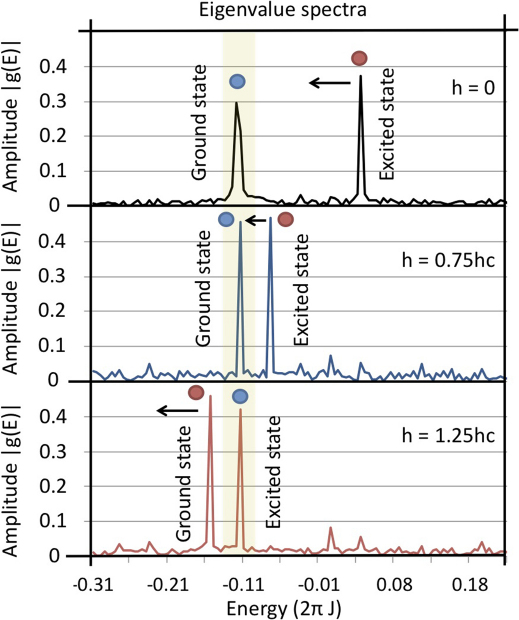
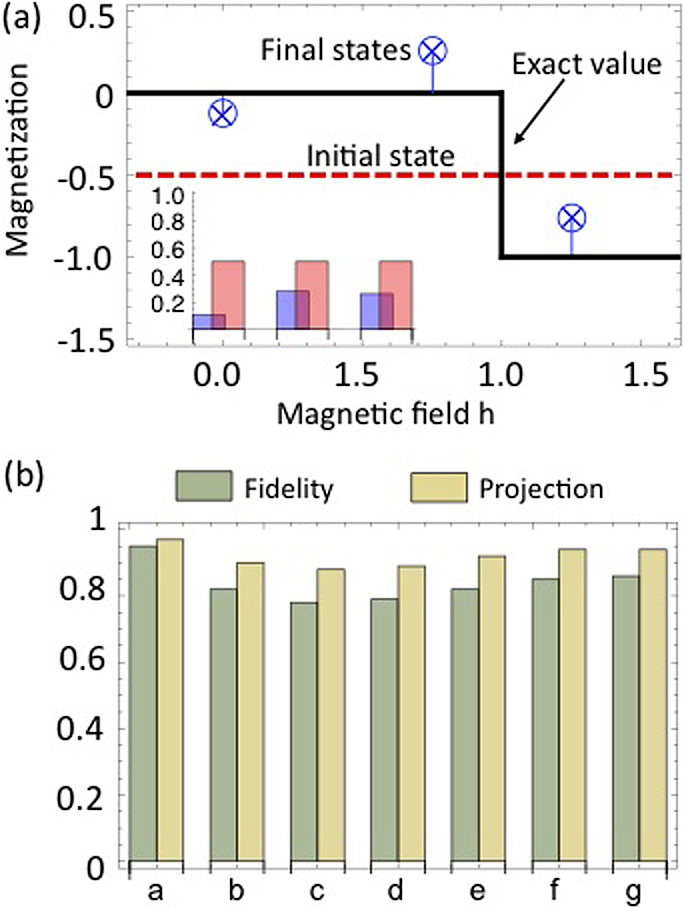
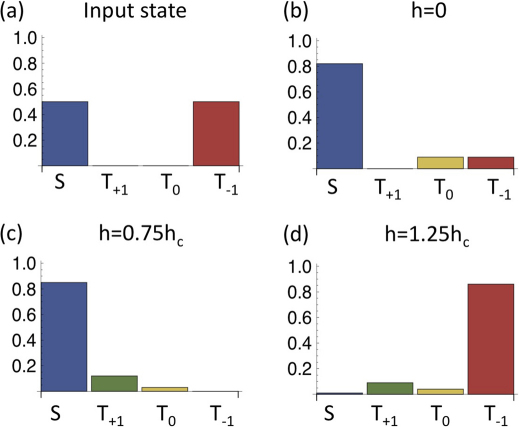
Quantum ground-state problems are computationally hard problems for general many-body Hamiltonians; there is no classical or quantum algorithm known to be able to solve them efficiently. Nevertheless, if a trial wavefunction approximating the ground state is available, as often happens for many problems in physics and chemistry, a quantum computer could employ this trial wavefunction to project the ground state by means of the phase estimation algorithm (PEA). We performed an experimental realization of this idea by implementing a variational-wavefunction approach to solve the ground-state problem of the Heisenberg spin model with an NMR quantum simulator. Our iterative phase estimation procedure yields a high accuracy for the eigenenergies (to the 10⁻⁵ decimal digit). The ground-state fidelity was distilled to be more than 80%, and the singlet-to-triplet switching near the critical field is reliably captured. This result shows that quantum simulators can better leverage classical trial wave functions than classical computers.
Overview
The claims and statistics of this paper haven’t been checked yet.
Free: it reads the open-access text and checks the first 5 claims that cite a source we can check. Create a free account to check every claim.
Integrity signals
Registry
Cites
Statistics
Figures




Verification
Claims the paper makes
The claims and statistics of this paper haven’t been checked yet.
Free: it reads the open-access text and checks the first 5 claims that cite a source we can check. Create a free account to check every claim.
Claims other papers make about this one
Each is checked against this paper’s own text: does it say what the citing paper says it does?
The source backs part of the claim, not all of it — or backs it for a different population, condition or comparison.
In the citing paper
“In fact, locating these eigenvalues can be achieved by the phase estimation method utilizing one extra ancilla qubit12 corresponding, in our case, to one additional ion.”
From From transistor to trapped-ion computers for quantum chemistry (2014) · cites this paper as [12]
Experimental — accuracy not yet measured
Self-check
Percentages, sums and reported differences re-computed from the paper’s own numbers.
The self-check needs the paper’s full text.
Citations
Cites
Simulating physics with computers
Feynman, R. P. (1982) · International Journal of Theoretical Physics · doi:10.1007/bf02650179 · Cited by 7,691
Ladd, T. D., Jelezko, F., Laflamme, R., Nakamura, Y., Monroe, C., & O’Brien, J. L. (2010) · Nature · doi:10.1038/nature08812 · Cited by 3,592
Solution of the Schrödinger equation by a spectral method
Feit, M. D., Fleck, J. A., & Steiger, A. (1982) · Journal of Computational Physics · doi:10.1016/0021-9991(82)90091-2 · Cited by 3,368
Nobel Lecture: Electronic structure of matter—wave functions and density functionals
Kohn, W. (1999) · Reviews of Modern Physics · doi:10.1103/revmodphys.71.1253 · Cited by 2,637
Molecular Electronic‐Structure Theory
Helgaker, T., Jørgensen, P., & Olsen, J. (2000) · doi:10.1002/9781119019572 · Cited by 2,594
Brucker, P. (1995) · Scheduling Algorithms · doi:10.1007/978-3-662-03088-2_3 · Cited by 2,289
Molecular electronic-structure theory
Ratner, M. A. (2000) · Cited by 1,565
Simulated Quantum Computation of Molecular Energies
Aspuru-Guzik, A., Dutoi, A. D., Love, P. J., & Head-Gordon, M. (2005) · Science · doi:10.1126/science.1113479 · Cited by 1,418
Self-citationClassical and Quantum Computation
Kitaev, A., Shen, A., & Vyalyi, M. (2002) · Graduate Studies in Mathematics · doi:10.1090/gsm/047 · Cited by 1,387
On the computational complexity of Ising spin glass models
Barahona, F. (1982) · Journal of Physics A: Mathematical and General · doi:10.1088/0305-4470/15/10/028 · Cited by 1,306 · cited 1×
“The Ising model with nonuniform couplings is an example of an NP -problem (more precisely, NP -complete”
Method
Cited by
Georgescu, I. M., Ashhab, S., & Nori, F. (2014) · Reviews of Modern Physics · doi:10.1103/revmodphys.86.153 · Cited by 2,932
“Nuclear spins manipulated by means of NMR have been among the first experimental systems to implement small quantum algorithms and quantum simulation (Li et al., 2011; Peng and Suter, 2010; Peng et al., 2009; Zhang et al., 2012).”
MethodQuantum computational chemistry
McArdle, S., Endo, S., Aspuru-Guzik, A., Benjamin, S. C., & Yuan, X. (2020) · Reviews of Modern Physics · doi:10.1103/revmodphys.92.015003 · Cited by 1,621
Self-citationThe Variational Quantum Eigensolver: A review of methods and best practices
Tilly, J., Chen, H., Cao, S., Picozzi, D., Setia, K., Li, Y., Grant, E., Wossnig, L., Rungger, I., Booth, G. H., et al. (2022) · Physics Reports · doi:10.1016/j.physrep.2022.08.003 · Cited by 1,031
Self-citationQuantum optimization using variational algorithms on near-term quantum devices
Moll, N., Barkoutsos, P., Bishop, L. S., Chow, J. M., Cross, A., Egger, D. J., Filipp, S., Fuhrer, A., Gambetta, J. M., Ganzhorn, M., et al. (2018) · Quantum Science and Technology · doi:10.1088/2058-9565/aab822 · Cited by 744
Quantum Chemistry Calculations on a Trapped-Ion Quantum Simulator
Hempel, C., Maier, C., Romero, J., McClean, J., Monz, T., Shen, H., Jurcevic, P., Lanyon, B. P., Love, P., Babbush, R., et al. (2018) · Physical Review X · doi:10.1103/physrevx.8.031022 · Cited by 446
“[89] Zhaokai Li, Man-Hong Yung, Hongwei Chen, Danwei Lu, James D.”
MethodSelf-citationOpenFermion: the electronic structure package for quantum computers
McClean, J. R., Rubin, N. C., Sung, K. J., Kivlichan, I. D., Bonet-Monroig, X., Cao, Y., Dai, C., Fried, E. S., Gidney, C., Gimby, B., et al. (2020) · Quantum Science and Technology · doi:10.1088/2058-9565/ab8ebc · Cited by 464
Potential of quantum computing for drug discovery
Cao, Y., Romero, J., & Aspuru-Guzik, A. (2018) · IBM Journal of Research and Development · doi:10.1147/jrd.2018.2888987 · Cited by 357
Self-citationExperimental realization of Shor's quantum factoring algorithm using qubit recycling
Martín-López, E., Laing, A., Lawson, T., Alvarez, R., Zhou, X.-Q., & O'Brien, J. L. (2012) · Nature Photonics · doi:10.1038/nphoton.2012.259 · Cited by 349
“Reducing the number of qubits in quantum simulations and quantum chemistry has been achieved with recursive phase estimation 13–16 , while ground state projections have been demonstrated by exploiting similar techniques in NMR 17 .”
MethodCan one trust quantum simulators?
Hauke, P., Cucchietti, F. M., Tagliacozzo, L., Deutsch, I., & Lewenstein, M. (2012) · Reports on Progress in Physics · doi:10.1088/0034-4885/75/8/082401 · Cited by 315
From transistor to trapped-ion computers for quantum chemistry
Yung, M.-H., Casanova, J., Mezzacapo, A., McClean, J., Lamata, L., Aspuru-Guzik, A., & Solano, E. (2014) · Scientific Reports · doi:10.1038/srep03589 · Cited by 221
Self-citationWitnessing eigenstates for quantum simulation of Hamiltonian spectra
Santagati, R., Wang, J., Gentile, A. A., Paesani, S., Wiebe, N., McClean, J. R., Morley-Short, S., Shadbolt, P. J., Bonneau, D., Silverstone, J. W., et al. (2018) · Science Advances · doi:10.1126/sciadv.aap9646 · Cited by 211
“(3) Using theÂg for the ground state orfÂeigfor the excited ones in the state preparation, perform the IPEA, which further projects each state onto the closest eigenstate (34) and refines the energy estimate.”
Material platforms for defect qubits and single-photon emitters
Zhang, G., Cheng, Y., Chou, J.-P., & Gali, A. (2020) · Applied Physics Reviews · doi:10.1063/5.0006075 · Cited by 207
Adiabatic Quantum Simulation of Quantum Chemistry
Babbush, R., Love, P. J., & Aspuru-Guzik, A. (2014) · Scientific Reports · doi:10.1038/srep06603 · Cited by 191
“Adiabatic Quantum Simulation [1, 28, 29] Quantum Phase Estimation Algorithm [64, 65, 68, 84, 85]; Experimental Realization [68, 86, 87]”
MethodSelf-citationA quantum–quantum Metropolis algorithm
Yung, M.-H., & Aspuru-Guzik, A. (2012) · Proceedings of the National Academy of Sciences · doi:10.1073/pnas.1111758109 · Cited by 149
Self-citationEntangled Photon-Pair Two-Dimensional Fluorescence Spectroscopy (EPP-2DFS)
Raymer, M. G., Marcus, A. H., Widom, J. R., & Vitullo, D. L. P. (2013) · The Journal of Physical Chemistry B · doi:10.1021/jp405829n · Cited by 158
Exponentially more precise quantum simulation of fermions in second quantization
Babbush, R., Berry, D. W., Kivlichan, I. D., Wei, A. Y., Love, P. J., & Aspuru-Guzik, A. (2016) · New Journal of Physics · doi:10.1088/1367-2630/18/3/033032 · Cited by 135
Self-citationJohnson, T. H., Clark, S. R., & Jaksch, D. (2014) · EPJ Quantum Technology · doi:10.1140/epjqt10 · Cited by 127
Quantum Computing and Simulations for Energy Applications: Review and Perspective
Paudel, H. P., Syamlal, M., Crawford, S. E., Lee, Y., Shugayev, R., Lu, P., Ohodnicki, P. R., Mollot, D., & Duan, Y. (2022) · ACS Engineering Au · doi:10.1021/acsengineeringau.1c00033 · Cited by 189
Designer Spin Pseudomolecule Implemented with Trapped Ions in a Magnetic Gradient
Khromova, A., Piltz, C., Scharfenberger, B., Gloger, T. F., Johanning, M., Varón, A. F., & Wunderlich, C. (2012) · Physical Review Letters · doi:10.1103/physrevlett.108.220502 · Cited by 117
Quantum simulation of quantum field theory in the light-front formulation
Kreshchuk, M., Kirby, W. M., Goldstein, G. R., Beauchemin, P. H., & Love, P. J. (2022) · Physical Review A · doi:10.1103/physreva.105.032418 · Cited by 140
“Applications of these methods to condensed matter and quantum chemistry are well-developed theoretically [18, 19, 20, 21, 22, 23, 24, 25, 26, 27], and experiments have been performed on many different quantum architectures [28, 29, 30, 31, 32, 33, 34, 35, 36, 37, 38, 39, 40, 41, 42, 43, 44, 45].”
BackgroundAdiabatic state preparation study of methylene
Veis, L., & Pittner, J. (2014) · The Journal of Chemical Physics · doi:10.1063/1.4880755 · Cited by 84
Babbush, R., Berry, D. W., Sanders, Y. R., Kivlichan, I. D., Scherer, A., Wei, A. Y., Love, P. J., & Aspuru-Guzik, A. (2018) · Quantum Science and Technology · doi:10.1088/2058-9565/aa9463 · Cited by 85
Self-citationSimulating quantum materials with digital quantum computers
Oftelie, L. B., Urbánek, M., Metcalf, M., Carter, J. T., Kemper, A. F., & de Jong, W. A. (2021) · Quantum Science and Technology · doi:10.1088/2058-9565/ac1ca6 · Cited by 101
Spin-active defects in hexagonal boron nitride
Liu, W., Guo, N., Yu, S., Meng, Y., Li, Z., Yang, Y.-Z., Wang, Z., Zeng, X., Xie, L.-K., Li, Q., et al. (2022) · Materials for Quantum Technology · doi:10.1088/2633-4356/ac7e9f · Cited by 81
Self-citationAutomatic spin-chain learning to explore the quantum speed limit
Zhang, X., Cui, Z.-W., Wang, X., & Yung, M. (2018) · Physical Review A · doi:10.1103/physreva.97.052333 · Cited by 80
Self-citationQuantum embedding theories to simulate condensed systems on quantum computers
Vorwerk, C., Sheng, N., Govoni, M., Huang, B., & Galli, G. (2022) · Nature Computational Science · doi:10.1038/s43588-022-00279-0 · Cited by 89
Calculating unknown eigenvalues with a quantum algorithm
Zhou, X.-Q., Kalasuwan, P., Ralph, T. C., & O'Brien, J. L. (2013) · Nature Photonics · doi:10.1038/nphoton.2012.360 · Cited by 58
Digital quantum simulation of the statistical mechanics of a frustrated magnet
Zhang, J., Yung, M.-H., Laflamme, R., Aspuru-Guzik, A., & Baugh, J. (2012) · Nature Communications · doi:10.1038/ncomms1860 · Cited by 58
Self-citationVeis, L., Višňák, J., Nishizawa, H., Nakai, H., & Pittner, J. (2016) · International Journal of Quantum Chemistry · doi:10.1002/qua.25176 · Cited by 55
Variational Quantum Simulation for Quantum Chemistry
Li, Y., Hu, J., Zhang, X., Song, Z., & Yung, M. (2019) · Advanced Theory and Simulations · doi:10.1002/adts.201800182 · Cited by 65
Self-citationIntroduction to Quantum Algorithms for Physics and Chemistry
Yung, M., Whitfield, J. D., Boixo, S., Tempel, D. G., & Aspuru‐Guzik, A. (2014) · Advances in Chemical Physics · doi:10.1002/9781118742631.ch03 · Cited by 50
Self-citationRobust resource-efficient quantum variational ansatz through an evolutionary algorithm
Huang, Y., Li, Q., Hou, X., Wu, R.-B., Yung, M., Bayat, A., & Wang, X. (2022) · Physical Review A · doi:10.1103/physreva.105.052414 · Cited by 66
“There are several realizations of VQE in photonic chips [36], ion traps [15, 48, 49], nuclear magnetic resonance systems [50], and superconducting quantum devices [9–11 From a resource perspective, all quantum variational algorithms, including the VQE, demand two types of resources: (i) a classical…”
BackgroundSelf-citationQubit-efficient encoding scheme for quantum simulations of electronic structure
Shee, Y., Tsai, P.-K., Hong, C.-L., Cheng, H., & Goan, H. (2022) · Physical Review Research · doi:10.1103/physrevresearch.4.023154 · Cited by 62
Quantum chemistry simulation on quantum computers: theories and experiments
Lu, D., Xu, B., Xu, N., Li, Z., Chen, H., Peng, X., Xu, R., & Du, J. (2012) · Physical Chemistry Chemical Physics · doi:10.1039/c2cp23700h · Cited by 43
Self-citationSimulating the Electronic Structure of Spin Defects on Quantum Computers
Huang, B., Govoni, M., & Galli, G. (2022) · PRX Quantum · doi:10.1103/prxquantum.3.010339 · Cited by 54
Relativistic quantum chemistry on quantum computers
Veis, L., Višňák, J., Fleig, T., Knecht, S., Saue, T., Visscher, L., & Pittner, J. (2012) · Physical Review A · doi:10.1103/physreva.85.030304 · Cited by 36
Simulation of molecular spectroscopy with circuit quantum electrodynamics
Hu, L., Ma, Y.-C., Xu, Y., Wang, W.-T., Ma, Y.-W., Liu, K., Wang, H.-Y., Song, Y.-P., Yung, M.-H., & Sun, L.-Y. (2018) · 中国科学通报:英文版 · doi:10.1016/j.scib.2018.02.001 · Cited by 33
Self-citationAccelerated variational algorithms for digital quantum simulation of many-body ground states
Lyu, C., Montenegro, V., & Bayat, A. (2020) · Quantum · doi:10.22331/q-2020-09-16-324 · Cited by 36
“To overcome these obstacles, the VQE method, a hybrid combination of a quantum circuit and a classical optimizer, has been theoretically investigated [4, 52, 53, 55, 65, 82, 83, 88] and experimentally implemented on various NISQ simulators, including photonic chips [61], ion traps [33, 44, 73], nuclear magnetic resona…”
MethodCircuit-Depth Reduction of Unitary-Coupled-Cluster Ansatz by Energy Sorting
Fan, Y., Cao, C., Xu, X., Li, Z., Lv, D., & Yung, M. (2023) · The Journal of Physical Chemistry Letters · doi:10.1021/acs.jpclett.3c01804 · Cited by 43
“[7] Zhaokai Li, Man-Hong Yung, Hongwei Chen, Dawei Lu, James D.”
Self-citationAlgorithmic quantum heat engines
Köse, E., Çakmak, S., Gençten, A., Kominis, I. K., & Müstecaplıoğlu, Ö. E. (2019) · Physical review. E · doi:10.1103/physreve.100.012109 · Cited by 24
“[52] Zhaokai Li, Man Hong Yung, Hongwei Chen, Dawei Lu, James D.”
BackgroundControlling NMR spin systems for quantum computation
Jones, J. A. (2024) · Progress in Nuclear Magnetic Resonance Spectroscopy · doi:10.1016/j.pnmrs.2024.02.002 · Cited by 36
Decoherence Control of Nitrogen-Vacancy Centers
Lei, C., Peng, S., Ju, C., Yung, M., & Du, J. (2017) · Scientific Reports · doi:10.1038/s41598-017-12280-z · Cited by 23
Self-citationQuantum simulation of preferred tautomeric state prediction
Shee, Y., Yeh, T.-L., Hsiao, J.-Y., Yang, A., Lin, Y., & Hsieh, M.-H. (2023) · npj Quantum Information · doi:10.1038/s41534-023-00767-9 · Cited by 15
Quantum computing and neuroscience for 6G/7G networks: Survey
Glisic, S., & Lorenzo, B. (2024) · Intelligent Systems with Applications · doi:10.1016/j.iswa.2024.200346 · Cited by 19
Hardware-efficient quantum principal component analysis for medical image recognition
Lin, Z., Liu, H., Tang, K., Liu, Y., Che, L., Long, X., Wang, X., Fan, Y.-A., Huang, K., Yang, X., et al. (2024) · Frontiers of Physics · doi:10.1007/s11467-024-1391-x · Cited by 13
Self-citationLow-temperature environments for quantum computation and quantum simulation*
Fu, H., Wang, P., Hu, Z., Li, Y., & Lin, X. (2020) · Chinese Physics B · doi:10.1088/1674-1056/abd762 · Cited by 11
Quantum Zermelo problem for general energy resource bounds
Bofill, J. M., Sanz, Á. S., Albareda, G., Moreira, I. D. P. R., & Quapp, W. (2020) · Physical Review Research · doi:10.1103/physrevresearch.2.033492 · Cited by 8
“A simpler ansatz for Ĥ was already reported in [31], where only a fixed coupling, J , was considered.”
MethodEffective quantum state reconstruction using compressed sensing in NMR quantum computing
Yang, J. Z., Cong, S., Liu, X., Li, Z., & Li, K. (2017) · Physical Review A · doi:10.1103/physreva.96.052101 · Cited by 7
Self-citationMapping Molecular Hamiltonians into Hamiltonians of Modular cQED Processors
Lyu, N., Miano, A., Tsioutsios, I., Cortiñas, R. G., Jung, K. A., Wang, Y., Hu, Z., Geva, E., Kais, S., & Batista, V. S. (2023) · Journal of Chemical Theory and Computation · doi:10.1021/acs.jctc.3c00620 · Cited by 7
Quinones, M. P., & Junqueira, C. (2020) · arXiv · doi:10.48550/arxiv.2007.13245 · Cited by 6
“Some of these heuristics are the Variational Quantum Eigensolver (VQE) [2, 3] and its special form called Quantum Approximation Algorithm (QAOA)[4].”
MethodQuantum Zermelo problem for general energy resource bounds
Bofill, J. M., Sanz, Á. S., Albareda, G., Moreira, I. D. P. R., & Quapp, W. (2020) · Dipòsit Digital de la Universitat de Barcelona (Universitat de Barcelona) · Cited by 5
Quantum simulation dynamics and circuit synthesis of FMO complex on an NMR quantum computer
Mahdian, M., Yeganeh, H. D., & Dehghani, A. (2020) · International Journal of Quantum Information · doi:10.1142/s0219749920500343 · Cited by 8
“Different platforms have been used for implementing quantum simulators, such as ions trapped in the optical cavity [11, 12], cold atoms in optical lattices [13], super-conducting qubits [14, 15], photons [16], quantum dots [17] and the spin qubits based on magnetic resonance process [18, 19, 20, 21, 22].”
MethodQuantum Computing Approach to Nonrelativistic and Relativistic Molecular Energy Calculations
Veis, L., & Pittner, J. (2014) · Advances in Chemical Physics · doi:10.1002/9781118742631.ch04 · Cited by 3
Hardware‐Efficient Ansatz Variational Quantum Regression for Molecular Energy Prediction
Ramadhan, R. U., Permatahati, L. K., Prayitno, T. B., & Sarwono, Y. P. (2026) · ChemistrySelect · doi:10.1002/slct.202504473 · Cited by 6
Quantum algorithms for drone mission planning
Davies, E. G., & Kalidindi, P. V. (2024) · SPIE Quantum Technologies for Defence and Security · doi:10.1117/12.3036340 · Cited by 4
“The Ground State Problem (GSP) 26,27 is given a Hamiltonian, H , find the quantum state | ψ ⟩ , which minimizes ⟨ ψ | H | ψ ⟩ .”
BackgroundHybrid reconstruction of quantum density matrix: when low-rank meets sparsity
Li, K., Kai, Z., Yang, J., Cong, S., Liu, X., & Li, Z. (2017) · Quantum Information Processing · doi:10.1007/s11128-017-1720-x · Cited by 3
Self-citationCombinatorial optimization with variational approaches on noisy quantum devices
Miki, T., Okita, R., Shimada, M., & Shirakashi, J. (2021) · IEEE International Conference on Manipulation, Manufacturing and Measurement on the Nanoscale (3M-NANO) · doi:10.1109/3m-nano49087.2021.9599740 · Cited by 1
Algorithms Bridging Quantum Computation and Chemistry
McClean, J. R. (2015) · Digital Access to Scholarship at Harvard (DASH) (Harvard University) · Cited by 2
Exponentially More Precise Algorithms for Quantum Simulation of Quantum Chemistry
Wei, A. Y. (2016) · Digital Access to Scholarship at Harvard (DASH) (Harvard University)
Time-optimized quantum QFT gate in an Ising coupling system
Hong-Sheng, L., Jia-Xin, T., Shu-Na, Z., & Da-Xiu, W. (2015) · Acta Physica Sinica · doi:10.7498/aps.64.170301
Application of the Jaynes-Cummings model in quantum information processing
Madonsela, P. (2020)
Hybrid HPC and Quantum Computing Framework for Multiscale Modeling of Chemical Systems
Thacker, J. C. R., Meller, M., Popescu, A., Patterson, A., Izsák, R., Szeremi, V., & Keal, T. W. (2026) · Journal of Chemical Theory and Computation · doi:10.1021/acs.jctc.6c00542 · Cited by 1
Metadata
- Authors
- Li, Z., Yung, M.-H., Chen, H., Lu, D., Whitfield, J. D., Peng, X., Aspuru-Guzik, A., & Du, J.
- Affiliations
- University of Science and Technology of China (CN)
- Harvard University (US)
- Corresponding author
- Du, Jiangfeng
- Venue
- Scientific Reports
- Published
- 2011-09-09
- Volume
- 1
- Issue
- 1
- Pages
- 88-88
- ISSN
- 2045-2322 (ISSN-L)
- PMC
- PMC3216574
- OpenAlex
- W2034692119
- Cited by
- 63
- References
- 38
- Citations by year
- 2026: 2 · 2024: 4 · 2023: 3 · 2022: 8 · 2021: 2 · 2020: 10 · 2019: 2 · 2018: 6 · 2017: 4 · 2016: 3 · 2015: 3 · 2014: 7 · 2013: 2 · 2012: 7
- FWCI
- 4.71
- Type
- journal article
- Language
- en
- Update notices
- erratum (2012-11-29)
- Open access
- gold
- doi.org
- Licence
- cc-by-nc-nd
- creativecommons.org/licenses/by-nc-nd/3.0/ (tdm)
- creativecommons.org/licenses/by-nc-nd/3.0/ (vor)
- Locations
- Scientific Reports (publishedVersion, cc-by-nc-nd)
- PubMed Central (publishedVersion, cc-by-nc-nd)
- PubMed (publishedVersion)
- arXiv (Cornell University) (submittedVersion)
- Digital Access to Scholarship at Harvard (DASH) (Harvard University) (submittedVersion, cc-by)
- arXiv (Cornell University)
- Funders
- National Science Foundation (1037992)
- U.S. Department of Defense
- Alfred P. Sloan Foundation
- Camille and Henry Dreyfus Foundation
- Croucher Foundation
- National Natural Science Foundation of China
- Defense Advanced Research Projects Agency (N66001)
- Division of Chemistry (CHE-1037992)
- Topics
- Physical Sciences › Computer Science › Artificial Intelligence › Quantum Computing Algorithms and Architecture
- Physical Sciences › Physics and Astronomy › Atomic and Molecular Physics, and Optics › Quantum many-body systems
- Physical Sciences › Physics and Astronomy › Atomic and Molecular Physics, and Optics › Quantum Information and Cryptography
- Keywords
- variational quantum eigensolver, Heisenberg model, trial wave functions, ground-state fidelity, singlet-triplet transitions
About these checks
Registry, retraction, Cites and statistics results are computed, not judged, with one exception: a printed reference that no index lists is read once by a model before it counts as a citation error. Claims are extracted by a model and kept only when their quote appears verbatim in the text; each cited source is then checked, with a model’s help, for whether it says what the claim relies on. Those verdicts can be wrong — read the claim’s quote and the cited source before relying on one.
Statistics and arithmetic are recomputed, not judged.
Confidence bands are shown only for fields calibrated on our annotated test set. None is calibrated yet, so no band is shown.
What counts as a claim ›How we measure confidence ›How we check this ›
Are you an author, or do you see a problem with this page? Request a review
Data sources
Bibliographic data: Semantic Scholar, OpenAlex, Crossref.
Contains information from the Semantic Scholar Academic Graph Datasets, made available under the ODC Attribution License (ODC-BY 1.0).
Semantic Scholar’s data is described in: Kinney, R., et al. (2023). The Semantic Scholar Open Data Platform. arXiv:2301.10140.
