

Electronic system with memristive synapses for pattern recognition
Open accessThe DOI matches its Crossref record; 20 of the 20 references it cites were found in a registry or an index.
Abstract
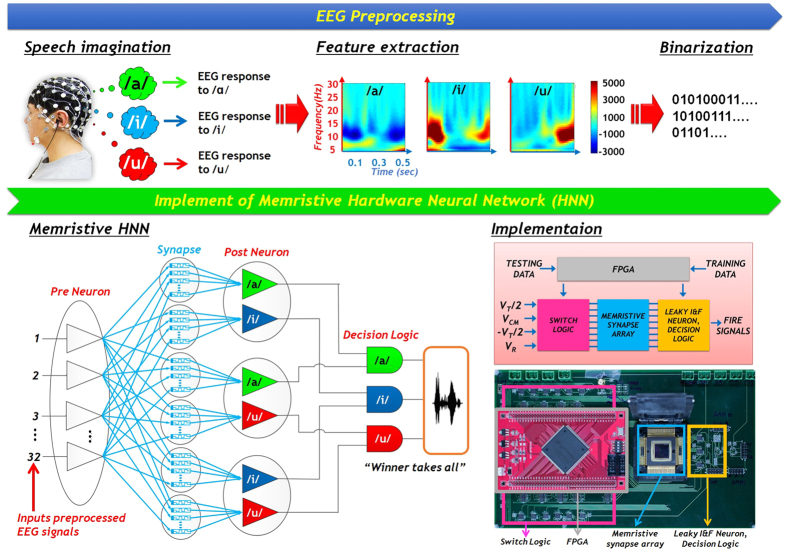
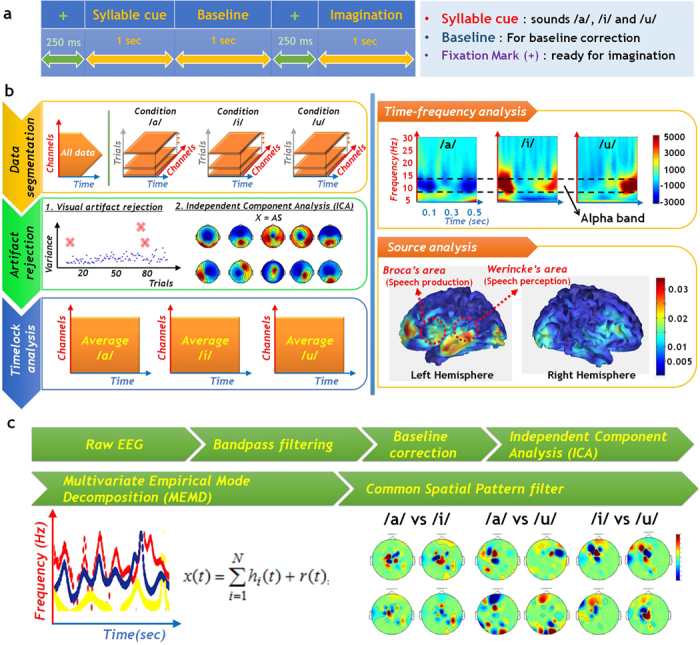
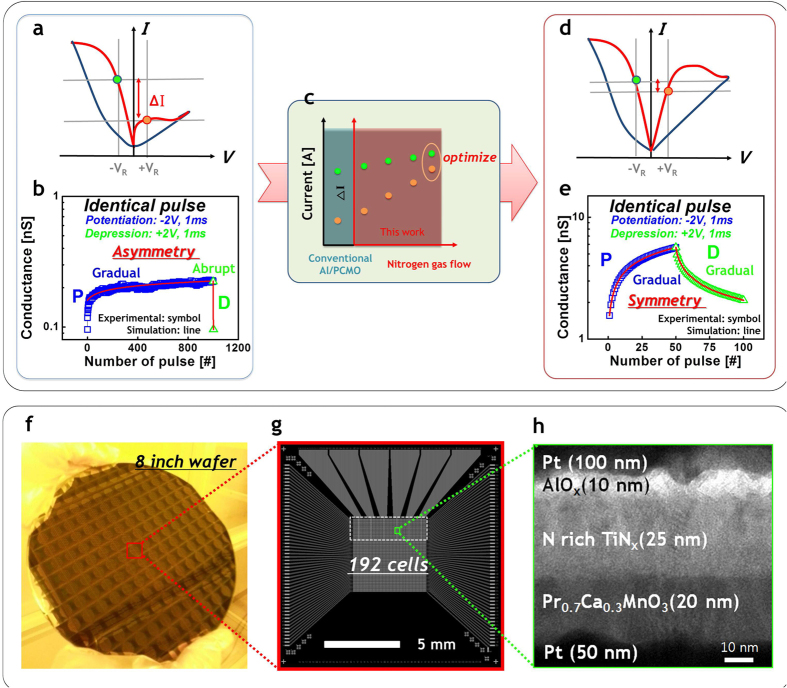
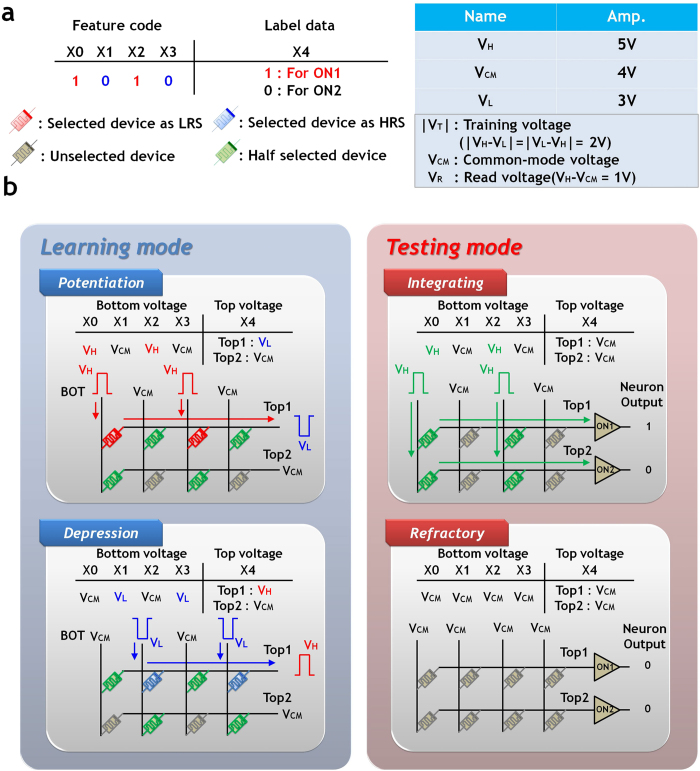
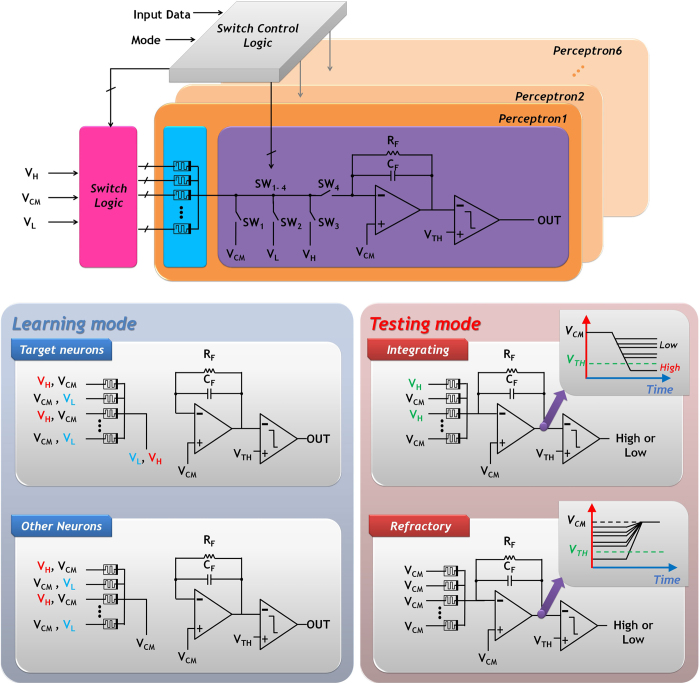
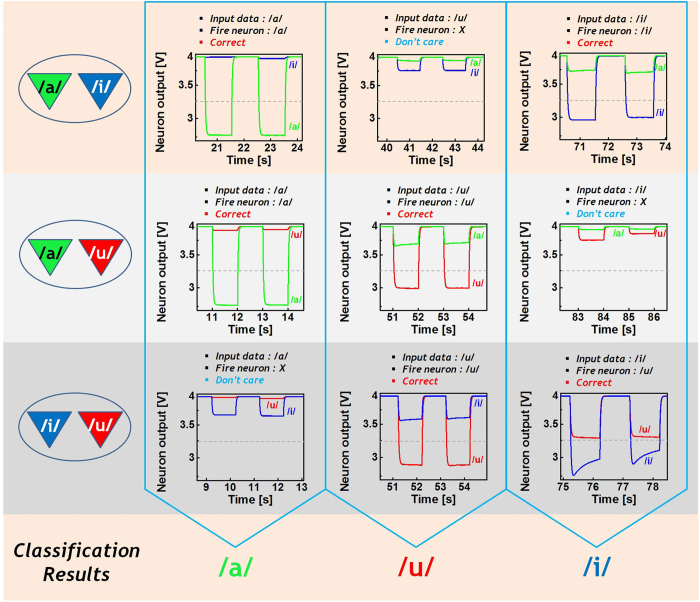
Memristive synapses, the most promising passive devices for synaptic interconnections in artificial neural networks, are the driving force behind recent research on hardware neural networks. Despite significant efforts to utilize memristive synapses, progress to date has only shown the possibility of building a neural network system that can classify simple image patterns. In this article, we report a high-density cross-point memristive synapse array with improved synaptic characteristics. The proposed PCMO-based memristive synapse exhibits the necessary gradual and symmetrical conductance changes and has been successfully adapted to a neural network system. The system learns and later recognizes, the human thought pattern corresponding to three vowels, i.e. /a /, /i / and /u/, using electroencephalography signals generated while a subject imagines speaking vowels. Our successful demonstration of a neural network system for EEG pattern recognition is likely to intrigue many researchers and stimulate a new research direction.
Overview
The claims and statistics of this paper haven’t been checked yet.
Free: it reads the open-access text and checks the first 5 claims that cite a source we can check. Create a free account to check every claim.
Integrity signals
Registry
Cites
Statistics
Figures
Verification
Claims the paper makes
The claims and statistics of this paper haven’t been checked yet.
Free: it reads the open-access text and checks the first 5 claims that cite a source we can check. Create a free account to check every claim.
Claims other papers make about this one
Each is checked against this paper’s own text: does it say what the citing paper says it does?
The cited source says what the claim attributes to it.
In the citing paper
“Crossbar arrays of two-terminal metal/insulator/metal (MIM) memristive devices can be fabricated easily using standard lithography and deposition techniques; this has been readily achieved by multiple groups57,64,68–70,85,93,105,216,217.”
From Hardware implementation of memristor-based artificial neural networks (2024) · cites this paper as [217]
Experimental — accuracy not yet measuredThe cited source says what the claim attributes to it.
In the citing paper
“Then, analogue VMM has been demonstrated both for binary inputs and weights218–220, as well as for binary inputs and analogue/multilevel weights60,85,105,217.”
From Hardware implementation of memristor-based artificial neural networks (2024) · cites this paper as [217]
Self-check
Percentages, sums and reported differences re-computed from the paper’s own numbers.
The self-check needs the paper’s full text.
Citations
Cites
A million spiking-neuron integrated circuit with a scalable communication network and interface
Merolla, P. A., Arthur, J. V., Alvarez-Icaza, R., Cassidy, A. S., Sawada, J., Akopyan, F., Jackson, B. L., Imam, N., Guo, C., Nakamura, Y., et al. (2014) · Science · doi:10.1126/science.1254642 · Cited by 4,147
Nanoelectronic programmable synapses based on phase change materials for brain-inspired computing
Kuzum, D., Jeyasingh, R. G. D., Lee, B., & Wong, H.-S. P. (2012) · Nano Letters · doi:10.1021/nl201040y · Cited by 1,267
Self-citationNeurogrid: A Mixed-Analog-Digital Multichip System for Large-Scale Neural Simulations
Benjamin, B. V., Gao, P., McQuinn, E., Choudhary, S., Chandrasekaran, A. R., Bussat, J.-M., Alvarez-Icaza, R., Arthur, J. V., Merolla, P. A., & Boahen, K. (2014) · Proceedings of the IEEE · doi:10.1109/jproc.2014.2313565 · Cited by 1,266
Artificial neural networks in hardware: A survey of two decades of progress
Misra, J., & Saha, I. (2010) · Neurocomputing · doi:10.1016/j.neucom.2010.03.021 · Cited by 646
Pattern classification by memristive crossbar circuits using ex situ and in situ training
Alibart, F., Zamanidoost, E., & Strukov, D. B. (2013) · Nature Communications · doi:10.1038/ncomms3072 · Cited by 642 · cited 1×
“using a simple crossbar array 13 .”
High-Density Crossbar Arrays Based on a Si Memristive System
Jo, S. H., Kim, K.-H., & Lu, W. (2009) · Nano Letters · doi:10.1021/nl8037689 · Cited by 574 · cited 1×
“A simple, two-terminal cross array structure is necessary for the practical implementation of high-density HNN 17 .”
BackgroundYu, S., Gao, B., Fang, Z., Yu, H., Kang, J., & Wong, H. ‐. P. (2013) · Advanced Materials · doi:10.1002/adma.201203680 · Cited by 527
Neuromorphic Hardware System for Visual Pattern Recognition With Memristor Array and CMOS Neuron
Chu, M., Kim, B., Park, S., Hwang, H., Jeon, M., Lee, B. H., & Lee, B.-G. (2015) · IEEE Transactions on Industrial Electronics · doi:10.1109/tie.2014.2356439 · Cited by 296
Self-citationCrossbar RRAM Arrays: Selector Device Requirements During Write Operation
Kim, S., Zhou, J., & Lu, W. D. (2014) · IEEE Transactions on Electron Devices · doi:10.1109/ted.2014.2327514 · Cited by 219 · cited 1×
“Generally, in memory applications 20 , this problem is easily solved using the half-bias scheme.”
MethodNeuromorphic speech systems using advanced ReRAM-based synapse
Park, S., Sheri, A., Kim, J., Noh, J., Jang, J., Jeon, M., Lee, B., Lee, B. R., Lee, B. H., & Hwang, H. (2013) · 2013 IEEE International Electron Devices Meeting · doi:10.1109/iedm.2013.6724692 · Cited by 201
Self-citation
Research works printed but not linked: 1
- Anzai, Y. Pattern Recognition & Machine Learning. (Elsevier, 1992).
Cited by
Items 101–182 of 182
Target wave in the network coupled by thermistors
Zhang, X., Yao, Z., Guo, Y., & Wang, C. (2020) · Chaos Solitons & Fractals · doi:10.1016/j.chaos.2020.110455 · Cited by 26
Large Memristor Crossbars for Analog Computing
Li, C., Li, Y., Jiang, H., Song, W., Lin, P., Wang, Z., Yang, J. J., Xia, Q., Hu, M., Montgomery, E., et al. (2018) · IEEE International Symposium on Circuits and Systems proceedings · doi:10.1109/iscas.2018.8351877 · Cited by 32
“[26] S.”
BackgroundNew pulse amplitude modulation for fine tuning of memristor synapses
Truong, S. N., Pham, K. V., Yang, W., Shin, S., Pedrotti, K. D., & Min, K. (2016) · Microelectronics Journal · doi:10.1016/j.mejo.2016.07.010 · Cited by 25
Electrode-induced polarity conversion in Nb2O5/NbOx resistive switching devices
Zhou, Z., Yang, M., Fu, Z., Wang, H., Ma, X., & Gao, H. (2020) · Applied Physics Letters · doi:10.1063/5.0020501 · Cited by 24
Alleviating Conductance Nonlinearity via Pulse Shape Designs in TaOx Memristive Synapses
Li, S.-J., Dong, B., Wang, B., Li, Y., Sun, H., He, Y., Xu, N., & Miao, X. (2018) · IEEE Transactions on Electron Devices · doi:10.1109/ted.2018.2876065 · Cited by 24
Pr x Ca 1 − x MnO 3 based stochastic neuron for Boltzmann machine to solve “maximum cut” problem
Khilwani, D., Moghe, V., Lashkare, S., Saraswat, V., Kumbhare, P., Baghini, M. S., Jandhyala, S., Subramoney, S., & Ganguly, U. (2019) · APL Materials · doi:10.1063/1.5108694 · Cited by 24
Lee, W., & Kim, J. (2019) · IEEE Transactions on Components Packaging and Manufacturing Technology · doi:10.1109/tcpmt.2019.2917910 · Cited by 23
Self-citationImproved switching and synapse characteristics using PEALD SiO2 thin film in Cu/SiO2/ZrO2/Pt device
Lee, D., Sokolov, A. S., Ku, B., Jeon, Y.-R., Kim, D. H., Kim, H. T., Kim, G. H., & Choi, C. (2021) · Applied Surface Science · doi:10.1016/j.apsusc.2021.149140 · Cited by 23
Reliability of NAND Flash Memory as a Weight Storage Device of Artificial Neural Network
-, M. M. H., & Ray, B. (2020) · IEEE Transactions on Device and Materials Reliability · doi:10.1109/tdmr.2020.3012430 · Cited by 22
Evolving conductive polymer neural networks on wetware
Akai‐Kasaya, M., Hagiwara, N., Hikita, W., Okada, M., Sugito, Y., Kuwahara, Y., & Asai, T. (2020) · Japanese Journal of Applied Physics · doi:10.35848/1347-4065/ab8e06 · Cited by 22
Memristors Based on 2D Materials: Bridging Device Theory and Potential Applications
Liu, X., Pan, Z., Xia, Z., Li, L., Deng, Q., Pan, Y., Li, J., & Huo, N. (2025) · Advanced Functional Materials · doi:10.1002/adfm.202520816 · Cited by 26
Compatible resistive switching mechanisms in Ni/SiOx/ITO and application to neuromorphic systems
Park, M., Park, J., & Kim, S. (2022) · Journal of Alloys and Compounds · doi:10.1016/j.jallcom.2022.163870 · Cited by 21
The Origin of CBRAM With High Linearity, On/Off Ratio, and State Number for Neuromorphic Computing
Liu, Y., Gao, J., Wu, F., Tian, H., & Ren, T. (2021) · IEEE Transactions on Electron Devices · doi:10.1109/ted.2021.3065013 · Cited by 23
A Survey on Architecture Advances Enabled by Emerging Beyond-CMOS Technologies
Chen, A., Datta, S., Hu, X. S., Niemier, M. T., Simunic, T., & Yang, J. J. (2019) · IEEE Design and Test · doi:10.1109/mdat.2019.2902359 · Cited by 27
Adaptive synchronization of memristor-based neural networks with discontinuous activations
Li, Y., Luo, B., Liu, D., Yang, Z., & Zhu, Y. (2019) · Neurocomputing · doi:10.1016/j.neucom.2019.11.018 · Cited by 20
Lee, D. H., Kim, J. E., Cho, Y. H., Kim, S., Park, G. H., Choi, H., Lee, S. Y., Kwon, T., Kim, D. H., Jeong, M., et al. (2024) · Materials Horizons · doi:10.1039/d4mh00519h · Cited by 19
Self-citationPyo, Y., Woo, J., Hwang, H.-G., Nahm, S., & Jeong, J. (2021) · Nanomaterials · doi:10.3390/nano11102684 · Cited by 19
Self-citationStudy of Recall Time of Associative Memory in a Memristive Hopfield Neural Network
Kong, D., Hu, S. G., Wang, J., Liu, Z., Chen, T. P., Yu, Q., & Liu, Y. (2019) · IEEE Access · doi:10.1109/access.2019.2915271 · Cited by 19
Njitacke, Z. T., Feudjio, C., Signing, V. R. F., Koumetio, B. N., Tsafack, N., & Awrejcewicz, J. (2022) · The European Physical Journal Plus · doi:10.1140/epjp/s13360-022-02821-5 · Cited by 19
Kim, S., Son, J., Kwak, H., & Kim, S. (2023) · Advanced Electronic Materials · doi:10.1002/aelm.202300476 · Cited by 18
Bio-inspired visual systems based on curved image sensors and synaptic devices
Long, Z., Ding, Y., Poddar, S., Gu, L., Zhang, Q., & Fan, Z. (2023) · Materials Today Electronics · doi:10.1016/j.mtelec.2023.100071 · Cited by 20
Biomedical applications of sensing devices with memristive behaviors
Yang, Y., Sun, B. T., Mao, S., Qin, J., Yang, Y., Liu, M., Rao, Z., Lin, W., & Zhao, Y. X. (2024) · Journal of Materials Chemistry C · doi:10.1039/d4tc02289k · Cited by 18
Analysis and generation of chaos using compositely connected coupled memristors
Zheng, C., Iu, H. H., Fernando, T. L., Yu, D., Guo, H., & Eshraghian, J. K. (2018) · Chaos An Interdisciplinary Journal of Nonlinear Science · doi:10.1063/1.5023142 · Cited by 17
Artificial synaptic behavior of the SBT-memristor*
Dou, G., Dou, M.-L., Liu, R.-Y., & Guo, M. L. (2021) · Chinese Physics B · doi:10.1088/1674-1056/ac05a3 · Cited by 17
Nonvolatile Memristive Materials and Physical Modeling for In‐Memory and In‐Sensor Computing
Go, S., Lim, K.-G., Lee, T. H., & Loke, D. K. (2024) · Small Science · doi:10.1002/smsc.202300139 · Cited by 16
Zhang, T., Yin, M., Lu, X., Cai, Y., Yang, Y., & Huang, R. (2017) · Nano Futures · doi:10.1088/2399-1984/aa678b · Cited by 16
Training deep neural networks with discrete state transition
Li, G., Deng, L., Tian, L., Cui, H., Han, W., Pei, J., & Shi, L. (2017) · Neurocomputing · doi:10.1016/j.neucom.2017.06.058 · Cited by 16
Siddique, M. A. B., Zhang, Y., & An, H. (2023) · Frontiers in Computational Neuroscience · doi:10.3389/fncom.2023.1274575 · Cited by 14
Hasina, D., Mandal, A., Basu, N., Srivastava, S. K., Mitra, A., & Som, T. (2022) · Applied Surface Science · doi:10.1016/j.apsusc.2022.155563 · Cited by 12
Compensated Synaptic Device for Improved Recognition Accuracy of Neuromorphic System
Lee, C., Koo, S., Oh, J., & Lee, D. (2018) · IEEE Journal of the Electron Devices Society · doi:10.1109/jeds.2018.2815703 · Cited by 12
A Quantum-Well Charge-Trap Synaptic Transistor With Highly Linear Weight Tunability
Yu, E., Cho, S., Roy, K., & Park, B. (2020) · IEEE Journal of the Electron Devices Society · doi:10.1109/jeds.2020.3011409 · Cited by 12
“…structures have been reported, showing the great geometric resemblance with biological synapse, along with high scalability [7]–[10], there can be room for better endurance, a wider window in conductance change, and higher completeness in functions, which calls for complemented devices [11], [12].”
BackgroundXiang, Y., Huang, P. C., Han, R., Zhou, Z., Shu, Q., Su, Z., Hu, H., Liu, L., Liu, Y., Liu, X., et al. (2019) · Advanced Materials Technologies · doi:10.1002/admt.201800720 · Cited by 11
Bennett, C. H., Parmar, V., Calvet, L. E., Klein, J., Suri, M., Marinella, M. J., & Querlioz, D. (2019) · IEEE Access · doi:10.1109/access.2019.2920076 · Cited by 12
Meyer, T., Kressdorf, B., Владимирович, Р. В., Hoffmann, J., Jooß, C., & Seibt, M. (2021) · Small Methods · doi:10.1002/smtd.202100464 · Cited by 11
Fundamental issues of implementing hardware neural networks using memristor
Gi, S.-G., Yeo, I., Chu, M., Kim, S.-H., & Lee, B. (2015) · International SoC Design Conference · doi:10.1109/isocc.2015.7401790 · Cited by 11
Self-citationManganite memristive devices: recent progress and emerging opportunities
Schulman, A., Huhtinen, H., & Paturi, P. (2024) · Journal of Physics D Applied Physics · doi:10.1088/1361-6463/ad6575 · Cited by 13
Pr1–xCaxMnO3-Based Memristive Heterostructures: Basic Mechanisms and Applications
Buczek, M., Moos, Z., Gutsche, A., Menzel, S., & Dittmann, R. (2025) · Chemical Reviews · doi:10.1021/acs.chemrev.4c00813 · Cited by 10
Correlated transition metal oxides and chalcogenides for Mott memories and neuromorphic applications
Cario, L., Tranchant, J., Corraze, B., & Janod, É. (2022) · Elsevier eBooks · doi:10.1016/b978-0-12-814629-3.00010-6 · Cited by 8
A Review of Recent Advances and Application for Spiking Neural Networks
Liu, H., Chai, H., Sun, Q., Yun, X., & Li, X. (2023) · Strategic Study of CAE · doi:10.15302/j-sscae-2023.06.011 · Cited by 10
Phase synchronization between nonlinear circuits by capturing electromagnetic field energy
Wang, C., Yao, Z., Xu, W., & Ren, G. (2020) · Modern Physics Letters B · doi:10.1142/s0217984920503236 · Cited by 7
Pattern selection in thermosensitive neuron network induced by noise
Li, F., Liu, S., & Li, X. (2021) · Physica A Statistical Mechanics and its Applications · doi:10.1016/j.physa.2021.126627 · Cited by 7
Tong, P., Xu, H., Sun, Y. K., Wang, Y., Peng, J., Liao, C., Wang, W., & Li, Q. (2022) · Chinese Physics B · doi:10.1088/1674-1056/ac9cbc · Cited by 7
Rectifying Resistive Memory Devices as Dynamic Complementary Artificial Synapses
Berco, D. (2018) · Frontiers in Neuroscience · doi:10.3389/fnins.2018.00755 · Cited by 7
Fully unsupervised online spike sorting based on an artificial spiking neural networkPreprint
Bernert, M., & Yvert, B. (2017) · bioRxiv (Cold Spring Harbor Laboratory) · doi:10.1101/236224 · Cited by 8
“In particular scalable nonvolatile resistive memory (memristive) devices enable building artificial synapses with embedded STDP plasticity 29,42,46,47 and thus open an opportunity to implement STDP networks in very power-efficient and miniaturized devices 43 compatible with future implantable…”
BackgroundMukhopadhyay, A. K., Chakrabarti, I., Basu, A., & Sharad, M. (2018) · arXiv (Cornell University) · doi:10.48550/arxiv.1802.09047 · Cited by 7
“Since memristors are nanoscaled devices and also compatible with silicon, they have attracted researchers in the field of neuromorphic engineering to make use of it in systems which can function similarly like a human brain for classifying objects and recognizing patterns [6][7][8].”
BackgroundGraphene enhanced charge transfer in ITO optoelectronic synapses for artificial vision systems
Liang, J., Yu, X., Cheng, C., Huang, B., Wang, Z., & Huang, L. (2024) · Journal of Materials Chemistry C · doi:10.1039/d4tc01913j · Cited by 6
Filamentary switching of ReRAM investigated by in-situ TEM
有田正志, Tsurumaki‐Fukuchi, A., & Takahashi, Y. (2020) · Japanese Journal of Applied Physics · doi:10.35848/1347-4065/ab709d · Cited by 6
Analog memristive devices based on La2NiO4+ δ as synapses for spiking neural networks
Khuu, T., Koroleva, A. A., Degreze, A., Vatajelu, E. I., Lefèvre, G., Jiménez, C., Blonkowski, S., Jalaguier, E., Bsiesy, A., & Burriel, M. (2023) · Journal of Physics D Applied Physics · doi:10.1088/1361-6463/ad1016 · Cited by 6
“These devices have already been used as analog synapses for pattern recognition [35], as integrate-and-fire (IF) neurons [36] and as stochastic neurons [37].”
Berco, D., & Ang, D. S. (2019) · Journal of Vacuum Science & Technology B Nanotechnology and Microelectronics Materials Processing Measurement and Phenomena · doi:10.1116/1.5123665 · Cited by 6
Pr0.7Ca0.3MnO3 (PCMO)-Based Synaptic Devices
Lee, D., & Hwang, H. (2017) · Springer eBooks · doi:10.1007/978-3-319-54313-0_3 · Cited by 6
Self-citationSingh, J. P. (2024) · Chaos Solitons & Fractals · doi:10.1016/j.chaos.2024.115551 · Cited by 5
Effect of SiO2 interfacial layer on InGaZnO-based memristors for neuromorphic computing applications
Myoung, S. J., Shin, D. H., Kim, D., Kim, C., Bae, J., Choi, S.-J., Kim, D. M., Woo, J., & Kim, D. H. (2024) · Ceramics International · doi:10.1016/j.ceramint.2024.12.203 · Cited by 5
Enhancing the photoelectric synaptic plasticity of β-Ga2O3 films via improving crystalline quality
Li, Z., Shen, R., Jiao, T., Zhu, J., Chang, Y., Li, C., Qu, Y., Liang, H., Xia, X., Jiang, Q., et al. (2025) · Journal of Alloys and Compounds · doi:10.1016/j.jallcom.2025.179771 · Cited by 5
Introduction to Neuro-Inspired Computing Using Resistive Synaptic Devices
Yu, S. (2017) · Springer eBooks · doi:10.1007/978-3-319-54313-0_1 · Cited by 18
Memristive device based learning for navigation in robots
Sarim, M., Kumar, M., Jha, R., & Minai, A. A. (2017) · Bioinspiration & Biomimetics · doi:10.1088/1748-3190/aa7eab · Cited by 5
Cheng, Z., Wang, H., Guan, Z., Zhu, Z., Shen, S., Yin, Y., & Li, X. (2025) · ACS Applied Materials & Interfaces · doi:10.1021/acsami.5c00740 · Cited by 4
Pr x Ca 1–x MnO 3 -Based Memory and Si Time-Keeping Selector for Area and Energy Efficient Synapse
Das, B., Lele, A. S., Kumbhare, P., Schulze, J., & Ganguly, U. (2019) · IEEE Electron Device Letters · doi:10.1109/led.2019.2914406 · Cited by 4
Synapse device based neuromorphic system for biomedical applications
Cho, S., Lee, C., & Lee, D. (2024) · Biomedical Engineering Letters · doi:10.1007/s13534-024-00392-1 · Cited by 3
“5c, the TiN/PCMO structure was selected for the PCMO synapse, considering factors such as power consumption, the number of conductance states, and bidirectional conductance change [16, 17, 25, 28].”
InfluentialTime-Delay Memristive Recurrent Neural Network and Its Complex Dynamics
Zhou, W., Fu, B., & Wang, G. (2022) · International Journal of Bifurcation and Chaos · doi:10.1142/s0218127422501504 · Cited by 3
Sakhuja, J., Patil, S. V., Mondal, S., Lashkare, S., & Ganguly, U. (2023) · IEEE Electron Devices Technology & Manufacturing Conference (EDTM) · doi:10.1109/edtm55494.2023.10103054 · Cited by 3
DUV optoelectronic bionic synapse based on the MOCVD-deposited amorphous gallium oxide film
Li, Z., Jiao, T., Li, W., Hu, Y., Dang, X., Chang, Y., Lu, H., Pan, C., Dong, X., & Zhang, B. (2024) · Materials Letters · doi:10.1016/j.matlet.2024.136304 · Cited by 3
A dummy cell added neural network using in pattern recognition for prevention of failed events
Li, C., & Song, Y. (2017) · Microelectronics Journal · doi:10.1016/j.mejo.2017.08.013 · Cited by 3
On Buildings that Compute. A Proposal
Adamatzky, A., Szacilowski, K. T., Konkoli, Z., Werner, L. C., Przyczyna, D., & Sirakoulis, G. C. (2019) · Emergence, complexity and computation · doi:10.1007/978-3-030-15792-0_13 · Cited by 5
Shchanikov, S., Zuev, A. D., Bordanov, I., Danilin, S. N., Korolev, D. S., Belov, A. I., Pigareva, Y., Pimashkin, A. S., Mikhaylov, A. N., & Kazantsev, V. (2020) · arXiv (Cornell University) · doi:10.48550/arxiv.2004.00154 · Cited by 3
“Bias voltages applied to the column and row electrodes of a passive array according to a specific algorithm can be used to eliminate the influence of sneak currents on the states of memristors during a programming process (Park et al., 2015).”
BackgroundMethodRadio Frequency Identification Technology Used to Monitor the Use of Water Point for Grazing Cattle
Kumawat, P. (2022) · Smart innovation, systems and technologies · doi:10.1007/978-3-030-92905-3_35 · Cited by 2
Gao, L., Chen, P.-Y., & Yu, S. (2016) · IEEE International Conference on Solid-State and Integrated Circuit Technology · doi:10.1109/icsict.2016.7998889 · Cited by 2
Fully Circuit Implementation of a two-layer Memristive Neural Network for Pattern Recognition
Li, M., Wang, X., & Chen, Z. (2021) · International Conference on Information Science and Technology · doi:10.1109/icist52614.2021.9440557 · Cited by 3
“Researchers applied memristors to implement perception network [12], long short-term memory network [13], convolutional neural network [14] for unsupervised learning [15], image processing [16], brain machine interfaces [17], pattern recognition [18] and so on.”
MethodBayesian‐Optimization‐Based Post‐Silicon Offset‐Cancelation Technique for Analog Multipliers
Kulatunga, T., Yanushkevich, S., & Belostotski, L. (2025) · IET Circuits Devices & Systems · doi:10.1049/cds2/5591883 · Cited by 1
An, S., Shen, L., Liu, T., Wang, Y., Han, Q., & Liu, M. (2025) · ACS Applied Materials & Interfaces · doi:10.1021/acsami.5c20352 · Cited by 1
Wang, G., Mamtimin, I., & Abdurahman, A. (2026) · Axioms · doi:10.3390/axioms15030209 · Cited by 1
Rajesh, A., Ananthasubramanian, P., Raghavan, N., & Kumar, A. (2026) · APL Machine Learning · doi:10.1063/5.0344059 · Cited by 3
Modeling of Memristive Devices for Neuromorphic Application
Zayer, F., Dghais, W., & Belagcem, H. (2017) · Lecture notes in networks and systems · doi:10.1007/978-3-319-72215-3_8 · Cited by 1
Neuromorphic Devices and Networks Based on Memristors with Ionic Dynamics
Yang, Y., Ke, Y., & Huang, R. (2019) · Springer eBooks · doi:10.1007/978-3-319-76375-0_18 · Cited by 1
Zhang, Y., Xiang, S., Guo, X., Wen, A., & Hao, Y. (2021) · Science China Information Sciences · doi:10.1007/s11432-020-3040-1 · Cited by 1
Sapna, R., & Hareesh, K. (2024) · IEEE Access · doi:10.1109/access.2024.3475643 · Cited by 1
“Nevertheless, ANNs can also be used in unsupervised and semi-supervised learning settings, where the availability of labelled data varies [74], [75], [76], [77], [78] sensor before it undergoes experimental validation saving the resources, cost, time as well as workforce.”
BackgroundCho, S., Han, G., Lee, C., Woo, J., & Lee, D. (2025) · Nanotechnology · doi:10.1088/1361-6528/adad78 · Cited by 1
“ReRAMs can be broadly classified into the filament and interface types [13, 14].”
2022 roadmap on neuromorphic computing and engineering
Christensen, D. V., Dittmann, R., Linares-Barranco, B., Sebastian, A., Le Gallo, M., Redaelli, A., Slesazeck, S., Mikolajick, T., Spiga, S., Menzel, S., et al. (2022) · Neuromorphic Computing and Engineering · doi:10.1088/2634-4386/ac4a83
Gao, L., & Yu, S. (2017) · Springer eBooks · doi:10.1007/978-3-319-54313-0_7
Development of an STDP neural network for unsupervised online spike-sorting
Bernert, M. (2019) · theses.fr (ABES) · doi:10.70675/3c360a1czee42z498bzbf6dz89b294ac76bb
3D printed neuromorphic sensing systems
Bao, C., & Bao, C. (2021) · Summit (Simon Fraser University)
Wang, G., & Abdurahman, A. (2026) · International Journal of Dynamics and Control · doi:10.1007/s40435-026-02057-6
Metadata
- Authors
- Park, S., Chu, M., Kim, J., Noh, J., Jeon, M., Hun Lee, B., Hwang, H., Lee, B., & Lee, B.-G.
- Affiliations
- Gwangju Institute of Science and Technology (KR)
- Pohang University of Science and Technology (KR)
- Corresponding author
- Lee, Boreom
- Lee, Byung-geun
- Venue
- Scientific Reports
- Published
- 2015-05-05
- Volume
- 5
- Issue
- 1
- Pages
- 10123-10123
- ISSN
- 2045-2322 (ISSN-L)
- PMC
- PMC4419523
- OpenAlex
- W2407840779
- Cited by
- 181
- References
- 20
- Citations by year
- 2026: 3 · 2025: 9 · 2024: 13 · 2023: 12 · 2022: 15 · 2021: 15 · 2020: 21 · 2019: 26 · 2018: 24 · 2017: 19 · 2016: 21 · 2015: 3
- FWCI
- 10.77
- Type
- journal article
- Language
- en
- Open access
- gold
- doi.org
- Licence
- cc-by
- creativecommons.org/licenses/by/4.0 (tdm)
- creativecommons.org/licenses/by/4.0 (vor)
- Locations
- Scientific Reports (publishedVersion, cc-by)
- Europe PMC (PubMed Central) (publishedVersion, cc-by)
- PubMed Central (publishedVersion, cc-by)
- PubMed (publishedVersion)
- Open Access System for Information Sharing (Pohang University of Science and Technology) (submittedVersion, cc-by-nc-nd)
- Funders
- National Research Foundation (2012-0009460)
- National Research Foundation of Korea (2012-0009460)
- Topics
- Physical Sciences › Engineering › Electrical and Electronic Engineering › Advanced Memory and Neural Computing
- Physical Sciences › Computer Science › Artificial Intelligence › Neural Networks and Applications
- Physical Sciences › Engineering › Electrical and Electronic Engineering › Ferroelectric and Negative Capacitance Devices
- Keywords
- memristive synapses, neural network hardware, pattern recognition, EEG, vowel recognition, synaptic conductance, artificial neural networks
- MeSH terms
- Electroencephalography, Electronics, Humans, Imagination, Learning, Pattern Recognition, Automated, Signal Processing, Computer-Assisted, Speech, Synapses, Neural Networks, Computer
About these checks
Registry, retraction, Cites and statistics results are computed, not judged, with one exception: a printed reference that no index lists is read once by a model before it counts as a citation error. Claims are extracted by a model and kept only when their quote appears verbatim in the text; each cited source is then checked, with a model’s help, for whether it says what the claim relies on. Those verdicts can be wrong — read the claim’s quote and the cited source before relying on one.
Statistics and arithmetic are recomputed, not judged.
Confidence bands are shown only for fields calibrated on our annotated test set. None is calibrated yet, so no band is shown.
What counts as a claim ›How we measure confidence ›How we check this ›
Are you an author, or do you see a problem with this page? Request a review
Data sources
Bibliographic data: Semantic Scholar, OpenAlex, Crossref.
Contains information from the Semantic Scholar Academic Graph Datasets, made available under the ODC Attribution License (ODC-BY 1.0).
Semantic Scholar’s data is described in: Kinney, R., et al. (2023). The Semantic Scholar Open Data Platform. arXiv:2301.10140.
