

Electronic system with memristive synapses for pattern recognition
Open accessThe DOI matches its Crossref record; 20 of the 20 references it cites were found in a registry or an index.
Abstract
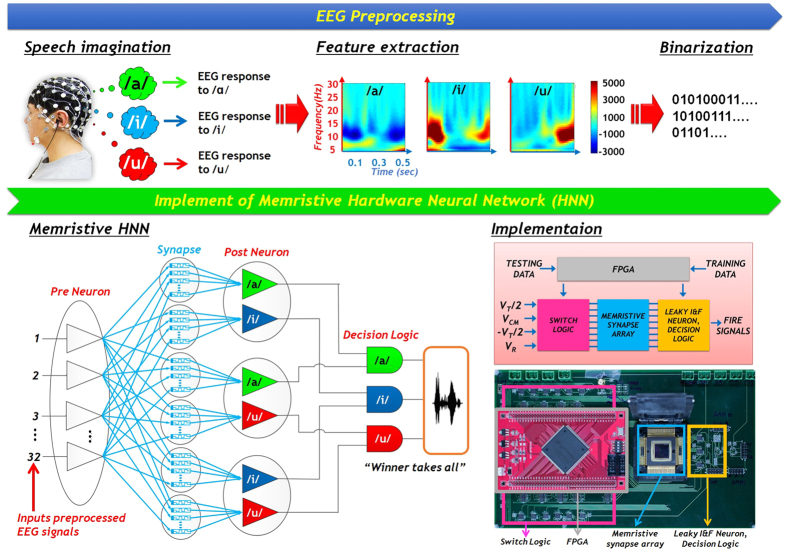
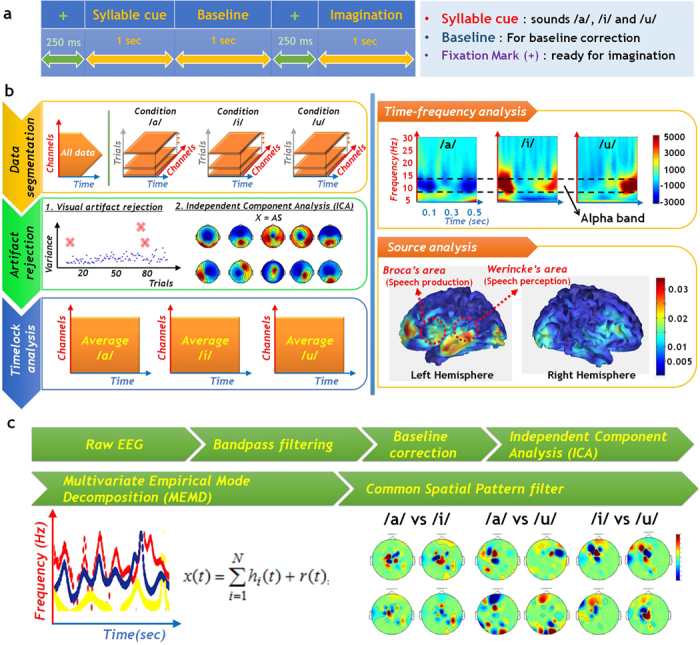
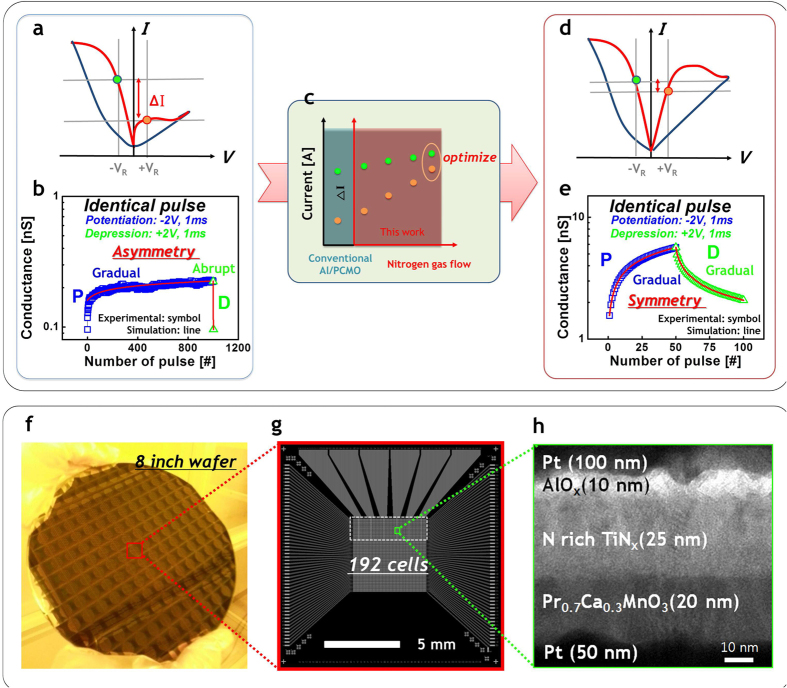
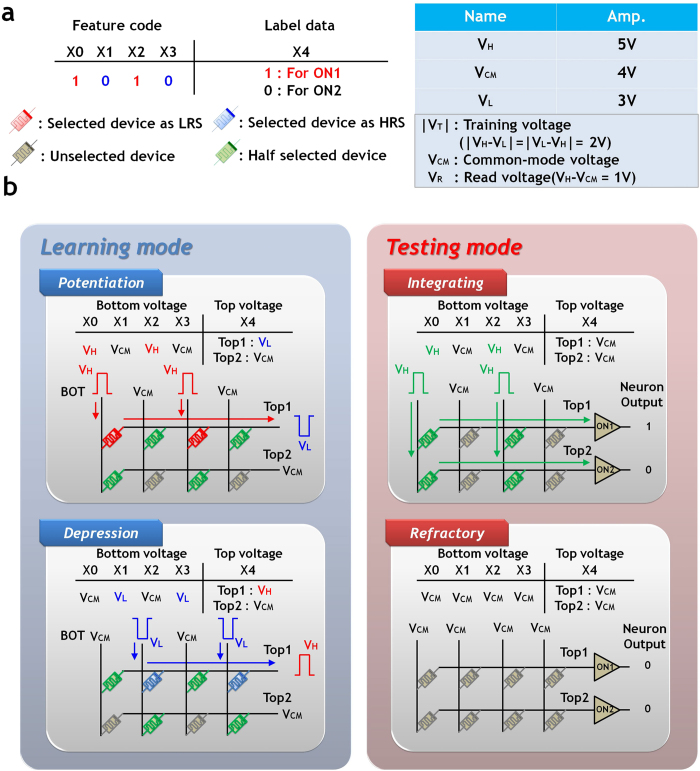
Memristive synapses, the most promising passive devices for synaptic interconnections in artificial neural networks, are the driving force behind recent research on hardware neural networks. Despite significant efforts to utilize memristive synapses, progress to date has only shown the possibility of building a neural network system that can classify simple image patterns. In this article, we report a high-density cross-point memristive synapse array with improved synaptic characteristics. The proposed PCMO-based memristive synapse exhibits the necessary gradual and symmetrical conductance changes and has been successfully adapted to a neural network system. The system learns and later recognizes, the human thought pattern corresponding to three vowels, i.e. /a /, /i / and /u/, using electroencephalography signals generated while a subject imagines speaking vowels. Our successful demonstration of a neural network system for EEG pattern recognition is likely to intrigue many researchers and stimulate a new research direction.
Overview
The claims and statistics of this paper haven’t been checked yet.
Free: it reads the open-access text and checks the first 5 claims that cite a source we can check. Create a free account to check every claim.
Integrity signals
Registry
Cites
Statistics
Figures
Verification
Claims the paper makes
The claims and statistics of this paper haven’t been checked yet.
Free: it reads the open-access text and checks the first 5 claims that cite a source we can check. Create a free account to check every claim.
Claims other papers make about this one
Each is checked against this paper’s own text: does it say what the citing paper says it does?
The cited source says what the claim attributes to it.
In the citing paper
“Crossbar arrays of two-terminal metal/insulator/metal (MIM) memristive devices can be fabricated easily using standard lithography and deposition techniques; this has been readily achieved by multiple groups57,64,68–70,85,93,105,216,217.”
From Hardware implementation of memristor-based artificial neural networks (2024) · cites this paper as [217]
Experimental — accuracy not yet measuredThe cited source says what the claim attributes to it.
In the citing paper
“Then, analogue VMM has been demonstrated both for binary inputs and weights218–220, as well as for binary inputs and analogue/multilevel weights60,85,105,217.”
From Hardware implementation of memristor-based artificial neural networks (2024) · cites this paper as [217]
Self-check
Percentages, sums and reported differences re-computed from the paper’s own numbers.
The self-check needs the paper’s full text.
Citations
Cites
A million spiking-neuron integrated circuit with a scalable communication network and interface
Merolla, P. A., Arthur, J. V., Alvarez-Icaza, R., Cassidy, A. S., Sawada, J., Akopyan, F., Jackson, B. L., Imam, N., Guo, C., Nakamura, Y., et al. (2014) · Science · doi:10.1126/science.1254642 · Cited by 4,147
Nanoelectronic programmable synapses based on phase change materials for brain-inspired computing
Kuzum, D., Jeyasingh, R. G. D., Lee, B., & Wong, H.-S. P. (2012) · Nano Letters · doi:10.1021/nl201040y · Cited by 1,267
Self-citationNeurogrid: A Mixed-Analog-Digital Multichip System for Large-Scale Neural Simulations
Benjamin, B. V., Gao, P., McQuinn, E., Choudhary, S., Chandrasekaran, A. R., Bussat, J.-M., Alvarez-Icaza, R., Arthur, J. V., Merolla, P. A., & Boahen, K. (2014) · Proceedings of the IEEE · doi:10.1109/jproc.2014.2313565 · Cited by 1,266
Artificial neural networks in hardware: A survey of two decades of progress
Misra, J., & Saha, I. (2010) · Neurocomputing · doi:10.1016/j.neucom.2010.03.021 · Cited by 646
Pattern classification by memristive crossbar circuits using ex situ and in situ training
Alibart, F., Zamanidoost, E., & Strukov, D. B. (2013) · Nature Communications · doi:10.1038/ncomms3072 · Cited by 642 · cited 1×
“using a simple crossbar array 13 .”
High-Density Crossbar Arrays Based on a Si Memristive System
Jo, S. H., Kim, K.-H., & Lu, W. (2009) · Nano Letters · doi:10.1021/nl8037689 · Cited by 574 · cited 1×
“A simple, two-terminal cross array structure is necessary for the practical implementation of high-density HNN 17 .”
BackgroundYu, S., Gao, B., Fang, Z., Yu, H., Kang, J., & Wong, H. ‐. P. (2013) · Advanced Materials · doi:10.1002/adma.201203680 · Cited by 527
Neuromorphic Hardware System for Visual Pattern Recognition With Memristor Array and CMOS Neuron
Chu, M., Kim, B., Park, S., Hwang, H., Jeon, M., Lee, B. H., & Lee, B.-G. (2015) · IEEE Transactions on Industrial Electronics · doi:10.1109/tie.2014.2356439 · Cited by 296
Self-citationCrossbar RRAM Arrays: Selector Device Requirements During Write Operation
Kim, S., Zhou, J., & Lu, W. D. (2014) · IEEE Transactions on Electron Devices · doi:10.1109/ted.2014.2327514 · Cited by 219 · cited 1×
“Generally, in memory applications 20 , this problem is easily solved using the half-bias scheme.”
MethodNeuromorphic speech systems using advanced ReRAM-based synapse
Park, S., Sheri, A., Kim, J., Noh, J., Jang, J., Jeon, M., Lee, B., Lee, B. R., Lee, B. H., & Hwang, H. (2013) · 2013 IEEE International Electron Devices Meeting · doi:10.1109/iedm.2013.6724692 · Cited by 201
Self-citationAnalog VLSI Circuit Implementation of an Adaptive Neuromorphic Olfaction Chip
Koickal, T. J., Hamilton, A., Tan, S. L., Covington, J. A., Gardner, J. W., & Pearce, T. (2007) · IEEE Transactions on Circuits and Systems I Fundamental Theory and Applications · doi:10.1109/tcsi.2006.888677 · Cited by 151
Suri, M., Bichler, O., Querlioz, D., Palma, G., Vianello, E., Vuillaume, D., Gamrat, C., & DeSalvo, B. (2012) · Technical digest - International Electron Devices Meeting/Technical digest · doi:10.1109/iedm.2012.6479017 · Cited by 149
Synchrony Detection and Amplification by Silicon Neurons With STDP Synapses
Bofill-i-Petit, A., & Murray, A. F. (2004) · IEEE Transactions on Neural Networks · doi:10.1109/tnn.2004.832842 · Cited by 144
Nanoscale RRAM-based synaptic electronics: toward a neuromorphic computing device
Park, S., Noh, J., Choo, M.-L., Sheri, A. M., Chang, M., Kim, Y.-B., Kim, C. J., Jeon, M., Lee, B.-G., Lee, B. H., et al. (2013) · Nanotechnology · doi:10.1088/0957-4484/24/38/384009 · Cited by 139
Self-citationAn Event-Based Neural Network Architecture With an Asynchronous Programmable Synaptic Memory
Moradi, S., & Indiveri, G. (2013) · IEEE Transactions on Biomedical Circuits and Systems · doi:10.1109/tbcas.2013.2255873 · Cited by 79
Contrastive divergence for memristor-based restricted Boltzmann machine
Sheri, A. M., Rafique, M. A., Witold Pedrycz, C., & Jeon, M. (2014) · Engineering Applications of Artificial Intelligence · doi:10.1016/j.engappai.2014.09.013 · Cited by 49
Self-citationA Pulsed Neural Network With On-Chip Learning and Its Practical Applications
Zhuang, H., Low, K., & Yau, W. (2007) · IEEE Transactions on Industrial Electronics · doi:10.1109/tie.2006.888684 · Cited by 37
Self‐formed Schottky barrier induced selector‐less RRAM for cross‐point memory applications
Park, S., Jung, S., Siddik, M., Jo, M., Park, J., Kim, S., Lee, W., Shin, J., Lee, D., Choi, G., et al. (2012) · physica status solidi (RRL) - Rapid Research Letters · doi:10.1002/pssr.201206382 · Cited by 36 · cited 1×
“The Al/PCMO memristive synapse has an inhomogeneous barrier at the interface between the Al (reactive metal) and PCMO (p-type semiconductor) 15 .”
BackgroundSelf-citationScene segmentation using neuromorphic oscillatory networks
Cosp, J., & Madrenas, J. (2003) · IEEE Transactions on Neural Networks · doi:10.1109/tnn.2003.816364 · Cited by 29
A nitrogen-treated memristive device for tunable electronic synapses
Park, S., Siddik, M., Noh, J., Lee, D., Moon, K., Woo, J., Lee, B. H., & Hwang, H. (2014) · Semiconductor Science and Technology · doi:10.1088/0268-1242/29/10/104006 · Cited by 16
Self-citation
Research works printed but not linked: 1
- Anzai, Y. Pattern Recognition & Machine Learning. (Elsevier, 1992).
Cited by
Analogue signal and image processing with large memristor crossbars
Li, C., Hu, M., Li, Y., Jiang, H., Ge, N., Montgomery, E., Zhang, J., Song, W., Dávila, N., Graves, C. E., et al. (2017) · Nature Electronics · doi:10.1038/s41928-017-0002-z · Cited by 1,292
“So far, demonstrations of this concept have been limited to binary signal input and/or binary matrix weights 14–16 .”
BackgroundResistive switching materials for information processing
Wang, Z., Wu, H., Burr, G. W., Hwang, C. S., Wang, K. L., Xia, Q., & Yang, J. J. (2020) · Nature Reviews Materials · doi:10.1038/s41578-019-0159-3 · Cited by 1,214
Neuro-Inspired Computing With Emerging Nonvolatile Memorys
Yu, S. (2018) · Proceedings of the IEEE · doi:10.1109/jproc.2018.2790840 · Cited by 1,170
“[98] demonstrated a single-layer perceptron network in 32 × 6 PCMO crossbar array with off-chip neuron circuits on a printed circuit board.”
BackgroundNeuromorphic computing using non-volatile memory
Burr, G. W., Shelby, R. M., Sebastian, A., Kim, S., Kim, S., Sidler, S., Virwani, K., Ishii, M., Narayanan, P., Fumarola, A., et al. (2017) · Advances in Physics: X · doi:10.1080/23746149.2016.1259585 · Cited by 1,107
Self-citationEfficient and self-adaptive in-situ learning in multilayer memristor neural networks
Li, C., Belkin, D., Li, Y., Yan, P., Hu, M., Ge, N., Jiang, H., Montgomery, E., Lin, P., Wang, Z., et al. (2018) · Nature Communications · doi:10.1038/s41467-018-04484-2 · Cited by 931
Metadata
- Authors
- Park, S., Chu, M., Kim, J., Noh, J., Jeon, M., Hun Lee, B., Hwang, H., Lee, B., & Lee, B.-G.
- Affiliations
- Gwangju Institute of Science and Technology (KR)
- Pohang University of Science and Technology (KR)
- Corresponding author
- Lee, Boreom
- Lee, Byung-geun
- Venue
- Scientific Reports
- Published
- 2015-05-05
- Volume
- 5
- Issue
- 1
- Pages
- 10123-10123
- ISSN
- 2045-2322 (ISSN-L)
- PMC
- PMC4419523
- OpenAlex
- W2407840779
- Cited by
- 181
- References
- 20
- Citations by year
- 2026: 3 · 2025: 9 · 2024: 13 · 2023: 12 · 2022: 15 · 2021: 15 · 2020: 21 · 2019: 26 · 2018: 24 · 2017: 19 · 2016: 21 · 2015: 3
- FWCI
- 10.77
- Type
- journal article
- Language
- en
- Open access
- gold
- doi.org
- Licence
- cc-by
- creativecommons.org/licenses/by/4.0 (tdm)
- creativecommons.org/licenses/by/4.0 (vor)
- Locations
- Scientific Reports (publishedVersion, cc-by)
- Europe PMC (PubMed Central) (publishedVersion, cc-by)
- PubMed Central (publishedVersion, cc-by)
- PubMed (publishedVersion)
- Open Access System for Information Sharing (Pohang University of Science and Technology) (submittedVersion, cc-by-nc-nd)
- Funders
- National Research Foundation (2012-0009460)
- National Research Foundation of Korea (2012-0009460)
- Topics
- Physical Sciences › Engineering › Electrical and Electronic Engineering › Advanced Memory and Neural Computing
- Physical Sciences › Computer Science › Artificial Intelligence › Neural Networks and Applications
- Physical Sciences › Engineering › Electrical and Electronic Engineering › Ferroelectric and Negative Capacitance Devices
- Keywords
- memristive synapses, neural network hardware, pattern recognition, EEG, vowel recognition, synaptic conductance, artificial neural networks
- MeSH terms
- Electroencephalography, Electronics, Humans, Imagination, Learning, Pattern Recognition, Automated, Signal Processing, Computer-Assisted, Speech, Synapses, Neural Networks, Computer
About these checks
Registry, retraction, Cites and statistics results are computed, not judged, with one exception: a printed reference that no index lists is read once by a model before it counts as a citation error. Claims are extracted by a model and kept only when their quote appears verbatim in the text; each cited source is then checked, with a model’s help, for whether it says what the claim relies on. Those verdicts can be wrong — read the claim’s quote and the cited source before relying on one.
Statistics and arithmetic are recomputed, not judged.
Confidence bands are shown only for fields calibrated on our annotated test set. None is calibrated yet, so no band is shown.
What counts as a claim ›How we measure confidence ›How we check this ›
Are you an author, or do you see a problem with this page? Request a review
Data sources
Bibliographic data: Semantic Scholar, OpenAlex, Crossref.
Contains information from the Semantic Scholar Academic Graph Datasets, made available under the ODC Attribution License (ODC-BY 1.0).
Semantic Scholar’s data is described in: Kinney, R., et al. (2023). The Semantic Scholar Open Data Platform. arXiv:2301.10140.
