

Computing Arm Movements with a Monkey Brainet
Open accessThe DOI matches its Crossref record; 46 of the 46 references it cites were found in a registry or an index.
Abstract
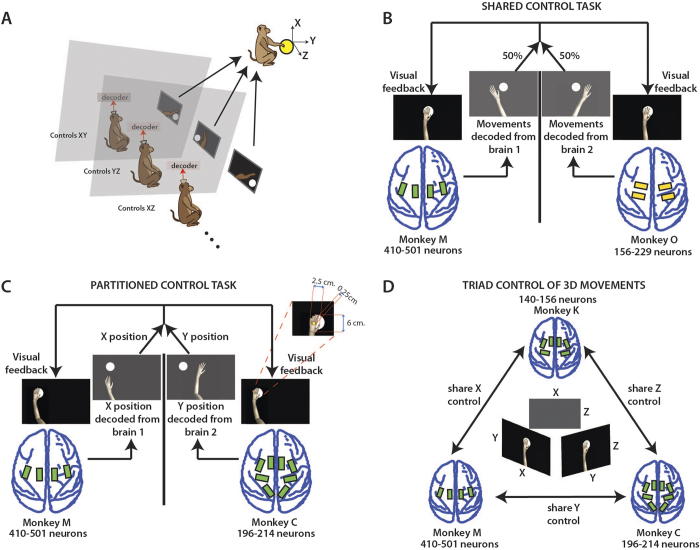
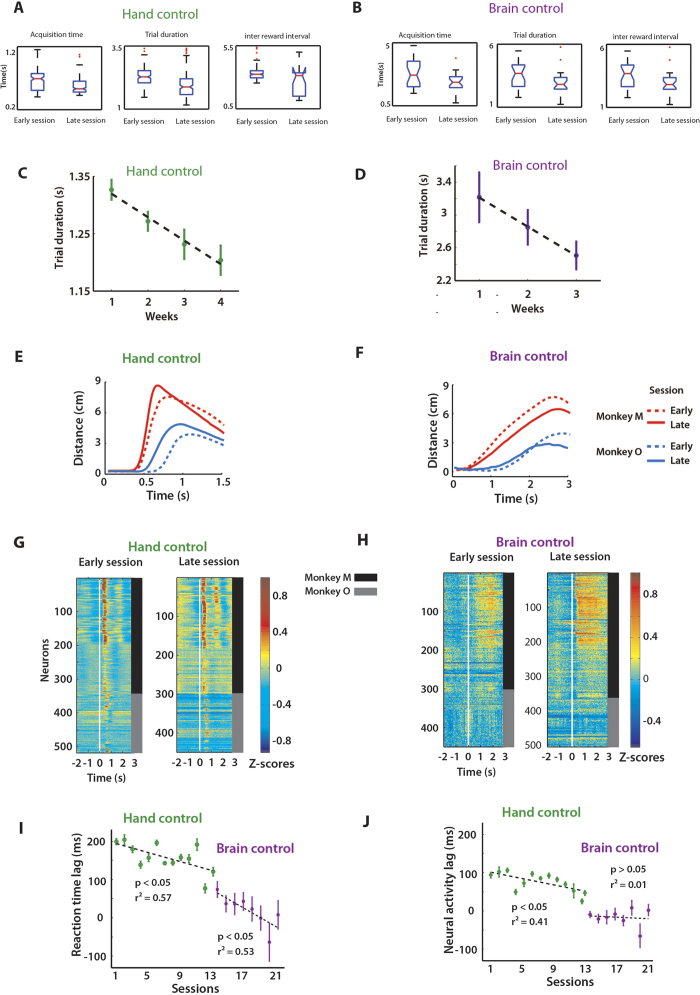
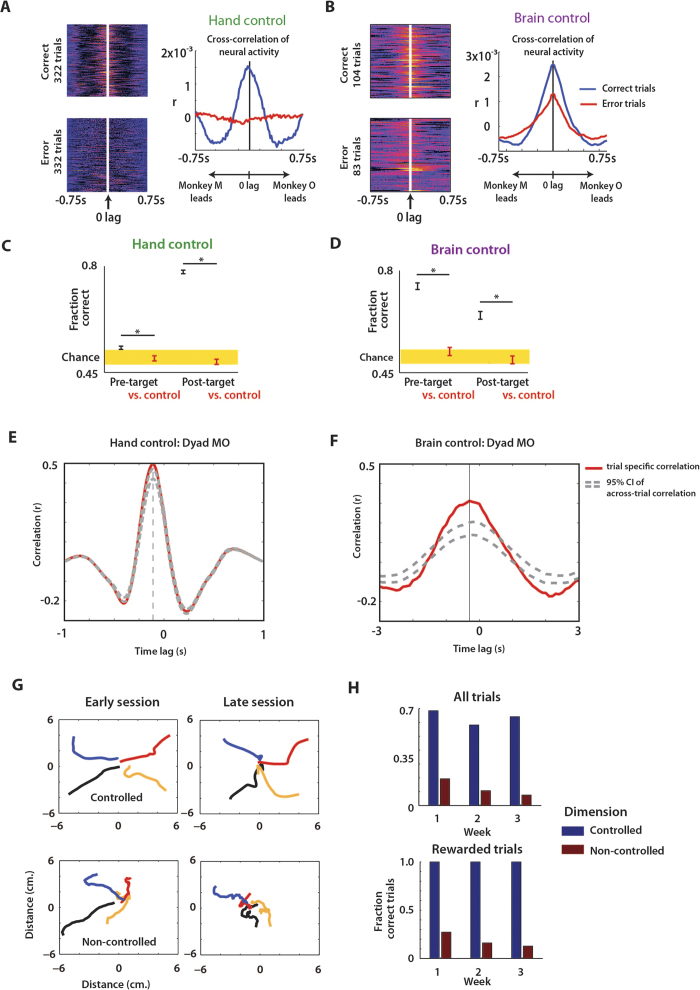
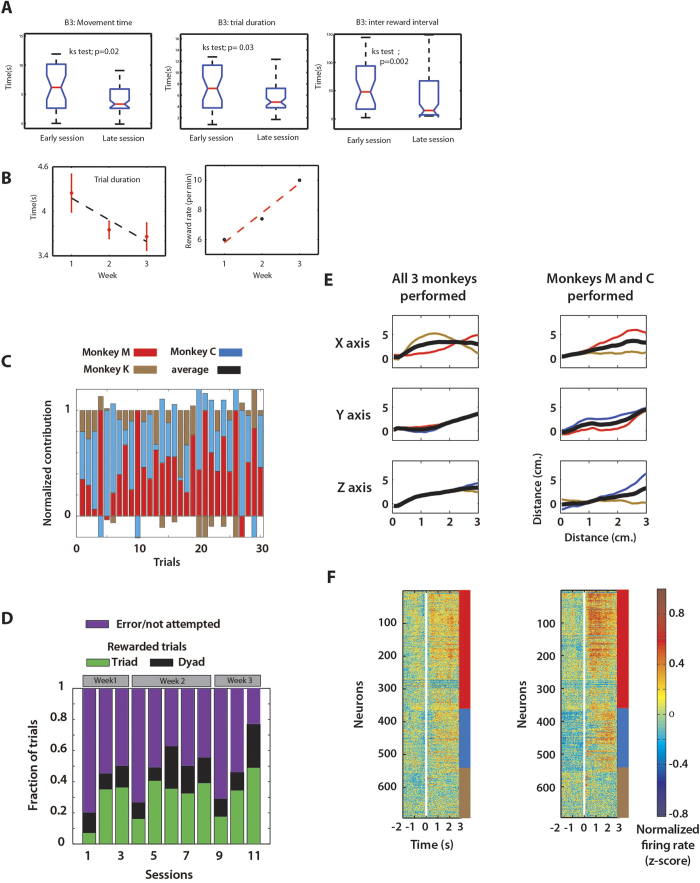
Traditionally, brain-machine interfaces (BMIs) extract motor commands from a single brain to control the movements of artificial devices. Here, we introduce a Brainet that utilizes very-large-scale brain activity (VLSBA) from two (B2) or three (B3) nonhuman primates to engage in a common motor behaviour. A B2 generated 2D movements of an avatar arm where each monkey contributed equally to X and Y coordinates; or one monkey fully controlled the X-coordinate and the other controlled the Y-coordinate. A B3 produced arm movements in 3D space, while each monkey generated movements in 2D subspaces (X-Y, Y-Z, or X-Z). With long-term training we observed increased coordination of behavior, increased correlations in neuronal activity between different brains and modifications to neuronal representation of the motor plan. Overall, performance of the Brainet improved owing to collective monkey behaviour. These results suggest that primate brains can be integrated into a Brainet, which self-adapts to achieve a common motor goal.
Overview
The claims and statistics of this paper haven’t been checked yet.
Free: it reads the open-access text and checks the first 5 claims that cite a source we can check. Create a free account to check every claim.
Integrity signals
Registry
Cites
Statistics
Figures
Verification
Claims the paper makes
The claims and statistics of this paper haven’t been checked yet.
Free: it reads the open-access text and checks the first 5 claims that cite a source we can check. Create a free account to check every claim.
Claims other papers make about this one
Each is checked against this paper’s own text: does it say what the citing paper says it does?
The cited source says what the claim attributes to it.
In the citing paper
“A different study12 demonstrated that three non-human primates can jointly control a 3D virtual avatar arm using brain signals recorded with invasive electrodes implanted in the motor cortex”
From BrainNet: A Multi-Person Brain-to-Brain Interface for Direct Collaboration Between Brains (2019) · cites this paper as [12]
The cited source says what the claim attributes to it.
In the citing paper
“again, the goal was distributing a single task across multiple individuals linked to a common BCI without encoding any neural information for feedback and interaction via stimulation.”
From BrainNet: A Multi-Person Brain-to-Brain Interface for Direct Collaboration Between Brains (2019) · cites this paper as [12]
The cited source says what the claim attributes to it.
In the citing paper
“Experiments have tested three different control systems using 2–3 implanted monkeys that shared BMI-mediated control of a virtual arm (Ramakrishnan et al., 2015).”
From Human Brain/Cloud Interface (2019) · cites this paper as Ramakrishnan et al., 2015
Self-check
Percentages, sums and reported differences re-computed from the paper’s own numbers.
The self-check needs the paper’s full text.
Citations
Cites
Neuronal ensemble control of prosthetic devices by a human with tetraplegia
Hochberg, L. R., Serruya, M. D., Friehs, G. M., Mukand, J. A., Saleh, M., Caplan, A. H., Branner, A., Chen, D., Penn, R. D., & Donoghue, J. P. (2006) · Nature · doi:10.1038/nature04970 · Cited by 3,295 · cited 1×
“To assess the performance of the B2 in manual control and brain control modes, we also calculated performance metrics reported in the previous literature 39,40 .”
MethodJoint action: bodies and minds moving together
SEBANZ, N., BEKKERING, H., & KNOBLICH, G. (2006) · Trends in Cognitive Sciences · doi:10.1016/j.tics.2005.12.009 · Cited by 1,950 · cited 1×
“Previously, joint motor behaviour was studied extensively in human psychophysics studies 18,19,41 .”
BackgroundBrain–machine interfaces: past, present and future
Lebedev, M. A., & Nicolelis, M. A. L. (2006) · Trends in Neurosciences · doi:10.1016/j.tins.2006.07.004 · Cited by 1,875 · cited 1×
“They were chronically implanted with multielectrode arrays in motor (M1) and somatosensory cortices (S1) 1,35 .”
MethodSelf-citationLearning to control a brain–machine interface for reaching and grasping by primates
Carmena, J. M., Lebedev, M. A., Crist, R. E., O'Doherty, J. E., Santucci, D. M., Dimitrov, D. F., Patil, P. G., Henriquez, C. S., & Nicolelis, M. A. L. (2003) · PLoS Biology · doi:10.1371/journal.pbio.0000042 · Cited by 1,761 · cited 2×
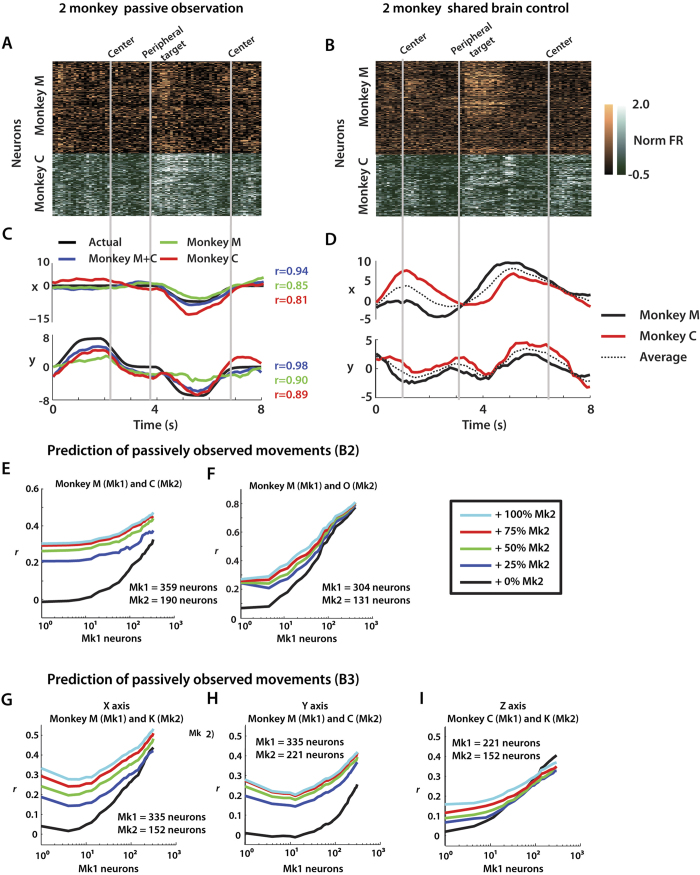
“This finding extends our previous results, using neuron dropping curve (NDC) analyses, where we showed that decoding accuracy consistently improved when larger neuronal samples were recorded from a single brain 4,5 .”
MethodResultSelf-citationControl of a two-dimensional movement signal by a noninvasive brain-computer interface in humans
Wolpaw, J. R., & McFarland, D. J. (2004) · Proceedings of the National Academy of Sciences · doi:10.1073/pnas.0403504101 · Cited by 1,512
Real-time prediction of hand trajectory by ensembles of cortical neurons in primates
Wessberg, J., Stambaugh, C. R., Kralik, J. D., Beck, P. D., Laubach, M., Chapin, J. K., Kim, J., Biggs, S. J., Srinivasan, M. A., & Nicolelis, M. A. L. (2000) · Nature · doi:10.1038/35042582 · Cited by 1,487
Self-citationGroup Performance and Decision Making
Kerr, N. L., & Tindale, R. S. (2004) · Annual Review of Psychology · doi:10.1146/annurev.psych.55.090902.142009 · Cited by 1,331
Real-time control of a robot arm using simultaneously recorded neurons in the motor cortex
Chapin, J. K., Moxon, K. A., Markowitz, R. S., & Nicolelis, M. A. L. (1999) · Nature Neuroscience · doi:10.1038/10223 · Cited by 1,164
Self-citationRf, G. (1985) · Cited by 949
Rocking together: Dynamics of intentional and unintentional interpersonal coordination
Richardson, M. J., Marsh, K. L., Isenhower, R. W., Goodman, J. R. L., & Schmidt, R. C. (2007) · Human Movement Science · doi:10.1016/j.humov.2007.07.002 · Cited by 796 · cited 1×
“Two individuals who are performing movements can become entrained when they mutually affect each other’s behaviour 42 , even if they are not explicitly instructed to do so 22 .”
Background
Research works printed but not linked: 1
- Gibson, J. J. The theory of affordances in Perceiving, Acting and Knowing (eds. Shaw, R. & Bransford, J. ) 67–82 (Wiley, 1977).
Cited by
Four ethical priorities for neurotechnologies and AI
Yuste, R., Goering, S., Arcas, B. A. Y., Bi, G., Carmena, J. M., Carter, A., Fins, J. J., Friesen, P., Gallant, J., Huggins, J. E., et al. (2017) · Nature · doi:10.1038/551159a · Cited by 678
Brain-Machine Interfaces: From Basic Science to Neuroprostheses and Neurorehabilitation
Lebedev, M. A., & Nicolelis, M. A. L. (2017) · Physiological Reviews · doi:10.1152/physrev.00027.2016 · Cited by 653
“In the same context, the concept of Brainets takes multitasking BMI designs to the next level by combining multiple brains into a higher order computational entity (614, 616, 657).”
BackgroundInfluentialSelf-citationKrucoff, M. O., Rahimpour, S., Slutzky, M. W., Edgerton, V. R., & Turner, D. A. (2016) · Frontiers in Neuroscience · doi:10.3389/fnins.2016.00584 · Cited by 187
“Other investigators have connected the brains of several animals into a single system, or “brainet,” where the animals try to achieve a single objective using brain control only (Pais-Vieira et al., 2015; Ramakrishnan et al., 2015).”
BackgroundBrainNet: A Multi-Person Brain-to-Brain Interface for Direct Collaboration Between Brains
Jiang, L., Stocco, A., Losey, D. M., Abernethy, J. A., Prat, C. S., & Rao, R. P. N. (2019) · Scientific Reports · doi:10.1038/s41598-019-41895-7 · Cited by 190
“…BrainNet (Figure 1), a next-generation BBI that addresses many of the limitations of past BBIs (The term “Brainet” was used by Ramakrishnan et al. 12 for their brain-computer interface system which combines recordings from multiple monkey brains to perform a common motor task; the interface was…”
BackgroundMethodInfluentialBuilding an organic computing device with multiple interconnected brains
Pais-Vieira, M., Chiuffa, G., Lebedev, M., Yadav, A., & Nicolelis, M. A. L. (2015) · Scientific Reports · doi:10.1038/srep11869 · Cited by 99
“According to this analysis, Brainets formed by larger cortical neuronal ensembles performed better than those containing just a few neurons 9 .”
BackgroundMethodInfluentialSelf-citation
Metadata
- Authors
- Ramakrishnan, A., Ifft, P. J., Pais-Vieira, M., Byun, Y. W., Zhuang, K. Z., Lebedev, M. A., & Nicolelis, M. A. L.
- Affiliations
- Duke University (US)
- Corresponding author
- Nicolelis, Miguel A.L.
- ORCID
- Venue
- Scientific Reports
- Published
- 2015-07-09
- Volume
- 5
- Issue
- 1
- Pages
- 10767-10767
- ISSN
- 2045-2322 (ISSN-L)
- PMC
- PMC4497496
- OpenAlex
- W998936125
- Cited by
- 54
- References
- 46
- Citations by year
- 2026: 2 · 2025: 2 · 2024: 5 · 2023: 7 · 2022: 5 · 2021: 7 · 2020: 4 · 2019: 4 · 2018: 5 · 2017: 6 · 2016: 6 · 2015: 1
- FWCI
- 3.57
- Type
- journal article
- Language
- en
- Open access
- gold
- doi.org
- Licence
- cc-by
- creativecommons.org/licenses/by/4.0 (tdm)
- creativecommons.org/licenses/by/4.0 (vor)
- Locations
- Scientific Reports (publishedVersion, cc-by)
- PubMed Central (publishedVersion, cc-by)
- PubMed (publishedVersion)
- Funders
- Fundação Bial
- National Institutes of Health
- National Institute of Mental Health (DP1MH099903)
- National Center for Chronic Disease Prevention and Health Promotion (DP1MH099903)
- Topics
- Life Sciences › Neuroscience › Cognitive Neuroscience › EEG and Brain-Computer Interfaces
- Life Sciences › Neuroscience › Cognitive Neuroscience › Motor Control and Adaptation
- Life Sciences › Neuroscience › Cellular and Molecular Neuroscience › Neuroscience and Neural Engineering
- Keywords
- brain-computer interface, non-human primates, arm movement control
- MeSH terms
- Animals, Haplorhini, Arm, Behavior, Animal, Brain, Electrodes, Implanted, Movement, Neurons, Brain-Computer Interfaces
About these checks
Registry, retraction, Cites and statistics results are computed, not judged, with one exception: a printed reference that no index lists is read once by a model before it counts as a citation error. Claims are extracted by a model and kept only when their quote appears verbatim in the text; each cited source is then checked, with a model’s help, for whether it says what the claim relies on. Those verdicts can be wrong — read the claim’s quote and the cited source before relying on one.
Statistics and arithmetic are recomputed, not judged.
Confidence bands are shown only for fields calibrated on our annotated test set. None is calibrated yet, so no band is shown.
What counts as a claim ›How we measure confidence ›How we check this ›
Are you an author, or do you see a problem with this page? Request a review
How to cite
Cite CoChat for the checks on this page, and the paper for its own findings.
- This page
- CoChat. (2026). Citation check: Computing Arm Movements with a Monkey Brainet. https://app.cochat.ai/papers/10.1038/srep10767
- The paper
- Ramakrishnan, A., Ifft, P. J., Pais-Vieira, M., Byun, Y. W., Zhuang, K. Z., Lebedev, M. A., & Nicolelis, M. A. L. (2015). Computing Arm Movements with a Monkey Brainet. Scientific Reports. https://doi.org/10.1038/srep10767
Data sources
Bibliographic data: Semantic Scholar, OpenAlex, Crossref.
Contains information from the Semantic Scholar Academic Graph Datasets, made available under the ODC Attribution License (ODC-BY 1.0).
Semantic Scholar’s data is described in: Kinney, R., et al. (2023). The Semantic Scholar Open Data Platform. arXiv:2301.10140.
