

Cryptococcus neoformans Intracellular Proliferation and Capsule Size Determines Early Macrophage Control of Infection
Open accessThe DOI matches its Crossref record; 59 of the 59 references it cites were found in a registry or an index.
Abstract
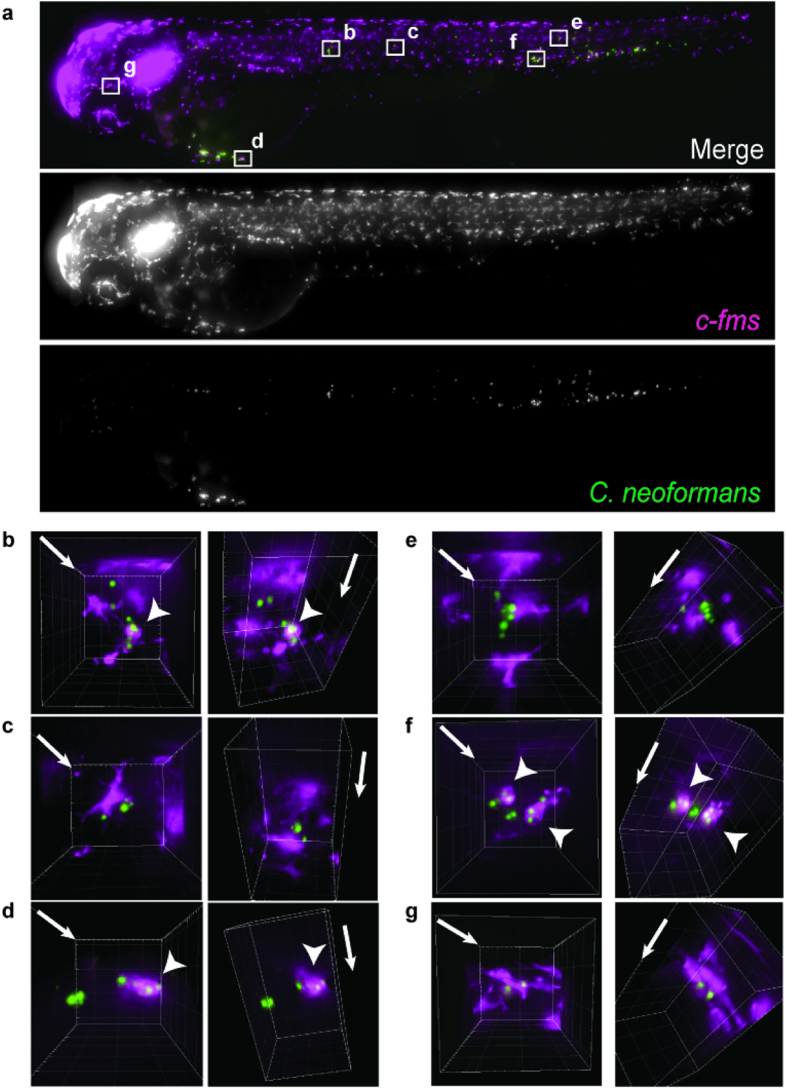
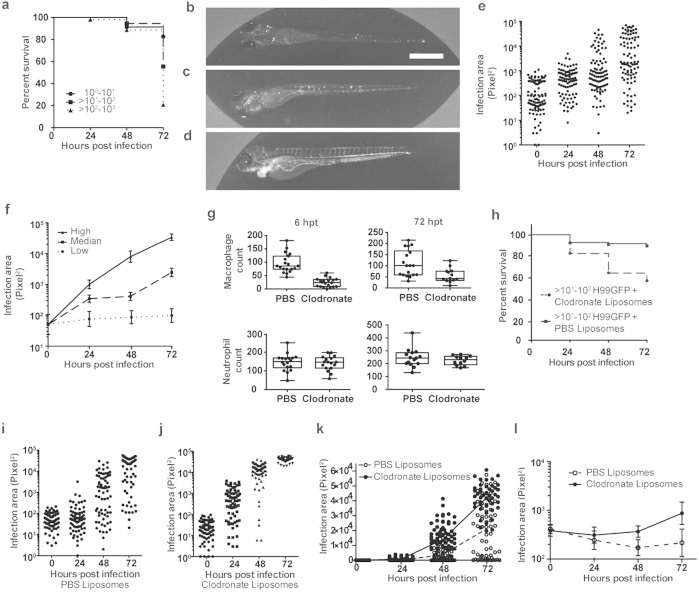
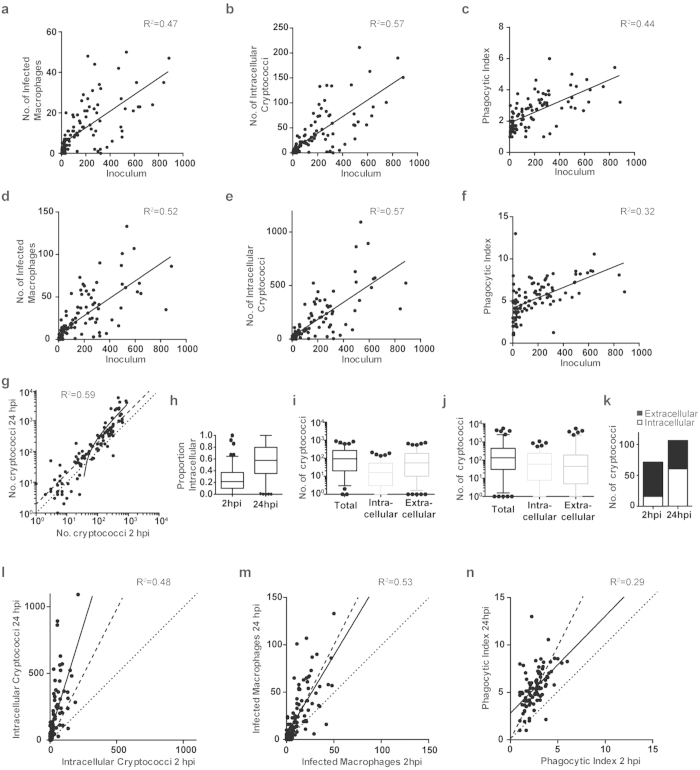
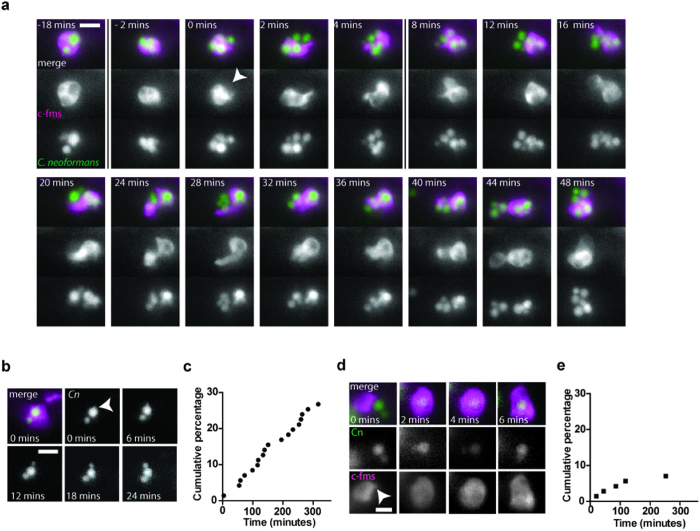
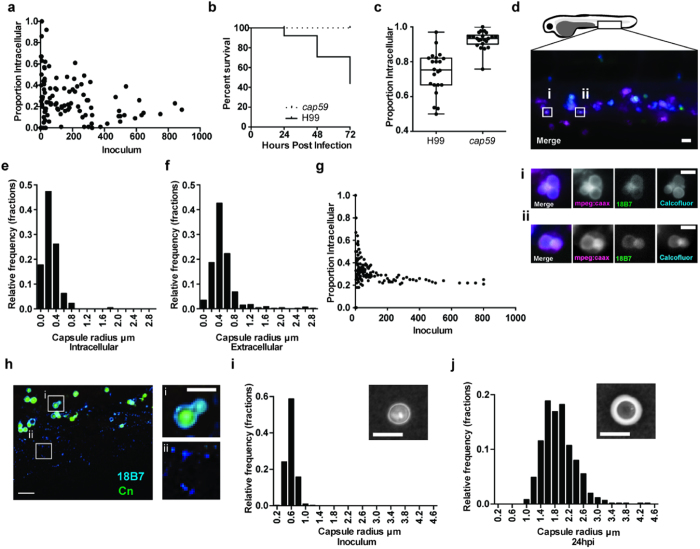
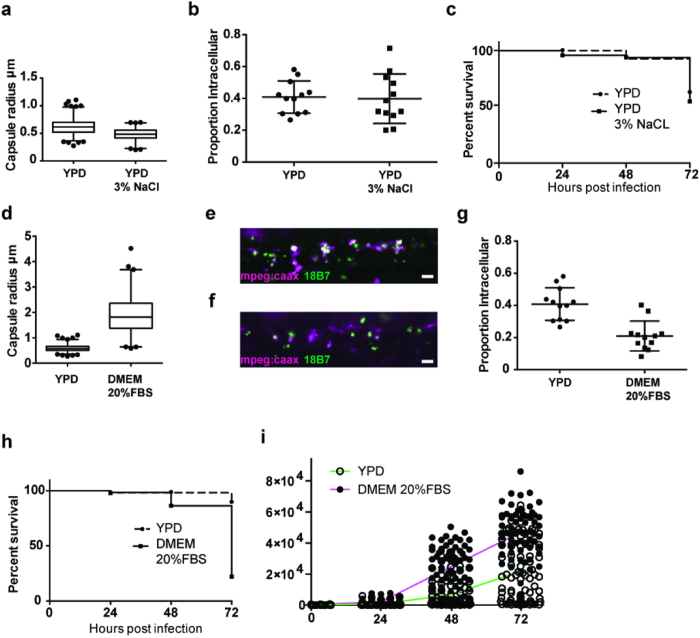
Cryptococcus neoformans is a significant fungal pathogen of immunocompromised patients. Many questions remain regarding the function of macrophages in normal clearance of cryptococcal infection and the defects present in uncontrolled cryptococcosis. Two current limitations are: 1) The difficulties in interpreting studies using isolated macrophages in the context of the progression of infection, and 2) The use of high resolution imaging in understanding immune cell behavior during animal infection. Here we describe a high-content imaging method in a zebrafish model of cryptococcosis that permits the detailed analysis of macrophage interactions with C. neoformans during infection. Using this approach we demonstrate that, while macrophages are critical for control of C. neoformans,a failure of macrophage response is not the limiting defect in fatal infections. We find phagocytosis is restrained very early in infection and that increases in cryptococcal number are driven by intracellular proliferation. We show that macrophages preferentially phagocytose cryptococci with smaller polysaccharide capsules and that capsule size is greatly increased over twenty-four hours of infection, a change that is sufficient to severely limit further phagocytosis. Thus, high-content imaging of cryptococcal infection in vivo demonstrates how very early interactions between macrophages and cryptococci are critical in the outcome of cryptococcosis.
Overview
The claims and statistics of this paper haven’t been checked yet.
Free: it reads the open-access text and checks the first 5 claims that cite a source we can check. Create a free account to check every claim.
Integrity signals
Registry
Cites
Statistics
Figures
Verification
Claims the paper makes
The claims and statistics of this paper haven’t been checked yet.
Free: it reads the open-access text and checks the first 5 claims that cite a source we can check. Create a free account to check every claim.
Claims other papers make about this one
Each is checked against this paper’s own text: does it say what the citing paper says it does?
The source backs part of the claim, not all of it — or backs it for a different population, condition or comparison.
In the citing paper
“In this regard, intravital microscopy has been recently used to study fungal dissemination through the imaging of dynamic interactions between fungal cells and endothelial cells as well as phagocytes [17, 91–93, 116, 129, 229].”
From Mechanisms of fungal dissemination (2021) · cites this paper as [17]
Experimental — accuracy not yet measured
Self-check
Percentages, sums and reported differences re-computed from the paper’s own numbers.
The self-check needs the paper’s full text.
Citations
Cites
Optical Sectioning Deep Inside Live Embryos by Selective Plane Illumination Microscopy
Huisken, J., Swoger, J., Del Bene, F., Wittbrodt, J., & Stelzer, E. H. K. (2004) · Science · doi:10.1126/science.1100035 · Cited by 2,355
Park, B. J., Wannemuehler, K. A., Marston, B. J., Govender, N., Pappas, P. G., & Chiller, T. M. (2009) · AIDS · doi:10.1097/qad.0b013e328322ffac · Cited by 2,014
The Tol2kit: A multisite gateway‐based construction kit for Tol2 transposon transgenesis constructs
Kwan, K. M., Fujimoto, E., Grabher, C., Mangum, B. D., Hardy, M. E., Campbell, D. S., Parant, J. M., Yost, H. J., Kanki, J. P., & Chien, C. (2007) · Developmental Dynamics · doi:10.1002/dvdy.21343 · Cited by 1,774
mpeg1 promoter transgenes direct macrophage-lineage expression in zebrafish
Ellett, F., Pase, L., Hayman, J. W., Andrianopoulos, A., & Lieschke, G. J. (2011) · Blood · doi:10.1182/blood-2010-10-314120 · Cited by 1,077
A transgenic zebrafish model of neutrophilic inflammation
Renshaw, S. A., Loynes, C. A., Trushell, D. M. I., Elworthy, S., Ingham, P. W., & Whyte, M. K. B. (2006) · Blood · doi:10.1182/blood-2006-05-024075 · Cited by 1,011
Self-citationLister, J. A., Robertson, C. P., Lepage, T., Johnson, S. L., & Raible, D. W. (1999) · Development · doi:10.1242/dev.126.17.3757 · Cited by 819
Zebrafish : a practical approach
Nüsslein‐Volhard, C., & Dahm, R. (2002) · Cited by 697
Zebrafish: A Practical Approach
(2002) · doi:10.1093/oso/9780199638086.001.0001 · Cited by 584
The lta4h Locus Modulates Susceptibility to Mycobacterial Infection in Zebrafish and Humans
Tobin, D. M., Vary, J. C., Ray, J. P., Walsh, G. S., Dunstan, S. J., Bang, N. D., Hagge, D. A., Khadge, S., King, M.-C., Hawn, T. R., et al. (2010) · Cell · doi:10.1016/j.cell.2010.02.013 · Cited by 528
Complementation of a capsule-deficient mutation of Cryptococcus neoformans restores its virulence.
Chang, Y. C., & Kwon-Chung, K. J. (1994) · Molecular and Cellular Biology · doi:10.1128/mcb.14.7.4912 · Cited by 490
Research works printed but not linked: 1
- Malik R. et al. Vetinary Insights into Cryptococcosis Caused by Cryptococcus neoformans and Cryptococcus gattii. (ASM Press, 2011).
Cited by
Trojan Horse Transit Contributes to Blood-Brain Barrier Crossing of a Eukaryotic Pathogen
Santiago-Tirado, F. H., Onken, M. D., Cooper, J. A., Klein, R. S., & Doering, T. L. (2017) · mBio · doi:10.1128/mbio.02183-16 · Cited by 238
“Although Trojan horse crossing was more frequent (36% of recorded events) than nonlytic exocytosis or direct transfer (26% or 3%, respectively) in our system, the latter mechanisms may contribute to brain entry in vivo (19, 57).”
BackgroundThe capsule of Cryptococcus neoformans
Casadevall, A., Coelho, C., Cordero, R. J. B., Dragotakes, Q., Jung, E., Vij, R., & Wear, M. P. (2019) · Virulence · doi:10.1080/21505594.2018.1431087 · Cited by 233
“neoformans strains with larger capsules had worse survival [80].”
BackgroundFungal Strategies to Evade the Host Immune Recognition
Hernández-Chávez, M., Pérez-García, L., Niño-Vega, G., & Mora-Montes, H. (2017) · Journal of Fungi · doi:10.3390/jof3040051 · Cited by 173
“It was also demonstrated that macrophages preferentially phagocytize cells with small capsules [70].”
InfluentialThe pathobiology of human fungal infections
Brown, G. D., Ballou, E. R., Bates, S., Bignell, E., Borman, A. M., Brand, A., Brown, A. J. P., Coelho, C., Cook, P. C., Farrer, R. A., et al. (2024) · Nature Reviews Microbiology · doi:10.1038/s41579-024-01062-w · Cited by 210
“This process has also been described for other fungal pathogens including Candida spp. 117 and been linked to fungal cell transfer between phagocytes 118 .”
Dee, C., Nagaraju, R. T., Athanasiadis, E. I., Gray, C., del Ama, L. F., Johnston, S. A., Secombes, C. J., Cvejic, A., & Hurlstone, A. F. L. (2016) · The Journal of Immunology · doi:10.4049/jimmunol.1600959 · Cited by 159
Self-citation
Metadata
- Authors
- Bojarczuk, A., Miller, K. A., Hotham, R., Lewis, A., Ogryzko, N. V., Kamuyango, A. A., Frost, H., Gibson, R. H., Stillman, E., May, R. C., Renshaw, S. A., & Johnston, S. A.
- Affiliations
- University of Sheffield (GB)
- University of Birmingham (GB)
- University Hospitals Birmingham NHS Foundation Trust (GB)
- Corresponding author
- Johnston, Simon A.
- ORCID
- Venue
- Scientific Reports
- Published
- 2016-02-18
- Volume
- 6
- Issue
- 1
- Pages
- 21489-21489
- ISSN
- 2045-2322 (ISSN-L)
- PMC
- PMC4757829
- OpenAlex
- W2278506590
- Cited by
- 170
- References
- 59
- Citations by year
- 2026: 7 · 2025: 14 · 2024: 23 · 2023: 9 · 2022: 17 · 2021: 10 · 2020: 26 · 2019: 21 · 2018: 18 · 2017: 17 · 2016: 8
- FWCI
- 19.97
- Type
- journal article
- Language
- en
- Open access
- gold
- doi.org
- Licence
- cc-by
- creativecommons.org/licenses/by/4.0 (tdm)
- creativecommons.org/licenses/by/4.0 (vor)
- Locations
- Scientific Reports (publishedVersion, cc-by)
- Europe PMC (PubMed Central) (publishedVersion, cc-by)
- PubMed Central (publishedVersion, cc-by)
- PubMed (publishedVersion)
- White Rose Research Online (University of Leeds, The University of Sheffield, University of York) (acceptedVersion)
- DMU Open Research Archive (De Montfort University) (submittedVersion)
- University of Birmingham Research Portal (University of Birmingham) (submittedVersion, cc-by)
- Funders
- Wellcome Trust (097377/Z/11/Z, 097377, RCHX14191)
- Department for International Development
- Directorate for Biological Sciences
- Medical Research Council (MR/M004864/1, MR/J008176/1, MR/J009156/1, G0701932, G0700091, R/140419, MR/J009156)
- Biotechnology and Biological Sciences Research Council (BB/L000830/1)
- Topics
- Health Sciences › Medicine › Infectious Diseases › Fungal Infections and Studies
- Health Sciences › Medicine › Infectious Diseases › Antifungal resistance and susceptibility
- Life Sciences › Immunology and Microbiology › Parasitology › Parasitic infections in humans and animals
- Keywords
- Cryptococcus neoformans, cryptococcosis, macrophages, phagocytosis, intracellular growth, capsule size, polysaccharide capsule, zebrafish infection model, high-content imaging, immunocompromised patients
- MeSH terms
- Animals, Cryptococcosis, Cryptococcus neoformans, Fish Diseases, Macrophages, Zebrafish, Organisms, Genetically Modified, Cell Proliferation
About these checks
Registry, retraction, Cites and statistics results are computed, not judged, with one exception: a printed reference that no index lists is read once by a model before it counts as a citation error. Claims are extracted by a model and kept only when their quote appears verbatim in the text; each cited source is then checked, with a model’s help, for whether it says what the claim relies on. Those verdicts can be wrong — read the claim’s quote and the cited source before relying on one.
Statistics and arithmetic are recomputed, not judged.
Confidence bands are shown only for fields calibrated on our annotated test set. None is calibrated yet, so no band is shown.
What counts as a claim ›How we measure confidence ›How we check this ›
Are you an author, or do you see a problem with this page? Request a review
How to cite
Cite CoChat for the checks on this page, and the paper for its own findings.
- This page
- CoChat. (2026). Citation check: Cryptococcus neoformans Intracellular Proliferation and Capsule Size Determines Early Macrophage Control of Infection. https://app.cochat.ai/papers/10.1038/srep21489
- The paper
- Bojarczuk, A., Miller, K. A., Hotham, R., Lewis, A., Ogryzko, N. V., Kamuyango, A. A., Frost, H., Gibson, R. H., Stillman, E., May, R. C., Renshaw, S. A., & Johnston, S. A. (2016). Cryptococcus neoformans Intracellular Proliferation and Capsule Size Determines Early Macrophage Control of Infection. Scientific Reports. https://doi.org/10.1038/srep21489
Data sources
Bibliographic data: Semantic Scholar, OpenAlex, Crossref.
Contains information from the Semantic Scholar Academic Graph Datasets, made available under the ODC Attribution License (ODC-BY 1.0).
Semantic Scholar’s data is described in: Kinney, R., et al. (2023). The Semantic Scholar Open Data Platform. arXiv:2301.10140.
