

Unraveling the cytotoxicity and metabolic pathways of binary natural deep eutectic solvent systems
Open accessThe DOI matches its Crossref record; 56 of the 56 references it cites were found in a registry or an index.
Abstract
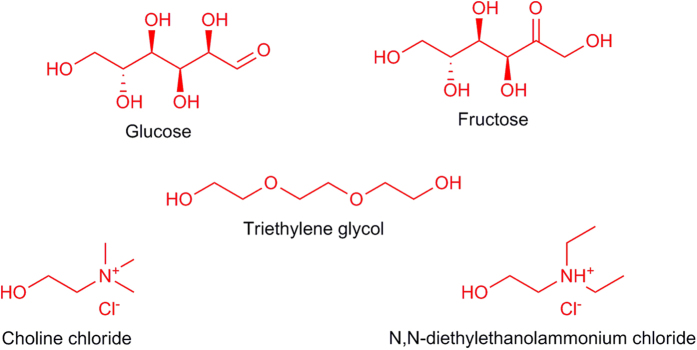
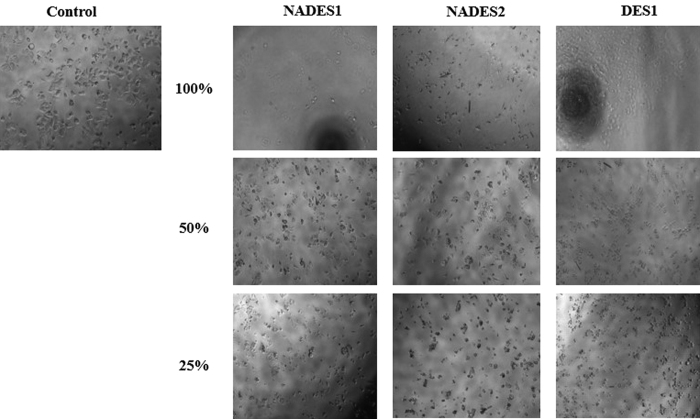
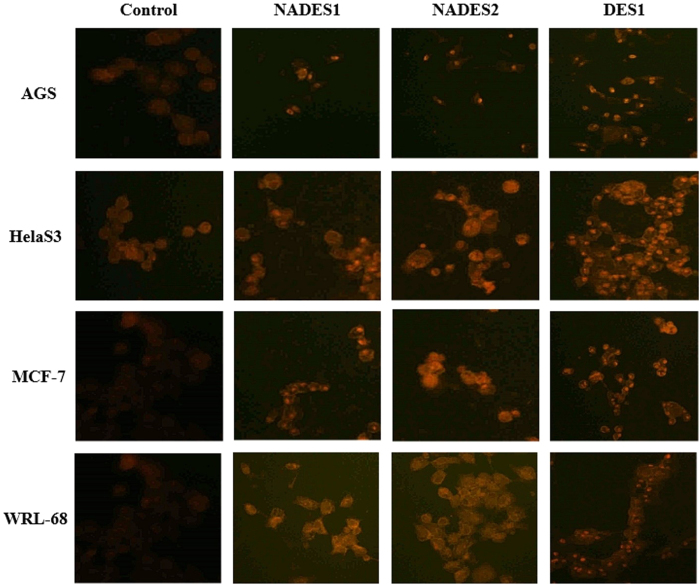
In this study, the anticancer potential and cytotoxicity of natural deep eutectic solvents (NADESs) were assessed using HelaS3, PC3, A375, AGS, MCF-7, and WRL-68 hepatic cell lines. NADESs were prepared from choline chloride, fructose, or glucose and compared with an N,N-diethyl ethanolammonium chloride:triethylene glycol DES. The NADESs (98 ≤ EC 50 ≥ 516 mM) were less toxic than the DES (34 ≤ EC 50 ≥ 120 mM). The EC 50 values of the NADESs were significantly higher than those of the aqueous solutions of their individual components but were similar to those of the aqueous solutions of combinations of their chief elements. Due to the uniqueness of these results, the possibility that NADESs could be synthesized intracellularly to counterbalance the cytotoxicity of their excess principal constituents must be entertained. However, further research is needed to explore this avenue. NADESs exerted cytotoxicity by increasing membrane porosity and redox stress.In vivo, they were more destructive than the DES and induced liver failure. The potential of these mixtures was evidenced by their anticancer activity and intracellular processing. This infers that they can serve as tools for increasing our understanding of cell physiology and metabolism. It is likely that we only have begun to comprehend the nature of NADESs.
Overview
The claims and statistics of this paper haven’t been checked yet.
Free: it reads the open-access text and checks the first 5 claims that cite a source we can check. Create a free account to check every claim.
Integrity signals
Registry
Cites
Statistics
Figures
Verification
Claims the paper makes
The claims and statistics of this paper haven’t been checked yet.
Free: it reads the open-access text and checks the first 5 claims that cite a source we can check. Create a free account to check every claim.
Claims other papers make about this one
Each is checked against this paper’s own text: does it say what the citing paper says it does?
The source backs part of the claim, not all of it — or backs it for a different population, condition or comparison.
In the citing paper
“In addition, LD 50 values were determined (LD 50 =1.84and 1.24 g mL -1 , for ChCl:fructose and ChCl:glucose, respectively).”
From The perspectives of natural deep eutectic solvents in agri-food sector (2020) · cites this paper as Mbous et al. 2017
Experimental — accuracy not yet measuredThe cited source says what the claim attributes to it.
In the citing paper
“According to obtained results of biochemical analysis of animal's blood, investigated NADESs exhibited hepatotoxic effect.”
From The perspectives of natural deep eutectic solvents in agri-food sector (2020) · cites this paper as Mbous et al. 2017
The cited source says what the claim attributes to it.
In the citing paper
“Mbous et al. (2017) suggested that the presence of water in NADES decrease their toxic effect.”
From The perspectives of natural deep eutectic solvents in agri-food sector (2020) · cites this paper as Mbous et al. (2017)
Self-check
Percentages, sums and reported differences re-computed from the paper’s own numbers.
The self-check needs the paper’s full text.
Citations
Cites
Deep Eutectic Solvents (DESs) and Their Applications
Smith, E. L., Abbott, A. P., & Ryder, K. S. (2014) · Chemical Reviews · doi:10.1021/cr300162p · Cited by 7,378
Deep eutectic solvents: syntheses, properties and applications
Zhang, Q., De Oliveira Vigier, K., Royer, S., & Jérôme, F. (2012) · Chemical Society Reviews · doi:10.1039/c2cs35178a · Cited by 4,899
Natural deep eutectic solvents as new potential media for green technology
Dai, Y., van Spronsen, J., Witkamp, G.-J., Verpoorte, R., & Choi, Y. H. (2013) · Analytica Chimica Acta · doi:10.1016/j.aca.2012.12.019 · Cited by 2,694
Natural Deep Eutectic Solvents – Solvents for the 21st Century
Paiva, A., Craveiro, R., Aroso, I., Martins, M., Reis, R. L., & Duarte, A. R. C. (2014) · ACS Sustainable Chemistry & Engineering · doi:10.1021/sc500096j · Cited by 2,458
Choi, Y. H., van Spronsen, J., Dai, Y., Verberne, M., Hollmann, F., Arends, I. W. C. E., Witkamp, G.-J., & Verpoorte, R. (2011) · Plant Physiology · doi:10.1104/pp.111.178426 · Cited by 1,368
Tailoring properties of natural deep eutectic solvents with water to facilitate their applications
Dai, Y., Witkamp, G.-J., Verpoorte, R., & Choi, Y. H. (2015) · Food Chemistry · doi:10.1016/j.foodchem.2015.03.123 · Cited by 1,367
The relevance of tumour pH to the treatment of malignant disease
Wike-Hooley, J. L., Haveman, J., & Reinhold, H. S. (1984) · Radiotherapy and Oncology · doi:10.1016/s0167-8140(84)80077-8 · Cited by 903
Deep Eutectic Solvents: Sustainable Media for Nanoscale and Functional Materials
Wagle, D. V., Zhao, H., & Baker, G. A. (2014) · Accounts of Chemical Research · doi:10.1021/ar5000488 · Cited by 887
Evaluation of toxicity and biodegradability of choline chloride based deep eutectic solvents
Radošević, K., Cvjetko Bubalo, M., Gaurina Srček, V., Grgas, D., Landeka Dragičević, T., & Radojčić Redovniković, I. (2015) · Ecotoxicology and Environmental Safety · doi:10.1016/j.ecoenv.2014.09.034 · Cited by 770
Are deep eutectic solvents benign or toxic?
Hayyan, M., Hashim, M. A., Hayyan, A., Al-Saadi, M. A., AlNashef, I. M., Mirghani, M. E. S., & Saheed, O. K. (2013) · Chemosphere · doi:10.1016/j.chemosphere.2012.11.004 · Cited by 675
Self-citation
Cited by
Green and sustainable solvents in chemical processes
Clarke, C. J., Tu, W.-C., Levers, O., Bröhl, A., & Hallett, J. P. (2018) · Chemical Reviews · doi:10.1021/acs.chemrev.7b00571 · Cited by 2,071
New horizons in the extraction of bioactive compounds using deep eutectic solvents: A review
Zainal-Abidin, M. H., Hayyan, M., Hayyan, A., & Jayakumar, N. S. (2017) · Analytica Chimica Acta · doi:10.1016/j.aca.2017.05.012 · Cited by 637
Self-citationDeep eutectic solvents for polysaccharides processing. A review
Zdanowicz, M., Wilpiszewska, K., & Spychaj, T. (2018) · Carbohydrate Polymers · doi:10.1016/j.carbpol.2018.07.078 · Cited by 460
Revisiting greenness of ionic liquids and deep eutectic solvents
Chen, Y., & Mu, T. (2021) · Green Chemical Engineering · doi:10.1016/j.gce.2021.01.004 · Cited by 395
Recent progress on deep eutectic solvents in biocatalysis
Xu, P., Zheng, G.-W., Zong, M.-H., Li, N., & Lou, W.-Y. (2017) · Bioresources and Bioprocessing · doi:10.1186/s40643-017-0165-5 · Cited by 392
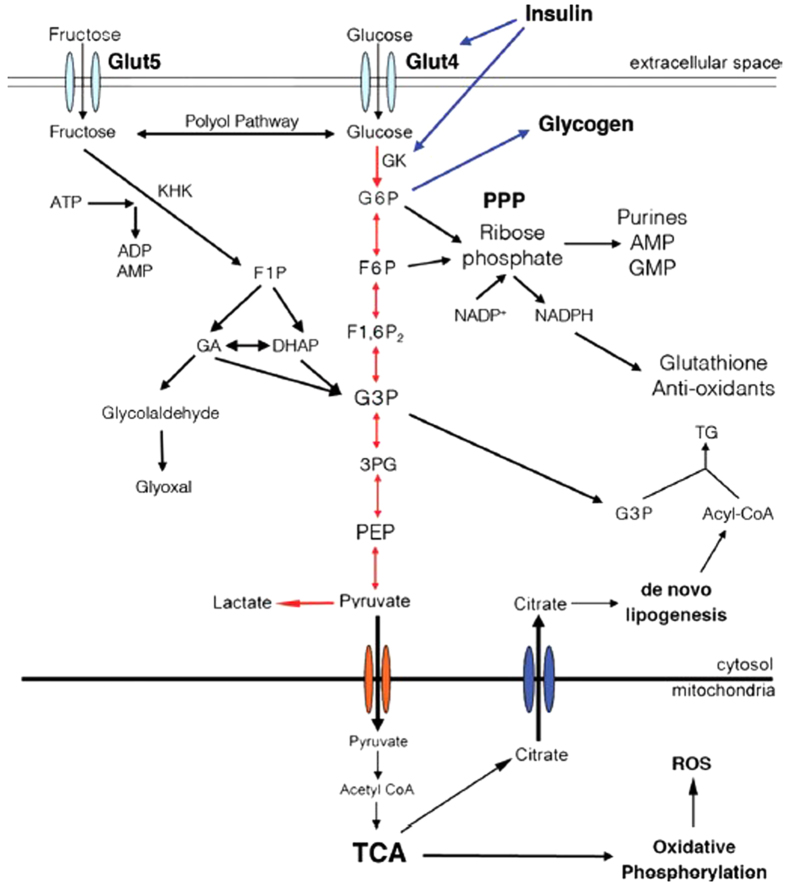
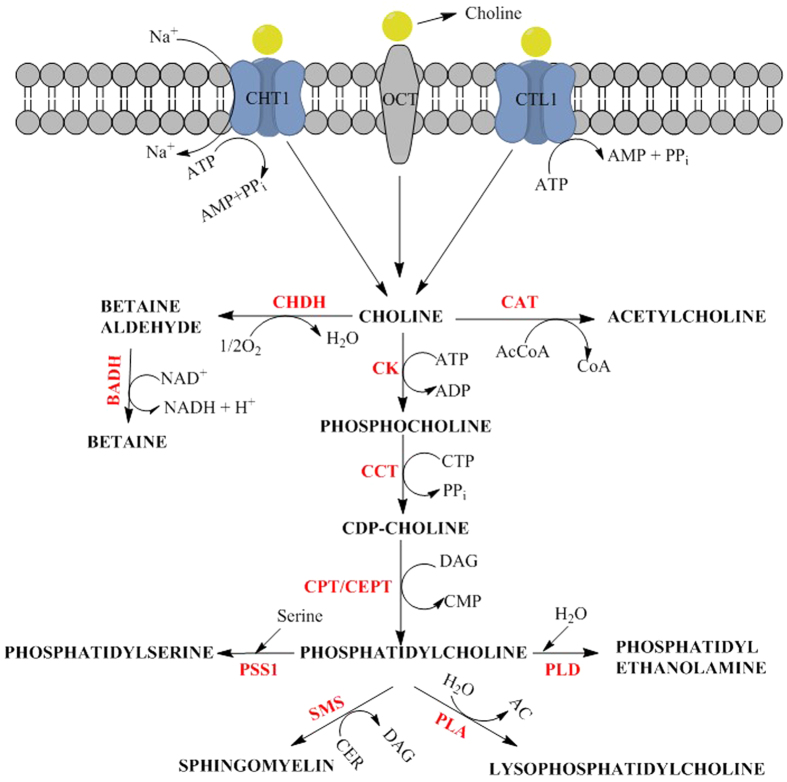
“Glycerol can enter the pathway of glycolysis or gluconeogenesis for final metabolism and the sugar portion can also be directly utilized (Mbous et al. 2017).”
Background
Metadata
- Authors
- Mbous, Y. P., Hayyan, M., Wong, W. F., Looi, C. Y., & Hashim, M. A.
- Affiliations
- University of Malaya (MY)
- Corresponding author
- Hayyan, Maan
- Venue
- Scientific Reports
- Published
- 2017-02-01
- Volume
- 7
- Issue
- 1
- Pages
- 41257-41257
- ISSN
- 2045-2322 (ISSN-L)
- PMC
- PMC5286504
- OpenAlex
- W2583107873
- Cited by
- 182
- References
- 56
- Citations by year
- 2026: 17 · 2025: 23 · 2024: 17 · 2023: 14 · 2022: 22 · 2021: 25 · 2020: 24 · 2019: 17 · 2018: 16 · 2017: 7
- FWCI
- 5.53
- Type
- journal article
- Language
- en
- Open access
- gold
- doi.org
- Licence
- cc-by
- creativecommons.org/licenses/by/4.0 (tdm)
- creativecommons.org/licenses/by/4.0 (vor)
- Locations
- Scientific Reports (publishedVersion, cc-by)
- PubMed Central (publishedVersion, cc-by)
- PubMed (publishedVersion)
- Greater South Information System
- Funders
- Universiti Malaya (RP037B-15AET, D000003-16001)
- Topics
- Physical Sciences › Chemistry › Physical and Theoretical Chemistry › Ionic liquids properties and applications
- Life Sciences › Pharmacology, Toxicology and Pharmaceutics › Toxicology › Bioactive Compounds and Antitumor Agents
- Physical Sciences › Chemistry › Organic Chemistry › Phytochemical Studies and Bioactivities
- Keywords
- natural deep eutectic solvents, cytotoxicity, anticancer activity, choline chloride, fructose, glucose, triethylene glycol, metabolic pathways, membrane porosity, redox stress, liver failure, intracellular processing, cancer cell lines
- MeSH terms
- Animals, Biological Transport, Cell Membrane Permeability, Cell Survival, Fructose, Glucose, Hydrogen-Ion Concentration, Mice, Inbred ICR, Models, Molecular, Oxidation-Reduction, Solvents, Viscosity, Cell Death, Glycation End Products, Advanced, Reactive Oxygen Species, Cell Line, Tumor, Metabolic Networks and Pathways
About these checks
Registry, retraction, Cites and statistics results are computed, not judged, with one exception: a printed reference that no index lists is read once by a model before it counts as a citation error. Claims are extracted by a model and kept only when their quote appears verbatim in the text; each cited source is then checked, with a model’s help, for whether it says what the claim relies on. Those verdicts can be wrong — read the claim’s quote and the cited source before relying on one.
Statistics and arithmetic are recomputed, not judged.
Confidence bands are shown only for fields calibrated on our annotated test set. None is calibrated yet, so no band is shown.
What counts as a claim ›How we measure confidence ›How we check this ›
Are you an author, or do you see a problem with this page? Request a review
Data sources
Bibliographic data: Semantic Scholar, OpenAlex, Crossref.
Contains information from the Semantic Scholar Academic Graph Datasets, made available under the ODC Attribution License (ODC-BY 1.0).
Semantic Scholar’s data is described in: Kinney, R., et al. (2023). The Semantic Scholar Open Data Platform. arXiv:2301.10140.
