

The DOI matches its Crossref record; 69 of the 73 references it cites were found in a registry or an index, and 4 are not checked yet.
Model agnostic generation of counterfactual explanations for molecules
Open accessPublished version of a preprint
Abstract
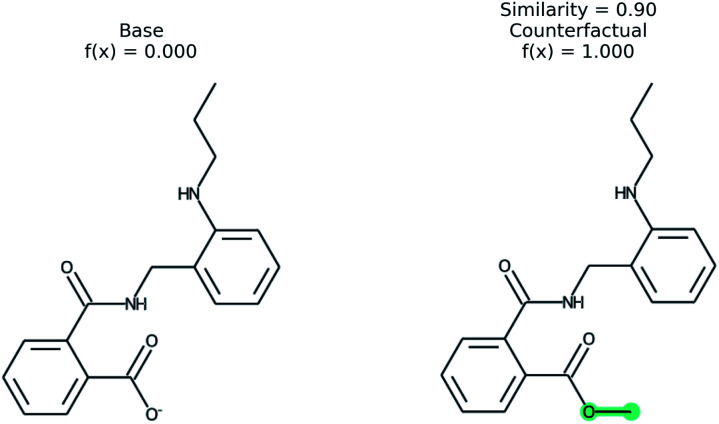
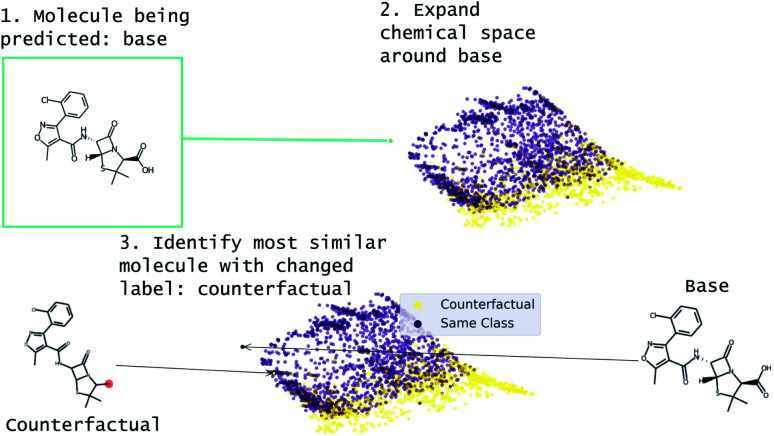
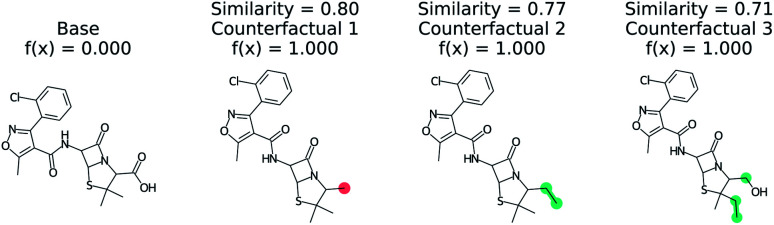
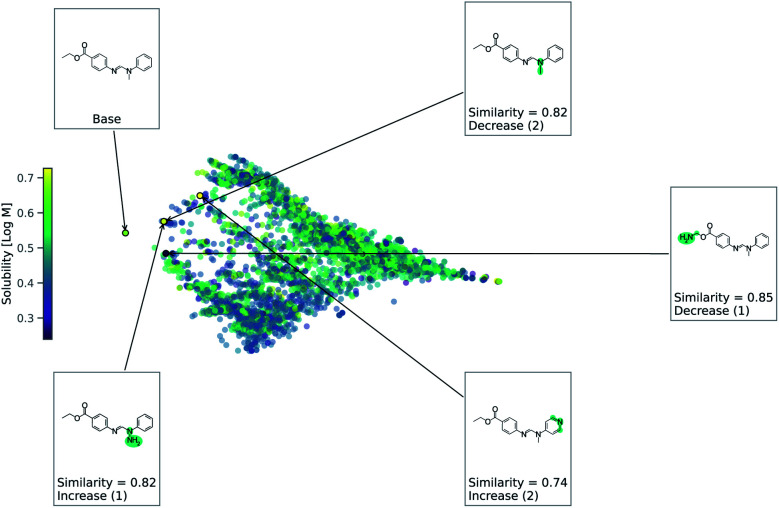
Generating model agnostic molecular counterfactual explanations to explain model predictions.
Overview
The claims and statistics of this paper haven’t been checked yet.
Run the check — free, no account needed. It reads the open-access text and checks the sources it cites.
Integrity signals
Registry
Cites
Statistics
Figures
Verification
Claims the paper makes
The claims and statistics of this paper haven’t been checked yet.
Run the check — free, no account needed. It reads the open-access text and checks the sources it cites.
Claims other papers make about this one
Each is checked against this paper’s own text: does it say what the citing paper says it does?
In the citing paper
“This often reveals punctual modifications of the input that cause abrupt changes in the output (a.k.a. “counterfactuals”),276”
From Advancing Targeted Protein Degradation via Multiomics Profiling and Artificial Intelligence (2023) · cites this paper as [276]
Self-check
Percentages, sums and reported differences re-computed from the paper’s own numbers.
The self-check needs the paper’s full text.
Citations
Cites
"Why Should I Trust You?": Explaining the Predictions of Any Classifier
Ribeiro, M. T., Singh, S., & Guestrin, C. (2016) · Proceedings of the 22nd ACM SIGKDD International Conference on Knowledge Discovery and Data Mining · doi:10.1145/2939672.2939778 · Cited by 17,555
Proceedings of the 24th international conference on Machine learning
(2007) · doi:10.1145/1273496 · Cited by 11,869
Causality: Models, Reasoning, and Inference
Pearl, J. (2009) · doi:10.1017/cbo9780511803161 · Cited by 11,653
Empirical Evaluation of Gated Recurrent Neural Networks on Sequence Modeling
Chung, J., Gulcehre, C., Cho, K., & Bengio, Y. (2014) · arXiv · doi:10.48550/arxiv.1412.3555 · Cited by 11,008
Double-slit photoelectron interference in strong-field ionization of the neon dimer
Kunitski, M., Eicke, N., Huber, P., Köhler, J., Zeller, S., Voigtsberger, J., Schlott, N., Henrichs, K., Sann, H., Trinter, F., et al. (2019) · Nature Communications · doi:10.1038/s41467-018-07882-8 · Cited by 8,162
Weininger, D. (1988) · Journal of Chemical Information and Computer Sciences · doi:10.1021/ci00057a005 · Cited by 7,436
Trust in Automation: Designing for Appropriate Reliance
Lee, J. D., & See, K. A. (2004) · Human Factors: The Journal of the Human Factors and Ergonomics Society · doi:10.1518/hfes.46.1.50_30392 · Cited by 6,605
Lipton, Z. C. (2018) · Queue · doi:10.1145/3236386.3241340 · Cited by 5,427
Explanation in artificial intelligence: Insights from the social sciences
Miller, T. (2019) · Artificial Intelligence · doi:10.1016/j.artint.2018.07.007 · Cited by 5,302
Proceedings of the 21st International Conference on Neural Information Processing Systems
Koller, D., Schuurmans, D., Bengio, Y., & Bottou, L. (2008) · Cited by 4,461
Research works printed but not linked: 22
- Huang, 2016, Nat. Commun., 7, 1
- Lee, 2004, Hum. Factors, 46, 50, 10.1518/hfes.46.1.50.30392 · DOI · Paper page
- Goodman, 2017, AI Mag., 38, 50
- A. I. ACT , On Artificial Intelligence: A European Approach to Excellence and Trust , 2021 , COM/2021/206
- O.Biran and C.Cotton , IJCAI-17 workshop on explainable AI (XAI) , 2017 , pp. 8–13
- M.Sundararajan , A.Taly and Q.Yan , International Conference on Machine Learning , 2017 , pp. 3319–3328
- D.Erhan , Y.Bengio , A.Courville and P.Vincent , Technical Report , Univeristé de Montréal , 2009
- P. W.Koh and P.Liang , International Conference on Machine Learning , 2017 , pp. 1885–1894
- Humer, 2021, ChemRxiv
- M. F.Frisch , Theories, models, and explanation , University of California , Berkeley , 1998
- M. A.Bruckner , Banking & Financial Services Policy Report , 2018 , vol. 37
- S.Singla , Machine Learning to Predict Credit Risk in Lending Industry , 2020 , https://www.aitimejournal.com/@saurav.singla/machine-learning-to-predict-credit-risk-in-lending-industry
- Wachter, 2017, Harv. J. Law Technol., 31, 841
- J.Woodward , The Stanford Encyclopedia of Philosophy, Metaphysics Research Lab , Stanford University , Winter , 2016th edn, 2016
- Mauri, 2006, Match, 56, 237
- P. W.Battaglia , J. B.Hamrick , V.Bapst , A.Sanchez-Gonzalez , V.Zambaldi , M.Malinowski , A.Tacchetti , D.Raposo , A.Santoro , R.Faulkner et al. , 2018 , arXiv preprint arXiv:1806.01261 · arXiv
- T. T.Tanimoto , Internal IBM Technical Report , 1958
- M.Ester , H.-P.Kriegel , J.Sander and X.Xu , KDD , 1996 , pp. 226–231
- Pedregosa, 2011, J. Mach. Learn. Res., 12, 2825
- Savjani, 2012, Int. Scholarly Res. Not., 2012, 195727
- Bradley, 2010, Nat. Preced., 1
- D.Kingma and J.Ba , International Conference on Learning Representations , 2014
Cited by
Sorted by citations
Items 101–146 of 146
FLARE: Fuzzy Local Agnostic Rule-Based Explanations for Closed Box Classifiers
Fernández, G., Aledo, J. A., Gámez, J. A., & Puerta, J. M. (2025) · IEEE Transactions on Emerging Topics in Computational Intelligence · doi:10.1109/tetci.2025.3547875 · Cited by 1
Yang, C.-H., Lin, T. E., Hsieh, J., Hsu, K., & Chiueh, P.-T. (2025) · Journal of Chemical Information and Modeling · doi:10.1021/acs.jcim.5c01586 · Cited by 1
Fenogli, J., Grimaud, L., & Vuilleumier, R. (2025) · Digital Discovery · doi:10.1039/d5dd00212e · Cited by 1
CausGNN : A Causal‐Based Explanation Framework for Graph Neural Networks
Debbi, H. (2026) · Expert Systems · doi:10.1111/exsy.70252 · Cited by 1
Deciphering Zinc Binding Groups through Systematic Modeling and Cheminformatic Analysis
熊国丽, & Xiao, Z. (2026) · Journal of Chemical Information and Modeling · doi:10.1021/acs.jcim.5c02875 · Cited by 1
Long, W., Zhai, S., Liu, Y., Li, M., & Wen, Z. (2026) · International Journal of Molecular Sciences · doi:10.3390/ijms27114706 · Cited by 1
Comparative Analysis of Model‐Agnostic Explanation Methods in Materials Science
Przybyłowska, A., Neubauer, J., Sztuder, M., Taisner, W., Hryniewicka, A., Kolodziejczyk, J., Plonska-Brzezinska, M. E., & Brzeziński, D. (2026) · Advanced Intelligent Systems · doi:10.1002/aisy.70503 · Cited by 1
BARTReact: SELFIES-driven precision in reaction modeling
Farfán, D., Gómez-Márquez, C., Sandoval-Nuñez, D., Paredes, O., & Morales, J. A. (2024) · Franklin Open · doi:10.1016/j.fraope.2024.100106 · Cited by 4
The Road to Explainable Graph Neural Networks
Ranu, S. (2024) · ACM SIGMOD Record · doi:10.1145/3703922.3703930 · Cited by 1
Are Generative-Based Graph Counterfactual Explainers Worth It?
Prado-Romero, M. A., Prenkaj, B., & Stilo, G. (2024) · Communications in computer and information science · doi:10.1007/978-3-031-74633-8_10 · Cited by 1
Adapting to Change: Robust Counterfactual Explanations in Dynamic Data Landscapes
Prenkaj, B., Villaizán-Vallelado, M., Leemann, T., & Kasneci, G. (2025) · Communications in computer and information science · doi:10.1007/978-3-031-74630-7_22 · Cited by 1
Ground truth explanation dataset for chemical property prediction on molecular graphsPreprint
Hruška, E., Zhao, L., & Liu, F. (2022) · ChemRxiv · doi:10.26434/chemrxiv-2022-96slq · Cited by 1
Semantic-Aware Graph Embedding Approach Uncovers LC-61, a Potent Anti– Leishmania infantum CompoundPreprint
Costa, V. A. F., Carvalho, A. M. D. S., Chelucci, R. C., de Melo, F. D. S. M., Felizardo, G. S. S., Bernardes, C. A. C., Martin, H., Braga, R. C., Charneau, S. O., Muratov, E. N., et al. (2025) · bioRxiv (Cold Spring Harbor Laboratory) · doi:10.1101/2025.11.19.687645 · Cited by 1
Abdelalim, M. (2022) · ChemRxiv · doi:10.26434/chemrxiv-2022-090pf
Elaleem, M. A. (2022) · ChemRxiv · doi:10.26434/chemrxiv-2022-090pf-v2
Explaining compound activity predictions witha substructure-aware loss for graph neuralnetworksPreprint
Amara, K., Rodríguez-Pérez, R., & Jiménez-Luna, J. (2023) · ChemRxiv · doi:10.26434/chemrxiv-2022-qxq56-v3
Trustworthy Machine Learning Predictions to Support Clinical Research and Decisions
Bianchi, A. S., Marco, A. D., Marzi, F., Stilo, G., Pellegrini, C., Masi, S., Mengozzi, A., Virdis, A., Nobile, M. S., & Simeoni, M. (2023) · Proceedings - IEEE Symposium on Computer-Based Medical Systems · doi:10.1109/cbms58004.2023.00222
Teufel, J., Leinweber, A., & Friederich, P. (2025) · Communications in computer and information science · doi:10.1007/978-3-032-08333-3_15
Amara, K., Rodríguez-Pérez, R., & Jiménez-Luna, J. (2024) · Figshare · doi:10.6084/m9.figshare.26606533
Exploring Ensemble Strategies for Graph Counterfactual Explanations
Prado-Romero, M. A., Prenkaj, B., & Stilo, G. (2025) · Communications in computer and information science · doi:10.1007/978-3-032-08330-2_9
Medvedeva, A., Kolomeisky, K., & Kolomeisky, A. B. (2026) · The Journal of Chemical Physics · doi:10.1063/5.0308064
Isa, A., Boukari, S., & Aliyu, M. A. (2026) · Elsevier eBooks · doi:10.1016/b978-0-443-44415-9.00012-0
Ma, Z., Niu, M., Song, Y., Zhang, L. R., Wang, W., Wang, T., Zhu, J., Yang, C., Xu, L., Wu, X., et al. (2026) · Journal of Medicinal Chemistry · doi:10.1021/acs.jmedchem.6c00204
Machine learning-based closed-loop for optimizing HOMO–LUMO gap in diarylethene
Nguyen, L. T. H., Fabbrini, E., Olenko, A. Y., Staykov, A., & Cesana, P. (2026) · Physical Chemistry Chemical Physics · doi:10.1039/d6cp00402d
Lin, S., Xia, W., Nagata, Y., & Yang, H. (2026) · Lecture notes in computer science · doi:10.1007/978-3-032-23604-3_2 · Cited by 3
AI-driven drug development: integrating computational design, 3D printing, and genomic medicine
Medhansh, D. M., Mohan, D., Barwa, R., PAINGINKAR, T., Karri, V. V. S. R., Osmani, R. A. M., Muddukrishna, B. S., & Ravi, G. (2026) · Discover Applied Sciences · doi:10.1007/s42452-026-08748-1
Explainable AI for Pharmaceutical Prediction: A Critical Review of Trust and Reproducibility
Al-Qahtani, Y., Al-Salem, F., & Al-Harbi, A. (2025) · Pharmacophore · doi:10.51847/keuphbjlqn
Osei, D., Afriyie, A., & Adu, K. (2025) · International Journal of Pharmaceutical and Phytopharmacological Research · doi:10.51847/1xwhzbanl7
Al-Fahd, S., Al-Khalifa, N., & Al-Turki, O. (2025) · International Journal of Pharmaceutical and Phytopharmacological Research · doi:10.51847/awiguca4tu
A universal model for predicting the stability of complexes with rare earths and trivalent actinides
Karpov, K. V., Pikulin, I. S., Bokov, G. V., & Mitrofanov, A. A. (2026) · The Journal of Chemical Physics · doi:10.1063/5.0321792
KAN-based symbolic QSPR modeling for molecular property prediction
Liu, L., Jiang, Y., Yang, Y., Li, F., & Gong, K. (2026) · Computational Biology and Chemistry · doi:10.1016/j.compbiolchem.2026.109296
Blake, E., Russo, I., Richter, K., & Fernandez, M. (2024) · Pharmacophore · doi:10.51847/xagr5iorfc
Keller, L., Lehmann, T., Brunner, S., & Meier, C. (2025) · Pharmacophore · doi:10.51847/y4s7ry0dzz
Al-Fahd, S., Al-Khalifa, N., & Al-Turki, O. (2025) · International Journal Of Pharmaceutical Research And Allied Sciences · doi:10.51847/0r77qjpuot
From Prediction to Physical Meaning in Materials AI
Li, M., & Lin, P. (2026) · ACS Materials Au · doi:10.1021/acsmaterialsau.6c00170
García, R., Prado-Romero, M. A., Gullo, F., & Stilo, G. (2026) · Machine Learning · doi:10.1007/s10994-026-07157-0
Hajal, A. A. (2026) · Journal of Computer-Aided Molecular Design · doi:10.1007/s10822-026-00946-8
Language of Toxicity: An eXplainable Artificial Intelligence Approach
Amoroso, N., Pantaleo, E., Ciriaco, F., Cutropia, F., Gambacorta, N., Mastrolorito, F., Monaco, A., Orfino, A., Bellotti, R., & Nicolotti, O. (2026) · Journal of Chemical Information and Modeling · doi:10.1021/acs.jcim.5c03214
Tanaka, K., Kobayashi, Y., & Nakamura, T. (2024) · International Journal Of Pharmaceutical Research And Allied Sciences · doi:10.51847/yrdoe1cdev
Causal QSAR Requires Separation of Molecular Association from Mechanistic Explanation
Idrissi, F. E., Bennani, S., Benali, Y., & Ali, A. B. (2026) · International Journal Of Pharmaceutical Research And Allied Sciences · doi:10.51847/pzu1leayjy
Explainable and Uncertainty-Aware QSAR for Pharmaceutical Decision Making
Bello, A., Sule, Z., Musa, I., Adeyemi, G., & Youssef, A. (2026) · International Journal Of Pharmaceutical Research And Allied Sciences · doi:10.51847/wgzwhbzloq
Chen, H., Li, W., Guo, J., Wang, H., Yang, S., Wan, R., Liu, Y., Liu, Z., Qin, G., Wang, C., et al. (2026) · Frontiers in Plant Science · doi:10.3389/fpls.2026.1991648
Li, Y., Chen, T., Ma, P., Chung, T., Zhou, B., Wu, L., Golatkar, A. R., Mukta, S., Little, J. M., Whitley, H. C., et al. (2026) · Science Advances · doi:10.1126/sciadv.aef6378
How semi-deductive structures advance modern physical organic chemistry
García‐Padilla, E., & Qiu, G. (2026) · Advances in physical organic chemistry · doi:10.1016/bs.apoc.2026.10.003
Furman, O., Lenkiewicz, Ł. U., Stefanowski, J., Wielopolski, P., & Zięba, M. (2026) · Data Mining and Knowledge Discovery · doi:10.1007/s10618-026-01286-9
Metadata
- Authors
- Wellawatte, G. P., Seshadri, A., & White, A. D.
- Affiliations
- University of Rochester (US)
- Corresponding author
- White, Andrew D.
- Venue
- Chemical Science
- Publisher
- Royal Society of Chemistry (RSC)
- Published
- 2022
- Volume
- 13
- Issue
- 13
- Pages
- 3697-3705
- ISSN
- 2041-6520 (ISSN-L)
- 2041-6539
- PMC
- PMC8966631
- OpenAlex
- W4225876201
- Cited by
- 143
- References
- 67
- Citations by year
- 2026: 32 · 2025: 27 · 2024: 28 · 2023: 34 · 2022: 22
- FWCI
- 9.13
- Type
- journal article
- Language
- en
- Open access
- diamond
- doi.org
- Licence
- Locations
- Chemical Science (publishedVersion, cc-by)
- ChemRxiv (acceptedVersion, cc-by-nc)
- PubMed Central (publishedVersion, cc-by)
- PubMed (publishedVersion)
- Funders
- National Institute of General Medical Sciences (R35GM137966)
- National Science Foundation (1764415)
- Topics
- Physical Sciences › Computer Science › Artificial Intelligence › Explainable Artificial Intelligence (XAI)
- Life Sciences › Pharmacology, Toxicology and Pharmaceutics › Drug Discovery › Computational Drug Discovery Methods
- Physical Sciences › Materials Science › Materials Chemistry › Machine Learning in Materials Science
- Keywords
- counterfactual explanations, model-agnostic explanation, explainable deep learning, interpretability, black-box models, molecular property prediction, graph neural networks, random forest, sequence models, spurious correlations, molecular structure
About these checks
Registry, retraction, Cites and statistics results are computed, not judged, with one exception: a printed reference that no index lists is read once by a model before it counts as a citation error. Claims are extracted by a model and kept only when their quote appears verbatim in the text; each cited source is then checked, with a model’s help, for whether it says what the claim relies on. Those verdicts can be wrong — read the claim’s quote and the cited source before relying on one.
Statistics and arithmetic are recomputed, not judged.
Confidence bands are shown only for fields calibrated on our annotated test set. None is calibrated yet, so no band is shown.
What counts as a claim ›How we measure confidence ›How we check this ›
Are you an author, or do you see a problem with this page? Request a review
