

Structure and properties of nitrocellulose: approaching 200 years of research
Open accessThe DOI matches its Crossref record; 85 of the 85 references it cites were found in a registry or an index; none of the 95 sources its claims cite is checked for support yet.
Abstract
This review brings together almost 200 years of research on the structure of nitrocellulose to give an overview covering its production from cellulose through to application in composite materials such as propellants or biomedical tests.
Overview
CoChat Summary
TL;DR
This review synthesizes almost 200 years of fragmented research on nitrocellulose structure, from cellulose source and nitration to crystal models and composite interactions. It concludes that despite widespread use, key structural features—especially a credible atomistic solid-state model and the impact of cellulose source variability—remain unresolved.
Key findings
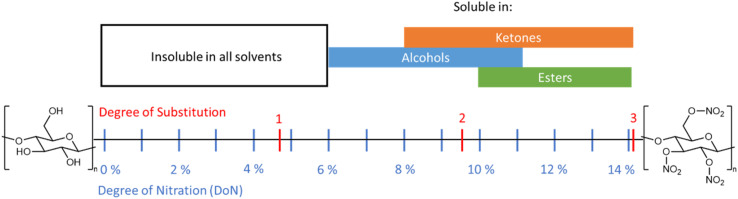
- Nitrocellulose properties depend on cellulose source and nitration method; degree of nitration ranges from 0% to a theoretical maximum of 14.14% and controls solubility, mechanical strength, and energetic properties. The global NC market was valued at USD 0.86 billion in 2021 and is expected to reach USD 1.39 billion by 2030.
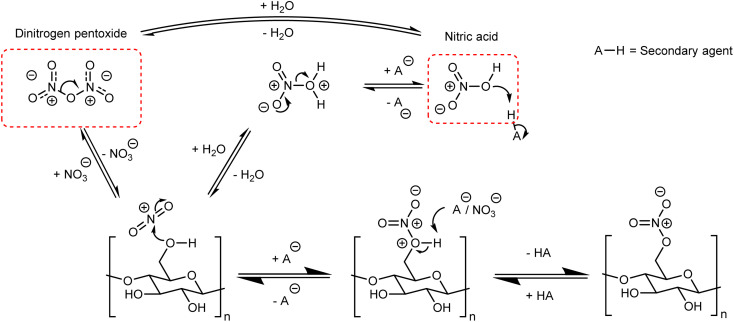
- Nitration proceeds via NO2+ attack on cellulose –OH groups; nitric/sulfuric acid mixtures are the main commercial route, with sulfuric acid promoting swelling and homogeneous nitration but also risking hydrolysis and sulfate ester formation. No systematic study exists on sulfuric acid-catalysed hydrolysis effects on NC chain length.
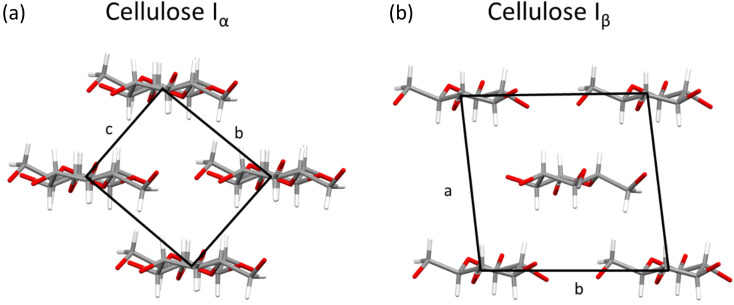
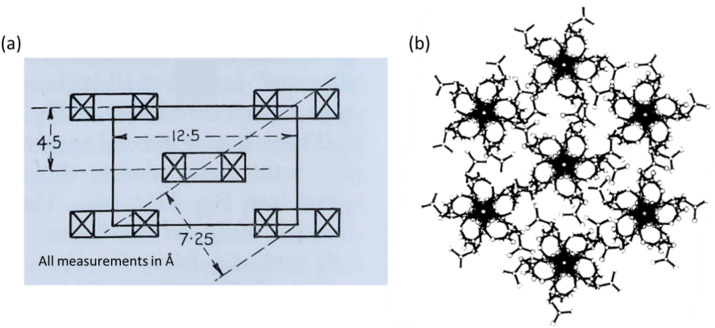
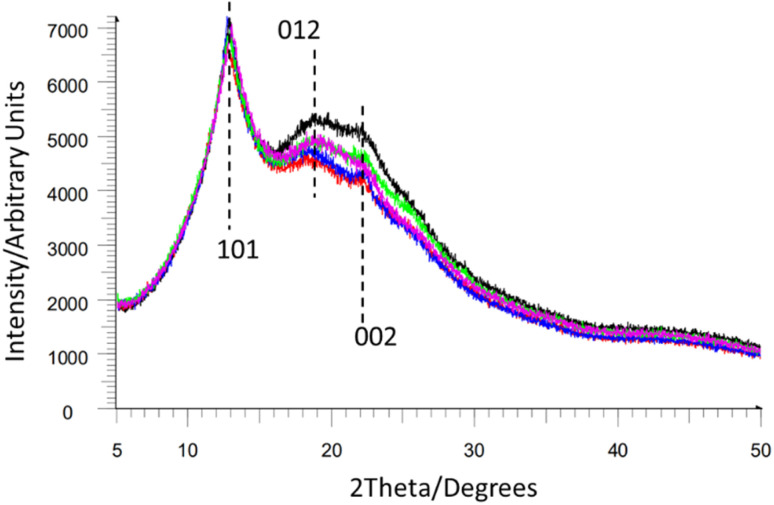
- Crystallographic models remain inconsistent: proposed unit cells vary, but shared features include staggered layered structures with inter-chain distances around 7.5 Å, compared with 4.5 Å in cellulose. PXRD gives crystalline domains of 58–90 Å in composite gun propellants, interlayer spacing ca. 7.1 Å, and unit-cell density approximately 1.9 g cm−3.
- NC interactions with solvents and biomolecules are central to applications: NC can swell over 13 times its weight in some solvents, and NC/nitroglycerin double-base propellants show molecular-scale combination. Biomolecule adsorption involves both ionic and hydrophobic interactions, but the influence of DoN on biomolecular absorption has not been experimentally tested.
Methods
- Design: critical narrative review, not a primary experimental study.
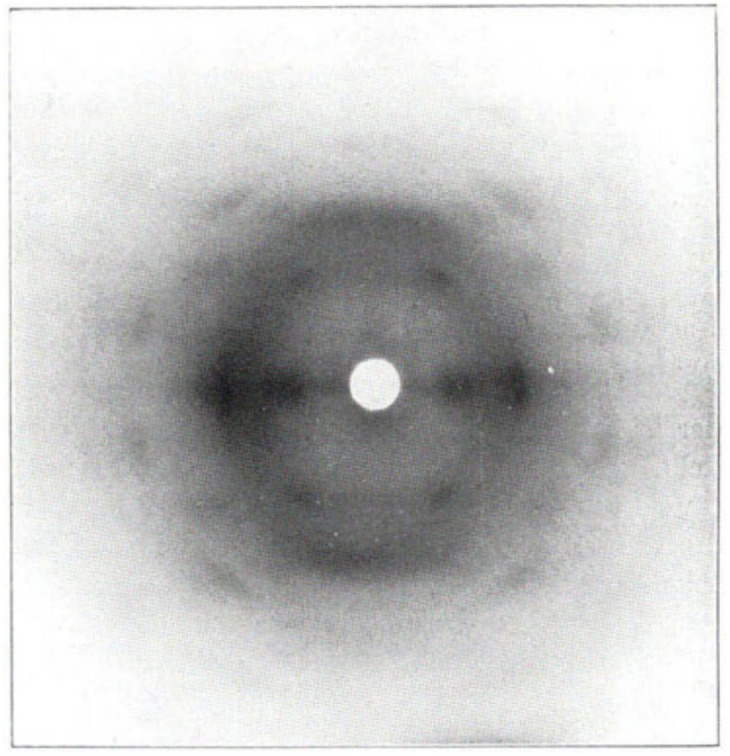
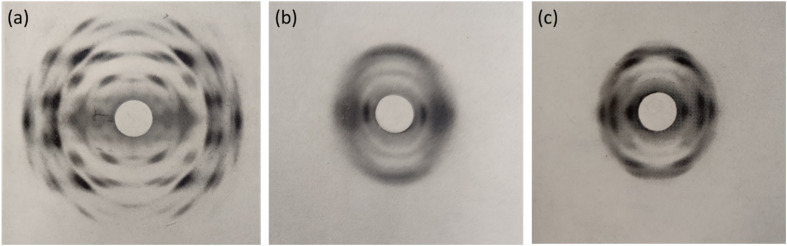
- Data/sample: literature spanning almost 200 years, including historical X-ray fibre diffraction, powder X-ray diffraction, molecular dynamics simulations, solubility/swelling studies, liquid crystal studies, and surface interaction studies.
- Main analysis: synthesizes and critically assesses reported structural features, separating confirmed aspects from those yet to be proven, and identifies gaps in understanding.
Limitations
- The paper states that the most significant gap is the lack of a credible solid-state atomistic-level structure for NC; no new single-crystal diffraction reports have appeared since the 1970s, and early work predates the fully determined cellulose crystal structure.
- The paper states that cellulose source variability, side reactions during nitration, and their effects on NC chain length and structure remain unclear; algal NC properties are unknown, and bacterial NC mechanical properties such as glass transition temperature and tensile strength remain under-reported.
- Evident from the text: as a review, it generates no new experimental data, and some cited historical methods are described as flawed—e.g., swelling methodology with arbitrary boundaries, and MD simulations initiated from a disputed 5-fold helix model.
Model-written summary. Check it against the paper before relying on it.
Integrity signals
Registry
Cites
Statistics
Figures

Verification
Claims the paper makes
0 Valid · 1 Not valid · 73 Not checked · 24 Own results and interpretations
In the paper
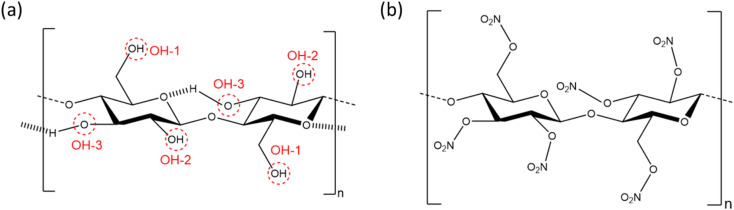
“The three hydroxyl groups in cellulose are responsible for strong inter- and intra-chain hydrogen bonding interactions, leading to cellulose being a highly para-crystalline material with short-range molecular order.7”
§ Structure and properties of nitrocellulose: approaching 200 years of research > Introduction
What the sources say
- Not matchedcites [7] Wohlert M. Benselfelt T. Wågberg L. Furó I. Berglund L. A. Wohlert J. Cellulose 2022 29 1 23
Its entry has no title and year that we can search by.
plainstates a cause- Asserted: passes — The authors put it forward as true.
- Checkable: passes — It can be checked against evidence.
- Load-bearing: passes — The paper’s conclusions depend on it.
- Based: passes — The paper gives a reason why it holds.
- Not matched
None of the sources cited for this claim have been checked yet.
In the paper
“While there are several reviews8,10 and chapters11,12 covering NC over the last 30 years, none are on the structure of NC.”
§ Structure and properties of nitrocellulose: approaching 200 years of research > Introduction
What the sources say
- Not matchedcites [8] Saunders C. W. Taylor L. T. J. Energ. Mater. 1990 8 149 203
Its entry has no title and year that we can search by.
- Not matchedcites [10] Mattar H. Baz Z. Saleh A. Shalaby S. A. Azzazy E. A. Salah H. Ismail I. Water, Energy, Food Environ. J. 2020 1 1 15
Its entry has no title and year that we can search by.
- Not checked yetcites [11] Meyer Rudolf K. J. H. A., Explosives, John Wiley & Sons, 7th edn, 2015
- Not checked yetcites [12] Liu J., Nitrate Esters Chemistry and Technology, Springer Singapore, 1st edn, 2019 source
plain- Asserted: passes — The authors put it forward as true.
- Checkable: passes — It can be checked against evidence.
- Load-bearing: passes — The paper’s conclusions depend on it.
- Based: passes — The paper gives a reason why it holds.
- Not matched
The paper states this without a source or data behind it here, so there is nothing to check it against. The quote shows it is in the paper.
In the paper
“However, despite nearly 200 years of research, many fundamental structural features of this important material remain only partially understood.”
§ Structure and properties of nitrocellulose: approaching 200 years of research > Introduction
plain- Asserted: passes — The authors put it forward as true.
- Checkable: passes — It can be checked against evidence.
- Load-bearing: passes — The paper’s conclusions depend on it.
- Based: unclear — It is unclear why the paper says it holds.
In the paper
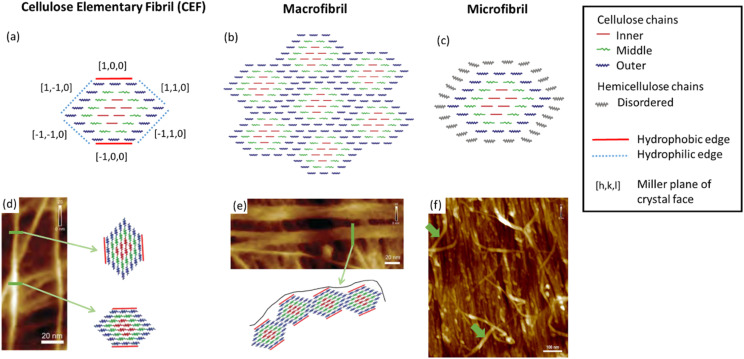
“In cellulose the CEFs are slightly distorted due to an imbalance in the strength of intra-molecular and inter-molecular hydrogen-bonding, giving a slight right-handed twist.45”
§ Structure and properties of nitrocellulose: approaching 200 years of research > Preparation of NC > Nitration methods
What the sources say
- Not matchedcites [45] Dumitrică T. Carbohydr. Polym. 2020 230 115624 31887879
Its entry has no title and year that we can search by.
plainstates a cause- Asserted: passes — The authors put it forward as true.
- Checkable: passes — It can be checked against evidence.
- Load-bearing: passes — The paper’s conclusions depend on it.
- Based: passes — The paper gives a reason why it holds.
- Not matched
In the paper
“The widely varying properties of NC are determined by two main factors: (i) the initial cellulose source and (ii) the method of nitration.6”
§ Structure and properties of nitrocellulose: approaching 200 years of research > Preparation of NC
What the sources say
- Not checked yetcites [6] Urbanski T., Chemistry and Technology of Explosives Vol. II, PWN Polish Scientific Publishers, Warsaw, 1965
plainstates a cause- Asserted: passes — The authors put it forward as true.
- Checkable: passes — It can be checked against evidence.
- Load-bearing: passes — The paper’s conclusions depend on it.
- Based: passes — The paper gives a reason why it holds.
36 more claims
Create a free account to see all 98 claims and to verify the 23 references still open.
- Probably not a substantial claim. 19
- It may state two separate claims as one. 45
- The quote only partly states this claim. 2
Self-check
Percentages, sums and reported differences re-computed from the paper’s own numbers.
Each contradiction between two passages listed here was confirmed by an independent check.
Rated minor: it would not touch a result — a value no result rests on, a p-value that stays on the same side of the significance level, or a conflict that is clerical, resolved elsewhere in the paper, or outside its own findings.
In the paper
§ Structure and properties of nitrocellulose: approaching 200 years of research > Preparation of NC > Sources and composition of cellulose
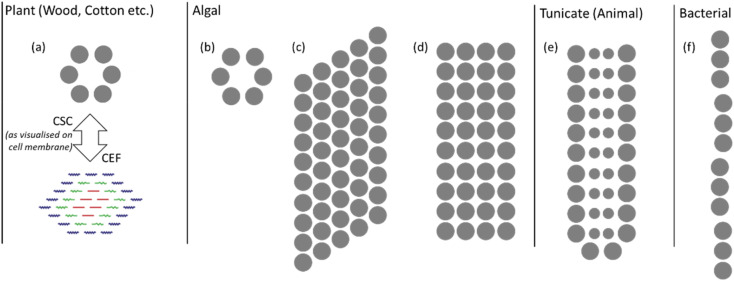
“Cellulose elementary fibrils (CEFs) form the most fundamental structural features in the crystalline domains, which for plants and many algae have a cross-sectional area of around 3 nm × 5 nm (the exact dimensions remain disputed) and lengths of up to several micrometres.”
§ Structure and properties of nitrocellulose: approaching 200 years of research > Preparation of NC > Sources and composition of cellulose
“With lengths almost a million times greater than their widths”
Rated minor: it would not touch a result — a value no result rests on, a p-value that stays on the same side of the significance level, or a conflict that is clerical, resolved elsewhere in the paper, or outside its own findings.
In the paper
§ Structure and properties of nitrocellulose: approaching 200 years of research > Preparation of NC > X-ray diffraction for the structure determination of NC
“| Orthorhombic | a = 12.4 | α = β = γ = 90° | F. D. Miles | 1955 | 15 |”
§ Structure and properties of nitrocellulose: approaching 200 years of research > References
“15. Miles F. D. Craik J. J. Phys. Chem. 1930 34 2607”
Citations
Cites
Cellulose: Fascinating Biopolymer and Sustainable Raw Material
Klemm, D., Heublein, B., Fink, H., & Bohn, A. (2005) · Angewandte Chemie International Edition · doi:10.1002/anie.200460587 · Cited by 7,551
Cellulose nanomaterials review: structure, properties and nanocomposites
Moon, R. J., Martini, A., Nairn, J., Simonsen, J., & Youngblood, J. (2011) · Chemical Society Reviews · doi:10.1039/c0cs00108b · Cited by 6,756
Cosgrove, D. J. (2005) · Nature Reviews Molecular Cell Biology · doi:10.1038/nrm1746 · Cited by 3,308
Nishiyama, Y., Langan, P., & Chanzy, H. (2002) · Journal of the American Chemical Society · doi:10.1021/ja0257319 · Cited by 3,028
Nishiyama, Y., Sugiyama, J., Chanzy, H., & Langan, P. (2003) · Journal of the American Chemical Society · doi:10.1021/ja037055w · Cited by 1,485
Koczula, K. M., & Gallotta, A. (2016) · Essays in Biochemistry · doi:10.1042/ebc20150012 · Cited by 1,147
Effect of microcrystallite preparation conditions on the formation of colloid crystals of cellulose
DONG, X. M., REVOL, J.-F., & GRAY, D. G. (1998) · Cellulose · doi:10.1023/a:1009260511939 · Cited by 1,032
Cellulose: A Review of Water Interactions, Applications in Composites, and Water Treatment
Etale, A., Onyianta, A. J., Turner, S. R., & Eichhorn, S. J. (2023) · Chemical Reviews · doi:10.1021/acs.chemrev.2c00477 · Cited by 817
On the mechanism of dissolution of cellulose
Lindman, B., Karlström, G., & Stigsson, L. (2010) · Journal of Molecular Liquids · doi:10.1016/j.molliq.2010.04.016 · Cited by 792
The structure and mechanical properties of sheets prepared from bacterial cellulose
Yamanaka, S., Watanabe, K., Kitamura, N., Iguchi, M., Mitsuhashi, S., Nishi, Y., & Uryu, M. (1989) · Journal of Materials Science · doi:10.1007/bf01139032 · Cited by 612
Cellulose and the role of hydrogen bonds: not in charge of everything
Wohlert, M., Benselfelt, T., Wågberg, L., Furó, I., Berglund, L. A., & Wohlert, J. (2022) · Cellulose · doi:10.1007/s10570-021-04325-4 · Cited by 580
X-ray Structure of Mercerized Cellulose II at 1 Å Resolution
Langan, P., Nishiyama, Y., & Chanzy, H. (2001) · Biomacromolecules · doi:10.1021/bm005612q · Cited by 564
NITRATION: Methods and Mechanisms
Olah, G. A., Malhotra, R., & Narang, S. C. (2003) · World Scientific series in 20th century chemistry · doi:10.1142/9789812791405_0192 · Cited by 554
The Maize Primary Cell Wall Microfibril: A New Model Derived from Direct Visualization
Ding, S.-Y., & Himmel, M. E. (2006) · Journal of Agricultural and Food Chemistry · doi:10.1021/jf051851z · Cited by 551
Bacterial Cellulose as a Raw Material for Food and Food Packaging Applications
Azeredo, H. M. C., Barud, H., Farinas, C. S., Vasconcellos, V. M., & Claro, A. M. (2019) · Frontiers in Sustainable Food Systems · doi:10.3389/fsufs.2019.00007 · Cited by 495
Cellulose Biosynthesis: Current Views and Evolving Concepts
SAXENA, I. M., & BROWN, R. M. (2005) · Annals of Botany · doi:10.1093/aob/mci155 · Cited by 424
Improved production of bacterial cellulose and its application potential
Vandamme, E. J., De Baets, S., Vanbaelen, A., Joris, K., & De Wulf, P. (1998) · Polymer Degradation and Stability · doi:10.1016/s0141-3910(97)00185-7 · Cited by 330
Brown, R. M. (1996) · Journal of Macromolecular Science, Part A · doi:10.1080/10601329608014912 · Cited by 311
Trache, D., Khimeche, K., Mezroua, A., & Benziane, M. (2016) · Journal of Thermal Analysis and Calorimetry · doi:10.1007/s10973-016-5293-1 · Cited by 283
Abitbol, T., Kloser, E., & Gray, D. G. (2013) · Cellulose · doi:10.1007/s10570-013-9871-0 · Cited by 280
Newman, R. H., Hill, S. J., & Harris, P. J. (2013) · PLANT PHYSIOLOGY · doi:10.1104/pp.113.228262 · Cited by 276
Periodic Disorder along Ramie Cellulose Microfibrils
Nishiyama, Y., Kim, U.-J., Kim, D.-Y., Katsumata, K. S., May, R. P., & Langan, P. (2003) · Biomacromolecules · doi:10.1021/bm025772x · Cited by 246
El Achaby, M., Kassab, Z., Aboulkas, A., Gaillard, C., & Barakat, A. (2018) · International Journal of Biological Macromolecules · doi:10.1016/j.ijbiomac.2017.08.067 · Cited by 243
Molecular correlation in thermotropic copolyesters
Windle, A. H., Viney, C., Golombok, R., Donald, A. M., & Mitchell, G. R. (1985) · Faraday Discussions of the Chemical Society · doi:10.1039/dc9857900055 · Cited by 219
Trache, D., & Tarchoun, A. F. (2017) · Journal of Materials Science · doi:10.1007/s10853-017-1474-y · Cited by 197
Western Blotting: An Introduction
Kurien, B. T., & Scofield, R. H. (2015) · Methods in Molecular Biology · doi:10.1007/978-1-4939-2694-7_5 · Cited by 183
Tertiary model of a plant cellulose synthase
Sethaphong, L., Haigler, C. H., Kubicki, J. D., Zimmer, J., Bonetta, D., DeBolt, S., & Yingling, Y. G. (2013) · Proceedings of the National Academy of Sciences · doi:10.1073/pnas.1301027110 · Cited by 169
Optimized culture conditions for bacterial cellulose production by Acetobacter senegalensis MA1
Aswini, K., Gopal, N. O., & Uthandi, S. (2020) · BMC Biotechnology · doi:10.1186/s12896-020-00639-6 · Cited by 168
Rapid Measurement of Cellulose Viscosity by Nitration Methods
Alexander, W. J., & Mitchell, R. L. (1949) · Analytical Chemistry · doi:10.1021/ac60036a018 · Cited by 160
Size, shape, and arrangement of native cellulose fibrils in maize cell walls
Ding, S., Zhao, S., & Zeng, Y. (2013) · Cellulose · doi:10.1007/s10570-013-0147-5 · Cited by 151
Heuser, E. (1944) · Cited by 149
Comparative study of plant and bacterial cellulose pellicles regenerated from dissolved states
Ul‐Islam, M., Khan, S., Ullah, M. W., & Park, J. K. (2019) · International Journal of Biological Macromolecules · doi:10.1016/j.ijbiomac.2019.06.232 · Cited by 142
Cellulose Nitrate in Conservation
Selwitz, C. M. (1988) · Cited by 141
Chemical Stability, Compatibility and Shelf Life of Explosives
Vogelsanger, B. (2004) · CHIMIA International Journal for Chemistry · doi:10.2533/000942904777677740 · Cited by 140
Crystallinity and crystallite size measurement in cellulose fibres: 1. Ramie and Fortisan
Hindeleh, A. M., & Johnson, D. J. (1972) · Polymer · doi:10.1016/0032-3861(72)90107-3 · Cited by 131
Towards the scalable isolation of cellulose nanocrystals from tunicates
Dunlop, M. J., Clemons, C., Reiner, R., Sabo, R., Agarwal, U. P., Bissessur, R., Sojoudiasli, H., Carreau, P. J., & Acharya, B. (2020) · Scientific Reports · doi:10.1038/s41598-020-76144-9 · Cited by 119
Li, S., Bashline, L., Zheng, Y., Xin, X., Huang, S., Kong, Z., Kim, S. H., Cosgrove, D. J., & Gu, Y. (2016) · Proceedings of the National Academy of Sciences · doi:10.1073/pnas.1613273113 · Cited by 118
Liquid crystal formation in cellulose and cellulose derivatives
Gilbert, R. D., & Patton, P. A. (1983) · Progress in Polymer Science · doi:10.1016/0079-6700(83)90001-1 · Cited by 116
Farrah, S. R., Shah, D. O., & Ingram, L. O. (1981) · Proceedings of the National Academy of Sciences · doi:10.1073/pnas.78.2.1229 · Cited by 112
A review of the synthesis, chemistry and analysis of nitrocellulose
Saunders, C. W., & Taylor, L. T. (1990) · Journal of Energetic Materials · doi:10.1080/07370659008012572 · Cited by 90
Novel Nitrocellulose Made from Bacterial Cellulose
Sun, D., Ma, B., Zhu, C., Liu, C., & Yang, J. (2010) · Journal of Energetic Materials · doi:10.1080/07370650903222551 · Cited by 65
Concentration of Viruses from Water by Membrance Chromatography
Wallis, C., Melnick, J. L., & Gerba, C. P. (1979) · Annual Review of Microbiology · doi:10.1146/annurev.mi.33.100179.002213 · Cited by 65
Nitrocellulose a tried and true polymer finds utility as a post-genomic substrate
Tonkinson, J. L., & Stillman, B. A. (2002) · Frontiers in bioscience · doi:10.2741/a755 · Cited by 63
Molecular dynamics study of the structure and performance of simple and double bases propellants
Ma, X., Zhu, W., Xiao, J., & Xiao, H. (2008) · Journal of Hazardous Materials · doi:10.1016/j.jhazmat.2007.12.068 · Cited by 63
Crystal Structure of Cellulose Triacetate I
Sikorski, P., Wada, M., Heux, L., Shintani, H., & Stokke, B. T. (2004) · Macromolecules · doi:10.1021/ma0498520 · Cited by 61
The fibrils untwisting limits the rate of cellulose nitration process
Nikolsky, S. N., Zlenko, D. V., Melnikov, V. P., & Stovbun, S. V. (2018) · Carbohydrate Polymers · doi:10.1016/j.carbpol.2018.10.019 · Cited by 55
Wang, Y., Shu, H., Chen, B., McGiffen, M. E., Zhang, W., Xu, N., & Zhou, Z. (2008) · Plant Growth Regulation · doi:10.1007/s10725-008-9337-9 · Cited by 54
Cellulose trinitrate: molecular conformation and packing considerations
Meader, D., Atkins, E. D. T., & Happey, F. (1978) · Polymer · doi:10.1016/0032-3861(78)90086-1 · Cited by 50
Nitrate Esters Chemistry and Technology
Liu, J. (2019) · doi:10.1007/978-981-13-6647-5 · Cited by 49
Moniruzzaman, M., Bellerby, J. M., & Bohn, M. A. (2014) · Polymer Degradation and Stability · doi:10.1016/j.polymdegradstab.2014.02.002 · Cited by 45
Bacterial Nanocellulose Nitrates
Будаева, В. В., Gismatulina, Y. А., Mironova, G. F., Skiba, E. A., Gladysheva, E. K., Kashcheyeva, Е. I., Байбакова, О. В., Александровна, К. А., Шавыркина, Н. А., Golubev, D. S., et al. (2019) · Nanomaterials · doi:10.3390/nano9121694 · Cited by 44
Rapid dissolution of spruce cellulose in H2SO4 aqueous solution at low temperature
Huang, W., Wang, Y., Zhang, L., & Chen, L. (2016) · Cellulose · doi:10.1007/s10570-016-1047-2 · Cited by 40
Moity, L., Molinier, V., Benazzouz, A., Joossen, B., Gerbaud, V., & Aubry, J. (2016) · Green Chemistry · doi:10.1039/c6gc00112b · Cited by 34
Thermal Decomposition of Organic Nitrates
Phillips, L. R. (1950) · Nature · doi:10.1038/165564a0 · Cited by 34
Angus, W. R., Jones, R. W., & Phillips, G. O. (1949) · Nature · doi:10.1038/164433a0 · Cited by 34
Handman, E., & Jarvis, H. M. (1985) · Journal of Immunological Methods · doi:10.1016/0022-1759(85)90064-x · Cited by 32
Herzog, R. O., & Londberg, G. (1924) · Berichte der deutschen chemischen Gesellschaft (A and B Series) · doi:10.1002/cber.19240570235 · Cited by 30
Transitions and relaxations in plasticised nitrocellulose
Warren, R. C. (1988) · Polymer · doi:10.1016/0032-3861(88)90155-3 · Cited by 29
Chemical physics of cellulose nitration
Stovbun, S. V., Никольский, С. Н., Melnikov, V. P., Mikhaleva, M. G., Litvin, Y. A., Shchegolikhin, A. N., Zlenko, D. V., Tverdislov, V. A., Gerasimov, D. S., & Rogozin, A. D. (2016) · Russian Journal of Physical Chemistry B · doi:10.1134/s199079311602024x · Cited by 27
Intrinsic twist in Iβ cellulose microfibrils by tight-binding objective boundary calculations
Dumitrică, T. (2019) · Carbohydrate Polymers · doi:10.1016/j.carbpol.2019.115624 · Cited by 26
Ueber ein labiles Nitrat der Cellulose
Knecht, E. (1904) · Berichte der deutschen chemischen Gesellschaft · doi:10.1002/cber.19040370188 · Cited by 24
Baldo, B. A., Tovey, E. R., & Ford, S. A. (1986) · Journal of Biochemical and Biophysical Methods · doi:10.1016/0165-022x(86)90063-1 · Cited by 20
A molecular dynamics study of plasticiser migration in nitrocellulose binders
Richards, L. A., Nash, A., Phipps, M. J. S., & de Leeuw, N. H. (2018) · New Journal of Chemistry · doi:10.1039/c8nj03464h · Cited by 17
Cellulose nitrate : the physical chemistry of nitrocellulose, its formation and use
Miles, F. D. (1955) · Oliver and Boyd eBooks · Cited by 16
Near real-time in vivo confocal imaging of mouse mammary tumors
Lacy, A. (2002) · Frontiers in bioscience · doi:10.2741/lacy · Cited by 16
Hansen Solubility Parameters of Nitrocellulose and Application toward Printable Energetics
Kotter, L. N., & Groven, L. J. (2022) · Langmuir · doi:10.1021/acs.langmuir.2c00597 · Cited by 15
The swelling of nitrocellulose in binary mixtures
Moore, W. R. (1947) · Transactions of the Faraday Society · doi:10.1039/tf9474300543 · Cited by 14
Impact sensitivity of nitroglycerin
Jones, M. L., & Lee, E. (1997) · Journal of Energetic Materials · doi:10.1080/07370659708216083 · Cited by 13
Gibbon, C., Pietro, P. D., Storr, M. T., Broughton, D. A., & Skylaris, C. (2023) · Physical Chemistry Chemical Physics · doi:10.1039/d2cp05550c · Cited by 12
Fivefold Helical Cellulose Trapped in a Sulfuric Acid Framework
Li, W., Ogawa, Y., Pérez, J., Mazeau, K., Morfin, I., & Nishiyama, Y. (2021) · Crystal Growth & Design · doi:10.1021/acs.cgd.1c00664 · Cited by 11
The Structure of Nitrated Cellulose. II
Miles, F. D., & Craik, J. (1930) · The Journal of Physical Chemistry · doi:10.1021/j150317a013 · Cited by 11
The Mechanism of Cellulose Nitration1
Klein, R., & Mentser, M. (1951) · Journal of the American Chemical Society · doi:10.1021/ja01156a529 · Cited by 10
Der krystalline Aufbau von Acetyl‐ und Nitrocellulose
Herzog, R. O. (1926) · Helvetica Chimica Acta · doi:10.1002/hlca.19260090179 · Cited by 9
Lyotropic Behaviour of Nitrocellulose
Viney, C., & Windle, A. H. (1987) · Molecular crystals and liquid crystals · doi:10.1080/00268948708071785 · Cited by 9
Röntgenographische Untersuchung der Nitrozellulose
Herzog, R. O., & Náray-Szabó, S. V. (1927) · Zeitschrift für Physikalische Chemie · doi:10.1515/zpch-1927-13066 · Cited by 7
Acid Adsorption and Stability of Nitrocellulose
Wiggam, D. R. (1931) · The Journal of Physical Chemistry · doi:10.1021/j150320a011 · Cited by 6
Über die Eigenschaften der Salpeterschwefelsäuregemische
Saposchnikow, A. (1905) · Zeitschrift für Physikalische Chemie · doi:10.1515/zpch-1905-5312 · Cited by 6
A STUDY OF SULPHATE IN NITROCELLULOSE USING S35O4− AS TRACER
Bricknell, A. G., Trevoy, L. W., & Spinks, J. W. T. (1957) · Canadian Journal of Chemistry · doi:10.1139/v57-099 · Cited by 5
Chu, Y., Wang, L., Liu, P., & Sui, P. (2023) · ACS Omega · doi:10.1021/acsomega.3c03547 · Cited by 5
Shchukin, E. D., Pertsov, A. V., Amelina, E. A., & Zelenev, A. S. (2001) · Studies in interface science · doi:10.1016/s1383-7303(01)80008-9 · Cited by 4
Über das Verhalten der Gemische von Salpetersäure und Schwefelsäure
Saposchnikow, A. (1905) · Zeitschrift für Physikalische Chemie · doi:10.1515/zpch-1905-5133 · Cited by 4
Die Phasenumwandlung α-AgJ/β-AgJ in Jodatmosphäre
Weiss, K., & Vermaas, P. A. (1965) · Zeitschrift für Physikalische Chemie · doi:10.1524/zpch.1965.44.5_6.372 · Cited by 3
Woodbridge, R. G. (1920) · Journal of Industrial & Engineering Chemistry · doi:10.1021/ie50124a024 · Cited by 3
(1909) · Journal of the Society of Chemical Industry · doi:10.1002/jctb.1909.28.9.457 · Cited by 3
(1965) · NASA Technical Reports Server (NASA)
Research works printed but not linked: 14
- Braconnot H. Ann. Chim. Phys. 1833 52 290 294
- Nitrocellulose Market: Information by Application (Printing Inks, Automotive Paints, Wood Coatings), Product (M-Grade Cellulose, E-Grade Cellulose), and Region – Forecast till 2030, https://straitsresearch.com/report/nitrocellulose-market
- Urbanski T., Chemistry and Technology of Explosives Vol. II, PWN Polish Scientific Publishers, Warsaw, 1965
- Mattar H. Baz Z. Saleh A. Shalaby S. A. Azzazy E. A. Salah H. Ismail I. Water, Energy, Food Environ. J. 2020 1 1 15
- Meyer Rudolf K. J. H. A., Explosives, John Wiley & Sons, 7th edn, 2015
- Bennett C. Timell T. Sven. Papperstidn. 1955 58 281 286
- Mathieu M. Comptes rendus 1935 200 401 403
- Mathieu M., in Reaction Topochemique, Hermann and Cie, Paris, 1936
- Herrmann M., Förterbarth U., Mauß J. and Bohn M., in 5th International Nitrocellulose Symposium, Spiez, 2012
- Herrmann M., Förter-Barth U., Kaiser M., Kupzik K. and Scheibel R., in ICT International Annual Conference, 2014
- Herrmann M., Förterbarth U., Mauß J. and Bohn M., in Nitrocellulose Workshop 2014, TNO, Rijswijk, 2014
- Nagorski H., in 5th International Nitrocellulose Symposium, Spiez, 2012
- Urbanski T., Chemistry and Technology of Explosives Vol. II, PWN Polish Scientific Publishers, Warsaw, 1st edn, 1965
- Hansen C. M., The Three Dimensional Solubility Parameter and Solvent Diffusion Coefficient: Their Importance in Surface Coating Formulation, Danish Technical Press, 1967
Cited by
Key attributes of nitrocellulose-based energetic materials and recent developments
Rahim, K. S. A., Samsuri, A., Jamal, S. H., Nor, S. A. M., Rusly, S. N. A., Ariff, H., & Latif, N. S. A. (2024) · Heliyon · doi:10.1016/j.heliyon.2024.e41282 · Cited by 44
Kashcheyeva, Е. I., Александровна, К. А., Gismatulina, Y. А., Gladysheva, E. K., Будаева, В. В., & Sakovich, G. V. (2023) · Polymers · doi:10.3390/polym16010042 · Cited by 31
Boukeciat, H., Tarchoun, A. F., Trache, D., Abdelaziz, A., Belmehdi, D., Meziani, R., Boumaza, L., & Klapötke, T. M. (2024) · FirePhysChem · doi:10.1016/j.fpc.2024.04.002 · Cited by 29
Cellulose Nitrates-Blended Composites from Bacterial and Plant-Based Celluloses
Gismatulina, Y. А., & Будаева, В. В. (2024) · Polymers · doi:10.3390/polym16091183 · Cited by 27
Cellulose immobilization strategies for paper-based immunoassays
Belfakir, S. B., Svendsen, W. E., Laustsen, A. H., & Ross, G. M. S. (2024) · TrAC Trends in Analytical Chemistry · doi:10.1016/j.trac.2024.117770 · Cited by 21
Metadata
- Authors
- Morris, E., Pulham, C. R., & Morrison, C. A.
- Affiliations
- University of Edinburgh (GB)
- Corresponding author
- Pulham, Colin R.
- Morrison, Carole A.
- Venue
- RSC Advances
- Publisher
- Royal Society of Chemistry (RSC)
- Published
- 2023
- Volume
- 13
- Issue
- 46
- Pages
- 32321-32333
- ISSN
- 2046-2069 (ISSN-L)
- PMC
- PMC10620853
- OpenAlex
- W4388224027
- Cited by
- 102
- References
- 85
- Citations by year
- 2026: 46 · 2025: 39 · 2024: 16 · 2023: 1
- FWCI
- 1.48
- Type
- journal article
- Language
- en
- Open access
- gold
- doi.org
- Locations
- RSC Advances (publishedVersion, cc-by)
- PubMed Central (publishedVersion, cc-by)
- PubMed (publishedVersion)
- Edinburgh Research Explorer (University of Edinburgh) (publishedVersion, cc-by)
- Funders
- Ministry of Defence (WSTC1086)
- Topics
- Physical Sciences › Materials Science › Biomaterials › Advanced Cellulose Research Studies
- Physical Sciences › Materials Science › Materials Chemistry › Energetic Materials and Combustion
- Life Sciences › Agricultural and Biological Sciences › Plant Science › Polysaccharides and Plant Cell Walls
- Keywords
- nitrocellulose, crystal structure, composite materials, structural model, material properties
About these checks
Registry, retraction, Cites and statistics results are computed, not judged, with one exception: a printed reference that no index lists is read once by a model before it counts as a citation error. Claims are extracted by a model and kept only when their quote appears verbatim in the text; each cited source is then checked, with a model’s help, for whether it says what the claim relies on. Those verdicts can be wrong — read the claim’s quote and the cited source before relying on one.
A language model drew the claims from the paper on 2026-11-24, under version 3 of the claim definition (model deepseek-v4.1-flash, prompt extract-v3).
A second model labelled each claim on 2026-11-24 (model jev-1.13-20260917, definition revision gold-guideline-v0.2).
Statistics and arithmetic are recomputed, not judged.
Confidence bands are shown only for fields calibrated on our annotated test set. None is calibrated yet, so no band is shown.
What counts as a claim ›How we measure confidence ›How we check this ›
Are you an author, or do you see a problem with this page? Request a review
Data sources
Bibliographic data: Semantic Scholar, OpenAlex, Crossref.
Contains information from the Semantic Scholar Academic Graph Datasets, made available under the ODC Attribution License (ODC-BY 1.0).
Semantic Scholar’s data is described in: Kinney, R., et al. (2023). The Semantic Scholar Open Data Platform. arXiv:2301.10140.
