

Shining a light on an additional clinical burden: work-related digital communication survey study–COVID-19 impact on NHS staff wellbeing
Open accessThe DOI matches its Crossref record; 35 of the 35 references it cites were found in a registry or an index.
Abstract
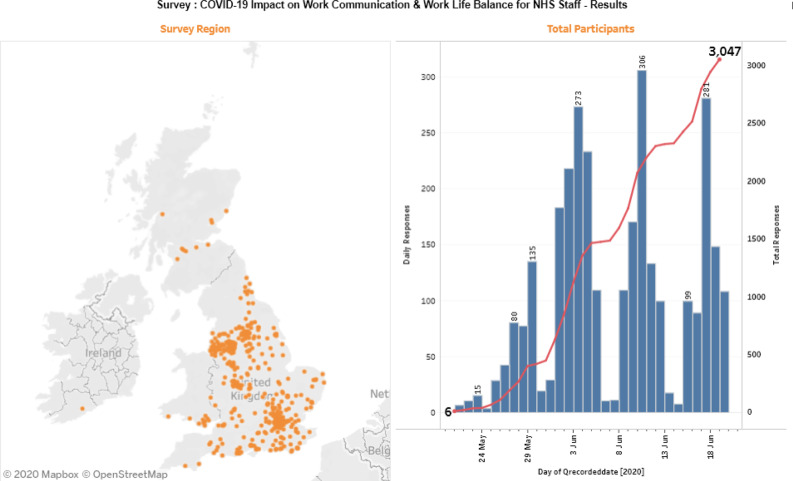
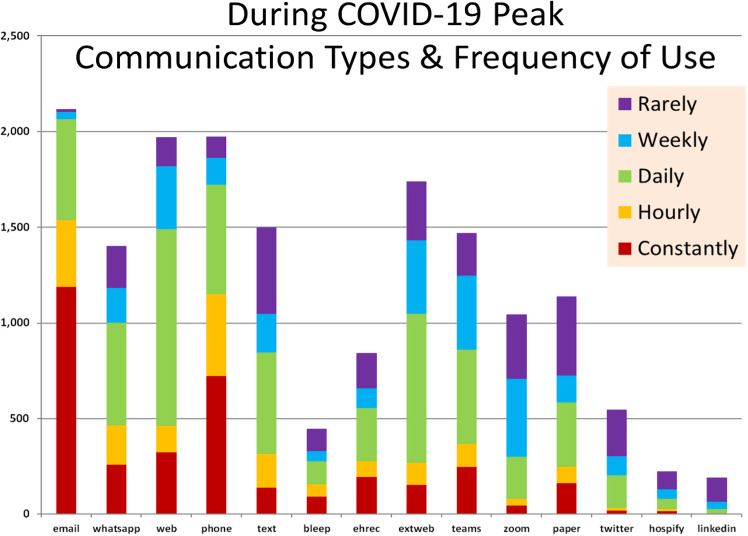
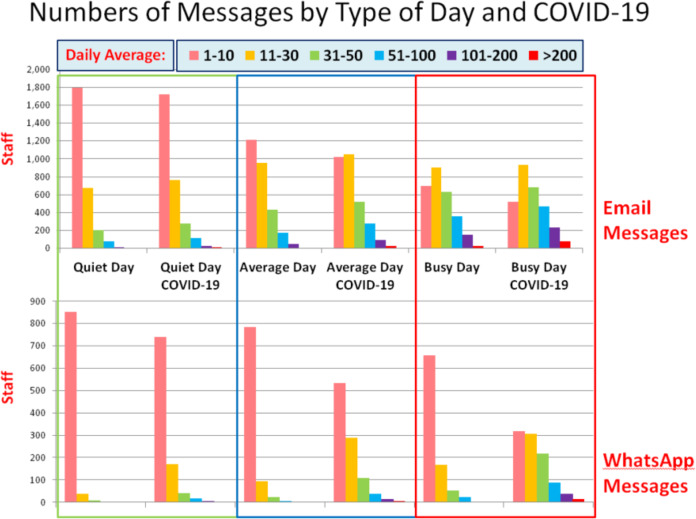
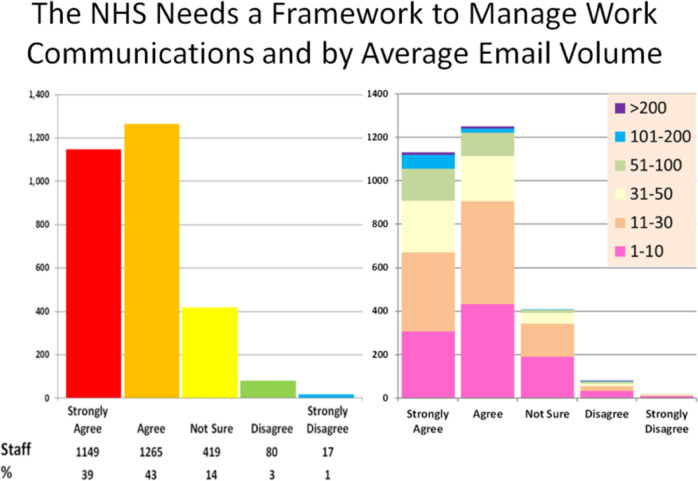
Work-related communication volume within the United Kingdom’s National Health Service (NHS) has had little systematic research previously. The impact of communication volume on work-life balance of healthcare staff in the NHS is also not known and has not been an area of focus or governance. COVID-19 led to a shift to non-physical work, with greater reliance on digital communication for clinical decision making. We sought to elucidate the relationship between communication, work-life balance, and COVID-19. An online survey was conducted to assess the platforms used to communicate professionally, the volume of and time spent on work-related communications, how this has changed from before to during COVID-19, and the effect on work-life balance. A total of 3047 healthcare staff provided consent and evaluable data. Emails were reported as the most frequently used communication tool, and the majority of staff asked, reported increased work-related communications due to COVID-19. Staff estimated receiving 14 emails on an average day before COVID-19. During the pandemic, staff estimated getting approximately 17 emails on an average day and 29 emails on a busy day. Work communications reportedly took up increased amounts of family and home time during COVID-19. A large proportion (36%) of staff were unable to switch off from work-related communications already before COVID-19, worsening (57%) during the pandemic. Work-related digital communication is a vital component of working in the NHS. We provide the first detailed data on the types, volume, and impact of such communication on NHS staff during the COVID-19 pandemic, compared to pre-pandemic levels. We found that 82% of staff support the need for NHS guidance on work-related communications to help manage overload, protect emotional wellbeing, and increase resilience. Further work is urgently needed in this area to tackle the negative impact of communication technologies (technostress) on work-life balance to reduce staff stress, burnout, and turnover or early retirement of some staff.
Overview
The claims and statistics of this paper haven’t been checked yet.
Free: it reads the open-access text and checks the first 5 claims that cite a source we can check. Create a free account to check every claim.
Integrity signals
Registry
Cites
Statistics
Figures
Verification
Claims the paper makes
The claims and statistics of this paper haven’t been checked yet.
Free: it reads the open-access text and checks the first 5 claims that cite a source we can check. Create a free account to check every claim.
Claims other papers make about this one
Each is checked against this paper’s own text: does it say what the citing paper says it does?
The source backs part of the claim, not all of it — or backs it for a different population, condition or comparison.
In the citing paper
“Furthermore, reviews of the literature conducted by Patel et al. (93), Bakhai et al. (94); McTaggart & Walker (95) highlight that healthcare professionals often struggle to manage the constant influx of digital communication, leading to feelings of overload and a blurring of personal and professional boundaries.”
From Improving health literacy using the power of digital communications to achieve better health outcomes for patients and practitioners. (2023) · cites this paper as [94]
Experimental — accuracy not yet measuredThe cited source says what the claim attributes to it.
In the citing paper
“Research shows that the rapid influx of messages, notifications and electronic communications can lead to increased workload and time demands for healthcare staff.”
From Improving health literacy using the power of digital communications to achieve better health outcomes for patients and practitioners. (2023) · cites this paper as [94]
Self-check
Percentages, sums and reported differences re-computed from the paper’s own numbers.
The self-check needs the paper’s full text.
Citations
Cites
Managing mental health challenges faced by healthcare workers during covid-19 pandemic
Greenberg, N., Docherty, M., Gnanapragasam, S., & Wessely, S. (2020) · BMJ · doi:10.1136/bmj.m1211 · Cited by 2,135 · cited 1×
“Beyond the use of WhatsApp, there are no previous studies exploring communication pattern interplay with healthcare crises such as the COVID-19 pandemic (Greenberg et al. 2020; Horton et al. 2021).”
MethodImpact of Technostress on End-User Satisfaction and Performance
Tarafdar, M., Tu, Q., & Ragu-Nathan, T. S. (2010) · Journal of Management Information Systems · doi:10.2753/mis0742-1222270311 · Cited by 930 · cited 1×
“Digital communication has been recognised as an important area of ‘technostress’, that is, a cause of workplace stress arising from the digitisation of work (Tarafdar et al., 2014).”
BackgroundFactors related to physician burnout and its consequences: a review
Patel, R. S., Bachu, R., Adikey, A., Malik, M., & Shah, M. (2018) · Behavioral Sciences · doi:10.3390/bs8110098 · Cited by 896 · cited 1×
“Conversely, ineffective communication is associated with low staff morale, poor patient experience, adverse patient outcomes and increases staff stress and burnout rates (Patel et al. 2018; Nohammer and Stichlberger 2019).”
BackgroundVideo consultations for covid-19
Greenhalgh, T., Wherton, J., Shaw, S., & Morrison, C. (2020) · BMJ · doi:10.1136/bmj.m998 · Cited by 866 · cited 2×
“With increased remote consultations (Greenhalgh et al. 2020), work from home or non-patient facing sites, email traffic and phone calls increase in volume during COVID-19 is a trend likely to continue beyond the pandemic, as remote working becomes a mainstay of clinical delivery (Murphy et al.”
BackgroundMurphy, M., Scott, L. J., Salisbury, C., Turner, A., Scott, A., Denholm, R., Lewis, R., Iyer, G., Macleod, J., & Horwood, J. (2021) · British Journal of General Practice · doi:10.3399/bjgp.2020.0948 · Cited by 486
The digital workplace and its dark side: An integrative review
Marsh, E., Vallejos, E. P., & Spence, A. (2022) · Computers in Human Behavior · doi:10.1016/j.chb.2021.107118 · Cited by 348
Challenges for NHS hospitals during covid-19 epidemic
Willan, J., King, A. J., Jeffery, K., & Bienz, N. (2020) · BMJ · doi:10.1136/bmj.m1117 · Cited by 251 · cited 1×
“…emotional and physical risks to NHS staff were recognised from the outset of the pandemic, together with the need to provide psychosocial support (Willian et al. 2020; Royal College of HUMANITIES AND SOCIAL SCIENCES COMMUNICATIONS | (2022) 9:414 | https://doi.org/10.1057/s41599-022-01427-7…”
BackgroundInfluentialNew Technology, Work and Employment in the era of COVID‐19: reflecting on legacies of research
Hodder, A. (2020) · New Technology, Work and Employment · doi:10.1111/ntwe.12173 · Cited by 233 · cited 2×
“…of work communications on staff as demonstrated by our finding bring call for NHS employers to consider providing an effective framework and support to staff to minimise stressors associated with work communications as part of their duty of care to protect staff health and wellbeing (Hodder 2020).”
BackgroundJohnson, S., Dalton-Locke, C., Vera San Juan, N., Foye, U., Oram, S., Papamichail, A., Landau, S., Rowan Olive, R., Jeynes, T., Shah, P., et al. (2021) · Social Psychiatry and Psychiatric Epidemiology · doi:10.1007/s00127-020-01927-4 · Cited by 227
Puranik, H., Koopman, J., & Vough, H. C. (2020) · Journal of Management · doi:10.1177/0149206319887428 · Cited by 210
Gadeyne, N., Verbruggen, M., Delanoeije, J., & De Cooman, R. (2018) · Journal of Vocational Behavior · doi:10.1016/j.jvb.2018.03.008 · Cited by 198
Barber, L. K., & Jenkins, J. S. (2014) · Stress and Health · doi:10.1002/smi.2536 · Cited by 169 · cited 1×
“Furthermore, employees experiencing high workplace telepressure have difficulty winding down during the evening since they are constantly on alert to incoming messages (Barber and Jenkins 2014; Van Laethem et al. 2018).”
BackgroundImpact of the COVID-19 pandemic on the mental health and well-being of UK healthcare workers
Gilleen, J., Santaolalla, A., Valdearenas, L., Salice, C., & Fusté, M. (2021) · BJPsych Open · doi:10.1192/bjo.2021.42 · Cited by 166 · cited 2×
“…balance, similarly to our study they report the widespread presence of workplace stress factors and their adverse impact on staff during COVID-19 (Gilleen et al. 2021; Rathod et al. 2020; Johnson et al. 2021), exacerbating adverse trends already present before the pandemic (GMC 2020; Sharp 2019).”
BackgroundResultWorkplace telepressure and work–life balance outcomes: The role of work recovery experiences
Barber, L. K., Conlin, A. L., & Santuzzi, A. M. (2019) · Stress and Health · doi:10.1002/smi.2864 · Cited by 139 · cited 4×
“…study suggests that workplace communications across the healthcare sector spending time reviewing or managing communications outside work, had similar negative associations on work-life balance and this may inevitably contribute to staff burnout (Barber et al. 2019).”
BackgroundInfluentialExtended work availability and its relation with start-of-day mood and cortisol.
Dettmers, J., Vahle-Hinz, T., Bamberg, E., Friedrich, N., & Keller, M. (2016) · Journal of Occupational Health Psychology · doi:10.1037/a0039602 · Cited by 137 · cited 1×
“Staff in the NHS often work in multidisciplinary or multi-agency teams, communicating with team members, other professionals involved in providing care, and with patients and their relatives or advocates (The King’s Fund 2019; Dettmers et al. 2016; Iliffe 2008).”
BackgroundMellner, C. (2016) · International Journal of Workplace Health Management · doi:10.1108/ijwhm-07-2015-0050 · Cited by 124 · cited 2×
“…of the NHS, this implies that further work is needed to investigate and mitigate these negative effects of digital communication and remote working (Mellner 2016), and indeed, staff perceive this too in their clear desire for guidance on actively managing the volume of work communication to…”
BackgroundEngaged or just connected? Smartphones and employee engagement
MacCormick, J. S., Dery, K., & Kolb, D. G. (2012) · Organizational Dynamics · doi:10.1016/j.orgdyn.2012.03.007 · Cited by 120 · cited 1×
“In a work environment omnipresent with technological devices and their frequent use by others, employees may feel pressured or expected to do the same and be more responsive (MacCormick et al. 2012).”
BackgroundVan Laethem, M., van Vianen, A. E. M., & Derks, D. (2018) · Frontiers in Psychology · doi:10.3389/fpsyg.2018.01808 · Cited by 98 · cited 1×
“Furthermore, employees experiencing high workplace telepressure have difficulty winding down during the evening since they are constantly on alert to incoming messages (Barber and Jenkins 2014; Van Laethem et al. 2018).”
BackgroundElectronic communication in the workplace: boon or bane?
Stich, J., Tarafdar, M., & Cooper, C. L. (2018) · Journal of Organizational Effectiveness People and Performance · doi:10.1108/joepp-05-2017-0046 · Cited by 85 · cited 1×
“Excessive email communication has also been noted to be associated with a sense of being overwhelmed, which can lead to sub-optimal selfrated health, cognitive disturbances, and symptoms of burnout (Stich et al. 2018; Puranik et al. 2020, Marsh et al. 2020).”
BackgroundBecker, W. J., Belkin, L. Y., Conroy, S. A., & Tuskey, S. (2021) · Journal of Management · doi:10.1177/0149206319890655 · Cited by 73 · cited 1×
“Higher email load (Stich et al. 2019) demands to reply rapidly (Becker et al. 2021), and organisational norms and expectations to monitor email in non-work hours (Gadeyne 2018; Waldhauser 2019) have been found to be associated with higher levels of stress.”
BackgroundBelkin, L. Y., Becker, W. J., & Conroy, S. A. (2020) · Group & Organization Management · doi:10.1177/1059601120933143 · Cited by 67 · cited 1×
“This resulted in an unprecedented shift across all aspects of healthcare services to streamline efforts and optimise management of COVID-19 patients (Belkin et al. 2020; Stevens and Pritchard 2020).”
BackgroundThulin, E., & Vilhelmson, B. (2021) · New Technology Work and Employment · doi:10.1111/ntwe.12224 · Cited by 64 · cited 2×
“Despite being seen on one hand as a convenient coping strategy to balance work and home life, ‘telework’ or managing work through digital communications from home, has brought blurred boundaries and work-life conflict, by transforming the temporal and spatial conditions of daily work and life routines (Thulin and Vilh…”
BackgroundNikolic, A., Wickramasinghe, N. S., Claydon-Platt, D., Balakrishnan, V., & Smart, P. (2018) · JMIR Medical Informatics · doi:10.2196/medinform.9526 · Cited by 63 · cited 2×
“Instant messaging applications, particularly WhatsApp, are common in clinical practice (Morris et al. 2021) and enhance communication during emergencies where rapid coordinated response is vital (Skryabina et al. 2021; Nikolic et al. 2018).”
BackgroundDigitalization, innovative work behavior and extended availability
Nöhammer, E., & Stichlberger, S. (2019) · Journal of Business Economics · doi:10.1007/s11573-019-00953-2 · Cited by 62 · cited 1×
“Conversely, ineffective communication is associated with low staff morale, poor patient experience, adverse patient outcomes and increases staff stress and burnout rates (Patel et al. 2018; Nohammer and Stichlberger 2019).”
BackgroundWanted: a WhatsApp alternative for clinicians
Thomas, K. (2018) · BMJ · doi:10.1136/bmj.k622 · Cited by 60 · cited 2×
“Through a review of literature, social media, and by consulting NHS staff, we determined a range of communication platforms that staff could encounter in their day-to-day duties—from email, Microsoft Teams, NHS library-approved apps such as Hospify and Panda, to commonly available applications not designed for medical…”
BackgroundWhatsApp in Clinical Practice—The Challenges of Record Keeping and Storage. A Scoping Review
Morris, C., Scott, R. E., & Mars, M. (2021) · International Journal of Environmental Research and Public Health · doi:10.3390/ijerph182413426 · Cited by 59 · cited 2×
“Instant messaging applications, particularly WhatsApp, are common in clinical practice (Morris et al. 2021) and enhance communication during emergencies where rapid coordinated response is vital (Skryabina et al. 2021; Nikolic et al. 2018).”
BackgroundRathod, S., Pallikadavath, S., Young, A. H., Graves, L., Rahman, M. M., Brooks, A., Soomro, M. G., Rathod, P., & Phiri, P. (2020) · Journal of Affective Disorders Reports · doi:10.1016/j.jadr.2020.100005 · Cited by 56 · cited 1×
“…balance, similarly to our study they report the widespread presence of workplace stress factors and their adverse impact on staff during COVID-19 (Gilleen et al. 2021; Rathod et al. 2020; Johnson et al. 2021), exacerbating adverse trends already present before the pandemic (GMC 2020; Sharp 2019).”
BackgroundE-mail load, workload stress and desired e-mail load: a cybernetic approach
Stich, J.-F., Tarafdar, M., Stacey, P., & Cooper, C. L. (2019) · Information Technology & People · doi:10.1108/itp-10-2017-0321 · Cited by 54 · cited 2×
“Higher email load (Stich et al. 2019) demands to reply rapidly (Becker et al. 2021), and organisational norms and expectations to monitor email in non-work hours (Gadeyne 2018; Waldhauser 2019) have been found to be associated with higher levels of stress.”
BackgroundBlake, H., Gupta, A., Javed, M., Wood, B., Knowles, S., Coyne, E., & Cooper, J. (2021) · International Journal of Environmental Research and Public Health · doi:10.3390/ijerph18073626 · Cited by 53 · cited 1×
“Many staff returned to frontline clinical duties from academia, research, or retirement (Blake et al. 2021).”
BackgroundSkryabina, E., Betts, N., Reedy, G. B., Riley, P., & Amlôt, R. (2020) · Emergency Medicine Journal · doi:10.1136/emermed-2019-208966 · Cited by 49
Work–Life Balance, Burnout, and the Electronic Health Record
Alexander, A. G., & Ballou, K. A. (2018) · The American Journal of Medicine · doi:10.1016/j.amjmed.2018.02.033 · Cited by 29 · cited 1×
“There is also evidence to suggest that electronic health records are independently associated with burnout (Alexander and Ballou 2018) but no volume data are presented.”
BackgroundThe burden of inbox-messaging systems and its effect on work-life balance in dermatology
Bittar, P. G., & Nicholas, M. W. (2017) · Journal of the American Academy of Dermatology · doi:10.1016/j.jaad.2017.12.026 · Cited by 21 · cited 1×
“Bittar and Nicholas (2018) surveyed 14 dermatologists and compared findings with the number of messages received in their electronic health record, showing that increased messaging, higher perceived burden, and longer time to completion were all correlated with the increased risk of burnout.”
BackgroundBurnout among trainees is at all time high, GMC survey shows
Wise, J. (2022) · BMJ · doi:10.1136/bmj.o1796 · Cited by 18 · cited 1×
“Reducing the risk of staff burnout is a priority for all healthcare systems worldwide (Wise 2022); thus, there is great scope to expand our insights through further research and policy action.”
BackgroundHutchings, S., Perry, J., MILLS, A. J., Bartley, F., Bartley, M., & Park, C. (2021) · Journal of the Intensive Care Society · doi:10.1177/1751143720982191 · Cited by 15 · cited 3×
“2021), we confirm the equally vital role of WhatsApp in managing the ‘unfolding’ COVID-19 crisis, which was far more ‘complex and varied’ compared to the previous ‘exploding crises’ (Hutchings et al. 2021).”
BackgroundResultMyths and realities in multidisciplinary team-working
Iliffe, S. (2008) · London Journal of Primary Care · doi:10.1080/17571472.2008.11493220 · Cited by 12 · cited 1×
“Staff in the NHS often work in multidisciplinary or multi-agency teams, communicating with team members, other professionals involved in providing care, and with patients and their relatives or advocates (The King’s Fund 2019; Dettmers et al. 2016; Iliffe 2008).”
Background
Research works printed but not linked: 2
- Wang MJ Low A Chinese employees suffer from telepressure: how can employees contribute to solutions Clin Med Images 2019 2 1 1 4
- Waldhauser B (2019) ICT-related interruptions and work-related stress: a systematic literature review. Cryptocurrencies, Technostress, HR Management, Didactics and Group Reflection, 27:67–78.
Cited by
Fitzpatrick, P. J. (2023) · Frontiers in Digital Health · doi:10.3389/fdgth.2023.1264780 · Cited by 416
Technostress and employee well-being: A systematic review of empirical evidence
Mansuroğlu, E., & Smith, A. P. (2026) · Computers in Human Behavior Reports · doi:10.1016/j.chbr.2026.100941 · Cited by 69
Győrffy, Z., Radó, N., Pölczman, L., Sükösd, A., & Boros, J. (2023) · BMC Health Services Research · doi:10.1186/s12913-023-10101-w · Cited by 25
“%) during the pandemic [47].”
The determinants of mental well-being of healthcare professionals during the COVID-19 pandemic
Ceular-Villamandos, N., Navajas-Romero, V., Caridad, L., & Vázquez-García, M. J. (2024) · Humanities and Social Sciences Communications · doi:10.1057/s41599-024-02884-y · Cited by 11
“This has been shown in the increased workloads, obligatory use of personal protective wear, and strict compliance with safety measures (Bakhai et al., 2022).”
Simon, C. (2026) · Corporate Communications An International Journal · doi:10.1108/ccij-08-2025-0231 · Cited by 1
Metadata
- Authors
- Bakhai, A., McCauley, L., Stones, L., Khalil, S., Mehta, J., Price, N., Krishnamurthy, V., Parker, L. H. H., & Hughes, D.
- Affiliations
- Royal Free London NHS Foundation Trust (GB)
- Aberdeen Royal Infirmary (GB)
- Corresponding author
- Bakhai, Ameet
- Venue
- Humanities and Social Sciences Communications
- Published
- 2022-11-18
- Volume
- 9
- Issue
- 1
- Pages
- 414-414
- ISSN
- 2055-1045 (ISSN-L)
- 2662-9992
- PMC
- PMC9676904
- OpenAlex
- W4309473608
- Cited by
- 10
- References
- 35
- Citations by year
- 2026: 3 · 2024: 4 · 2023: 2
- FWCI
- 1.42
- Type
- journal article
- Language
- en
- Open access
- gold
- doi.org
- Licence
- cc-by
- creativecommons.org/licenses/by/4.0 (tdm)
- creativecommons.org/licenses/by/4.0 (vor)
- Locations
- Humanities and Social Sciences Communications (publishedVersion, cc-by)
- PubMed Central (publishedVersion, cc-by)
- PubMed (publishedVersion)
- RePEc: Research Papers in Economics (submittedVersion)
- DOAJ (DOAJ: Directory of Open Access Journals) (submittedVersion, cc-by-sa)
- UCL Discovery (University College London) (submittedVersion)
- Funders
- Alder Hey Children's NHS Foundation Trust
- Royal Free London NHS Foundation Trust
- Joint Information Systems Committee
- Topics
- Social Sciences › Psychology › Social Psychology › Technostress in Professional Settings
- Social Sciences › Sociology and Political Science › Work-Family Balance Challenges
- Health Sciences › Health Professions › General Health Professions › Healthcare professionals’ stress and burnout
- Keywords
- work-life balance, COVID-19 pandemic, work overload, technostress, healthcare workers, burnout, resilience, communication technology
About these checks
Registry, retraction, Cites and statistics results are computed, not judged, with one exception: a printed reference that no index lists is read once by a model before it counts as a citation error. Claims are extracted by a model and kept only when their quote appears verbatim in the text; each cited source is then checked, with a model’s help, for whether it says what the claim relies on. Those verdicts can be wrong — read the claim’s quote and the cited source before relying on one.
Statistics and arithmetic are recomputed, not judged.
Confidence bands are shown only for fields calibrated on our annotated test set. None is calibrated yet, so no band is shown.
What counts as a claim ›How we measure confidence ›How we check this ›
Are you an author, or do you see a problem with this page? Request a review
Data sources
Bibliographic data: Semantic Scholar, OpenAlex, Crossref.
Contains information from the Semantic Scholar Academic Graph Datasets, made available under the ODC Attribution License (ODC-BY 1.0).
Semantic Scholar’s data is described in: Kinney, R., et al. (2023). The Semantic Scholar Open Data Platform. arXiv:2301.10140.
