

Religious diversity education: raising children’s awareness of religious diversity through augmented reality
Open accessThe DOI matches its Crossref record; 46 of the 46 references it cites were found in a registry or an index; 1 of the 19 sources its claims cite were checked for support.
Abstract
Mixed-methods experiment comparing interactive AR with traditional methods in elementary religious diversity education.
Overview
CoChat Summary
## TL;DR
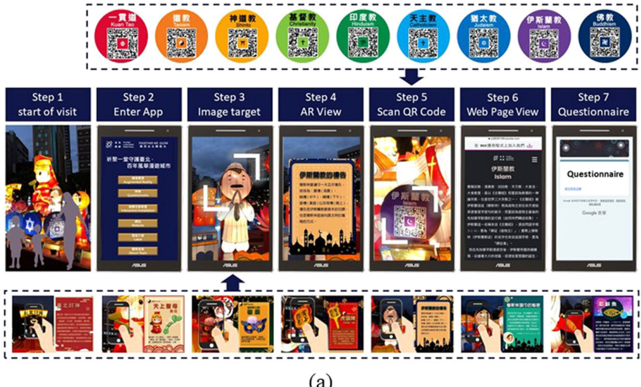
This quasi-experimental study tested whether augmented reality (AR) could improve elementary students’ learning about religious diversity at the Taipei Lantern Festival. Compared with a paper brochure, AR was associated with higher objective and subjective learning outcomes and high technology acceptance among the experimental group.
## Key findings
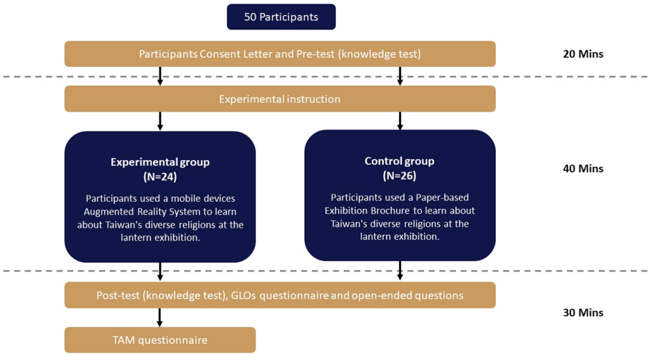
- The study recruited 50 elementary students in grades 3–4, split into an experimental group (n = 24) and a control group (n = 26).
- On the knowledge test, both groups improved, but the experimental group did better post-test: 92.92 vs 85.58, with a significant difference (t = 3.620, P = 0.001); the pretest did not differ significantly (P = 0.952).
- On the GLOs questionnaire, the experimental group scored significantly higher on knowledge and understanding (6.0000 vs 4.9712, P = 0.000), attitudes and values (5.9722 vs 4.8718, P = 0.000), enjoyment/inspiration/creativity (6.1875 vs 4.8942, P = 0.000), and evidence of action/behaviour/progression (5.667 vs 4.8590, P = 0.001); skills did not differ significantly (5.3750 vs 5.2538, P = 0.530).
- In the experimental group’s TAM results, acceptance of AR was high: PU 5.3133, PEOU 5.1760, ATU 5.2800, and BIOU 5.0960, all significantly above the neutral comparison value of 4 (P = 0.000).
## Methods
- The paper used an experimental, comparative, mixed-methods design during the 8–16 February 2020 Taipei Lantern Festival Exhibition.
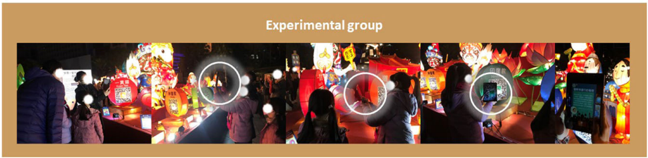
- Participants were randomly assigned to an AR experimental group or a paper-brochure control group; both groups had the same four learning objectives and 40 minutes of study time. The experimental group additionally completed a TAM questionnaire.
- Data sources included a 20-item knowledge test, a 19-item GLOs questionnaire, a 19-item TAM questionnaire, and open-ended questions; analysis used independent-samples t tests, a one-sample t test for TAM, reliability checks with Cronbach’s alpha, and qualitative coding of open-ended responses with two researchers.
## Limitations
- The paper states that the study was conducted in Taipei with a limited sample of students in grades 3–4 from a specific ethnic group, which limits generalisability.
- The sample was limited to 50 subjects due to the COVID-19 pandemic.
- Evident from the text: the intervention was conducted in a festival/exhibition setting with short exposure time, so the findings may not transfer directly to regular classroom instruction.
Model-written summary. Check it against the paper before relying on it.
Integrity signals
Registry
Cites
Statistics
Figures


Verification
Claims the paper makes
1 Valid · 0 Not valid · 14 Not checked · 62 Own results and interpretations
Every source the paper cites for this claim was checked and supports it.
In the paper
“This fi nding con fi rms previous results (Cheng et al., 2013) where children were found to be positively accepting of interactive technologies.”
What the sources say
- Supportedcites Cheng et al., 2013 matched to “Investigating elementary school students' technology acceptance by applying digital game-based learning to environmental education” (2013) source
The Abstract and Discussion of Cheng et al. (2013) report that 32 fourth-grade elementary students showed a high degree of positive, significant correlation among perceived ease of use, perceived usefulness, attitude toward use and intention to use, and that 'three factors had positive effects on the learners' acceptance of DGBL' — i.e. children were positively accepting of the interactive digital-game technology studied. The paper itself frames the object generically as 'Digital games, an interactive technology within the multimedia learning environment ... especially among young learners', so the paraphrase's wording is a mild generalisation beyond the single DGBL system rather than a mismatch of population or direction. Note the strongest generic statement ('digital games ... are widely accepted among children and teenagers', Literature Review) is credited in the paper to Latif (2007), but the paper's own results independently establish children's positive acceptance. (LLM, conf=0.80)
plain- Asserted: passes — The authors put it forward as true.
- Checkable: passes — It can be checked against evidence.
- Load-bearing: passes — The paper’s conclusions depend on it.
- Based: passes — The paper gives a reason why it holds.
- Supported
A result the paper reports from its own data — it cites no other source for it, so there is none to check. The quote shows it is in the paper.
In the paper
“The results of the study showed that the experimental group performed significantly better in both subjective and objective learning outcomes.”
- Also stated in: § Results · hedged
“However, the post-test scores of the two groups were signi fi cantly different ( P = 0.001 < 0.05), suggesting that the experimental group performed signi fi cantly better than the control group on the objective learning measure.”
plainstates a cause- Asserted: passes — The authors put it forward as true.
- Checkable: passes — It can be checked against evidence.
- Load-bearing: passes — The paper’s conclusions depend on it.
- Based: passes — The paper gives a reason why it holds.
- Also stated in: § Results · hedged
A result the paper reports from its own data — it cites no other source for it, so there is none to check. The quote shows it is in the paper.
In the paper
“The results showed that the PU, PEOU, ATU, and BIOUP scores differed signi fi cantly from four points ( P = 0.000 < 0.001)”
plain- Asserted: passes — The authors put it forward as true.
- Checkable: passes — It can be checked against evidence.
- Load-bearing: unclear — It is unclear whether the paper’s conclusions depend on it.
- Based: passes — The paper gives a reason why it holds.
A result the paper reports from its own data — it cites no other source for it, so there is none to check. The quote shows it is in the paper.
In the paper
“Participants in the experimental group indicated that learning through the exhibit was more interesting than learning in the classroom (E4).”
hedged- Asserted: passes — The authors put it forward as true.
- Checkable: passes — It can be checked against evidence.
- Load-bearing: unclear — It is unclear whether the paper’s conclusions depend on it.
- Based: passes — The paper gives a reason why it holds.
A result the paper reports from its own data — it cites no other source for it, so there is none to check. The quote shows it is in the paper.
In the paper
“Thus, it can be seen that the experimental group performed signi fi cantly better than the control group on the subjective measure.”
plain- Asserted: passes — The authors put it forward as true.
- Checkable: passes — It can be checked against evidence.
- Load-bearing: passes — The paper’s conclusions depend on it.
- Based: passes — The paper gives a reason why it holds.
31 more claims
Create a free account to see all 77 claims and to verify the 2 references still open.
- It may state two separate claims as one. 29
- The quote only partly states this claim. 6
- Probably not a substantial claim. 16
Self-check
Percentages, sums and reported differences re-computed from the paper’s own numbers.
Each contradiction between two passages listed here was confirmed by an independent check.
Rated minor: it would not touch a result — a value no result rests on, a p-value that stays on the same side of the significance level, or a conflict that is clerical, resolved elsewhere in the paper, or outside its own findings.
In the paper
§ Materials
“A total of 19 topics corresponding to perceived usefulness (PU), perceived ease of use (PEOU), attitude toward using (ATU), and behavioural intention to use (BIOU) were evaluated.”
§ Results
“The results showed that the PU, PEOU, ATU, and BIOUP scores differed signi fi cantly from four points ( P = 0.000 < 0.001), indicating that the experimental group subjects had a high level of acceptance of the technology used.”
Citations
Cites
Perceived usefulness, perceived ease of use, and user acceptance of information technology
Davis, F. D. (1989) · MIS Quarterly · doi:10.2307/249008 · Cited by 68,483
Current status, opportunities and challenges of augmented reality in education
Wu, H.-K., Lee, S. W.-Y., Chang, H.-Y., & Liang, J.-C. (2013) · Computers & Education · doi:10.1016/j.compedu.2012.10.024 · Cited by 2,674
Salloum, S. A., Qasim Mohammad Alhamad, A., Al-Emran, M., Abdel Monem, A., & Shaalan, K. (2019) · IEEE Access · doi:10.1109/access.2019.2939467 · Cited by 651
Here and now mobile learning: An experimental study on the use of mobile technology
Martin, F., & Ertzberger, J. (2013) · Computers & Education · doi:10.1016/j.compedu.2013.04.021 · Cited by 609
Huizenga, J., Admiraal, W., Akkerman, S., & Dam, G. T. (2009) · Journal of Computer Assisted Learning · doi:10.1111/j.1365-2729.2009.00316.x · Cited by 548
Huang, T.-C., Chen, C.-C., & Chou, Y.-W. (2016) · Computers & Education · doi:10.1016/j.compedu.2016.02.008 · Cited by 453
Self-citationSahin, D., & Yilmaz, R. M. (2020) · Computers & Education · doi:10.1016/j.compedu.2019.103710 · Cited by 447
Teaching based on augmented reality for a technical creative design course
Wei, X., Weng, D., Liu, Y., & Wang, Y. (2015) · Computers & Education · doi:10.1016/j.compedu.2014.10.017 · Cited by 362
Mobile English learning: An evidence-based study with fifth graders
Sandberg, J., Maris, M., & de Geus, K. (2011) · Computers & Education · doi:10.1016/j.compedu.2011.01.015 · Cited by 328
Wrzesien, M., & Alcañiz Raya, M. (2010) · Computers & Education · doi:10.1016/j.compedu.2010.01.003 · Cited by 300
Research works printed but not linked: 10
- Cheng I (2014) Home-going or home-making? The citizenship legislation and Chinese identity of Indonesian Chinese women in Taiwan. In: Chiu Kuei-fen, Dafydd Fell, Lin Ping (eds) Migration to and from Taiwan. Routledge, p 135-158
- Chien H-O, Shiu S-C (2016) Innovative teaching design of religion curriculum in general education-takes Buddhist humanity and art as example. Ling Tung J 39:203–230
- Hsu Y-D, Kao L-S (2011) Constitution basis-searching for implement of religion curriculum in compulsory education. J Religious Philos 55:1–33. https://doi.org/10.6309/jorp.201103_(55).0002 · doi:10.6309/jorp.201103_(55).0002
- Lee Y-Y (2020) Considering the feasibility of promoting religious education in Taiwan ' s twelve-year basic education from the perspectives of religious pluralism and multicultural education. Taiwan J Religious Stud 19(2):31 -69
- Lin C-S (2013) Perspectives and strategies for implementing religious education in schools. Taiwan Educ Rev Monthly 2(9):83–88
- Oviedo HC, Campo-Arias A (2005) An approach to the use of Cronbach ' s Alfa. Revista Colombiana de Psiquiatría 34(4):572 -580
- (ed) Proceedings of the Virtual Reality International Conference-Laval Virtual 2017, pp 1-5
- Shieh J-C (2017) Religious education in the public school of a plural democracy: challenge and overcome. Universitas: Monthly Rev Philos Cult 44(4):131–145
- Tosti HCC, Stephen JHY, Gwo-Jen H (2014) An augmented reality-based mobile learning system to improve students’ learning achievements and motivations in natural science inquiry activities. J Educ Technol Soc 17(4):352–365. http://www.jstor.org/stable/jeductechsoci.17.4.352
- Wen M-L (2015) A discourse of religious pedagogy in axiology: bildung of religious pedagogy. Curric Instruction Quarterly 18(3):1–23. https://doi.org/10.6384/ciq.201507_18(3).0001 · doi:10.6384/ciq.201507_18(3).0001
Cited by
Zhao, H.-G., Li, X., & Kang, X. (2024) · Humanities and Social Sciences Communications · doi:10.1057/s41599-024-03839-z · Cited by 50
“Furthermore, many researchers understand students ’ learning outcomes through mixed assessment methods (Li et al., 2023), which can more comprehensively understand children ’ s subjective and objective learning outcomes.”
Self-citationPhilosophical Foundations in Training Traditional Religious Educators: Bridging Past and Present
Uyuni, B., & Adnan, M. (2024) · Futurity Philosophy. · doi:10.57125/fp.2024.06.30.03 · Cited by 12
Papakostas, C. (2026) · Lecture notes in networks and systems · doi:10.1007/978-3-032-10827-2_19 · Cited by 12
Children's engagement with digital technology in educational spaces: A scoping review
Harverson, J., Zomer, C., Chu, C. P. Y., Horwood, S., Horwood, M., Nicholas, M., & Paatsch, L. E. (2025) · Computers & Education · doi:10.1016/j.compedu.2025.105454 · Cited by 18
The Spiritual and Socio-Educational Implications of Geojassi Christian School
Chung, J.-K. (2024) · Pharos Journal of Theology · doi:10.46222/pharosjot.106.26 · Cited by 3
Metadata
- Authors
- Li, X.-Z., Chen, C.-C., & Kang, X.
- Affiliations
- National Taipei University of Technology (TW)
- NingboTech University (CN)
- Corresponding author
- Kang, Xin
- Venue
- Humanities and Social Sciences Communications
- Published
- 2023-10-16
- Volume
- 10
- Issue
- 1
- ISSN
- 2055-1045 (ISSN-L)
- 2662-9992
- OpenAlex
- W4387667303
- Cited by
- 14
- References
- 44
- Citations by year
- 2026: 4 · 2025: 7 · 2024: 3
- FWCI
- 1.27
- Type
- journal article
- Language
- en
- Update notices
- correction (2024-01-18)
- Open access
- gold
- doi.org
- Licence
- cc-by
- creativecommons.org/licenses/by/4.0 (tdm)
- creativecommons.org/licenses/by/4.0 (vor)
- Locations
- Humanities and Social Sciences Communications (publishedVersion, cc-by)
- RePEc: Research Papers in Economics (submittedVersion)
- DOAJ (DOAJ: Directory of Open Access Journals) (submittedVersion, cc-by-sa)
- Topics
- Physical Sciences › Computer Science › Computer Vision and Pattern Recognition › Augmented Reality Applications
- Social Sciences › Education › Religious Education and Schools
- Physical Sciences › Computer Science › Information Systems › Multimedia Learning Systems
- Keywords
- religious diversity education, augmented reality, religious education, elementary school students, learning outcomes, interactive technologies, religious consciousness, cognitive overload, student motivation, Taiwan
About these checks
Registry, retraction, Cites and statistics results are computed, not judged, with one exception: a printed reference that no index lists is read once by a model before it counts as a citation error. Claims are extracted by a model and kept only when their quote appears verbatim in the text; each cited source is then checked, with a model’s help, for whether it says what the claim relies on. Those verdicts can be wrong — read the claim’s quote and the cited source before relying on one.
A language model drew the claims from the paper on 2026-10-10, under version 3 of the claim definition (model deepseek-v4.1-flash, prompt extract-v3).
A second model labelled each claim on 2026-10-10 (model jev-1.13-20260917, definition revision gold-guideline-v0.2).
Cited sources are checked with a language model’s help (qwen3.8-omni-flash).
Statistics and arithmetic are recomputed, not judged.
Confidence bands are shown only for fields calibrated on our annotated test set. None is calibrated yet, so no band is shown.
What counts as a claim ›How we measure confidence ›How we check this ›
Are you an author, or do you see a problem with this page? Request a review
How to cite
Cite CoChat for the checks on this page, and the paper for its own findings.
- This page
- CoChat. (2026). Citation check: Religious diversity education: raising children’s awareness of religious diversity through augmented reality. https://app.cochat.ai/papers/10.1057/s41599-023-02123-w
- The paper
- Li, X.-Z., Chen, C.-C., & Kang, X. (2023). Religious diversity education: raising children’s awareness of religious diversity through augmented reality. Humanities and Social Sciences Communications. https://doi.org/10.1057/s41599-023-02123-w
Data sources
Bibliographic data: Semantic Scholar, OpenAlex, Crossref.
Contains information from the Semantic Scholar Academic Graph Datasets, made available under the ODC Attribution License (ODC-BY 1.0).
Semantic Scholar’s data is described in: Kinney, R., et al. (2023). The Semantic Scholar Open Data Platform. arXiv:2301.10140.
