

High-speed long-wave infrared ultra-thin photodetectors
Open accessThe DOI matches its Crossref record; 62 of the 62 references it cites were found in a registry or an index.
Abstract
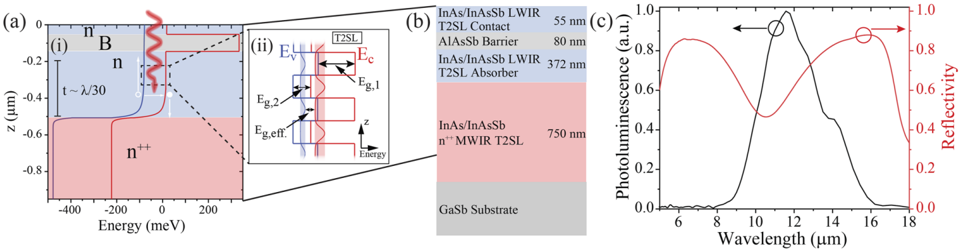
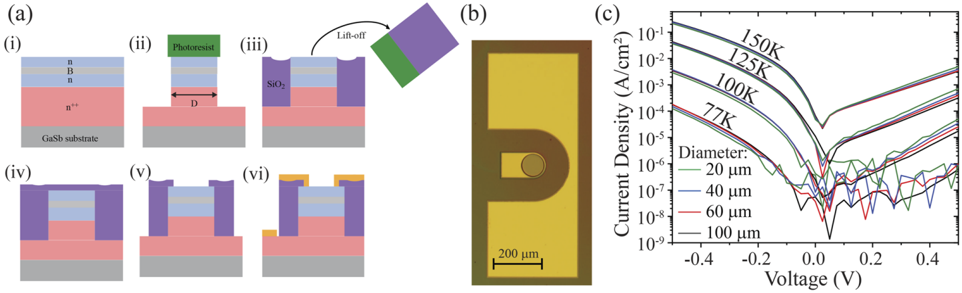
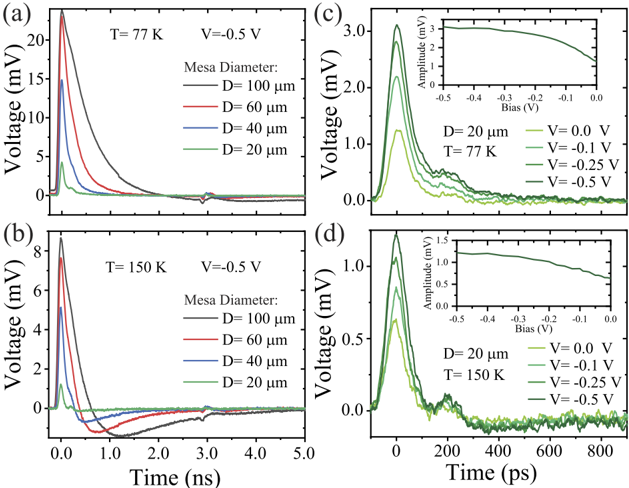
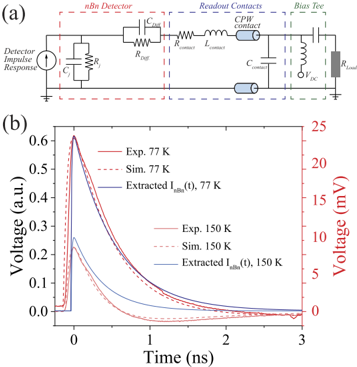
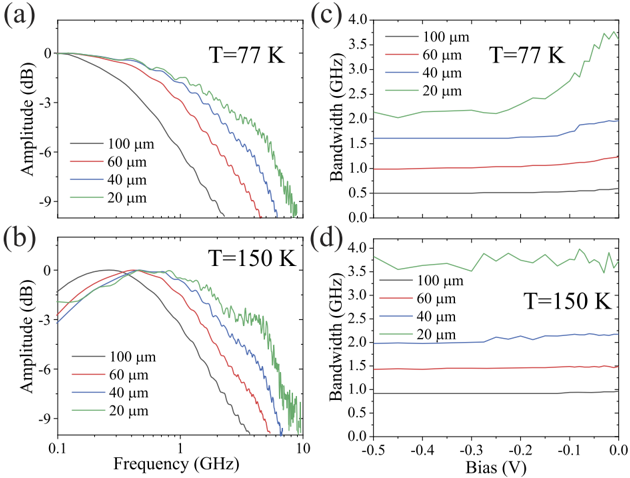
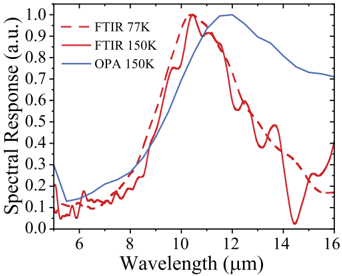
The primary challenge for long-wavelength infrared (λ = 8–13 µm) detection has long been the mitigation of dark current while achieving a high conversion efficiency of optical to electrical signals. Often overlooked is the bandwidth of detector response, despite several existing and expected future long-wave infrared high bandwidth applications. Here, we demonstrate ultra-fast response times in long-wave infrared detectors leveraging ultra-thin absorbers. The time response of the detectors is characterized using mid-infrared femtosecond pulses generated by an optical parametric amplifier, as a function of the device temperature and operating bias, as well as excitation wavelength. An equivalent circuit model for the detectors is presented and compared to our experimental results with excellent agreement. We demonstrate detector impulse response times of <100ps and 3 dB bandwidths in the GHz frequency range (f3dB > 3.5 GHz). Spectral response measurements confirm that the detectors have a resonant cavity mode enhanced response in the long-wave infrared, peaking at 10.2 µm. The presented detectors offer a potential solution for a range of high-frequency applications in the long-wave infrared.
Overview
The claims and statistics of this paper haven’t been checked yet.
Free: it reads the open-access text and checks the first 5 claims that cite a source we can check. Create a free account to check every claim.
Integrity signals
Registry
Cites
Statistics
Figures

Verification
Claims the paper makes
The claims and statistics of this paper haven’t been checked yet.
Free: it reads the open-access text and checks the first 5 claims that cite a source we can check. Create a free account to check every claim.
Self-check
Percentages, sums and reported differences re-computed from the paper’s own numbers.
The self-check needs the paper’s full text.
Citations
Cites
Extraordinary optical transmission through sub-wavelength hole arrays
Ebbesen, T. W., Lezec, H. J., Ghaemi, H. F., Thio, T., & Wolff, P. A. (1998) · Nature · doi:10.1038/35570 · Cited by 7,687
Coddington, I., Newbury, N., & Swann, W. (2016) · Optica · doi:10.1364/optica.3.000414 · Cited by 1,754
Quantum-well infrared photodetectors
Levine, B. F. (1993) · Journal of Applied Physics · doi:10.1063/1.354252 · Cited by 1,663
Third-generation infrared photodetector arrays
Rogalski, A., Antoszewski, J., & Faraone, L. (2009) · Journal of Applied Physics · doi:10.1063/1.3099572 · Cited by 827
Proposal for strained type II superlattice infrared detectors
Smith, D. L., & Mailhiot, C. (1987) · Journal of Applied Physics · doi:10.1063/1.339468 · Cited by 726
n B n detector, an infrared detector with reduced dark current and higher operating temperature
Maimon, S., & Wicks, G. W. (2006) · Applied Physics Letters · doi:10.1063/1.2360235 · Cited by 708
A Proposed High-Frequency, Negative-Resistance Diode
Read, W. T. (1958) · Bell System Technical Journal · doi:10.1002/j.1538-7305.1958.tb01527.x · Cited by 554
Dual-comb spectroscopy based on quantum-cascade-laser frequency combs
Villares, G., Hugi, A., Blaser, S., & Faist, J. (2014) · Nature Communications · doi:10.1038/ncomms6192 · Cited by 529
Wheeler, M. D., Newman, S. M., Orr-Ewing, A. J., & Ashfold, M. N. R. (1998) · Journal of the Chemical Society, Faraday Transactions · doi:10.1039/a707686j · Cited by 394
A high-performance long wavelength superlattice complementary barrier infrared detector
Ting, D. Z.-Y., Hill, C. J., Soibel, A., Keo, S. A., Mumolo, J. M., Nguyen, J., & Gunapala, S. D. (2009) · Applied Physics Letters · doi:10.1063/1.3177333 · Cited by 364
Research works printed but not linked: 3
- 1. A. Rogalski, Infrared Detectors (CRC Press, 2000).
- 22. μm," Appl. Phys. Lett. 89, 061119 (2006).
- 58. R. T. Howe and C. G. Sodini, Microelectronics: An Integrated Approach (Prentice Hall Upper, Saddle River, NJ, 1997).
Cited by
Bansal, S., Jain, A., Kumar, S., Kumar, A. V., Kumar, P. R., Prakash, K., Soliman, M. S., Islam, M. S., & Islam, M. T. (2024) · Scientific Reports · doi:10.1038/s41598-024-79727-y · Cited by 80
Du, P., Fang, X., Bao, Z., Zeng, L., Li, J., Zuo, S., Li, C., Zhang, T., Li, W., Xie, L., et al. (2026) · Applied Physics Letters · doi:10.1063/5.0312069 · Cited by 24
Photodetector Innovations for Advancing Wearable Optical Biosensors: A Review
Ebrahimi, Z., & Gosselin, B. J. (2024) · IEEE Sensors Journal · doi:10.1109/jsen.2024.3515893 · Cited by 18
Zeng, Y., Ge, X., Zhang, Y., Xiao, S., Zhao, F., chongchong, R., Wu, M., Gan, F., Wu, J., & Yang, J. (2025) · Optics Express · doi:10.1364/oe.570816 · Cited by 8
Polymer–Perovskite Microcrystal Heterojunction for Self-Powered Optical Sensing and Communication
Sathyanarayana, S., & Das, B. C. (2026) · Advanced Materials · doi:10.1002/adma.202517950 · Cited by 7
Contactless Multicolor Infrared Detection
Dev, S., Anthony, N. M., Allen, M., & Allen, J. (2024) · ACS Photonics · doi:10.1021/acsphotonics.4c01200 · Cited by 5
Self-citationUncooled Poisson Bolometer for High-Speed Event-Based Long-Wave Thermal Imaging
Mousa, M. A., Bauer, L., Singh, U., Yang, Z., Deka, A., & Jacob, Z. (2026) · IEEE Sensors Journal · doi:10.1109/jsen.2026.3682677 · Cited by 4
“In the SP bolometer, the noise is dominated by the Poisson statistics of the stochastic switching events, rather than by the bandwidth-dependent electronic noise floor of an analog amplification chain [37].”
Chulukhadze, V., Wang, Y., Matto, L., Liao, M. E., Anderson, I., Kramer, J. J., Cho, S., Goorsky, M. S., & Lu, R. (2026) · IEEE Transactions on Electron Devices · doi:10.1109/ted.2025.3644272 · Cited by 3
“The process was first developed in [36] for microscale infrared detection applications and recalibrated for this work.”
Self-citationTheoretical analysis of the response time of MWIR InAs/InAsSb T2SL barrier detector
Manyk, T., Rutkowski, J., Pawluczyk, J., & Kopytko, M. (2024) · Optics & Laser Technology · doi:10.1016/j.optlastec.2024.111492 · Cited by 2
Capacitance measurements of HOT LWIR Auger-suppressed HgCdTe IR detectors
Achtenberg, K., Gawron, W., & Martyniuk, P. M. (2026) · Sensors and Actuators A Physical · doi:10.1016/j.sna.2026.117935
A review of multiband photodetectors: From ultraviolet to infrared
Zhu, J., (34436), P. W., Dai, Q., & Fan, L. (2026) · Materials Science in Semiconductor Processing · doi:10.1016/j.mssp.2026.110887
Murawski, K., Kołodziej, G., Seredyński, B., Kubiszyn, Ł., Michalczewski, K., & Kopytko, M. (2026) · Optics Express · doi:10.1364/oe.600776
Modeling and Experimental Validation of a QWIP-LED with Quasi-GHz Upconversion Speed
Li, G. Q., Cai, J., Bai, P., Chen, M., Zhao, Z., & Wang, Y. (2026) · Cross Strait Radio Science and Wireless Technology Conference (CSRSWTC) · doi:10.1109/csrswtc71154.2026.11669750
“Acquisition of optical intensity, spectral, and temporal information in this band is of great significance for ultrafast optoelectronics, infrared imaging, and dynamic sensing[1].”
Self-citation
Metadata
- Authors
- Wang, Y., Muhowski, A. J., Nordin, L., Dev, S., Allen, M., Allen, J., & Wasserman, D.
- Affiliations
- The University of Texas at Austin (US)
- Sandia National Laboratories (US)
- University of Central Florida (US)
- Eglin Air Force Base (US)
- Corresponding author
- Wasserman, Daniel
- ORCID
- Venue
- APL Photonics
- Publisher
- AIP Publishing
- Published
- 2024-01-01
- Volume
- 9
- Issue
- 1
- ISSN
- 2378-0967 (ISSN-L)
- OpenAlex
- W4391377856
- Semantic Scholar
- 3e27cf33d2b652ba8c3d8b1065e27a5849b0a5d6
- Cited by
- 13
- References
- 62
- Citations by year
- 2026: 7 · 2025: 2 · 2024: 4
- FWCI
- 1.34
- Type
- journal article
- Language
- en
- Open access
- gold
- doi.org
- Licence
- cc-by
- creativecommons.org/licenses/by/4.0/ (vor, 30 d)
- creativecommons.org/licenses/by/4.0/ (tdm, 30 d)
- Locations
- APL Photonics (publishedVersion, cc-by)
- DOAJ (DOAJ: Directory of Open Access Journals) (submittedVersion, cc-by-sa)
- Funders
- Air Force Office of Scientific Research (23RWCOR002)
- University of Dayton Research Institute (RSC20061)
- National Science Foundation (NNCI-202522, ECCS-1926187)
- Topics
- Physical Sciences › Engineering › Electrical and Electronic Engineering › Advanced Semiconductor Detectors and Materials
- Physical Sciences › Engineering › Electrical and Electronic Engineering › Terahertz technology and applications
- Physical Sciences › Chemistry › Spectroscopy › Spectroscopy and Laser Applications
- Keywords
- ultrathin absorber, high-speed response, femtosecond pulse characterization, equivalent circuit model, resonant cavity modes, 3-dB bandwidth, dark current, mid-infrared detection, optical parametric amplifier
About these checks
Registry, retraction, Cites and statistics results are computed, not judged, with one exception: a printed reference that no index lists is read once by a model before it counts as a citation error. Claims are extracted by a model and kept only when their quote appears verbatim in the text; each cited source is then checked, with a model’s help, for whether it says what the claim relies on. Those verdicts can be wrong — read the claim’s quote and the cited source before relying on one.
Statistics and arithmetic are recomputed, not judged.
Confidence bands are shown only for fields calibrated on our annotated test set. None is calibrated yet, so no band is shown.
What counts as a claim ›How we measure confidence ›How we check this ›
Are you an author, or do you see a problem with this page? Request a review
Data sources
Bibliographic data: Semantic Scholar, OpenAlex, Crossref.
Contains information from the Semantic Scholar Academic Graph Datasets, made available under the ODC Attribution License (ODC-BY 1.0).
Semantic Scholar’s data is described in: Kinney, R., et al. (2023). The Semantic Scholar Open Data Platform. arXiv:2301.10140.
