

Components of Aesthetic Experience: Aesthetic Fascination, Aesthetic Appraisal, and Aesthetic Emotion
Open accessThe DOI matches its Crossref record; 103 of the 103 references it cites were found in a registry or an index.
Abstract
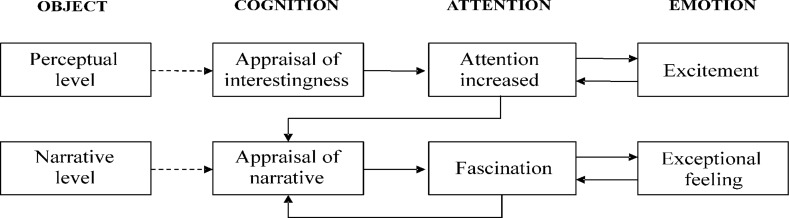
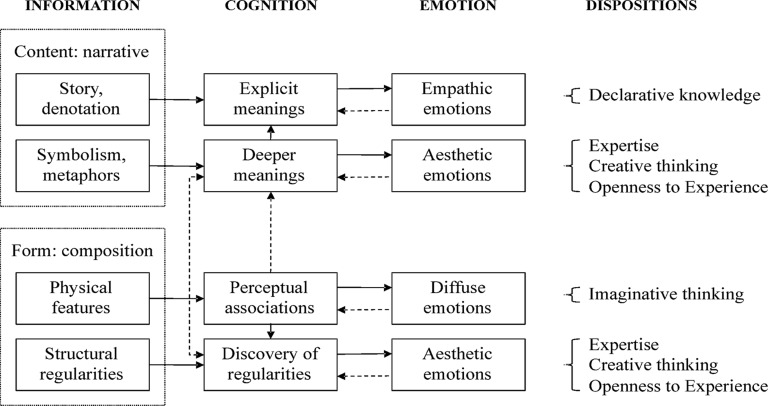
In this paper aesthetic experience is defined as an experience qualitatively different from everyday experience and similar to other exceptional states of mind. Three crucial characteristics of aesthetic experience are discussed: fascination with an aesthetic object (high arousal and attention), appraisal of the symbolic reality of an object (high cognitive engagement), and a strong feeling of unity with the object of aesthetic fascination and aesthetic appraisal. In a proposed model, two parallel levels of aesthetic information processing are proposed. On the first level two sub-levels of narrative are processed, story (theme) and symbolism (deeper meanings). The second level includes two sub-levels, perceptual associations (implicit meanings of object's physical features) and detection of compositional regularities. Two sub-levels are defined as crucial for aesthetic experience, appraisal of symbolism and compositional regularities. These sub-levels require some specific cognitive and personality dispositions, such as expertise, creative thinking, and openness to experience. Finally, feedback of emotional processing is included in our model: appraisals of everyday emotions are specified as a matter of narrative content (eg, empathy with characters), whereas the aesthetic emotion is defined as an affective evaluation in the process of symbolism appraisal or the detection of compositional regularities.
Overview
The claims and statistics of this paper haven’t been checked yet.
Free: it reads the open-access text and checks the first 5 claims that cite a source we can check. Create a free account to check every claim.
Integrity signals
Registry
Cites
Statistics
Figures
Verification
Claims the paper makes
The claims and statistics of this paper haven’t been checked yet.
Free: it reads the open-access text and checks the first 5 claims that cite a source we can check. Create a free account to check every claim.
Claims other papers make about this one
Each is checked against this paper’s own text: does it say what the citing paper says it does?
The source backs part of the claim, not all of it — or backs it for a different population, condition or comparison.
In the citing paper
“Empirical studies on visual [31], auditory [42] and haptic aesthetic experiences [57] [8] all converge in intertwining perception with embodied cognition.”
From Crafting Critical Heritage Discourses into Interactive Exhibition Design (2020) · cites this paper as [31]
Experimental — accuracy not yet measuredThe cited source says what the claim attributes to it.
In the citing paper
“The aesthetic experience is not the experience of beauty -for it can be pleasant or unpleasant; it is characterized by intense attention, extended cognitive engagement, and affective responses [31].”
From Crafting Critical Heritage Discourses into Interactive Exhibition Design (2020) · cites this paper as [31]
Self-check
Percentages, sums and reported differences re-computed from the paper’s own numbers.
The self-check needs the paper’s full text.
Citations
Cites
Well-being : the foundations of hedonic psychology
Kahneman, D. J., Diener, E. F., & Schwarz, N. (1999) · Cited by 8,305
The fusiform face area: a module in human extrastriate cortex specialized for face perception
Kanwisher, N., McDermott, J., & Chun, M. M. (1997) · The Journal of Neuroscience · doi:10.1523/jneurosci.17-11-04302.1997 · Cited by 7,738
Maslow, A. (1962) · D Van Nostrand eBooks · doi:10.1037/10793-000 · Cited by 7,192
Journal of Consciousness Studies
(2022) · Journal of Consciousness Studies · doi:10.53765/20512201 · Cited by 6,832
Csíkszentmihályi, M. (1975) · Cited by 5,690
What are emotions? And how can they be measured?
Scherer, K. R. (2005) · Social Science Information · doi:10.1177/0539018405058216 · Cited by 4,264 · cited 1×
“Koestler (1970) put aesthetic experience in the framework of creative processes emerging in art, science, humour, and playing.”
BackgroundFlow: The Psychology of Optimal Experience
Mirvis, P. H., & Csikszentmihalyi, M. (1991) · The Academy of Management Review · doi:10.2307/258925 · Cited by 3,611
Mood and judgment: The affect infusion model (AIM).
Forgas, J. P. (1995) · Psychological Bulletin · doi:10.1037/0033-2909.117.1.39 · Cited by 3,470 · cited 2×
“W J Cupchik G C, Gebotys R J, 1990 “Interest and pleasure as dimensions of aesthetic response” Empirical Studies of the Arts 8 1–14 J Cupchik G C, Vartanian O, Crawley A, Mikulis D J, 2009 “Viewing artworks: Contributions of cognitive control and perceptual facilitation to aesthetic experience” Brain and Cognition 70…”
InfluentialDynamic predictions: Oscillations and synchrony in top–down processing
Engel, A. K., Fries, P., & Singer, W. (2001) · Nature Reviews Neuroscience · doi:10.1038/35094565 · Cited by 3,454 · cited 1×
“However, other studies suggested that consciousness is not concentrated at local brain regions but is associated with globally distributed networks across a large scale of neuronal groups (cf Baars 2002; Engel et al 2001; Freeman 1991; Kanwisher 2001; Rees 2001a; Tononi and Edelman 1998; Watt 2004).”
BackgroundStory and Discourse: Narrative Structure in Fiction and Film
Austin, T. R., & Chatman, S. (1979) · The Journal of Aesthetics and Art Criticism · doi:10.2307/430732 · Cited by 2,658
Research works printed but not linked: 15
- Arnheim R 1980 Visual thinking Berkeley and Los Angeles University of California Press
- Brooks C Warren R P 1979 Modern rhetoric New York Harcourt Brace Jovanovich
- Eco U 2004 History of beauty Rizzoli International Publications
- Eco U 2007 On ugliness Rizzoli International Publications
- Frijda N H 1986 The emotions Cambridge Cambridge University Press
- Gardner H 1993 Creating minds New York Basic Books
- Gombrich E H 1969 Art and illusion Princeton New Jersey Princeton University Press
- Janković D Marković S 2001 Takete—Maluma phenomenon Perception 30 29
- Kabat-Zinn J 1998 Meditation Psycho-oncology New York Oxford University Press
- Koestler A 1970 The act of creation London Pan Books
- Marković S Janković D 2001 Implicit and explicit features of visual Gestalten Perception 30 30
- Marković S Janković D Subotić I 2002 Implicitna i eksplicitna svojstva vizuelnog gestalt [Implicit and explicit features of visual Gestalt] Psihološka istraživanja 11/ 12 75 112
- Neperud R W 1989 The relationship of art training and sex differences to aesthetic valuing Visual Arts Research 12 1 9
- Ognjenović P 1997 Psihološka teorija umetnosti [Psychological theory of art] Belgrade Institut za psihologiju
- Sternberg R J Lubart T I 1995 Defying the crowd New York Free Press
Cited by
Measuring aesthetic emotions: A review of the literature and a new assessment tool
Schindler, I., Hosoya, G., Menninghaus, W., Beermann, U., Wagner, V., Eid, M., & Scherer, K. R. (2017) · PLOS ONE · doi:10.1371/journal.pone.0178899 · Cited by 382
Menninghaus, W., Wagner, V., Wassiliwizky, E., Schindler, I., Hanich, J., Jacobsen, T., & Koelsch, S. (2019) · Psychological Review · doi:10.1037/rev0000135 · Cited by 374
Art and Psychological Well-Being: Linking the Brain to the Aesthetic Emotion
Mastandrea, S., Fagioli, S., & Biasi, V. (2019) · Frontiers in Psychology · doi:10.3389/fpsyg.2019.00739 · Cited by 223
Toward a Neural Chronometry for the Aesthetic Experience of Music
Brattico, E., Bogert, B., & Jacobsen, T. (2013) · Frontiers in Psychology · doi:10.3389/fpsyg.2013.00206 · Cited by 200
“Markovic (2012) instead specifically proposes a definition of an aesthetic experience as an “exceptional state of mind,” in which focused attention plays a crucial role, and which responds not to bodily needs (such as appetitive and mating functions) but provides “pleasures for the mind” (p. 2).”
BackgroundInfluentialContext effects on emotional and aesthetic evaluations of artworks and IAPS pictures
Gerger, G., Leder, H., & Kremer, A. (2014) · Acta Psychologica · doi:10.1016/j.actpsy.2014.06.008 · Cited by 174
Metadata
- Authors
- Marković, S.
- Affiliations
- University of Belgrade (RS)
- Corresponding author
- Marković, Slobodan
- ORCID
- Marković, Slobodan
- Venue
- i-Perception
- Publisher
- SAGE Publications
- Published
- 2012-01
- Volume
- 3
- Issue
- 1
- Pages
- 1-17
- ISSN
- 2041-6695 (ISSN-L)
- PMC
- PMC3485814
- OpenAlex
- W2096535767
- Cited by
- 346
- References
- 102
- Citations by year
- 2026: 28 · 2025: 42 · 2024: 34 · 2023: 40 · 2022: 49 · 2021: 39 · 2020: 16 · 2019: 21 · 2018: 23 · 2017: 18 · 2016: 12 · 2015: 12 · 2014: 7 · 2013: 2 · 2012: 3
- FWCI
- 3.93
- Type
- journal article
- Language
- en
- Open access
- gold
- doi.org
- Licence
- cc-by-nc-nd
- journals.sagepub.com/page/policies/text-and-data-mining-license (tdm)
- Locations
- i-Perception (publishedVersion, cc-by-nc-nd)
- Europe PMC (PubMed Central) (publishedVersion, cc-by-nc-nd)
- PubMed Central (publishedVersion, cc-by-nc-nd)
- PubMed (publishedVersion)
- DOAJ (DOAJ: Directory of Open Access Journals) (submittedVersion, cc-by-sa)
- Topics
- Life Sciences › Neuroscience › Cognitive Neuroscience › Aesthetic Perception and Analysis
- Social Sciences › Arts and Humanities › Philosophy › Ethics, Aesthetics, and Art
- Social Sciences › Arts and Humanities › Visual Arts and Performing Arts › Art, Aesthetics, and Perception
- Keywords
- aesthetic experience, aesthetic appreciation, symbolism, narrative, emotional processing, expertise, creative thinking, openness to experience, empathy, affective evaluation
About these checks
Registry, retraction, Cites and statistics results are computed, not judged, with one exception: a printed reference that no index lists is read once by a model before it counts as a citation error. Claims are extracted by a model and kept only when their quote appears verbatim in the text; each cited source is then checked, with a model’s help, for whether it says what the claim relies on. Those verdicts can be wrong — read the claim’s quote and the cited source before relying on one.
Statistics and arithmetic are recomputed, not judged.
Confidence bands are shown only for fields calibrated on our annotated test set. None is calibrated yet, so no band is shown.
What counts as a claim ›How we measure confidence ›How we check this ›
Are you an author, or do you see a problem with this page? Request a review
How to cite
Cite CoChat for the checks on this page, and the paper for its own findings.
- This page
- CoChat. (2026). Citation check: Components of Aesthetic Experience: Aesthetic Fascination, Aesthetic Appraisal, and Aesthetic Emotion. https://app.cochat.ai/papers/10.1068/i0450aap
- The paper
- Marković, S. (2012). Components of Aesthetic Experience: Aesthetic Fascination, Aesthetic Appraisal, and Aesthetic Emotion. i-Perception. https://doi.org/10.1068/i0450aap
Data sources
Bibliographic data: Semantic Scholar, OpenAlex, Crossref.
Contains information from the Semantic Scholar Academic Graph Datasets, made available under the ODC Attribution License (ODC-BY 1.0).
Semantic Scholar’s data is described in: Kinney, R., et al. (2023). The Semantic Scholar Open Data Platform. arXiv:2301.10140.
