

Components of Aesthetic Experience: Aesthetic Fascination, Aesthetic Appraisal, and Aesthetic Emotion
Open accessThe DOI matches its Crossref record; 103 of the 103 references it cites were found in a registry or an index.
Abstract
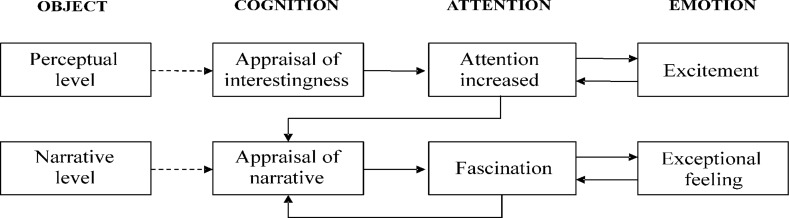
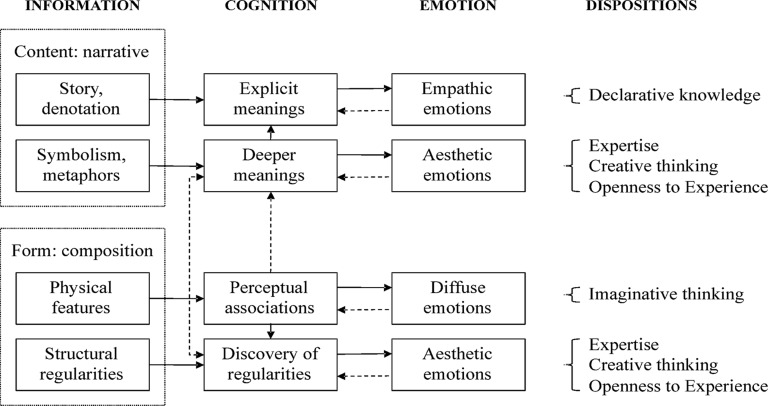
In this paper aesthetic experience is defined as an experience qualitatively different from everyday experience and similar to other exceptional states of mind. Three crucial characteristics of aesthetic experience are discussed: fascination with an aesthetic object (high arousal and attention), appraisal of the symbolic reality of an object (high cognitive engagement), and a strong feeling of unity with the object of aesthetic fascination and aesthetic appraisal. In a proposed model, two parallel levels of aesthetic information processing are proposed. On the first level two sub-levels of narrative are processed, story (theme) and symbolism (deeper meanings). The second level includes two sub-levels, perceptual associations (implicit meanings of object's physical features) and detection of compositional regularities. Two sub-levels are defined as crucial for aesthetic experience, appraisal of symbolism and compositional regularities. These sub-levels require some specific cognitive and personality dispositions, such as expertise, creative thinking, and openness to experience. Finally, feedback of emotional processing is included in our model: appraisals of everyday emotions are specified as a matter of narrative content (eg, empathy with characters), whereas the aesthetic emotion is defined as an affective evaluation in the process of symbolism appraisal or the detection of compositional regularities.
Overview
The claims and statistics of this paper haven’t been checked yet.
Free: it reads the open-access text and checks the first 5 claims that cite a source we can check. Create a free account to check every claim.
Integrity signals
Registry
Cites
Statistics
Figures
Verification
Claims the paper makes
The claims and statistics of this paper haven’t been checked yet.
Free: it reads the open-access text and checks the first 5 claims that cite a source we can check. Create a free account to check every claim.
Claims other papers make about this one
Each is checked against this paper’s own text: does it say what the citing paper says it does?
The source backs part of the claim, not all of it — or backs it for a different population, condition or comparison.
In the citing paper
“Empirical studies on visual [31], auditory [42] and haptic aesthetic experiences [57] [8] all converge in intertwining perception with embodied cognition.”
From Crafting Critical Heritage Discourses into Interactive Exhibition Design (2020) · cites this paper as [31]
Experimental — accuracy not yet measuredThe cited source says what the claim attributes to it.
In the citing paper
“The aesthetic experience is not the experience of beauty -for it can be pleasant or unpleasant; it is characterized by intense attention, extended cognitive engagement, and affective responses [31].”
From Crafting Critical Heritage Discourses into Interactive Exhibition Design (2020) · cites this paper as [31]
Self-check
Percentages, sums and reported differences re-computed from the paper’s own numbers.
The self-check needs the paper’s full text.
Citations
Cites
Well-being : the foundations of hedonic psychology
Kahneman, D. J., Diener, E. F., & Schwarz, N. (1999) · Cited by 8,305
The fusiform face area: a module in human extrastriate cortex specialized for face perception
Kanwisher, N., McDermott, J., & Chun, M. M. (1997) · The Journal of Neuroscience · doi:10.1523/jneurosci.17-11-04302.1997 · Cited by 7,738
Maslow, A. (1962) · D Van Nostrand eBooks · doi:10.1037/10793-000 · Cited by 7,192
Journal of Consciousness Studies
(2022) · Journal of Consciousness Studies · doi:10.53765/20512201 · Cited by 6,832
Csíkszentmihályi, M. (1975) · Cited by 5,690
What are emotions? And how can they be measured?
Scherer, K. R. (2005) · Social Science Information · doi:10.1177/0539018405058216 · Cited by 4,264 · cited 1×
“Koestler (1970) put aesthetic experience in the framework of creative processes emerging in art, science, humour, and playing.”
BackgroundFlow: The Psychology of Optimal Experience
Mirvis, P. H., & Csikszentmihalyi, M. (1991) · The Academy of Management Review · doi:10.2307/258925 · Cited by 3,611
Mood and judgment: The affect infusion model (AIM).
Forgas, J. P. (1995) · Psychological Bulletin · doi:10.1037/0033-2909.117.1.39 · Cited by 3,470 · cited 2×
“W J Cupchik G C, Gebotys R J, 1990 “Interest and pleasure as dimensions of aesthetic response” Empirical Studies of the Arts 8 1–14 J Cupchik G C, Vartanian O, Crawley A, Mikulis D J, 2009 “Viewing artworks: Contributions of cognitive control and perceptual facilitation to aesthetic experience” Brain and Cognition 70…”
InfluentialDynamic predictions: Oscillations and synchrony in top–down processing
Engel, A. K., Fries, P., & Singer, W. (2001) · Nature Reviews Neuroscience · doi:10.1038/35094565 · Cited by 3,454 · cited 1×
“However, other studies suggested that consciousness is not concentrated at local brain regions but is associated with globally distributed networks across a large scale of neuronal groups (cf Baars 2002; Engel et al 2001; Freeman 1991; Kanwisher 2001; Rees 2001a; Tononi and Edelman 1998; Watt 2004).”
BackgroundStory and Discourse: Narrative Structure in Fiction and Film
Austin, T. R., & Chatman, S. (1979) · The Journal of Aesthetics and Art Criticism · doi:10.2307/430732 · Cited by 2,658
Research works printed but not linked: 15
- Arnheim R 1980 Visual thinking Berkeley and Los Angeles University of California Press
- Brooks C Warren R P 1979 Modern rhetoric New York Harcourt Brace Jovanovich
- Eco U 2004 History of beauty Rizzoli International Publications
- Eco U 2007 On ugliness Rizzoli International Publications
- Frijda N H 1986 The emotions Cambridge Cambridge University Press
- Gardner H 1993 Creating minds New York Basic Books
- Gombrich E H 1969 Art and illusion Princeton New Jersey Princeton University Press
- Janković D Marković S 2001 Takete—Maluma phenomenon Perception 30 29
- Kabat-Zinn J 1998 Meditation Psycho-oncology New York Oxford University Press
- Koestler A 1970 The act of creation London Pan Books
- Marković S Janković D 2001 Implicit and explicit features of visual Gestalten Perception 30 30
- Marković S Janković D Subotić I 2002 Implicitna i eksplicitna svojstva vizuelnog gestalt [Implicit and explicit features of visual Gestalt] Psihološka istraživanja 11/ 12 75 112
- Neperud R W 1989 The relationship of art training and sex differences to aesthetic valuing Visual Arts Research 12 1 9
- Ognjenović P 1997 Psihološka teorija umetnosti [Psychological theory of art] Belgrade Institut za psihologiju
- Sternberg R J Lubart T I 1995 Defying the crowd New York Free Press
Cited by
Measuring aesthetic emotions: A review of the literature and a new assessment tool
Schindler, I., Hosoya, G., Menninghaus, W., Beermann, U., Wagner, V., Eid, M., & Scherer, K. R. (2017) · PLOS ONE · doi:10.1371/journal.pone.0178899 · Cited by 382
Menninghaus, W., Wagner, V., Wassiliwizky, E., Schindler, I., Hanich, J., Jacobsen, T., & Koelsch, S. (2019) · Psychological Review · doi:10.1037/rev0000135 · Cited by 374
Art and Psychological Well-Being: Linking the Brain to the Aesthetic Emotion
Mastandrea, S., Fagioli, S., & Biasi, V. (2019) · Frontiers in Psychology · doi:10.3389/fpsyg.2019.00739 · Cited by 223
Toward a Neural Chronometry for the Aesthetic Experience of Music
Brattico, E., Bogert, B., & Jacobsen, T. (2013) · Frontiers in Psychology · doi:10.3389/fpsyg.2013.00206 · Cited by 200
“Markovic (2012) instead specifically proposes a definition of an aesthetic experience as an “exceptional state of mind,” in which focused attention plays a crucial role, and which responds not to bodily needs (such as appetitive and mating functions) but provides “pleasures for the mind” (p. 2).”
BackgroundInfluentialContext effects on emotional and aesthetic evaluations of artworks and IAPS pictures
Gerger, G., Leder, H., & Kremer, A. (2014) · Acta Psychologica · doi:10.1016/j.actpsy.2014.06.008 · Cited by 174
Genç, V., & Genc, S. G. (2022) · Journal of Hospitality and Tourism Insights · doi:10.1108/jhti-08-2021-0218 · Cited by 172
Abraham, A. (2016) · Human Brain Mapping · doi:10.1002/hbm.23300 · Cited by 160
Neural signatures of attentional engagement during narratives and its consequences for event memory
Song, H., Finn, E. S., & Rosenberg, M. D. (2021) · Proceedings of the National Academy of Sciences · doi:10.1073/pnas.2021905118 · Cited by 151
van Paasschen, J., Bacci, F., & Melcher, D. (2015) · PLoS ONE · doi:10.1371/journal.pone.0134241 · Cited by 145
Destination Aesthetics and Aesthetic Distance in Tourism Experience
Kirillova, K., & Lehto, X. (2015) · Journal of Travel & Tourism Marketing · doi:10.1080/10548408.2014.958608 · Cited by 114
“Markovic (2012) compares aesthetic experience to the state of “flow” (Csikszentmihalyi, 1975) in a sense that in that mental state individuals are drawn to the object of appreciation, which evokes a loss of self-consciousness and a sense of time.”
BackgroundBoccia, M., Barbetti, S., Piccardi, L., Guariglia, C., Ferlazzo, F., Giannini, A. M., & Zaidel, D. W. (2015) · Neuroscience & Biobehavioral Reviews · doi:10.1016/j.neubiorev.2015.09.009 · Cited by 142
“…shift from an automatic visuo-perceptual processing to an “aesthetic state of mind”, more explicitly directed to the sensory experience (Cupchik and Winston, 1996; Cupchik, 1992) and to reflect a unique, emotionally colored, self-transcending subject–object relationship (Marković, 2012).”
Empathy, engagement, entrainment: the interaction dynamics of aesthetic experience
Brinck, I. (2018) · Cognitive Processing · doi:10.1007/s10339-017-0805-x · Cited by 113
“Ignoring functional and pragmatic properties, they are characterized by high arousal, sustained attention, and marked personal engagement both cognitively and emotionally (Markovic 2012; Vessel et al. 2012).”
BackgroundComputational and Experimental Approaches to Visual Aesthetics
Brachmann, A., & Redies, C. (2017) · Frontiers in Computational Neuroscience · doi:10.3389/fncom.2017.00102 · Cited by 137
“…aesthetic appreciation; several researchers have included combinations of both types of factors in their models of aesthetic experience (for example, see Jacobsen, 2006; Locher et al., 2007; Markovi´c, 2012; Chatterjee and Vartanian, 2014; Kozbelt and Kaufman, 2014; Shimamura, 2014; Redies, 2015).”
BackgroundInfluentialMarin, M. M., Lampatz, A., Wandl, M., & Leder, H. (2016) · Frontiers in Human Neuroscience · doi:10.3389/fnhum.2016.00536 · Cited by 109
Curve Appeal: Exploring Individual Differences in Preference for Curved Versus Angular Objects
Cotter, K. N., Silvia, P. J., Bertamini, M., Palumbo, L., & Vartanian, O. A. (2017) · i-Perception · doi:10.1177/2041669517693023 · Cited by 108
“Many studies, from Berlyne’s (1971) early work to the present (Marković, 2012; Silvia & Kashdan, in press), show that liking and interest respond differently to low-level features like complexity and familiarity.”
BackgroundVartanian, O. A., Navarrete, G., Chatterjee, A. K., Fich, L. B., Leder, H., Modroño, C., Rostrup, N., Skov, M., Corradi, G. B., & Nadal, M. (2017) · Psychology of Aesthetics Creativity and the Arts · doi:10.1037/aca0000150 · Cited by 103
Music Listening in Classical Concerts: Theory, Literature Review, and Research Program
Wald‐Fuhrmann, M., Egermann, H., Czepiel, A. M., O’Neill, K., Weining, C., Meier, D., Tschacher, W., Uhde, F., Toelle, J., & Tröndle, M. (2021) · Frontiers in Psychology · doi:10.3389/fpsyg.2021.638783 · Cited by 116
“Recently, more specific qualities of aesthetic experiences were proposed, i.e., aesthetic emotion (Marković, 2012; Juslin, 2013; Schindler et al., 2017; Menninghaus et al., 2019), fascination (Marković, 2012), awe (Konečni, 2005), or being moved (Konečni, 2005; Menninghaus et al., 2015).”
BackgroundNeural Correlates of Music Listening: Does the Music Matter?
Reybrouck, M., Vuust, P., & Brattico, E. (2021) · Brain Sciences · doi:10.3390/brainsci11121553 · Cited by 103
Johnson-Laird, P., & Oatley, K. (2022) · Acta Psychologica · doi:10.1016/j.actpsy.2022.103506 · Cited by 64
“Stopping for knowledge”: The sense of beauty in the perception-action cycle
Sarasso, P., Neppi-Mòdona, M., Sacco, K., & Ronga, I. (2020) · Neuroscience & Biobehavioral Reviews · doi:10.1016/j.neubiorev.2020.09.004 · Cited by 99
Schiller, D., Yu, A. N. C., Alia‐Klein, N., Becker, S., Cromwell, H. C., Dolcos, F., Eslinger, P. J., Frewen, P., Kemp, A. H., Pace-Schott, E. F., et al. (2023) · Neuroscience & Biobehavioral Reviews · doi:10.1016/j.neubiorev.2023.105450 · Cited by 102
Affective Video Content Analysis: A Multidisciplinary Insight
Baveye, Y., Chamaret, C., Dellandréa, E., & Chen, L. (2017) · IEEE Transactions on Affective Computing · doi:10.1109/taffc.2017.2661284 · Cited by 85
van Dongen, N. N. N., Strien, J. W. V., & Dijkstra, K. (2016) · Brain and Cognition · doi:10.1016/j.bandc.2016.06.003 · Cited by 89
“The emotional distance to an artwork may thus be further enhanced because art viewing may have the observer focus on the techniques employed in the art work rather than its emotional content (Markovic, 2012).”
Ullrich, S., Aryani, A., Kraxenberger, M., Jacobs, A. M., & Conrad, M. (2017) · Frontiers in Psychology · doi:10.3389/fpsyg.2016.02073 · Cited by 83
“…less dominant than in narrative fiction (Oatley, 1994; Jacobs, 2011, 2015a; Mar et al., 2011), whereas aesthetic emotions— characterized mainly by the affective evaluation and appreciation of artistic style, beauty, etc.—play a more dominant role (Frijda, 1989; Leder et al., 2004; Marković, 2012).”
BackgroundThe importance of the visual aesthetics of colours in food at a workday lunch
Paakki, M., Aaltojärvi, I., Sandell, M. A., & Hopia, A. (2018) · International Journal of Gastronomy and Food Science · doi:10.1016/j.ijgfs.2018.12.001 · Cited by 81
The Aesthetic Dimension of Organizing: A Review and Research Agenda
Baldessarelli, G., Stigliani, I., & Elsbach, K. D. (2021) · Academy of Management Annals · doi:10.5465/annals.2020.0198 · Cited by 69
Not all about sex: neural and biobehavioral functions of human dance
Christensen, J. F., Cela‐Conde, C. J., & Gomila, A. (2017) · Annals of the New York Academy of Sciences · doi:10.1111/nyas.13420 · Cited by 100
Gartus, A., Klemer, N. T., & Leder, H. (2015) · Acta Psychologica · doi:10.1016/j.actpsy.2015.01.005 · Cited by 63
“…Nadal, Leder, & Rosenberg, 2014; Gartus & Leder, 2014; Gerger, Leder, & Kremer, 2014; Hagtvedt & Patrick, 2011; Kirk, 2008; Kirk, Skov, Hulme, Christensen, & Zeki, 2009; Marković, 2012; Noguchi & Murota, 2013; Swami, 2013), the actual processes that cause contextual differences are yet unclear.”
BackgroundZhuang, M., Zhang, H., Li, P., Shen, C., Xiao, X., & Zhang, J. (2023) · Tourism Management · doi:10.1016/j.tourman.2023.104768 · Cited by 58
The experience – economy revisited: an interdisciplinary perspective and research agenda
Chevtchouk, Y., Veloutsou, C. A., & Paton, R. A. (2021) · Journal of Product & Brand Management · doi:10.1108/jpbm-06-2019-2406 · Cited by 69
Sarasso, P., Ronga, I., Kobau, P., Bosso, T., Artusio, I., Ricci, R., & Neppi-Mòdona, M. (2019) · Neuropsychologia · doi:10.1016/j.neuropsychologia.2019.107282 · Cited by 54
Electrophysiological brain dynamics during the esthetic judgment of human bodies and faces
Muñoz, F., & Martín‐Loeches, M. (2014) · Brain Research · doi:10.1016/j.brainres.2014.10.061 · Cited by 47
“However, Markovic (2012) points out that the esthetic experience emerges beyond the perceptual properties of the object, eliciting the higher level of esthetic feelings of pleasure (see also Kubovy, 1999; Martindale and Moore, 1988; Winkielman and Cacioppo, 2001).”
BackgroundFayn, K., Silvia, P. J., Erbaş, Y., Tiliopoulos, N., & Kuppens, P. (2017) · Cognition & Emotion · doi:10.1080/02699931.2017.1322554 · Cited by 49
Gist Perception of Image Composition in Abstract Artworks
Schwabe, K., Menzel, C., Mullin, C. R., Wagemans, J. P., & Redies, C. (2018) · i-Perception · doi:10.1177/2041669518780797 · Cited by 48
“The different terms, which can have positive or negative valence (Augustin et al., 2012), relate to different concepts underlying aesthetic evaluation (Graf & Landwehr, 2015; Markovic, 2012).”
BackgroundE-Sport Events within Tourism Paradigm: A Conceptual Discussion
Dilek, S. E. (2019) · International Journal of Contemporary Tourism Research · doi:10.30625/ijctr.525426 · Cited by 42
Aesthetic Highlight Detection in Movies Based on Synchronization of Spectators’ Reactions
Muszyński, M., Κωστούλας, Θ., Lombardo, P., Pun, T., & Chanel, G. (2018) · ACM Transactions on Multimedia Computing Communications and Applications · doi:10.1145/3175497 · Cited by 41
“It can be defined as a special kind of relationship between a person and an artistic object in which a particular object absorbs the person’s mind and overshadows other surrounding objects and events [56].”
BackgroundAesthetic experiences and their transformative power: a systematic review
Pizzolante, M., Pelowski, M. J., Demmer, T. R., Bartolotta, S., Sarcinella, E. D., Gaggioli, A., & Chirico, A. (2024) · Frontiers in Psychology · doi:10.3389/fpsyg.2024.1328449 · Cited by 67
“Also, we refer to the definition of aesthetic experience provided by Mastandrea et al. (2019) and Markovi´c (2012), which state that aesthetic experiences involve the appreciation of aesthetic objects, resulting in a particular kind of “pleasure”.”
BackgroundVirtual fashion experiences in virtual reality fashion show spaces
Kim, S. J. (2023) · Frontiers in Psychology · doi:10.3389/fpsyg.2023.1276856 · Cited by 50
““Aesthetic” refers to a sensory experience that is related to the visual form, texture, harmony, order, and beauty of an artifact (Venkatesh and Meamber, 2008), and is an ideal experience characterized by an aesthetic quality that is distinct from everyday experiences (Marković, 2012).”
BackgroundMarin, M. M., & Leder, H. (2015) · Acta Psychologica · doi:10.1016/j.actpsy.2015.10.002 · Cited by 48
Pupillary response to representations of light in paintings
Castellotti, S., Conti, M., Feitosa-Santana, C., & Viva, M. M. D. (2020) · Journal of Vision · doi:10.1167/jov.20.10.14 · Cited by 43
“It is well known that aesthetic experience is unique to each individual (Kuchinke, Trapp, Jacobs, & Leder, 2009; Marković, 2010; Marković, 2011; Marković, 2012; Marković & Radonjić, 2008).”
BackgroundSzubielska, M., & Imbir, K. K. (2021) · PLoS ONE · doi:10.1371/journal.pone.0250924 · Cited by 45
Artful Terms: A Study on Aesthetic Word Usage for Visual Art versus Film and Music
Augustin, M. D., Carbon, C., & Wagemans, J. P. (2012) · i-Perception · doi:10.1068/i0511aap · Cited by 41
Α path to our heart: Visual metaphors and “white” space in advertising aesthetic pleasure
Margariti, K., Hatzithomas, L., Boutsouki, C., & Zotos, Y. C. (2021) · International Journal of Advertising · doi:10.1080/02650487.2021.1914446 · Cited by 38
“As in many aesthetic experience models, when an individual comes across a stimulus, cognitive and affective reactions lead to the evaluation of the stimulus (Marković 2012).”
BackgroundHuman-robot interaction: the impact of robotic aesthetics on anticipated human trust
Pinney, J., Carroll, F., & Newbury, P. (2022) · PeerJ Computer Science · doi:10.7717/peerj-cs.837 · Cited by 49
The sensory valuation account of aesthetic experience
Nadal, M., & Skov, M. (2024) · Nature Reviews Psychology · doi:10.1038/s44159-024-00385-y · Cited by 46
“Most scientists who study aesthetic experience describe it as a psychological event in which an ‘aesthetic evaluation’ of an ‘aesthetic object’ produces an ‘aesthetic outcome’ 5,14,16,19,20 .”
InfluentialAnger framed: A field study on emotion, pleasure, and art.
Wagner, V., Klein, J., Hanich, J., Shah, M., Menninghaus, W., & Jacobsen, T. (2016) · Psychology of Aesthetics Creativity and the Arts · doi:10.1037/aca0000029 · Cited by 40
Sarasso, P., Ronga, I., Pistis, A., Forte, E., Garbarini, F., Ricci, R., & Neppi-Mòdona, M. (2019) · Scientific Reports · doi:10.1038/s41598-019-55131-9 · Cited by 36
Aesthetic design of app interfaces and their impact on secondary students’ interest and learning
Ruf, A., Zahn, C., Agotai, D., Iten, G. H., & Opwis, K. (2022) · Computers and Education Open · doi:10.1016/j.caeo.2022.100075 · Cited by 56
Visual cortex activation predicts visual preference: Evidence from Britain and Egypt
Makin, A. D. J., Helmy, M. S., & Bertamini, M. (2017) · Quarterly Journal of Experimental Psychology · doi:10.1080/17470218.2017.1350870 · Cited by 33
“For one thing, it is impossible to evoke strong emotions such as intense fascination (Kubovy, 2000) and aesthetic rapture (Markovic, 2012) with controlled stimuli on repeated trials.”
BackgroundBodily feelings and aesthetic experience of art
Nummenmaa, L., & Hari, R. (2023) · Cognition & Emotion · doi:10.1080/02699931.2023.2183180 · Cited by 52
Christensen, J. F., & Gomila, A. (2018) · Progress in brain research · doi:10.1016/s0079-6123(18)30032-3 · Cited by 31
Multiple dimensions of biodiversity drive human interest in tide pool communities
Fairchild, T. P., Fowler, M. S., Pahl, S., & Griffin, J. N. (2018) · Scientific Reports · doi:10.1038/s41598-018-33155-x · Cited by 36
Edge-Orientation Entropy Predicts Preference for Diverse Types of Man-Made Images
Grebenkina, M., Brachmann, A., Bertamini, M., Kaduhm, A., & Redies, C. (2018) · Frontiers in Neuroscience · doi:10.3389/fnins.2018.00678 · Cited by 28
“Another model, proposed by Marković (2012), identified two similar factors: aesthetic experience and hedonic tone.”
BackgroundThe major-minor mode dichotomy in music perception
Carraturo, G., Pando‐Naude, V., Costa, M., Vuust, P., Bonetti, L., & Brattico, E. (2024) · Physics of Life Reviews · doi:10.1016/j.plrev.2024.11.017 · Cited by 35
Boccia, M., Nemmi, F., Tizzani, E., Guariglia, C., Ferlazzo, F., Galati, G., & Giannini, A. M. (2014) · Behavioural Brain Research · doi:10.1016/j.bbr.2014.09.041 · Cited by 31
TMS over the superior temporal sulcus affects expressivity evaluation of portraits
Ferrari, C., Schiavi, S., & Cattaneo, Z. (2018) · Cognitive Affective & Behavioral Neuroscience · doi:10.3758/s13415-018-0630-4 · Cited by 27
“…and the aesthetic features (e.g., style) occurring during the perception of an artwork (Kesner & Horáček, 2017; see also Cupchik et al., 2009; Marković, 2010, 2012), may reduce the strength of the emotional and empathic responses toward the depicted objects, further weakening (in the case of…”
BackgroundBoz, T. E., Demirkan, H., & Ürgen, B. A. (2024) · Psychology of Aesthetics Creativity and the Arts · doi:10.1037/aca0000504 · Cited by 33
Samaritter, R. (2018) · Behavioral Sciences · doi:10.3390/bs8040041 · Cited by 33
“It is not an objective standard that identifies a situation as being aesthetic or that turns a work into art work but it is an experiential engagement between the maker and the material, between the performer and the audience or the piece of art work and the onlooker, that contributes to an aesthetic unfolding of the…”
BackgroundCrafting Critical Heritage Discourses into Interactive Exhibition Design
Claisse, C., Petrelli, D., Ciolfi, L., Dulake, N., Marshall, M. T., & Durrant, A. C. (2020) · Proceedings of the 2020 CHI Conference on Human Factors in Computing Systems · doi:10.1145/3313831.3376689 · Cited by 30
On the perceptual aesthetics of interactive objects
Soranzo, A., Petrelli, D., Ciolfi, L., & Reidy, J. G. (2018) · Quarterly Journal of Experimental Psychology · doi:10.1177/1747021817749228 · Cited by 23
“It is known that moving stimuli attract attention and arousal more than static stimuli (Franconeri & Simons, 2003), and aesthetics positively correlates with arousal (Marković, 2012).”
Exploring the First Momentary Unboxing Experience with Aesthetic Interaction
Kim, C., Self, J. A., & Bae, J. (2018) · The Design Journal · doi:10.1080/14606925.2018.1444538 · Cited by 23
“Here aesthetics is not seen as a means to satisfy bodily needs, but rather as a provocation of higher-level pleasures of the mind (Marković 2012).”
BackgroundSchubert, E. (2023) · Empirical Studies of the Arts · doi:10.1177/02762374221143728 · Cited by 31
“…of reas-signing a regular emotion word to an aesthetic version of itself by adding the adjective ‘ aesthetic ’ , as in ‘ aesthetic anger ’ (e.g., Markovic ́ , 2012), ‘ aesthetic awe ’ (Konec ̌ ni, 2005), ‘ aesthetic chills ’ (Silvia & Nusbaum, 2011), and ‘ aesthetic enjoyment ’…”
BackgroundMultimodal Affect and Aesthetic Experience
Κωστούλας, Θ., Muszyński, M., Chaspari, T., & Amelidis, P. (2020) · INTERNATIONAL CONFERENCE ON MULTIMODAL INTERACTION · doi:10.1145/3382507.3420055 · Cited by 21
“Aesthetic experience corresponds to the personal experience when engaged with art and differs from the everyday experience which deals with the interpretation of natural objects, events, environments and people [3,13].”
BackgroundAesthetic experiences and flourishing in science: A four-country study
Jacobi, C. J., Varga, P. J., & Vaidyanathan, B. (2022) · Frontiers in Psychology · doi:10.3389/fpsyg.2022.923940 · Cited by 29
“When aesthetic contents are experienced in characteristically transcendent ways, the effect is qualitatively different from more mundane experiences of prettiness or pleasantness and closely parallels other higher states (Marković, 2012), indicating a largely underexplored relationship between aesthetics and well-bein…”
BackgroundInfluentialMencke, I., Seibert, C., Brattico, E., & Wald‐Fuhrmann, M. (2022) · Psychology of Music · doi:10.1177/03057356221091312 · Cited by 21
“However, since existential and transcendental dimensions represent prominent characteristics in conceptualizations of an aesthetic experience (Dewey, 1958; Gabrielsson & Wik, 2003; Konečni, 2005; Marković, 2012; Pelowski et al., 2017), several questions remain unanswered at present.”
BackgroundThe Black radical imagination: a space of hope and possible futures
Hill‐Jarrett, T. G. (2023) · Frontiers in Neurology · doi:10.3389/fneur.2023.1241922 · Cited by 28
“This form of imagination consists of attentional focus, cognitive engagement/ appraisal, and emotional connection in relation to an object (52).”
BackgroundHarrison, N., & Clark, D. P. A. (2016) · Mindfulness · doi:10.1007/s12671-016-0536-6 · Cited by 29
“The importance of perceptual awareness and perceptual processing of an art object is emphasized in several information-processing models of aesthetic experience (Chatterjee, 2011; Leder et al., 2004; Marković, 2012; Nadal, Munar, Capo, Rosselio, & Cela-Conde, 2008).”
BackgroundKuliga, S., Dalton, R., & Hölscher, C. (2013) · Lancaster EPrints (Lancaster University) · Cited by 27
KAISER, D. H., & Nyga, K. (2020) · Scientific Reports · doi:10.1038/s41598-020-74009-9 · Cited by 27
Karim, A. K. M. R., Proulx, M. J., de Sousa, A. A., & Likova, L. T. (2022) · Cognitive Affective & Behavioral Neuroscience · doi:10.3758/s13415-022-01004-0 · Cited by 36
“…fashion (see CelaConde et al., 2011; Conway & Rehding, 2013; Ramachandran & Hirstein, 1999), with only some authors having aesthetic perception discussed as different from everyday perception (Boccia et al., 2015; Cupchik et al., 2009; Cupchik & Winston, 1996; Mamassian, 2008; Marković, 2012).”
BackgroundPersonal Meanings Inspired by the Beauty of Paintings
Oleś, P., Chmielnicka-Kuter, E., Jankowski, T., Francuz, P., Augustynowicz, P., & Łysiak, M. (2021) · Art & Perception · doi:10.1163/22134913-bja10023 · Cited by 31
Art and higher education for environmental sustainability: a matter of emergence?
Heinrich, F., & Kørnøv, L. (2021) · International Journal of Sustainability in Higher Education · doi:10.1108/ijshe-01-2021-0012 · Cited by 24
Sarasso, P., Francesetti, G., Roubal, J., Gecele, M., Ronga, I., Neppi-Mòdona, M., & Sacco, K. (2022) · Frontiers in Human Neuroscience · doi:10.3389/fnhum.2022.906188 · Cited by 26
“…Section “Natura Sanat: The Role of Aesthetic Attitude in Allowing Change,” aesthetic perception might not be concerned with the extrinsic homeostatic and utilitarian value of stimuli, but rather with the intrinsic quality (i.e., informational value) of the aesthetic object itself (Marković, 2012).”
BackgroundInfluentialKähler, S. T., Abben, T., Luna‐Rodriguez, A., Tomat, M., & Jacobsen, T. (2022) · Technology in Society · doi:10.1016/j.techsoc.2022.102096 · Cited by 20
The Role of Musical Aesthetic Emotions in Social Adaptation to the Covid-19 Pandemic
Sarasso, P., Ronga, I., Neppi-Mòdona, M., & Sacco, K. (2021) · Frontiers in Psychology · doi:10.3389/fpsyg.2021.611639 · Cited by 20
Phenomenology of atmospheres. The felt meanings of clinical encounters
Costa, C. D. F., Carmenates, S., Madeira, L., & Stanghellini, G. (2014) · Florence Research (University of Florence) · Cited by 18
Theory of Mind Increases Aesthetic Appreciation in Visual Arts
Iosifyan, M. (2021) · Art & Perception · doi:10.1163/22134913-bja10011 · Cited by 26
“Cognitive processes are one of the key characteristics of aesthetic experience (Marković, 2012).”
BackgroundGeller, H. A., Bartho, R., Thömmes, K., & Redies, C. (2022) · Frontiers in Neuroscience · doi:10.3389/fnins.2022.999720 · Cited by 24
“…used in the present study were previously shown to correlate with image properties (Schwabe et al., 2018; Stanischewski et al., 2020), and they have been associated with different aspects of aesthetic perception and evaluation (Cupchik and Gebotys, 1990; Marković, 2012; Graf and Landwehr, 2015).”
MethodThe relationship between the dancers’ and the audience’s aesthetic experience
Vukadinovic, M. S., & Marković, S. (2017) · Psihologija · doi:10.2298/psi160222009v · Cited by 17
“On the other hand, studying the aesthetic experience of the whole dance performance complicates the stimulus definition (Glass, 2005; Grove et al., 2005; Vukadinović & Marković, 2012).”
BackgroundMethodSelf-citationSzubielska, M., Ganczarek, J., Pietras, K., & Stolińska, A. (2021) · Poetics · doi:10.1016/j.poetic.2021.101537 · Cited by 17
Influence of aesthetics attributes of brand Web pages on customer brand engagement
Marmat, G. (2022) · Global Knowledge, Memory and Communication · doi:10.1108/gkmc-07-2021-0126 · Cited by 27
Fekete, A., Maidhof, R. M., Specker, E., Nater, U. M., & Leder, H. (2022) · PLoS ONE · doi:10.1371/journal.pone.0266545 · Cited by 29
“Similarly, empathy [86] and absorption [87] are also associated with emotional engagement in the context of viewing visual art.”
BackgroundΚωστούλας, Θ., Chanel, G., Muszyński, M., Lombardo, P., & Pun, T. (2017) · Frontiers in ICT · doi:10.3389/fict.2017.00011 · Cited by 20
“Aesthetic experience and Aesthetic emotions are held to be different from everyday experience and emotions (Scherer, 2005; Marković, 2012).”
BackgroundInfluentialWeigand, R., & Jacobsen, T. (2021) · PLoS ONE · doi:10.1371/journal.pone.0248529 · Cited by 28
“Since aesthetic experiences arise in response to a variety of domains, it is necessary to consider the mental mode of processing involved in this “exceptional state of mind” [4](p.”
BackgroundAugustin, M. D., & Wagemans, J. P. (2012) · i-Perception · doi:10.1068/i0541aap · Cited by 17
“Definitions of aesthetics-related terms differ widely between authors, and terminology is far from systematic (Augustin et al 2012b; Faerber et al 2010; Marković 2012).”
InfluentialContextualizing information enhances the experience of environmental art.
Keller, E., Sommer, L. K., Klöckner, C. A., & Hanss, D. (2019) · Psychology of Aesthetics Creativity and the Arts · doi:10.1037/aca0000213 · Cited by 25
“Emotions are a central variable in many art studies, as they contribute substantially to the experience of art (Marković, 2012), even independently of art expertise (van Paasschen, Bacci, & Melcher, 2015).”
BackgroundA Trans-Disciplinary Vocabulary for Assessing the Visual Performance of BIPV
Scognamiglio, A. (2021) · Sustainability · doi:10.3390/su13105500 · Cited by 21
Pronurturance Plus at birth: A risk reduction strategy for preventing postpartum haemorrhage
Saxton, A., Fahy, K. M., & Hastie, C. R. (2015) · Women and Birth · doi:10.1016/j.wombi.2015.11.007 · Cited by 20
Seeking a higher level of arts integration across the curriculum
Sotiropoulou-Zormpala, M. (2016) · Arts Education Policy Review · doi:10.1080/10632913.2014.966288 · Cited by 19
Monastero, B., McGookin, D. K., & Torre, G. (2016) · International Conference on Mobile and Ubiquitous Multimedia (MUM) · doi:10.1145/3012709.3012725 · Cited by 14
Marschallek, B. E., Löw, A., & Jacobsen, T. (2023) · Neuropsychologia · doi:10.1016/j.neuropsychologia.2023.108520 · Cited by 18
Object Domains and the Experience of Beauty
Marković, S. (2014) · Art & Perception · doi:10.1163/22134913-00002020 · Cited by 14
Self-citationUrban routes and commuting bicyclist’s aesthetic experience
Stefánsdóttir, H. (2014) · FormAkademisk - forskningstidsskrift for design og designdidaktikk · doi:10.7577/formakademisk.777 · Cited by 15
The Human AffectomePreprint
Schiller, D., Yu, A. N. C., Alia‐Klein, N., Becker, S., Cromwell, H. C., Dolcos, F., Eslinger, P. J., Frewen, P., Kemp, A. H., Pace-Schott, E. F., et al. (2022) · PsyArXiv (OSF Preprints) · doi:10.31234/osf.io/9nu32 · Cited by 31
Effects of creativity on aesthetic experience7
Stojilović, I. Z. (2017) · Psihologija · doi:10.2298/psi1703319s · Cited by 14
Mindful Awareness, But Not Acceptance, Predicts Engagement with Natural Beauty
Harrison, N., & Clark, D. P. A. (2020) · Ecopsychology · doi:10.1089/eco.2019.0025 · Cited by 14
“…likely crucial for perceiving aesthetic qualities in nature, and indeed the sensory/perceptual appraisal of an object forms part of the initial stages of processing in models of information processing associated with aesthetic experience of both artworks and natural scenes (e.g., Markovic´, 2012).”
Cross-cultural interpretation of filmic metaphors: A think-aloud experiment
Bort-Mir, L., Bolognesi, M., & Ghaffaryan, S. (2020) · Intercultural Pragmatics · doi:10.1515/ip-2020-4001 · Cited by 18
Zheng, Z., Qing-yun, H., & Xiang, Z. (2022) · Sustainability · doi:10.3390/su141811500 · Cited by 15
Basic dimensions of experience of architectural objects’ expressiveness: Effect of expertise
Marković, S., & Alfirevic, D. (2015) · Psihologija · doi:10.2298/psi1501061m · Cited by 13
“Also, of interest is more detailed examination of specific relations between hedonic aspect of experience of expressiveness and aesthetic experience that includes in-depth symbolic elaboration and aesthetic fascination (cf. Marković, 2010, 2012).”
BackgroundSelf-citationSubjective experience of poetry: Latent structure and differences between experts and non-experts
Nenadić, F., Vejnović, D., & Marković, S. (2019) · Poetics · doi:10.1016/j.poetic.2018.11.005 · Cited by 11
Self-citation
Metadata
- Authors
- Marković, S.
- Affiliations
- University of Belgrade (RS)
- Corresponding author
- Marković, Slobodan
- ORCID
- Marković, Slobodan
- Venue
- i-Perception
- Publisher
- SAGE Publications
- Published
- 2012-01
- Volume
- 3
- Issue
- 1
- Pages
- 1-17
- ISSN
- 2041-6695 (ISSN-L)
- PMC
- PMC3485814
- OpenAlex
- W2096535767
- Cited by
- 346
- References
- 102
- Citations by year
- 2026: 28 · 2025: 42 · 2024: 34 · 2023: 40 · 2022: 49 · 2021: 39 · 2020: 16 · 2019: 21 · 2018: 23 · 2017: 18 · 2016: 12 · 2015: 12 · 2014: 7 · 2013: 2 · 2012: 3
- FWCI
- 3.93
- Type
- journal article
- Language
- en
- Open access
- gold
- doi.org
- Licence
- cc-by-nc-nd
- journals.sagepub.com/page/policies/text-and-data-mining-license (tdm)
- Locations
- i-Perception (publishedVersion, cc-by-nc-nd)
- Europe PMC (PubMed Central) (publishedVersion, cc-by-nc-nd)
- PubMed Central (publishedVersion, cc-by-nc-nd)
- PubMed (publishedVersion)
- DOAJ (DOAJ: Directory of Open Access Journals) (submittedVersion, cc-by-sa)
- Topics
- Life Sciences › Neuroscience › Cognitive Neuroscience › Aesthetic Perception and Analysis
- Social Sciences › Arts and Humanities › Philosophy › Ethics, Aesthetics, and Art
- Social Sciences › Arts and Humanities › Visual Arts and Performing Arts › Art, Aesthetics, and Perception
- Keywords
- aesthetic experience, aesthetic appreciation, symbolism, narrative, emotional processing, expertise, creative thinking, openness to experience, empathy, affective evaluation
About these checks
Registry, retraction, Cites and statistics results are computed, not judged, with one exception: a printed reference that no index lists is read once by a model before it counts as a citation error. Claims are extracted by a model and kept only when their quote appears verbatim in the text; each cited source is then checked, with a model’s help, for whether it says what the claim relies on. Those verdicts can be wrong — read the claim’s quote and the cited source before relying on one.
Statistics and arithmetic are recomputed, not judged.
Confidence bands are shown only for fields calibrated on our annotated test set. None is calibrated yet, so no band is shown.
What counts as a claim ›How we measure confidence ›How we check this ›
Are you an author, or do you see a problem with this page? Request a review
Data sources
Bibliographic data: Semantic Scholar, OpenAlex, Crossref.
Contains information from the Semantic Scholar Academic Graph Datasets, made available under the ODC Attribution License (ODC-BY 1.0).
Semantic Scholar’s data is described in: Kinney, R., et al. (2023). The Semantic Scholar Open Data Platform. arXiv:2301.10140.
