

Components of Aesthetic Experience: Aesthetic Fascination, Aesthetic Appraisal, and Aesthetic Emotion
Open accessThe DOI matches its Crossref record; 103 of the 103 references it cites were found in a registry or an index.
Abstract
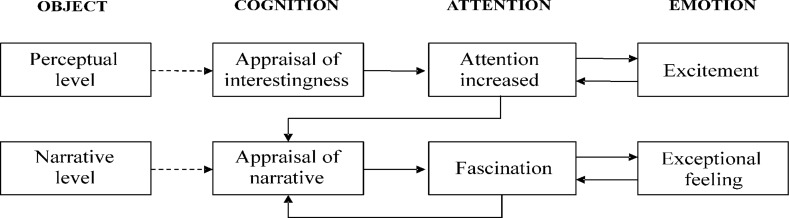
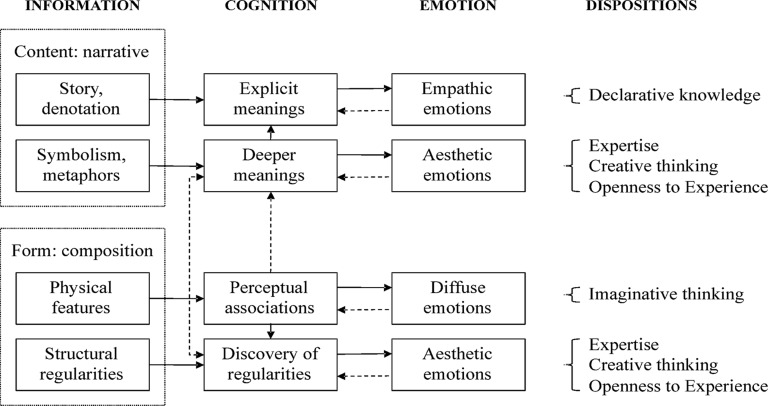
In this paper aesthetic experience is defined as an experience qualitatively different from everyday experience and similar to other exceptional states of mind. Three crucial characteristics of aesthetic experience are discussed: fascination with an aesthetic object (high arousal and attention), appraisal of the symbolic reality of an object (high cognitive engagement), and a strong feeling of unity with the object of aesthetic fascination and aesthetic appraisal. In a proposed model, two parallel levels of aesthetic information processing are proposed. On the first level two sub-levels of narrative are processed, story (theme) and symbolism (deeper meanings). The second level includes two sub-levels, perceptual associations (implicit meanings of object's physical features) and detection of compositional regularities. Two sub-levels are defined as crucial for aesthetic experience, appraisal of symbolism and compositional regularities. These sub-levels require some specific cognitive and personality dispositions, such as expertise, creative thinking, and openness to experience. Finally, feedback of emotional processing is included in our model: appraisals of everyday emotions are specified as a matter of narrative content (eg, empathy with characters), whereas the aesthetic emotion is defined as an affective evaluation in the process of symbolism appraisal or the detection of compositional regularities.
Overview
The claims and statistics of this paper haven’t been checked yet.
Free: it reads the open-access text and checks the first 5 claims that cite a source we can check. Create a free account to check every claim.
Integrity signals
Registry
Cites
Statistics
Figures
Verification
Claims the paper makes
The claims and statistics of this paper haven’t been checked yet.
Free: it reads the open-access text and checks the first 5 claims that cite a source we can check. Create a free account to check every claim.
Claims other papers make about this one
Each is checked against this paper’s own text: does it say what the citing paper says it does?
The source backs part of the claim, not all of it — or backs it for a different population, condition or comparison.
In the citing paper
“Empirical studies on visual [31], auditory [42] and haptic aesthetic experiences [57] [8] all converge in intertwining perception with embodied cognition.”
From Crafting Critical Heritage Discourses into Interactive Exhibition Design (2020) · cites this paper as [31]
Experimental — accuracy not yet measuredThe cited source says what the claim attributes to it.
In the citing paper
“The aesthetic experience is not the experience of beauty -for it can be pleasant or unpleasant; it is characterized by intense attention, extended cognitive engagement, and affective responses [31].”
From Crafting Critical Heritage Discourses into Interactive Exhibition Design (2020) · cites this paper as [31]
Self-check
Percentages, sums and reported differences re-computed from the paper’s own numbers.
The self-check needs the paper’s full text.
Citations
Cites
Well-being : the foundations of hedonic psychology
Kahneman, D. J., Diener, E. F., & Schwarz, N. (1999) · Cited by 8,305
The fusiform face area: a module in human extrastriate cortex specialized for face perception
Kanwisher, N., McDermott, J., & Chun, M. M. (1997) · The Journal of Neuroscience · doi:10.1523/jneurosci.17-11-04302.1997 · Cited by 7,738
Maslow, A. (1962) · D Van Nostrand eBooks · doi:10.1037/10793-000 · Cited by 7,192
Journal of Consciousness Studies
(2022) · Journal of Consciousness Studies · doi:10.53765/20512201 · Cited by 6,832
Csíkszentmihályi, M. (1975) · Cited by 5,690
What are emotions? And how can they be measured?
Scherer, K. R. (2005) · Social Science Information · doi:10.1177/0539018405058216 · Cited by 4,264 · cited 1×
“Koestler (1970) put aesthetic experience in the framework of creative processes emerging in art, science, humour, and playing.”
BackgroundFlow: The Psychology of Optimal Experience
Mirvis, P. H., & Csikszentmihalyi, M. (1991) · The Academy of Management Review · doi:10.2307/258925 · Cited by 3,611
Mood and judgment: The affect infusion model (AIM).
Forgas, J. P. (1995) · Psychological Bulletin · doi:10.1037/0033-2909.117.1.39 · Cited by 3,470 · cited 2×
“W J Cupchik G C, Gebotys R J, 1990 “Interest and pleasure as dimensions of aesthetic response” Empirical Studies of the Arts 8 1–14 J Cupchik G C, Vartanian O, Crawley A, Mikulis D J, 2009 “Viewing artworks: Contributions of cognitive control and perceptual facilitation to aesthetic experience” Brain and Cognition 70…”
InfluentialDynamic predictions: Oscillations and synchrony in top–down processing
Engel, A. K., Fries, P., & Singer, W. (2001) · Nature Reviews Neuroscience · doi:10.1038/35094565 · Cited by 3,454 · cited 1×
“However, other studies suggested that consciousness is not concentrated at local brain regions but is associated with globally distributed networks across a large scale of neuronal groups (cf Baars 2002; Engel et al 2001; Freeman 1991; Kanwisher 2001; Rees 2001a; Tononi and Edelman 1998; Watt 2004).”
BackgroundStory and Discourse: Narrative Structure in Fiction and Film
Austin, T. R., & Chatman, S. (1979) · The Journal of Aesthetics and Art Criticism · doi:10.2307/430732 · Cited by 2,658
The evolution of human sexuality
Wilson, G. (1980) · Personality and Individual Differences · doi:10.1016/0191-8869(80)90074-4 · Cited by 2,505
Tellegen, A., & Atkinson, G. (1974) · Journal of Abnormal Psychology · doi:10.1037/h0036681 · Cited by 2,196
A model of aesthetic appreciation and aesthetic judgments
Leder, H., Belke, B., Oeberst, A., & Augustin, D. (2004) · British Journal of Psychology · doi:10.1348/0007126042369811 · Cited by 1,968 · cited 7×
“…the following elements particularly important: (a) feedback relationship between perceptual-cognitive and emotional processes (Chatterjee 2003; Leder et al 2004; Nadal et al 2008), (b) the role of attentional mechanisms in aesthetic information processing (Chatterjee 2003; Nadal et al 2008),…”
BackgroundMethodInfluentialBlizek, W., & Berlyne, D. E. (1973) · The Journal of Aesthetics and Art Criticism · doi:10.2307/429334 · Cited by 1,930
Tononi, G. (1998) · Science · doi:10.1126/science.282.5395.1846 · Cited by 1,561
Neural correlates of category-specific knowledge
Martin, A., Wiggs, C. L., Ungerleider, L. G., & Haxby, J. V. (1996) · Nature · doi:10.1038/379649a0 · Cited by 1,551 · cited 1×
“…the right fusiform gyrus (this area was associated with the perception of specific categories of objects, including faces; cf Kanwisher et al 1997; Martin et al 1996; McCarthy et al 1997), whereas the aesthetic orientation corresponded to a higher activation of the left and right insula (these…”
BackgroundAdaptive significance of female physical attractiveness: role of waist-to-hip ratio
Singh, D. (1993) · Journal of Personality and Social Psychology · doi:10.1037/0022-3514.65.2.293 · Cited by 1,334 · cited 1×
“…was a favourite topic of psychoanalytically oriented theories (cf Freud 1910; Kris 1952), whereas the psycho-biological approaches were predominantly oriented towards a biological basis of aesthetic preference and aesthetic attraction (cf Ramachandran and Hirstein 1999; Singh 1993; Symons 1979).”
BackgroundEffects of Perceptual Fluency on Affective Judgments
Reber, R., Winkielman, P., & Schwarz, N. (1998) · Psychological Science · doi:10.1111/1467-9280.00008 · Cited by 1,320 · cited 2×
“Complementing emotions are similar to the emotions in real life: they are generated by the artwork content, such as a suffering for the pain of the depicted character.”
BackgroundEricsson, K. A. (1996) · Cited by 1,285
The science of art: A neurological theory of aesthetic experience
Ramachandran, V. S., & Hirstein, W. (1999) · PhilPapers (PhilPapers Foundation) · Cited by 1,177
Piedmont, R. L. (1999) · Journal of Personality · doi:10.1111/1467-6494.00080 · Cited by 1,172 · cited 1×
“Also, it is close to spiritual transcendence, which is the feeling of connectedness and unity with other people, life, nature, and the like (Piedmont 1999).”
BackgroundFace-specific processing in the human fusiform gyrus
McCarthy, G., Puce, A., Gore, J. C., & Allison, T. (1997) · Journal of Cognitive Neuroscience · doi:10.1162/jocn.1997.9.5.605 · Cited by 1,127
Psychoanalytic Explorations in Art
Schnier, J., & Kris, E. (1953) · College Art Journal · doi:10.2307/772401 · Cited by 1,030
Psychoanalytic Explorations in Art
Kaplan, A., & Kris, E. (1953) · The Journal of Aesthetics and Art Criticism · doi:10.2307/426885 · Cited by 1,003 · cited 1×
“…of art, the functional aspect of symbolism in aesthetic experience was a favourite topic of psychoanalytically oriented theories (cf Freud 1910; Kris 1952), whereas the psycho-biological approaches were predominantly oriented towards a biological basis of aesthetic preference and aesthetic…”
BackgroundThe conscious access hypothesis: origins and recent evidence
Baars, B. J. (2002) · Trends in Cognitive Sciences · doi:10.1016/s1364-6613(00)01819-2 · Cited by 994 · cited 1×
“However, other studies suggested that consciousness is not concentrated at local brain regions but is associated with globally distributed networks across a large scale of neuronal groups (cf Baars 2002; Engel et al 2001; Freeman 1991; Kanwisher 2001; Rees 2001a; Tononi and Edelman 1998; Watt 2004).”
Winkielman, P., & Cacioppo, J. T. (2001) · Journal of Personality and Social Psychology · doi:10.1037//0022-3514.81.6.989 · Cited by 931 · cited 1×
“On the other hand, some authors identified aesthetic feelings with either pleasurable emotions (cf Martindale and Moore 1988; Winkielman and Cacioppo 2001) or negative (unpleasant) emotions (Furnham and Avison 1997; Rawlings 2003; Rawlings et al 2000; Silvia 2005, 2009; Tobacyck et al 1981; Zaleski…”
BackgroundFreeman, W. J. (1991) · Scientific American · doi:10.1038/scientificamerican0291-78 · Cited by 902
Neuroanatomical correlates of pleasant and unpleasant emotion
Lane, R. D., Reiman, E. M., Bradley, M. M., Lang, P. J., Ahern, G. L., Davidson, R. J., & Schwartz, G. E. (1997) · Neuropsychologia · doi:10.1016/s0028-3932(97)00070-5 · Cited by 830 · cited 1×
“…to a higher activation of the left and right insula (these areas were involved in emotional experience; cf Paradiso et al 1999; Teasdale et al 1999; Lane et al 1997) and left lateral pre-frontal cortex (this area plays a role in the cognitive control and the higher-order selfreferential processes;…”
BackgroundThe gateway hypothesis of rostral prefrontal cortex (area 10) function
Burgess, P. W., Dumontheil, I., & Gilbert, S. J. (2007) · Trends in Cognitive Sciences · doi:10.1016/j.tics.2007.05.004 · Cited by 749 · cited 1×
“…of the left and right insula (these areas were involved in emotional experience; cf Paradiso et al 1999; Teasdale et al 1999; Lane et al 1997) and left lateral pre-frontal cortex (this area plays a role in the cognitive control and the higher-order selfreferential processes; cf Burgess et al 2007).”
BackgroundAn ecological valence theory of human color preference
Palmer, S. E., & Schloss, K. B. (2010) · Proceedings of the National Academy of Sciences · doi:10.1073/pnas.0906172107 · Cited by 744
Leonardo Da Vinci and a Memory of His Childhood
Stites, R. S., Freud, S., & Tyson, A. (1965) · Art Education · doi:10.2307/3190663 · Cited by 670 · cited 1×
“…the psychology of art, the functional aspect of symbolism in aesthetic experience was a favourite topic of psychoanalytically oriented theories (cf Freud 1910; Kris 1952), whereas the psycho-biological approaches were predominantly oriented towards a biological basis of aesthetic preference and…”
BackgroundWest, C. K., & Berlyne, D. E. (1978) · Journal of Aesthetic Education · doi:10.2307/3331807 · Cited by 627
Studies in the New Experimental Aesthetics
Alluisi, E. A., & Berlyne, D. E. (1975) · The American Journal of Psychology · doi:10.2307/1421783 · Cited by 558
The measurement of flow in everyday life: toward a theory of emergent motivation.
Csíkszentmihályi, M., & Rathunde, K. (1992) · PubMed · Cited by 430
Marshall, H. J., & Arnheim, R. (1976) · Art Education · doi:10.2307/3192104 · Cited by 428 · cited 1×
“According to Arnheim (1949, 1969, 1980), the aesthetic effects of abstract compositions are based on the holistic nature of perception and the capability for abstract perceptual thinking.”
BackgroundMetacognition, mindfulness and the modification of mood disorders
Teasdale, J. D. (1999) · Clinical Psychology & Psychotherapy · doi:10.1002/(sici)1099-0879(199905)6:2<146::aid-cpp195>3.0.co;2-e · Cited by 423
Emotional Responses to Art: From Collation and Arousal to Cognition and Emotion
Silvia, P. J. (2005) · Review of General Psychology · doi:10.1037/1089-2680.9.4.342 · Cited by 421 · cited 3×
“…identified aesthetic feelings with either pleasurable emotions (cf Martindale and Moore 1988; Winkielman and Cacioppo 2001) or negative (unpleasant) emotions (Furnham and Avison 1997; Rawlings 2003; Rawlings et al 2000; Silvia 2005, 2009; Tobacyck et al 1981; Zaleski 1984; Zuckerman et al 1993).”
BackgroundCupchik, G. C., Vartanian, O., Crawley, A., & Mikulis, D. J. (2009) · Brain and Cognition · doi:10.1016/j.bandc.2009.01.003 · Cited by 421 · cited 1×
“In their neuroimaging studies Cupchik and collaborators (Cupchik et al 2009) have shown that distinct cortical areas were activated when the observers were oriented to the pragmatic and aesthetic aspects of the same paintings.”
BackgroundSilvia, P. J. (2009) · Psychology of Aesthetics, Creativity, and the Arts · doi:10.1037/a0014632 · Cited by 340
Priming, prototypicality, and preference.
Martindale, C., & Moore, K. (1988) · Journal of Experimental Psychology: Human Perception and Performance · doi:10.1037//0096-1523.14.4.661 · Cited by 338
Paradiso, S., Johnson, D. L., Andreasen, N. C., O’Leary, D. S., Watkins, G. L., Boles Ponto, L. L., & Hichwa, R. D. (1999) · American Journal of Psychiatry · doi:10.1176/ajp.156.10.1618 · Cited by 312 · cited 1×
“…the aesthetic orientation corresponded to a higher activation of the left and right insula (these areas were involved in emotional experience; cf Paradiso et al 1999; Teasdale et al 1999; Lane et al 1997) and left lateral pre-frontal cortex (this area plays a role in the cognitive control and…”
BackgroundDeeson, E. (1974) · Physics Bulletin · doi:10.1088/0031-9112/25/8/030 · Cited by 312
Prospects for a cognitive neuroscience of visual aesthetics: (514602010-003)
Chatterjee, A. (2003) · PsycEXTRA Dataset · doi:10.1037/e514602010-003 · Cited by 309 · cited 4×
“We found the following elements particularly important: (a) feedback relationship between perceptual-cognitive and emotional processes (Chatterjee 2003; Leder et al 2004; Nadal et al 2008), (b) the role of attentional mechanisms in aesthetic information processing (Chatterjee 2003; Nadal et al…”
BackgroundInfluentialEntitling art: Influence of title information on understanding and appreciation of paintings
Leder, H., Carbon, C.-C., & Ripsas, A.-L. (2006) · Acta Psychologica · doi:10.1016/j.actpsy.2005.08.005 · Cited by 306
Perception and Psychophysics 17, 460–464
(1977) · Journal of Sound and Vibration · doi:10.1016/0022-460x(77)90631-9 · Cited by 302
Functional MRI Study of the Cognitive Generation of Affect
Teasdale, J. D., Howard, R. J., Cox, S. G., Ha, Y., Brammer, M. J., Williams, S. C. R., & Checkley, S. A. (1999) · American Journal of Psychiatry · doi:10.1176/ajp.156.2.209 · Cited by 290 · cited 1×
“While Tellegan and Atkinson (1974) were interested in the individual differences in absorption, some studies were focused on its stimulus constraints.”
BackgroundThe evaluation of high art and popular art by naive and experienced viewers.
Winston, A. S., & Cupchik, G. C. (1992) · Visual Arts Research · Cited by 275
Neural events and perceptual awareness
Kanwisher, N. (2001) · Cognition · doi:10.1016/s0010-0277(00)00125-6 · Cited by 253
The Role of Formal Art Training on Perception and Aesthetic Judgment of Art Compositions
Nodine, C. F., Locher, P. J., & Krupinski, E. A. (1993) · Leonardo · doi:10.2307/1575815 · Cited by 244 · cited 2×
“Further studies should provide more precise models applicable for the states of expanded and intensive awareness in aesthetic experience.”
BackgroundTaylor, I. (2017) · Routledge eBooks · doi:10.4324/9781315126265 · Cited by 238
How We Understand Art: A Cognitive Development Account of Aesthetic Experience
Smith, R. A., & Parsons, M. J. (1991) · British Journal of Educational Studies · doi:10.2307/3121000 · Cited by 234
Bornstein, M., Kreitler, H., & Kreitler, S. (1973) · The Journal of Aesthetics and Art Criticism · doi:10.2307/428719 · Cited by 227
Effort after meaning and the hedonic value of paintings
Russell, P. A. (2003) · British Journal of Psychology · doi:10.1348/000712603762842138 · Cited by 209 · cited 3×
“Aesthetic emotions could be identified as one of the Kubovy’s (1999) pleasures of the mind. According to Kubovy, pleasures of the mind have no distinctive physiological and behavioural expressions typical for basic emotions and pleasures of the body. Namely, pleasures of the mind are not simple emotional reactions, bu…”
BackgroundHow We Understand Art. A Cognitive Developmental Account of Aesthetic Experience
Dixon, R., & Parsons, M. (1989) · Leonardo · doi:10.2307/1575164 · Cited by 203
Art expertise: a study of concepts and conceptual spaces
Augustin, M., & Leder, H. (2006) · Psychology science · Cited by 184
Story and Discourse. Narrative Structure in Fiction and Film
Prince, G., Chatman, S., Corti, M., Bogat, M., & Mandelbaum, A. (1979) · MLN · doi:10.2307/2906308 · Cited by 183 · cited 3×
“In its strict meaning, a narrative is defined as a temporal semantic structure which provides different kinds of information (Chatman 1978).”
BackgroundEmotion in aesthetics: Reactive and reflective models
Cupchik, G. C. (1995) · Poetics · doi:10.1016/0304-422x(94)00014-w · Cited by 179 · cited 1×
“Similarly, Cupchik (1994) proposed two models of aesthetic emotional processing, reactive and reflective.”
BackgroundOpenness to Experience, Non-Conformity, and the Preference for Abstract Art
Feist, G. J., & Brady, T. R. (2004) · Empirical Studies of the Arts · doi:10.2190/y7ca-tby6-v7lr-76gk · Cited by 178 · cited 1×
“Further studies should provide more precise models applicable for the states of expanded and intensive awareness in aesthetic experience.”
BackgroundSilvia, P. J., & Brown, E. M. (2007) · Psychology of Aesthetics Creativity and the Arts · doi:10.1037/1931-3896.1.2.100 · Cited by 177 · cited 1×
“Similarly, Ognjenović (1997) defined aesthetic experience as a special kind of subject-object relationship in which a particular object strongly engages the subject’s mind, shadowing all other surrounding objects and events.”
BackgroundTowards a framework for the study of the neural correlates of aesthetic preference
Capó, M. À., Cela‐Conde, C. J., Munar, E., Rosselló, J., & Nadal, M. (2008) · Spatial Vision · doi:10.1163/156856808784532653 · Cited by 167
Hekkert, P., & van Wieringen, P. C. W. (1996) · Acta Psychologica · doi:10.1016/0001-6918(95)00055-0 · Cited by 166
An ecological valence theory of human color preferences
Schloss, K. B., & Palmer, S. E. (2010) · Journal of Vision · doi:10.1167/9.8.358 · Cited by 159 · cited 2×
“…some studies have shown that sharp irregular figures were experienced as more disturbing than oval regular shapes (cf Arnheim 1980; Janković and Marković 2001, 2009; Oyama et al 2008), light reddish colours were judged as more pleasant than dark brown ones (Palmer and Schloss 2010), and so on.”
BackgroundEmerging Visions of the Aesthetic Process: Psychology, Semiology and Philosophy
Cupchik, G. C., & Laszlo, J. (1995) · The Journal of Aesthetics and Art Criticism · doi:10.2307/430988 · Cited by 158
Evidence for a global scanpath strategy in viewing abstract compared with realistic images
Zangemeister, W. H., Sherman, K., & Stark, L. R. (1995) · Neuropsychologia · doi:10.1016/0028-3932(95)00014-t · Cited by 156
Personality and preference for surreal paintings
Furnham, A. F., & Avison, M. (1997) · Personality and Individual Differences · doi:10.1016/s0191-8869(97)00131-1 · Cited by 146 · cited 2×
“…the possibility that both highly structured (eg, classicistic) and ‘chaotic’ (eg, expressionistic) paintings can be experienced as highly fascinating, exceptional, and the like (cf Furnham and Avison 1997; Rawlings 2003; Rawlings et al 2000; Tobacyck et al 1981; Zaleski 1984; Zuckerman et al 1993).”
BackgroundConsciousness, Emotional Self-Regulation and the Brain
(2004) · Advances in Consciousness Research · doi:10.1075/aicr.54 · Cited by 137
Interest and Pleasure as Dimensions of Aesthetic Response
Cupchik, G. C., & Gebotys, R. J. (1990) · Empirical Studies of the Arts · doi:10.2190/l789-tppy-bd2q-t7tw · Cited by 132
Sensation seeking and reactions to nature paintings
Zuckerman, M., Ulrich, R. S., & McLaughlin, J. P. (1993) · Personality and Individual Differences · doi:10.1016/0191-8869(93)90340-9 · Cited by 116 · cited 2×
“…the possibility that both highly structured (eg, classicistic) and ‘chaotic’ (eg, expressionistic) paintings can be experienced as highly fascinating, exceptional, and the like (cf Furnham and Avison 1997; Rawlings 2003; Rawlings et al 2000; Tobacyck et al 1981; Zaleski 1984; Zuckerman et al 1993).”
BackgroundRawlings, D., Barrantes i Vidal, N., & Furnham, A. (2000) · European Journal of Personality · doi:10.1002/1099-0984(200011/12)14:6<553::aid-per384>3.0.co;2-h · Cited by 115 · cited 2×
“…the possibility that both highly structured (eg, classicistic) and ‘chaotic’ (eg, expressionistic) paintings can be experienced as highly fascinating, exceptional, and the like (cf Furnham and Avison 1997; Rawlings 2003; Rawlings et al 2000; Tobacyck et al 1981; Zaleski 1984; Zuckerman et al 1993).”
BackgroundKubovy, M. (1999) · Cited by 107
Sternberg, R. J. (1996) · Cited by 106
Personality correlates of liking for ‘unpleasant’ paintings and photographs
Rawlings, D. (2003) · Personality and Individual Differences · doi:10.1016/s0191-8869(02)00062-4 · Cited by 100 · cited 4×
“Empirical data clearly show that high scorers of the Openness prefer less structured, more complex, and abstract artistic stimuli (Feist and Brady 2004; Rawlings 2000, 2003).”
BackgroundInfluentialSagoff, M., & Mandelbaum, M. (1973) · Journal of Aesthetics and Art Criticism · doi:10.2307/428721 · Cited by 96
Neuroimaging of visual awareness in patients and normal subjects
Rees, G. E. (2001) · Current Opinion in Neurobiology · doi:10.1016/s0959-4388(00)00190-2 · Cited by 90 · cited 3×
“Existing literature does not provide neural models of specific ‘aesthetic awareness’, but some fMRI studies suggested that the higher activities in parietal and frontal areas could be neural correlates of general awareness and consciousness (for a review, see Rees 2001b).”
BackgroundThe Gestalt theory of expression.
Arnheim, R. (1949) · Psychological Review · doi:10.1037/h0061787 · Cited by 89 · cited 1×
“According to Arnheim (1949, 1969, 1980), the aesthetic effects of abstract compositions are based on the holistic nature of perception and the capability for abstract perceptual thinking.”
BackgroundSensation-seeking and preference for emotional visual stimuli
Zaleski, Z. (1984) · Personality and Individual Differences · doi:10.1016/0191-8869(84)90040-0 · Cited by 86 · cited 3×
“…the possibility that both highly structured (eg, classicistic) and ‘chaotic’ (eg, expressionistic) paintings can be experienced as highly fascinating, exceptional, and the like (cf Furnham and Avison 1997; Rawlings 2003; Rawlings et al 2000; Tobacyck et al 1981; Zaleski 1984; Zuckerman et al 1993).”
BackgroundConfluence and Divergence in Empirical Aesthetics, Philosophy, and Mainstream Psychology
Cupchik, G. C., & Winston, A. S. (1996) · Elsevier eBooks · doi:10.1016/b978-012161966-4/50005-0 · Cited by 86 · cited 1×
“According to Cupchik and Winston (1996), aesthetic experience is a psychological process in which the attention is focused on the object while all other objects, events, and everyday concerns are suppressed.”
BackgroundBulletin of Psychology and the Arts
(2003) · PsycEXTRA Dataset · doi:10.1037/e514602010-001 · Cited by 86
Aesthetic emotions and reality.
Frijda, N. H. (1989) · American Psychologist · doi:10.1037/0003-066x.44.12.1546 · Cited by 81 · cited 1×
“Frijda (1989) specified aesthetic emotions more precisely.”
Perception While Watching Movies: Effects of Physical Screen Size and Scene Type
Trościanko, T., Meese, T. S., & Hinde, S. (2012) · i-Perception · doi:10.1068/i0475aap · Cited by 78
Priming semantic concepts affects the dynamics of aesthetic appreciation
Faerber, S. J., Leder, H., Gerger, G., & Carbon, C. (2010) · Acta Psychologica · doi:10.1016/j.actpsy.2010.06.006 · Cited by 75 · cited 2×
“Many studies found the crucial role of top-down processing and an activation of semantic networks in the aesthetic appreciation of various classes of stimuli (cf Faerber et al 2010; Jakesch et al 2011; Leder et al 2006; see also Leder et al 2004).”
BackgroundO’Hare, D. (1976) · Perception & Psychophysics · doi:10.3758/bf03208280 · Cited by 74
From perception to production: A multilevel analysis of the aesthetic process.
Cupchik, G. C. (1992) · Cited by 74
The hierarchical structure of common Turkish person-descriptive adjectives
Goldberg, L. R., & Somer, O. (2000) · European Journal of Personality · doi:10.1002/1099-0984(200011/12)14:6<497::aid-per379>3.0.co;2-r · Cited by 69
Aesthetic experience and the emotional content of paintings
Marković, S. (2010) · Psihologija · doi:10.2298/psi1001047m · Cited by 65
Self-citationTemme, J. E. V. (1992) · Visual Arts Research · Cited by 60
Reversal Theory, Cognitive Synergy and the Arts
Apter, M. J. (1984) · Advances in psychology · doi:10.1016/s0166-4115(08)62361-4 · Cited by 53 · cited 1×
“According to Apter (1984) the distinctive feature of aesthetic experience is that it is not goal directed (ie, pragmatic), but focused more upon the activity itself (ie, self-rewarding).”
BackgroundRawlings, D. (2000) · Empirical Studies of the Arts · doi:10.2190/71ct-aa49-xrmg-c842 · Cited by 51 · cited 3×
“Empirical data clearly show that high scorers of the Openness prefer less structured, more complex, and abstract artistic stimuli (Feist and Brady 2004; Rawlings 2000, 2003).”
BackgroundIntrospection Distinct From First-Order Experiences
Overgaard, M. S., & Sørensen, T. A. (2004) · Cited by 47
Field-Dependence, Sensation-Seeking, and Preference of Paintings
Tobacyk, J., Myers, H., & Bailey, L. (1981) · Journal of Personality Assessment · doi:10.1207/s15327752jpa4503_8 · Cited by 47 · cited 3×
“…the possibility that both highly structured (eg, classicistic) and ‘chaotic’ (eg, expressionistic) paintings can be experienced as highly fascinating, exceptional, and the like (cf Furnham and Avison 1997; Rawlings 2003; Rawlings et al 2000; Tobacyck et al 1981; Zaleski 1984; Zuckerman et al 1993).”
BackgroundImplicit and explicit features of paintings
Marković, S., & Radonjić, A. (2008) · Spatial Vision · doi:10.1163/156856808784532563 · Cited by 44
Self-citationOpposing Art: Rejection as an Action Tendency of Hostile Aesthetic Emotions
Cooper, J. M., & Silvia, P. J. (2008) · Empirical Studies of the Arts · doi:10.2190/em.27.1.f · Cited by 44 · cited 2×
“Silvia has pointed out that aesthetic appraisal includes a wide spectrum of specific emotions including pleasure, pride, surprise, anger, disgust, contempt, shame, guilt, regret, embarrassment, confusion, and so on (Silvia 2009; see also Cooper and Silvia 2009; Silvia and Brown 2007).”
BackgroundHow temporal distance changes novices' attitudes towards unconventional arts.
Schimmel, K., & Förster, J. (2008) · Psychology of Aesthetics Creativity and the Arts · doi:10.1037/1931-3896.2.1.53 · Cited by 42 · cited 2×
“Facilitation of the preference for abstract art emerged even after short-term training sessions in which participants were informed about context and conditions of the creation of artworks (Schimmel and Forster 2008) or after participants were encouraged in ‘abstract thinking’ (Temme 1992).”
BackgroundSuccessive Contrast Effects for Judgments of Abstraction in Artwork following Minimal Pre-Exposure
Specht, S. M. (2007) · Empirical Studies of the Arts · doi:10.2190/w717-88w2-2233-12h3 · Cited by 34
Scenario-based touching: on the influence of top-down processes on tactile and visual appreciation
Jakesch, M., Zachhuber, M., Leder, H., Spingler, M., & Carbon, C. (2011) · Research in Engineering Design · doi:10.1007/s00163-010-0102-5 · Cited by 30 · cited 2×
“Many studies found the crucial role of top-down processing and an activation of semantic networks in the aesthetic appreciation of various classes of stimuli (cf Faerber et al 2010; Jakesch et al 2011; Leder et al 2006; see also Leder et al 2004).”
BackgroundContextual Information, Artistic Style and the Perception of Art
Bordens, K. S. (2010) · Empirical Studies of the Arts · doi:10.2190/em.28.1.g · Cited by 23
Soszynski, M. (2006) · Philosophy now · Cited by 21
Rees, G. E. (2001) · Nature Neuroscience · doi:10.1038/89446 · Cited by 20
Processing of Aesthetic Information
Ognjenović, P. (1991) · Empirical Studies of the Arts · doi:10.2190/kc25-jwtn-nrx4-c7a1 · Cited by 16
SIMILARITIES IN FORM SYMBOLISM AMONG VARIOUS LANGUAGES AND GEOGRAPHICAL REGIONS
Oyama, T., Agostini, T., Kamada, A., Marković, S., Osaka, E., Sakurai, S., Sarmány-Schuller, I., & Sarris, V. (2008) · PSYCHOLOGIA · doi:10.2117/psysoc.2008.170 · Cited by 14 · cited 3×
“…some studies have shown that sharp irregular figures were experienced as more disturbing than oval regular shapes (cf Arnheim 1980; Janković and Marković 2001, 2009; Oyama et al 2008), light reddish colours were judged as more pleasant than dark brown ones (Palmer and Schloss 2010), and so on.”
BackgroundInfluentialSelf-citationConsciousness, emotional self-regulation and the brain: Review article
Watt, D. F. (2004) · Journal of Consciousness Studies · Cited by 14
Structure of aesthetic experience
Polovina, M., & Marković, S. (2006) · Psihologija · doi:10.2298/psi0601039p · Cited by 8 · cited 4×
“In the study by Polovina and Marković (2006) factor analyses of the ratings of different sets of paintings on selected descriptors (ie, scales) revealed a single factor named Aesthetic Experience.”
BackgroundMethodInfluentialSelf-citationImplicit semantic features and aesthetic preference
Janković, D., & Marković, S. (2010) · Journal of Vision · doi:10.1167/9.8.942 · Cited by 1
Self-citation
Research works printed but not linked: 15
- Arnheim R 1980 Visual thinking Berkeley and Los Angeles University of California Press
- Brooks C Warren R P 1979 Modern rhetoric New York Harcourt Brace Jovanovich
- Eco U 2004 History of beauty Rizzoli International Publications
- Eco U 2007 On ugliness Rizzoli International Publications
- Frijda N H 1986 The emotions Cambridge Cambridge University Press
- Gardner H 1993 Creating minds New York Basic Books
- Gombrich E H 1969 Art and illusion Princeton New Jersey Princeton University Press
- Janković D Marković S 2001 Takete—Maluma phenomenon Perception 30 29
- Kabat-Zinn J 1998 Meditation Psycho-oncology New York Oxford University Press
- Koestler A 1970 The act of creation London Pan Books
- Marković S Janković D 2001 Implicit and explicit features of visual Gestalten Perception 30 30
- Marković S Janković D Subotić I 2002 Implicitna i eksplicitna svojstva vizuelnog gestalt [Implicit and explicit features of visual Gestalt] Psihološka istraživanja 11/ 12 75 112
- Neperud R W 1989 The relationship of art training and sex differences to aesthetic valuing Visual Arts Research 12 1 9
- Ognjenović P 1997 Psihološka teorija umetnosti [Psychological theory of art] Belgrade Institut za psihologiju
- Sternberg R J Lubart T I 1995 Defying the crowd New York Free Press
Cited by
Measuring aesthetic emotions: A review of the literature and a new assessment tool
Schindler, I., Hosoya, G., Menninghaus, W., Beermann, U., Wagner, V., Eid, M., & Scherer, K. R. (2017) · PLOS ONE · doi:10.1371/journal.pone.0178899 · Cited by 382
Menninghaus, W., Wagner, V., Wassiliwizky, E., Schindler, I., Hanich, J., Jacobsen, T., & Koelsch, S. (2019) · Psychological Review · doi:10.1037/rev0000135 · Cited by 374
Art and Psychological Well-Being: Linking the Brain to the Aesthetic Emotion
Mastandrea, S., Fagioli, S., & Biasi, V. (2019) · Frontiers in Psychology · doi:10.3389/fpsyg.2019.00739 · Cited by 223
Toward a Neural Chronometry for the Aesthetic Experience of Music
Brattico, E., Bogert, B., & Jacobsen, T. (2013) · Frontiers in Psychology · doi:10.3389/fpsyg.2013.00206 · Cited by 200
“Markovic (2012) instead specifically proposes a definition of an aesthetic experience as an “exceptional state of mind,” in which focused attention plays a crucial role, and which responds not to bodily needs (such as appetitive and mating functions) but provides “pleasures for the mind” (p. 2).”
BackgroundInfluentialContext effects on emotional and aesthetic evaluations of artworks and IAPS pictures
Gerger, G., Leder, H., & Kremer, A. (2014) · Acta Psychologica · doi:10.1016/j.actpsy.2014.06.008 · Cited by 174
Metadata
- Authors
- Marković, S.
- Affiliations
- University of Belgrade (RS)
- Corresponding author
- Marković, Slobodan
- ORCID
- Marković, Slobodan
- Venue
- i-Perception
- Publisher
- SAGE Publications
- Published
- 2012-01
- Volume
- 3
- Issue
- 1
- Pages
- 1-17
- ISSN
- 2041-6695 (ISSN-L)
- PMC
- PMC3485814
- OpenAlex
- W2096535767
- Cited by
- 346
- References
- 102
- Citations by year
- 2026: 28 · 2025: 42 · 2024: 34 · 2023: 40 · 2022: 49 · 2021: 39 · 2020: 16 · 2019: 21 · 2018: 23 · 2017: 18 · 2016: 12 · 2015: 12 · 2014: 7 · 2013: 2 · 2012: 3
- FWCI
- 3.93
- Type
- journal article
- Language
- en
- Open access
- gold
- doi.org
- Licence
- cc-by-nc-nd
- journals.sagepub.com/page/policies/text-and-data-mining-license (tdm)
- Locations
- i-Perception (publishedVersion, cc-by-nc-nd)
- Europe PMC (PubMed Central) (publishedVersion, cc-by-nc-nd)
- PubMed Central (publishedVersion, cc-by-nc-nd)
- PubMed (publishedVersion)
- DOAJ (DOAJ: Directory of Open Access Journals) (submittedVersion, cc-by-sa)
- Topics
- Life Sciences › Neuroscience › Cognitive Neuroscience › Aesthetic Perception and Analysis
- Social Sciences › Arts and Humanities › Philosophy › Ethics, Aesthetics, and Art
- Social Sciences › Arts and Humanities › Visual Arts and Performing Arts › Art, Aesthetics, and Perception
- Keywords
- aesthetic experience, aesthetic appreciation, symbolism, narrative, emotional processing, expertise, creative thinking, openness to experience, empathy, affective evaluation
About these checks
Registry, retraction, Cites and statistics results are computed, not judged, with one exception: a printed reference that no index lists is read once by a model before it counts as a citation error. Claims are extracted by a model and kept only when their quote appears verbatim in the text; each cited source is then checked, with a model’s help, for whether it says what the claim relies on. Those verdicts can be wrong — read the claim’s quote and the cited source before relying on one.
Statistics and arithmetic are recomputed, not judged.
Confidence bands are shown only for fields calibrated on our annotated test set. None is calibrated yet, so no band is shown.
What counts as a claim ›How we measure confidence ›How we check this ›
Are you an author, or do you see a problem with this page? Request a review
Data sources
Bibliographic data: Semantic Scholar, OpenAlex, Crossref.
Contains information from the Semantic Scholar Academic Graph Datasets, made available under the ODC Attribution License (ODC-BY 1.0).
Semantic Scholar’s data is described in: Kinney, R., et al. (2023). The Semantic Scholar Open Data Platform. arXiv:2301.10140.
