

Fluctuating radiocarbon offsets observed in the southern Levant and implications for archaeological chronology debates
Open accessThe DOI matches its Crossref record; 65 of the 66 references it cites were found in a registry or an index; none of the 124 sources its claims cite is checked for support yet.
Abstract
Significance: We observe a substantive and fluctuating offset in measured radiocarbon ages between plant material growing in the southern Levant versus the standard Northern Hemisphere radiocarbon calibration dataset derived from trees growing in central and northern Europe and North America. This likely relates to differences in growing seasons with a climate imprint. This finding is significant for, and affects, any radiocarbon application in the southern Levant region and especially for high-resolution archaeological dating—the focus of much recent work and scholarly debate, especially surrounding the timeframe of the earlier Iron Age (earlier Biblical period). Our findings change the basis of this debate; our data point to lower (more recent) ages by variously a few years to several decades.
Overview
CoChat Summary
TL;DR
The paper reports a substantive, fluctuating radiocarbon offset between known-age Juniperus phoenicea tree rings from the southern Levant and the Northern Hemisphere IntCal13 calibration curve. The offset averages around 19 ± 3 14C years overall, rises to about 24 ± 5 14C years in two intervals, and shifts high-resolution archaeological age ranges to lower/more recent calendar ages.
Key findings
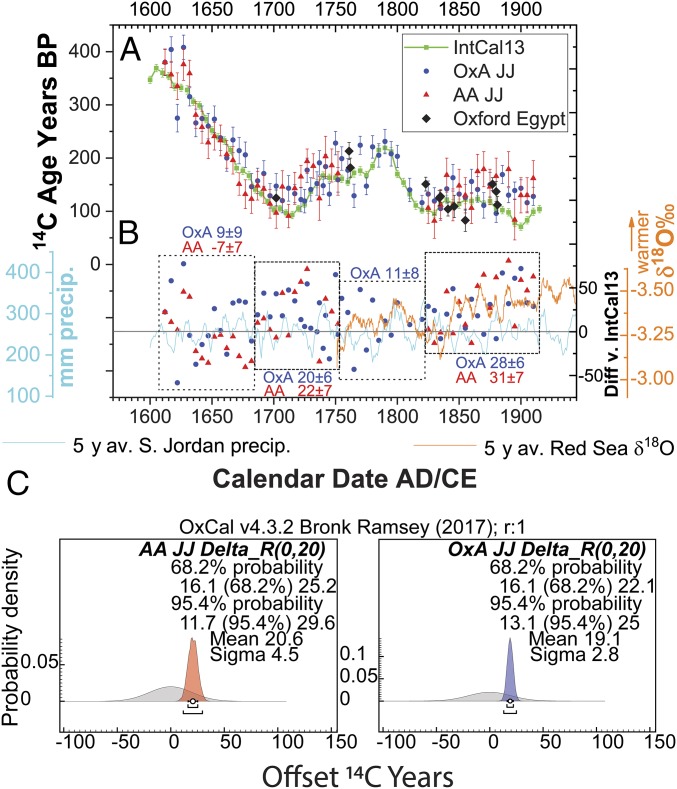
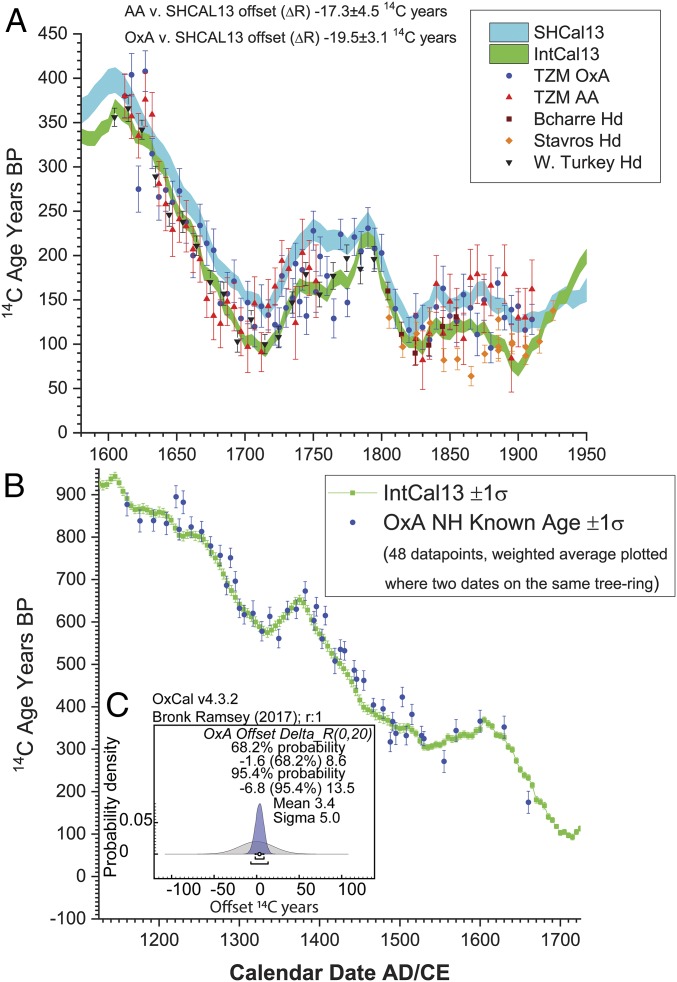
- Jordanian juniper samples yield older 14C ages than IntCal13: posterior offsets were 20.6 ± 4.5 14C years for Arizona data, 19.1 ± 2.8 14C years for Oxford data, and 18.6 ± 2.5 14C years combined, comparable to the previously reported 19 ± 5 14C years offset for Egypt.
- The offset fluctuates over time; two intervals with larger apparent offsets, AD 1685–1762 and AD 1818–1912, show about 24 ± 5 14C years (around 3‰), while overall combined estimates are around 19 ± 3 14C years or 16 ± 5 14C years depending on the comparison method.
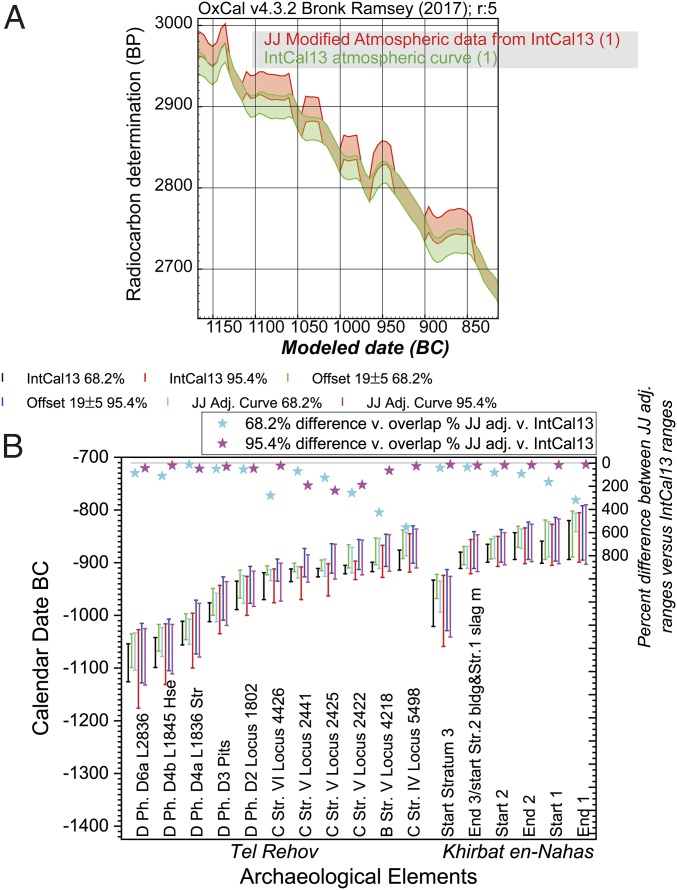
- Applying an approximate southern Levant-adjusted IntCal13 curve to Tel Rehov and Khirbat en-Nahas shifts calendar ranges to lower/more recent ages; 14 of 17 (82%) 68.2% ranges varied by ≥50%, and 12 of 17 (71%) 95.4% ranges varied by ≥20%. A general 19 ± 5 14C years correction created larger differences in 76% versus 24% of cases compared with the JJ-adjusted curve.
- The proposed explanation is growing-season differences and climate variability; no correlation was evident with reconstructed precipitation for southern Jordan, but associations appear with warmer temperatures after ∼AD 1835 and with reversals in IntCal13 corresponding to increased solar irradiance.
Methods
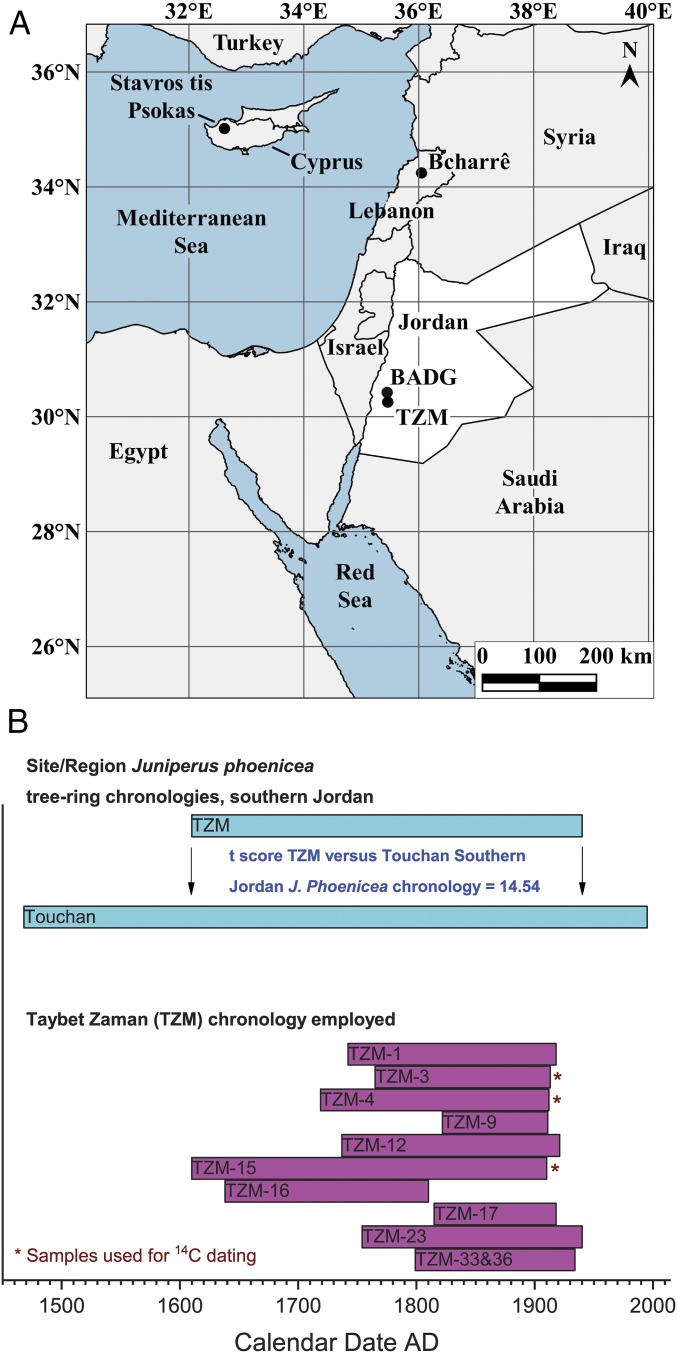
- Known-age 5-year sections of Juniperus phoenicea tree rings from historic structures at Taybet Zaman (TZM), southern Jordan, were cross-dated using standard dendrochronology against an existing J. phoenicea reference chronology dating AD 1469–1995; the TZM chronology was placed in absolute calendar time AD 1610–1940.
- Samples were dated at the Arizona (AA) and Oxford (OxA) AMS 14C laboratories, with additional ordered samples from BADG, and compared against IntCal13 and previously published known-age plant material from 18th–19th century AD Egypt.
- Analyses used OxCal 4.3, including Delta_R calculations with a neutral prior of 0 ± 20, linear interpolation of the 5-year IntCal13 record to 1-year resolution where stated, and Bayesian modeling of Tel Rehov and Khirbat en-Nahas sequences with and without offsets.
Limitations
- The paper states that the Iron Age adjustment is “approximate and subjective,” aimed to be indicative and not robust, and that a southern Levant radiocarbon calibration curve or at least a longer comparison curve is needed; before AD 1610 no such calibration time series is available for the southern Levant.
- The paper states that applying the observed AD 1610–1910 pattern to earlier periods assumes similar conditions and processes apply, while accepting possible variations.
- Evident from the text: the study’s direct comparison covers AD 1610–1912, the offset explanation is partly inferred from growing-season and climate associations, and available paleoclimate data for the earlier Iron Age are described as inconclusive.
Model-written summary. Check it against the paper before relying on it.
Integrity signals
Registry
Cites
Statistics
Figures
Verification
Claims the paper makes
0 Valid · 0 Not valid · 44 Not checked · 44 Own results and interpretations
In the paper
“The JJ 14C ages for some periods compare very well with values from the Southern Hemisphere (SH) 14C calibration dataset, SHCal13 (2) (Fig. 3A).”
§ Fluctuating radiocarbon offsets observed in the southern Levant and implications for archaeological chronology debates > Results
What the sources say
- Not checked yetcites [2] Hogg AG 2013 SHCal13 southern hemisphere calibration, 0-50,000 years cal BP Radiocarbon 55 1889 1903 source
boostedstates an association- Asserted: passes — The authors put it forward as true.
- Checkable: passes — It can be checked against evidence.
- Load-bearing: unclear — It is unclear whether the paper’s conclusions depend on it.
- Based: passes — The paper gives a reason why it holds.
A result the paper reports from its own data — it cites no other source for it, so there is none to check. The quote shows it is in the paper.
In the paper
“We observe a substantive and fluctuating offset in measured radiocarbon ages between plant material growing in the southern Levant versus the standard Northern Hemisphere radiocarbon calibration dataset derived from trees growing in central and northern Europe and North America.”
§ Fluctuating radiocarbon offsets observed in the southern Levant and implications for archaeological chronology debates > Abstract
plainstates an association- Asserted: passes — The authors put it forward as true.
- Checkable: passes — It can be checked against evidence.
- Load-bearing: passes — The paper’s conclusions depend on it.
- Based: passes — The paper gives a reason why it holds.
A result the paper reports from its own data — it cites no other source for it, so there is none to check. The quote shows it is in the paper.
In the paper
“With one partial exception, at AD 1855, the OxA 14C data on known-age annual plant material from Egypt produced similar age estimates (and, even for the 1855 exception, the JJ data from both AA and OxA show a consonant shift to more recent 14C ages centered at this year).”
§ Fluctuating radiocarbon offsets observed in the southern Levant and implications for archaeological chronology debates > Results
plain- Asserted: passes — The authors put it forward as true.
- Checkable: passes — It can be checked against evidence.
- Load-bearing: unclear — It is unclear whether the paper’s conclusions depend on it.
- Based: passes — The paper gives a reason why it holds.
In the paper
“While no correlation of the changing offset is evident with reconstructed precipitation for southern Jordan (24), there do appear associations between an increased offset and warmer temperatures as reconstructed from Red Sea corals in the period after ∼AD 1835 (28) (Fig. 2B), or generally for the extratropical NH (29), and with reversals in IntCal13 which correspond to increased solar irradiance (”
§ Fluctuating radiocarbon offsets observed in the southern Levant and implications for archaeological chronology debates > Results
What the sources say
- Not checked yetcites [28] Felis T 2000 A coral oxygen isotope record from the northern Red Sea documenting NAO, ENSO, and North Pacific teleconnections on Middle East climate variability since the year 1750 Paleoceanography 15 679 694 source
hedgedstates an association- Asserted: passes — The authors put it forward as true.
- Checkable: passes — It can be checked against evidence.
- Load-bearing: unclear — It is unclear whether the paper’s conclusions depend on it.
- Based: passes — The paper gives a reason why it holds.
A result the paper reports from its own data — it cites no other source for it, so there is none to check. The quote shows it is in the paper.
In the paper
“another ordered series of JJ samples from a different location (4 km NNW of Al-Bayda, site code BADG, ∼30°25′18″N, 35°26′58″E) (Fig. 1A) also exhibit similar and contemporary 14C offsets versus IntCal13”
§ Fluctuating radiocarbon offsets observed in the southern Levant and implications for archaeological chronology debates > Results
plainstates an association- Asserted: passes — The authors put it forward as true.
- Checkable: passes — It can be checked against evidence.
- Load-bearing: passes — The paper’s conclusions depend on it.
- Based: passes — The paper gives a reason why it holds.
47 more claims
Create a free account to see all 88 claims and to verify the 124 references still open.
- Probably not a substantial claim. 11
- It may state two separate claims as one. 28
- The quote only partly states this claim. 1
Claims other papers make about this one
Each is checked against this paper’s own text: does it say what the citing paper says it does?
The source backs part of the claim, not all of it — or backs it for a different population, condition or comparison.
In the citing paper
“Manning et al. (2018) also reported fluctuating regional offsets from AD 1610 to 1940 from trees growing in Jordan compared with IntCal13 averaging 19 ± 3 14 C yr, associated with periods of reversals and plateaus in the 14 C calibration record.”
From The IntCal20 Northern Hemisphere Radiocarbon Age Calibration Curve (0–55 cal kBP) (2020) · cites this paper as Manning et al. 2018
Experimental — accuracy not yet measuredThe source backs part of the claim, not all of it — or backs it for a different population, condition or comparison.
In the citing paper
“While small, the impact of these 14C offsets can be substantial for Mediterranean and Near Eastern archaeology because of the intricate and densely integrated timeframes involved and the small margins of tolerance2,7,8,10,12.”
From Radiocarbon offsets and old world chronology as relevant to Mesopotamia, Egypt, Anatolia and Thera (Santorini) (2020) · cites this paper as [8]
Experimental — accuracy not yet measuredThe source backs part of the claim, not all of it — or backs it for a different population, condition or comparison.
In the citing paper
“and appear associated with changes in 14C production and thus likely with variations in solar activity and climate (and ocean systems), and potentially also, therefore, changes in percentage contributions of early and late wood to given tree-rings5,8–10,13.”
From Radiocarbon offsets and old world chronology as relevant to Mesopotamia, Egypt, Anatolia and Thera (Santorini) (2020) · cites this paper as [8]
Experimental — accuracy not yet measuredThe source backs part of the claim, not all of it — or backs it for a different population, condition or comparison.
In the citing paper
“and potentially also, therefore, changes in percentage contributions of early and late wood to given tree-rings5,8–10,13.”
From Radiocarbon offsets and old world chronology as relevant to Mesopotamia, Egypt, Anatolia and Thera (Santorini) (2020) · cites this paper as [8]
Experimental — accuracy not yet measuredThe source backs part of the claim, not all of it — or backs it for a different population, condition or comparison.
In the citing paper
“Hence, there is a potential for different aspects of the annual 14C cycle to be represented, especially as measurement of 14C increases in accuracy and precision6–10.”
From Radiocarbon offsets and old world chronology as relevant to Mesopotamia, Egypt, Anatolia and Thera (Santorini) (2020) · cites this paper as [8]
Experimental — accuracy not yet measured
21 more claims about this paper
Create a free account to see every claim other papers make about this one.
Citations
Cites
IntCal13 and Marine13 radiocarbon age calibration curves 0–50,000 years cal BP
Reimer, P. J., Bard, E., Bayliss, A., Beck, J. W., Blackwell, P. G., Ramsey, C. B., Buck, C. E., Cheng, H., Edwards, R. L., Friedrich, M., et al. (2013) · Radiocarbon · doi:10.2458/azu_js_rc.55.16947 · Cited by 14,591 · cited 10×
“Discussion The explanation proposed for the observed Egyptian offset (7, 12) was the different, almost opposite, growing season (winter to spring) for plants in Egypt in antiquity (before the Aswan Dam constructions in the 20th century AD) versus the spring and especially summer growing season for the central and nort…”
BackgroundMethodInfluentialSelf-citationBayesian Analysis of Radiocarbon Dates
Bronk Ramsey, C. (2009) · Radiocarbon · doi:10.1017/s0033822200033865 · Cited by 8,725 · cited 14×
“3 (27) versus IntCal13 with curve resolution set at 1 y with a neutral prior of 0 ± 20, yields a posterior of 20.”
BackgroundMethodInfluentialIntCal13とMarine13放射性炭素年代較正曲線0-50,000年cal BP
Reimer, P. J., Bard, É., Bayliss, A., Warren, B. J., Blackwell, P. G., Bronk, R., Buck Caitlin, E., Cheng, H., Lawrence, E. R., Michael, F., et al. (2013) · Radiocarbon · Cited by 5,676
Self-citation(1990) · Springer eBooks · doi:10.1007/978-94-015-7879-0 · Cited by 2,421
SHCal13 Southern Hemisphere Calibration, 0–50,000 Years cal BP
Hogg, A. G., Hua, Q., Blackwell, P. G., Niu, M., Buck, C. E., Guilderson, T. P., Heaton, T. J., Palmer, J. G., Reimer, P. J., Reimer, R. W., et al. (2013) · Radiocarbon · doi:10.2458/azu_js_rc.55.16783 · Cited by 1,849 · cited 5×
“The JJ (14)C ages for some periods compare very well with values from the Southern Hemisphere (SH) (14)C calibration dataset, SHCal13 (2) (Fig.”
BackgroundMethodInfluentialMethods of Dendrochronology, Applications in the Environmental Sciences
Yamaguchi, D. K., Cook, E. R., & Kairiukstis, L. A. (1991) · Arctic and Alpine Research · doi:10.2307/1551446 · Cited by 1,682
Response of vegetation to drought time-scales across global land biomes
Vicente-Serrano, S. M., Gouveia, C., Camarero, J. J., Beguería, S., Trigo, R., López-Moreno, J. I., Azorín-Molina, C., Pasho, E., Lorenzo-Lacruz, J., Revuelto, J., et al. (2013) · Proceedings of the National Academy of Sciences · doi:10.1073/pnas.1207068110 · Cited by 1,675
Atmospheric radiocarbon for the period 1950–2010
Hua, Q., Barbetti, M., & Rakowski, A. Z. (2013) · Radiocarbon · doi:10.2458/azu_js_rc.v55i2.16177 · Cited by 1,019
The Tropospheric 14CO2 Level in Mid-Latitudes of the Northern Hemisphere (1959–2003)
Levin, I., & Kromer, B. (2004) · Radiocarbon · doi:10.1017/s0033822200033130 · Cited by 533 · cited 1×
“An increased scale of observed offset from the early 20th century might be associated with the increased Suess effect from fossil fuel use evident over Europe from about this time (47) (and thence transport to the East Mediterranean), especially since the Suess effect, which produces older observed (14)C ages, peaks o…”
BackgroundSchweingruber, F. H. (1988) · doi:10.1007/978-94-009-1273-1 · Cited by 431
Cited by
The IntCal20 Northern Hemisphere Radiocarbon Age Calibration Curve (0–55 cal kBP)
Reimer, P. J., Austin, W. E. N., Bard, E., Bayliss, A., Blackwell, P. G., Bronk Ramsey, C., Butzin, M., Cheng, H., Edwards, R. L., Friedrich, M., et al. (2020) · Radiocarbon · doi:10.1017/rdc.2020.41 · Cited by 7,900
“Manning et al. (2018) also reported fluctuating regional offsets from AD 1610 to 1940 from trees growing in Jordan compared with IntCal13 averaging 19 ± 3 14 C yr, associated with periods of reversals and plateaus in the 14 C calibration record.”
BackgroundSelf-citationEleven-year solar cycles over the last millennium revealed by radiocarbon in tree rings
Brehm, N., Bayliss, A., Christl, M., Synal, H.-A., Adolphi, F., Beer, J., Kromer, B., Muscheler, R., Solanki, S. K., Usoskin, I., et al. (2021) · Nature Geoscience · doi:10.1038/s41561-020-00674-0 · Cited by 213
Radiocarbon re-dating of contact-era Iroquoian history in northeastern North America
Manning, S. W., Birch, J., Conger, M. A., Dee, M. W., Griggs, C., Hadden, C. S., Hogg, A. G., Ramsey, C. B., Sanft, S., Steier, P., et al. (2018) · Science Advances · doi:10.1126/sciadv.aav0280 · Cited by 54
Self-citationMediterranean radiocarbon offsets and calendar dates for prehistory
Manning, S. W., Kromer, B., Cremaschi, M., Dee, M. W., Friedrich, R., Griggs, C., & Hadden, C. S. (2020) · Science Advances · doi:10.1126/sciadv.aaz1096 · Cited by 41
Self-citationIntCal20 Tree Rings: An Archaeological Swot Analysis
Bayliss, A., Marshall, P., Dee, M. W., Friedrich, M., Heaton, T. J., & Wacker, L. (2020) · Radiocarbon · doi:10.1017/rdc.2020.77 · Cited by 40
Metadata
- Authors
- Manning, S. W., Griggs, C., Lorentzen, B., Bronk Ramsey, C., Chivall, D., Jull, A. J. T., & Lange, T. E.
- Affiliations
- Cornell University (US)
- Research Laboratory for Archaeology, School of Archaeology, OX1 3TG Oxford, United Kingdom;
- University of Oxford (GB)
- University of Arizona (US)
- Corresponding author
- Manning, Sturt W.
- Venue
- Proceedings of the National Academy of Sciences
- Publisher
- National Academy of Sciences
- Published
- 2018-05-29
- Volume
- 115
- Issue
- 24
- Pages
- 6141-6146
- ISSN
- 0027-8424 (ISSN-L)
- 1091-6490
- PMC
- PMC6004441
- OpenAlex
- W2807356405
- Semantic Scholar
- fe61d313df307cf56e1fc7bd28a6575f9d610922
- Cited by
- 51
- References
- 66
- Citations by year
- 2026: 3 · 2025: 1 · 2024: 5 · 2023: 8 · 2022: 9 · 2021: 6 · 2020: 10 · 2019: 6 · 2018: 2
- FWCI
- 4.41
- Type
- journal article
- Language
- en
- Open access
- hybrid
- doi.org
- Licence
- Locations
- Proceedings of the National Academy of Sciences (publishedVersion, cc-by-nc-nd)
- Europe PMC (PubMed Central) (publishedVersion, cc-by-nc-nd)
- PubMed Central (publishedVersion, cc-by-nc-nd)
- PubMed (publishedVersion)
- Funders
- National Science Foundation (BCS1219315)
- Gouvernement du Canada | Social Sciences and Humanities Research Council of Canada (895-2011-1026)
- Topics
- Social Sciences › Archeology › Archaeology and ancient environmental studies
- Physical Sciences › Earth and Planetary Sciences › Atmospheric Science › Tree-ring climate responses
- Physical Sciences › Earth and Planetary Sciences › Atmospheric Science › Geology and Paleoclimatology Research
- Keywords
- radiocarbon calibration, Southern Levant, plant material, growing season, archaeological chronology, biblical period, high-resolution dating
About these checks
Registry, retraction, Cites and statistics results are computed, not judged, with one exception: a printed reference that no index lists is read once by a model before it counts as a citation error. Claims are extracted by a model and kept only when their quote appears verbatim in the text; each cited source is then checked, with a model’s help, for whether it says what the claim relies on. Those verdicts can be wrong — read the claim’s quote and the cited source before relying on one.
A language model drew the claims from the paper on 2026-11-24, under version 3 of the claim definition (model deepseek-v4.1-flash, prompt extract-v3).
A second model labelled each claim on 2026-11-24 (model jev-1.13-20260917, definition revision gold-guideline-v0.2).
Statistics and arithmetic are recomputed, not judged.
Confidence bands are shown only for fields calibrated on our annotated test set. None is calibrated yet, so no band is shown.
What counts as a claim ›How we measure confidence ›How we check this ›
Are you an author, or do you see a problem with this page? Request a review
Data sources
Bibliographic data: Semantic Scholar, OpenAlex, Crossref.
Contains information from the Semantic Scholar Academic Graph Datasets, made available under the ODC Attribution License (ODC-BY 1.0).
Semantic Scholar’s data is described in: Kinney, R., et al. (2023). The Semantic Scholar Open Data Platform. arXiv:2301.10140.
