

Oligodendrocyte precursor survival and differentiation requires chromatin remodeling by Chd7 and Chd8
Open accessThe DOI matches its Crossref record; 51 of the 51 references it cites were found in a registry or an index.
Abstract
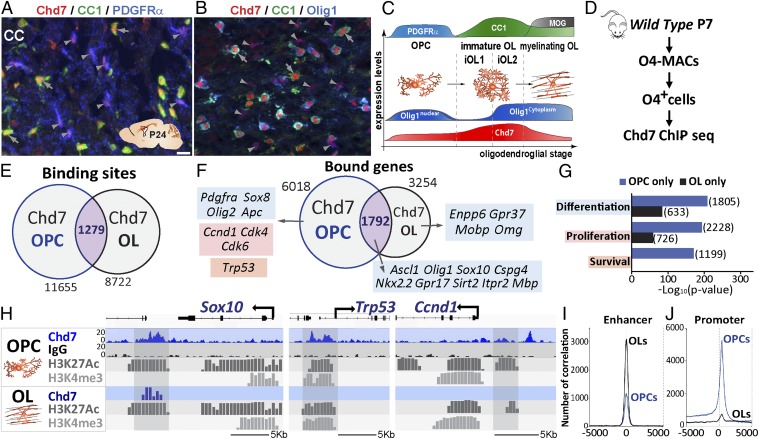
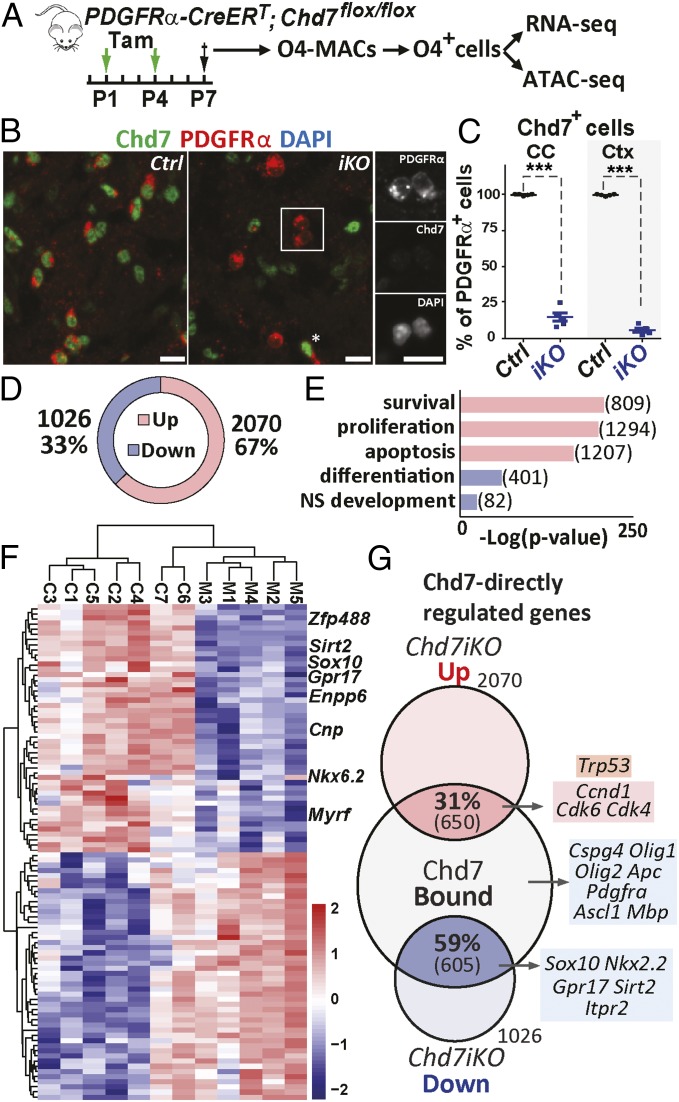
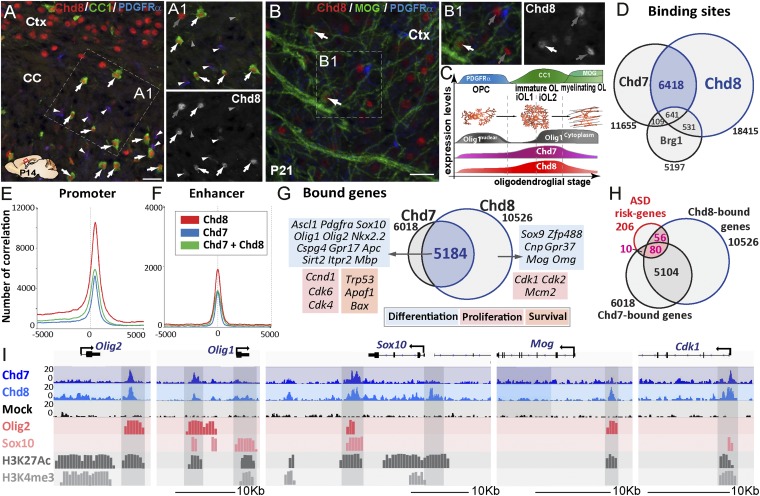
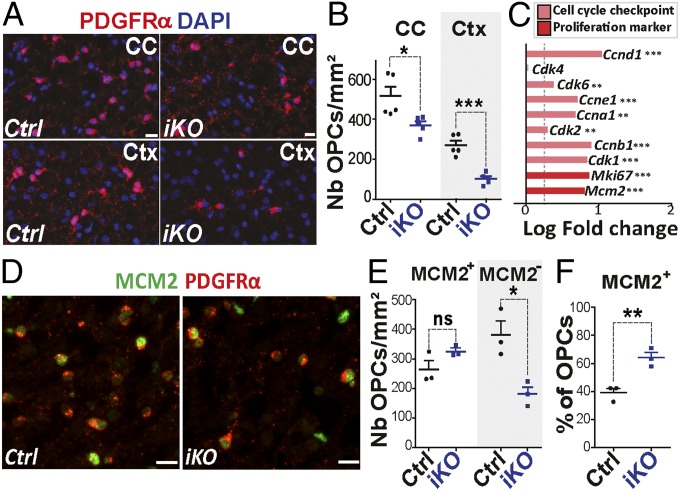
Significance: Oligodendrocyte precursor cells (OPCs) constitute the main proliferative cells in the adult brain and deregulation of OPC proliferation-differentiation balance results in either glioma formation or defective (re)myelination. Mutations in chromatin remodelers CHD7 and CHD8 are the cause of CHARGE syndrome and some autism spectrum disorders (ASD). Here we show that Chd7 protects OPCs from apoptosis by chromatin closing and gene repression of p53 , while Chd7 induces chromatin opening and gene activation of OPC-differentiation regulators. Chd7 is, however, dispensable for oligodendrocyte stage progression, consistent with Chd8 compensatory function, as suggested by their common chromatin-binding profiles, including ASD-risk–associated genes. Our results thus involve oligodendroglia in ASD and CHARGE and offer new avenues to understand and modulate CHD7/CHD8 functions in normal and pathological brain development.
Overview
The claims and statistics of this paper haven’t been checked yet.
Free: it reads the open-access text and checks the first 5 claims that cite a source we can check. Create a free account to check every claim.
Integrity signals
Registry
Cites
Statistics
Figures
Verification
Claims the paper makes
The claims and statistics of this paper haven’t been checked yet.
Free: it reads the open-access text and checks the first 5 claims that cite a source we can check. Create a free account to check every claim.
Claims other papers make about this one
Each is checked against this paper’s own text: does it say what the citing paper says it does?
In the citing paper
“This is consistent with recent reports that Chd8 loss-of-function potentiates an impaired OPC development phenotype caused by deletion of Chd7 (28).”
From In vivo Perturb-Seq reveals neuronal and glial abnormalities associated with autism risk genes (2020) · cites this paper as [28]
In the citing paper
“Our results showed that Chd8 modulates gene modules for oligodendrocyte differentiation and maturation, consistent with previously reported ChIP-Seq results showing that CHD8 interacts directly with OPC maturation genes at perinatal stages of development (28, 43).”
From In vivo Perturb-Seq reveals neuronal and glial abnormalities associated with autism risk genes (2020) · cites this paper as [28]
Self-check
Percentages, sums and reported differences re-computed from the paper’s own numbers.
The self-check needs the paper’s full text.
Citations
Cites
Zhang, Y., Chen, K., Sloan, S. A., Bennett, M. L., Scholze, A. R., O'Keeffe, S., Phatnani, H. P., Guarnieri, P., Caneda, C., Ruderisch, N., et al. (2014) · The Journal of Neuroscience · doi:10.1523/jneurosci.1860-14.2014 · Cited by 4,875 · cited 1×
“3 B and C, arrows), in agreement to Chd8 transcript pattern in postnatal brain cells shown by RNA-seq databases (34, 35).”
BackgroundHistone H3K27ac separates active from poised enhancers and predicts developmental state
Creyghton, M. P., Cheng, A. W., Welstead, G. G., Kooistra, T., Carey, B. W., Steine, E. J., Hanna, J., Lodato, M. A., Frampton, G. M., Sharp, P. A., et al. (2010) · Proceedings of the National Academy of Sciences · doi:10.1073/pnas.1016071107 · Cited by 4,302 · cited 1×
“S2I), characteristic of active regulatory elements (31), and are mainly located outside promoter regions (31) (SI Appendix, Fig.”
BackgroundATAC-seq: a method for assaying chromatin accessibility genome-wide
Buenrostro, J. D., Wu, B., Chang, H. Y., & Greenleaf, W. J. (2015) · Current Protocols in Molecular Biology · doi:10.1002/0471142727.mb2129s109 · Cited by 3,289 · cited 1×
“Therefore, we generated a genome-wide chromatin accessibility profiling by Tn5 transposaseaccessible chromatin with high-throughput sequencing (ATACseq) combined with sequencing (43), from purified O4 cells from either Chd7iKO or control cortices (Fig.”
MethodSporadic autism exomes reveal a highly interconnected protein network of de novo mutations
O’Roak, B. J., Vives, L., Girirajan, S., Karakoc, E., Krumm, N., Coe, B. P., Levy, R., Ko, A., Lee, C., Smith, J. D., et al. (2012) · Nature · doi:10.1038/nature10989 · Cited by 2,165 · cited 1×
“main cause of CHARGE syndrome, an autosomal-dominant syndrome that often impairs normal brain development, leading to cognitive disabilities (24), CHD8 is one of the nine highconfidence autism spectrum disorder (ASD)-risk genes (25, 26) and autism features are found in some CHARGE syndrome patients (27).”
BackgroundOligodendroglia metabolically support axons and contribute to neurodegeneration
Lee, Y., Morrison, B. M., Li, Y., Lengacher, S., Farah, M. H., Hoffman, P. N., Liu, Y., Tsingalia, A., Jin, L., Zhang, P.-W., et al. (2012) · Nature · doi:10.1038/nature11314 · Cited by 1,664 · cited 3×
“1E), corresponding to ∼30% of commonly bound genes (2,168) (Fig.”
BackgroundGlycolytic oligodendrocytes maintain myelin and long-term axonal integrity
Fünfschilling, U., Supplie, L. M., Mahad, D., Boretius, S., Saab, A. S., Edgar, J., Brinkmann, B. G., Kassmann, C. M., Tzvetanova, I. D., Möbius, W., et al. (2012) · Nature · doi:10.1038/nature11007 · Cited by 1,523
Mutations in a new member of the chromodomain gene family cause CHARGE syndrome
Vissers, L. E. L. M., van Ravenswaaij, C. M. A., Admiraal, R., Hurst, J. A., de Vries, B. B. A., Janssen, I. M., van der Vliet, W. A., Huys, E. H. L. P. G., de Jong, P. J., Hamel, B. C. J., et al. (2004) · Nature Genetics · doi:10.1038/ng1407 · Cited by 1,285 · cited 1×
“Discussion Mounting evidence indicates that chromatin remodeling factors play important roles in normal development and neurodevelopmental diseases (46), with CHD7 haploinsuficiency being the cause of CHARGE syndrome (47) and CHD8 being one of the strongest ASD high-risk–associated genes (25).”
BackgroundOligodendrocyte heterogeneity in the mouse juvenile and adult central nervous system
Marques, S., Zeisel, A., Codeluppi, S., van Bruggen, D., Mendanha Falcão, A., Xiao, L., Li, H., Häring, M., Hochgerner, H., Romanov, R. A., et al. (2016) · Science · doi:10.1126/science.aaf6463 · Cited by 1,132 · cited 6×
“An oligodendroglia single-cell transcriptome database (35) was used to classify genes according to their expression timing (Fig.”
BackgroundMethodInfluentialWillsey, A. J., Sanders, S. J., Li, M., Dong, S., Tebbenkamp, A. T., Muhle, R. A., Reilly, S. K., Lin, L., Fertuzinhos, S., Miller, J. A., et al. (2013) · Cell · doi:10.1016/j.cell.2013.10.020 · Cited by 934
Disruptive CHD8 Mutations Define a Subtype of Autism Early in Development
Bernier, R., Golzio, C., Xiong, B., Stessman, H. A., Coe, B. P., Penn, O., Witherspoon, K., Gerdts, J., Baker, C., Vulto-van Silfhout, A. T., et al. (2014) · Cell · doi:10.1016/j.cell.2014.06.017 · Cited by 798 · cited 2×
“Discussion Mounting evidence indicates that chromatin remodeling factors play important roles in normal development and neurodevelopmental diseases (46), with CHD7 haploinsuficiency being the cause of CHARGE syndrome (47) and CHD8 being one of the strongest ASD high-risk–associated genes (25).”
Background
Cited by
SCENIC+: single-cell multiomic inference of enhancers and gene regulatory networks
González-Blas, C. B., De Winter, S., Hulselmans, G., Hecker, N., Matetovici, I., Christiaens, V., Poovathingal, S., Wouters, J., Aibar, S., & Aerts, S. (2022) · doi:10.1101/2022.08.19.504505 · Cited by 778
SCENIC+: single-cell multiomic inference of enhancers and gene regulatory networks
Bravo González-Blas, C., De Winter, S., Hulselmans, G., Hecker, N., Matetovici, I., Christiaens, V., Poovathingal, S., Wouters, J., Aibar, S., & Aerts, S. (2023) · Nature Methods · doi:10.1038/s41592-023-01938-4 · Cited by 778
In vivo Perturb-Seq reveals neuronal and glial abnormalities associated with autism risk genes
Jin, X., Simmons, S. K., Guo, A., Shetty, A. S., Ko, M., Nguyen, L., Jokhi, V., Robinson, E., Oyler, P., Curry, N., et al. (2020) · Science · doi:10.1126/science.aaz6063 · Cited by 317
“These results also agree with previous findings that Chd8 loss of function is connected to abnormal OPC development (Marie et al., 2018).”
ResultInfluentialRole of Oligodendrocytes and Myelin in the Pathophysiology of Autism Spectrum Disorder
Galvez-Contreras, A. Y., Zarate-Lopez, D., Torres-Chavez, A. L., & Gonzalez-Perez, O. (2020) · Brain Sciences · doi:10.3390/brainsci10120951 · Cited by 123
Life-long oligodendrocyte development and plasticity
Nishiyama, A., Shimizu, T., Sherafat, A., & Richardson, W. D. (2021) · Seminars in Cell & Developmental Biology · doi:10.1016/j.semcdb.2021.02.004 · Cited by 114
Metadata
- Authors
- Marie, C., Clavairoly, A., Frah, M., Hmidan, H., Yan, J., Zhao, C., Van Steenwinckel, J., Daveau, R., Zalc, B., Hassan, B., Thomas, J.-L., Gressens, P., Ravassard, P., Moszer, I., Martin, D. M., Lu, Q. R., & Parras, C.
- Affiliations
- Centre National de la Recherche Scientifique (FR)
- Inserm (FR)
- Cincinnati Children's Hospital Medical Center (US)
- Promoting Research Oriented Towards Early CNS Therapy, INSERM, Université Paris Diderot, Sorbonne Paris Cité, F-75019 Paris, France;
- University of Michigan (US)
- Corresponding author
- Parras, Carlos
- ORCID
- Venue
- Proceedings of the National Academy of Sciences
- Publisher
- National Academy of Sciences
- Published
- 2018-08-14
- Volume
- 115
- Issue
- 35
- Pages
- E8246-E8255
- ISSN
- 0027-8424 (ISSN-L)
- 1091-6490
- PMC
- PMC6126750
- OpenAlex
- W2885048100
- Cited by
- 103
- References
- 51
- Citations by year
- 2026: 7 · 2025: 8 · 2024: 6 · 2023: 12 · 2022: 9 · 2021: 33 · 2020: 16 · 2019: 11 · 2018: 1
- FWCI
- 5.58
- Type
- journal article
- Language
- en
- Open access
- hybrid
- doi.org
- Licence
- Locations
- Proceedings of the National Academy of Sciences (publishedVersion, cc-by-nc-nd)
- Europe PMC (PubMed Central) (publishedVersion, cc-by-nc-nd)
- PubMed Central (publishedVersion, cc-by-nc-nd)
- PubMed (publishedVersion)
- HAL (submittedVersion)
- Research Portal (King's College London) (submittedVersion, cc-by-nc-nd)
- Funders
- National Multiple Sclerosis Society (NMSS RG-1501-02851)
- Fondation pour l'Aide à la Recherche sur la Sclérose en Plaques (ARSEP grants 2014, 2015, 2017)
- Fondation pour la Recherche Médicale (2017)
- HHS | National Institutes of Health (R01NS072427 and R01NS075243, R01 DC009410 and R01 DC014456)
- Agence Nationale de la Recherche (ANR-10- IAIHU-06 and ANR-11-INBS-0011-NeurATRIS)
- Topics
- Life Sciences › Neuroscience › Developmental Neuroscience › Neurogenesis and neuroplasticity mechanisms
- Life Sciences › Biochemistry, Genetics and Molecular Biology › Molecular Biology › Genomics and Chromatin Dynamics
- Life Sciences › Biochemistry, Genetics and Molecular Biology › Molecular Biology › Chromatin Remodeling and Cancer
- Keywords
- oligodendrocyte precursor cells, CHD7, CHD8, chromatin remodeling, apoptosis, p53, oligodendrocyte differentiation, myelination, CHARGE syndrome, autism spectrum disorder, gene repression, gene activation, oligodendroglia, brain development
- MeSH terms
- Autism Spectrum Disorder, Homeobox Protein Nkx-2.2, Animals, Cell Survival, DNA-Binding Proteins, Nuclear Proteins, Oligodendroglia, Stem Cells, Transcription Factors, Mice, Knockout, Homeodomain Proteins, Chromatin Assembly and Disassembly, Mice, CHARGE Syndrome
About these checks
Registry, retraction, Cites and statistics results are computed, not judged, with one exception: a printed reference that no index lists is read once by a model before it counts as a citation error. Claims are extracted by a model and kept only when their quote appears verbatim in the text; each cited source is then checked, with a model’s help, for whether it says what the claim relies on. Those verdicts can be wrong — read the claim’s quote and the cited source before relying on one.
Statistics and arithmetic are recomputed, not judged.
Confidence bands are shown only for fields calibrated on our annotated test set. None is calibrated yet, so no band is shown.
What counts as a claim ›How we measure confidence ›How we check this ›
Are you an author, or do you see a problem with this page? Request a review
Data sources
Bibliographic data: Semantic Scholar, OpenAlex, Crossref.
Contains information from the Semantic Scholar Academic Graph Datasets, made available under the ODC Attribution License (ODC-BY 1.0).
Semantic Scholar’s data is described in: Kinney, R., et al. (2023). The Semantic Scholar Open Data Platform. arXiv:2301.10140.
