Cited by 194

The DOI matches its Crossref record; 4 of the 4 references it cites were found in a registry or an index.

A glycyl radical enzyme enables hydrogen sulfide production by the human intestinal bacterium Bilophila wadsworthia

Peck, Spencer C., Denger, Karin, Burrichter, Anna, Irwin, Stephania M., Balskus, Emily P., Schleheck, David·2019·Proceedings of the National Academy of Sciences

Abstract

Significance: This paper describes a pathway for anaerobic bacterial metabolism of taurine (2-aminoethanesulfonate), an abundant substrate in the human intestinal microbiota, by the intestinal bacterium and opportunistic pathogen, Bilophila wadsworthia . This metabolism converts taurine to the toxic metabolite hydrogen sulfide (H 2 S), an activity associated with inflammatory bowel disease and colorectal cancer. A critical enzyme in this pathway is isethionate sulfite-lyase, a member of the glycyl radical enzyme family. This enzyme catalyzes a novel, radical-based C-S bond-cleavage reaction to convert isethionate (2-hydroxyethanesulfonate) to sulfite and acetaldehyde. This discovery improves our understanding of H 2 S production in the human body and may also offer new approaches for controlling intestinal H 2 S production and B. wadsworthia infections.

Overview

The claims and statistics of this paper haven’t been checked yet.

Run the check — free, no account needed. It reads the open-access text and checks the sources it cites.

A few free checks a day · papers already verified open instantly · results are public

Integrity signals

Registry

Crossref · 10.1073/pnas.1815661116

Cites

4 of 4 references verified0 citation errors · 0 not checkable

Statistics

Figures

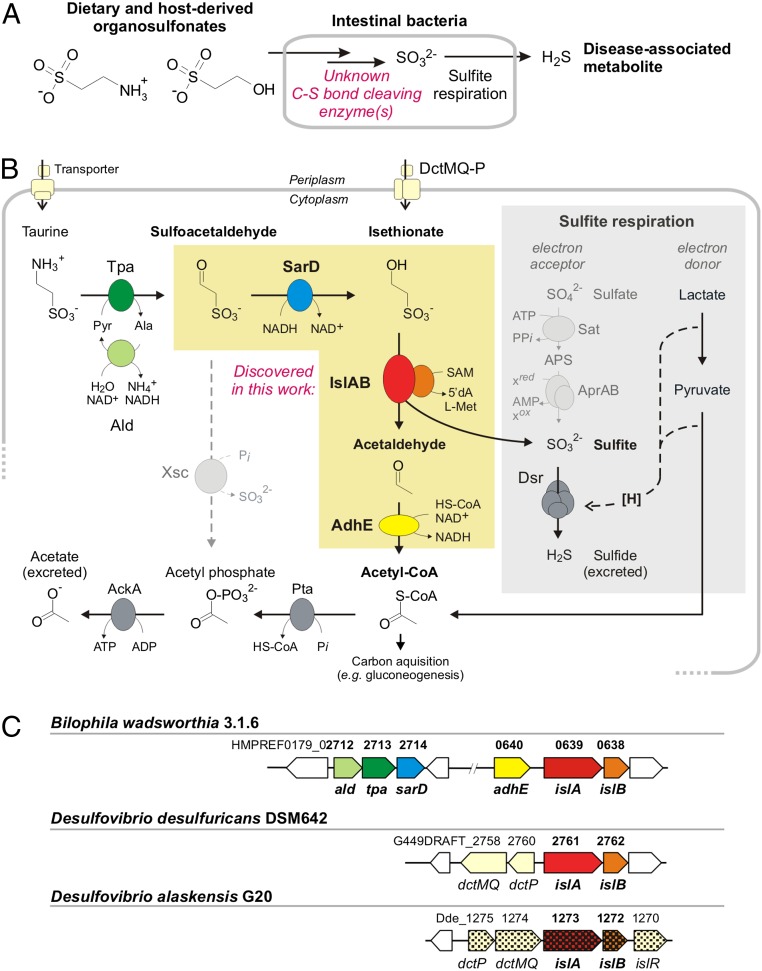
Fig. 1. Metabolism of taurine and isethionate by the human gut bacterium B. wadsworthia and by Desulfovibrio spp. (A) B. wadsworthia and other intestinal bacteria degrade dietary and host-derived organosulfonates to access sulfite as an electron acceptor for their anaerobic respiration. The desulfonation reaction in B. wadsworthia has not yet been identified. (B) Summary of the pathways investigated in this study (no single organism represented). B. wadsworthia uses taurine and isethionate as electron acceptors, and the two Desulfovibrio spp. strains can use isethionate, but not taurine. All three strains lack the Xsc enzyme known in many aerobic bacteria (dashed line on the left). Instead, the GRE IslA with its GRE-activase component (IslB) are found in both B. wadsworthia and the Desulfovibrio spp., and a novel NADH-coupled, isethionate-forming sulfoacetaldehyde reductase (SarD) is found only in B. wadsworthia. The sulfite released by the GRE is reduced to sulfide by Dsr and coupled to proton translocation for ATP synthesis (symbolized as [H]) when using electrons from oxidation of an alternative electron donor, such as lactate (gray box). AckA, acetate kinase; Pta, phosphotransacetylase. (C) The gene clusters identified in this study. In B. wadsworthia, two separate clusters encode for taurine transport and conversion to isethionate (ald, tpa, and sarD), and also for isethionate desulfonation and the conversion of acetaldehyde to acetyl-CoA (adhE, islA, and islB). The Desulfovibrio strains harbor only a gene cluster for isethionate transport (dctP and fused dctMQ) and desulfonation (islA and islB), and acetaldehyde dehydrogenases are encoded elsewhere in their genomes (not depicted in C). Single-gene knockouts in D. alaskensis G20 that result in an inability to use isethionate (but not free sulfite) are indicated by squared gene symbols.
Fig. 1. Metabolism of taurine and isethionate by the human gut bacterium B. wadsworthia and by Desulfovibrio spp. (A) B. wadsworthia and other intestinal bacteria degrade dietary and host-derived organosulfonates to access sulfite as an electron acceptor for their anaerobic respiration. The desulfonation reaction in B. wadsworthia has not yet been identified. (B) Summary of the pathways investigated in this study (no single organism represented). B. wadsworthia uses taurine and isethionate as electron acceptors, and the two Desulfovibrio spp. strains can use isethionate, but not taurine. All three strains lack the Xsc enzyme known in many aerobic bacteria (dashed line on the left). Instead, the GRE IslA with its GRE-activase component (IslB) are found in both B. wadsworthia and the Desulfovibrio spp., and a novel NADH-coupled, isethionate-forming sulfoacetaldehyde reductase (SarD) is found only in B. wadsworthia. The sulfite released by the GRE is reduced to sulfide by Dsr and coupled to proton translocation for ATP synthesis (symbolized as [H]) when using electrons from oxidation of an alternative electron donor, such as lactate (gray box). AckA, acetate kinase; Pta, phosphotransacetylase. (C) The gene clusters identified in this study. In B. wadsworthia, two separate clusters encode for taurine transport and conversion to isethionate (ald, tpa, and sarD), and also for isethionate desulfonation and the conversion of acetaldehyde to acetyl-CoA (adhE, islA, and islB). The Desulfovibrio strains harbor only a gene cluster for isethionate transport (dctP and fused dctMQ) and desulfonation (islA and islB), and acetaldehyde dehydrogenases are encoded elsewhere in their genomes (not depicted in C). Single-gene knockouts in D. alaskensis G20 that result in an inability to use isethionate (but not free sulfite) are indicated by squared gene symbols.CC BY · PubMed Central
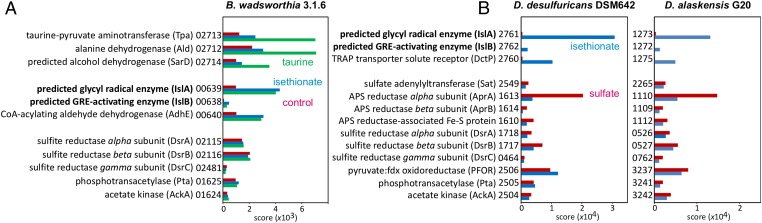
Fig. 2. Proteomics experiments with cell-free extracts reveal a putative desulfonating GRE. (A and B) Proteins encoded by the taurine and isethionate utilization gene clusters, including the predicted isethionate GRE (IslA) and GRE-activase (IslB) components, are specifically and strongly expressed during growth with taurine (B. wadsworthia) and isethionate (B. wadsworthia, Desulfovibrio strains). Constitutively expressed proteins for, for example, sulfite reduction (Dsr) and metabolism of acetyl-CoA (Pta and AckA), are shown for comparison. IMG locus tag numbers are given; their prefixes are shown in Fig. 1C. Shown are results of representative total proteomic analyses replicated at least twice with extracts prepared from independent growth experiments.
Fig. 2. Proteomics experiments with cell-free extracts reveal a putative desulfonating GRE. (A and B) Proteins encoded by the taurine and isethionate utilization gene clusters, including the predicted isethionate GRE (IslA) and GRE-activase (IslB) components, are specifically and strongly expressed during growth with taurine (B. wadsworthia) and isethionate (B. wadsworthia, Desulfovibrio strains). Constitutively expressed proteins for, for example, sulfite reduction (Dsr) and metabolism of acetyl-CoA (Pta and AckA), are shown for comparison. IMG locus tag numbers are given; their prefixes are shown in Fig. 1C. Shown are results of representative total proteomic analyses replicated at least twice with extracts prepared from independent growth experiments.CC BY · PubMed Central
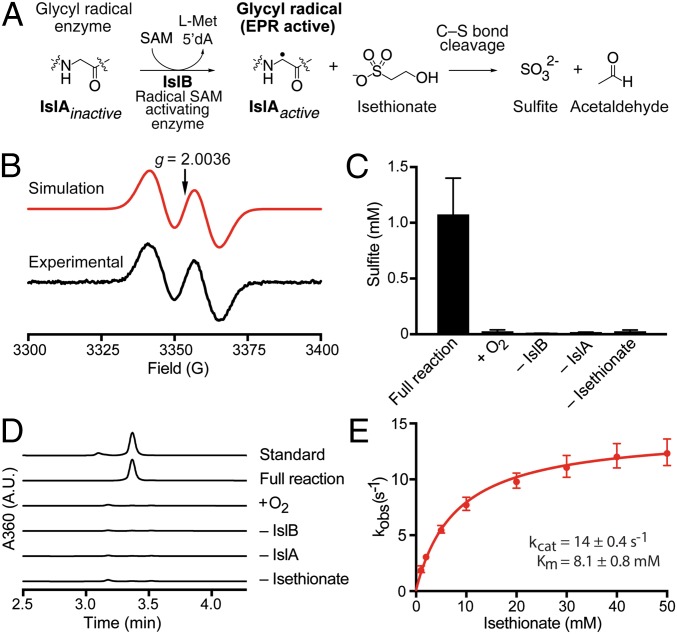
Fig. 3. The B. wadsworthia GRE is a C-S bond-cleaving IslA. (A) The GRE-activating radical SAM enzyme IslB installs a protein-centered, stable glycyl radical within the GRE IslA. Activated IslA then catalyzes a C-S bond-cleavage reaction with isethionate as the substrate. The mechanistic hypothesis is illustrated in SI Appendix, Fig. S1B. (B) Electron paramagnetic resonance spectroscopy demonstrating glycyl radical formation on recombinantly produced and purified IslA after its activation by recombinant purified and reconstituted GRE-activase IslB. (C) Conversion of isethionate to sulfite by IslA was observed only in the absence of molecular oxygen and in the presence of all reaction components, as was acetaldehyde formation (D). The data in C are shown as the mean ± SD of three technical replicates, and data in D are shown as representative HPLC chromatograms of a minimum of two technical replicates. (E) The Michaelis–Menten kinetics of isethionate cleavage were determined by using a coupled spectrophotometric assay with yeast alcohol dehydrogenase and NADH. The kcat was 14 ± 0.4 s−1, and the Km was 8.1 ± 0.8 mM. Data are shown as the mean ± SD of four technical replicates.
Fig. 3. The B. wadsworthia GRE is a C-S bond-cleaving IslA. (A) The GRE-activating radical SAM enzyme IslB installs a protein-centered, stable glycyl radical within the GRE IslA. Activated IslA then catalyzes a C-S bond-cleavage reaction with isethionate as the substrate. The mechanistic hypothesis is illustrated in SI Appendix, Fig. S1B. (B) Electron paramagnetic resonance spectroscopy demonstrating glycyl radical formation on recombinantly produced and purified IslA after its activation by recombinant purified and reconstituted GRE-activase IslB. (C) Conversion of isethionate to sulfite by IslA was observed only in the absence of molecular oxygen and in the presence of all reaction components, as was acetaldehyde formation (D). The data in C are shown as the mean ± SD of three technical replicates, and data in D are shown as representative HPLC chromatograms of a minimum of two technical replicates. (E) The Michaelis–Menten kinetics of isethionate cleavage were determined by using a coupled spectrophotometric assay with yeast alcohol dehydrogenase and NADH. The kcat was 14 ± 0.4 s−1, and the Km was 8.1 ± 0.8 mM. Data are shown as the mean ± SD of four technical replicates.CC BY · PubMed Central
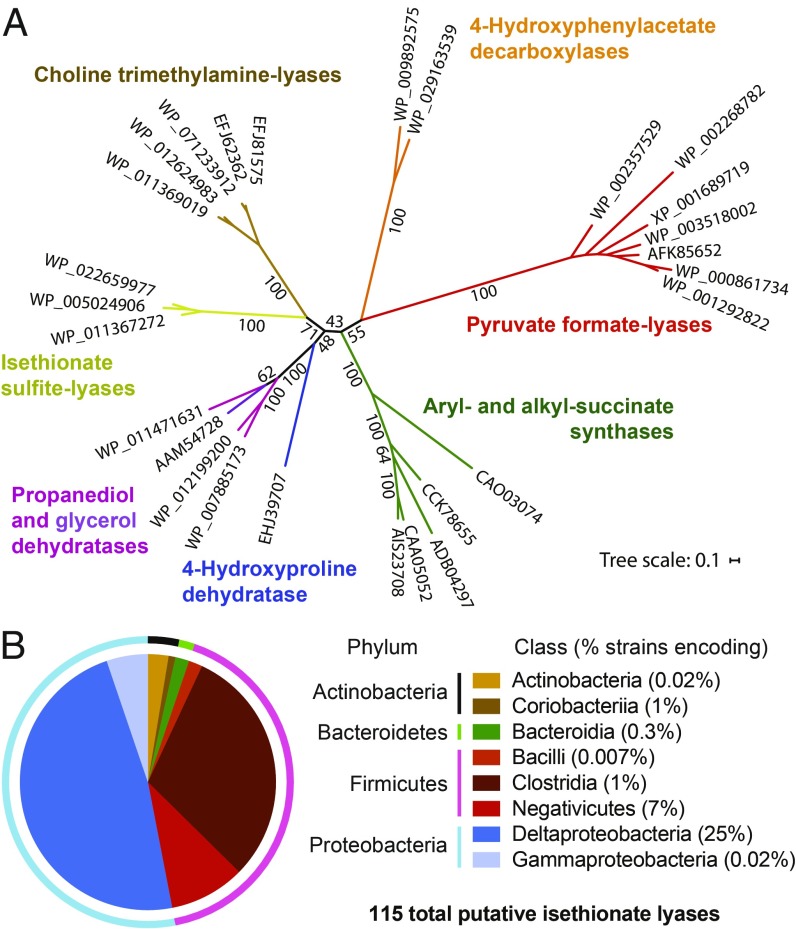
Fig. 4. Anaerobic organosulfonate metabolism has an unexpectedly broad distribution in sequenced bacteria. (A) A maximum likelihood phylogenetic tree illustrating that the IslAs are phylogenetically distinct from previously characterized GREs. The listed sequence identifiers are GenBank accession codes. (B) Illustration of the distribution of 115 putative IslAs, as retrieved from the National Center for Biotechnology Information database at a threshold of 62% identity across sequenced bacterial genomes (SI Appendix, Table S1). The pie chart showing their relative taxonomic distribution on the phylum level (outer ring) demonstrates that the majority are found in genomes of Proteobacteria and Firmicutes, and at the class level (inner circle), that they are distributed predominantly across Deltaproteobacteria, Clostridia, and Negativicute genomes. The percentages shown in brackets indicate (at the class level) the number of genomes with putative IslAs relative to all known genome sequences for this class, confirming the enrichment of IslAs in the Deltaproteobacteria (encoded in 25% of all known genomes).
Fig. 4. Anaerobic organosulfonate metabolism has an unexpectedly broad distribution in sequenced bacteria. (A) A maximum likelihood phylogenetic tree illustrating that the IslAs are phylogenetically distinct from previously characterized GREs. The listed sequence identifiers are GenBank accession codes. (B) Illustration of the distribution of 115 putative IslAs, as retrieved from the National Center for Biotechnology Information database at a threshold of 62% identity across sequenced bacterial genomes (SI Appendix, Table S1). The pie chart showing their relative taxonomic distribution on the phylum level (outer ring) demonstrates that the majority are found in genomes of Proteobacteria and Firmicutes, and at the class level (inner circle), that they are distributed predominantly across Deltaproteobacteria, Clostridia, and Negativicute genomes. The percentages shown in brackets indicate (at the class level) the number of genomes with putative IslAs relative to all known genome sequences for this class, confirming the enrichment of IslAs in the Deltaproteobacteria (encoded in 25% of all known genomes).CC BY · PubMed Central

Verification

Claims the paper makes

The claims and statistics of this paper haven’t been checked yet.

Run the check — free, no account needed. It reads the open-access text and checks the sources it cites.

A few free checks a day · papers already verified open instantly · results are public

Claims other papers make about this one

Each is checked against this paper’s own text: does it say what the citing paper says it does?

Self-check

Percentages, sums and reported differences re-computed from the paper’s own numbers.

The self-check needs the paper’s full text.

Citations

Cites

Show all 4 references

Research works printed but not linked: 37

  1. 10.3389/fphys.2012.00448 · DOI · Paper page
  2. 10.3390/microorganisms3040866 · DOI · Paper page
  3. MS Attene-Ramos, , DNA damage and toxicogenomic analyses of hydrogen sulfide in human intestinal epithelial FHs 74 Int cells. Environ Mol Mutagen 51, 304–314 (2010). · DOI
  4. 10.1016/j.molmed.2016.01.002 · DOI
  5. 10.1126/science.1209855 · DOI
  6. 10.3390/molecules21111558 · DOI
  7. 10.1152/ajpgi.00249.2017 · DOI
  8. 10.1038/s41467-018-05357-4 · DOI
  9. EJ Baron, , Bilophila wadsworthia, gen. nov. and sp. nov., a unique gram-negative anaerobic rod recovered from appendicitis specimens and human faeces. J Gen Microbiol 135, 3405–3411 (1989).
  10. 10.1128/aem.63.5.2016-2021.1997 · DOI
  11. 10.1038/ismej.2011.90 · DOI
  12. 10.1128/jcm.30.7.1882-1884.1992 · DOI
  13. 10.1136/gutjnl-2016-313321 · DOI · Paper page
  14. 10.1186/s13099-017-0208-7 · DOI
  15. 10.1007/s002030050376 · DOI
  16. 10.1007/s00203-002-0497-0 · DOI
  17. 10.1042/bj20021455 · DOI
  18. 10.1042/bj3570581 · DOI
  19. H Laue Biochemical and molecular characterization of taurine metabolism in the anaerobic bacterium Bilophila wadsworthia . Doctoral dissertation (University of Konstanz Konstanz Germany). (2000). · DOI
  20. 10.1128/mBio.01041-14 · DOI
  21. 10.1073/pnas.1312524110 · DOI
  22. 10.1128/JCM.41.6.2752-2754.2003 · DOI
  23. 10.1038/nature12947 · DOI
  24. 10.1073/pnas.1507049112 · DOI
  25. 10.1007/s002030000190 · DOI
  26. 10.1046/j.1432-1033.2000.01782.x · DOI
  27. 10.1080/10409238.2017.1373741 · DOI
  28. 10.1074/jbc.M116.721142 · DOI
  29. 10.1126/science.aai8386 · DOI
  30. 10.1021/acs.biochem.8b00164 · DOI
  31. 10.1016/j.chembiol.2016.07.020 · DOI
  32. 10.1007/s00203-005-0069-1 · DOI
  33. MA Kertesz, Riding the sulfur cycle–Metabolism of sulfonates and sulfate esters in gram-negative bacteria. FEMS Microbiol Rev 24, 135–175 (2000).
  34. J Knappe, G Sawers, A radical-chemical route to acetyl-CoA: The anaerobically induced pyruvate formate-lyase system of Escherichia coli. FEMS Microbiol Rev 6, 383–398 (1990).
  35. 10.1007/s10482-007-9215-x · DOI
  36. 10.1128/AEM.02587-15 · DOI
  37. 10.1152/physrev.1968.48.2.424 · DOI

Cited by

Sorted by citations

Metadata

Authors
Peck, S. C., Denger, K., Burrichter, A., Irwin, S. M., Balskus, E. P., & Schleheck, D.
Affiliations
  • Department of Chemistry and Chemical Biology, Harvard University, Cambridge, MA 02138;
  • Department of Biology, University of Konstanz, D-78457 Konstanz, Germany;
Venue
Proceedings of the National Academy of Sciences
Published
2019-02-04
Volume
116
Issue
8
Pages
3171-3176
ISSN
  • 0027-8424
  • 1091-6490
Cited by
194
References
4
Language
en
Funders
  • Deutsche Forschungsgemeinschaft (SCHL1936/3-4)
  • Bill and Melinda Gates Foundation (unknown (to DS))

About these checks

Registry, retraction, Cites and statistics results are computed, not judged, with one exception: a printed reference that no index lists is read once by a model before it counts as a citation error. Claims are extracted by a model and kept only when their quote appears verbatim in the text; each cited source is then checked, with a model’s help, for whether it says what the claim relies on. Those verdicts can be wrong — read the claim’s quote and the cited source before relying on one.

Statistics and arithmetic are recomputed, not judged.

Confidence bands are shown only for fields calibrated on our annotated test set. None is calibrated yet, so no band is shown.

What counts as a claim ›How we measure confidence ›How we check this ›

Are you an author, or do you see a problem with this page? Request a review